Search Results(13805)

2009-04-03
PIER B
Vol. 14, 87-106
Diversity Monopulse Antenna Based on a Dual-Frequency and Dual Mode CRLH Rat-Race Coupler
David De Castro-Galan , Luis Enrique Garcia-Munoz , Daniel Segovia-Vargas and Vicente Gonzalez-Posadas
A diversity monopulse antenna is presented in this paper. This monopulse antenna is based on a dual frequency dual mode rat-race coupler that has been designed by using Composite Right/Left Handed (CRLH) Transmission Lines (TL). The device has two input ports while the (Σ) and (Δ) outputs are interchangable at either of the two operating frequencies. In this way the monopulse antenna can work at two different frequencies with two sets of radiation patterns, Σ and Δ. In addition, there is no need of diplexing to separate the (Σ) and (Δ) radiation patterns since these patterns at either frequency are directly obtained at different ports. The dual frequency dual mode rat-race requires that the phase delay of the CRLH lines must be different at either working frequency. As an example of an application, a 950 MHz/1.8 GHz dual-band dual-mode rat-race coupler is shown.
DIVERSITY MONOPULSE ANTENNA BASED ON A DUAL-FREQUENCY AND DUAL MODE CRLH RAT-RACE COUPLER
2009-04-03
PIER B
Vol. 14, 65-86
Truncation Effect on Precursor Field Structure of Pulse Propagation in Dispersive Media
Jiaran Qi and Ari Sihvola
The dynamic evolutions of full Gaussian and particularly the truncated Gaussian pulses in dispersive Lorentz media are studied numerically in detail. The observed qualitative phenomena lead to revised interpretation regarding both Sommerfeld and Brillouin precursors. Neither strict Sommerfeld nor Brillouin precursor is present for the case of an incident full Gaussian pulse for any finite propagation distance. In addition, the Brillouin effect can be separated into a tail and a forerunner depending on the turn-on point of the initial pulse. Moreover, the essence of an artificial precursor is discussed, which deserves caution when handling the high dynamic range problems by numerical algorithm.
TRUNCATION EFFECT ON PRECURSOR FIELD STRUCTURE OF PULSE PROPAGATION IN DISPERSIVE MEDIA
2009-04-02
PIER
Vol. 91, 303-318
Ceramic Processing Route and Characterization of a Ni-Zn Ferrite for Application in a Pulsed-Current Monitor
Vera Lucia Othero de Brito , Antonio Carlos da Cunha Migliano , L. V. Lemos and F. C. L. Melo
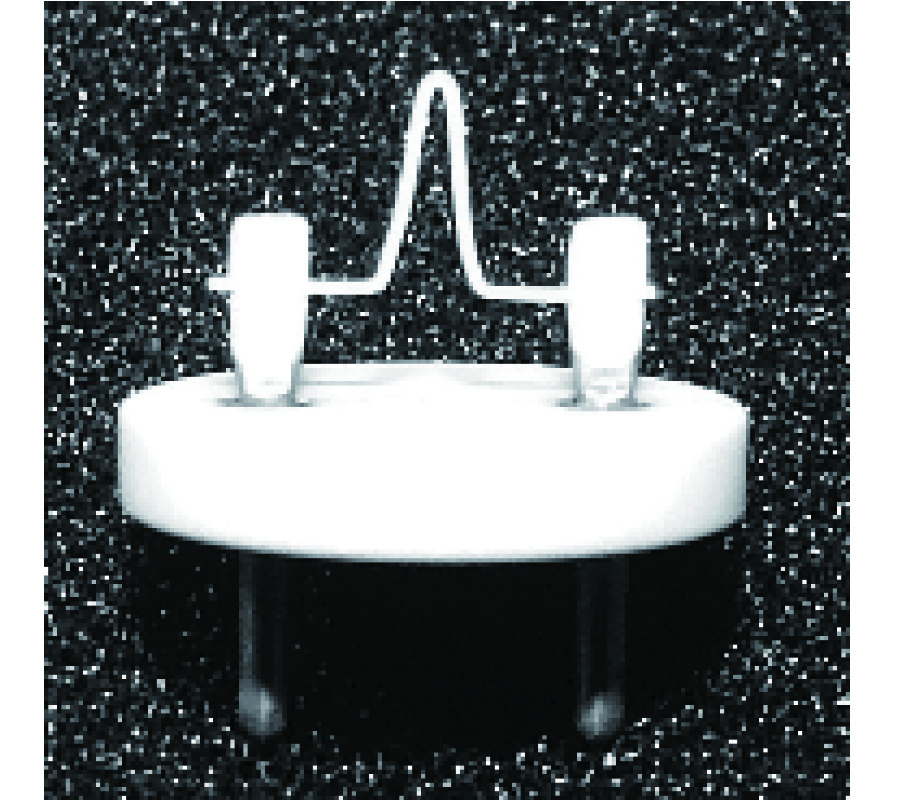
Pulsed-current sensors require transducers constituted of magnetic materials with high magnetic permeability in a frequency range compatible with the period and the frequency of the current pulse. The use of ferrites in this application has the advantage of low cost and low losses in high frequencies. The aim of this work is to present a procedure for selection of the ceramic processing route of Ni-Zn ferrite for application in a pulsed-current sensor. The ferrite samples were prepared under different processing parameters and characterized in terms of microstructure, chemical analysis, complex magnetic permeability, and magnetic hysteresis. The chosen processing route included high energy milling of the pre-sintered powder, its disaggregation before sample forming, and sintering of the samples in air for 2h at 1300οC. Tests were performed and it was verified that using this processing route for the fabrication of the sensor's core it was possible to monitor pulses of 0.1-1.0 μs.
CERAMIC PROCESSING ROUTE AND CHARACTERIZATION OF A NI-ZN FERRITE FOR APPLICATION IN A PULSED-CURRENT MONITOR
2009-04-02
PIER Letters
Vol. 7, 127-137
Procedure for the Design of Ladder Baw Filters Taking Electrodes into Account
Oscar Menendez , Pedro de Paco , Eden Corrales and Jordi Verdu
This paper aims to complete a published systematic methodology for the design of ladder BAW filters in order to include the effect of the electrodes, since infinitely thin electrodes are assumed in this design methodology. The new procedure is validated against the work of other authors, finding very good agreement between results.
PROCEDURE FOR THE DESIGN OF LADDER BAW FILTERS TAKING ELECTRODES INTO ACCOUNT
2009-03-31
PIER
Vol. 91, 287-301
Mutual Inductance Calculation for Non-Coaxial Circular Air Coils with Parallel Axes
Cevdet Akyel , Slobodan Babic and Mohamed-Mehdi Mahmoudi
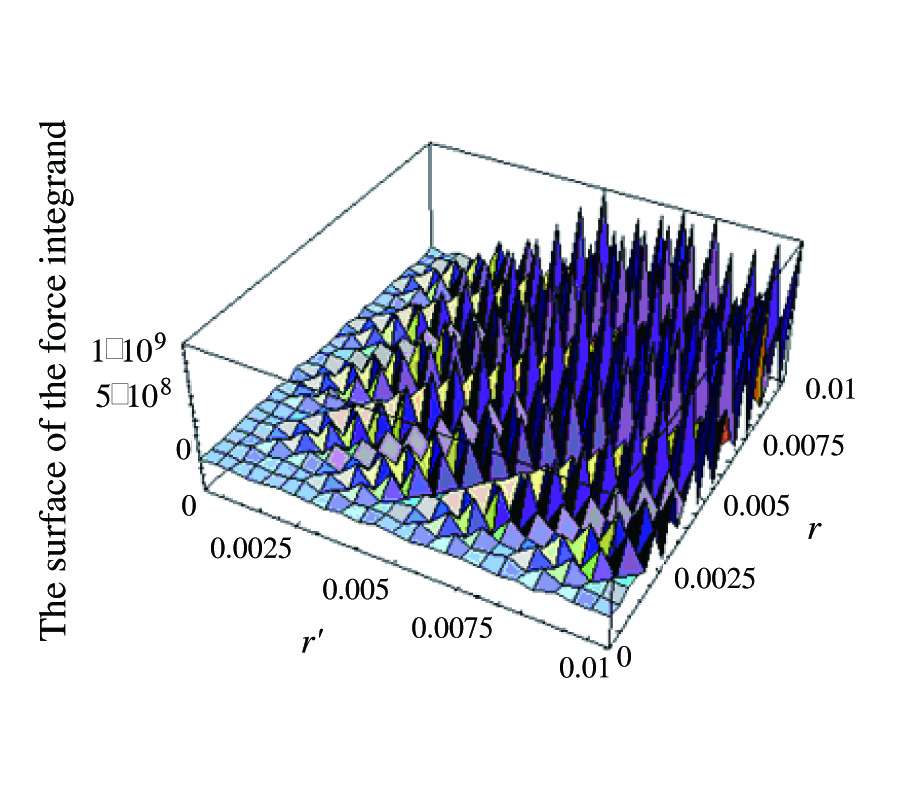
We present a practical and simple method for calculating the mutual inductance between two non-coaxial circular coils with parallel axes. All possible circular coils such as coils of rectangular cross section, thin wall solenoids, thin disk coils (pancakes) and circular filamentary coils are taken into consideration. We use Grover's formula for the mutual inductance between two filamentary circular coils with parallel axes. The filament method is applied for all coil combinations, for coils of the rectangular cross section and for thin coils. We consider that the proposed method is very simple, accurate and practical for engineering applications. Computed mutual inductance values obtained by the proposed method have been verified by previously published data and the software Fast-Henry. All results are in a very good agreement. This method can be used in various electromagnetic applications such as coil guns, tubular linear motors, transducers, actuators and biomedical implanted sensors.
MUTUAL INDUCTANCE CALCULATION FOR NON-COAXIAL CIRCULAR AIR COILS WITH PARALLEL AXES
2009-03-27
PIER M
Vol. 6, 139-153
Mathematical Model for the Prediction of Microwave Signal Attenuation Due to Duststorm
Zain Elabdin Omer Elshaikh , Islam Md. Rafiqul , Othman O. Khalifa and Hany Abd-El-Raouf
The microwave signal attenuation caused by dust is one of the major problems in utilizing microwave bands for terrestrial and space communication especially at desert and semi desert area. This paper presents a mathematical model developed to characterize the microwave signal attenuation due to dust. This model enables a convenient calculation of the microwave signal path attenuation which relates attenuation to visibility, frequency, particle size and complex permittivity. The predicted values from the mathematical model, which are compared with the measured values observed by the author in Sudan show relatively optimistic agreement.
MATHEMATICAL MODEL FOR THE PREDICTION OF MICROWAVE SIGNAL ATTENUATION DUE TO DUSTSTORM
2009-03-27
PIER B
Vol. 14, 45-63
Multi-Polarization Dimensionality of Multi-Antenna Systems
Michel Elnaggar , Sujeet Chaudhuri and Safieddin Safavi-Naeini
Based on the deterministic Maxwellian framework, we investigate the ability of each of the dual fields (electric and magnetic) in carrying independent information in a multi-polarization MIMO system. We quantify the performance by using a well-defined power independent dimensionality (PID) metric. We present numerical results for 3 deterministic scenarios: a canonical free-space (near and far field exact solution), a canonical PEC corridor (using rigorous modal analysis) and a lossy-wall corridor (using image ray tracing). The deterministic results show that in a multi-path rich environment, the hexapole system (collocated polarized electric and magnetic point radiators) is almost guaranteed to provide more than 3 DOF. However, in the simulated scenarios, the maximum 6 DOF are never attained due to the inevitable coupling between the electric and magnetic fields. On the other hand, for a tripole system, the upper-limit of 3 DOF is achievable.
MULTI-POLARIZATION DIMENSIONALITY OF MULTI-ANTENNA SYSTEMS
2009-03-26
PIER
Vol. 91, 273-285
Double-Ridged Antenna for Wideband Applications
Ali Reza Mallahzadeh and Ali Imani
In this paper, the design, simulation, and fabrication of a double-ridged antenna is presented. The designed double-ridged antenna is most suitable as a feed element in reflectors of the radar systems and EMC applications. The designed antenna has a voltage standing wave ratio (VSWR) less than 2 for the frequency range of 8-18 GHz. Moreover, the proposed antenna exhibits satisfactory far-field radiation characteristics in the entire operating bandwidth. A coaxial line to rectangular double-ridged waveguide transition is introduced for coaxial feeding of the designed antenna. The proposed antenna is simulated with commercially available packages such as CST microwave studio and Ansoft HFSS in the operating frequency range. Simulation results for the VSWR, radiation patterns, and gain of the designed antenna over the frequency band 8-18 GHz are presented and discussed.
DOUBLE-RIDGED ANTENNA FOR WIDEBAND APPLICATIONS
2009-03-26
PIER C
Vol. 7, 37-50
Design and Manufacture of the Wide-Band Aperture-Coupled Stacked Microstrip Antenna
Fei Zhao , Ke Xiao , Wen-Jin Feng , Shun-Lian Chai and Jun-Jie Mao
The X-band wide band aperture-coupled stacked microstrip antenna is studied and manufactured. Based on the finite-difference time-domain method, a parametric study of the input impedance of the antenna is presented, and the effects of some parameters which are not easy to control in manufacture of the antenna impedance are illustrated. The structure of screw-plane-support is used for the manufacture of this kind of antenna. And several notes for manufacture are considered based on the parameter analysis. The measured bandwidth in which VSWR≤2 is greater than 50%. The measured results are basically accordant to numerical simulated results. It testifies the capability of the model in expanding bandwidth and validity of this structure. The radiation patterns within operation bandwidth are presented and discussed.
DESIGN AND MANUFACTURE OF THE WIDE-BAND APERTURE-COUPLED STACKED MICROSTRIP ANTENNA
2009-03-26
PIER B
Vol. 14, 23-44
Mutual Coupling Between a Pair of Identical Beam Steering Dielectric Resonator Antennas
Hazem Fayad and Paul Record
A comparative study using numerical models on the mutual coupling (MC) between two different heterogeneous beam steering dielectric resonator antennas (DRAs) and an omni-directional dielectric resonator antenna (DRA) is presented in this paper. The mutual coupling was investigated by varying the separation between the antennas and manipulating the far field radiation pattern of each antenna. Several arrangements with element separation ranging from 0.1 to 0.5 free space wave length were investigated at the design frequency of 10 GHz. Different configurations contributed to different isolation levels. It was found that a significant isolation (< -15 dB) between an array of heterogeneous DRAs can be obtained even with antennas placed in close proximity (0.1 free space wavelength separation). It was also shown that the resonant frequency and return loss are most affected at settings where the direction of the main lobe of antenna A overlaps with the direction of the main lobe of antenna B. The expected inverse proportionality between 'd' (the separation between two antennas) and the level of MC was also demonstrated.
MUTUAL COUPLING BETWEEN A PAIR OF IDENTICAL BEAM STEERING DIELECTRIC RESONATOR ANTENNAS
2009-03-26
PIER B
Vol. 14, 1-21
Soil Ionization Due to High Pulse Transient Currents Leaked by Earth Electrodes
Guido Ala , Maria Luisa Di Silvestre , Fabio Viola and Elisa Francomano
This paper proposes a numerical model of soil ionization phenomena that can occur when earth electrodes are injected by high pulse transient currents, as the current associated with a direct lightning stroke. Based on finite difference time domain numerical scheme, this model ascribes the electrical breakdown in the soil to the process of discharge in the air. In fact, as soon as the local electric field overcomes the electrical strength, the air in the voids trapped among soil particles is ionized, and the current is conducted by ionized plasma paths locally grow. The dimension of these ionized air channels are strictly dependent upon the local temperature. Thus, a local heat balance is enforced in order to obtain the time variable conductivity profile of the medium. This model can be implemented both for concentrated and extended electrodes, since no hypothesis has to be enforced about the geometric shape of the ionized region. Validation of the proposed model is obtained by comparing simulation results with experimental data found in technical literature.
SOIL IONIZATION DUE TO HIGH PULSE TRANSIENT CURRENTS LEAKED BY EARTH ELECTRODES
2009-03-25
PIER
Vol. 91, 259-272
TWI Experimental Results by a Linear Inverse Scattering Approach
Raffaele Solimene , Adriana Brancaccio , Rocco Pierri and Francesco Soldovieri
A through-wall imaging problem is tackled by means a linear inverse scattering approach described and numerically analyzed in previous works by the same authors. Here, such an approach is checked for against experimental data. To this end, a CW-SF ultrawideband radar system is used to take measurements in a controlled environment as well as for in situ experiments. Different types of scatterers and of obscuring walls are considered.
TWI EXPERIMENTAL RESULTS BY A LINEAR INVERSE SCATTERING APPROACH
2009-03-25
PIER
Vol. 91, 243-258
Study on the Demodulation Structure of Reader Receiver in a Passive RFID Environment
Ji-Hoon Bae , Won-Kyu Choi , Jeong-Seok Kim , Gil-Young Choi and Jong-Suk Chae
In this paper, we present a demodulation structure suitable for a reader receiver in a passive Radio Frequency IDentification (RFID) environment. In a passive RFID configuration, undesirable DC-offset phenomenon may appear in the baseband of the reader receiver. As a result, this DC-offset phenomenon can severely degrade the performance of the extraction of valid information from a received signal in the reader receiver. To mitigate the DC-offset phenomenon, we propose a demodulation structure to reconstruct a corrupted signal with the DC-offset phenomenon, by extracting useful transition information from the corrupted signal. It is shown that the proposed method can successfully detect valid data from a received signal, even when the received baseband signal is distorted with the DC-offset phenomenon.
STUDY ON THE DEMODULATION STRUCTURE OF READER RECEIVER IN A PASSIVE RFID ENVIRONMENT
2009-03-25
PIER M
Vol. 6, 123-137
Electromagnetic Field Generated by a Horizontal Electric Dipole on a Double Negative Medium Half Space
Xiuqin Zhu , Wei-Yan Pan and Bo-Ran Guan
The electromagnetic field produced by a horizontal electric dipole over a double negative (DNG) medium half space is discussed, and the analytical expressions of the field which are convenient for calculation are derived. It can be concluded that the dipole on the configuration composed of the double positive (DPS) medium and the DNG medium half space can effectively excite the surface wave. The propagation wave number of the surface wave is less than that in both of the mediums, so that this kind of surface wave is a slow wave. Considered both the mediums are lossless, the amplitude of the surface wave decreases with the radial distance as ρ1/2. The total field shows complicated interference because of the superposition of three kinds of wave modes.
ELECTROMAGNETIC FIELD GENERATED BY A HORIZONTAL ELECTRIC DIPOLE ON A DOUBLE NEGATIVE MEDIUM HALF SPACE
2009-03-23
PIER M
Vol. 6, 107-122
Reconstruction Permittivity Tensor and Principal Axis for Uniaxial Medium in Microwave Band
Bing Wei , Fei Wang and De-Biao Ge
The relationship of permittivity tensor of anisotropic medium in principal coordinate system and laboratory coordinate system is given. The characteristic of permittivity tensor of uniaxial anisotropic medium in the laboratory coordinate system is discussed. The transverse permittivity of an anisotropic plate are reconstructed in laboratory coordinate system based on the resonance and polarization characteristics of back scattering radar cross section (RCS) in wide band. Then, a new scheme of reconstructing the principal axis direction for a uniaxial sample plate is proposed, subject to the principal axis is unknown. The back scattering characteristics of a sample plate are discussed when the electromagnetic (EM) wave of different polarization is incident perpendicularity to the sample plate. Three sample plates, which are cut perpendicularly to the x', y', and z' axis in the laboratory coordinate system, are required. A numerical reconstruction example is given to demonstrate the availability of presented scheme.
RECONSTRUCTION PERMITTIVITY TENSOR AND PRINCIPAL AXIS FOR UNIAXIAL MEDIUM IN MICROWAVE BAND
2009-03-20
PIER Letters
Vol. 7, 115-125
Microstrip-Fed Monopole Antenna with a Shorted Parasitic Element for Wideband Application
Ching-Fang Tseng , Cheng-Liang Huang and Cheng-Hsing Hsu
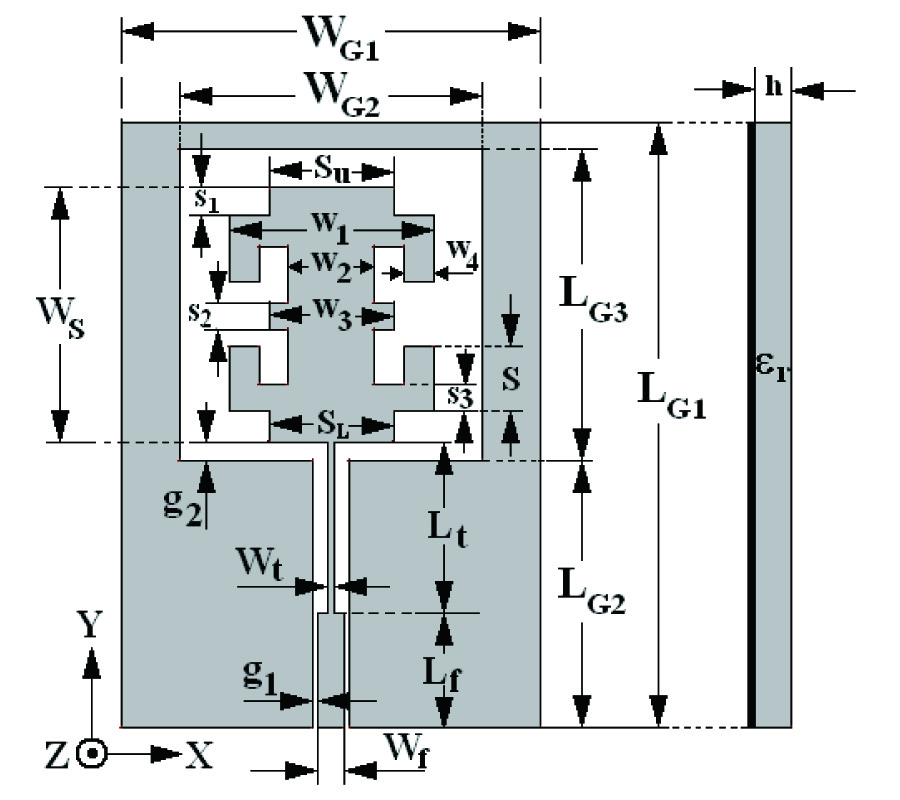
A microstrip-fed planar monopole antenna consisting of an inverted-L monopole and a square parasitic element extending from ground plane directly to obtain wideband operation covering Bluetooth/ISM, 2.5 GHz WiMAX, 3.5 GHz WiMAX and 5.2/5.8 GHz WLAN bands is presented. The proposed antenna employs a shorted parasitic element to improve the bandwidth. The return loss of the suggested antenna geometry was calculated by a commercial HFSS 9 simulator and the results are compared with measured return loss, which shows a good agreement between them. Details of the proposed antenna designs and experimental results of the constructed prototypes are presented.
MICROSTRIP-FED MONOPOLE ANTENNA WITH A SHORTED PARASITIC ELEMENT FOR WIDEBAND APPLICATION
2009-03-20
PIER C
Vol. 7, 25-35
A 802.11a Pulse-Swallow Integer-n Frequency Synthesizer
Cheng-Chan Tien , Tsung-Mo Tien and Christina F. Jou
In this paper we will explain thoroughly a 802.11a pulse-swallow integer-N frequency synthesizer. The whole circuit is designed on chip except the loop filter. The reference frequency is set to 10 MHz and a pulse-swallow counter is designed for the purpose of controlling the dual-modulus divider (÷8/9). The frequency tuning range varies from 4.98 GHz to 5.73 GHz meanwhile the output power of the voltage-controlled oscillator is -13.5 dBm, and the phase noise measured at 1MHz is -126 dBc/Hz. The settling time of the closed loop is about 20 us, the total power dissipation is 26.35 mW with 1.8 V supply voltage. The chip is fabricated under TSMC CMOS 0.18 um.
A 802.11A PULSE-SWALLOW INTEGER-N FREQUENCY SYNTHESIZER
2009-03-19
PIER
Vol. 91, 229-242
Development and Electromagnetic Characterization of Adaptable Open-Architecture WLAN Systems
Vassilios P. Papantoniou and Thomas Xenos
The construction and comprehensive electromagnetic analysis of a novel class of WLAN layouts is presented in this paper. The main purpose is to construct a wireless system according to the 802.11 a/b/g standards, which enables significantly larger and more reliable data transfer rates, making use of a new largescale field prediction technique, based on the parabolic equation with finite differences. Thus, four distinct structures, based on two different operating systems and two different hardware architectures, are proposed and elaborately examined. On the other hand, for the prediction algorithm a 3D wide-angle parabolic equation scheme is devised and a recursive approximation of the forward wave equation is accomplished. Unlike existing methods that characterize obstacles by means of surface impedance boundary conditions, a more rigorous approach, by treating them as penetrable objects with known material features is utilized. In this manner, the "interface" problem is systematically formulated and high levels of accuracy are attained. Moreover, the proposed technique is proven to be sufficiently faster and numerically more efficient, as the lattice, so constructed, along with the numbering of degrees of freedom remain unchanged from a parabolic equation plane to another. Extensive results and measurements certify the aforementioned merits for various realistic exterior and interior configurations.
DEVELOPMENT AND ELECTROMAGNETIC CHARACTERIZATION OF ADAPTABLE OPEN-ARCHITECTURE WLAN SYSTEMS
2009-03-19
PIER Letters
Vol. 7, 105-114
Removal of Beam Squinting Effects in a Circularly Polarized Offset Parabolic Reflector Antenna Using a Matched Feed
Shashi Sharma , Dhaval A. Pujara , Soumyabrata B. Chakrabarty and Vijay Kumar Singh
This paper presents the design of a tri-mode matched feed horn to remove the beam squinting effects in a circularly polarized offset parabolic reflector antenna. In a conical horn, three modes i.e., TE11, TM11 and TE21 are combined in proper amplitude and phase proportion to obtain a tri-mode matched feed configuration. The proposed tri-mode horn is then used as a primary feed device to illuminate the circularly polarized offset parabolic reflector antenna. The simulated data on radiation characteristics of the offset reflector are used to estimate the magnitude of beam squinting and the results are compared with that of a conventional potter horn fed offset reflector. The experimental results on secondary radiation pattern are also incorporated in the paper.
REMOVAL OF BEAM SQUINTING EFFECTS IN A CIRCULARLY POLARIZED  OFFSET PARABOLIC REFLECTOR ANTENNA USING A MATCHED FEED
2009-03-17
PIER
Vol. 91, 213-227
Novel Compact "via-Less" Ultra-Wide Band Filter Utilizing Capacitive Microstrip Patch
Mohammad Shahrazel Razalli , Alyani Ismail , Mohd Adzir Mahdi and Mohd Nizar bin Hamidon
This paper presents a novel compact "via-less" UWB filter derived from a quarter-wavelength short-circuited stubs model. In this compact "via-less" UWB filter, there is no connecting vias as short circuit elements. Unlike its previous model that has 5 short-circuited stubs, this novel shape consists of two pairs of stubs which are joint together to share on the same microstrip patch and thus reduces total size of the UWB filter itself making it more compact in nature. With proper width optimization, the microstrip patch is able to decouple and provides low impedance to the ground in the UWB frequencies range. The filter delivers 3.85 GHz to 10.44 GHz frequency range with 92.23% of fractional bandwidth. The magnitude of insertion loss is below than 0.53 dB and the return loss is lower than -14.8 dB in the passband frequencies. The -3 dB bandwidth is from 3.85 GHz to 10.44 GHz with 92.23% of fractional bandwidth. The group delay only varied by 0.47 ns in the passband, which makes it suitable for radio communication systems.
NOVEL COMPACT