Search Results(13979)

2007-12-17
PIER
Vol. 80, 349-368
Mutual External Inductance in Stripline Structures
Marina Koledintseva , James Drewniak , Thomas Van Doren , David Pommerenke , Matteo Cocchini and David Hockanson
The Method of Edge Currents (MEC) proposed in our previous paper [1] is applied herein for calculating the mutual external inductance associated with fringing magnetic fields that wrap ground planes of a stripline structure. This method employs a quasi-static approach, image theory, and direct magnetic field integration. The resultant mutual external inductance is frequency-independent. The approach has been applied to estimating mutual inductance for both symmetrical and asymmetrical stripline structures. Offset of the signal trace from the centered position both in horizontal and vertical directions is taken into account in asymmetrical structures. The results are compared with numerical simulations using the CST Microwave Studio Software.
MUTUAL EXTERNAL INDUCTANCE IN STRIPLINE STRUCTURES
2007-12-17
PIER B
Vol. 3, 95-104
To Analyze Inhomogeneous Planar Layers by Cascading Thin Linear Layers
Mohammad Khalaj-Amirhosseini
A new method is introduced to analyze lossy Inhomogeneous Planar Layers (IPLs) for both TE and TM polarizations in this paper. The IPLs are subdivided into several thin linear layers instead of uniform ones. The chain parameter matrix of linear layers is obtained by expressing the electric and magnetic fields in power series expansion. This method is applicable to all arbitrary lossy IPLs. The accuracy of the proposed method is verified using a comprehensive example.
TO ANALYZE INHOMOGENEOUS PLANAR LAYERS BY CASCADING THIN LINEAR LAYERS
2007-12-17
PIER B
Vol. 3, 73-94
Diffraction of Hybrid Modes in a Cylindrical Cavity Resonator by a Transverse Circular Slot with a Plane Anisotropic Dielectric Layer
Peter Kukharchik , Vladimir Serdyuk and Joseph Titovitsky
A rigorous solution of the homogeneous Maxwell equations for hybrid modes of a microwave cylindrical cavity with a transverse annular slot in the perfectly conducting walls of arbitrary thickness and a plane infinite anisotropic dielectric passing through the slot is constructed based on eigenfunction expansion. In each of the field existence regions (the cavity itself, the interior of a slot and outer space), the field solution is constructed as a superposition of natural piecewise harmonic and exponential modes that allow for reflection and refraction at the plane boundaries of the dielectric.The dependence of the complex wave number of free oscillations of a resonant system on its geometrical parameters and on complex permittivity of the dielectric is investigated. It is shown that a cylindrical cavity with a transverse annular slot is a stable and high-sensitive system for online measuring of dielectric parameters.
DIFFRACTION OF HYBRID MODES IN A CYLINDRICAL CAVITY RESONATOR BY A TRANSVERSE CIRCULAR SLOT WITH A PLANE ANISOTROPIC DIELECTRIC LAYER
2007-12-13
PIER B
Vol. 3, 63-72
Influence of Even Order Dispersion on Soliton Transmission Quality with Coherent Intereference
Aleksandra Panajotovic , Daniela Milovic and Anjan Biswas
The transmission speed of optical networks strongly depends on the impact of higher order dispersion. In the presence of coherent interference which can't be kept under control by optical filtering, the impact of higher order dispersion becomes more serious. In this paper we give general expressions that describe pulse deformation due to even higher order dispersion in a single-mode fiber. The impulsive responses for even order dispersion in the presence of coherent interference are characterized by symmetrical waveforms with long trailing skirts. Individual and joint influence of second and fourth order dispersion on the transmission quality is studied. Pulse shape and eye diagram are obtained.
INFLUENCE OF EVEN ORDER DISPERSION ON SOLITON TRANSMISSION QUALITY WITH COHERENT INTEREFERENCE
2007-12-13
PIER Letters
Vol. 1, 205-210
Numerical Method of Simulation of Material Influences in Mr Tomography
Miloslav Steinbauer , Radek Kubasek and Karel Bartusek
Generally all Magnetic Resonance Imaging (MRI) techniques are affected by magnetic and electric properties of measured materials, resulting in errors in MR image. Using numerical simulation we can solve the effect of changes in homogeneity of static and RF magnetic fields caused by specimen made from conductive and/or magnetic material in MR tomograph. This paper deals with numerical simulation of material susceptibility influence to magnetic field.
NUMERICAL METHOD OF SIMULATION OF MATERIAL INFLUENCES IN MR TOMOGRAPHY
2007-12-13
PIER Letters
Vol. 1, 197-204
Latest Trends in Millimeter-Wave Imaging Technology
Soichi Oka , Hiroyoshi Togo , Naoya Kukutsu and Tadao Nagatsuma
This paper overviews the latest trends of millimeterwave (MMW) imaging technologies, focusing mainly on applications of and technical parameter variations for security surveillance and nondestructive inspections (NDI).We introduce a smart NDI tool using active W-band imaging, which is capable of detecting hidden surface cracks in concrete structures.
LATEST TRENDS IN MILLIMETER-WAVE IMAGING TECHNOLOGY
2007-12-12
PIER
Vol. 80, 337-348
Frequency and Time Domain Characteristic of a Novel Notch Frequency UWB Antenna
Lida Akhoondzadeh-Asl , Masum Fardis , Ali Abolghasemi and Gholamreza R. Dadashzadeh
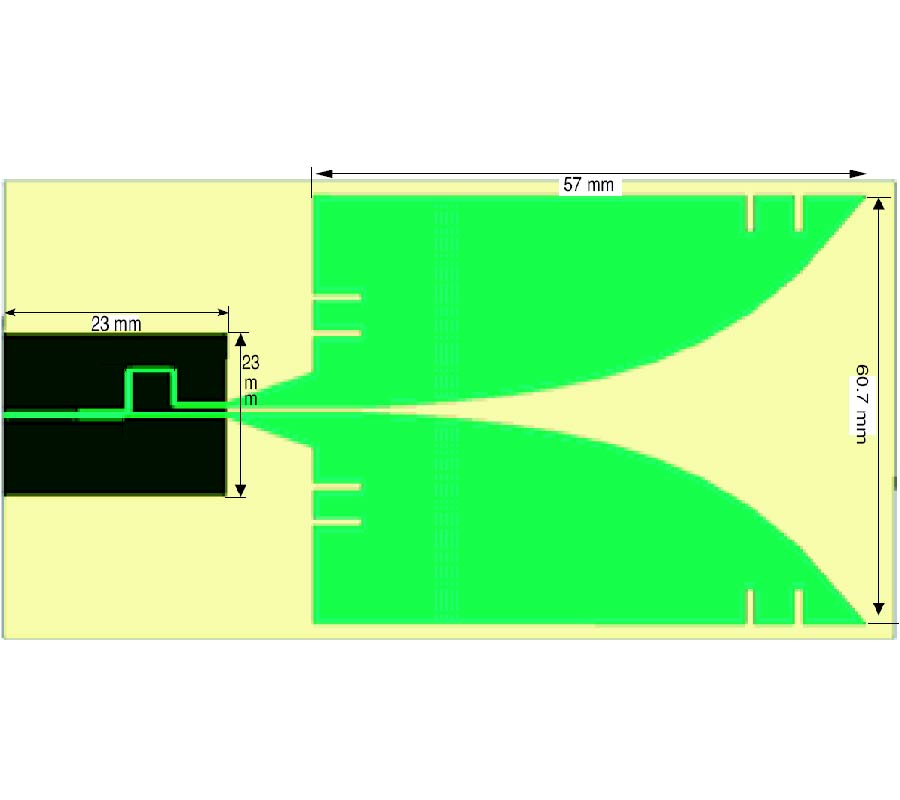
An ultra-wideband (UWB) monopole antenna with a band-notch characteristic is presented which needs only two parameters to tune the notch frequency. The proposed monopole antenna is embedded with a crescent slot, whose length is determined by parametric study. By adjusting the slot length, the notched frequency band within the antenna's operating bandwidth can be easily controlled. Also, the time-domain behaviours are discussed and the fidelity factor is calculated.
FREQUENCY AND TIME DOMAIN CHARACTERISTIC OF A NOVEL NOTCH FREQUENCY UWB ANTENNA
2007-12-12
PIER
Vol. 80, 321-336
Prediction of the SAR Level Induced in a Dielectric Sphere by a Thin Wire Dipole Antenna
Nikolaos Kouveliotis and Christos N. Capsalis
The interaction between a dipole antenna,represen ting a simplified model of a mobile terminal,and a homogeneous spherical model of the human head is examined. The Finite Difference Time Domain (FDTD) method is utilized,to calculate the either peak or average value of the Specific Absorption Rate (SAR),corresp onding to different distances between antenna and phantom. The variation of the SAR with the distance between the mobile antenna and the human phantom has gained significant attention in the recent literature and is investigated here. An attempt to correlate the computed SAR values with the basic antenna characteristics,suc h as the standing wave ratio (SWR),rev eals that a precise estimation of the level of the SAR can be achieved regarding data acquired from the mobile terminal.
PREDICTION OF THE SAR LEVEL INDUCED IN A DIELECTRIC SPHERE BY A THIN WIRE DIPOLE ANTENNA
2007-12-12
PIER B
Vol. 3, 47-62
A Practical Miniaturized U-Slot Patch Antenna with Enhanced Bandwidth
Farhad Gh. Khodaei , Javad Nourinia and Changiz Ghobadi
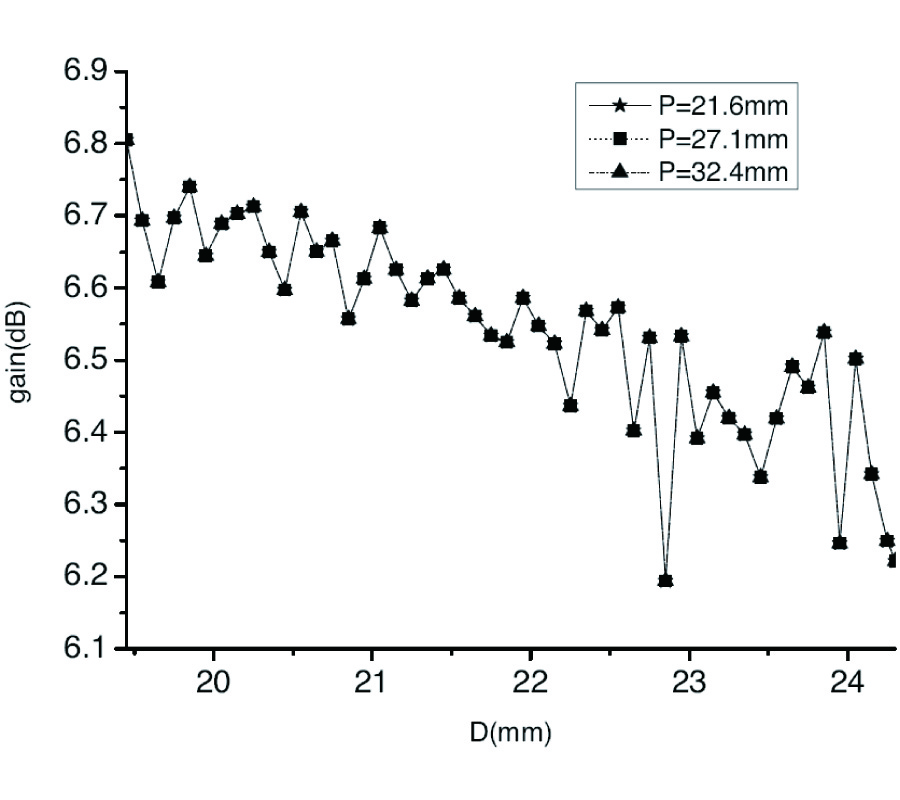
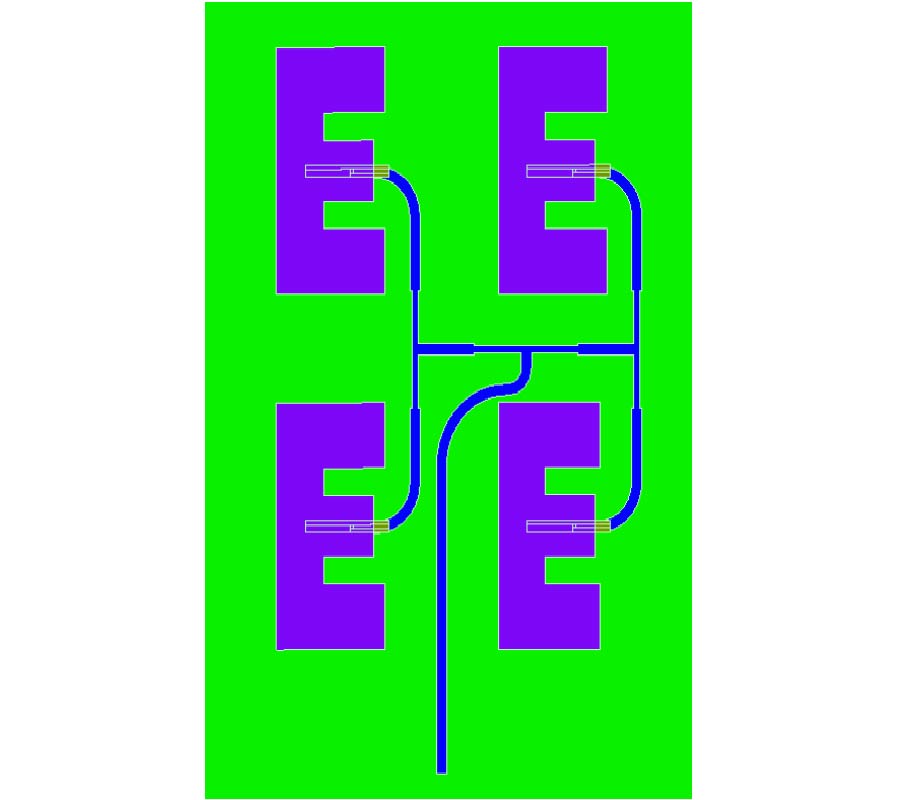
In this paper, an asymmetric U-slot patch antenna with low probe diameter is presented. It will be shown that reduction in probe diameter causes in reduction in bandwidth. One of the characteristics of this antenna is keeping the bandwidth in 30% in spite of reduction in antenna size and use of low probe diameter compared to antenna presented in [1]. The presented antenna in this paper has been fabricated by pcb technique and tested. The far-field results have also been presented based on simulation and measurement. Although the antenna has high cross polarisation level, in the case of using circular polarisation, the use of this antenna can be recommended because of its reduced size, high impedance bandwidth, high total gain in spite of having low size, and ease of fabrication.
A PRACTICAL MINIATURIZED U-SLOT PATCH ANTENNA WITH ENHANCED BANDWIDTH
2007-12-12
PIER Letters
Vol. 1, 189-196
Analysis of Capacitance Across Interconnects of Low-k Dielectric Used in a Deep Sub-Micron CMOS Technology
Sonanvane Avinash , Bhavana N. Joshi and Ashok Mahajan
The paper presents the detailed analysis of the interconnect capacitance, crosstalk time and peak crosstalk voltage. The dependency of the couple capacitance and fringe capacitance on the interconnect layer dimensions affects significantly to the interconnect capacitance. The peak crosstalk time obtained to be 13 femtoseconds for 9.6 femtoseconds of propagation delay, while the maximum crosstalk voltage obtained to be 178 mV.
ANALYSIS OF CAPACITANCE ACROSS INTERCONNECTS OF LOW-K DIELECTRIC USED IN A  DEEP SUB-MICRON CMOS TECHNOLOGY
2007-12-12
PIER Letters
Vol. 1, 181-188
3D Microstructuring of Glass by Femtosecond Laser Direct Writing and Application to Biophotonic Microchips
Koji Sugioka , Yasutaka Hanada and Katsumi Midorikawa
Three-dimensional (3D) microfabrication of photostructurable glass by femtosecond (fs) laser direct writing is demonstrated for manufacture of biophotonic microchips. The fs laser direct writing followed by annealing and successive wet etching can fabricate the hollow microstructures, achieving a variety of microfluidic components and microoptical components in a glass chip. One of the interesting and important applications of the 3D microfluidic structures fabricated by the present technique is inspection of living microorganisms. The microchips used for this application are referred to as nanoaquarium. Furthermore, the optical waveguide is written inside the glass by the fs laser direct writing without the annealing and the successive etching. It is revealed that integration of the microfluidic and microoptical components with the optical waveguides in a single glass chip is of great use for biochemical analysis and medical inspection based on optical sensing.
3D MICROSTRUCTURING OF GLASS BY FEMTOSECOND LASER DIRECT WRITING AND APPLICATION TO BIOPHOTONIC MICROCHIPS
2007-12-12
PIER Letters
Vol. 1, 173-179
An Example of Holographic Radar Using at Restoration Works of Historical Building
Vladimir Razevig , Sergey Ivashov , Anton Sheyko , Igor Vasilyev and Andrey Zhuravlev
The former Senate building, Saint-Petersburg, Russia is being refitted for using it by the Constitutional court of Russian Federation. The team of Remote Sensing Laboratory was invited to participate in this work. The case is that the underfloor water heating system had been installed in the Senate building. The arrangement of pipes hasn't been precisely documented. Besides, there are power and communications cables as well as metal mesh under the concrete floor of the building. Workers were afraid of damaging pipes and cables during laying the parquet floor. Main purpose was to investigate the building floor and to define exact position of pipes and cables with the help of subsurface holographic radars developed by Remote Sensing Laboratory.
AN EXAMPLE OF HOLOGRAPHIC RADAR USING AT RESTORATION WORKS OF HISTORICAL BUILDING
2007-12-11
PIER B
Vol. 3, 35-46
Breast Cancer Detection Using a Hybrid Finite Difference Frequency Domain and Particle Swarm Optimization Techniques
Saber Zainud-Deen , Walaa Hassan , Emadeldeen Hassan and Kamal Awadalla
A hybrid technique based on Finite-difference frequency domain and particle swarm optimization techniques is proposed to reconstruct the breast cancer cell dimension and determines its position. Finite-difference frequency domain is formulated to calculate the scattered field after illuminating the breast by a microwave transmitter. Two-dimensional and three-dimensional models for the breast are used. The models include randomly distributed fatty breast tissue, glandular tissue, 2-mm thick skin, as well as chest wall tissue. The models are characterized by the dielectric properties of the normal breast tissue and malignant tissue at 800 MHz. Computer simulations have been performed by means of a numerical program; results show the capabilities of the proposed approach.
BREAST CANCER DETECTION USING A HYBRID FINITE DIFFERENCE FREQUENCY DOMAIN AND PARTICLE SWARM OPTIMIZATION TECHNIQUES
2007-12-11
PIER B
Vol. 3, 23-34
Electromagnetic Scattering from Two Eccentric Metamaterial Cylinders with Frequency-Dependent Permittivities Differing Slightly Each Other
Constantinos Valagiannopoulos
The interaction between a metamaterial cylindrical structure and an incident plane wave is investigated. The structure is comprised of two cylinders, one embedded into the other, whose effective characteristics vary with the operating frequency following similar laws. Such a model can be used to describe periodic structures, constituting metamaterials, with slightly different features. The well-known eigenfunction expansions are adopted, while the boundary conditions are manipulated with help of the translation theorem for cylindrical coordinates. A first-order perturbation solution is obtained leading to simple and computationally efficient formulas. The fluctuations of near-field and far-field responses with respect to the position of the internal cylinder, the permittivities and the frequency are observed and discussed.
ELECTROMAGNETIC SCATTERING FROM TWO ECCENTRIC METAMATERIAL CYLINDERS WITH FREQUENCY-DEPENDENT PERMITTIVITIES DIFFERING SLIGHTLY EACH OTHER
2007-12-11
PIER B
Vol. 2, 291-303
FDTD Analysis of Rectangular Waveguide in Receiving Mode as EMI Sensors
Maifuz Ali and Subrata Sanyal
Testing electronic equipment for radiated emissions requires the accurate calibration of EMI sensor. The performance of the sensor depends on its Antenna Factor (AF), which is the ratio of the incident electric field on the antenna surface to the received voltage at the load end across 50Ω resistance. The theoretical prediction of the AF of EMI sensors is a very attractive alternative if one takes into consideration the enormous expenditure and time required for calibrating a sensor experimentally. In this work, FDTD is developed to predict the performance of rectangular waveguide for EMI sensors.
FDTD ANALYSIS OF RECTANGULAR WAVEGUIDE IN RECEIVING MODE AS EMI SENSORS
2007-12-10
PIER Letters
Vol. 1, 167-172
Enhancement of the Electronic Confinement Improves the Mobility in P-n -P Delta-Doped Quantum Wells in Si
Augusto Ariza-Flores and Isaac Rodríguez-Vargas
The electronic structure and mobility trends in a n-type delta-doped quantum well in Si, matched between p-type delta-doped barriers of the same material, is presented. The distance between the n-type well and p-type barriers is varied from 50A to 500A; and also the impurity density from 5 × 1012 cm-2 to 5 × 1013 cm-2, for both, donors and acceptors. An increase in the mobility by a factor of 1.6 at interwell distance of 50A with donor and acceptor concentrations of 5 × 1012 cm-2 and 5 × 1013 cm-2 compared with a single delta-doped well without p-type barriers is found. This improvement in mobility could be attributed to a better confinement of carriers, which favors excited levels with nodes in the donor plane. This trade-off between carrier concentration and mobility could be exploited in high-speed, high-power and high-frequency applications.
ENHANCEMENT OF THE ELECTRONIC CONFINEMENT IMPROVES THE MOBILITY IN P-N-P DELTA-DOPED QUANTUM WELLS IN SI
2007-12-10
PIER Letters
Vol. 1, 159-165
Electron Subband Structure and Mobility Trends in P-n Delta-Doped Quantum Wells in Si
Augusto Ariza-Flores and Isaac Rodríguez-Vargas
We present the electronic spectrum of a n-type deltadoped quantum well in Si coupled to a p-type delta-doped barrier within the envelope function effective mass approximation. We applied the Thomas-Fermi approximation to derive an analytical expression for the confining potential, and thus, we obtain the electronic structure in a simple manner. We analyzed the electron subband structure varying the distance between the doping planes (l) as well as the impurity density in them (n2D, p2D). We also study the mobility trends through an empirical formula that is based on the electron levels, the electron wave functions and the Fermi level. We find a monotonic decrease in the mobility as the p-type barrier moves away from the n-type well, and optimum parameters, l = 70A and n2D = 5 × 1012 cm-2 and p2D = 5×1013 cm-2, for maximum mobility.
ELECTRON SUBBAND STRUCTURE AND MOBILITY TRENDS IN P-N DELTA-DOPED QUANTUM WELLS IN SI
2007-12-08
PIER B
Vol. 3, 1-22
Quasi-Static Models Based on Artificial Neural Neworks for Calculating the Characteristic Parameters of Multilayer Cylindrical Coplanar Waveguide and Strip Line
Celal Yildiz and Mustafa Turkmen
In this paper, two different neural models are proposed for calculating the quasi-static parameters of multilayer cylindrical coplanar waveguides and strip lines. These models were basically developed by training the artificial neural networks with the numerical results of quasi-static analysis. Neural models were trained with four different learning algorithms to obtain better performance and faster convergence with simpler structure. When the performances of neural models are compared with each other, the best test results are obtained from the multilayered perceptrons trained by the Levenberg- Marquardt algorithm. The results obtained from the neural models are in very good agreements with the theoretical results available in the literature.
QUASI-STATIC MODELS BASED ON ARTIFICIAL NEURAL NEWORKS FOR CALCULATING THE CHARACTERISTIC PARAMETERS OF MULTILAYER CYLINDRICAL COPLANAR WAVEGUIDE AND STRIP LINE
2007-12-08
PIER Letters
Vol. 1, 149-158
An Analytic Formula of the Current Distribution for the VLF Horizontal Wire Antenna Above Lossy Half-Space
Hai Chen , Jian-Xin Luo and Da-Kui Zhang
An analytical formula of the current distribution for the VLF horizontal wire antenna located above the ground is presented in this paper. This formula is suitable for the VLF horizontal antenna which is fed at arbitrary position and with arbitrary loaded impedance at the end. In order to validate the analytical formula, a numerical code based on MoM is also developed. The comparison between the results obtained by two methods proves the validity of the analytical formula proposed in this paper.
AN ANALYTIC FORMULA OF THE CURRENT DISTRIBUTION FOR THE VLF HORIZONTAL WIRE ANTENNA ABOVE LOSSY HALF-SPACE
2007-12-08
PIER Letters
Vol. 1, 139-148
Strong Geomagnetic Disturbances and Induced Currents on Earth Surface
Ana Elias and V. Silbergleit
Long-term variations in strong geomagnetic storms are analyzed and linked to electric fields induced on Earth. In fact, geomagnetic disturbances generate electric fields that drive currents in the Earth which may have significant effects on electrical systems and pipelines. The present study will be carried out using aa, AE and Dst index data to estimate long-term variations in strong geomagnetic disturbances. The results are extended then to the space weather topic through a rough assessment of the expected Earth electric field from measured horizontal components of the surface magnetic field, and also through a qualitative estimation of the consequent currents and voltages induced in a pipeline using the distributed source transmission line (DSTL) theory.
STRONG GEOMAGNETIC DISTURBANCES AND INDUCED CURRENTS ON EARTH SURFACE