Search Results(13786)

2004-12-13
PIER
Vol. 52, 81-108
Surface Integral Equation Method for General Composite Metallic and Dielectric Structures with Junctions
Pasi Yla-Oijala , Matti Taskinen and Jukka Sarvas
The surface integral equation method is applied for the electromagnetic analysis of general metallic and dielectric structures of arbitrary shape. The method is based on the EFIE-CFIE-PMCHWT integral equation formulation with Galerkins type discretization. The numerical implementation is divided into three independent steps: First, the electric and magnetic field integral equations are presented and discretized individually in each non-metallic subdomain with the RWG basis and testing functions. Next the linearly dependent and zero unknowns are removed from the discretized system by enforcing the electromagnetic boundary conditions on interfaces and at junctions. Finally, the extra equations are removed by applying the wanted integral equation formulation, and the reduced system is solved. The division into these three steps has two advantages. Firstly, it greatly simplifies the treatment of composite ob jects with multiple metallic and dielectric regions and junctions since the boundary conditions are separated from the discretization and integral equation formulation. In particular, no special junction basis functions or special testing procedures at junctions are needed. Secondly, the separation of the integral equation formulation from the two previous steps makes it easy to modify the procedure for other formulations. The method is validated by numerical examples.
SURFACE INTEGRAL EQUATION METHOD FOR GENERAL COMPOSITE METALLIC AND DIELECTRIC STRUCTURES WITH JUNCTIONS
2004-12-13
PIER
Vol. 52, 47-80
Analytical Techniques to Evaluate the Integrals of 3D and 2D Spatial Dyadic Green's Functions
Guozhong Gao , Carlos Torres-Verdin and Tarek Habashy
The Dyadic Green's function is in general viewed as a generalized, or distribution function. A commonly used procedure to evaluate its volume integral is the principal-volume method, in which an infinitesimal volume around the singularity is excluded from the integration volume. In this paper, we develop a general analytical technique to evaluate the integral of the dyadic Green's function without the need to specify an exclusion volume. The newly derived expressions accurately integrate the singularity and can be used for integration over any shape of spatial discretization cell. We derive explicit expressions for the integral of the 3D dyadic Green's function over a sphere and over a general rectangular block. Similar expressions are obtained for the 2D dyadic Green's function over a cylinder and over a general rectangular cell. It is shown that using the integration technique described in this paper for spherical/circular cells, simple analytical expressions can be derived, and these expressions are exactly the same as those obtained using the principal-volume method. Furthermore, the analytical expressions for the integral of the dyadic Green's function are valid regardless of the location of the observation point, both inside and outside the integration domain. Because the expressions only involve surface integrals/line integrals, their evaluation can be performed very efficiently with a high degree of accuracy. We compare our expressions against the equivalent volume approximation for a wide range of frequencies and cell sizes. These comparisons clearly show the efficiency and accuracy of our technique. It is also shown that the cubic cell (3D) and the square cell (2D) can be approximated with an equivalent spherical cell and circular cell, respectively, over a wide range of frequencies. The approximation can be performed analytically, and the results can be written as the value of the dyadic Green's function at the center multiplying a "geometric factor". We describe analytical procedures to derive the corresponding geometric factors.
ANALYTICAL TECHNIQUES TO EVALUATE THE INTEGRALS OF 3D AND 2D SPATIAL DYADIC GREEN'S FUNCTIONS
2004-12-13
PIER
Vol. 52, 23-46
Analysis of the Temperature Increase Linked to the Power Induced by RF Source
Ahmed Ibrahiem , Christian Dale , Walid Tabbara and Joe Wiart
Temperature increase analysis has been performed with consideration to the anatomical model of the human head exposed to a cellular phone operating at 900 MHz. Four different numerical methods, in particular an implicit method based on the Alternating Direction Implicit technique (ADI), were applied to solve the Bio-Heat Equation (BHE), their advantages and limitations were compared using a canonical case. The tests performed on the latest have shown that the implicit approach is well adapted to solve this type of equations. The rise of temperature in the human head exposed to the RF emission of a mobile phone with a radiated power of 250 mW at 900 MHz was analyzed. In addition the influence of the presence of the telephone kit close to the head was discussed. The influence of different thermal parameters such as the thermal conductivity and the blood perfusion coefficient on the rise of temperature has been analyzed. The simulation carried out showed that the maximum temperature increase in the internal tissues linked to SAR deposition does not exceed 0.1ºC. We recorded a temperature difference of 1.6ºC in the skin due to the presence of a switched off cellular phone, which has been confirmed by the experimental measurements performed.
ANALYSIS OF THE TEMPERATURE INCREASE LINKED TO THE POWER INDUCED BY RF SOURCE
2004-12-13
PIER
Vol. 52, 1-21
Elliptical and Circular Step-Index Fibers with Conducting Helical Windings on the Core-Cladding Boundaries for Different Winding Pitch Angles - a Comparative Modal Dispersion Analysis
Deepak Kumar and Onkar Singh II
The propagation characteristics of an elliptical step-index fiber with a conducting helical winding on the core-cladding boundary are investigated analytically and compared with those of a circular step index fiber with a conducting radial winding. Our optical waveguides are unconventional: in view of the existence of helical conducting windings on the core-cladding boundaries. Appropriate coordinate systems, circular cylindrical and elliptic cylindrical, are chosen for the circular and elliptical fibers. Applying the boundary conditions as modified by the presence of conducting helical windings, the characteristic equations are obtained for both the fibers. Dispersion curves are also obtained for two special values of the helical pitch angle ψ, namely, for ψ = 0º and ψ = π/2 for each fiber and the results have been compared. It is found that the introduction of the helical winding has two main effects on the characteristics of both types of fibers. These are: (1) The helix introduces band gaps and (2) has the effect of splitting a mode into a pair of adjacent modes In the case of the elliptical helically clad waveguide we find two band gaps for V < 30 whereas for circular guide we have only one band gap in the same range of V-values, V being the normalized frequency parameter.
ELLIPTICAL AND CIRCULAR STEP-INDEX FIBERS WITH CONDUCTING HELICAL WINDINGS ON THE CORE-CLADDING BOUNDARIES FOR DIFFERENT WINDING PITCH ANGLES - A COMPARATIVE MODAL DISPERSION ANALYSIS
2004-12-10
PIER
Vol. 51, 329-341
Axially Slotted Antenna on a Circular or Elliptic Cylinder Coated with Metamaterials
Abdul-Kadir Hamid
The radiation properties of an axially slotted circular or elliptical antenna coated with metamaterials are investigated. The fields inside and outside the dielectric coating are expressed in terms of Mathieu functions. The boundary conditions at various surfaces are enforced to obtain the unknown field expansion coefficients. Numerical results are presented graphically for the radiation pattern, aperture conductance and antenna gain for the TM case. It was found that slotted antenna coated with metamaterials has more directive beam with lower sidelobes compared to coated with conventional dielectric material.
AXIALLY SLOTTED ANTENNA ON A CIRCULAR OR ELLIPTIC CYLINDER COATED WITH METAMATERIALS
2004-12-10
PIER
Vol. 51, 295-328
A Study of Using Metamaterials as Antenna Substrate to Enhance Gain
Bae-Ian Wu , Weijen Wang , Joe Pacheco , Xudong Chen , Tomasz M. Grzegorczyk and Jin Au Kong
Using a commercial software, simulations are done on the radiation of a dipole antenna embedded in metamaterial substrates. Metamaterials under consideration are composed of a periodic collection of rods, or of both rods and rings. The S-parameters of these metamaterials in a waveguide are analyzed and compared with their equivalent plasma or resonant structure. Farfield radiation is optimized by analytic method and is simulated numerically. The metamaterial is shown to improve the directivity.
A STUDY OF USING METAMATERIALS AS ANTENNA SUBSTRATE TO ENHANCE GAIN
2004-12-10
PIER
Vol. 51, 281-293
The Experimental Study of /4 Monopole Antennas in Meta-Material
Qiang Sui , Chao Li and Fang Li
The paper focuses on λ/4 monopole antennas located in a meta-material that exhibits simultaneously negative values of effective permeability and permittivity within a microwave frequency band, as well as our experimental study in an anechoic chamber. The experimental results show that the electromagnetic waves radiated by the monopole are negatively refracted at the interface between the meta-material and the air at certain directions. In addition, the radiation pattern of the monopole in the meta-material is directional while it is non-directional without the meta-material.
THE EXPERIMENTAL STUDY OF  /4 MONOPOLE ANTENNAS IN META-MATERIAL
2004-12-10
PIER
Vol. 51, 249-279
Experimental Study on Several Left-Handed Matamaterials
Li-Xin Ran , Jiangtao Huangfu , Hongsheng Chen , Xian-Min Zhang , Kang Chen , Tomasz M. Grzegorczyk and Jin Au Kong
Left-handed materials (LHM) are engineered structures that exhibit electromagnetic properties not found in nature. Real applications of LHM need substrates with low loss, wide bandwidth as well as stable mechanical characteristics. In this paper, we summarize some experimental as well as numerical results of left-handed materials with different configurations of rods and split-ring resonators (SRRs). Hot-press technics utilized in PC board manufacture are used to produce solid-state multi-layer left-handed materials. Either mechanical or electromagnetic characteristics of LH samples are notably improved.
EXPERIMENTAL STUDY ON SEVERAL LEFT-HANDED MATAMATERIALS
2004-12-10
PIER
Vol. 51, 231-247
Magnetic Properties of S-Shaped Split-Ring Resonators
Hongsheng Chen , Li-Xin Ran , Jiangtao Huangfu , Xian-Min Zhang , Kang Chen , Tomasz M. Grzegorczyk and Jin Au Kong
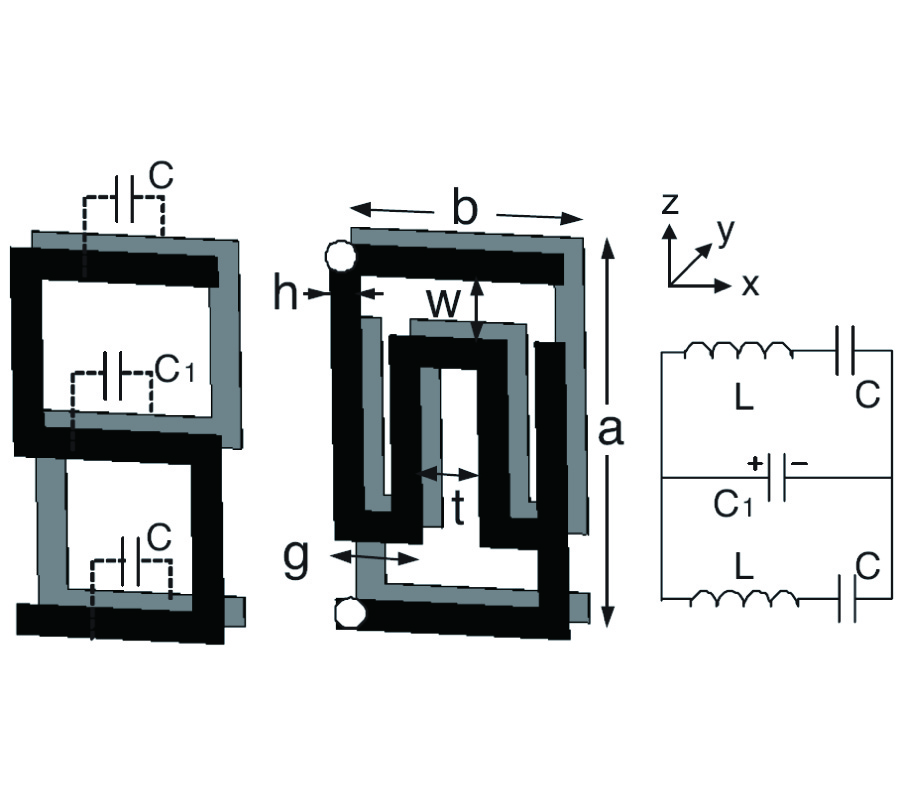
We present a theoretical analysis of the radiation of an S-shaped split ring resonator (S-SRR) for the realization of a metamaterial exhibiting left-handed properties. It is shown that the structure is resonant due to its internal capacitances and inductances, which can be adjusted such that the electric plasma frequency and magnetic plasma frequency, both due to the S-SRR only, appear within the same frequency band. Using the same idea, we also present some extended S-shaped split-ring resonator structures with improved performance.
MAGNETIC PROPERTIES OF S-SHAPED SPLIT-RING RESONATORS
2004-12-10
PIER
Vol. 51, 219-229
Quasi-Static Analysis of Materials with Small Tunable Stacked Split Ring Resonators
S.-W. Lee , Yasuo Kuga and Akira Ishimaru
This paper presents a quasi-static analysis of a metamaterial consisting of a three-dimensional array of small tunable stacked split ring resonators (SSRRs). The resonance frequency of the proposed resonator structure can be controlled by adjusting the auxiliary lumped elements which are inserted between the split of each ring. In addition, the size of the ring resonator can be reduced to an order of 0.01λ that is one tenth that of the split ring resonator (SRR) by choosing the proper lumped elements. The analysis is based on the quasi-static Lorentz theory, and the generalized matrix representation of the macroscopic constitutive relations of the composite medium is calculated.
QUASI-STATIC ANALYSIS OF MATERIALS WITH SMALL TUNABLE STACKED SPLIT RING RESONATORS
2004-12-10
PIER
Vol. 51, 197-217
Macroscopic Performance Analysis of Metamaterials Synthesized from Micrsocopic 2-d Isotropic Cross Split-Ring Resonator Array
Hai-Ying Yao , Joshua Le-Wei Li , Qun Wu and Jin Au Kong
Two-dimensional isotropic metamaterials fabricated from cross split-ring resonators (CSRRs) are characterized and their constitutive relation tensors are studied in this paper. The effective constitutive parameters of the metamaterials are determined utilizing the quasi-static Lorentz theory and numerical method (i.e., the method of moments for solving the electric field integral equation). The induced current distributions of a single CSRR at the resonant frequency are presented. Moreover, the dependence of the resonant frequency on the dimensions of a single CSRR and the space distances of the CSRR array is also discussed. Reflection and transmission coefficients of a metamaterial slab versus frequency are finally discussed.
MACROSCOPIC PERFORMANCE ANALYSIS OF METAMATERIALS SYNTHESIZED FROM MICRSOCOPIC 2-D ISOTROPIC CROSS SPLIT-RING RESONATOR ARRAY
2004-12-10
PIER
Vol. 51, 187-195
Complex Guided Wave Solution of Grounded Dielectric Slab Made of Metamaterials
Chao Li , Qiang Sui and Fang Li
This paper focuses on the complex guided wave solutions of grounded slab made of metamaterials. Complex solutions of both TE and TM modes have been analyzed. It is found that they are distributed on the proper Riemann sheet. This property differs dramatically from that of a conventional grounded slab. A number of other distribution properties are studied analytically. Some numerical examples are given to verify the analytical results. It is important to take the peculiar complex solutions into account in the problems of microstrip and surface wave excitation.
COMPLEX GUIDED WAVE SOLUTION OF GROUNDED DIELECTRIC SLAB MADE OF METAMATERIALS
2004-12-10
PIER
Vol. 51, 167-185
Guided Waves in Uniaxial Wire Medium Slab
Igor Nefedov and Ari Viitanen
Guided waves in a wire medium slab are studied. The wire medium is considered as a continuous medium described in terms of uniaxial permittivity dyadic. Nonlocal model of the wire medium, taking into account spatial dispersion, is used in the analysis. Different cases of an arrangement of the wires are considered. Analytic expressions for the fields in unbounded media and numerical solutions for eigenmodes spectrum in wire medium slab are obtained. Comparison of the results given by old (local) and new model of wire medium is presented.
GUIDED WAVES IN UNIAXIAL WIRE MEDIUM SLAB
2004-12-10
PIER
Vol. 51, 153-165
Analysis of the Left-Handed Metamaterials Using Multi-Domain Pseudospectral Time-Domain Algorithm
Yan Shi and Chang-Hong Liang
The increasing interest in electromagnetic effects in double-negative (DNG) materials requires a formulation capable of a full analysis of wave propagation in such materials. We develop a novel technique for discretization of the Drude medium model and adopt multi-domain pseudospectral time-domain (PSTD) algorithm and well-posed PML formulation to analysis the plane wave scattering properties of a single circular cylinder and a periodic array of the circular cylinders fabricated from the Drude medium. The simulation results show accuracy of the proposed constitutive equation-discretization scheme.
ANALYSIS OF THE LEFT-HANDED METAMATERIALS USING MULTI-DOMAIN PSEUDOSPECTRAL TIME-DOMAIN ALGORITHM
2004-12-10
PIER
Vol. 51, 139-152
Generalized Surface Plasmon Resonance Sensors Using Metamaterials and Negative Index Materials
Akira Ishimaru , Sermak Jaruwatanadilok and Yasuo Kuga
nullOptical surface plasmon resonance sensors have been known for a long time. In this paper, we discuss the use of metamaterials to construct a surface plasmon sensor which can be used at microwave frequencies. We review the conditions for the existence of surface plasmon and the use of the forward and backward surface waves. A sharp dip in the reflection coefficient occurs when the propagation constant of the incident wave along the surface is nearly equal to the propagation constant of the plasmon surface wave and may be used to probe bulk material characteristics or to determine metamaterial characteristics. Numerical examples are given to illustrate the basic characteristics.
GENERALIZED SURFACE PLASMON RESONANCE SENSORS USING METAMATERIALS AND NEGATIVE INDEX MATERIALS
2004-12-10
PIER
Vol. 51, 127-137
Surface Wave Character on a Slab of Metamaterial with Negative Permittivity and Permeability
Samir Mahmoud and Ari Viitanen
Characteristics of surface wave modes on a grounded slab of negative permittivity and negative permeability parameters are investigated. It is shown that, unlike a slab with positive parameters, the dominant mode can have evanescent fields on both sides of the interface between the slab and the surrounding air. Detailed characteristics of such mode for various combinations of the slab parameters are given.
SURFACE WAVE CHARACTER ON A SLAB OF METAMATERIAL WITH NEGATIVE PERMITTIVITY AND PERMEABILITY
2004-12-10
PIER
Vol. 51, 115-126
The Effective Constitutive Parameters at Interface of Different Media
Long Gen Zheng and Wen-Xun Zhang
This paper presents a new approach to estimate effective constitutive parameters for a cell across an interface between two bianisotropic media. The work is different from those studying effective properties of bi-anisotropic mixtures in that the boundary conditions of field components are taken into consideration. The degenerated cases, including interfaces of two bi-isotropic, anisotropic and isotropic media, are discussed respectively in detail. Simulation for anisotropic media shows significant improvements can be expected from the adoption of the new approach.
THE EFFECTIVE CONSTITUTIVE PARAMETERS AT INTERFACE OF DIFFERENT MEDIA
2004-12-10
PIER
Vol. 51, 83-113
Reflection Coefficients and Goos-Hanchen Shifts in Anisotropic and Bianisotropic Left-Handed Metamaterials
Tomasz M. Grzegorczyk , Xudong Chen , Joe Pacheco , Jianbing Chen , Bae-Ian Wu and Jin Au Kong
We show in this paper that metamaterials in which some components of the permittivity and permeability tensors can have negative real values (thus associated with left-handed metamaterials) call for a reconsideration of the common concepts of critical angle and Brewster angle. By studying the reflection coefficient for isotropic and biaxial half-spaces and slabs, we show that a metamaterial for which the Brewster angle appears beyond the critical angle is realizable. In addition, we also show that the Goos-Hänchen shift induced by left-handed isotropic slabs is not necessarily negative but could be positive when the second interface of the slab supports a surface plasmon. Finally, upon studying a bianisotropic metamaterial, we show that propagation at a negative angle can occur, although it would not if only the permittivity and permeability tensors were considered. All the results have been obtained using an eigenvalue method which we extend to bianisotropic media in this paper.
REFLECTION COEFFICIENTS AND GOOS-HANCHEN SHIFTS IN ANISOTROPIC AND BIANISOTROPIC LEFT-HANDED METAMATERIALS
2004-12-10
PIER
Vol. 51, 65-82
Metamaterials and Depolarization Factors
Ari Sihvola
Depolarization factors of scatterers within anisotropic media are functions of not only the shape of the inclusion but also of the degree of anisotropy of the environment. In this contribution the depolarization factors are studied for anisotropic metamaterials. In such case, qualitatively new phenomena appear because the effective axial ratio of the scatterers, which determines the depolarization factors, may become complex. The negative real part of the depolatization factors is interpreted as "repolarization." The effect of the various parameters on the depolarization factors and effective dielectric parameters are analyzed and discussed for both three- and two-dimensional mixtures, with emphasis on the dissipative character of the homogenized metamaterials.
METAMATERIALS AND DEPOLARIZATION FACTORS
2004-12-10
PIER
Vol. 51, 49-63
Anomalous Properties of Scattering from Cavities Partially Loaded with Double-Negative or Single-Negative Metamaterials
Filiberto Bilotti , Andrea Alu , Nader Engheta and Lucio Vegni
In this paper, the theoretical justification and the numerical verification of the anomalous scattering from cavities partially filled with metamaterials are presented. A hybrid numerical formulation based on the Finite Element Method (FEM) and on the Boundary Integral (BI) for the analysis of cavity backed structures with complex loading metamaterials is first presented. The proposed approach allows the analysis of cavities filled with materials described by tensorial linear constitutive relations, which may well describe artificial metamaterials synthesized with proper inclusions in a host dielectric. It is found that cavities loaded with pairs of metamaterial layers with "resonant" features possess unusual scattering properties, and with judicious selection of constitutive parameters for these materials the transparency effect or significant enhancement in the backscattering from such cavities are obtained. This may be considered as a first step towards the analysis of the scattering and radiating features of cavity-backed patch antennas and reflect-arrays in presence of multilayered metamaterial loads.
ANOMALOUS PROPERTIES OF SCATTERING FROM CAVITIES PARTIALLY LOADED WITH DOUBLE-NEGATIVE OR SINGLE-NEGATIVE METAMATERIALS