Search Results(13878)

2005-06-25
PIER
Vol. 55, 147-174
Algebraic Function Approximation to Eigenvalue Problems in Lossless Metallic Waveguides (Revisited)
Namik Yener
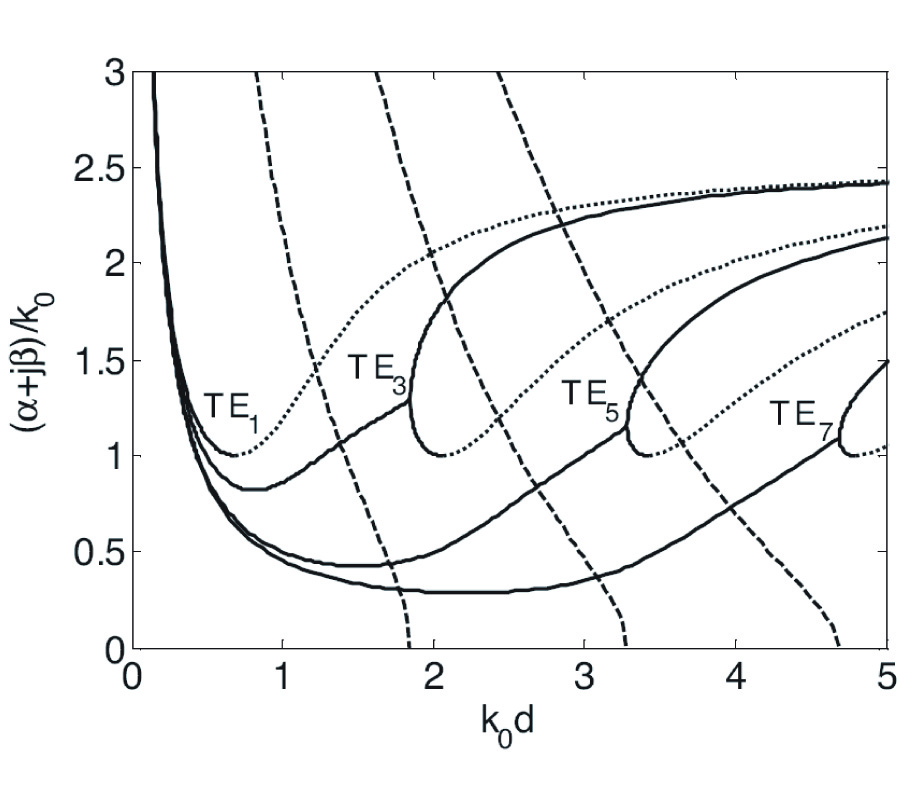
The problem of studying modal characteristics of metallic waveguides filled with lossless inhomogeneous and/or anisotropic media, is one of studying properties of the propagation constant of the guiding structure. It is shown that modal behavior in the neighborhood of critical frequencies such as cutoff frequencies and frequencies marking the onset of complex wave mode intervals, can be modeled through approximation of the propagation constant by a root of an algebraic equation. The particular form of the algebraic function approximating the propagation constant is discussed in the neighborhood of a singularity. A numerical example is included to stress the viability of the technique.
ALGEBRAIC FUNCTION APPROXIMATION TO EIGENVALUE PROBLEMS IN LOSSLESS METALLIC WAVEGUIDES (REVISITED)
2005-04-23
PIER
Vol. 55, 117-146
About the Zero Mass of Photon
Antonio Puccini
The photon, that is the messenger of the electromagnetic force, is considered with a zero restmass. Yet, just as there is no energy with a zero value, so we talk about a "Zero Point Energy", for the equivalence between mass and energy (datum point of the Theory of Relativity and foundation of modern Physics), there should exist also a "Zero Point Mass". That is, no particle, with energy, though extremely small, as the energy of the quantum of light, the Planck's grain, can have a zero mass. In other words, just for the equivalence Mass-Energy (E = mc2), to any particle with energy should correspond a mass equal to the energy carried, divided the square of the speed of light. Of course when we consider particles like the photon this value will be extremely small, however it should be ≠ 0. Thus, a lot of the behaviours of the photon, in which it shows a clear sort of mechanic action (see photoelectric effect, Compton effect, or the Raman effect), so far ascribed to a mere energetic effect, may probably be considered as real "mass effects".
2005-04-23
PIER
Vol. 55, 95-116
Mathematical Modelling of Electromagnetic Scattering from a Thin Penetrable Target
Zinoviy Theodorovych Nazarchuk and Kazuya Kobayashi
Three mathematical models based on approximate surface integral equations for electromagnetic analysis of scalar wave scattering from thin extended target are considered. Such models include different systems of the second kind singular integral equations determined on the target median. The effective algorithm for direct (without preliminary regularization) numerical solution of the systems is based on the special quadrature formulae for singular integrals. Verification of the mathematical models and their comparison is performed in the case of penetrable cylindrical shell in homogeneous non-magnetic medium.
MATHEMATICAL MODELLING OF ELECTROMAGNETIC SCATTERING FROM A THIN PENETRABLE TARGET
2005-04-23
PIER
Vol. 55, 79-93
RETRACTED: IMPROVED TRANSMISSION FOR PHOTONIC CRYSTAL Y-JUNCTIONS
2005-04-23
PIER
Vol. 55, 47-78
Translation Procedures for Broadband MLFMA
Henrik Wallen and Jukka Sarvas
The multilevel fast multipole algorithm (MLFMA) is used in computing acoustic and electromagnetic fields with integral equation The multilevel fast multipole algorithm (MLFMA) is used in computing acoustic and electromagnetic fields with integral equation methods. The traditional MLFMA, however, suffers from a low-frequency breakdown that effectively limits the minimum division cube side length to approximately one wavelength. To overcome this low-frequency breakdown and get a broadband MLFMA, we propose an efficient and relatively straightforward implementation of the field translations based on the spectral representation of the Green's function. As an alternative we also consider the so called uniform MLFMA, which has a lower computational cost but limited accuracy. We consider the essential implementation details and finally provide numerical examples to demonstrate the error controllability of the translations.
TRANSLATION PROCEDURES FOR BROADBAND MLFMA
2005-04-23
PIER
Vol. 55, 33-46
Wideband and Efficient Microstrip Interconnects Using Multi-Segmented Ground and Open Traces
Mohammad Khalaj-Amirhosseini and Ahmad Cheldavi
In this paper, two new interconnect structures called Multi-Segmented S-G-S (Signal-Ground-Signal) and S-O-S (Signal- Open-Signal) interconnects are proposed and compared with the conventional S-S-S interconnects. In these interconnect structures a multi-segmented grounded or opened line is inserted between two adjacent signal lines. The grounded (opened) lines have been grounded (opened) not only in their terminals, but also in some places along their length. The performances of these interconnects are studied via some examples.
WIDEBAND AND EFFICIENT MICROSTRIP INTERCONNECTS USING MULTI-SEGMENTED GROUND AND OPEN TRACES
2005-04-23
PIER
Vol. 55, 1-31
Homogenization of Corrugated Interfaces in Electromagnetics
Gerhard Kristensson
A surface with periodic corrugations of sufficiently small periodicity is shown to be electromagnetically equivalent to an inhomogeneous transition region (slab). Explicit expressions for the inhomogeneous transition region are found for one-dimensional corrugations and for two-dimensional corrugations a local elliptic problem has to be solved in order to find the equivalent electromagnetic properties. The homogenized surface can be characterized by its surface impedance dyadic or its reflection dyadic. A few numerical examples illustrate the theory.
HOMOGENIZATION OF CORRUGATED INTERFACES IN ELECTROMAGNETICS
2005-04-18
PIER
Vol. 54, 321-333
Electromagnetic Wave Equation in Differential-Form Representation
Ismo Veikko Lindell
Differential-form formalism has been often applied, in stead of the more commonplace Gibbsian vector calculus, to express the basic electromagnetic equations in simple and elegant form. However, representing higher-order equations has met with unexpected difficulties, in particular, when dealing with general linear electromagnetic media. In the present study, wave equations involving scalar operators of the fourth order are derived for the electromagnetic two-form and the potential one-form, for the general linear bi-anisotropic medium. This generalizes previous coordinate- free approaches valid for certain special classes of media. The analysis is based on some multivector and dyadic identities derived in the Appendix.
2005-04-18
PIER
Vol. 54, 303-319
A Unique Solution to the 2-d h-Scattering Problem for a Semicircular Trough in a PEC Ground Plane
Alexander Tyzhnenko
A rigorous solution to the Neumann boundary value problem (BVP) for semicircular trough in a perfectly electrically conducting (PEC) ground plane is presented. The known Rayleigh's method expansion of a solution by eigensolutions of the Helmholtz equation in cylindrical coordinates coupled with partial orthogonality of trigonometric functions is used. In contrast to previous works on this theme, a Fredholm 2nd kind matrix equation for modal coefficients is obtained, which permits one to derive very fast convergent approximate solution for any incidence angle and trough dimension. The method solution permits one to consider a dielectric loading as well. A strong broadband fall-off of backscattering from apertures loaded with lossy dielectric is theoretically revealed.
A UNIQUE SOLUTION TO THE 2-D H-SCATTERING PROBLEM FOR A SEMICIRCULAR TROUGH IN A PEC GROUND PLANE
2005-04-18
PIER
Vol. 54, 283-302
An Innovative Fuzzy-Logic-Based Strategy for an Effective Exploitation of Noisy Inverse Scattering Data
Renzo Azaro , Aronne Casagranda , Davide Franceschini and Andrea Massa
This paper presents an innovative inverse scattering approach based on a fuzzy-logic strategy aimed at fully exploiting the information content of the scattered data in a microwave imaging system. The effectiveness of the proposed method is assessed through the results of a numerical analysis concerned with the reconstruction of single as well as multiple dielectric targets in various noisy environments. For comparison purposes, the obtained performance are compared with those of a standard method in terms of reconstruction accuracy and computational load to point out the improvement induced by the proposed approach.
AN INNOVATIVE FUZZY-LOGIC-BASED STRATEGY FOR AN EFFECTIVE EXPLOITATION OF NOISY INVERSE SCATTERING DATA
2005-04-18
PIER
Vol. 54, 263-281
Non-Relativistic Scattering: Pulsating Interfaces
Dan Censor
Scattering by pulsating objects is discussed. In the case of the pulsating cylinder, its surface vibrates time-harmonically in the radial direction. The formalism is based on first-order v/c relativistic approximations, and on the assumption that the ambient media are not affected by the mechanical motion of the interface. This is conducive to simpler and amenable approximations. The cases analyzed display the modulation effect due to the mechanical motion at frequency Ω, creating new spectral components in the scattered wave, peaking at the sideband frequencies ωex ± nΩ around the excitation frequency. To put such phenomena in a quasi-relativistic and electromagnetic context, and account for the boundary-condition problem and the representation of the scattered wave is the subject of the present investigation. Such effects can be used to remotely sense the properties of the scatterer, especially its motion.
2005-04-18
PIER
Vol. 54, 245-262
Application of Integral Equation Method to Metal-Plate Lens Structures
Akira Matsushima , Y. Nakamura and S. Tomino
The present paper concerns the design, numerical analysis, and measurement for simple metal-plate lens structures. The power of electromagnetic waves can be concentrated by arranging flat strips parallel to one another and adjusting the transverse and longitudinal length of the waveguide regions. The simple designing procedures are described for the lenses with plane, concave, and convex profiles. These steps are practically applied to construct the lenses for the X band. In order to discuss the dependence of focusing properties on the lens and source types, we numerically analyze the scattering problems using the integral equations combined with the moment method. The lenses are made up by aluminum plates, and the field amplitude in the transmission region is measured. We confirm the formation of the focus near the design point.
APPLICATION OF INTEGRAL EQUATION METHOD TO METAL-PLATE LENS STRUCTURES
2005-04-18
PIER
Vol. 54, 221-244
Electromagnetci Field from a Horizontal Electric Dipole in the Spherical Electrically Earth Coated with n-Layered Dielectrics
Kai Li and Yi-Long Lu
In this paper, the electromagnetic field in air from a radiating horizontal electric dipole located in the homogeneous isotropic spherical electrically earth coated with N-layered dielectrics is investigated anew. The starting point is based on the formulas for the electromagnetic fields in air from vertical electric and magnetic dipoles situated in air above the surface of the earth coated with N-layered dielectrics. The complete explicit formulas are derived for the electromagnetic fields in the earth due to vertical electric and magnetic dipoles located in air. By using reciprocity theorem, the formulas are readily obtained for the six components of the electromagnetic field in air radiated by a horizontal electric dipole located in the earth.
ELECTROMAGNETCI FIELD FROM A HORIZONTAL ELECTRIC DIPOLE IN THE SPHERICAL ELECTRICALLY EARTH COATED WITH N-LAYERED DIELECTRICS
2005-04-18
PIER
Vol. 54, 199-220
Depolarized Upward and Downward Multiple Scattering from a Very Rough Surface
Chin-Yuan Hsieh and Adrian Fung
From a very roughly random surface the backscattering enhancement is predicted due to the constructive interference of multiple surfaces scattering. For specialized surfaces involving roughness large compared with the incident wavelength, the backscattering enhancement takes place. The phenomenon of backscatter enhancement becomes evident for both larger normalized surface height and surface rms slope. In this paper we take further study to predict the backscattering enhancement mainly comes from upward multiple scattering. On the contrary the downward multiple scattering has no contributions to the scatter strength of backscattering enhancement. The model developed in this paper is based upon the integral equation method and able to predict this phenomenon of multiple scattering and backscattering enhancement. The depolarized multiple scattering makes much contribution along the plane of incidence from random rough surfaces, but depolarized single scattering makes little contributions. The total multiple scattering strength is the summation of upward and downward multiple scattering strength. In comparison of model prediction of total multiple scattering strength with measured data along the specular plane, excellent agreement is obtained.
DEPOLARIZED UPWARD AND DOWNWARD MULTIPLE SCATTERING FROM A VERY ROUGH SURFACE
2005-04-18
PIER
Vol. 54, 179-198
Reconstruction of Equivalent Currents Using a Near-Field Data Transformation - with Radome Applications
Kristin Persson and Mats Gustafsson
Knowledge of the current distribution on a radome can be used to improve radome design, detect manufacturing errors, and to verify numerical simulations. In this paper, the transformation from near-field data to its equivalent current distribution on a surface of arbitrary material, i.e., the radome, is analyzed. The transformation is based on the scalar surface integral representation that relates the equivalent currents to the near-field data. The presence of axial symmetry enables usage of the fast Fourier transform (FFT) to reduce the computational complexity. Furthermore, the problem is regularized using the singular value decomposition (SVD). Both synthetic and measured data are used to verify the method. The quantity of data is large since the height of the radome corresponds to 29-43 wavelengths in the frequency interval 8.0-12.0 GHz. It is shown that the method gives an accurate description of the field radiated from an antenna, on a surface enclosing it. Moreover, disturbances introduced by copper plates attached to the radome surface, not localized in the measured near field, are focused and detectable in the equivalent currents.
RECONSTRUCTION OF EQUIVALENT CURRENTS USING A NEAR-FIELD DATA TRANSFORMATION - WITH RADOME APPLICATIONS
2005-02-18
PIER
Vol. 54, 155-178
FDTD Analysis of a Dual-Frequency Microstrip Patch Antenna
Steven Gao , Joshua Le-Wei Li and A. Sambell
Characteristics of a single-layer, dual-frequency microstrip patch antenna, which uses a T-strip loaded rectangular microstrip patch, are studied. This antenna is easy to achieve good impedance matching at both frequencies by tuning the feed position and other design parameters. Another advantageous aspect is that it has high polarization purity. A detailed parameter study is performed and the theoretical analysis is based on the finite-difference time-domain (FDTD) method. The FDTD programs are developed and validated by measurement results. The effects of various antenna parameters on two resonant frequencies, frequency ratio, and radiation pattern characteristics of the antenna are analyzed and discussed. It is shown that various frequency ratios (1.5-2.49) can be obtained by varying the design parameters of this antenna. Similar radiation patterns with same polarization are obtained at two resonant frequencies. Several design curves are presented.
FDTD ANALYSIS OF A DUAL-FREQUENCY MICROSTRIP PATCH ANTENNA
2005-02-18
PIER
Vol. 54, 19-36
Loaded Wire Antenna as EMI Sensor
Saswati Ghosh , Ajay Chakraborty and Subrata Sanyal
This paper describes the performance of different loaded wire antennas (e.g., inverted L, T, I and C-shaped antennas) as electromagnetic interference (EMI) sensors. Loaded wire antennas in transmitting mode are widely used for low frequency communication. However, while using these antennas as EMI sensors, the extra loading is likely to introduce the reception of cross-polarized component of incident electric field and investigation on this has not yet been performed. This paper highlights the results of the initial investigation on the performance of these loaded antennas as EMI sensors in terms of the Antenna Factor for the desired and cross-polarized component of incident electric field. The Method of Moments with Pulse basis function and Point-matching technique has been used to evaluate the current distribution on the antenna surface and hence the Antenna Factor.
LOADED WIRE ANTENNA AS EMI SENSOR
2005-02-18
PIER
Vol. 54, 1-17
Edge-Preserving Regularization Scheme Applied to Modified Gradient Method to Reconstruct Two-Dimensional Targets from Data Laboratory-Controlled
Kamal Belkebir , Alexandre Baussard and Denis Premel
Abstract-In this paper, a two-dimensional inverse scattering problem dealing with microwave tomography is considered. To solve this non linear and ill-posed problem, an iterative scheme based on the Modified Gradient Method (MGM) is used. The object to be estimated is represented by a complex function, and some modifications of the MGM formulation have been considered. This algorithm leads to an efficient regularization scheme, based on edge preserving functions which act separately on the real and imaginary parts of the object. In order to show the interest of this regularized MGM, the algorithm is tested against laboratory-controlled microwave data.
EDGE-PRESERVING REGULARIZATION SCHEME APPLIED TO MODIFIED GRADIENT METHOD TO RECONSTRUCT TWO-DIMENSIONAL TARGETS FROM DATA LABORATORY-CONTROLLED
2005-02-17
PIER
Vol. 54, 137-154
Effective Exploitation of Multi-View Data through the Iterative Multi-Scaling Method - an Experimental Assessment
Massimo Donelli , Davide Franceschini , Gabriele Franceschini and Andrea Massa
The reconstruction capabilities of a microwave imaging algorithm can be enhanced by exploiting a multi-view measurement set-up. In the past, different researches have proved that collecting scattering data by probing the unknown scenario from different incidence angles, it allows to acquire more information on the scenario under test. This paper is aimed at verifying such an assumption in a real scenario when the Iterative Multi-Scaling Approach (IMSA) is used to fully exploit multi-view data. In fact, unlike synthetic data, in a real environment more measurements introduce larger systematic errors that could affect the physical constraints used in the inversion procedure and, consequently, the reconstruction process. Thus, the analysis is carried out by considering a set of experimental data concerning different scattering configurations involving single and multiple dielectric scatterers.
EFFECTIVE EXPLOITATION OF MULTI-VIEW DATA THROUGH THE ITERATIVE MULTI-SCALING METHOD - AN EXPERIMENTAL ASSESSMENT
2005-02-17
PIER
Vol. 54, 109-135
Use of Semi-Inversion Method for the Dirichlet Problem in Rough Surface Scattering
V. Tatarskii
The scattering problem from the random interface with the Dirichlet boundary condition can be formulated as an integral equation x = K̂y with respect to surface sources y (here, K̂ is the integral operator). Starting with an approximate operator K̂0, for which the inverse operator M̂=K̂−10 is known, the series in powers of the operator Ẑ=M̂(K̂0−K̂) is derived. As an approximate kernel, we consider the kernel depending only on the difference of arguments: K0=K0(r-r´), for which the kernel of the operator M̂ can be found in terms of generalized functions. The norm of the difference operator ||Ẑ|| is found; the conditions of convergency ||Ẑ||≤ 1 were obtained.
USE OF SEMI-INVERSION METHOD FOR THE DIRICHLET PROBLEM IN ROUGH SURFACE SCATTERING