Search Results(13878)

2006-02-20
PIER
Vol. 60, 43-83
Exact Formulas for the Lateral Electromagnetic Pulses from a Horizontal Electric Dipole on the Boundary Between a Isotropic Medium and One-Dimensionally Anisotropic Medium
Kai Li and Yi-Long Lu
In this paper, the exact formulas are derived for the timedomain electromagnetic field generated by a delta-function current in a horizontal electric dipole located on the planar boundary between a homogeneous isotropic medium and one-dimensionally anisotropic medium. Similar to the isotropic case, the amplitude of the tangential pulsed electric field along the boundary is 1/ρ2, which is characteristic of the surface-wave or lateral pulse. The tangential electric field consists of a delta-function pulse travelling in Region 2 (anisotropic medium), a oppositely directed delta-function travelling in Region 1 (isotropic medium), and a final static electric field due to the charges left on the dipole. It is seen that the pulsed electromagnetic field components consist of the first and second pulsed in the two regions with different velocities.
EXACT FORMULAS FOR THE LATERAL ELECTROMAGNETIC PULSES FROM A HORIZONTAL ELECTRIC DIPOLE ON THE BOUNDARY BETWEEN A ISOTROPIC MEDIUM AND ONE-DIMENSIONALLY ANISOTROPIC MEDIUM
2006-02-20
PIER
Vol. 60, 19-41
Application of Physical Spline Finite Element Method (PSFEM) to Fullwave Analysis of Waveguides
Xingling Zhou and George Pan
In this paper, the physical spline finite element method (PSFEM) is applied to the fullwave analysis of inhomogeneous waveguides. Combining (rectangular) edge element and the PSFEM, the cubic spline interpolation is successfully applied to the wave equation. For waveguide problems, the resulting nonlinear eigenvalue problem is solved by a simple iteration method in which the initial estimate is taken as the linear Lagrange interpolation, and then the solutions are improved by a few iterations. The bandwidth of the resultant matrix from the PSFEM is the same as that of linear Lagrange interpolation and is sparse. As a result, sparse matrix solver can be used. Three typical examples are demonstrated and compared with the analytical solutions and with the linear Lagrange interpolation results. It is observed that the present method converges much faster than the Lagrange interpolation method.
APPLICATION OF PHYSICAL SPLINE FINITE ELEMENT METHOD (PSFEM) TO FULLWAVE ANALYSIS OF WAVEGUIDES
2006-01-09
PIER
Vol. 59, 17-38
Development of a 10 GHz Phased Array Cylindrical Antenna System in Corporating IF Phase Processing
Nikolaos Athanasopoulos , Nikolaos Uzunoglu and John Kanellopoulos
This paper presents an experimental Phased Array Antenna System operating at 10 GHz. Geometry of the antenna array is cylindrical. Antenna element excitation phases are adjusted at the intermediate frequency stage. Antenna element excitation amplitudes are taken to be constant. A least squares technique is used for phase computation and radiation pattern synthesis. The obtained radiation patterns provide steerable main lobes and nulls at predefined directions including control of the side lobes at specified levels. Units of the system are presented in detail and their architecture is explained. A phase calibration is used to compensate the system. Measurements of radiation patterns are presented and are compared with calculated patterns.
DEVELOPMENT OF A 10 GHz PHASED ARRAY CYLINDRICAL ANTENNA SYSTEM IN CORPORATING IF PHASE PROCESSING
2006-01-06
PIER
Vol. 59, 325-333
Mutual Coupling Effect on Thermal Noise in Multi-Element Antenna Systems
Snezana Krusevac , Predrag Rapajic and Rodney Kenneddy
In this paper, we investigate the thermal noise behavior of the multi-antenna communication systems, when antenna elements are closely spaced. We analyze the mutual coupling effect on thermal noise. We apply the Nyquist's thermal noise theorem to determine thermal noise power in the multi-antenna system and to confirm the partial correlation of thermal noise for antenna spacing lower then one wavelength. Simulation results confirm the decrease of thermal noise power level when antenna spacings drop below a half wavelength.
MUTUAL COUPLING EFFECT ON THERMAL NOISE IN MULTI-ELEMENT ANTENNA SYSTEMS
2006-01-06
PIER
Vol. 59, 299-324
Multi-Layer Crystals of Metallic Wires: Analysis of the Transmission Coefficient for Outside and Inside Exciation
Halim Boutayeb , Kouroch Mahdjoubi and Anne-Claude Tarot
This paper proposes a new analysis of the transmission coefficient at normal incidence for 2-D periodic crystals (also called Electromagnetic Band Gap (EBG) structures), which are finite in the direction of wave-propagation and are composed of metallic wires. The crystal is considered as a set of parallel Partially Reflecting Surfaces (PRSs), whose transmission and reflection characteristics are obtained rigorously using the Finite Difference Time Domain (FDTD) method. The transmission coefficient of the EBG structure is then obtained by using a plane-wave cascading approach considering single mode interactions between PRSs. The accuracy of the results given by the hybrid method is assessed compared to those obtained directly by the Finite Difference Time Domain (FDTD) method. The minima and maxima envelops and the resonance frequencies of the transmission coefficient are studied, with analytical expressions, for both, excitation from outside and excitation from inside. A discussion is also presented concerning the strength of the coefficient greater than one obtained when the plane-wave source is inside the EBG structure. In addition, by using a transmission line model, a normalized version for this coefficient is proposed, which considers the available power by the source.
MULTI-LAYER CRYSTALS OF METALLIC WIRES: ANALYSIS OF THE TRANSMISSION COEFFICIENT FOR OUTSIDE AND INSIDE EXCIATION
2006-01-06
PIER
Vol. 59, 267-297
A Time-Domain Theory of Waveguide
Geyi Wen
A new time-domain theory for waveguides has been presented in the paper. The electromagnetic fields are first expanded by using the complete sets of vector modal functions derived from the transverse electric field. The expansion coefficients are then determined by solving inhomogeneous Klein-Gordon equation in terms of retarded Green's function. The theory has been validated by considering propagation problems excited by various excitation waveforms, which indicates that the higher order modes play a significant role in the field distributions excited by a wideband signal.
A TIME-DOMAIN THEORY OF WAVEGUIDE
2006-01-06
PIER
Vol. 59, 251-265
Interference Supression of the Linear Antenna Arrays Controlled by Phase with Use of Sqp Algorithm
Moctar Mouhamadou , Paul Armand , Patrick Vaudon and Mohammed Rammal
The performance of mobile cellular radio networks is limited by the level of cochannel interference that can be tolerated. The use of antennas arrays is very helpful in enhancing the performance and capacity of the wireless communication system. This paper presents a method for antenna pattern synthesis that suppress multiple interfering narrow or wide band signals while receiving the desired signal by controlling only the phase. Excitation phases are computed using the Sequential Quadratic Programming (SQP) technique. This method transforms the nonlinear minimization (or maximization) problem to a sequence of quadratic subproblems, based on a quadratic approximation of the Lagrangian function.
INTERFERENCE SUPRESSION OF THE LINEAR ANTENNA ARRAYS CONTROLLED BY PHASE WITH USE OF SQP ALGORITHM
2006-01-06
PIER
Vol. 59, 231-249
Conducting Sheath Helical Winding on the Core-Cladding Interface of a Lightguide Having a Piet Hein Super Elliptical Core Cross-Section and a Standard Optical Fiber of Circular Cross-Section-a Comparative Modal Analysis
Vivek Singh , S. Maurya , B. Prasad and Sant Ojha
In this article, a theoretical and computational analysis has been made to obtain the modal dispersion characteristics of an unconventional optical waveguide with a Piet Hein core cross section having a conducting sheath helix winding on its core-cladding boundary. A simple analytical method using the vector boundary conditions has been utilized to get the modal eigen value equation. From this equation dispersion curves are obtained and plotted for some particular values of the pitch angles of the winding. Next, these predicted results are compared with those of a new optical fiber having a conducting sheath helix winding on its core-cladding boundary. It is seen that the cutoff values are somewhat lower for the Piet Hein lightguide than those for the circular guide. This is not unexpected since the Piet Hein curve approaches the shape of a square. The introduction of a conducting helical winding leads to a modification of the modal characteristics of the lightguides and gives us an additional means to control them.
CONDUCTING SHEATH HELICAL WINDING ON THE CORE-CLADDING INTERFACE OF A LIGHTGUIDE HAVING A PIET HEIN SUPER ELLIPTICAL CORE CROSS-SECTION AND A STANDARD OPTICAL FIBER OF CIRCULAR CROSS-SECTION-A COMPARATIVE MODAL ANALYSIS
2006-01-06
PIER
Vol. 59, 215-230
Asymptotics of Creeping Waves in the Case of Nondiagonalizable Matrix Impedance
Ivan Viktorovitch Andronov and Daniel Bouche
Creeping waves propagate in the shadow along the surface of a convex body. In the case of a perfectly conducting body coated with high index anisotropic dielectric, this surface can be described by anisotropic impedance boundary condition. In a previous paper the general case of anisotropic impedance was studied. In this paper we discuss a special case characterized by a degenerated impedance matrix. The ansatz for ordinary creeping waves does not allow the asymptotics to be constructed and a new ansatz is suggested. In contrast to the usual one, this ansatz contains an additional quick factor proportional to k1/6 (where k is the wavenumber). As a result, the field is described by an asymptotic sequence in inverse powers of k1/6 . We derive the principal order term of the asymptotics and discuss specific properties of creeping waves on a surface with degenerated impedance.
ASYMPTOTICS OF CREEPING WAVES IN  THE CASE OF NONDIAGONALIZABLE MATRIX IMPEDANCE
2006-01-06
PIER
Vol. 59, 199-213
Fractional Curl Operator in Chiral Medium and Fractional Non-Symmetric Transmission Line
Akhtar Hussain and Qaisar Abbas Naqvi
Fractional curl operator has been utilized to wave propagation in lossless, isotropic, homogeneous and reciprocal chiral medium when it contains interfaces. The fractional solutions for the corresponding standing wave solution and transverse impedance are determined. Equivalent fractional non-symmetric transmission line has also been analyzed.
2006-01-06
PIER
Vol. 59, 187-198
Analysis of Lossy Inhomogeneous Planar Layers Using Finite Difference Method
Mohammad Khalaj-Amirhosseini
A general method is introduced to frequency domain analysis of lossy Inhomogeneous Planar Layers (IPLs). In this method, the IPLs are subdivided to several thin homogeneous layers, at first. Then the electric and magnetic fields are obtained using second order finite difference method. The accuracy of the method is studied using analysis of some special types of IPLs.
ANALYSIS OF LOSSY INHOMOGENEOUS PLANAR LAYERS USING FINITE DIFFERENCE METHOD
2006-01-06
PIER
Vol. 59, 175-186
Dielectric Studies of Corn Syrup for Applications in Microwave Breast Imaging
Gopinathan Nair Bindu , Anil Lonappan , Vinu Thomas , Chandroth K. Aanandan and K. Mathew
Permittivity and conductivity studies of corn syrup in various concentrations are performed using coaxial cavity perturbation technique over a frequency range of 250 MHz-3000 MHz. The results are utilized to estimate relaxation time and dipole moments of the samples. The stability of the material over the variations of time is studied. The measured specific absorption rate of the material complies with the microwave power absorption rate of biological tissues. This suggests the feasibility of using corn syrup as a suitable, cost effective coupling medium for microwave breast imaging. The material can also be used as an efficient breast phantom in microwave breast imaging studies.
DIELECTRIC STUDIES OF CORN SYRUP FOR APPLICATIONS IN MICROWAVE BREAST IMAGING
2006-01-06
PIER
Vol. 59, 151-174
Prediction of Propagation Characteristics in Indoor Radio Communication Environments
Nathalie Yarkony and Nathan Blaunstein
In this work, we present a semi empirical approach and the analytical model on how to predict the total path loss in various indoor communication links, taking into account the new analytical methods of the derivation of the fading phenomenon between floors and along corridors, respectively. We take into account the stochastic method of slow and fast fading estimations, caused by diffraction and multipath phenomena, respectively. The statistical parameters required for statistical description of the diffraction and multipath phenomena, such as the standard deviations of the signal strength due to slow and fast fading are obtained from the corresponding measurements. The path loss characteristics together with evaluated parameters of slow and fast fading give a more precise link budget predictor, and obtain full radio coverage of all subscribers located in the area of service inside each building. Based on strict and completed path loss prediction, an algorithm of link budget performance is presented for different scenarios of radio propagation within indoor communication links. Results of proposed unified approach are compared with the analytical Bertoni's model, which is well-known and usually used in link budget design in various indoor environments. The results are also compared with measurements carried out for different propagation scenarios, along corridor and between floors, occurred in the indoor communication channels. A better agreement with experimental data is obtained compared to the model in consideration.
PREDICTION OF PROPAGATION CHARACTERISTICS IN INDOOR RADIO COMMUNICATION ENVIRONMENTS
2006-01-06
PIER
Vol. 59, 113-149
C-Method: Several Aspects of Spectral Theory of Gratings
Anatoly Poyedinchuk , Yury Tuchkin , Nataliya Yashina , Jean Chandezon and Gerard Granet
The goal of the present paper is two folded. The first, the methodological one, is the complementation of well established in diffraction theory of gratings C method with certain elements of spectral theory and the development of interactive numerical algorithm that made feed back conjunction between diffraction and spectral problems. As a natural result the second goal appeared: the appearing of such tool for numerical experiments resulted in profound qualitative and quantitative study of rather peculiar phenomena in resonant scattering from periodic surface. Special attention has been paid to the investigation of electromagnetic waves diffraction from periodic boundaries of material with single and double negative parameters.
C-METHOD: SEVERAL ASPECTS OF SPECTRAL THEORY OF GRATINGS
2006-01-06
PIER
Vol. 59, 101-112
Modal Expansion for the 2D Green's Function in a Non-Orthogonal Coordinates System
J. Plumey , M. Kofi Edee and Gerard Granet
We present an efficient modal method to calculate the two-dimensional Green's function for electromagnetics in curvilinear coordinates. For this purpose the coordinate transformation based differential method, introduced for the numerical analysis of surface-relief gratings, is directly used with perfectly matched layers (PMLs). The covariant formalism Maxwell's equations, very convenient for the non-orthogonal coordinates formulation, also gives an unified analysis of PMLs. Numerical results for a line source placed above a perfectly conducting corrugated surface are presented.
MODAL EXPANSION FOR THE 2D GREEN'S FUNCTION IN A NON-ORTHOGONAL COORDINATES SYSTEM
2006-01-06
PIER
Vol. 59, 85-100
A Novel Implementation of Modified Maxwell's Equations in the Periodic Finite-Difference Time-Domain Method
Guiping Zheng , Ahmed Kishk , Allen Wilburn Glisson and Alexander Yakovlev
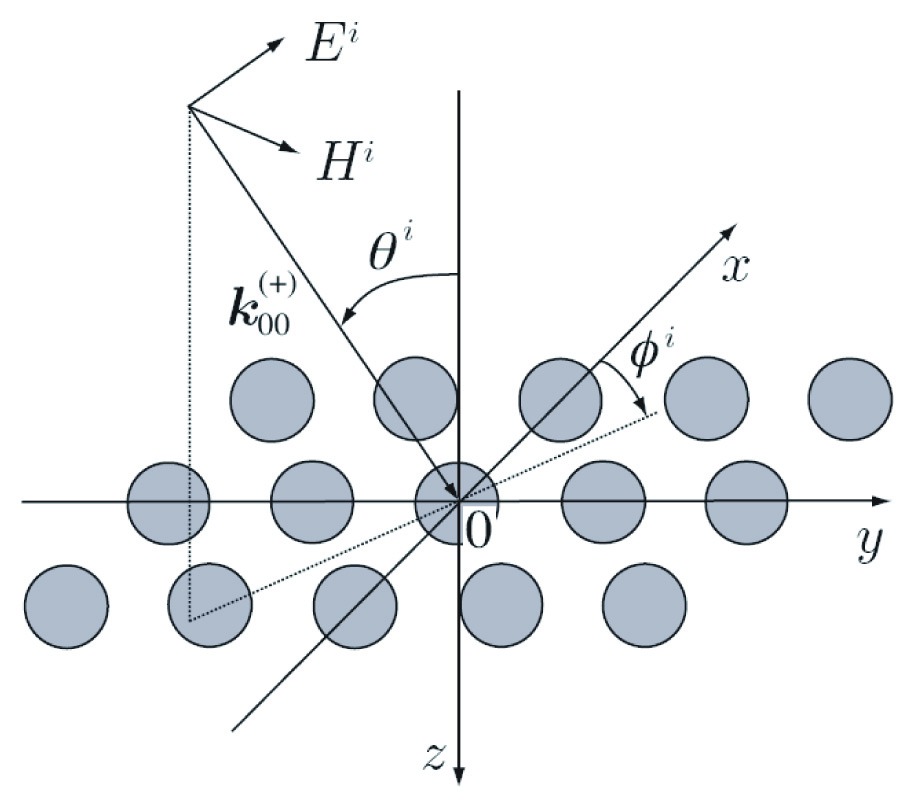
To model periodic structures with oblique incident waves/scan angles in FDTD, the field transformation method is successfully used to analyze their characteristics. In the field transformation method, Maxwell's equations are Floquet-transformed so that only a single period of infinite periodic structure can be modeled in FDTD by using periodic boundary conditions (PBCs). A new discretization method based on the exponential time differencing (ETD) algorithm is proposed here for the discretization of the modified Maxwell's equations in the periodic FDTD method. This new discretization method provides an alternative way to discretize the modified Maxwell's equations with simpler updating forms that requires less CPU time and memory than the traditional stability factor method (SFM). These two methods have the same numerical accuracy and stability in the periodic FDTD method. Some validation cases are provided showing perfect match between the results of both methods.
A NOVEL IMPLEMENTATION OF MODIFIED MAXWELL'S EQUATIONS IN THE PERIODIC FINITE-DIFFERENCE TIME-DOMAIN METHOD
2006-01-06
PIER
Vol. 59, 69-83
Optical Properties of the Quasi-Periodic One-Dimensional Genarilized Multilayer Fibonacci Structures
M. Aissaoui , Jihene Zaghdoudi , Mounir Kanzari and B. Rezig
Optical properties of generalized dielectric Fibonacci multilayer generated by the rule Sl+1 = Sn l Sm l-1 with a pair of positive integers m and n were studied. The initial generations S1 and S2 are taken as S1 = H and S2 = L where H and L are two elementary layers with refractive indices nL = 1.45 and nH = 2.3, respectively. In the following numerical investigation, we chose SiO2 (L) and TiO2 (H) as two elementary layers. We use the so-called "antitrace" map to determine the transmission spectra of the structures. Based on the representation of the transmittance spectra in the visible range an analysis depending on the pair (n,m) is presented. We show that the whole structure Sn l Sm l-1 has an interesting application for well selection pairs (m, n) values.
OPTICAL PROPERTIES OF THE QUASI-PERIODIC ONE-DIMENSIONAL GENARILIZED MULTILAYER FIBONACCI STRUCTURES
2006-01-06
PIER
Vol. 59, 51-67
A Combined Method of Auxiliary Sources-Reaction Matching Approach for Analyzing Moderately Large-Scale Arrays of Cylindrical Dipoles
Panagiotis Papakanellos , Ioannis Heretakis and Pantelis Varlamos
In the present paper, a combined method of auxiliary sources (MAS)-reaction matching (RM) approach is presented for the analysis of arrays of arbitrarily located cylindrical dipoles. It is shown that the addition of auxiliary monopole terminal sources to each array element results in a superior solution with regard to the numerical stability of the computed quantities, the behavior of the current distributions of the array elements and the resulting errors of the electric field boundary condition. Numerical results are presented for various representative array configurations, in order to illustrate the features of the proposed method and exhibit its advantages over conventional Method of Moments (MoM) schemes, especially in cases of moderately large-scale arrays. Finally, a few concluding remarks are discussed.
A COMBINED METHOD OF AUXILIARY SOURCES-REACTION MATCHING APPROACH FOR ANALYZING MODERATELY LARGE-SCALE ARRAYS OF CYLINDRICAL DIPOLES
2006-01-06
PIER
Vol. 59, 39-50
A Simple Model for the Orthogonal Coupled Strip Lines in Multilayer PCB: (Quasi-TEM Approach)
Ahmad Cheldavi and Ali Arshadi
In the present paper a simple model has been given to simulate the signal propagation through cross orthogonal coupled strip lines in multilayer PCB board. First the structure has been analyzed using a full wave software (such as microwave office) then a simple and suitable lumped equivalent circuit is proposed for the coupled cross talk region. The values of the lumped equivalent circuit are then obtained using a simple method. These values are then optimized to fit the S-parameters obtained using full wave analysis. Finally the s-parameters of this equivalent circuit compared with the results of full wave simulations. The results show good agreement up to some GHz.
A SIMPLE MODEL FOR THE ORTHOGONAL COUPLED STRIP LINES IN MULTILAYER PCB: (QUASI-TEM APPROACH)
2005-11-28
PIER
Vol. 58, 319-333
Electromagnetic Fields in Self-Dual Media in Differential-Form Representation
Ismo Veikko Lindell
Four-dimensional differential-form formalism is applied to define the duality transformation between electromagnetic fields and sources. The class of linear media invariant in any non-trivial duality transformation is labeled as that of self-dual media. It is shown that the medium dyadic of a self-dual medium, which represents a mapping between the two electromagnetic field two-forms, satisfies a quadratic algebraic equation. Further, it is shown that fields and sources in a self-dual medium can be decomposed in two uncoupled sets each self-dual with respect to a duality transformation. Also, for each of the decomposed fields the original medium can be replaced by a simpler effective medium. Splitting the electromagnetic problem in two self-dual parts can be used to simplify the solution process because differential equations for fields are reduced to those with second-order scalar operators. This is applied to find plane-wave solutions for the general self-dual medium.