Search Results(14191)

0000-00-00
PIER
Vol. 120, 403-421
FETD Computation of the Temperature Distribution Induced into a Human Eye by a Pulsed Laser
Mario Cvetković , Dragan Poljak and Andres Peratta
In this paper we present the three-dimensional finite element time domain model of the human eye exposed to pulsed holmium: YAG laser radiation used in thermokeratoplasty procedure. The model is based on the Pennes' bioheat transfer equation and takes into account the focusing action of the lens. The absorption of laser energy inside the eye tissues is modeled using the Lambert-Beer's law. Model takes into account the pulse temporal profile. The maximum temperature values obtained from steady state and transient analysis are compared against those reported from other papers. Finally, sensitivity analysis of several parameters on the calculated temperature field is carried out.
0000-00-00
PIER Letters
Vol. 12, 183-189
A Low-Loss Patch LTCC BPF for 60 GHz System-on-Package (Sop) Applications
Young Chul Lee and Tae Wan Kim
In this paper, a three-dimensional (3-D) low-loss and wideband BPF based on lowtemperature co-fired ceramic (LTCC) has been presented for 60 GHz wireless communication applications. Via pads in the vertical via transitions are designed as an additional resonator for lowloss and wide-bandwidth of the BPF. The proposed BPF has been designed by investigating its characteristics as a function of dimensions of the resonators such as a single-mode patch and via pads and also a length of feed lines are optimized for effective coupling. The designed BPF was fabricated in a 6-layer LTCC dielectric. The fabricated BPF shows a centre frequency (fc) of 61.46 GHz and a 3dB bandwidth of 10.5% from 58.2 to 64.7 GHz (6.47 GHz). An insertion loss of -2.88 dB at fc and return losses below -10 dB are achieved. Its whole size is 4.72 × 1.7 × 0.684 mm3.
A LOW-LOSS PATCH LTCC BPF FOR 60 GHZ SYSTEM-ON-PACKAGE (SoP) APPLICATIONS
Evolution Time of the Electromagnetic Wave Instability in Metals under
the Action of a Current Pulse
Solution of the Scalar Helmholtz Wave Equation by Lanczos Reduction
0000-00-00
PIER B
Vol. 1, 135-145
Performance Improvement in Amplitude Synthesis of Unequally Spaced Array Using Least Mean Square Method
S. Kazemi , Hamid Reza Hassani , Gholamreza R. Dadashzadeh and Fatemeh Gharakhili
In this paper, an efficient method to obtain the elements current distribution for a non uniformly spaced array is presented. For a given far field pattern, after sampling the array factor the proposed method uses the least mean square error technique to solve the system ofequations rather than solving the previously published Legendre function method. It's shown that the average side lob level obtained by this proposed method is some 5 dB lower in comparison with the existing Legendre function method ofsolution. Ifthe Legendre function method published in the literature is to be used to solve for the current distribution, in the final part ofthis paper, a criteria on how to choose suitable vectors that would result in a 3 dB lower side lobe level performance will be provided.
PERFORMANCE IMPROVEMENT IN AMPLITUDE SYNTHESIS OF UNEQUALLY SPACED ARRAY USING LEAST MEAN SQUARE METHOD
0000-00-00
PIER C
Vol. 1, 113-122
A Multimode Interference Coupler with Exponentially Tapered Waveguide
Ji-Jiang Wu
An exponentially tapered structure is introduced into multimode interference (MMI) devices. Compared with a parabolically tapered structure,which has been successfully used in MMI devices, this structure can further reduce the length of these devices. The performances of the 1 × 2 MMI coupler with exponentially tapered structure,such as the optical transmission,the wavelength response and the fabrication tolerance,are investigated by the 2D finite difference beam propagation method. Results show that the exponentially tapered MMI coupler exhibits a similar property to that with a parabolically tapered structure.
A MULTIMODE INTERFERENCE COUPLER WITH EXPONENTIALLY TAPERED WAVEGUIDE
0000-00-00
PIER
Vol. 09, 351-397
Theoretical Study of Electromagnetic Properties of Non-Local Ω Media
0000-00-00
PIER
Vol. 09, 181-218
Electromagnetic Waves in Planar Intergrated Pseudochiral Ω Structures
0000-00-00
PIER
Vol. 06, 315-326
Prediction of Electromagnetic Properties of Ferrite Composites
Y. Ma , Vijay K. Varadan and Vasundara V. Varadan
Prediction of Electromagnetic Properties of Ferrite Composites
0000-00-00
PIER
Vol. 06, 303-313
Modeling of Porous Ceramics During Microwave Sintering
V. K. Varadan , Y. Ma , Akhlesh Lakhtakia and Vasundara V. Varadan
Modeling of Porous Ceramics During Microwave Sintering
0000-00-00
PIER
Vol. 06, 41-100
Static Permittivity of Emulsions
Jean-Louis Greffe and C. Grosse
Static Permittivity of Emulsions
0000-00-00
PIER
Vol. 05, 241-300
Numerical Implementations of the Conjugate Gradient Method and the CG-FFT for Electromagnetic Scattering
COUPLED POTENTIALS FOR ELECTROMAGNETIC FIELDS IN INHOMOGENOUS MEDIA
0000-00-00
PIER
Vol. 02, 69-112
A FINITE ELEMENT METHOD FOR COMPOSITE SCATTERERS
PRINCIPLES OF FINITE METHODS IN ELECTROMAGNETIC SCATTERING
PIER
Vol. 44, 217-229
Cooperative Targets Detection and Tracking Range Maximization Using Multimode Ladar/Radar and Transponders
A LAser raDAR (LADAR) system was described in previous papers for detecting and tracking cooperative targets. The LADAR system was optimized to achieve accurate tracking with a high probability of detection and low False Alarm Rate (FAR). However, the operation range was limited to about thirty km's under clear sky conditions and less in low visibility and bad weather conditions. To obtain operation ranges in the order of hundreds km's without affecting tracking accuracy a LADAR/RADAR dual mode system was developed. Moreover, very bulky, expensive and powerful RADAR equipments are required. In this paper, we propose a tactical mobile tracking LADAR/RADAR systems based on a multi-mode LADAR/RADAR combination using active transponders on cooperative targets for predetection and tracking at higher range distances. The optimal solution described in this paper is based on a six-step multimode operation procedure, which starts from an L-band active transponder for maximal distance detection and tracking, and with decreasing distance it switches to an L-band RADAR , Ka-band RADAR with and without active transponder, LADAR with transponder and then to a LADAR without transponder for the final tracking step. Although relatively complicated (6 steps), our proposed solution requires significantly lower power levels and produces less radio interference than the former dualmode system as shown in Table 1.
Cooperative Targets Detection and Tracking Range Maximization Using Multimode LADAR/RADAR and Transponders
PIER
Vol. 44, 197-215
The Proper Current Spectra of an Open Integrated Microstrip Waveguide
Continuous current spectrum of an integrated open waveguide structure is identified as the branch cut contribution to singularity expansion of those currents in the complex axial transform plane. Those singularities in that plane include poles associated with the guiding structure and branch points contributed by layered background environments. The manner in which singularities in background environments manifest themselves as branch points in the complex axial transform plane is reviewed. Based on spectral integral equation formulation, approximate and analytical expression for spatial microstrip current is obtained. That approximation is based on Maxwellian distribution for the transverse current profile. This result is the representation of currents in terms of proper propagation mode spectrum. During the integration around branch cuts, singularities in the transverse transform plane migrate in a complicated manner. The trajectories of this migration are identified and suitably accommodated during the real axis integration in that plane. This overall procedure leads to a decomposition of the total currents into bound modes and continuous spectrum contributions. This representation is validated by real axis integration in the axial transform plane. The quasi TEM characteristic impedance of bound mode is calculated and validated by comparison with well-known empirical formula.
The Proper Current Spectra of an Open Integrated Microstrip Waveguide
PIER
Vol. 44, 169-195
Effective Permittivity of a Statistically Inhomogeneous Medium with Strong Permittivity Fluctuations
Most previous multiple-scattering theories for electromagnetic waves in strongly fluctuating media are limited by the assumption of statistical homogeneity of media. In the paper, a lossy electrically isotropic random medium is considered whose mean permittivity distribution, as well as the multipoint permittivity's moments are invariant under arbitrary rotations about and translations along a fixed symmetry axis, and are inhomogeneous in the radial direction. The goal of the paper is to calculate the effective permittivity operator (EPO) for such medium in the case of strong permittivity fluctuations. For this purpose, one has to eliminate the secular terms from the spectral representation of the-EPO in the basis set of waves suited to a statistically inhomogeneous medium. This is achieved via a renormalization approach which takes into proper account a delta function singularity of the spectral Green's function (rather than that of the spatial Green's function accounted for in the past) referring to a spatially inhomogeneous electrically anisotropic background medium. On this basis, the permittivity matrix of the background medium is explicitly found, a full perturbation series solution and a bilocal approximation for the EPO are derived, the macroscopic properties of the spatially dispersive effective medium are studied, and a perturbative solution for the propagation constants of guided modes of the mean field is obtained.
PIER
Vol. 44, 143-167
Plane Wave Diffraction by Dielectric Loaded Thick-Walled Parallel-Plate Impedance Waveguide
The high frequency diffraction of Ez-polarized plane waves by a dielectric loaded thick-walled parallel-plate impedance waveguide is investigated rigorously by using Fourier transform technique in conjunction with the mode-matching method. Relying upon the image bisection principle, the original problem is splitted up into two simpler ones and each individual boundary-value problem is formulated with this mixed method which gives rise to a scalar Wiener-Hopf equation of the second kind. The solution of each Wiener-Hopf equation contains infinitely many constants satisfying an infinite system of linear algebraic equations. A numeric solution of this system is obtained for various values of the dielectric constant, plate impedances plate thickness, and the distance between the plates through which the effect of these parameters on the diffraction phenomenon is studied.
Plane Wave Diffraction by Dielectric Loaded Thick-Walled Parallel-Plate Impedance Waveguide
PIER
Vol. 44, 103-129
Scattering of X-Waves from a Circular Disk Using a Time Domain Incremental Theory of Diffraction
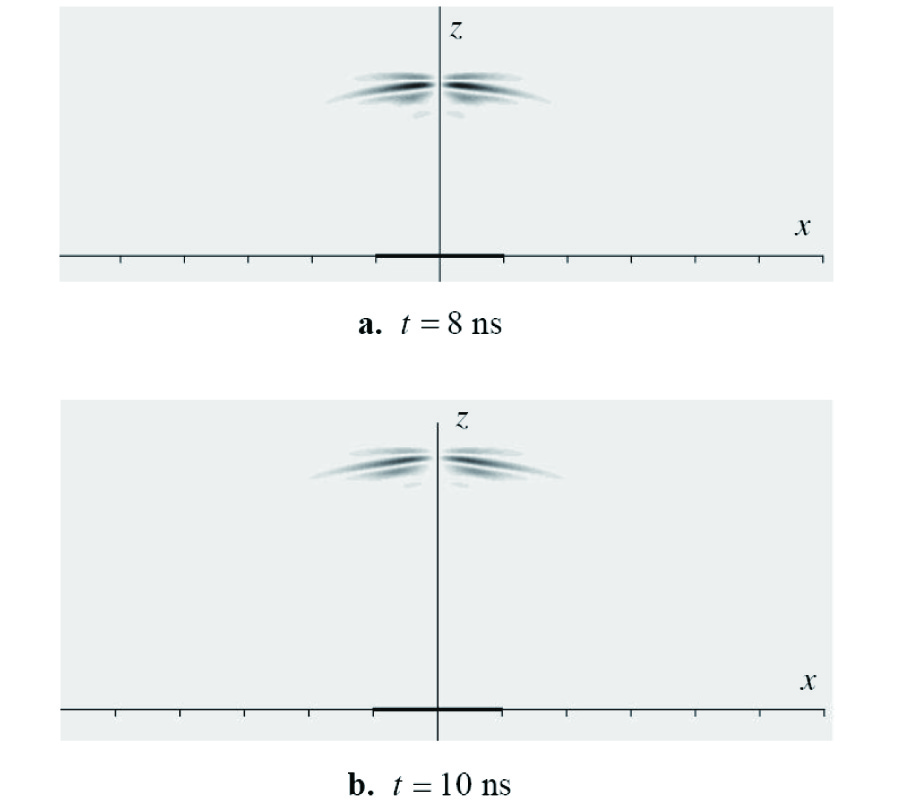
The diffraction and scattering of a first-order ultrawideband TE X-wave by a perfectly conducting circular disk is investigated using an augmented time-domain incremental theory of diffraction. The analysis relies on a pulsed plane wave representation of the incident X-wave. The diffraction and scattering of each constituent pulsed plane wave component is calculated at the observation point. A subsequent azimuthal angular superposition yields the diffracted and scattered field due to the incident X-wave pulse. Making use of the localization and symmetry properties of the incident TE X-wave, a novel four-sensor correlated detection scheme is introduced which is particularly effective in detecting the edges of the scattering disk and has an exceptional resolving power.
Scattering of X-Waves from a Circular Disk Using a Time Domain Incremental Theory of Diffraction