Search Results(13786)

2023-08-01
PIER Letters
Vol. 111, 121-129
A Hybrid-Fed Dual-Polarized Patch Antenna with Metasurface Coverage for 5G Applications
Hanhan Guo , Dan Zhang , Yue Juan , Zhendong Ding and Jin He
A hybrid-fed dual-polarized antenna with matesurface coverage is proposed in this paper, which can be used for 5G mobile communication base station antennas. By placing the two feeding ports on different layers of dielectric plates in an orthogonal manner, and using electromagnetic coupling and slit coupling for feeding respectively, the antenna can achieve inter-port isolation higher than 35 dB in the operating frequency band. In order to widen the bandwidth and obtain higher gain, the metasurface covering unit is loaded above the patch. The metasurface layer contains an array of 5 × 5 square patch units printed on the top surface of the dielectric plate. The measurement results show that the proposed antenna has an impedance bandwidth of 12% (3.24 to 3.66 GHz). In addition, the antenna obtains a stable gain of about 5.32 dBi at 3.5 GHz. The proposed antenna meets all the requirements of base station antennas and can be a promising candidate for application in 5G base station systems.
A Hybrid-fed Dual-polarized Patch Antenna with Metasurface Coverage for 5G Applications
2023-08-01
PIER B
Vol. 102, 1-17
A Parallel 3D Spatial Spectral Volume Integral Equation Method for Electromagnetic Scattering from Finite Scatterers
Stefan Eijsvogel , Roeland Johannes Dilz and Martijn Constant van Beurden
Parallel computing for the three-dimensional spatial spectral volume integral equation method is presented for the computation of electromagnetic scattering by finite dielectric scatterers in a layered medium. The first part exploits the Gabor-frame expansion to compute the Gabor coefficients of scatterers in a parellel manner. The second part concerns the decomposition and restructuring of the matrix-vector product of this spatial spectral volume integral equation into (partially) independent components to enable parallel computing. Both capitalize on the hardware to reduce the computation time by shared-memory parallelism. Numerical experiments in the form of solving electrically large scattering problems, namely volumes up to 1300 cubic wavelengths, in combination with a large number of finite scatterers show a significant reduction in wall-clock time owing to parallel computing, while maintaining accuracy.
A Parallel 3D Spatial Spectral Volume Integral Equation Method for Electromagnetic Scattering from Finite Scatterers
2023-07-30
PIER C
Vol. 135, 157-172
Intelligent Sensor System with Transmission Coefficient in X-Band Frequency for Determining Sugar Content
Pornpimon Chaisaeng , Thunyawat Limpiti and Prapan Leekul
This study describes a noncontact low-cost X-band sensor system for determining the soluble solid content (SSC) of a sugar solution. The system adopts a transmission signal technique with two frequency pairs (10.2 GHz paired with 10.4 GHz and 10.2 GHz paired with 10.6 GHz) from three transceiver modules. Each module has a microstrip patch antenna, mixer circuit, and dielectric resonator oscillator. To simplify the transmission power frequency of each frequency pair, the frequency is down-converted to an intermediate frequency (IF) signal using a frequency mixer. The IF signals are then compared using a gain and phase detector to find their magnitude ratio and phase difference. The measured SSC-level data are randomly divided into three datasets and input to an artificial neural network (ANN) for training. The training output is the SSC level in Brix degree. The proposed ANN structure comprises four input nodes, eight hidden nodes, and four output nodes, affording low complexity and resource savings while providing 92.98% accuracy. Therefore, the proposed low-cost sensor system can achieve precise decision-making and real-time measurement.
Intelligent Sensor System with Transmission Coefficient in X-band Frequency for Determining Sugar Content
2023-07-29
PIER C
Vol. 135, 145-156
Finite Element Analysis on Doubly Salient Singly Excited Machine for Electrified Transportation Systems
Prabhu Sundaramoorthy , Vijayakumar Arun , Balaji Mahadevan , Peruthambi Venkatesh , Puluru Venkata Aravindha Reddy , Sane Siva Mohan , Sareddy Raju Kumar Reddy and Somu Santhosh Kumar Reddy
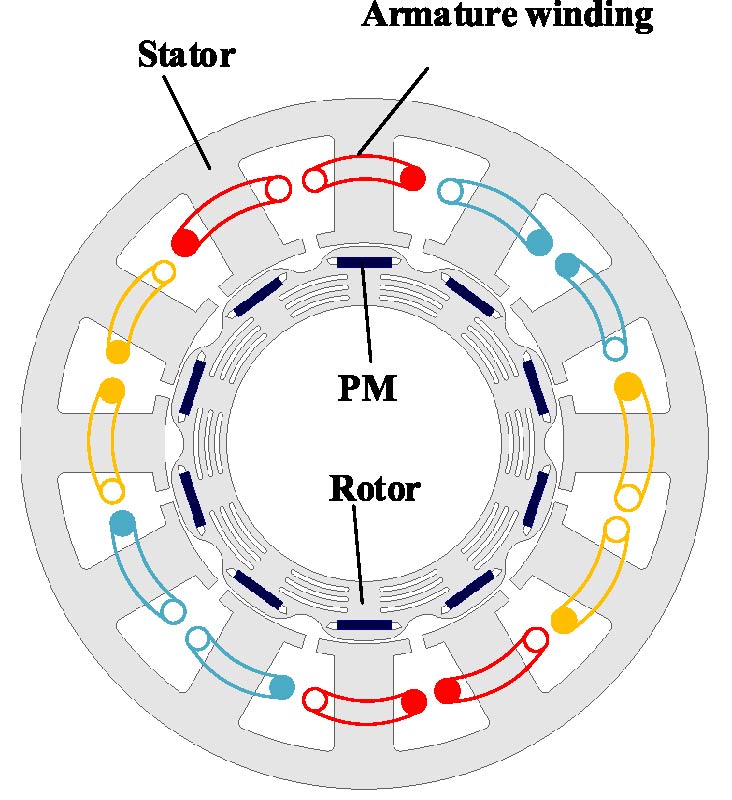
Doubly Salient Singly Excited Machine (DSSEM) inbuilt with the features as high torque density, high speed density, compactness, low maintenance, but the machine reduces its application due to its demerits as torque ripple. This study enhances the performance of switched reluctance motor (SRM) in the track of electromagnetic and mechanical characteristics. A 290 Volts, 10 Amps, 3000 rpm, 4 N-m SRM undergoes finite element (FE) characterization in the view of parameters like torque ripple. In the regard of torque characterization, the ripple torque is estimated under rated condition. FE analysis gives accurate results by 2D analysis. Torque ripple is the main concern in electrical machines, because these two are responsible for producing harmonics, vibration, and noise. So, a novel machine is designed to reduce the torque ripple content. The losses are considered as heat generation as a source of temperature rise in a motor, and the heat distribution is analyzed. The experimental setup is arranged to evaluate the simulation results with the current profile of FE analysis and prototype for verification.
Finite Element Analysis on Doubly Salient Singly Excited Machine for Electrified Transportation Systems
2023-07-29
PIER C
Vol. 135, 131-144
A Multiband Flexible Wideband CPW Wearable Slot Antenna for Biomedical and IoT Applications
Nageswara Rao Regulagadda and Uppalapati Venkata Ratna Kumari
This paper presents a multiband flexible wideband coplanar waveguide (CPW) wearable slot antenna for biomedical and Internet of Things (IoT) applications. The proposed antenna comprises an elliptical patch with a slot designed on top of a thin and flexible polyimide substrate of thickness 0.1 mm. CPW feeding with slotting on the ground and a protruding microstrip from the ground on one side of the patch is used to have resonance at multi-frequencies for the proposed antenna design. The measured results show that the developed antenna resonates at 2.81 GHz with an impedance bandwidth of 0.8 GHz (2.23-3.2 GHz) and at 4.43 GHz, 5.96 GHz, and 9.38 GHz with an impedance bandwidth of 6.7 GHz (3.5-10.3 GHz). The proposed antenna is simple and portable to mount on any part of the human body and obtains justified specific absorption rate (SAR) values. The prototype of the suggested antenna underwent the fabrication process. A comparison of the antenna parameters was carried out, and there was a reasonable correlation between the simulation and measured results. The proposed antenna is a good contender for Wireless Body Area Networks (WBANs) and IoT applications.
A Multiband Flexible Wideband CPW Wearable Slot Antenna for Biomedical and IoT Applications
2023-07-29
PIER C
Vol. 135, 121-130
Interpretation of the Solution of Maxwell's Equations for a Moving Hertzian Dipole
Steffen Kühn
Owing to the principle of relativity, the present state of knowledge explicitly allows Maxwell's equations to be solved not only in the rest frame of an electromagnetic transmitter but also directly in the rest frame of the receiver without use of the Lorentz transformation and the Lorentz force. Recently, such a calculation was first performed for the Hertzian dipole. The analysis of the resulting formula breaks new scientific ground and indicates that Maxwell's equations predict that electromagnetic waves in vacuum propagate at the speed of light, notably for each receiver, even when these receivers have relative velocities with respect to each other. Although this paradoxical phenomenon was expected, the finding that Maxwell's equations nevertheless predict a classical Doppler effect was unexpected and indicates inconsistent or not yet fully understood aspects of canonical Lorentz-Einstein electrodynamics consisting of Maxwell's equations, Lorentz force and Lorentz transformation.
Interpretation of the Solution of Maxwell's Equations for a Moving Hertzian Dipole
2023-07-29
PIER M
Vol. 118, 83-92
A Novel Frequency Selective Surface Loaded MIMO Antenna with Low Mutual Coupling and Enhanced Gain
Habib Ullah , Qunsheng Cao , Ijaz Khan , Saeed Ur Rahman and Adamu Halilu Jabire
This study focuses on the utilization of a slotted patch MIMO antenna to enhance isolation and gain. The MIMO antenna configuration includes two radiators integrated with an array of Frequency Selective Surfaces (FSSs). These antenna components are implemented on an FR-4 substrate and encompassed by FSS units that are optimized for X-band frequencies. The proposed MIMO antenna possesses dimensions of 65 mm (width) × 45 mm (length) × 1.6 mm (height). The primary objective of incorporating FSSs is to not only enhance isolation but also achieve high gain. The proposed FSS design features a circular ring structure with a rectangular loop at its center. The FSS unit cells exhibit excellent stability across various polarization incidence angles and operate within the frequency range of 7 to 9 GHz. The FSS loaded antenna offers a bandwidth ranging from 8.0 to 8.55 GHz, with a peak gain of 6.5 dB and isolation exceeding -20 dB among the MIMO elements. Furthermore, the study explores the MIMO antenna's performance in terms of diversity gain (DG), efficiency, and Envelope Correlation Coefficient (ECC), demonstrating superior results compared to existing state-of-the-art approaches. The proposed findings are validated by fabricating a sample prototype and conducting a comprehensive comparison between simulated and measured results.
A Novel Frequency Selective Surface Loaded MIMO Antenna with Low Mutual Coupling and Enhanced Gain
2023-07-29
PIER Letters
Vol. 111, 111-120
Wideband Circular Polarized Fractal Antenna for RFID/WiMAX/WLAN Applications
Enchen Wang , Xiufeng Liu and Hu Chang
A novel wideband circularly polarized (CP) dipole antenna for RFID/WiMAX/WLAN applications is presented. A pair of crossed fan-shaped dipoles printed on both sides of the substrate are used as the primary radiating elements. The antenna achieves circular polarization by using a 90° phase shifted microstrip line between the dipoles. By changing the edge of fan dipoles into Minkowski fractal curve, miniaturization and wide bandwidth of the antenna can be realized. Besides, incorporating the U-slot into the fractal crossed dipoles can obtain a wider bandwidth. The test results show that the proposed antenna achieves a wide impedance bandwidth of 63.2% (1.9-3.7 GHz) for VSWR < 2 and a 3-dB axial ratio (AR) bandwidth of 42.9% (2.2-3.4 GHz). The maximum gain in the operating frequency band can reach 7 dBi. The proposed antenna has good radiation characteristics in both low and high frequencies, which makes it a candidate for applications of RFID, WLAN, WiMAX, and other communication systems.
Wideband Circular Polarized Fractal Antenna for RFID/WiMAX/WLAN Applications
2023-07-28
PIER
Vol. 177, 127-137
Two-Dimensional Acoustic Asymmetric Vortex Focusing Lens by Binary-Phase Mode Converters
Yin Wang , Hong-Yu Zou , Yu-Jing Lu , Shuai Gu , Jiao Qian , Jian-Ping Xia , Yong Ge , Hong-Xiang Sun , Shou-Qi Yuan and Xiao-Jun Liu
Recently, the study of acoustic vortex beams has attracted a great attention owing to its potential applications in medical ultrasound imaging and trapping particles. In some special applications of medical ultrasound, it generally needs the simultaneous realization of vortex focusing and asymmetric propagation in three-dimensional (3D) space. However, the design of a two-dimensional (2D) device with asymmetric acoustic vortex focusing (AAVF) remains a challenge. To overcome it, we experimentally demonstrate a 2D AAVF lens composed of three types of binary-phase mode converters. By simultaneously introducing the phase profiles of acoustic focusing and vortex caused by the mode converters, we design a 2DAAVF lens with the topological charge n = 2, i.e., the sound energy can pass through the lens from the upper side and forms a vortex focus in 3D space; however, it cannot transmit through the lens from the other side. The vortex focusing and asymmetric transmission arise from the phase manipulation and the conversion between the zero-order and first-order waves caused by the mode converters, respectively. The measured fractional bandwidth can reach about 0.19. The proposed lens has the advantages of high-performance AAVF, broad bandwidth and complex sound modulation in 3D space, which provides diverse routes for designing 3D multi-functional sound devices with promising applications in medical ultrasound.
Two-dimensional Acoustic Asymmetric Vortex Focusing Lens by Binary-phase Mode Converters
2023-07-28
PIER B
Vol. 101, 175-191
High-Isolation and Side Lobe Level Reduction for Dual-Band Series-Fed Centre-Fed X/Ku Shared Aperture Binomial Array Antenna for Airborne Synthetic Aperture Radar Applications
Praveena Kati and Venkata Kishore Kothapudi
This research paper introduces a novel dual-band single-polarized (DBSP) series-fed center-fed open stub (SFCFOS) Binomial Antenna Array synthesis technique to improve side lobe levels (SLL) and better isolation for the use in Airborne Synthetic Aperture Radars (AIR-SARs). The antenna utilizes a shared-aperture array (SAA) architecture, operating in both X and Ku-bands with center frequencies of 9.3 and 13.265 GHz with a frequency ratio of 1:1.426. The SAA consists of a 7-element linear array of square microstrip patches for the X/Ku-band. The inter-element spacing between patches is set at 0.7λ to meet the ±25˚ scan range requirements. The X-band (9.3 GHz) frequency is ideal for soil moisture estimation in agricultural areas, while the Ku-band (13.265 GHz) is suitable for applications in snow-covered regions, cold areas, and disaster monitoring. To validate the antenna design, a prototype is fabricated and tested for S-parameters, radiation characteristics, and gain measurements. The size of the shared-aperture antenna is 200 mm × 50 mm × 0.787 mm. The measured results of the prototype align well with the simulated ones, exhibiting excellent radiation performance and high isolation. The bandwidth of 1.07% (X-band) and 1.5% (Ku-Band) and return loss of 25 dB/-15.7 dB at 9.3/13.265 GHz are achieved. The measured isolation is -45 dB which provides a large signal separation at X/Ku-bands. The antenna design shows a side-lobe level (SLL) of -39.5 dB at E-Plane (φ=0˚) and -17.9 dB for H-plane (φ=90˚) for the X-band and -35 dB at φ=0˚-19 dB for H-plane (φ=90˚) for the Ku-band. Additionally, it achieves high gain values of 12.8 dBi for the X-band and 13.2 dBi for the Ku-band. This research presents the first reported shared-aperture X/Ku-band single polarized planar array with binomial amplitude distribution synthesis technique, which holds significant value for AIR-SAR applications. All the measured results were in line with simulated ones and matched reasonably well.
High-isolation and Side Lobe Level Reduction for Dual-band Series-fed Centre-fed X/Ku Shared Aperture Binomial Array Antenna for Airborne Synthetic Aperture Radar Applications
2023-07-27
PIER C
Vol. 135, 107-119
Novel Folded Antenna Design and SAR Analysis for WCE and Biomedical Applications
Asmae Mimouni , Brahim Fady , Jaouad Terhzaz , Abdelwahed Tribak and Hanan Akhdar
This study presents a pioneering curved antenna design that is seamlessly integrated into Wireless Capsule Endoscopy (WCE) devices. The proposed antenna features a miniature height of 25 mm, a radius of curvature of only 5.5 mm, and a conductive line width of up to 2 mm, making it an ideal fit for use in compact WCE applications. The antenna is specifically designed to operate in the ISM5800 band and achieves outstanding performance metrics, such as an S11 of -10 dB and a Gain of 5.8 dBi. To evaluate the safety of our design for human usage, we conducted an investigation of the specific absorption rate (SAR) of the Hugo Model antenna in various positions for ISM5800 and compared our findings to the safety limits specified by the Federal Communications Commission (FCC) standards. Our results confirm that the proposed antenna design meets the safety requirements for wireless communication systems in biomedical applications, thereby demonstrating its potential for clinical use.
Novel Folded Antenna Design and SAR Analysis for WCE and Biomedical Applications
2023-07-27
PIER C
Vol. 135, 95-106
Koch Snowflake Fractal Embedded Octagonal Patch Antenna with Hexagonal Split Ring for Ultra-Wide Band and 5G Applications
Ezhumalai Aravindraj , Ganesan Nagarajan and Palaniappan Ramanathan
A Koch Snowflake fractal structure embedded octagonal patch antenna with hexagonal split ring for Ultra-Wide Band (UWB) and 5G applications is proposed. In this proposed design, Koch Snowflake pattern is chosen for embedding into the octagon-shaped patch antenna, which tentatively develops a miniaturized cross-sectional area in the radiator and introduces wide resonance with enhanced gain. A hexagonal split ring is introduced into patch to handle negative refraction in the radiations and to initiates self-inductance and capacitance which manages the impedance matching. Here, a co-planar waveguide (CPW) is employed for transferring electric field into patch and a lumped port is used to induct field between patch and ground. The two slots S1 and S2 made on ground are supportive in obtaining wider resonance. The Substrate used in the proposed design is Flame Retardant 4 (FR-4), which is utilized in various electronic modules. The dielectric constant and loss tangent of FR-4 substrate are εr = 4.4 and δ = 0.02 respectively. The complete dimensions of the proposed model are 25 x 30 x 1.6 mm3. The simulated antenna is designed using Ansys High Frequency Electromagnetic Simulation Software 17.2 (HFSS 17.2). The simulated design features a Peak Gain of 6.3 dBi and Fractional Bandwidth (FBW) of 168% (Frequency ranges from 2.6 GHz to 28.9 GHz) with Bandwidth ratio of 11.1:1. Also, the designed antenna is fabricated using Milling method and the fabricated prototype offers Fractional Bandwidth (FBW) of 168% (Frequency ranges from 2.4 GHz to 28.5 GHz) and gain of 6.27 dB which are tested and measured using Microwave analyzer and anechoic chamber. Thus, the proposed antenna covers the resonance which includes S-band, C-band, X-band, Ku-band and K-band. Also, it completely wraps the UWB spectrum range (3.1 GHz to 10.6 GHz), 5G (Sub-6 GHz band) Frequency Range 1 (FR 1) spectrum, and most deployed 5G mm-wave Frequency Range 2 (FR2) spectrum (24.25 GHz to 29.5 GHz).
Koch Snowflake Fractal Embedded Octagonal Patch Antenna with Hexagonal Split Ring for Ultra-wide Band and 5G Applications
2023-07-27
PIER C
Vol. 135, 83-94
Design and Analysis of a Compact 38 GHz Wideband Monopole Antenna for 5G mm-Wave Wireless Applications
Idrish Shaik and Sahukara Krishna Veni
In the current system of wireless communication, Users expect devices that are lightweight and offer broad bandwidth as well as a high data transmission rate. Developments in data speeds, bandwidth, ultra-low response times, excellent dependability, considerable accessibility and improved device-to-device connectivity are what have driven wireless systems toward 5G. These 5G wireless systems require small and efficient antenna designs. This work proposes a 5G mm-wave quadrilateral slotted defected ground structure (QSDGS) including a wideband monopole antenna (WMA) for n259 and n260 5G mm-wave bands. Here, the DGS was modelled using two quadrilateral slots on a ground plane. An inset feeding technique and multiple slots were employed to patch. This structure consists of a DGS-loaded slotted antenna patch mounted on a Rogers/RT Duriod 5880 (εr = 2.2, loss tangent = 0.0009) with dimensions of 12x11x0.9 mm3 (1.42λgx1.30λgx0.10λg). This embedded antenna radiating structure resonates from 35.5 GHz to 44.7 GHz, giving an impedance bandwidth of 9.2 GHz (24.2%), with a centre frequency of 38 GHz. 9.48 dB was the peak gain, and 83-94% efficiency was obtained over the wide band. Based on the extracted data from the proposed antenna, it was found that the antenna is capable of covering the 5G NR n259 and n260 with significant gain, bandwidth, and efficiency. Thus, the antenna has the ability to be considered a possible contender to be used in 5G wireless applications using mm-wave frequencies. A good agreement can be seen here between simulated and measured return losses.
Design and Analysis of a Compact 38 GHz Wideband Monopole Antenna for 5G mm-wave Wireless Applications
2023-07-27
PIER M
Vol. 118, 71-82
Improved Side-Lobe Suppression by Optimizing the Beam Synthetization in Uniform Circular Arrays for OAM Generation
Layth Abogneem , Ahmad Alamayreh and Nidal Qasem
Enhancing the capacity of wireless communications systems is necessary to manage growing networks. Thus, this work presents an analytical model for describing the deterioration in orbital angular momentum (OAM). The proposed model is based on a uniform circular array, which can be applied in OAM generation to obtain the desired beam properties. First, the side-lobe problem in OAM applications is examined and resolved by optimizing the beam synthetization. Then, comparisons between the two window techniques are used to evaluate their impacts. Finally, the effects of selecting the optimal window technique and width on the solutions are investigated. Numerical results and the comparisons between derived formulas and those obtained via full-wave numerical simulations are shown.
Improved Side-lobe Suppression by Optimizing the Beam Synthetization in Uniform Circular Arrays for OAM Generation
2023-07-26
PIER Letters
Vol. 111, 103-110
A Compact Tunable Microstrip Bandpass Filter with Tuning Range and Bandwidth Enhanacement
Shuang Li , Shengxian Li , Jun Liu and Neng Zhang
This letter presents a compact constant absolute bandwidth (ABW) frequency tunable bandpass filter (BPF) with bandwidth and tuning range enhancement. The fundamental structure consists of two varactor-loaded step-impedance resonators (SIRs) and input/output feeding lines. By adjusting the position of varactors, the slope of coupling coefficient between the two resonators can bechanged easily, which is crucial to realizing constant ABW. The tuning range is improved due to the application of varactor-loaded SIR. To expand the bandwidth, interdigital coupling structures between varactor-loaded SIRs are adopted. Besides, source-load coupling is introduced, and two transmission zeroes (TZs) are generated on both sides of the passband to enhance the rejection level of stopband. The measured results show that the proposed BPF achieves a center frequency tuning range from 0.79 to 1.2 GHz (41.2%), and the 3-dB ABW remains 108 ± 5 MHz. The insertion loss (IL) is 1.8-2.2 dB, and the return loss is greater than 10 dB during the whole tuning range.
A Compact Tunable Microstrip Bandpass Filter with Tuning Range and Bandwidth Enhanacement
2023-07-25
PIER C
Vol. 135, 69-81
A Folded Rectenna on a Flexible Substrate for 5G Energy Harvesting Applications
Mustapha Bajtaoui , Mohammed Ali Ennasar , Mariem Aznabet , Abdelmounaim Tachrifat and Otman El Mrabet
This paper presents the design, fabrication, and measurement results of a flexible folded dipole rectenna for 5G technology. The proposed rectenna is a single-sided structure fabricated on a flexible Kapton substrate with a maximum RF to DC conversion efficiency close to 53% for an input power of -9 dBm at 3.5 GHz with 3-KΩ. Moreover, the measured results show that the conversion efficiency is above 40% across a broad range of input power levels (from -14 to -8 dBm). The paper discusses the prototype's design and simulation results, fabrication steps, and measurement results. The proposed rectenna is compact, low-cost, and flexible, making it suitable for wearable applications.
A Folded Rectenna on a Flexible Substrate for 5G Energy Harvesting Applications
2023-07-25
PIER M
Vol. 118, 59-69
Time Domain Modeling Method for the Coupling Analysis of Branched Lines Excited by Ambient Wave
Zhihong Ye , Xin Xia , Changchang Lu and Yu Zhang
An efficient time domain hybrid method, consisting of the finite-difference time-domain (FDTD) method, Norton's theorem, transmission line (TL) equations, and some interpolation techniques, is presented to realize the fast coupling simulation of branched lines (BLs) radiated by ambient wave. Firstly, the branched lines are decomposed into multiple independent multi-conductor transmission lines (MTLs) according to the branched nodes. Then the TL equations with interpolation techniques are employed to build the coupling model of each MTL. The transient responses on these MTLs are solved by the FDTD method, which are employed to extract the Norton circuits of these MTLs acting on the branched nodes according to the Norton's theorem. Finally, the correlation matrix of the voltages and currents at the ports of the branched nodes is derived and solved. Meanwhile, these voltages are fed back to the corresponding MTLs as boundaries to realize the interference signal transmission among the BLs. Numerical examples about the coupling of branched lines contributed by five wires in free space and complex environment are simulated and compared with that of traditional FDTD to verify the correctness and efficiency of this proposed method.
Time Domain Modeling Method for the Coupling Analysis of Branched Lines Excited by Ambient Wave
2023-07-25
PIER M
Vol. 118, 47-57
Time Domain Coupling Analysis of the Transmission Line Excited by the Leakage EM Fields from the Integrated Circuit with Shielded Enclosure
Zhihong Ye , Sihao Wang , Changchang Lu and Yu Zhang
At present, numerical methods suitable for the electromagnetic interference (EMI) analysis of the transmission line (TL) excited by the leakage electromagnetic (EM) fields generated by the integrated circuit (IC) of the electronic device are still rare. An efficient time domain hybrid method, consisting of the dynamic differential evolution (DDE) algorithm, transmission line equations, finite difference time domain (FDTD) method and non-uniform grid technique, is presented to realize the fast simulation of the leakage EM fields to the TL. Firstly, a source reconstruction method based on the DDE algorithm is employed to extract the equivalent dipole array to represent the leakage EM radiation from the IC of the device. Then, the coupling model of the TL excited by the leakage EM fields is constructed by the TL equations and non-uniform grid technique, and solved by the FDTD method to realize the synchronous calculation of the leakage EM field radiation and the transient responses on the TL. Finally, the correctness of the source reconstruction method has been tested, and the accuracy and efficiency of the proposed method have been verified via two simulation cases of the transmission line excited by leakage EM fields arising from IC in free space and shielded enclosure by comparing with that of the MOM method.
Time Domain Coupling Analysis of the Transmission Line Excited by the Leakage EM Fields from the Integrated Circuit with Shielded Enclosure
2023-07-25
PIER B
Vol. 101, 155-173
Soil Water Content Estimation Over Plantation Area Using FMCW Radar
Fildha Ridhia , Aloysius Adya Pramudita and Fiky Yosef Suratman
In plantation areas, soil conditions affect the crop's quality. One of the crucial elements in the soil for plant survival is soil water content (SWC). Radar system has advantages that can be implemented for measuring SWC in plantation areas. A radar system operates by utilizing electromagnetic waves to obtain the dielectric characteristics of the soil. However, the presence of tea plants has become an obstacle to the radar wave propagation toward the soil layer. Reflected signal, which is influenced by the presence of vegetation, makes the estimation of SWC inaccurate. Consequently, the estimation of SWC needs to consider the vegetation's effect. This study uses an FMCW radar system, which operates at a frequency of 24 GHz. A layer medium propagation model is proposed in this study to prove the relationship between the reflected signal and the SWC. The reflection coefficient extracted from the radar signal is used to estimate the SWC. The vegetation propagation constant was obtained from the average field measurement results. The gravimetric method is used to validate the SWC estimation in vegetation's presence using the radar system. The results of the field experiments showed that the proposed method succeeded in estimating the SWC by considering the presence of vegetation with an average error of 3.57%. The proposed method has the potential to be applied to plantation areas.
SOIL WATER CONTENT ESTIMATION OVER PLANTATION AREA USING FMCW RADAR
2023-07-24
PIER C
Vol. 135, 55-67
Dual-Band 4×4 Hexagonal SRR MIMO Antenna with Port Excitation-Controlled Gain and Directivity for WLAN/WiMAX Applications
Puneet Sehgal and Kamlesh Patel
This paper presents the total gain and directivity control with port excitation in a 4×4 hexagonal split-ring resonator (H-SRR) MIMO antenna for dual-band operation in 2.4/5.2 GHz bands. The MIMO antenna is shown more than 15 dB isolation between antenna elements placed orthogonally, and a spacing was introduced between them to achieve higher isolation in the first proposed design, then, a Z-shaped structure of specific dimensions was inserted to further improve the isolation between antenna elements. The simulated and measured return losses and transmission coefficients confirmed the improved performances for impedance bandwidth and isolation. The gain, axial ratio, and radiation pattern performances of the 4×4 H-SRR MIMO antenna are studied by exciting different port combinations of the four ports of the proposed antenna. A wide range of gain and axial ratio variations are observed on exciting single, dual, triple, and quad-ports of the proposed MIMO antenna and discussed using the radiation patterns. Also, various MIMO parameters, ECC < 0.04, TARC < -10 dB, MEG < -6 dB, DG < 10 dB, and CCL < 0.4 bits per second per Hz, are found in the 2.4/5.2 GHz bands, which confirms the applicability of proposed H-SRR MIMO antenna with polarization diversity.
Dual-band 4×4 Hexagonal SRR MIMO Antenna with Port Excitation-controlled Gain and Directivity for WLAN/WiMAX Applications