Search Results(13789)

2021-06-23
PIER M
Vol. 103, 49-60
Decoupling Control of Permanent Magnet Synchronous Motor Based on Parameter Identification of Fuzzy Least Square Method
Xin Liu , Yanfei Pan , Yilin Zhu , Hui Han and Lei Ji
In order to improve the performance of decoupling control for an interior permanent magnet synchronous motor (IPMSM), a recursive least square algorithm with fuzzy forgetting factor is proposed to identify IPMSM parameters. Firstly, the problems of coupling and parameter identification of IPMSM are analyzed. Secondly, the identification process of resistance and flux linkage is analyzed, and the static parameters are identified as the initial value or constant value. Thirdly, fuzzy control is used to dynamically adjust the forgetting factor in the recursive least square algorithm to make the identification of direct axis and quadrature axis inductance parameters more accurate. Finally, the effectiveness and accuracy of the proposed parameter identification algorithm are verified on the platform, and the good performance of the proposed algorithm in decoupling control is verified. The experimental results show that the identification method can accurately identify the motor parameters in static state and dynamic state. At the same time, the forgetting factor is dynamically adjusted to improve the parameter identification effect and decoupling control performance of the motor.
DECOUPLING CONTROL OF PERMANENT MAGNET SYNCHRONOUS MOTOR BASED ON PARAMETER IDENTIFICATION OF FUZZY LEAST SQUARE METHOD
2021-06-22
PIER Letters
Vol. 98, 105-111
Surface Mounted Microstrip Antenna Using Ball Grid Array Packaging for mmWave Systems Integration
Xi Wang , Xiubo Liu , Wei Zhang , Dongning Hao and Yanyan Liu
In this letter, two cost-effective surface-mount patch antenna elements for millimeter-wave (mmWave) systems using ball grid array (BGA) packaging are presented. A single-layer substrate based on FR4 is used to meet the low-cost requirements. The BGA packaging makes the proposed antenna element compact and easy to integrate. A U-slot is added to the patch to improve the impedance bandwidth of the patch antenna, and a vertical transition is designed to transmit the excitation signal by using a plated through-hole (PTH). The design process of the antenna is illustrated in detail. The antenna prototype has been simulated, fabricated, and measured to validate the design. The size of the fabricated prototype is 5 mm × 5 mm × 1.3 mm, which is very suitable for integration into a mmWave system.
SURFACE MOUNTED MICROSTRIP ANTENNA USING BALL GRID ARRAY PACKAGING FOR MMWAVE SYSTEMS INTEGRATION
2021-06-22
PIER Letters
Vol. 98, 95-103
A Low-F/d Wideband Transmitarray Antenna
Yan-Fang Liu , Lin Peng , Bo Wang , Wei-Sheng Yu , Tian-Cheng Zheng and Xing Jiang
In this paper, a wide 3-dB gain bandwidth transmitarray (TA) antenna with low focal length to diameter ratio (F/D) is presented. The TA comprises four identical metasurface layers, and the metasurfaces are printed on thin dielectric substrates, which are separated by air gaps. The unit cells of the metasurfaces are constructed by etching slots on the metal layers, which include a serrated crevice and two disjunct slots. The F/D of the TA is designed as 0.48 to accommodate the applications required low profiles. A TA is constructed by arranging high transmission elements at the center and the other elements in the external of the aperture. A transmitarray antenna (TAA) operating at 9~13 GHz is designed by applying a horn antenna to the TA, which achieves a measured 1-dB gain bandwidth of 10.5% (3-dB gain bandwidth of 23.3% and measured maximum gain of 22.48 dBi at 10.5 GHz) and a maximum measured aperture efficiency of 38.4%. Compared to the reported works, the proposed TA has outstanding F/D and wide 3-dB gain bandwidth.
A LOW-F/D WIDEBAND TRANSMITARRAY ANTENNA
2021-06-22
PIER M
Vol. 103, 37-47
Analysis of Conformal Quad Band Metamaterial Absorber Design on Planar and Cylindrical Surface
Nitinkumar J. Bathani and Jagdish M. Rathod
A conformal metamaterial absorber operating at the quad band is analyzed in this paper. The proposed structure is fabricated on a 0.5 mm thick, flexible polyester dielectric substrate. The proposed structure works at the chosen frequencies 4.11 GHz, 5.37 GHz, 7.39 GHz and 8.4 GHz with the absorptivities of 96%, 95%, 90% and 94%, respectively. The structure has essential novelty of miniaturization of λ/146 in the thickness, which is an exceptionally flexible material for Radar applications. Quad band excitation can also be analyzed by the iteration of the proposed structure as well as circuit analysis. The flexible polyester material is etched with silver coating for the development of the fabricated structure. The simulated results can also be associated with the measured ones from the planar as well as a cylindrical surface to realize flexibility for stealth technology. It can be accomplished by the free space measurement technique in an anechoic chamber.
ANALYSIS OF CONFORMAL QUAD BAND METAMATERIAL ABSORBER DESIGN ON PLANAR AND CYLINDRICAL SURFACE
2021-06-21
PIER Letters
Vol. 98, 85-94
Design of Low-Profile and Safe Low SAR Tri-Band Textile EBG-Based Antenna for IoT Applications
Wissem El May , Imen Sfar , Jean Marc Ribero and Lotfi Osman
A coplanar tri-band wearable antenna combined with an electromagnetic bandgap (EBG) structure is described for sub-6 GHz 5G and wireless local area network (WLAN) applications. The proposed antenna is fully implemented in textile materials thus offering a robust, compact, and discreet solution to meet the requirements of wearable applications. The addition of the EBG structure increases the textile antenna performance in terms of radiation patterns in the presence of the human body. The experimental results show that the proposed design exhibits tolerance to various bending conditions as well as loading by body tissues. In addition, to ensure the safety of the design for human health, the values of the specific absorption rate (SAR) have been reduced by more than 95%, which complies with the international standard. This design could thus be considered as a good candidate for IoT applications compared to the current state of the art while having a tri-band behavior and smaller volume.
2021-06-18
PIER Letters
Vol. 98, 75-84
Design of Tri-Band Hybrid Dielectric Resonator Antenna for Wireless Applications
Lavuri Nageswara Rao , Govardhani Immadi and Madhavareddy Venkata Narayana
In this article, a compact dielectric resonator antenna (DRA) with partial ground plane for wireless applications is examined. The exhibited structure is fed by a microstrip line. To demonstrate the functionality of a tri-band, a circular dielectric resonator antenna with concentric circular rings is created. The developed antenna parametric analysis has been performed on HFSS platform. The configured design operates at three frequency bands, i.e. 1.98-2.59 GHz (ISM), 3.24-3.85 GHz (Wi-max), and 4.85-5.85 GHz (WLAN), with the fractional bandwidths of 26.6%, 20.4%, and 18.67%, respectively. The customized concentric rings are placed onto the substrate to reinforce the antenna appearance and also miniaturize the size. The measured outcomes are strongly in accordance with the simulated results. The designed model can be customized with certain attributes to wireless applications.
DESIGN OF TRI-BAND HYBRID DIELECTRIC RESONATOR ANTENNA FOR WIRELESS APPLICATIONS
2021-06-16
PIER Letters
Vol. 98, 69-74
Compact LTCC Filter with 7th-Order Harmonics Suppression for 5G N77 Band Applications
Lan Luo , Huanyan Tie , Qiang Ma and Bo Zhou
A compact dual-mode band-pass filter (BPF) with 7th-order harmonics suppression is proposed. The proposed dual-mode BPF is designed using a three-section stepped-impedance-variable feeding line (SIVFL) and a square resonator. The high-order harmonics suppression is achieved by the SIVFL structures, and the size reduction is achieved using meandered lines and a resonator with two degenerate modes. The proposed BPF has a wide stopband up to 7th-order harmonics and a compact size of only 7 x 7 x 0.3 mm. The proposed BPF is suitable for the fifth-generation (5G) N77 band applications due to its working frequency, compact size, and good performance. Comparison and discussion are implemented as well.
COMPACT LTCC FILTER WITH 7TH-ORDER HARMONICS SUPPRESSION FOR 5G N77 BAND APPLICATIONS
2021-06-16
PIER C
Vol. 113, 147-160
Multi-Objective Optimal Design and Analysis of Variable Leakage Flux IPM Motors for Improve Flux-Weakening Ability
Xiping Liu , Gaosheng Guo , Longxin Du and Wenjian Zhu
In this paper, two variable leakage flux permanent magnet (VLFPM) machines are proposed. The keys are to adopt the rotor with single-layer and double-layer PMs and intentionally create leakage flux paths to extend the operating speed range and increase the machine efficiency. The characteristics of the variable leakage flux of the proposed machines are investigated. In order to improve the performances of the VLFPM machines, the Multi-Objective Genetic Algorithm (MOGA) method is applied for achieving the multi-objective optimizations of variables. Then, the performances of the double-layer permanent magnet variable leakage flux motor (DLPM-VLFM) and the single-layer permanent magnet variable leakage flux motor (SLPM-VLFM) are analyzed and compared with conventional interior PM machine (CIPMM) in detail. The performances mainly include flux linkage and torque, flux-weakening capability and efficiency. Finally, it is shown by analysis and comparison that the DLPM-VLFM can have a wider range of speed and high efficiency.
MULTI-OBJECTIVE OPTIMAL DESIGN AND ANALYSIS OF VARIABLE LEAKAGE FLUX IPM MOTORS FOR IMPROVE FLUX-WEAKENING ABILITY
2021-06-16
PIER C
Vol. 113, 137-146
Human Multicomponent Micro-Doppler Signals Separation Based on a Novel Local Time-Frequency Sparse Reconstruction Method
Zhongfei Ni and Bin-Ke Huang
The use of radar micro-Doppler (m-D) signatures for human activities classification, surveillance and healthcare has become a hot topic in recent years. While m-D signals are always multicomponent, it is necessary to separate them into mono-components signals associated with individual body parts for easier features analysis and extraction. In this paper, a novel method called local time-frequency sparse reconstruction (LTFSR) is proposed to iteratively extract and separate m-D components one by one in a descending intensity order from a time-frequency (T-F) representation. For the current strongest m-D component, we first estimate its instantaneous frequency (IF) by dividing the signal into short overlapping time intervals and selecting the best matching chirp atom to approximate the local frequency in each time interval based on matching pursuit. Then, a T-F filtering is used to extract and remove the strongest component from the multicomponent signal. Repeat the above steps until all m-D components are separated. Simulations are given to validate the effectiveness and robustness of the proposed method.
HUMAN MULTICOMPONENT MICRO-DOPPLER SIGNALS SEPARATION BASED ON A NOVEL LOCAL TIME-FREQUENCY SPARSE RECONSTRUCTION METHOD
2021-06-16
PIER C
Vol. 113, 123-136
Design of Compact 4-Port MIMO Antenna Based on Minkowski Fractal Shape DGS for 5G Applications
Sara Yehia Abdel Fatah , Ehab K. I. Hamad , Wael Swelam , Abdemegeed Mahmoud M. A. Allam and Hesham Abd Elhady Mohamed
A 4-port wideband Multiple-Input Multiple-Output (MIMO) antenna operating in the frequency band from 24.8 GHz to 27.6 GHz dedicated to 5G application is proposed in this manuscript. The MIMO antenna is implemented on a 23.75 × 42.5 × 0.508 mm3 Roger/Druoid 5880 substrate with relative dielectric constant εr = 2.2 and loss tangent 0.0009. Firstly, the design starts with a simulation and optimization of a single element antenna based on Minkowski fractal shape as Defected Ground Structures (DGSs) using CST Studio Suite. The single proposed element shows a 7 dBi gain and antenna efficiency of 85% at the operating frequency band. Secondly, to design a MIMO antenna with good isolation, three different configurations are used, and overall MIMO performances such as low Envelope Correlation Coefficient (ECC), high Diversity gain (DG), and low Channel Capacity Loss (CCL) are calculated and analyzed. Finally, fabrication and measurement are conducted to validate the concept for single and 2-port MIMO antenna performance.
DESIGN OF COMPACT 4-PORT MIMO ANTENNA BASED ON MINKOWSKI FRACTAL SHAPE DGS FOR 5G APPLICATIONS
2021-06-15
PIER Letters
Vol. 98, 61-68
Bandpass Filters Based SIW Square Cavity with Novel Feeding and Coupling Schemes
Bo Yin , Qianqian Huang and Xiangyu Shi
This paper presents two novel different feeding and coupling schemes to solve the problem of generating transmission zeros (TZ) in lower stopband and their applications to design single-band filters. The designed two filters are based on substrate integrated waveguide (SIW) square cavity with orthogonal ports. In the design of Filter A, two L-shaped stubs are introduced to form an addition coupling path between two ports, which cause the generation of one TZ. Other two TZs are formed due to the resonance characteristics of L-shaped stubs and ports offset. Two metal vias are used to adjust center frequency slightly. In the design of Filter B, other two stubs are designed to form two additional coupling paths, thus forming a total of three coupling paths with the original path. Two TZs are obtained by utilizing the phase difference between different paths, and one TZ is generated for the resonance characteristics of the proposed stub 3. Simultaneously, an L-shaped slot is used to adjust center frequency. Both designed filters use the coplanar waveguide (CPW) structure to control bandwidth. Two filters are set to operate at 14.4 GHz with bandwidth of 800 MHz. Both filters are fabricated and measured. The simulation results of two filters are in good agreement with the measured ones.
BANDPASS FILTERS BASED SIW SQUARE CAVITY WITH NOVEL FEEDING AND COUPLING SCHEMES
2021-06-15
PIER M
Vol. 103, 27-36
Eigenbeam Analysis of Singly Curved Conformal Antenna Array
Irfanullah , Hina Munsif and Ali Imram Najam
In this paper, eigen analysis of the correlation matrix for an 8-element singly curved conformal antenna array with plane wave(s) incident at different angles is presented. The signal eigenvectors derived from the correlation matrix are used as the array weights to generate peak beams toward the directions of the signals, and the noise eigenvectors derived from the correlation matrix are used as the array weights to generate nulls in the directions of the signals. A 1 x 8 microstrip patch antenna array is embedded on an anhedral corner type structure with different amount of surface deformation to analyse the array pattern. The patch antenna elements in the conformal array are excited with attenuators (for amplitude control) and phase shifters (for phase control) to implement the complex signal eigenvectors practically. The simulated eigenbeams using conformal antenna array are in good agreement with the measurement results. Furthermore, the effects of surface deformation on gain and beamwidth of array main beam is discussed. The proposed eigenbeam conformal antenna array can be used in smart and adaptive array applications.
EIGENBEAM ANALYSIS OF SINGLY CURVED CONFORMAL ANTENNA ARRAY
2021-06-14
PIER C
Vol. 113, 111-122
Eight-Port Double Band Printed MIMO Antenna Investigated for Mutual-Coupling and SAR Effects for Sub-6 GHz 5G Mobile Applications
Insha Ishteyaq , Issmat Shah Masoodi and Khalid Muzaffar
An 8-element/8-port antenna with four resonating dual-polarized slot radiator elements for sub-6 GHz 5G multiple-input multiple-output (MIMO) applications is proposed in this paper. The proposed MIMO design comprises four annular slot radiators with dual-polarized characteristic and has rectangular micro-strip line feeds. The designed elements operate in the frequency bands 2.73-3.12 GHz and 4.33-4.68 GHz providing an acceptable characteristic for dual-polarizations. The isolation improvement and reduction in mutual coupling factor are achieved by using split ring resonator (SRR) structures on the top layer along the slot radiator. The proposed design has a -10dB wide impedance bandwidth in both bands, considerable realized peak gain around 4 dBi, and better efficiencies around 80\% with ECC < 0.004 which has enhanced the performance of the MIMO array in terms of diversity. The antenna is fabricated, characterized, and it is shown that the measured results are in good agreement with the simulated ones. The proposed MIMO design has been analyzed for SAR functions and the radiation coverage in the vicinity of the user human head. The SAR values studied are found to be less than `2' which is quite desirable. All the features achieved in the proposed MIMO design suggest it to be suitable for 5G mobile terminal applications.
2021-06-11
PIER C
Vol. 113, 97-110
Octa-Band Metamaterial Inspired Multiband Monopole Antenna for Wireless Application
Samuel Prasad Jones Christydass and Nagarajan Gunavathi
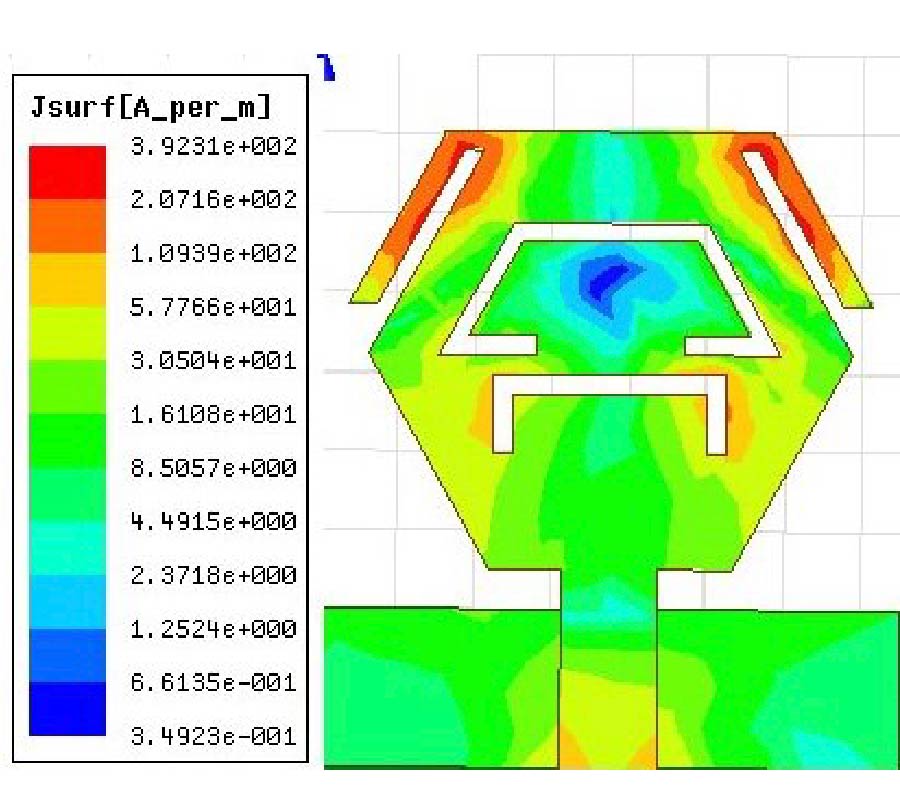
In this paper, a Rectangular Monopole Antenna (RMPA) with offset microstrip feed is presented. The structure is fabricated on an FR4 substrate with a dimension of 28 x 32 x 1.6 mm3. The proposed structure achieves multiband operation by engraving 2 Complementary Split Ring Resonators (CSRRs) and a C-Shaped slot. Also, 2 Split Ring Resonators (SRRs) are printed on the adjacent sides of the radiating element. The parametric analysis is used to determine the optimum position of the feed and other critical parameters. The proposed structure operates at 2.25 GHz, 3.86 GHz, 4.60 GHz, 5.64 GHz, 5.86 GHz, 6.94 GHz,7.48 GHz, and 9.47 GHz. The permeability of the SRR and permittivity of the CSRR are extracted and presented. The proposed antenna is fabricated and measured. The measured results of S11, radiation pattern, and gain are on par with the simulated results. The proposed antenna's simulated surface current and efficiency are also presented to validate the performance. Simple structure, stable radiation patten, multiband operation, reasonable gain, and efficiency are the significant features of the proposed RMPA.
OCTA-BAND METAMATERIAL INSPIRED MULTIBAND MONOPOLE ANTENNA FOR WIRELESS APPLICATION
2021-06-11
PIER M
Vol. 103, 15-26
The Analytical Formula for Calculating the Self-Inductance for the Circular Coil of the Rectangular Cross-Section with a Non-Uniform Current Density
Slobodan Babic , Matthew Smith , Nikiforos Fokas , Yuriy Langer and Jerry P. Selvaggi
In this article we give an analytical formula for calculating the self-inductance for circular coils of rectangular cross-section which has a non-uniform current density. Recently, the formula for calculating this important electromagnetic quantity was published in the form of the single integral whose kernel function was asum of elementary functions. However, a new formula is obtained in the form of elementary functions, single integrals, and the complete elliptic integral of the first, second and third kind. Although its development looks tedious, we obtain a rather user-friendly expression for the calculation. From the general case, the self-inductance of the thin disk coil (pancake coil) with the nonuniform current is obtained in a remarkably simple form. The results of this work are compared with different known methods, and all results are in the excellent agreement. Our approach has not been found in the literature.
2021-06-10
PIER C
Vol. 113, 83-96
A Dual Bandpass Filter Design Using Strong Coupling, Evanescent Mode and Modular Concept
Sek-Meng Sow , Peng Tan and Jian Lu
This paper presents a new design concept of dual bandpass filter. Based on the strong coupling between two resonators, a dual 1-pole band-pass filter is designed and is used as the basic building block. By providing appropriate weak coupling between these building blocks, a higher-order dual bandpass filter can be realized. In addition, these building blocks can be stacked vertically and/or horizontally to construct a compact filter. In this way, by using 3D full wave EM and circuit co-simulation, the simulation time required in the design stage can be reduced. In addition, it also provides a way to post-tune each building block individually and further reduces the time required in prototype post tuning process. For demonstration, an L-band dual 4-pole bandpass filter is designed with passband frequencies of 1.23 GHz~1.255 GHz and 1.55 GHz~1.6 GHz. In order to reduce the size of the filter and obtain a wide stopband bandwidth, a suitable evanescent mode cavity is used to realize the resonant structure. The measurement result shows that the insertion losses of the low passband and high passband are 1.03 dB~2.00 dB and 1.02 dB~1.75 dB, respectively; the return loss of both passbands is better than 15 dB. Furthermore, up to 5 GHz (> 3fo, where fo is at 1.39 GHz), the stopband rejection level is better than 80 dB.
A DUAL BANDPASS FILTER DESIGN USING STRONG COUPLING, EVANESCENT MODE AND MODULAR CONCEPT
2021-06-10
PIER C
Vol. 113, 69-82
A Compact Four-Port High Isolation Hook Shaped ACS Fed MIMO Antenna for Dual Frequency Band Applications
Praveen Vummadisetty Naidu , Dhanekula Maheshbabu , Akkapanthula Saiharanadh , Arvind Kumar , Neelima Vummadisetty , Lam Sumanji and Khalim Amjad Meerja
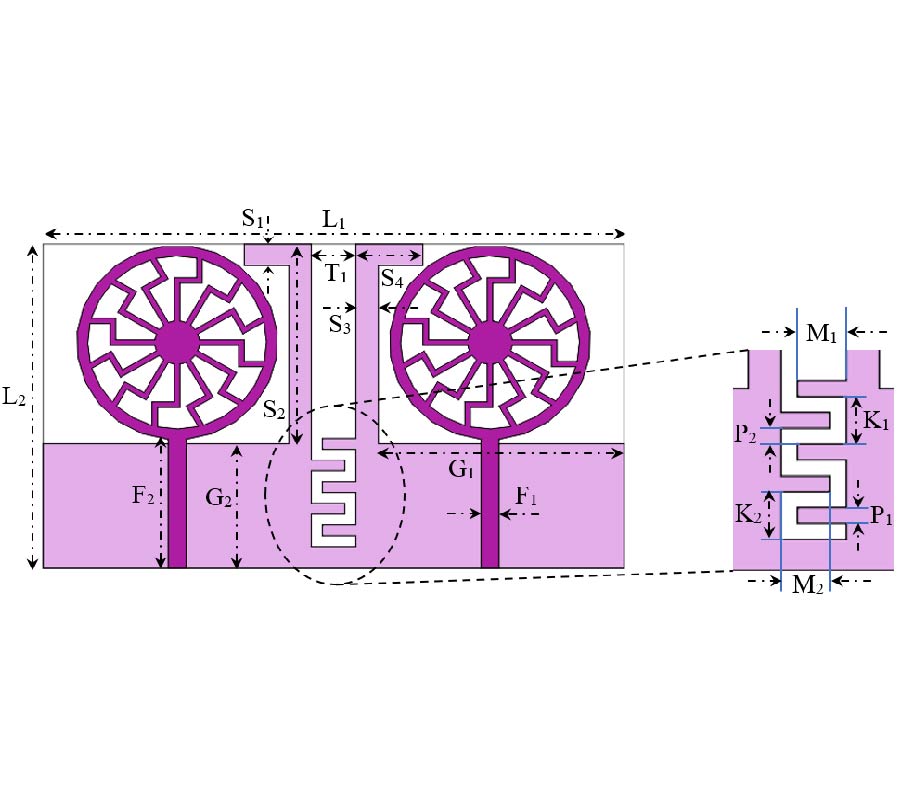
In this work, a novel 4 element Multi-Input Multi-Output (MIMO) antenna is reported. The proposed antenna has a size of 50x50x1.6 mm3 is printed on the FR-4 substrate having dielectric constant εr = 4.4 and loss tangent (tan δ = 0.02). The four antenna elements are positioned in each corner of the PCB board in an orthogonal manner such that they can provide better isolation between antenna elements. The proposed MIMO antenna is designed to operate in frequency bands of 2.25 GHz to 2.4 GHz and 4.7 GHz to 6.3 GHz. The lower band ranges from 2.25 GHz to 2.4 GHz and covers 2.3 GHz WiBro applications while the upper band ranging from 4.7 GHz to 6.3 GHz is useful for Hiper LAN and Wi-MAX applications. The proposed antenna acquires return loss less than -10 dB and isolated by more than 16 dB throughout the dual operating bands. The structure exhibits stable gain and radiation patterns. Various diversity performance metrics including envelope correlation coefficient (ECC), diversity gain (DG), and mean effective gain (MEG) are evaluated and are within acceptable limits.
A COMPACT FOUR-PORT HIGH ISOLATION HOOK SHAPED ACS FED MIMO ANTENNA FOR DUAL FREQUENCY BAND APPLICATIONS
2021-06-10
PIER C
Vol. 113, 59-68
A Compact Dual Asymmetric L-Slot Frequency Reconfigurable Microstrip Patch Antenna
Bhaben Saikia , Pulin Dutta and Kunal Borah
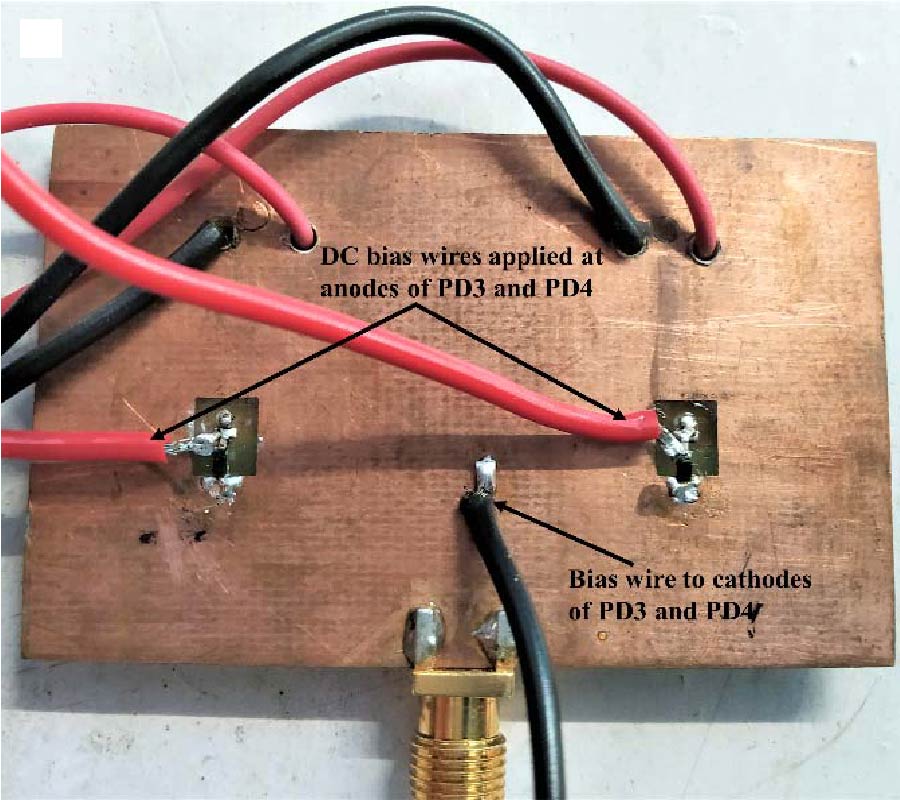
A frequency reconfigurable microstrip patch antenna with two asymmetric L-slots is proposed in this article. Two RF pin diodes inserted on the asymmetric L-slots are used to switch the operating frequency over the C band. Design and optimization of different physical parameters of the antenna viz. slot dimensions, feed location, notch size and pin diode positions are carried out using High Frequency Structure Simulator Version 13.0. The design is implemented on an FR4 substrate (εr = 4.4) of dimension (35×40×1.6) mm3. DC bias circuitry for RF PIN diode activation is also integrated with the antenna. Switching combinations of two PIN diodes offer four reconfiguration modes of operation at 4.75, 5.05, 5.11 and 5.18 GHz. In all the states, the -10 dB bandwidth shows minimal changes with average variations of 15.8% with respect to the state when both PIN diodes are OFF. The gains of the antenna for different modes of operation are found almost stable with an average of 6.64 dBi.
A COMPACT DUAL ASYMMETRIC L-SLOT FREQUENCY RECONFIGURABLE MICROSTRIP PATCH ANTENNA
2021-06-09
PIER M
Vol. 103, 1-13
Prestress Monitoring of Internal Steel Strands Using the Magnetoelastic Inductance Method
Lei Liu , Senhua Zhang , Jianting Zhou , Hong Zhang , Huiling Liu , Kui Tan and Leng Liao
Monitoring the prestress of prestressed steel strands is important but difficult. The magnetoelastic inductance (MI) method is used to monitor the prestress. A coupling model was established to describe the correlation among stress, magnetism, and inductance. A prestress monitoring system based on the MI effect was proposed. To verify the feasibility of the method, experiments were carried out. The results showed that influenced by the hydration heat of the grouting materials, the fluctuation range of the inductance was 1.033%. When the hydration came to an end, the inductance approached the initial inductance. For internal steel strands, the obtained inductance-prestress relationship was similar to the relationship of external steel strands. Thus, the prestress of the internal steel strands could be monitored by the MI method.
PRESTRESS MONITORING OF INTERNAL STEEL STRANDS USING THE MAGNETOELASTIC INDUCTANCE METHOD
2021-06-07
PIER Letters
Vol. 98, 55-60
Surface-Mount PIFA Using Ball Grid Array Packaging for 5G mmWave
Xi Wang , Xiubo Liu , Wei Zhang , Dongning Hao and Yanyan Liu
In this letter, a surface-mount planar inverted-F antenna (PIFA) is proposed for the 5G mmWave system using ball grid array packaging (BGA). To meet the requirement of cost-effectiveness, the proposed antenna element is designed on a single FR4 layer to achieve low cost. To achieve a compact size, the BGA packaging is used on the proposed antenna element. Finally, the size of the antenna prototype is only 4.5 mm × 4.5 mm × 1.3 mm. Besides, the surface-mount feature allows the proposed antenna to be integrated with other devices in the same system package. The simulation and measurement results are discussed in detail. The measurement results show that the impedance bandwidth of - 10 dB is 15.3 % (24.7-29.6 GHz), and the peak gain is 5.85 dBi at 28 GHz. The proposed PIFA can be used in the 5G NR bands N257 (26.5-29.5 GHz), N258 (24.25-27.5 GHz), and N261 (27.5-28.35 GHz).
SURFACE-MOUNT PIFA USING BALL GRID ARRAY PACKAGING FOR 5G MMWAVE