Search Results(13789)

2021-07-20
PIER M
Vol. 103, 185-196
Improving Electromagnetic Compatibility Performance of Narrowband-IoT SiP Module
Haiyan Sun , Ting Zhou , Shoukun Huang , Jicong Zhao , Zhilong Zhang and Xiaoyong Miao
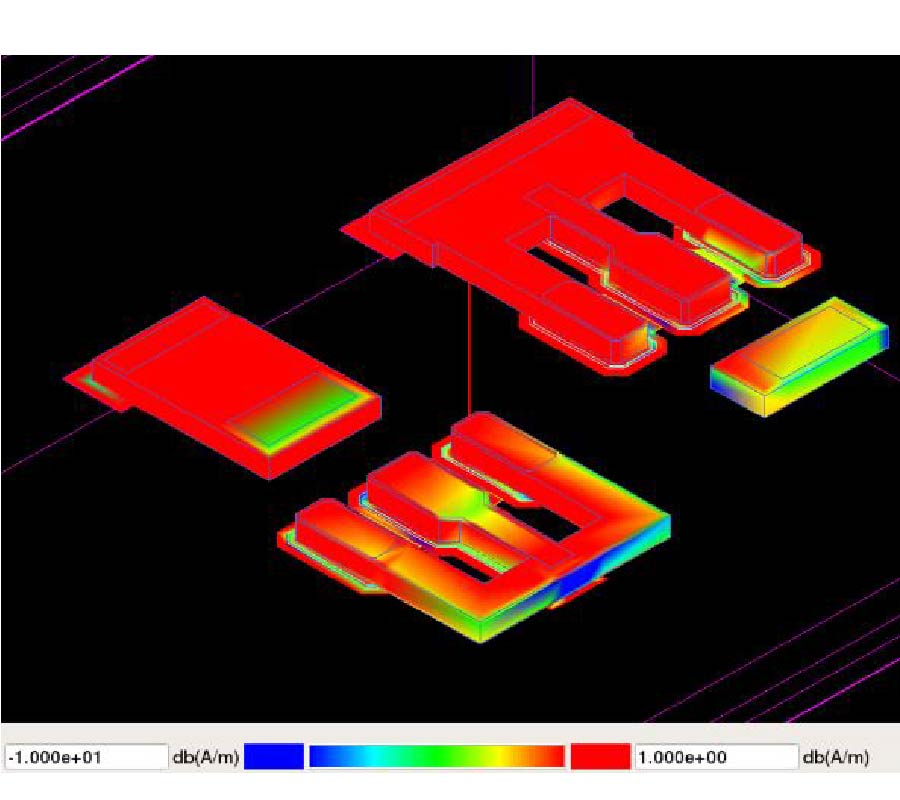
A package-board co-design method was applied for a Narrowband Internet-of-Things (NB-IoT) SiP module. The electromagnetic interference (EMI) generated by the module was studied by improving the transmission quality of radio frequency (RF) signal. The SiP models of the initial design and the optimized design were simulated separately to show that the optimized design significantly increased effective transmission power of the RF signal and suppressed near-field electromagnetic radiation intensity to a certain extent. In addition, the optimized design model was verified by measurement. The measured results show good agreement with the simulated ones and demonstrate that the package-board co-design method can improve the electromagnetic compatibility (EMC) of NB-IoT applications.
IMPROVING ELECTROMAGNETIC COMPATIBILITY PERFORMANCE OF NARROWBAND-IOT SIP MODULE
2021-07-19
PIER Letters
Vol. 99, 35-43
A Low-Profile Half-Mode Substrate Integrated Waveguide Filtering Antenna with High Frequency Selectivity
Hai-Yan Wang , Gang Zhao , Rui-Yang Li and Yong-Chang Jiao
A low-profile half-mode substrate integrated waveguide (HMSIW) filtering antenna with high frequency selectivity is proposed in this letter. The proposed antenna with a height of 0.014λ00 is the free-space wavelength) consists of a slot-loaded HMSIW cavity, two parasitic patches, and five shorting pins. An upper-edge radiation null is generated by the interaction between the HMSIW cavity and parasitic patches. A rectangular slot etched on the HMSIW cavity is adopted to generate another null to improve the filtering performances at the upper stopband. Besides, the radiation in the lower stopband is suppressed by two nulls which emerge due to placing shorting pins under two parasitic patches. Thus, four radiation nulls can be obtained to enhance the frequency selectivity. The measured results illustrate that the proposed antenna provides an impedance bandwidth of 4.3% ranging from 2.74 to 2.86 GHz and a peak gain of 6.76 dBi during the operating frequency band. Moreover, four radiation nulls appear at 2.34, 2.56, 3, and 3.24 GHz in the lower and upper stopbands.
A LOW-PROFILE HALF-MODE SUBSTRATE INTEGRATED WAVEGUIDE FILTERING ANTENNA WITH HIGH FREQUENCY SELECTIVITY
2021-07-19
PIER C
Vol. 114, 57-67
A Novel Miniaturized L-Band Filter with Great Stopband Characteristics Using Interdigitated Coupled Lines CRLH-TL Structure
Peng Wang , Kaiyue Duan , Minquan Li , Man Zhang and Baokun Jin
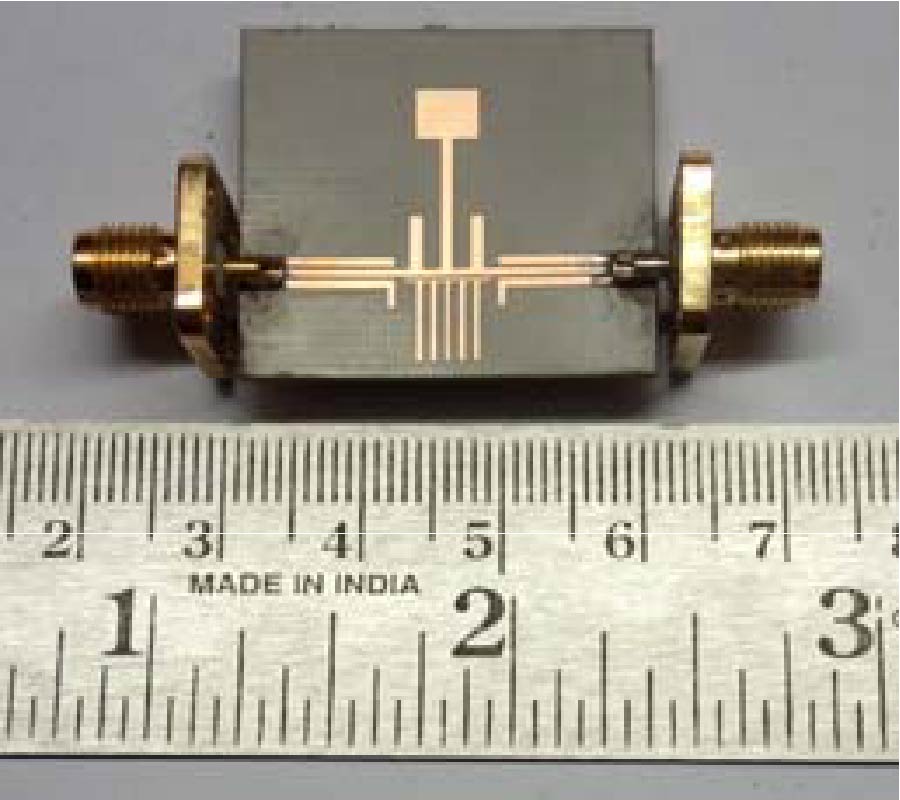
This paper proposes a novel bandpass filter for L-band based on CRLH TL, which is mainly formed by coupling a high-pass characteristic module with a low-pass characteristic module in a cascade. The high-pass module consists of an interdigitated coupled line and a grounding via, owning to its singular characteristics, which the miniaturization is realized. The low-pass module is composed of a C-type resonator with high-low impedance lines, which can realize great sideband attenuation characteristics. To further improve its out-of-band rejection characteristics, a complementary split-ring resonator (CSRR) defective ground structure with single-pole attenuation characteristics is loaded, and a transmission zero is introduced at 2.5f0 out-of-band. The test results are in great agreement with the simulation ones, and the dimensions are only 0.20λg*0.22λg. Compared with other similar types, the filter proposed in this paper has miniaturization, great passband selection characteristics, stopband characteristics, and the advantage of low insertion loss.
A NOVEL MINIATURIZED L-BAND FILTER WITH GREAT STOPBAND CHARACTERISTICS USING INTERDIGITATED COUPLED LINES CRLH-TL STRUCTURE
2021-07-19
PIER M
Vol. 103, 173-183
Surface Mountable Multiband Dielectric Resonator Antenna for Wireless Communication Systems
Rajat Pandey and Trushit K. Upadhyaya
This paper presents a star-shaped compact dielectric resonator antenna for wideband and multiband wireless applications. The slots in the dielectric slab have been created to achieve wider bandwidth. The star-shaped alumina dielectric is placed on a low cost FR-4 substrate and fed using a microstrip line. The electrical dimensions of the proposed dielectric resonator antenna are 0.86λ0×0.86λ0×0.13λ0. The proposed design resonates at multiple frequency bands of 5.04-6.13 GHz, 6.87-7.97 GHz, and 8.58-9.63 GHz having the fractional bandwidths of 20.76%, 15.3%, and 11.4%, with peak gains of 3.71 dBi, 6.20 dBi, and 8.10 dBi, respectively. The design was fabricated to validate the simulation results. Good agreement can be seen between the measured and simulated results.
SURFACE MOUNTABLE MULTIBAND DIELECTRIC RESONATOR ANTENNA FOR WIRELESS COMMUNICATION SYSTEMS
2021-07-19
PIER M
Vol. 103, 161-171
Fast Optimization of Array Antenna Enclosed by Asymmetric Radome Using AEP Combined with Enhanced HGAPSO
Legen Dai , Yong-Jun Xie , Chungang Zhang and Peiyu Wu
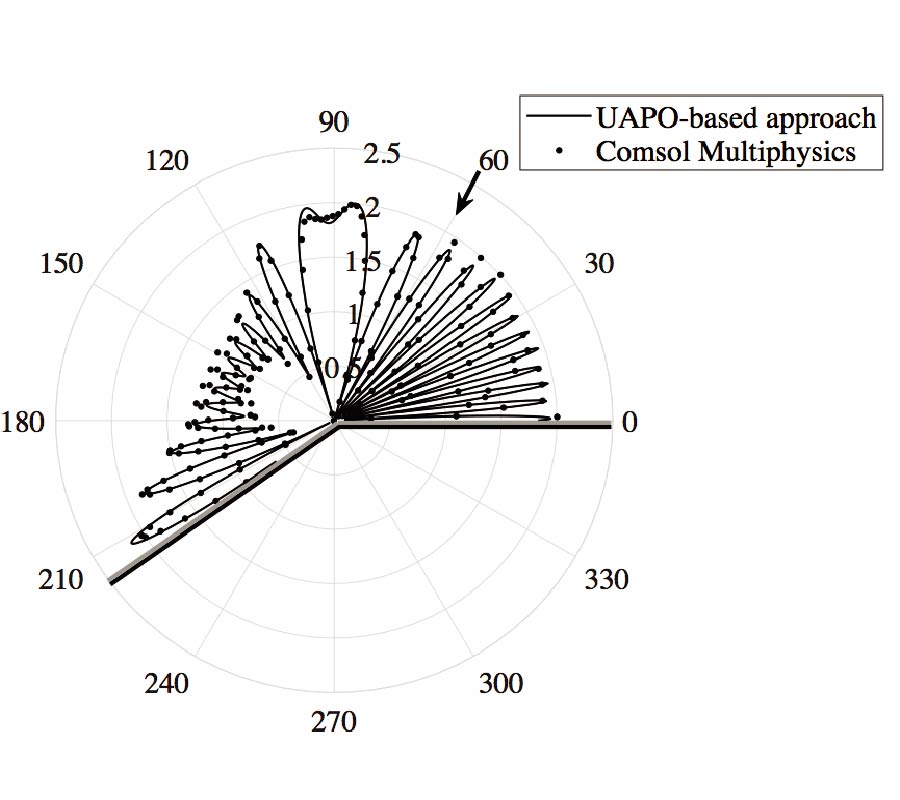
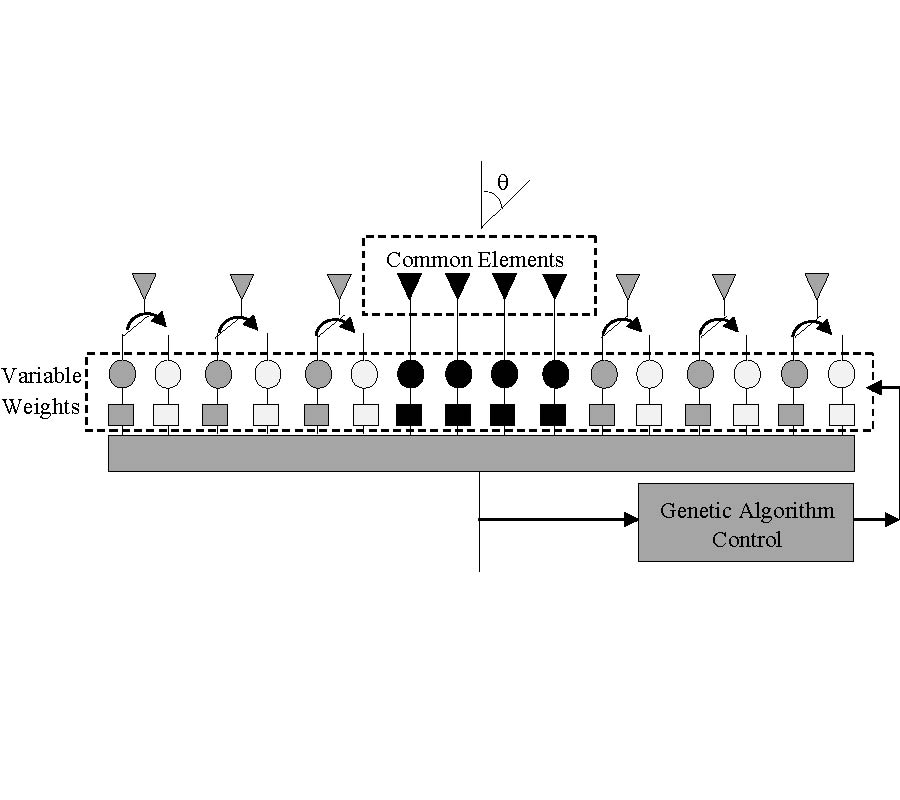
An efficient analysis and optimization method is proposed to compensate the influence of asymmetric radome on an antenna by correcting amplitude and phase of the excitations. The asymmetrical and heteromorphic radomes are inevitable for the radar on high-speed aircraft. Many previous researches focused on the optimization of the radome structure and thickness to reduce the influence of radomes. However, the influence of complex streamlined radome cannot be compensated by merely optimizing the structure and thickness of the radome. Therefore, an alternative optimization method, optimizing amplitude and phase of feeds, is used in this paper. This paper adopts the active element pattern (AEP) technique, utilizing full-wave simulation method to extract the AEP for each antenna element and computing radiation patterns of array antenna by using vector composition of AEP. In combination with hybrid genetic algorithm-particle swarm optimization (HGAPSO), the antenna radiation characteristics can be obtained by updating excitations, which avoid the repeated full-wave simulation in the optimization process. Furthermore, the speed updating formula of PSO algorithm is improved combined with prior information, and the convergence speed is further increased. Finally, a 64 elements array antenna-radome system was optimized as an example in the cases of continuously adjustable phase and digital discrete phase.
FAST OPTIMIZATION OF ARRAY ANTENNA ENCLOSED BY ASYMMETRIC RADOME USING AEP COMBINED WITH ENHANCED HGAPSO
2021-07-18
PIER M
Vol. 103, 151-159
A Comprehensive Error Analysis of Free-Space Techniques for Extracting the Permeability and Permittivity of Materials Using Reflection-Only Measurements
Raenita A. Fenner and Mili Shah
The electromagnetic characterization of layered materials is applicable to many different applications. In previous work it has been shown that reflection-only techniques - which vary the underlying structure of the sample stack to obtain two independent measurements - are a variation of a single unifying scheme such that there is a single set of closed-form unifying extraction equations for the electric permittivity and magnetic permeability. In this paper, the error propagation method is applied to this single set of closed-form extraction equations in order to derive an accompanying set of closed-form equations to predict the measurement uncertainty of electric permittivity and magnetic permeability. An error analysis is performed on the layer-shift method, and results are compared to a Monte Carlo simulation to prove the viability of the general error analysis equations.
A COMPREHENSIVE ERROR ANALYSIS OF FREE-SPACE TECHNIQUES FOR EXTRACTING THE PERMEABILITY AND PERMITTIVITY OF MATERIALS USING REFLECTION-ONLY MEASUREMENTS
2021-07-17
PIER B
Vol. 93, 1-22
Metal Discovery by Highly Sensitive Microwave Multi-Band Metamaterial-Inspired Sensors
Ghaleb Al-Duhni and Nantakan Wongkasem
A simple, compact, contactless, and high sensitivity metamaterial-inspired sensorhas been developed to detect and classify precious transition metals in the S- and C-band regime, using reflection coefficients. A multi-band metamaterial, quadruple concentric circular split ring resonator, is specifically designed as a sensing enhancer, where the additional bands can effectively trigger the electromagnetic properties, as well as enhance the differentiation between the testing metal samples. The proposed sensor was tested on precious transition metals, silver, platinum and gold thin slabs of various thicknesses, from 0.5 μm to 3 mm. Five resonances were established in the frequency range of 2-8 GHz. Distinguishable frequency responses generated from different metal samples at those five resonances specify the capability of classifying the metal contents and thicknesses.
METAL DISCOVERY BY HIGHLY SENSITIVE MICROWAVE MULTI-BAND METAMATERIAL-INSPIRED SENSORS
2021-07-17
PIER C
Vol. 114, 43-56
A Compact Non-Uniform Composite Right/Left-Handed Leaky-Wave Scanning Antenna with Elliptical Polarization for X-Band Application
Alexander Ostankov , Vladimir Kashkarov and Evgeniy Khripunov
A new compact nonuniform leaky-wave antenna (LWA) with left-handed elliptical polarization (LHEP), based on composite right/left-handed (CRLH) metamaterial operating in the range of 7-10.2 GHz is presented in the work. The nonuniform structure of a CRLH transmission line (TL) is realized by the placement of different configurations of inter-digital capacitor (IDC) in the form of sinusoid (SIN-IDC), on the top of metal wall of a half-mode substrate integrated waveguide (HMSIW). Balanced condition of the unit cells is provided by the change in slit width, amplitude and the number of SIN-IDC periods, as well as by relocation of two additional transition apertures arranged by both sides of SIN-IDC. Based on the known Hensen-Woodyard criterion, the optimal number of the unit cells was determined, when the gain coefficient varied from 7.5 to 9.8 dB in all of the operational range of antenna. The developed prototype of nonuniform CRLH LWA has the size of 8.1x115.2 mm. It is characterized by a continuous scan angle range equal to 117°. The maximum angle of rotation radiation pattern is -66° for backward radiation and +51° for direct radiation. The maximum efficiency of the antenna radiation is 85%, while the total one is 68%.
A COMPACT NON-UNIFORM COMPOSITE RIGHT/LEFT-HANDED LEAKY-WAVE SCANNING ANTENNA WITH ELLIPTICAL POLARIZATION FOR X-BAND APPLICATION
2021-07-16
PIER Letters
Vol. 99, 25-33
Printed MIMO/Diversity Antenna with Polarization Diversity
Bharghava Punna and Pachiyaannan Muthusamy
In this work, a diversity antenna with a high level of isolation is presented in this paper. To make the antenna compact, the radiating parts are arranged on opposing sides of the substrate. The isolation between the ports is sufficient for the use of a MIMO system, which is achieved through the orthogonal positioning of radiating elements. Wideband and narrowband antennas are placed on opposite sides of the substrate. The suggested monopole antenna has an impedance bandwidth of 3.1 GHz to 14.9 GHz, whereas the rectangular narrowband antenna has an impedance bandwidth of 5.4 GHz to 5.62 GHz. More than 16 dB of isolation exists between the two ports. The proposed antenna has a maximum gain of 2.9 dB. The diversity nature of the proposed MIMO antenna is studied in terms of Envelope Correlation Coefficient (ECC), Diversity Gain (DG), and Total Active Reflection Coefficient (TARC).
PRINTED MIMO/DIVERSITY ANTENNA WITH POLARIZATION DIVERSITY
2021-07-16
PIER C
Vol. 114, 31-41
Analysis of Lightning Interference and Protection Methods on Secondary Cables in Substation
Wen Cao , Haoming Miao , Qian Liu , Wei Shen , Xinyi Zhang , Yiliang Yu , Jianyi Qin and Hao Yang
When a substation is struck by lightning, it will cause the ground potential to rise, which will further cause serious interference to the secondary cable. This article is based on the grounding grid established in the testing ground. The grounding copper bar is laid in the cable trench to connect with the grounding grid. At different grounding grid points, use a lighting current impulse generator to apply high current. At the same time, the grounding grid model is established by using the ATP-EMTP software. Through the combination of test and simulation, the influence of different lighting inflow locations on the protection effect of grounding copper bar is studied, and combined with the connection method of the grounding copper bar and the grounding grid, the protective effect of the grounding copper bar on the secondary cable under the impact of lightning current was analyzed. The research results showed that the laying of grounding copper bars can reduce the influence of interference voltage on the secondary cables under certain circumstances, but when there are multiple connection points between the grounding copper bar and the grounding grid, the current injection position is different, which will affect the voltage between the cable core and the shielding layer. At the same time, it will also affect the ground potential rise of cable grounding point in different degrees.
ANALYSIS OF LIGHTNING INTERFERENCE AND PROTECTION METHODS ON SECONDARY CABLES IN SUBSTATION
2021-07-16
PIER M
Vol. 103, 141-149
Polarization Sensitive Dual-Band Metasurface Lens for X-Band Applications
Pallapati Vinod Kumar and Basudeb Ghosh
This paper presents a dual-band polarization dependent phase gradient metasurface (PGMS) lens based on phase compesation method. The proposed metasurface (MTS) consists of a multi-layered unitcell with elliptical structures encircled by a square loop. Owing to the elliptical shape, the unitcell produces an independent phase control for different polarizations of incident wave at two operating frequencies. The present work is aimed to design a dual band gain enhancement MTS lens antenna in the broadside direction at 10 GHz and 12 GHz. The proposed MTS is designed by one-to-one spatial phase mapping with major and minor axes of the elliptical unitcell at 10 and 12 GHz for x- and y-polarized incident waves, respectively. The performance of the MTS is validated by placing two linearly polarized patch antennas operating at 10 GHz and 12 GHz at the focal distance. The simulation and measured results show a gain enhancement of 10 dB in the frequency range of [9.5-10.1] GHz and [11.6-12.1] GHz for x- and y-polarized waves, respectively.
POLARIZATION SENSITIVE DUAL-BAND METASURFACE LENS FOR X-BAND APPLICATIONS
2021-07-14
PIER Letters
Vol. 99, 1-9
Design of a Reconfigurable Band-Notch SWB Antenna
Jiahao Sun , Hua Jing , Hongcheng Zhou , Yu Wang , Ping Wang and Yifei Qin
This paper introduces a novel planar super-wideband (SWB) antenna with reconfigurable band-notch characteristic. The antenna can work in band-notch mode or band-notch free mode. A good impedance matching is responsible for the SWB characteristic of the proposed antenna by adopting a gradient ground, a gradient feeder line, and a gradient radiating patch. Furthermore, to achieve a reconfigurable notched band function, a 0.3 mm deep slot which is 16 mm in length and 8 mm in width is dug near the antenna feeder for the placement of dielectric plates etched with different sizes of split ring resonator (SRR). The designed antenna has a size of 200 mm × 109 mm × 0.79 mm, and the measured frequency band of bandwidth covers 0.8-26 GHz with a reconfigurable band-rejection characteristic. The dielectric plates with different SRRs reject the part of WLAN band (5.44-5.55 GHz), X-band satellite downlink band (7.65 GHz-7.82 GHz), and 6.33 GHz-6.59 GHz. A good agreement is achieved within the super-wideband frequency range between simulated and measured results.
DESIGN OF A RECONFIGURABLE BAND-NOTCH SWB ANTENNA
2021-07-14
PIER M
Vol. 103, 129-140
A Compact CPW-Fed Triple-Band MIMO Antenna with Neutralization Line Decoupling for WLAN/WiMAX/5G Applications
Chengzhu Du , Zhuolin Zhao , Xun Wang and Fu-Hui Yang
A compact CPW-fed triple-band Multiple Input Multiple Output (MIMO) antenna is designed for WLAN, WiMAX, and 5G applications in this article. Three resonant frequencies, including 2.4 GHz, 3.5 GHz, and 5.5 GHz are generated by two branches and a rectangle radiation patch. The proposed antenna comprises two antenna elements placed side by side with a meandering neutralization line (NL) inserted between the elements to realize decoupling. To analyze the performance, it is fabricated and experimented. The measured results reveal that it has three impedance bandwidths: 2.38-2.52 GHz (5.7%), 3.28-3.62 GHz (10.1%), and 5.05-6.77 GHz (29.1%) with the measured isolation up to 16 dB. Furthermore, the parameters of diversity performance like envelope correlation coefficient (ECC), diversity gain (DG), efficiency, gain, channel capacity loss (CCL), mean effective gain (MEG), and total active reflection coefficient (TARC) are also analyzed, and the results indicate that the proposed antenna is desirable for integration in WLAN/WiMAX/5G devices.
A COMPACT CPW-FED TRIPLE-BAND MIMO ANTENNA WITH NEUTRALIZATION LINE DECOUPLING FOR WLAN/WIMAX/5G APPLICATIONS
2021-07-13
PIER B
Vol. 93, 23-46
Compact 2 × 2 Automotive MIMO Antenna Systems for Sub-6 GHz 5G and V2X Communications
Ahmad Yacoub , Mohamed Khalifa and Daniel N. Aloi
Various multiple-input multiple-output (MIMO) antenna systems for vehicles are presented in this paper usingtwo uniquely designed elements: low profile wideband Planar Inverted-F antenna (PIFA), and compact wideband monopole for automotive application in the sub-6 GHz 5G systems and Vehicle-to-Everything (V2X) communications that operate on the frequency range from 617 MHz to 6 GHz. This paper presents different MIMO configurations to be used in a low-profile housing or a shark fin style on the vehicle's roof. Each MIMO system achievesa satisfactory MIMO performance across the whole band withsuitable physical dimensions. The envelope correlation coefficient (ECC) and diversity gain (DG) are calculated using MATLAB in each MIMO configuration as they represent the two key factors in the MIMO performance. Simulation results are presented along with measured data on 1-meter rolled-edge ground plane (GND) and on vehicle's roof from properly cut metal sheet prototypes. The results are discussed in terms of VSWR, passive isolation between elements, combined radiation patterns, port-efficiencies, ECC and DG.
COMPACT 2 × 2 AUTOMOTIVE MIMO ANTENNA SYSTEMS FOR SUB-6 GHZ 5G AND V2X COMMUNICATIONS
2021-07-12
PIER Letters
Vol. 99, 19-24
A Design Method of Spaceborne Circularly Polarized Multi-Beam Antenna Array
Yuanyuan Li , Zhou Zhang , Liang Sun , Guodong Han and Peisong Dong
In this paper, a design method of spaceborne multi-beam antenna array is proposed. Multi-beam is achieved by rotating subarrays. A high efficiency circularly polarized horn antenna array working in Ka band is designed and processed. The antenna array has 16 large axial ratio elliptical beams, which can achieve the beam coverage range of 53°×49.1°. The simulation results are basically consistent with the test results, verifying the effectiveness of the proposed method. The design method of multi-beam antenna proposed in this paper can meet the requirements of multi-beam seamless coverage.
A DESIGN METHOD OF SPACEBORNE CIRCULARLY POLARIZED MULTI-BEAM ANTENNA ARRAY
2021-07-12
PIER Letters
Vol. 98, 155-163
Compact Four-Band Cactus-Shaped Antenna for 5G and WLAN Applications
Juan Zhang , Xiaoming Liu , Chen Wang , Lu Gan , Ye Wang and Lijun Sun
A low-profile coplanar waveguide fed four-band compact antenna for 5G and WLAN applications is presented in this letter. Multiple bands are generated using a cactusshaped patch, which consists of several inverted L-shaped slots and branches. The proposed antenna provides 150 MHz (2.10 GHz-2.25 GHz), 400 MHz (3.25 GHz-3.65 GHz), 1022 MHz (4.42 GHz-5.44 GHz), 1400 MHz (5.60 GHz-7.00 GHz) bandwidths of 10 dB return loss, corresponding to the target N1/N78/N79 5G bands and 5.8 GHz WLAN band, respectively. Moreover, the proposed antenna has a low profile of 21 mm × 29 mm × 1.6 mm, while maintaining tolerable gain in these operation bands. In addition, monopole-like radiation patterns are obtained, which is suitable for wireless communication. In order to verify this design, a prototype has been fabricated and measured. The measured results show satisfactory agreement with the simulated ones.
COMPACT FOUR-BAND CACTUS-SHAPED ANTENNA FOR 5G AND WLAN APPLICATIONS
2021-07-11
PIER C
Vol. 114, 13-29
Multiple-Input Multiple-Output Antenna for Sub-Six GHz 5G Applications Using Coupled Folded Antenna with Defective Ground Surface
Alaa M. Hediya , Ahmed Attiya and Walid Saber El-Deeb
A 6-element MIMO antenna system is introduced in this paper for N77, N78, and N79 (5G) communication bands. The proposed antenna element is composed of a four-section coupled line folded antenna. The performance of this antenna element is improved by using a partial ground plane combined with the DGS between the different elements of the MIMO antenna. The separated single antenna in this case has a reflection coefficient less than -10 dB over the frequency band from 3 GHz to 5 GHz. For the complete MIMO configuration, the reflection coefficientis less than -7 dB over the same frequency band for all the antenna elements. On the other hand, the isolation between antenna elements in the MIMO configuration is greater than 15 dB. The values of the MIMO parameters are calculated. These parameters include the Envelope Correlation Coefficient between the different elements (ECC), Diversity gain (DG), Total Active Reflection Coefficient (TARC), Channel Capacity Loss (CCL), and Mean Effective Gain (MEG). Good results are obtained for the MIMO parameters where ECC < 0.006, DG = 10, TARC < -7, CLL < 0.6, and -3 < MEG < -8. These performance parameters of the proposed MIMO system indicate that this antenna is suitable for 5G applications. The effect of the human hand on the S-parameter is also investigated. The proposed antenna is fabricated and measured to verify the simulation results.
MULTIPLE-INPUT MULTIPLE-OUTPUT ANTENNA FOR SUB-SIX GHZ 5G APPLICATIONS USING COUPLED FOLDED ANTENNA WITH DEFECTIVE GROUND SURFACE
2021-07-10
PIER C
Vol. 114, 1-11
A Size-Reduced, Broadband, Bidirectional, Circularly Polarized Antenna for Potential Application in WLAN, WiMAX, 4G, and 5G Frequency Bands
Mason Moore , Zabed Iqbal and Sungkyun Lim
A bidirectional, circularly polarized antenna with a miniaturized design and broadband capabilities is proposed for consideration in WLAN 2.4/3.65-GHz, WiMAX 2.3/2.5-GHz, 4G, and 5G frequency bands. The frontside of the antenna consists of a hexagonal slot, a hexagonal patch, ten meander tips, and rectangular corner notches to achieve broad impedance and axial ratio bandwidth. The feedline on the backside of the antenna with accompanying shorting pin is offset to further increase the common bandwidth. Also, the four corners of the antenna substrate are removed to decrease the electrical size. The designed antenna is fabricated and measured to validate simulation results. From measured results the antenna has a -10-dB impedance bandwidth of 89.7% (1.60-4.20 GHz) and a 3-dB axial ratio bandwidth of 70.5% (1.80-3.76 GHz). The peak realized gain in the boresight direction is 3.65 dBi, which occurs at 1.88 GHz.
A SIZE-REDUCED, BROADBAND, BIDIRECTIONAL, CIRCULARLY POLARIZED ANTENNA FOR POTENTIAL APPLICATION IN WLAN, WIMAX, 4G, AND 5G FREQUENCY BANDS
2021-07-09
PIER Letters
Vol. 99, 11-18
A Low Cost Coplanar Capacitively Coupled Probe Fed Stacked Patch Antenna for GNSS Applications
Muhammad Awais , Ahmad Bilal and Shuaib Salamat
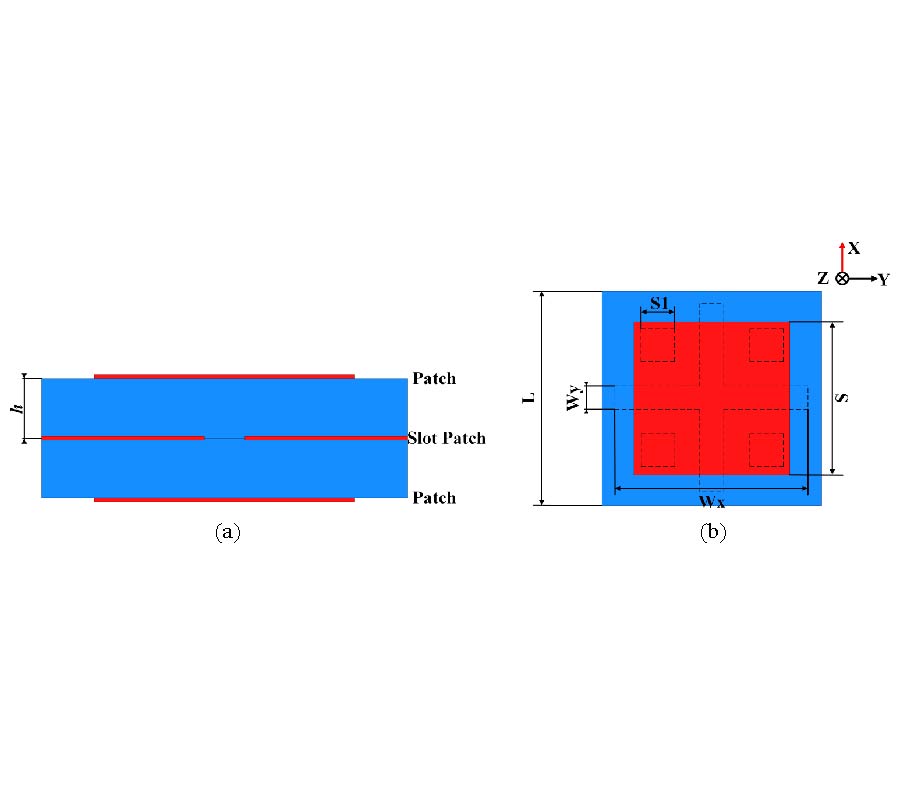
This letter presents a low-cost dual-band circularly polarized microstrip antenna for GNSS applications. The dual-band operation is achieved by stacking two metallic patches on a conventional FR4 substrate. The designed antenna can cover GPS L1 band, BeiDou B1 band, Galileo E1, E5b bands, and GLONASS G1, G3 bands, through a bandwidth of 1.118 GHz-1.215 GHz in lower L band and a bandwidth of 1.55 GHz-1.61 GHz in the upper L band. In order to achieve a wide axial ratio bandwidth, a dual-feed mechanism utilizing a capacitively coupled probe feeding scheme is incorporated. The overall size of the proposed antenna is 100 mm by 100 mm. The measured results indicate an excellent correlation with simulations.
A LOW COST COPLANAR CAPACITIVELY COUPLED PROBE FED STACKED PATCH ANTENNA FOR GNSS APPLICATIONS
2021-07-09
PIER B
Vol. 92, 163-192
Robust CFAR Detection of Noise Jamming in Coherent Radars
Anatolii A. Kononov , Dohyung Kim , Sung-Hyun Choi and Haksoo Kim
This paper introduces a robust constant false alarm rate (CFAR) method to detect continuous noise jamming in coherent radar systems with a single antenna having no pattern control. The proposed detector is robust to interfering signals such as strong spikes from neighboring radars and returns from targets of interest and is resistant to land, sea, and weather clutter. The detector operates on data vectors extracted from a real-valued Range-Doppler data matrix generated at the output of Doppler processing for each azimuth cell within the entire scanning sector. Each data vector consists of statistically independent range samples associated with one of the specified Doppler bins. These samples are selected from non-overlapping range intervals allocated within the noise-dominant region in the full range coverage to mitigate the effect of clutter on the detector's performance. To perform jamming detection for each cell under test (CUT) in the current antenna scan, the proposed detector uses the CUT-associated data vectors generated in the current antenna scan and CFAR reference data vectors generated in the previous antenna scan. These reference data vectors are extracted from Range-Doppler data matrices associated with reference azimuth cells uniformly distributed within the entire scanning sector. The proposed detector achieves robustness to interfering signals by using a two-step detection algorithm. The first step performs censored video integration (CVI) for the CUT and reference data vectors and individual adaptive CFAR detection in each specified Doppler bin. The detector applies the "m-of-m" detection strategy to a complete set of decisions declared by the individual CFAR detectors in the second step. This strategy provides immunity to the simultaneous presence of interfering signals in the specified Doppler bins. The robustness of the proposed noise jamming detector is verified using Monte-Carlo simulations.
ROBUST CFAR DETECTION OF NOISE JAMMING IN COHERENT RADARS