Search Results(13789)

2021-06-06
PIER M
Vol. 102, 233-241
MIMO Antenna Phase Error Effects on Capacity
Chengyi Chu and Nicholas E. Buris
This paper describes the ramifications in the capacity of Multiple Input Multiple Output (MIMO) wireless links when the antenna systems involved are mischaracterized and contain phase errors. Errors in simulated as well as measured radiation patterns are considered. Also, simple deterministic Line of Sight and stochastic propagation environments are examined. The analyses are carried out on a 2×2 MIMO system. Results show that the resultant error in capacity depends on the degree of the phase error between the antenna ports, the type of propagation environment, as well as the degree of the illumination Signal to Noise Ratio (i-SNR).
MIMO ANTENNA PHASE ERROR EFFECTS ON CAPACITY
2021-06-03
PIER
Vol. 170, 187-197
Optically Transparent Microwave Shielding Hybrid Film Composited by Metal Mesh and Graphene
Xin-Ran Wang , Xiao-Bai Wang , Hang Ren , Nan-Shu Wu , Jing-Wen Wu , Wen-Ming Su , Yin-Long Han and Su Xu
Transparent conducting materials with the ability of broadband electromagnetic shielding have a widespread range of applications in aerospace, medical equipment and electronic communications. Achieving enhanced electromagnetic shielding effect without sacrificing much optical transparency is the technical trend in both academia and industries. Here, we experimentally propose a flexible hybrid film constructed by nano-printing based metal meshes and a graphene coating for the transparent electromagnetic shielding application. Numerical analysis is carried out to investigate optimal balance between electromagnetic shielding and optical transparency. In the experiment, enhanced shielding ability of hybrid film is observed without excessively sacrificing optical transmittance, compared to the reference group (the case only with metal mesh). Our work provides a hybrid platform for the high-performance optically transparent shielding materials for electromagnetic environment safety protection.
OPTICALLY TRANSPARENT MICROWAVE SHIELDING HYBRID FILM COMPOSITED BY METAL MESH AND GRAPHENE
2021-06-03
PIER
Vol. 170, 177-186
Surface Electromagnetic Waves at Gradual Interfaces Between Lossy Media
Igor I. Smolyaninov
A low loss propagating electromagnetic wave is shown to exist at a gradual interface between two lossy conductive media. Such a surface wave may be guided by a seafloor-seawater interface and it may be used in radio communication and imaging underwater. It should allow communication distances of the order of 500 m at 10 kHz along a sandy seabed. Similar surface waves may also be guided by various tissue boundaries inside a human body. For example, such surface wave solutions may exist at planar interfaces between skull bones and grey matter inside a human head at 6 GHz.
SURFACE ELECTROMAGNETIC WAVES AT GRADUAL INTERFACES BETWEEN LOSSY MEDIA
2021-06-02
PIER Letters
Vol. 98, 49-54
Synthesis of in-Line Fully Canonical Response Filters with Frequency-Variant Couplings
Angel Triano and Pedro de Paco
A direct synthesis approach is presented to realize in-line topology filters with adjacent frequency-variant couplings implementing a transmission response with the same number of finite transmission zeros as poles. The proposed method starts with an N-order fully canonical filter response definition. A non-resonant node (NRN) is incorporated into the transversal network to make room for an extra coupling, and as a consequence of the extended similarity transformation applied, the NRN is transformed into a resonant node. The result is a network with N poles and N transmission zeros implemented with N+1 resonant nodes and N FVC, being able to describe a fully canonical response with an inline network without cross couplings.
SYNTHESIS OF IN-LINE FULLY CANONICAL RESPONSE FILTERS WITH FREQUENCY-VARIANT COUPLINGS
2021-06-02
PIER M
Vol. 102, 217-232
A Compact Tri-Band Flexible MIMO Antenna Based on Liquid Crystal Polymer for Wearable Applications
Chengzhu Du , Xun Wang and Gao-Ya Jin
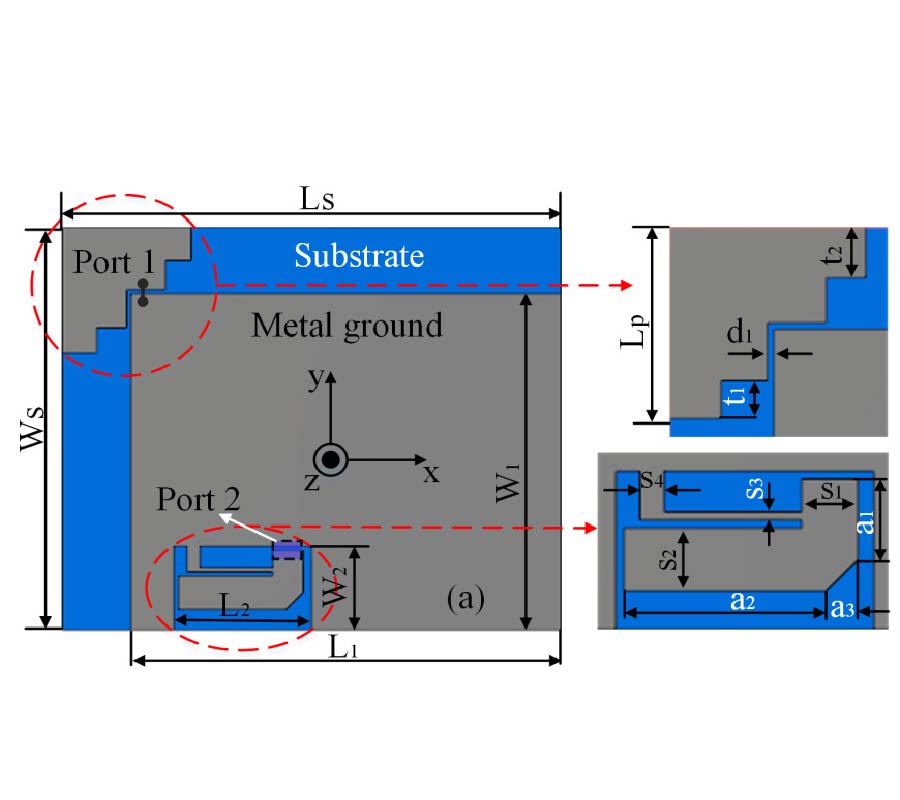
In this paper, a compact tri-band flexible MIMO antenna based on liquid crystal polymer (LCP) is designed to operate in WLAN and WiMAX bands. The antenna consists of two identical antenna elements. The isolation structure includes a ground slot, two I-shaped branches, and a parasitic strip. The measured results show that the impedance bandwidth (S11 < -10 dB) covers three frequency bands of 2.38-2.55 GHz, 3.37-3.60 GHz, and 4.92-5.37 GHz, and the S21 of working bands is basically better than -19 dB. Moreover, the flexibility of the MIMO antenna is analyzed at different bent cases. The specific absorption ratio (SAR) values are obtained by simulating the model of antenna approaching human body. The simulated results show that the SAR value of the antenna meets the European Union (EU) standard. The proposed antenna demonstrates the characteristics of satisfactory radiation, high isolation, sound gain in working bands and flexibility, which has good application prospects in the wearable field.
A COMPACT TRI-BAND FLEXIBLE MIMO ANTENNA BASED ON LIQUID CRYSTAL POLYMER FOR WEARABLE APPLICATIONS
2021-06-01
PIER C
Vol. 113, 47-58
Radiation of Electromagnetic Waves by an Arbitrarily Oriented Slot at the End Wall of a Rectangular Waveguide
Mikhail Nesterenko , Viktor A. Katrich , Victor I. Kijko and Svetlana V. Pshenichnaya
A problem of electromagnetic waves radiation diffracted at a narrow rectilinear arbitrarily oriented slot cut in an end wall of a semi-infinite rectangular waveguide is solved by an asymptotic averaging method. The slot radiates into a half-space over an infinite perfectly conducting plane. An influence of slot inclination angle upon energy and spatial characteristics is numerically studied. Theoretical results are compared with experimental data. A numerical-analytical problem of a narrow rectilinear slot radiating into the space above an infinite impedance plane is also presented. The asymptotic solution for the slot magnetic current was obtained by a generalized method of induced magnetomotive forces (MMF) by using Green's functions of a space above the impedance plane. The effect of the plane with impedance coating on the slot is reduced taking into account an additional term to the slot external conductivity, for which the expressions were obtained in an analytical form.
RADIATION OF ELECTROMAGNETIC WAVES BY AN ARBITRARILY ORIENTED SLOT AT THE END WALL OF A RECTANGULAR WAVEGUIDE
2021-05-31
PIER C
Vol. 113, 29-46
Investigating the Equivalent Source and the Plane Wave Spectrum Methods in Predicting the Magnetic Field Behavior in the Vicinity of Microstrip Patch Antenna for Bluetooth and Wi-Fi Applications
Mohamed Amine Benchana , Abdesselam Babouri , Zouheir Riah , Abderrezak Khalfallaoui , Abdelaziz Ladjimi and Jamel Nebhen
Over the past few years, the continuous evolution of embedded electronic systems has increased electromagnetic interferences problems. It has also generated a new design constraint on electromagnetic compatibility. Hence, predicting the electromagnetic field behavior in the vicinity of the electronic components and systems becomes a priority to avoid the potential for unwanted coupling occurrence, as well as to ensure the electromagnetic compatibility compliance for those components and systems which are embedded in a confined space. As a result, the designers of electronics' equipment are extremely interested in radiated emission models. This paper reports a comparative study in which two different methods will be applied: the equivalent source method and plane wave spectrum method. These two methods will be used to predict the magnetic field behavior in the vicinity of a microstrip patch antenna. The latter works in ISM band for Wi-Fi and Bluetooth applications. The two applied models are constructed from the tangential magnetic fields cartographies of the antenna obtained from HFSS® at 3.5 mm and validated by comparing the HFSS® results with those of the models at a higher elevation. Furthermore, the relative error between the simulated field of the antenna and those of the equivalent source model according to the dipoles number is presented to determine the minimum number of dipoles that allow users to obtain the results with better accuracy. Subsequently, the relative error as function of different elevations along the z axis together with the two methods comparison results is presented.
INVESTIGATING THE EQUIVALENT SOURCE AND THE PLANE WAVE SPECTRUM METHODS IN PREDICTING THE MAGNETIC FIELD BEHAVIOR IN THE VICINITY OF MICROSTRIP PATCH ANTENNA FOR BLUETOOTH AND WI-FI APPLICATIONS
2021-05-30
PIER Letters
Vol. 98, 41-48
Gain Enhancement Using Modified Circular Loop FSS Loaded with Slot Antenna for Sub-6 GHz 5G Application
Anubhav Kumar , Asok De and Rakesh Kumar Jain
In this paper, a modified circular loop FSS with a slot antenna is proposed for sub-6 GHz 5G applications. The proposed FSS reduces the resonant frequency to towards lower bands of conventional circular FSS without change in its size. The operating bandwidth (-10 dB) of proposed antenna loaded with polarization insensitive single-layer FSS varies from 3.6 GHz to 6.1 GHz with an average gain of 7-7.5 dB and a maximum realized gain of 7.87 dB. An FSS superstrate is loaded onto a slot antenna to increase the realized gain of 4 dB, where the FSS shows desirable electromagnetic wave reflection characteristics over operating bandwidth and can be used in 5G sub-6 GHz band applications.
GAIN ENHANCEMENT USING MODIFIED CIRCULAR LOOP FSS LOADED WITH SLOT ANTENNA FOR SUB-6 GHZ 5G APPLICATION
2021-05-29
PIER Letters
Vol. 98, 33-40
A Low-Loss Dual-Band Negative Group Delay Circuit with Flexible Design
Yuwei Meng , Zhongbao Wang , Yu Bai , Shao-Jun Fang and Hongmei Liu
A low-loss dual-band negative group delay circuit (NGDC) with a flexible design is proposed. The proposed NGDC consists of a transmission line coupled asymmetrically with two step-impedance open-loop resonators. The negative group delay (NGD) times and center frequencies of the lower and upper bands can be tuned independently. To verify the design concept, two dual-band NGDC prototypes I and II are fabricated and measured. The measured NGD times of prototype I are -4.9 ns and -4.8 ns at the center frequencies of 1.949 GHz and 2.054 GHz, respectively. The insertion loss is lower than 2.7 dB and the return loss larger than 11.2 dB in both NGD bands. For prototype II, the NGD times at 1.949 GHz and 2.086 GHz are -4.7 ns and -3.3 ns, respectively. The measured insertion loss is better than 2.4 dB with the return loss larger than 11.9 dB.
A LOW-LOSS DUAL-BAND NEGATIVE GROUP DELAY CIRCUIT WITH FLEXIBLE DESIGN
2021-05-28
PIER M
Vol. 102, 207-215
A Prior Parameter Extraction Method for the Solution of Wide-Angle Electromagnetic Scattering Problems Based on Compressed Sensing
Daoping Wang , Ming Sheng Chen , Xin-Yuan Cao , Qi Qi , Xiangxiang Liu and Chundong Hu
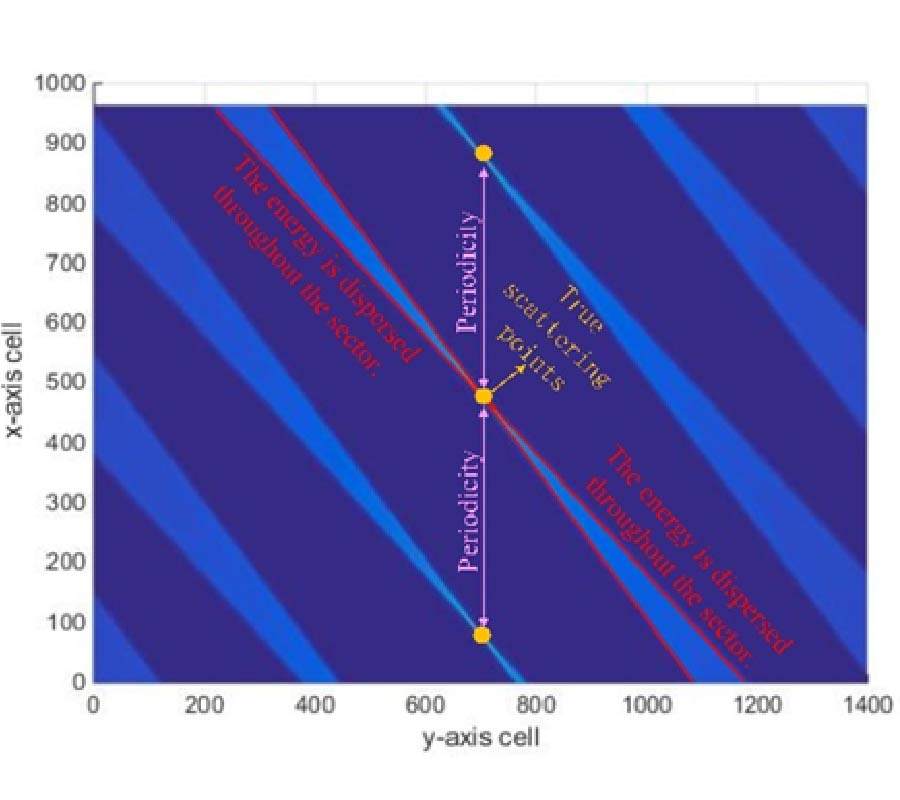
A fast solution for electromagnetic (EM) scattering problems over a wide incident angle based on compressed sensing (CS) has been proposed in recent years. Since current expansion coefficients are not known in advance, the parameters of this solution (e.g., the times of measurements, the selection of sparse transforms) for different scattering objects are difficult to determine. In order to solve this problem, this paper presents a prior parameter extraction method based on the principle of on-surface discretized boundary equation (OS-DBE), in which an approximate distribution of current expansion coefficients at any given point of the scatterer is first obtained with low-coverage and low-complexity, and then the prior parameters can be determined by CS tests for the approximate result. The implementation method is elaborated, and its effectiveness is verified by numerical results.
A PRIOR PARAMETER EXTRACTION METHOD FOR THE SOLUTION OF WIDE-ANGLE ELECTROMAGNETIC SCATTERING PROBLEMS BASED ON COMPRESSED SENSING
2021-05-28
PIER M
Vol. 102, 193-206
First Microwave Tomography Approach Towards a Truly Noninvasive, Pain-Free and Wearable Blood Glucose Monitoring Device
Asma Bakkali , Clément Buisson , Lourdes Mounien , Jean François Landrier , Victoria Tishkova and Pierre Sabouroux
Despite the advancements in the field of glucose monitoring sensors, the development of noninvasive, wearable, continuous and comfortable systems is still a real challenge. New technologies are required for noninvasive, continuous and effective measurements remaining discreet, painless, comfortable to the patient and avoiding additional costs.This article presents a truly noninvasive microwavetomography prototype designed for glucose monitoring. The system is based on an array of dipole antennas placed in a circular configuration.The transmitted field data are collected using a switchmatrix connected to a vector network analyzer. A heterogeneous 3-D arm model and a 3-D electromagnetic solver have been used to model the human arm and to characterize the system. Blood electromagnetic properties are affected by the glucose concentration, a promising correlation between the dielectric properties of blood and glucose level should be investigated. By simulating the antenna array on the arm phantom, the characteristics of the S-Parameters were interesting at the frequencies of interest. The transmission coefficient amplitude decreases as the dielectric constant decreases from 63 to 40, and the conductivity increases from 1.5 S/m to 3.5 S/m. For each value of dielectric properties, a given transmission coefficient value can be clearly identified. Experimental measurements validated the arm phantom and confirmed the relationship between the response of the system and the dielectric properties of blood tissue. The armband sensor is designed as an inexpensive, noninvasive, and light weight device suitable for all patients with a high level of discretion. This work, under optimization for preclinical and clinical testing, demonstrates the proof of concept of an innovative microwave tomography system for noninvasive glucose monitoring. Compared to studies with a similar aim, this research may achieve distinct advances and offers promising hope in the field of noninvasive glucose sensors.
FIRST MICROWAVE TOMOGRAPHY APPROACH TOWARDS A TRULY NONINVASIVE, PAIN-FREE AND WEARABLE BLOOD GLUCOSE MONITORING DEVICE
2021-05-26
PIER M
Vol. 102, 181-192
Metamaterial Vivaldi Printed Circuit Antenna Based Solar Panel for Self-Powered Wireless Systems
Ahmed Abdulmjeed , Taha Ahmed Elwi and Sefer Kurnaz
A high-gain wide-band planar antenna with H-Shaped Resonators (HSRs) for Self-Powered wireless systems is proposed in this paper. The proposed antenna consists of four major parts, namely, a grating Vivaldi electrical dipole, a half-ring magnetic dipole, HSRs, and a solar panel reflector. The dipoles are etched from both antenna substrate sides by each half on one side. The HSR structures are etched on a single side of the used substrate to avoid the capacitive coupling effects which cause the radiation efficiency reduction. HSR inclusions are designed and tested numerically to have the desired electromagnetic properties at frequency band of interest. After introducing the HSR inclusions to the antenna structure, the antenna performance is tested numerically and compared to that without HSR inclusions. The fabricated prototype based HSR structure shows an enhanced gain bandwidth product to cover the frequencies from 1.75 GHz up to 7.43 GHz with a gain varying from 9.52 dBi up to 16.71 dBi over the entire frequency range. Finally, an excellent agreement has been achieved between the gathered numerical results and those from the experimental measurements.
METAMATERIAL VIVALDI PRINTED CIRCUIT ANTENNA BASED SOLAR PANEL FOR SELF-POWERED WIRELESS SYSTEMS
2021-05-23
PIER B
Vol. 92, 149-161
Diffraction Radiation Generated by a Density-Modulated Electron Beam Flying Over the Periodic Boundary of the Medium Section. IV. Structures of Finite Thickness
Yuriy Sirenko , Seil S. Sautbekov , Nataliya Yashina and Kostyantyn Sirenko
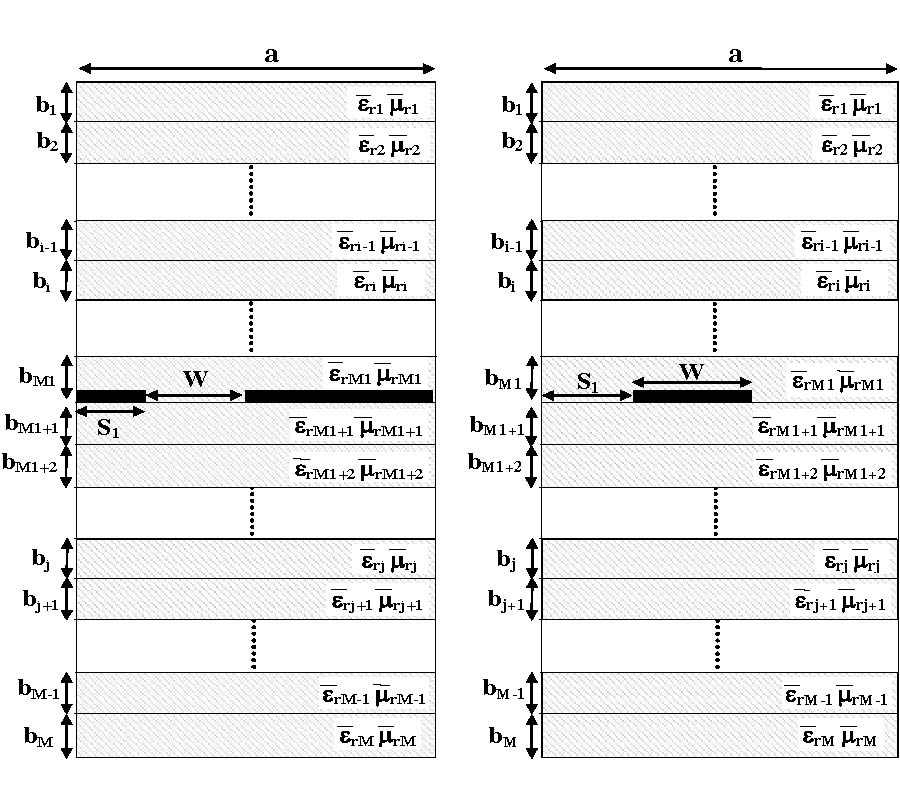
The paper is focused on reliable modeling and analysis of the effects connected with the resonant transformation of the field of a plane and density-modulated electron beam flying over the periodic rough boundary of a natural or artificial medium. In the paper such a medium occupies a part of the half-space, limited in thickness. Therefore, the numerous effects appeared due to transverse (in the thickness of the periodic structure) resonances, and the coupling of eigen regimes of two different periodic interfaces also contributes to the anomalies appearing due to excitation of the surface eigen waves of the periodic boundary interface that had been discussed in previous papers of this series.
DIFFRACTION RADIATION GENERATED BY A DENSITY-MODULATED ELECTRON BEAM FLYING OVER THE PERIODIC BOUNDARY OF THE MEDIUM SECTION. IV. STRUCTURES OF FINITE THICKNESS
2021-05-19
PIER Letters
Vol. 98, 25-31
Optimization of the Wheeler Cap Technique for Efficiency Measurement of RFID Antennas Matched to Complex Loads
Nadeen Rishani , Jean-Marc Laheurte , Stephane Protat and Raed Shubair
This paper proposes an improved mathematical formulation of Johnston's approach to measure the radiation efficiency of an antenna, based on the Wheeler Cap (WC) technique. The proposed modifications allow the measurement of the radiation efficiency of small antennas matched to complex loads implemented on Radio Frequency IDentification (RFID) tags. The studied structure is a low-cost, silver-printed, differentially-fed RFID dipole antenna. The antenna is printed on a flexible PET (polyethylene terephthalate) paper that is conformable on various objects. Link budget measurements validate the accuracy of the formulation, which can be applied to any dipole antenna matched to an RFID chip with a complex input impedance.
OPTIMIZATION OF THE WHEELER CAP TECHNIQUE FOR EFFICIENCY MEASUREMENT OF RFID ANTENNAS MATCHED TO COMPLEX LOADS
2021-05-19
PIER M
Vol. 102, 171-180
Modern Applications of the Bateman-Whittaker Theory
Ioannis Besieris , Peeter Saari and Amr Shaarawi
The Bateman-Whittaker theory, which was developed a century ago, is shown to be a comprehensive basis for deriving a large class of null spatiotemporally localized electromagneticwaves characterized by intriguing vortical structures. In addition, it provides the modeling for studying topological structures dealing with linked and knotted electromagnetic waves.
MODERN APPLICATIONS OF THE BATEMAN-WHITTAKER THEORY
2021-05-19
PIER M
Vol. 102, 159-169
A Novel Triple Band MIMO Antenna Array for Simultaneous Communications
Jangampally Rajeshwar Goud , Nalam Venkata Koteswara Rao and Avala Mallikarjuna Prasad
A novel and compact triple-band two-element Multiple Input Multiple Output (MIMO) antenna array is designed to provide simultaneous communications for uplink and downlink which covers GSM, LTE, and sub-6 base station applications. The proposed MIMO system is a configuration of four triple-band two-element arrays in which two are used for uplink and the other two for downlink. This compact structure with separate antennas for uplink and downlink provides simultaneous communication. For this proposed structure, the parameters like impedance bandwidth, efficiency, gain and cross polarization aspects are presented for all the three specified bands. To achieve good isolation uplink and downlink arrays are placed orthogonal to each other. Further, to enhance the isolation a defected ground is incorporated for the antenna array structure, and isolation strips are provided between uplink and downlink arrays. In addition, for the proposed structure diversity performance with Envelope Correlation Coefficient (ECC) and diversity gains are also calculated. The simulated and measured results are in acceptable correlation.
A NOVEL TRIPLE BAND MIMO ANTENNA ARRAY FOR SIMULTANEOUS COMMUNICATIONS
2021-05-18
PIER Letters
Vol. 97, 157-163
Optimization Technique for Lumped-Element LC Resonator Constructed on Multilayer Substrate
Ke Cao and Xia Pan
Parasitic effects in a lumped-element multilayer LC resonator are analyzed with an equivalent circuit. An optimization technique is proposed. With this technique, undesired influences of parasitic effects may be reduced. Meanwhile, some of the parasitic effects may be used for the size-reduction and performance improvement. A lumped-element multilayer LC resonator is used for demonstration. The optimized resonator outperforms the resonator before optimization in both performance and size. A multilayer filter composed of four LC resonators is used for verification. The measurement results agree very well with circuit results. The measured parasitic resonances are higher than the third harmonic frequency. These facts show the effectiveness of the proposed technique.
OPTIMIZATION TECHNIQUE FOR LUMPED-ELEMENT LC RESONATOR CONSTRUCTED ON MULTILAYER SUBSTRATE
2021-05-18
PIER C
Vol. 113, 13-27
Design, Optimization, and Analyses of Nano-Optical Couplers Consisting of Nanocubes to Construct Efficient Nanowire Transmission Systems
Aşkın Altınoklu and Özgür Ergül
We present the design, optimization, and analyses of efficient couplers to construct nano-optical transmission systems involving nanowires. The couplers consist of optimized arrangements of nanocubes and are integrated into critical locations, such as nanowire inputs, corners, and junctions, to improve electromagnetic transmission in accordance with design purposes. Optimization and numerical analyses are performed by employing an efficient simulation environment based on a full-wave solver and genetic algorithms. Using the designed couplers, we obtain various configurations that enable efficient transmission and distribution of input powers to multiple outputs. With their favorable properties, the designed couplers and constructed systems can be further used to build larger nanowire networks.
DESIGN, OPTIMIZATION, AND ANALYSES OF NANO-OPTICAL COUPLERS CONSISTING OF NANOCUBES TO CONSTRUCT EFFICIENT NANOWIRE TRANSMISSION SYSTEMS
2021-05-18
PIER C
Vol. 113, 1-11
A Compact Broadband Circularly-Polarized Patch Antenna with Wide Axial-Ratio Beamwidth for Universal UHF RFID Applications
Zhongbao Wang , Ya-Nan Wang , Xinhong Liu , Hongmei Liu and Shao-Jun Fang
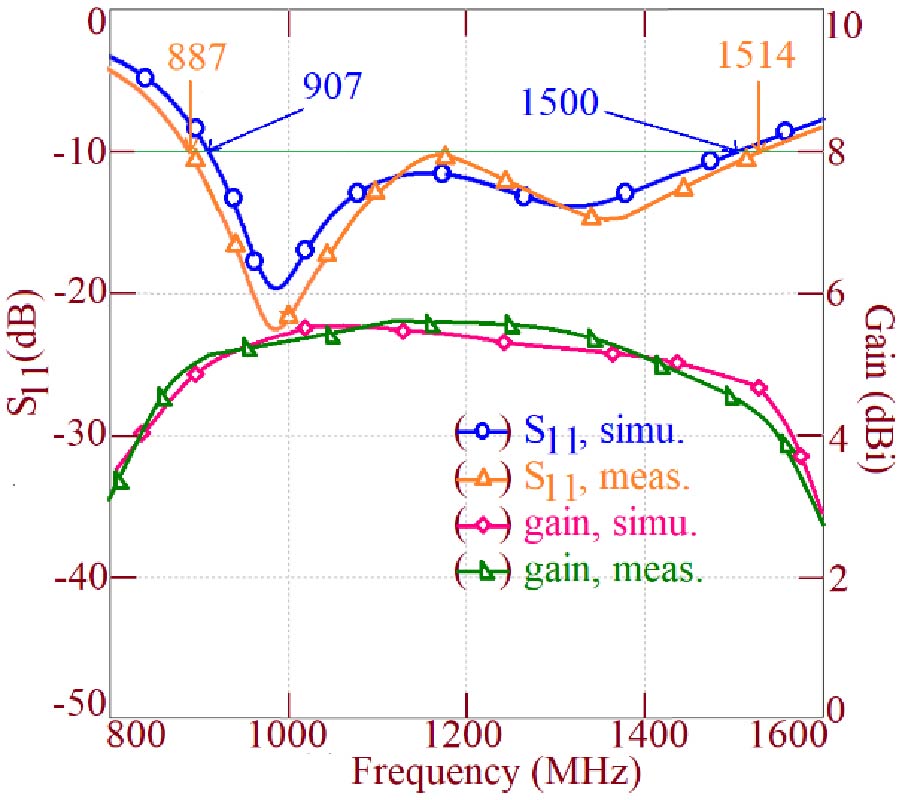
A compact broadband circularly-polarized (CP) patch antenna with a wide 3-dB axial-ratio (AR) beamwidth is proposed for universal ultra-high-frequency (UHF) radio frequency identification (RFID) applications. The proposed antenna consists of four triangular radiation patches and a compact feed network. Each of the radiation patches is grounded by shorting pins for 3-dB AR beamwidth enhancement and patch miniaturization. The feed network having a miniaturized hybrid coupler and two trans-directional couplers is proposed for good circular polarization. Measured results show that the -10-dB impedance bandwidth of the antenna is 18.4% (820-986 MHz); the 2.5-dB AR bandwidth is 32.8% (700-975 MHz); and the gain is 5.12 dBic. The measured 3-dB AR beamwidths for the planes of phi = 0° and phi = 45° are 177° and 190°, respectively. The overall antenna size is 0.408λ0 × 0.408λ0 × 0.053λ0 at 900 MHz.
A COMPACT BROADBAND CIRCULARLY-POLARIZED PATCH ANTENNA WITH WIDE AXIAL-RATIO BEAMWIDTH FOR UNIVERSAL UHF RFID APPLICATIONS
2021-05-18
PIER C
Vol. 112, 251-261
Triangular Shaped QMSIW Cavity Back Slot Antenna for Tri-Band Operation
Dokuparthi Jagadeesh and Alapati Sudhakar
In this paper, a triangle-shaped Quarter Mode Substrate Integrated Waveguide (QMSIW) cavity back slot antenna is developed using TE110, TE220, and TE310, 130 modes for tri-band operation. The QMSIW is obtained from the quadrant part of a square SIW (Substrate Integrated Waveguide) structure. The electric field distributions of resonant modes are studied for the Full Mode SIW, Half Mode SIW, and Quarter Mode SIW cavities through HFSS simulation tool. The generation of the hybrid mode TE310, 130 mode is clearly explained with the simulation tool. A rectangular slot is engraved on top layer of the structure along the perfect electric wall, to radiate the EM (Electro Magnetic) wave towards positive Z-direction. Further, a metallized via has been inserted to bring reflection coefficient below -10 dB at the three resonant modes. The developed antenna achieves resonance at 5.2 GHz, 9.88 GHz, and 10.6 GHz frequencies with peak gains of 9 dB, 6.2 dB, and 7.9 dB, respectively. The antenna is designed on a single layer thin substrate which reduces the fabrication complexity.
TRIANGULAR SHAPED QMSIW CAVITY BACK SLOT ANTENNA FOR TRI-BAND OPERATION