Search Results(13789)

2021-04-13
PIER C
Vol. 112, 21-34
Simultaneous Measurement of Temperature and Strain Using Multi-Core Fiber Within-Line Cascaded Symmetrical Ellipsoidal Fiber Balls-Based Mach-Zehnder Interferometer Structure
Farhan Mumtaz , Hongfeng Lin , Yutang Dai , Wenbin Hu , Muhammad Aqueel Ashraf , Lashari Ghulam Abbas , Shu Cheng and Pu Cheng
Simultaneous measurement of temperature and strain using multi-core fiber (MCF) with an in-line cascaded symmetrical ellipsoidal fiber balls structure of Mach-Zehnder interferometer (MZI) is presented. The sensor is fabricated by using an ordinary fusion apparatus. The thermo-coupling effect is realized through Germanium (Ge)-doped central and hexagonal distributed outer cores of MCF. A high-quality transmission spectrum is obtained with a fringe visibility of 12-15 dB and higher extinction ratio. The sensor exhibits superior mechanical strength compared with the fragile structures, such as tapered, etched, misaligned and offset fibers. The temperature sensitivity of 137.6 pm/°C and 68.1 pm/°C in the range of 20-90°C, and the strain sensitivity of -0.42 pm/με and -1.19 pm/με in the range of 0-801 με are obtained, when probe ``L'' is 40 mm and 20 mm, respectively. Simultaneous measurement of temperature and strain can be achieved by solving the coefficient matrix and tracing the wavelength shifts in the interference spectrum. Besides, the sensor has many advantages, such as high sensitivity, easy fabrication, simple structure, being stable and inexpensive, which may find potential applications in the field of optical sensing.
SIMULTANEOUS MEASUREMENT OF TEMPERATURE AND STRAIN USING MULTI-CORE FIBER WITHIN-LINE CASCADED SYMMETRICAL ELLIPSOIDAL FIBER BALLS-BASED MACH-ZEHNDER INTERFEROMETER STRUCTURE
2021-04-13
PIER C
Vol. 111, 257-269
A Tunable Diode-Based Reflective Analog Predistortion Linearizer for Microwave Power Amplifiers
Parsa Tahbazalli and Hossein Shamsi
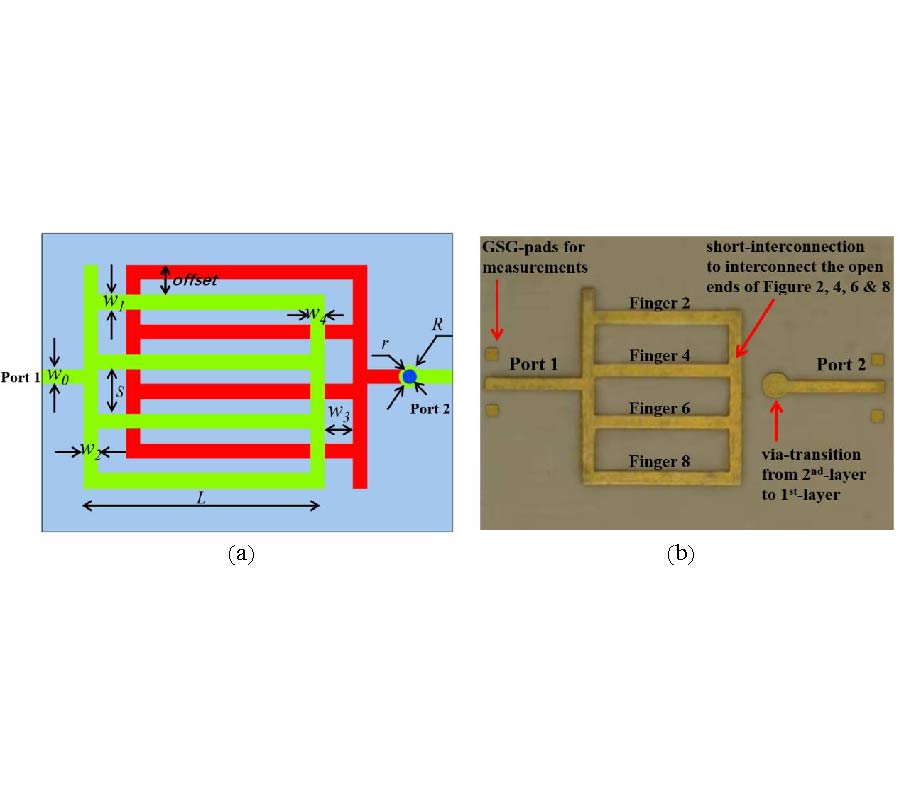
Analog predistortion is an efficient method for improving the linearity of power amplifiers. This paper presents a simple and tunable analog predistortion linearizer with low insertion loss, capable of reducing the non-linearity effects of microwave power amplifiers. The linearizer employs Schottky diodes as a distortion generator and does not require any additional matching circuit. By controlling the DC bias of the diodes, various combinations of characteristics can be obtained; therefore, this structure can be used to match different device behaviors. Experimental validation using a εr = 3.38, 20-mil thick Rogers substrate at the center frequency of 2 GHz shows that the fabricated linearizer can provide up to 7.5 dB gain expansion. The fractional bandwidth and insertion loss of the linearizer are 10% and 1.7 dB, respectively. The simulated and measured results are in good agreement with each other. To illustrate an approach for compensating the limited phase characteristics of the presented structure, the design and simulation of a dual-branch linearizer utilizing the reflective Schottky diode predistortion linearizer as a nonlinear unit are also presented.
A TUNABLE DIODE-BASED REFLECTIVE ANALOG PREDISTORTION LINEARIZER FOR MICROWAVE POWER AMPLIFIERS
2021-04-13
PIER M
Vol. 102, 53-63
Non-Iterative Microwave Imaging Solutions for Inverse Problems Using Deep Learning
Thathamkulam Agamanandan Anjit , Ria Benny , Philip Cherian and Palayyan Mythili
This paper describes a U-net based Deep Learning (DL) approach in combination with Subspace-Based Variational Born Iterative Method (SVBIM) to provide a solution for quantitative reconstruction of scatterer from the measured scattered field. The proposed technique can be used as an alternative to conventional time consuming and computationally complex iterative methods. This technique comprises of a numerical solver (SVBIM) for generating the initial contrast function and a DL network to reconstruct the scatterer profile from the initial contrast function. Further, the proposed technique is validated against theoretical and experimental results available from the literature. Root Mean Square Error (RMSE) value is used as the metric to measure the accuracy of the reconstructed image. The RMSE values of the proposed method show a significant reduction in the reconstruction error when compared with the recent Back Propagation-Direct Sampling Method (BP-DSM). The proposed method produces an RMSE value of 0.0813 against 0.1070 in the case of simulation (Austria Profile). The error value obtained by validating against the FoamDielExt experimental database in the case of the proposed method is 0.1037 against 0.1631 reported for BP-DSM method.
NON-ITERATIVE MICROWAVE IMAGING SOLUTIONS FOR INVERSE PROBLEMS USING DEEP LEARNING
2021-04-12
PIER Letters
Vol. 97, 95-103
Quad-Port Miniaturized Ultra-Wideband MIMO Antenna with Metal Vias
Qingzhi Yang , Kang Wang and Yufa Sun
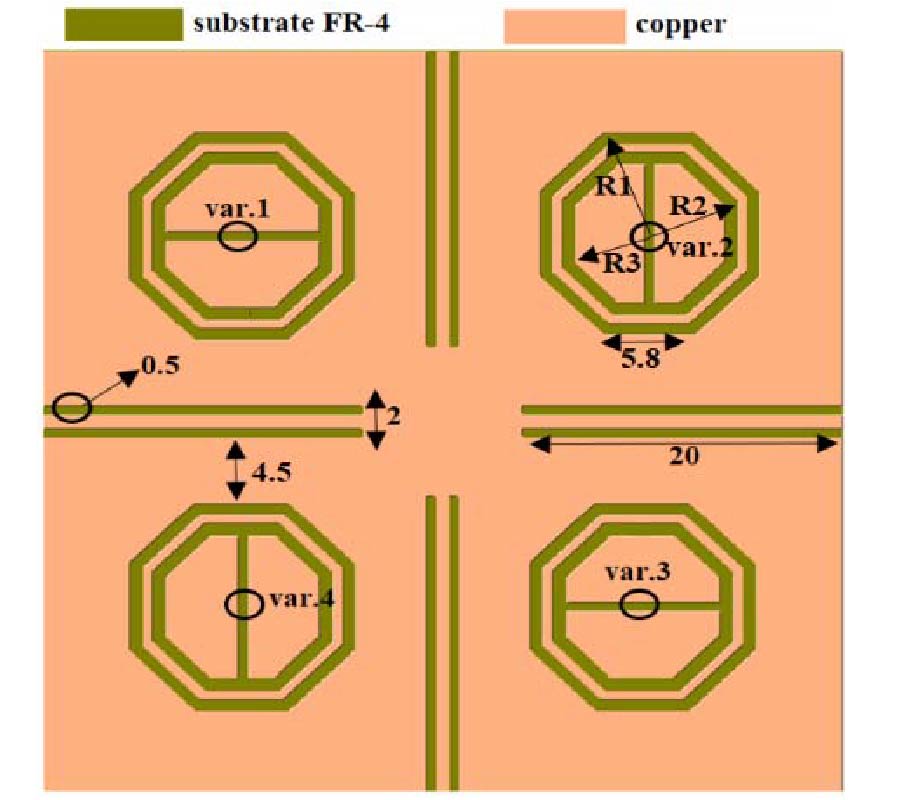
A miniaturized four-port multiple-input multiple-output (MIMO) antenna for ultra-wideband (UWB) applications is presented. The proposed UWB MIMO antenna has a compact size of 34 × 34 mm2. Four antenna elements are placed orthogonally, and the element is connected to the feed line through metal vias in the substrate. These metal vias increase the bandwidth of the high frequency part of the antenna. A T-shaped slit, a rectangular slit, and a triangular chamfer are etched on the ground between two adjacent antenna elements. The working bandwidth of the antenna is 2.5-11.6 GHz, covering the entire UWB application band. The isolation between antenna elements is more than 18 dB within the operating bandwidth. Details of the design methodology and results are presented and discussed. Envelope correlation coefficient is computed, and it is within the acceptable limit, which validates the design concept for building a compact MIMO antenna system with good performance.
QUAD-PORT MINIATURIZED ULTRA-WIDEBAND MIMO ANTENNA WITH METAL VIAS
2021-04-11
PIER C
Vol. 112, 11-20
Dual-Band Subharmonic Mixer for WiFi Application with Improved Conversion Loss and RF-to-IF Isolation
Kumari Pushpa and Jayanta Ghosh
A dual-band subharmonic mixer that employs both the second and fourth harmonics of a local oscillator signal in the mixing process is demonstrated for WIFI application. The design results in a simple and cost-effective mixer as it requires only one local oscillator (LO). A quarter-wave stepped impedance stub has been used to suppress both bands of radio frequency (RF) signal. The proposed dual-band subharmonic mixer is designed for two RF bands with the center frequencies at 2.45 GHz and 5 GHz using a single LO frequency at 1.3 GHz. For mixing purpose, the second and fourth harmonics of LO are utilized. Experimental measurements show high port-to-port isolation and achieve minimum conversion losses of 6.87 dB and 10.0 dB at 2.59 GHz and 5 GHz, respectively. The 3-dB RF bandwidth is 2.3 to 2.95 GHz for the second harmonic and 4.8 to 5.5 GHz for the fourth harmonic of LO signal. The input P1-dB compression points for two modes of the mixer are -9 dBm and -5 dBm, respectively. The RF-to-IF isolations are more than 18 dB (maximum 36 dB) and 20 dB (maximum 33 dB), over both the RF bands.
DUAL-BAND SUBHARMONIC MIXER FOR WIFI APPLICATION WITH IMPROVED CONVERSION LOSS AND RF-TO-IF ISOLATION
2021-04-11
PIER C
Vol. 111, 241-256
Wideband Dual Polarized Compact Design of Pi-Shape Microstrip Antenna for GSM, ISM, and Satellite Applications
Aarti G. Ambekar and Amit A. Deshmukh
The design of a compact Pi-shape microstrip antenna for dual-polarized wideband response is proposed. The Pi-shape geometry is realized by modifying a compact C-shape patch. The two stubs placed on the Pi-shape patch edge, optimize the spacing in between the higher order TM20 and TM30 modes with respect to the fundamental TM10 mode which yield a bandwidth of more than 430 MHz (>35%). On an air suspended substrate, antenna exhibits broadside gain of more than 5 dBi over the impedance bandwidth. The orthogonal surface current variations across the TM10, TM20 and TM30 modes realize polarization agility satisfying the requirements of GSM900/navigation satellite applications/ISM900. With respect to the band start frequency, the proposed configuration offers 11% reduction as compared with the equivalent rectangular microstrip antenna. Further, by defining the resonant length at each of the Pi-shape patch modes, the formulation for their resonant frequency is proposed. The Pi-shape antennas redesigned using them at the given fundamental mode frequency yield similar dual polarized wideband responses offering bandwidth of > 35%.
WIDEBAND DUAL POLARIZED COMPACT DESIGN OF PI-SHAPE MICROSTRIP ANTENNA FOR GSM, ISM, AND SATELLITE APPLICATIONS
2021-04-10
PIER M
Vol. 102, 39-51
Time-Domain Analysis for the Coupling Problem of Overhead Lines Above Multilayered Earth
Ayoub Lahmidi and Abderrahman Maaouni
This paper investigates the effect of an external plane wave on a Multi-conductor transmission line (MTL) located above a multilayer soil directly in the time domain. An improved finite-difference time-domain (FDTD) method is used, in conjunction with the Vector Fitting (VF), to obtain the recursion relations of voltages and currents along the line by discretizing the equations in time and one-dimensional space. The source terms of the coupling equations are efficiently obtained in the time domain based on the Gaver-Stehfest algorithm. An equivalent model is also established in this work, where the geometry with three conductors is reduced to two conductors. Finally, some examples are presented to illustrate the effect of the soil and the plane wave on the transient.
TIME-DOMAIN ANALYSIS FOR THE COUPLING PROBLEM OF OVERHEAD LINES ABOVE MULTILAYERED EARTH
2021-04-09
PIER C
Vol. 111, 225-239
Comparative Design and Analysis of a New Type of Mechanical-Variable-Flux Flux-Intensifying Interior Permanent Magnet Motor
Xiping Liu , Gaosheng Guo , Wenjian Zhu and Longxin Du
In this paper, a novel mechanical-variable-flux flux-intensifying interior permanent magnet (MVF-FI-IPM) motor is proposed, which employs a mechanical flux-adjusting device and owns the characteristic of Ld>Lq. The magnetic poles can be rotated by the mechanical device to vary the leakage flux and adjust the angle of magnetization direction relative to the d-axis. The characteristic of Ld>Lq is achieved through the adoption of surface flux barriers. The topology structure and operation principle of the machine are introduced. Then, the operation of the mechanical flux-adjusting device is analyzed by virtual prototype technology. Based on the two-dimensional finite element method (FEM), the electromagnetic characteristics of the proposed motor and FI-IPM motor are compared. Finally, the results show the proposed motor with a better flux-weakening capability and a lower risk of irreversible demagnetization than that of the FI-IPM motor.
COMPARATIVE DESIGN AND ANALYSIS OF A NEW TYPE OF MECHANICAL-VARIABLE-FLUX FLUX-INTENSIFYING INTERIOR PERMANENT MAGNET MOTOR
2021-04-08
PIER Letters
Vol. 97, 87-94
Highly Sensitive Polymer Based Fabry-Perot Interferometer for Temperature Sensing
Lashari Ghulam Abbas , Farhan Mumtaz , Yutang Dai , Ai Zhou , Wenbin Hu and Muhammad Aqueel Ashraf
A highly sensitive temperature sensor based on a polymer cavity of a Fabry-Perot interferometer (FPI) is experimentally demonstrated. The interferometer gives ease in fabrication, and it can be formed by the induction of a thermos-sensitive polymer layer in between two single mode fibers (SMFs). The polymer is used as an FPI cavity for temperature sensing. Due to high thermal expansion coefficient (TEC) and thermos-optic coefficient (TOC) of polymer make the interferometer highly sensitive to ambient temperature. The maximum temperature sensitivity of 2.2209 nm/°C for the polymer FPI cavity of 40.61 µm in the ambient temperature range of 28°C to 34°C is obtained. The proposed sensor shows the advantages of high sensitivity, compactness, simple fabrication, and low cost. Thus, it may become a part of various practical applications in the field of environmental science and engineering sciences.
HIGHLY SENSITIVE POLYMER BASED FABRY-PEROT INTERFEROMETER FOR TEMPERATURE SENSING
2021-04-08
PIER Letters
Vol. 97, 77-85
A Novel Miniaturized Bandpass Filter Basing on Stepped-Impedance Resonator
Man Zhang , Minquan Li , Pingjuan Zhang , Kaiyue Duan , Baokun Jin , Lichang Huang and Yawen Song
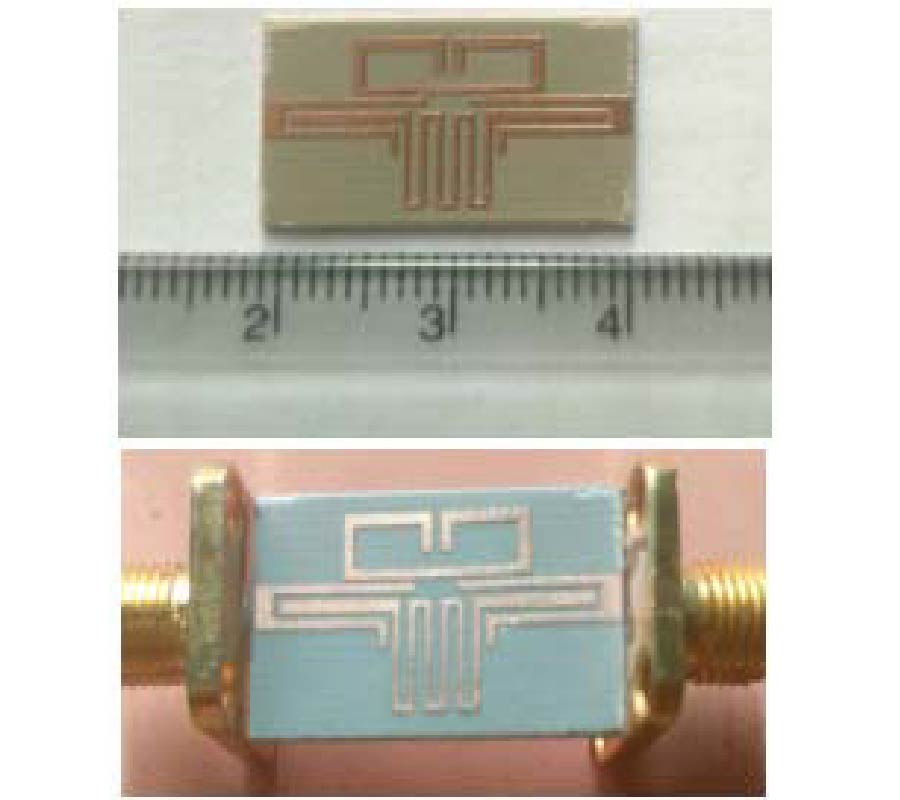
This paper proposes a novel miniaturized bandpass filter by loading a stepped-impedance resonator (SIR). Owing to the intrinsic characteristic of SIR, a third-order bandpass filter with SIR is presented, which has a size reduction of 38% compared with the conventional hairpin-line filter. On account of the electrical tape gap effect of a defected ground structure (DGS), further miniaturization is realized by introducing a pair of complementary split-ring resonator (CSRR) DGSs. Besides, frequency selectivity and out-of-band rejection can be improved by adding CSRR DGS and source-load (S-L) coupling structures, which produce two transmission zeros at two side band of passband respectively. The results show that the passband range is 3.4-3.6 GHz, and the final size is reduced by 50.3%.
A NOVEL MINIATURIZED BANDPASS FILTER BASING ON STEPPED-IMPEDANCE RESONATOR
2021-04-08
PIER C
Vol. 111, 207-224
MmWave/THz Reconfigurable Ultra-Wideband (UWB) Microstrip Antenna
Uri Nissanov and Ghanshyam Singh
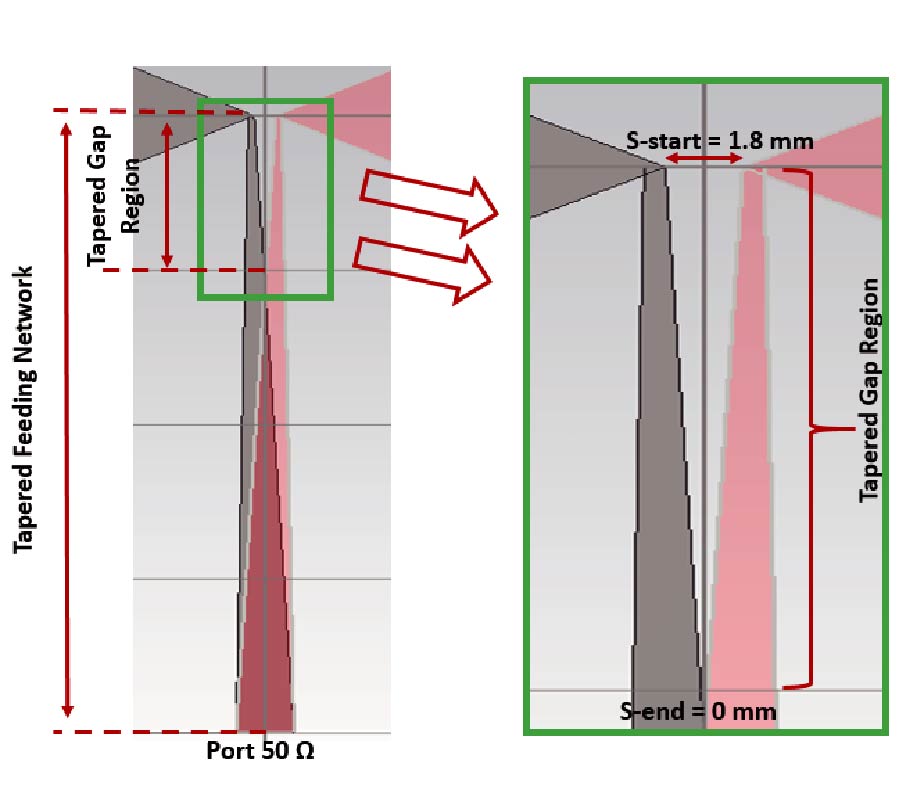
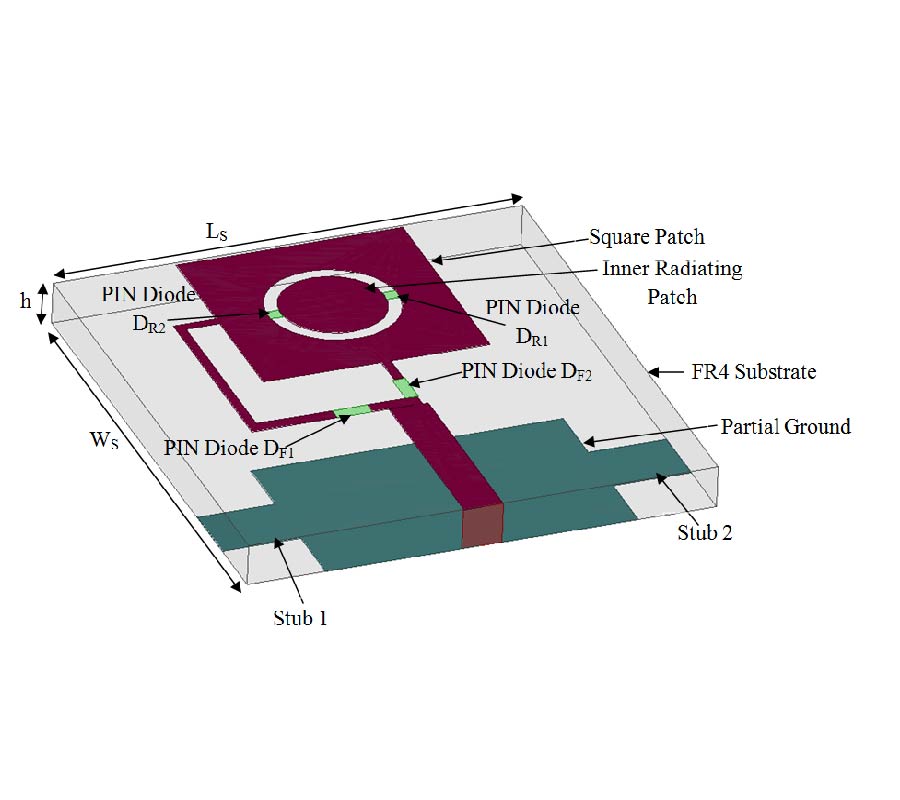
The concept of ultra-wideband (UWB) reconfigurable mmWave/THz microstrip antenna with a newfangled gold radiating patch with two PIN diodes installed on a benzocyclobutene (BCB) polymer is presented. The reconfigurable types of the proposed antenna are frequencies, bandwidths (BWs), and beams reconfigurations. This reconfigurable antenna was designed and simulated with the time-domain based on a FIT solver at the CST MWS solver, while the comparison was with the frequency-domain based onthe FEM solver at the CST MWS solver. The simulation results obtained from both solvers were in fair agreement, supporting the proposed antenna design. These antennas may be used in cellular communication at mmWave/THz band for beyond 5G.
MMWAVE/THZ RECONFIGURABLE ULTRA-WIDEBAND (UWB) MICROSTRIP ANTENNA
2021-04-07
PIER Letters
Vol. 97, 69-76
Comparative Analysis of Electromagnetic Performance of Magnetic Gear
Xiaocun Huang , Yuxiu Guo and Libing Jing
In order to investigate the influence of different magnetization modes on the electromagnetic performance of magnetic gear, four models of magnetic gear with different magnetization modes are established. The finite element method is used to simulate the four models and compare their performances. The distribution of magnetic flux lines, air gap magnetic field, harmonic distribution, static torque and dynamic torque are calculated, respectively. The simulation results show that the coaxial magnet gear with Halbach array has larger air gap flux density amplitude, smaller air gap harmonic content and higher output torque than the other three kinds of magnetic gears.
COMPARATIVE ANALYSIS OF ELECTROMAGNETIC PERFORMANCE OF MAGNETIC GEAR
2021-04-07
PIER C
Vol. 111, 191-206
Finite Element Method Based Design and Analysis of a Low Torque Ripple Double-Stator Switched Reluctance Motor
Tripurari Das Gupta and Kalpana Chaudhary
Double-stator switched reluctance motors (DSSRMs) acquire attention because of their high torque/power generating capability compared to conventional and segmented rotor switched reluctance motors. One of the main limiting performance indices of such motors for industrial applications is its high torque ripple. This paper proposes a 12/10/12 pole DSSRM with an angular shift of half of the stroke angle between inner and outer stators. The respective phase windings of the inner and outer stators are parallelly excited with the same phase angle shift to reduce the torque ripple. Each rotor segment is constructed with a pair of half rotor segments that are isolated from each other through the insertion of a non-magnetic isolator between them. Firstly, the design hypothesis for a low torque ripple DSSRM has been presented; thereafter, some geometric modifications have been suggested and investigated to obtain a nearby response in the proposed DSSRM. The calculation of the width of the non-magnetic isolator, modification in the pole height of outer stator and modification in the arc angles of rotor segments/stator poles are discussed in detail. The effectiveness of the proposed motor is investigated through a 2D finite-element modelling and simulation in ANSYS/MAXWELL software. Simulation results show that the torque ripple is significantly reduced by 74.9% in the proposed DSSRM compared to the baseline DSSRM.
FINITE ELEMENT METHOD BASED DESIGN AND ANALYSIS OF A LOW TORQUE RIPPLE DOUBLE-STATOR SWITCHED RELUCTANCE MOTOR
2021-04-06
PIER Letters
Vol. 97, 61-68
Design of Low Profile Multiband Reflective Polarization Converter for Both Linear and Circular Polarized Waves
Surya Durga Padmaja Bikkuri and Alapati Sudhakar
This paper presents a multifunctional metasurface based reflective polarization converter, to convert the polarization of incident electromagnetic wave in three adjacent frequency bands. In the first band linear to circular polarization conversion and in the remaining two bands linear to orthogonal polarization conversion is achieved. The designed metasurface consists of two circular split rings and a star-shaped split resonator which is fabricated on a metal-backed dielectric substrate. From the simulation results, it is evident that the orthogonal linear polarization conversion band is observed at 9.2 GHz and 12.8 GHz with a polarization conversion ratio of more than 92%. Similarly, it is identified that the same metasurface converts the incident linear polarized wave to circularly polarized wave at 7.3 GHz. Furthermore, the proposed metasurface maintains the handedness of the circularly polarized incident wave at 9.2 & 12.8 GHz frequency upon reflection. The proposed multifunctional polarization converter has a simple planar geometry and low profile which can be used in many applications, such as reflector antennas, imaging systems, remote sensors, and radiometers.
DESIGN OF LOW PROFILE MULTIBAND REFLECTIVE POLARIZATION CONVERTER FOR BOTH LINEAR AND CIRCULAR POLARIZED WAVES
2021-04-06
PIER C
Vol. 111, 173-189
Design of a 3-Port Compact MIMO Antenna Based on Characteristics Mode Analysis Approach
Asutosh Mohanty and Bikash Ranjan Behera
In this paper, a 3-port compact MIMO antenna is designed using Characteristics Mode Analysis (CMA). It consists of three antenna elements. Ant-1 is 45˚ tilted, and Ant-2 and Ant-3 has L-bend transitions. Ant-2 is 1/4th, and Ant-3 is 1/2 in size w.r.t. Ant-1. To improve 10-dB impedance bandwidth and isolation > 17 dB, fractal slot is etched at bottom, and deformity in antenna structures has three distinct modes. Ant-1 operates in UWB mode from (4.8-10.6) GHz with 75.32% IBW, and Ant-2 and Ant-3 operate in wide-band mode from (8.1-10.8) GHz with 28.57% IBW and from (7.2-9.8) GHz with 30.58% IBW. CMA is utilized to investigate the anonymous behaviour of antenna, predicts modal significance (MS), characteristics angle (CA) and eigen values (EV). From these parameters bandwidth potential, radiation energy source and Q-factor are estimated. For investigations first six modes are swept in modal navigator, where dominant modes are traced as ideal antenna resonant modes, and unwanted modes are neglected. The antenna gain is (3-7) dBi with ECC < 0.08. The proposed antenna is fabricated and measured for validation. From the outcomes, it is found suitable for UWB, air traffic and defense tracking, meteorological, amateur satellite, maritime vessel traffic controlling, and X-band satellite applications.
DESIGN OF A 3-PORT COMPACT MIMO ANTENNA BASED ON CHARACTERISTICS MODE ANALYSIS APPROACH
2021-04-06
PIER M
Vol. 102, 27-37
A CPW-Fed UWB-MIMO Antenna with High Isolation and Dual Band-Notched Characteristic
Jian-Yong Zhou , Yanfei Wang , Jia-Ming Xu and Chengzhu Du
A coplanar waveguide (CPW) fed multiple-input multiple-output (MIMO) ultra-wideband (UWB) antenna with high isolation and dual band-notched characteristic is proposed. The antenna consists of two orthogonal circle patches. An annular SRR slot and a rectangular SRR slot are added on the patches to produce two notched bands. High isolation is successfully acquired by adopting a double Y-shaped branch between the two radiation elements. By cutting the fractional substrate, the antenna size has been reduced by 31.4 percent. The measured results show that the working bandwidth of the antenna covers 2.36-12 GHz, and at the same time, the notched bands cover 3.37 GHz-3.98 GHz and 4.71 GHz-5.51 GHz. The isolation is better than 21 dB. The paper also studies the radiation pattern, peak gain, and envelope correlation coefficient (ECC) of the UWB MIMO antenna.
A CPW-FED UWB-MIMO ANTENNA WITH HIGH ISOLATION AND DUAL BAND-NOTCHED CHARACTERISTIC
2021-04-05
PIER C
Vol. 111, 163-172
A q-Band Current-Reused Low Noise Amplifier with Simultaneous Noise and Input Matching
Chunshuang Xie , Peng Wu , Zhongjun Yu and Cheng Tan
In this paper, a Q-band GaAs low noise amplifier (LNA) for satellite communications is presented. The LNA is designed using common-source (CS) topology, self-biased configuration and current-reused technology. Simultaneous noise and input matching are achieved by employing source series inductance. The current-reused LNA is fabricated in a 90 nm GaAs pseudomorphic high electron mobility transistor (pHEMT) process. On-wafer measurement results show that the LNA features a small-signal gain of 23.8~24.5 dB, noise figure (NF) of 2~2.1 dB, and output 1-dB compression point (OP1 dB) of 6.6~8 dBm over 36~42 GHz, while consuming 10.9 mA with a supply voltage of 5 V. The chip size is 1.6×0.8 mm2 including all RF and dc pads.
A Q-BAND CURRENT-REUSED LOW NOISE AMPLIFIER WITH SIMULTANEOUS NOISE AND INPUT MATCHING
2021-04-03
PIER
Vol. 170, 129-152
L-Band Radar Scattering and Soil Moisture Retrieval of Wheat, Canola and Pasture Fields for SMAP Active Algorithms
Huanting Huang , Tien-Hao Liao , Seung Bum Kim , Xiaolan Xu , Leung Tsang , Thomas J. Jackson and Simon Yueh
Wheat, canola, and pasture are three of the major vegetation types studied during the Soil Moisture Active Passive Validation Experiment 2012 (SMAPVEX12) conducted to support NASA's Soil Moisture Active Passive (SMAP) mission. The utilized model structure is integrated in the SMAP baseline active retrieval algorithm. Forward lookup tables (data-cubes) for VV and HH backscatters at L-band are developed for wheat and canola fields. The data-cubes have three axes: vegetation water content (VWC), root mean square (RMS) height of rough soil surface and soil permittivity. The volume scattering and doublebounce scattering of the fields are calculated using the distorted Born approximation and the coherent reflectivity in the double-bounce scattering. The surface scattering is determined by the numerical solutions of Maxwell equations (NMM3D). The results of the data-cubes are validated with airborne radar measurements collected during SMAPVEX12 for ten wheat fields, five canola fields, and three pasture fields. The results show good agreement between the data-cube simulation and the airborne data. The root mean squared errors (RMSE) were 0.82 dB, 0.78 dB, and 1.62 dB for HH, and 0.97 dB, 1.30 dB, and 1.82 dB for VV of wheat, canola, and pasture fields, respectively. The data-cubes are next used to perform the time-series retrieval of the soil moisture. The RMSEs of the soil moisture retrieval are 0.043 cm3/cm3, 0.082 cm3/cm3, and 0.082 cm3/cm3 for wheat, canola, and pasture fields, respectively. The results of this paper expand the scope of the SMAP baseline radar algorithm for wheat, canola, and pastures formed and provide a quantitative validation of its performance. It will also have applications for the upcoming NISAR (NASA-ISRO SAR Mission).
L-BAND RADAR SCATTERING AND SOIL MOISTURE RETRIEVAL OF WHEAT, CANOLA AND PASTURE FIELDS FOR SMAP ACTIVE ALGORITHMS
2021-04-03
PIER C
Vol. 111, 147-162
Nonuniform Circular Array Synthesis for Low Side Lobe Level Using Dynamic Invasive Weeds Optimization
Elhadi Kenane , Fadila Benmeddour and Farid Djahli
The use of invasive weeds optimization in the synthesis of antenna arrays has become popular in the last few years. This optimization method is robust, simple and can be easily improved. Like other stochastic algorithms, IWO suffers from premature convergence and other drawbacks. To overcome these problems, a dynamic IWO is proposed and used for synthesizing two antenna array topologies (linear and circular array). This proposed method tries to achieve an optimal array pattern by acting on the amplitude excitation of elements in the non-uniform circular array and their positions on the array to obtain an array pattern with deep nulls in some directions of interferences and low side lobe level. For the linear array, the nulls control can be achieved by acting on the relative amplitude excitation of each element in the array for an optimal inter-element spacing. This proposed method improves the performance greatly and allows to achieve a maximum reduction in side lobe level in band Nulls with an acceptable dynamic range ratio (DRR). To show the performance of the proposed method, for each topology, our results are compared to other results of the literature.
NONUNIFORM CIRCULAR ARRAY SYNTHESIS FOR LOW SIDE LOBE LEVEL USING DYNAMIC INVASIVE WEEDS OPTIMIZATION
2021-04-01
PIER M
Vol. 102, 13-26
Scattering Characteristics of Ultra-High-Voltage Power Lines in Spaceborne SAR Images
Shuzhu Shi , Ailing Hou , Yan Liu , Lei Cheng and Zhiwei Chen
Owing to its all-day and all-weather imaging capabilities, high-resolution spaceborne synthetic aperture radar has shown great potential for the effective monitoring of wide-area, ultra-high-voltage (UHV) transmission lines. Scattering characteristics of UHV power lines in 3-m-resolution TerraSAR-X images is analyzed in this paper. First the study area and structure of the UHV transmission line are introduced. Then, the data processing method is described, which includes the preprocessing of TerraSAR-X images and target feature extraction. Finally, the scattering characteristics of the UHV power line are analyzed, and the analysis results demonstrate that the UHV power line can be visible in a TerraSAR-X image only when the angle between its extension direction and the azimuth of the sub-satellite ground track is within ±15°. Furthermore, besides the span length, the spatial location of the UHV power line in a TerraSAR-X image is also influenced by the angle between its extension direction and the azimuth of the sub-satellite ground track, as well as by the height difference between adjacent pylons.
SCATTERING CHARACTERISTICS OF ULTRA-HIGH-VOLTAGE POWER LINES IN SPACEBORNE SAR IMAGES