Search Results(13790)

2019-07-23
PIER Letters
Vol. 86, 21-26
Electromagnetic Shielding Effectiveness of Gypsum-Magnetite Composite at X-Band Frequency
Mohamad Ashry Jusoh , You Kok Yeow , Rodziah Nazlan and Fahmiruddin Esa
Rapid development of the electronic industry has increased the frequency of communication devices which lead to higher intensity of electromagnetic (EM) wave production. Too much exposure of EM wave can cause harm to health besides imposing disturbances in performances of other electronic devices. Hence, this research studies the structural and electromagnetic properties of materials that can act as electromagnetic shielding material at x-band frequency. Different compositions of magnetite powder/Fe3O4 (0, 10, 20 and 100 wt.%) were prepared to be dispersed in gypsum powders to form gypsum-magnetite composites. The structural properties of composites were characterized using Scanning Electron Microscopy (SEM) to observe homogeneity of the composites. The X-Ray Diffraction (XRD) was used to determine phase composition of the gypsum-magnetite composites. Scattering parameters of reflection coefficient, S11, and transmission coefficient, S21, were measured using Vector Network Analyzer (VNA). These parameters will be used to calculate the shielding effectiveness (SE) of gypsum-magnetite composite at x-band frequency. The results show that the total SE of the gypsum-magnetite composites were increased by adding magnetite powders.
ELECTROMAGNETIC SHIELDING EFFECTIVENESS OF GYPSUM-MAGNETITE COMPOSITE AT X-BAND FREQUENCY
2019-07-23
PIER B
Vol. 85, 49-63
Geomagnetic Field Perturbations Resulted from Tsunami Wave Impact on the Ionosphere
Valery M. Sorokin , Alexey K. Yashchenko and Vadim V. Surkov
The generation mechanism of the geomagnetic field perturbations associated with tsunami wave propagation in ocean is examined. The geomagnetic perturbations are produced by electric currents generated in both the seawater and conductive layers of the ionosphere. The electric current in conductive seawater is caused by the seawater motion due totsunami wave propagation whereas the current in the ionospheric plasmais generated by acoustic gravity wave (AGW) incident on the ionosphere from the atmosphere. The AGW is originated from vertical displacements of seawater surface due to the tsunami wave propagation. Although the ionospheric plasma conductivity is much lower than the seawater conductivity, the electric current in the ionosphere can be greater than that in the seawater due to an exponential increase of amplitude of the upward-propagating AGW. Our calculations are indicative of the possibility of space monitoring of tsunami wave based on onboard measurements of the geomagnetic field perturbations.
GEOMAGNETIC FIELD PERTURBATIONS RESULTED FROM TSUNAMI WAVE IMPACT ON THE IONOSPHERE
2019-07-23
PIER M
Vol. 83, 83-92
A Design Oriented Linear Model for CRLH Distributed Oscillators
Giancarlo Bartolucci , Stefan Simion and Lucio Scucchia
The aim of this paper is to present a model for a Composite Right-/Left-Handed (CRLH) distributed oscillator. A linear approach is used for the analysis of the circuit. The effects of the losses and of the parasitic elements, both present in the active devices and in the passive components, are included. Analytic formulas for the design of the transmission lines used in the oscillator are given. The model is validated by means of a comparison with previously published measured data.
A DESIGN ORIENTED LINEAR MODEL FOR CRLH DISTRIBUTED OSCILLATORS
2019-07-22
PIER C
Vol. 94, 145-159
Analysis of Hexagonal Wide Slot Antenna with Parasitic Element for Wireless Application
Barun Kumar , Bhupendra Kumar Shukla , Ajay Somkuwar and Om Prakash Meena
A rigorous analysis of hexagonal slot with electromagnetically coupled parasitic element is presented in this article. The wide band feature of the antenna highly depends on the shape and location of the parasitic element and tuning stub. It is found that tuning and overlapping of resonating modes at lower frequency band are mainly achieved by parasitic element. The proposed antenna exhibits the bandwidth of 120.83% from 1.45 to 5.8 GHz for S11<-10 dB. The parameters of the antenna and circuit model are studied. The role of individual resonators in circuit modeling is also explained. Series of equations for lower cutoff frequency and other resonating frequencies are deduced after inspecting the surface current distribution. At frequencies 2.27, 4.17, and 5.2 GHz, the simulated and measured far fields are compared.
ANALYSIS OF HEXAGONAL WIDE SLOT ANTENNA WITH PARASITIC ELEMENT FOR WIRELESS APPLICATION
2019-07-22
PIER C
Vol. 94, 131-144
Ultra Wide Band CPW Fed Patch Antenna with Fractal Elements and DGS for Wireless Applications
Anurima Majumdar , Sisir Kumar Das and Annapurna Das
This article describes multiresonance behaviour to achieve ultra-wideband (UWB) characteristics of a co-planar waveguide (CPW) fed circular patch antenna with a ground plane reflector by using fractal elements and rectangular defective ground structure (RDGS) technique. The patch consists of a circular disc with six ring type fractal elements on the periphery of the disc and slotted defective ground surface (DGS) at the bottom of an FR4_epoxy dielectric substrate to increase the antenna bandwidth. The antenna resonates at frequencies of 5.4 GHz, 9 GHz, & 10.8 GHz with return loss better than -20 dB. The proposed antenna also exhibits UWB characteristics with (≤ -10 dB) impedance bandwidth of 170.4% in the frequency range from 1.8 GHz to 11 GHz. This covers the whole UWB range from 3.1 GHz to10.6 GHz as defined by FCC. The antenna exhibits nearly omnidirectional radiation pattern and a gain ranging from 1 dBi to 6.8 dBi within the operating frequency range (1.8 GHz-11 GHz). An equivalent circuit model of the proposed antenna is developed, and the circuit response is obtained. All the measured results are found in good agreements with the simulated ones. The proposed antenna is suitable for applications in Wi-Fi, IEEE 802.11a Wireless LAN, WiMAX, ISM bands, wireless communications, etc.
ULTRA WIDE BAND CPW FED PATCH ANTENNA WITH FRACTAL ELEMENTS AND DGS FOR WIRELESS APPLICATIONS
2019-07-22
PIER B
Vol. 85, 27-48
Step-Like Structures in Electrostatic and Electrodynamic Implementation of Method of Moments: Some Unique Observations
Junbo Wang and Yahya Rahmat-Samii
Step-like perfect electric conductor (PEC) structures are studied in both electrostatic and electrodynamic cases implementing Method of Moments. The canonical geometries included in these step-like structures such as edges, wedges and corners as well as the unique charge and current behaviors are characterized and discussed. Both 2D and 3D electrostatic problems are studied. In 2D electrostatic problem, a constant is introduced to the traditional 2D Green's function which effectively adjusts the zero potential reference embedded in the Green's function. This modification alleviates the contradiction between 2D and 3D definitions of electrostatic quantities and avoids unrealistic charge solutions obtained by Method of Moments. In 2D electrodynamic problem, the occasional appearance of singular surface current near the step's right angle bends is observed, discussed and then linked with the analytical solution of a canonical wedge scattering problem. Physical Optics approximation is also utilized as a comparison to Method of Moments in solving the 2D scattering problems.
STEP-LIKE STRUCTURES IN ELECTROSTATIC AND ELECTRODYNAMIC IMPLEMENTATION OF METHOD OF MOMENTS: SOME UNIQUE OBSERVATIONS
2019-07-22
PIER M
Vol. 83, 73-82
A Space-Frequency Anti-Jamming Algorithm Based on Sub-Band Energy Detection
Ruiyan Du , Jiaqi Yang , Lei Liu , Fulai Liu and Hui Song
For most of space-frequency joint anti-jamming algorithms, the solution of adaptive steering vector is a high complexity problem. To solve this issue, a space-frequency combined anti-jamming algorithm based on sub-band energy detection (SF-SED) is proposed. At first, the algorithm performs fast Fourier transform (FFT) on the received data of the array antenna and obtains multi-snapshot data of each sub-band through sub-band decomposition. Then, the interference detection statistic and decision threshold are constructed by the energy of the sub-band to judge whether there is an interference in each sub-band. Finally, different methods are used to solve the adaptive weights of the two types of sub-bands according to sub-band classification results. Compared with the related work, the proposed algorithm not only has lower computational complexity, but also has higher output signal-to-interference-and-noise ratio. Theoretical analysis and simulation results demonstrate the anti-jamming performance of the proposed method.
A SPACE-FREQUENCY ANTI-JAMMING ALGORITHM BASED ON SUB-BAND ENERGY DETECTION
2019-07-22
PIER M
Vol. 83, 63-71
An Omnidirectional Resonator for Wireless Power Transfer
Yangjun Zhang and Masaki Obata
Angular misalignment is an issue for many potential wireless power transfer (WPT) applications. This paper proposes a resonator as an effort to solve this issue. In the beginning, this paper gives an example of quantitative coupling analysis on angular misalignments. Then, it proposes an omnidirectional resonator for electromagnetic coupling WPT system. The proposed resonator is based on the structure of a regular polyhedron. It is constructed of four planar spiral resonators arranged as a regular tetrahedron. The coupling between the proposed resonator and a planar spiral resonator is verified. Both the simulated and measured results show that the coupling coefficient can be kept at a certain level when the omnidirectional resonator rotates around all x, y, and z axes regardless of the orientation of the planar spiral resonator respect to the omnidirectional resonator.
AN OMNIDIRECTIONAL RESONATOR FOR WIRELESS POWER TRANSFER
2019-07-22
PIER M
Vol. 83, 51-61
Inductively-Tuned k/Ka Band RF MEMS Capacitive Switches
Hao Wei , Shiwang Jia and Zhongliang Deng
This paper designs, fabricates, and analyzes an inductively-tuned K/Ka band RF MEMS (Radio frequency micro-electro-mechanical-systems) capacitive switches. The MEMS switch employs a defect ground structure (DGS) and an air bridge. Two different MEMS switches, one with air bridges and the other not, are designed. Surface current distribution results of MEMS switches in different states are simulated and discussed. A novel actuation voltage's calculation approach of MEMS switch is proposed. Measured results indicate that the type MEMS switch's actuation voltage is 20 V. For the MEMS switch without air bridges, the isolation is more than 15 dB at 12.5~20 GHz, and the insertion loss is less than 0.28 dB up to 20 GHz. For the MEMS switch with integrated air bridges, the isolation is more than 15 dB at 18.3~40 GHz, and the insertion loss is less than 0.64 dB up to 40 GHz. Circuit models and measured results of the proposed MEMS switches show good agreements. The pull-in and release time of this switch are 99 μs and 49 μs, and the lifetime of this type of switch is more than three million.
INDUCTIVELY-TUNED K/KA BAND RF MEMS CAPACITIVE SWITCHES
2019-07-21
PIER Letters
Vol. 86, 13-19
Dual-Band Microstrip Filtering Antennas with Symmetrical Slots
Jianfang Deng and Lanping Feng
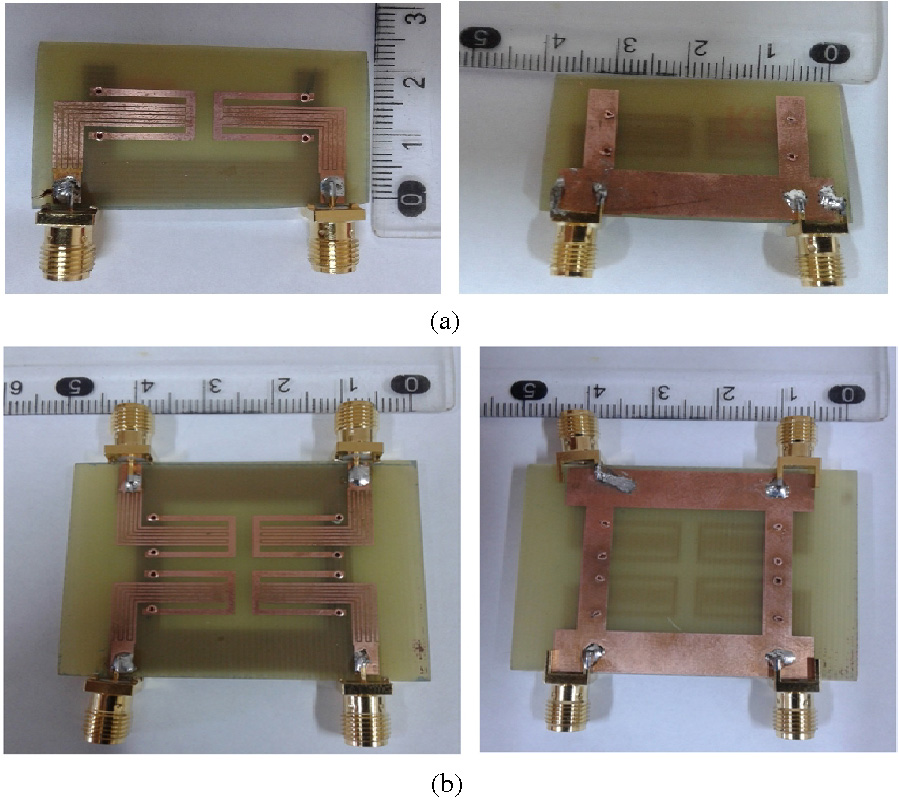
Two dual-band microstrip antennas with filtering responses are proposed in this letter. By introducing symmetrical slots (One is a U-shaped slot, and the other is an inverted H-shaped slot) at the edge of rectangle patches, additional resonant modes are induced, and both of the antennas have dual operation bands. More importantly, extra radiation nulls are observed between the two bands. In addition, the proposed antennas are fed by microstrip lines with two pairs of symmetrical open stubs, which offer two more radiation nulls at low frequencies. Thus, dual-band filtering responses for the proposed antennas are obtained. Simulated and measured results show good agreements with unidirectional radiation patterns, as well as high selectivity of realized gains.
DUAL-BAND MICROSTRIP FILTERING ANTENNAS WITH SYMMETRICAL SLOTS
2019-07-21
PIER Letters
Vol. 86, 7-12
A Compact Dispersive Delay Line Using Microstrip Lines and Opened Slot Lines
Yujie Li , Jiade Yuan , Shiji Wu and Zhimeng Xu
A dispersive delay line (DDL) with compact size, good group delay, and all pass response in 200-800 MHz band is presented. The proposed DDL is composed of a main microstrip transmission line with two shunted open stubs and two complementary slot lines, and a coupling slot line in ground plane. The length of the complementary slot line is reduced approximately from λg/2 to λg/4 through the upper end being opened, hence achieves miniaturization for the proposed DDL (λg is the guided wavelength at the center frequency). The overall area is 0.196×0.093λg2 with a peak group delay time of 3.2 ns. The proposed DDL has the advantages of compactness, good capability, and easy fabrication without any external matching network.
A COMPACT DISPERSIVE DELAY LINE USING MICROSTRIP LINES AND OPENED SLOT LINES
2019-07-17
PIER C
Vol. 94, 119-130
HF Skywave Polarized MIMO Channels with Oblique One-Hop Paths
Umaisaroh Umaisaroh , Gamantyo Hendrantoro and Varuliantor Dear
The presence of the O and X modes in the HF skywave propagation has previously been investigated experimentally for their role in providing polarization diversity and improving channel capacity when a MIMO structure is employed. A mathematical treatment of MIMO channel modelling and capacity improvement has also been reported but limited to NVIS links only. This paper reports the mathematical derivation of the HF 2×2 polarized MIMO channels when cross-dipoles, i.e., a pair of orthogonally polarized horizontally-oriented dipoles, are used at both ends to examine the cross-polarization property and the capacity improvement factor (CIF), with the transmitter-receiver range being near enough to allow single-hop paths only but also distant enough to make the trajectory oblique. Results on the cross-polarization property suggest that the power contributions of the waves from the two transmitters that arrive at each receiver are equal. In addition, the signal from any one of the transmitters is received by the two receivers with unbalanced powers that depend on the phase shift difference between the O and X paths. It is also observed that on average the MIMO channels with oblique paths have lower capacity than the NVIS MIMO channels due to the reduced orthogonality between polarizations of antennas in the dual-antenna system at each end. The above hypotheses are confirmed through ray-tracing simulation and field measurement over a 575 km HF radio link.
HF SKYWAVE POLARIZED MIMO CHANNELS WITH OBLIQUE ONE-HOP PATHS
2019-07-17
PIER C
Vol. 94, 103-117
Tapered Antenna Beam with Cosmological Far-off Retrieval on Fracto-Sun Signatures and Surfaces Gaits Approachability
Riaz Ahmed Soomro , Liguo Sun and Zipeng Xie
Space Sensing Models promulgates the channeling sequels of interstellar environs. A fractal array with sun-shaped irregular molds has arisen to solar activities by interchangeably pointing in the direction of sun and off source with beam swapping, whilst weighing the sun's position (psi, phi)-space (phi demarcates the antenna azimuth proportionate to north, psi contours the beam elevation over horizon) and its solid radioactivity hoarded in the antenna's beam width. The research feedback has incidents of solar fluxes and brightness temperatures to depict sun's activity. Phenomenally, nature-space fractals have been crucial quintessence in intuiting sun's after math pertaining to weather and biological sways {Weierstrass C(x,y)} on landscape, swirling with fractal clock underpinning magnetic flipping and irradiance fluctuations at phase vicissitudes have periodically wedged on territory. The remote alliance algorithms with random fractal contours have subsidized paths of self-affine topographic surfaces and space-earth stoichiometry. In this paper, antenna solar scan corollaries at X-band to detect the solar activity on fractal boresight physiognomies of 3-dB HPBW around 0.5° solar diameter with 36° crest atmospheric stray radiations (SLL) rope inpetite sidelobes 60˚ near the core flamboyant region, return loss S11<-10 dB at X/Ku-band on horizontal and vertical tilting bearings have been estimated.
TAPERED ANTENNA BEAM WITH COSMOLOGICAL FAR-OFF RETRIEVAL ON FRACTO-SUN SIGNATURES AND SURFACES GAITS APPROACHABILITY
2019-07-17
PIER B
Vol. 84, 171-187
Full Wave Indoor Propagation Modelling Using the Volume Integral Equation
Ian Kavanagh and Conor Brennan
The transition towards next generation communications has increased the need for fast and accurate propagation models that can predict all aspects of the wireless channel. This paper develops a very accurate approach for indoor propagation modelling based on the volume electric field integral equation (VEFIE). The three-dimensional form of the VEFIE is used to predict frequency domain characteristics. Whilst, a 2D to 3D model is developed based on the 2D VEFIE to perform accurate and efficient time domain predictions. The 2D to 3D model applies correction terms to the solution of the 2D VEFIE to account for three-dimensional propagation. Both models are compared against frequency and time domain measurements as well as popular empirical models for both scenarios.
FULL WAVE INDOOR PROPAGATION MODELLING USING THE VOLUME INTEGRAL EQUATION
2019-07-17
PIER B
Vol. 84, 153-170
PCE-Based Approach to Worst-Case Scenario Analysis in Wireless Telecommunication Systems
Piotr Gorniak and Wojciech Bandurski
In the paper, we present a novel PCE-based approach for the effective analysis of worst-case scenario in a wireless telecommunication system. Usually, in such analysis derivation of polynomial chaos expansion (PCE meta-model) of a considered EM field function for one precise set of probability densities of random variables does not provide enough information. Consequently, a number of PCE meta-models of the EM field function should be derived, each for the different joint probability density of a vector of random variables, e.g., associated with different mean (nominal) values of random variables. The general polynomial chaos (gPC) approach requires numerical calculations for each PCE meta-model derivation. In order to significantly decrease the time required to derive all of the PCE meta-models, the novel approach has been introduced. It utilizes the novel so-called primary approximation and the novel analytical formulas. They significantly decrease the number of numerical calculations required to derive all of the PCE meta-models compared with the gPC approach. In the paper, we analyze the stochastic EM fields distributions in a telecommunication system in a spatial domain. For this purpose, analysis of uncertainties associated with a propagation channel as well as with transmitting and receiving antennas was introduced. We take advantage of a ray theory in our analysis. This allows us to provide the novel method for rapid calculation of a PCE meta-model of a telecommunication system transfer function by using the separate PCE meta-models associated with antennas and a propagation channel.
PCE-BASED APPROACH TO WORST-CASE SCENARIO ANALYSIS IN WIRELESS TELECOMMUNICATION SYSTEMS
2019-07-17
PIER M
Vol. 83, 41-50
Bayesian Approach for Indoor Wave Propagation Modeling
Abdullah Al-Ahmadi , Yazeed Mohammad Qasaymeh , Praveen R. P. and Ali Alghamdi
This paper presents a parsimonious Bayesian indoor wave propagation model for predicting signal power in multi-wall multi-floor complex indoor environments. The received power is modeled as a Bayesian multiple regression model. The parameters of the model are assessed and validated using a two-tier validation strategy in which Bayes factor and posterior probability are used in the first tier and second tier, respectively. The performance of the two-tier strategy is then assessed using Bayesian information criterion. The proposed indoor propagation model is tested in a two-storey building with access points operating at 2.4 GHz.
BAYESIAN APPROACH FOR INDOOR WAVE PROPAGATION MODELING
2019-07-16
PIER M
Vol. 83, 29-40
Analysis of Ionized Field Under HVDC Transmission Lines Within the Influences of Suspended Particles
Yan Li , Yuan Shun , Fan Yang , Bing Gao , Tingting He and Jia Ran
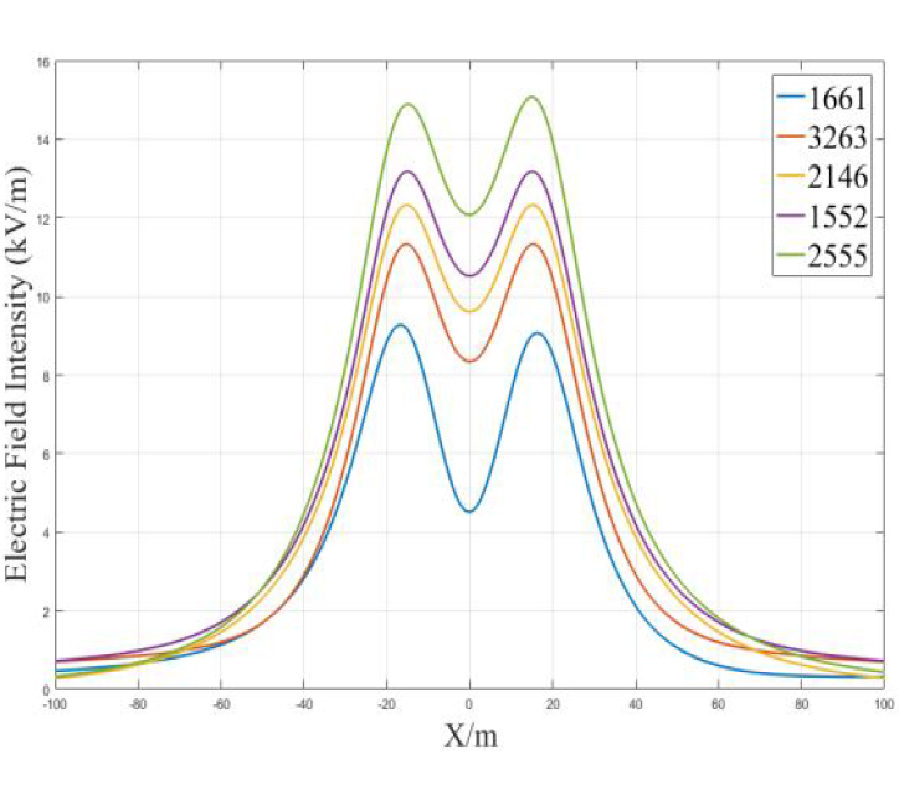
The ionized field under HVDC transmission lines have an impact on environment and people. With the industrial pollution and environment deterioration, the suspended particles that will influence the ionized field cannot be ignored. So the meshless local Petrov-Galerkin (MLPG) method based on moving least square (MLS) shape function is applied in this paper to calculate the ionized field of unipolar transmission line. Based on the calculation, the analysis of the ionized field within the influences of suspended particles has been done by establishing the charging model of suspended particles. The research shows that suspended particles indeed influence the ionized field by increasing space charge density, reducing corona onset electric field, and reducing the ion mobility.
ANALYSIS OF IONIZED FIELD UNDER HVDC TRANSMISSION LINES WITHIN THE INFLUENCES OF SUSPENDED PARTICLES
2019-07-15
PIER C
Vol. 94, 89-101
Design and Development of an Ultrathin Triple Band Microwave Absorber Using Miniaturized Metamaterial Structure for Near-Unity Absorption Characteristics
Naveen Mishra and Raghvendra Kumar Chaudhary
This article discusses about the design and development of an ultrathin triple band microwave absorber using a miniaturized metamaterial structure for near-unity absorption characteristics. In order to design a miniaturized metamaterial (MTM) absorber unit cell with triple band response, two resonators, named as Structure-I and Structure-II, are configured within the single unit cell. The geometrical proportions of the suggested resonators have been chosen in such a manner so that Structure-I can contribute one absorption band while Structure-II can contribute two absorption bands. Therefore, the combination of two resonators offers triple band response with the highest absorption values of 99.04%, 99.62%, and 99.33% at the frequencies of 4.25 GHz, 8.35 GHz, and 11.06 GHz, respectively. Additionally, the suggested absorber unit cell claims miniaturization with total electrical size of 0.156λ0 × 0.156λ0 × 0.014λ0, where λ0 corresponds to the free-space wavelength at the first peak absorption frequency of 4.25 GHz. Additionally, the electric field and vectored surface current distribution along with the input impedance graph has been used to discuss the absorption methodology of the suggested structure. Further, the MTM belongings of the suggested structure have been illustrated with the dispersion curve.
DESIGN AND DEVELOPMENT OF AN ULTRATHIN TRIPLE BAND MICROWAVE ABSORBER USING MINIATURIZED METAMATERIAL STRUCTURE FOR NEAR-UNITY ABSORPTION CHARACTERISTICS
2019-07-15
PIER Letters
Vol. 86, 1-6
A General ADE-FDTD with Crank-Nicolson Scheme for the Simulation of Dispersive Structures
Shi-Yu Long , Wei-Jun Chen , Qi-Wen Liang and Min Zhao
A general auxiliary differential equation (ADE) finite difference time-domain (FDTD) method with Crank-Nicolson (CN) scheme is proposed to model electromagnetic wave propagation in dispersive materials in this paper. The proposed method introduces an ADE technique that establishes the relationship between the electric displacement vector and electric field intensity with a differential equation in dispersive media. The CN scheme applies only to Faraday's law, resulting in reduced memory usage and computing time. To validate the advantages of the proposed approach, two examples with plane wave propagation in dispersive media are calculated. Compared with the conventional ADE-CN-FDTD method, the results from our proposed method show its accuracy and efficiency for dispersive media simulation.
A GENERAL ADE-FDTD WITH CRANK-NICOLSON SCHEME FOR THE SIMULATION OF DISPERSIVE STRUCTURES
2019-07-15
PIER Letters
Vol. 85, 145-149
Compact Two-Element MIMO Antenna Based on Half-Mode SIW Cavity with High Isolation
Bingjian Niu and Jie-Hong Tan
A compact two-element multiple-input-multiple-output (MIMO) antenna with high isolation is proposed in this paper. It is based on a half-mode substrate-integrated-waveguide (SIW) cavity where three edges are shorted by metallic vias, and one edge is opened to radiate cavity energy into free space. Fed by coaxial ports, two antenna elements are constructed in the SIW cavity, and a narrow T-shaped slot is introduced to enhance the isolation between them. High port isolation can be achieved by adjusting the slot length although these antenna elements are connected with each other. A prototype has been fabricated and measured. With the compact cavity size of 0.22λ0 × 0.44λ0, the fabricated antenna achieves the operating frequency of 3.51 GHz, enhanced isolation of 18.0 dB, low envelope correlation coefficient of 0.006, peak gain of 5.2 dBi, and high efficiency of 82.6%. Therefore, the proposed MIMO antenna has potential applications for wireless communication.
COMPACT TWO-ELEMENT MIMO ANTENNA BASED ON HALF-MODE SIW CAVITY WITH HIGH ISOLATION