Search Results(13790)

2019-06-21
PIER M
Vol. 82, 61-71
Plane Wave Scattering by Patches Periodically Placed on a Dielectric Rod Surface
Alexander Svezhentsev , Valeriy A. Kizka and Guy Vandenbosch
Plane wave diffraction by a finite number of metal cylindrical rectangular strips (patches) periodically placed on a dielectric rod (DR) surface in azimuth direction is considered. The problem is solved by the Method of Moments (MoM) in the spectral domain using PieceWise Sinusoidal (PWS) basis functions. Topologies with a highly resonant behavior of the patch currents in both azimuth and longitudinal directions are considered. This includes topologies with 1, 2, or 3 patches that are nearly touching, in which case one can also view the topology as a slotted metal cylinder. For these slotted cylinders with one and two slots it is shown that 2D approximate analytical solutions based on the rigorous Riemann-Hilbert approach yield a good agreement with 3D MoM solutions for the natural frequency of the half wavelength resonance until the slot width reaches 40˚. It is found that in the 3D case the natural frequency of the half-wavelength resonance for gap coupled patches tends to zero when the slot is vanishing. The radar cross-section versus frequency, resonant current distributions on the patches and far fields are presented.
2019-06-20
PIER C
Vol. 93, 199-209
Anti-Interference Circuit Configuration for Concurrent Dual-Band Operation in High-Efficiency GaN HEMT Power Amplifier
Haruka Nishizawa , Yoichiro Takayama , Ryo Ishikawa and Kazuhiko Honjo
An interference on a concurrent 4.5-/8.5-GHz-band operation has been effectively suppressed by applying a duplexer technique to high-efficiency GaN HEMT power amplifiers. Each harmonic was also suppressed by a harmonic reactive termination used for a high-efficiency operation. The developed concurrent dual-band amplifier delivered a 73% drain efficiency and a 61% power-added-efficiency (PAE) with 32 dBm output power at 8.24 GHz and a 69% drain efficiency and a 64% PAE with 37 dBm output power at 4.70 GHz. Undesired cross-modulation and intermodulation signals at nearby bands occurring due to dual-band interaction have been successfully suppressed to less than -41 dBc.
ANTI-INTERFERENCE CIRCUIT CONFIGURATION FOR CONCURRENT DUAL-BAND OPERATION IN HIGH-EFFICIENCY GAN HEMT POWER AMPLIFIER
2019-06-20
PIER Letters
Vol. 85, 59-64
Study on EMI Analysis and Inhibitory Techniques for Switching Converter Devices
Ru Li and Tao Wen
Due to the high power conversion efficiency, high efficiency and energy saving, wide voltage regulation range and light weight, switching converters are widely used in many fields such as industry, military, and medicine. However, strong electromagnetic interference can affect the normal operation of switching power supply and also has a negative impact on the external environment. Based on this phenomenon, we focus on the electromagnetic compatibility of switching power supply, and a high-frequency model for PSFB circuit is proposed. At last, a set of verification tests are conducted to verify the validity of the proposed model in this paper.
STUDY ON EMI ANALYSIS AND INHIBITORY TECHNIQUES FOR SWITCHING CONVERTER DEVICES
2019-06-20
PIER M
Vol. 82, 49-59
Spatial and Polarization Angle Estimation of Mixed-Targets in MIMO Radar
Srinivasarao Chintagunta and Palanisamy Ponnusamy
This paper proposes an approach for estimating the spatial and polarization angles of mixed-targets in bistatic MIMO radar. Mixed-targets mean the combination of uncorrelated, partially correlated, and groups of coherent targets. The approach resolves rank deficiency of received signal covariance matrix and then exploits the ESPRIT-based method for estimating the angles of direction-of-departure (DOD) and direction-of-arrival (DOA). This paper also presents an analytical review and necessary conditions for resolving the rank deficiency under various scenarios of the MIMO radar. Simulation results show the effectiveness of the proposed approach.
2019-06-19
PIER Letters
Vol. 85, 51-57
Design of a Wideband Circularly Polarized Cross-Dipole with Wide Axial-Ratio Beamwidth
Li-Xin Cao , Fu-Shun Zhang , Yi Zhao and Deng-Hui Li
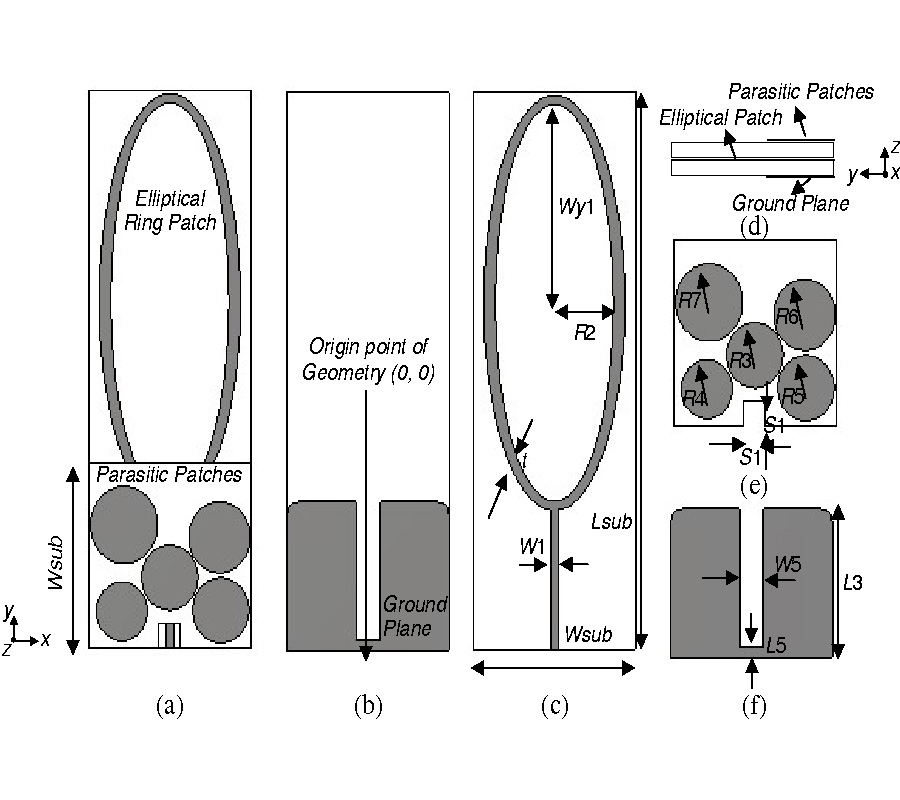
A novel wideband circularly polarized (CP) cross-dipole with wide 3 dB axial-ratio (AR) beamwidth is presented. To generate CP radiation, the cross-dipole is fed by a Wilkinson power divider which can provide 90° phase difference. The gain beamwidth and 3 dB AR beamwidth can be widened by the bent arm structures of cross-dipole and four vertical parasitic elements. As a result, the 3 dB AR beamwidth and gain beamwidth of the proposed antenna can achieve over 210° and 105°, respectively. It is observed that the impedance bandwidth (|S11| ≤ -10 dB) of the proposed antenna is 1.2~2.0 GHz, and the AR bandwidth (AR ≤ 3 dB) is 1.28~1.76 GHz. The simulated and measured results are in good agreement, which shows that the proposed antenna is a good candidate for the application of satellite communications.
DESIGN OF A WIDEBAND CIRCULARLY POLARIZED CROSS-DIPOLE WITH WIDE AXIAL-RATIO BEAMWIDTH
2019-06-19
PIER M
Vol. 81, 203-213
Performance Comparison of Stepped and Smooth Dielectric Lens-Loaded Flat Reflectors
Veluchamy Lingasamy , Krishnasamy Selvan and Patnam H. Rao
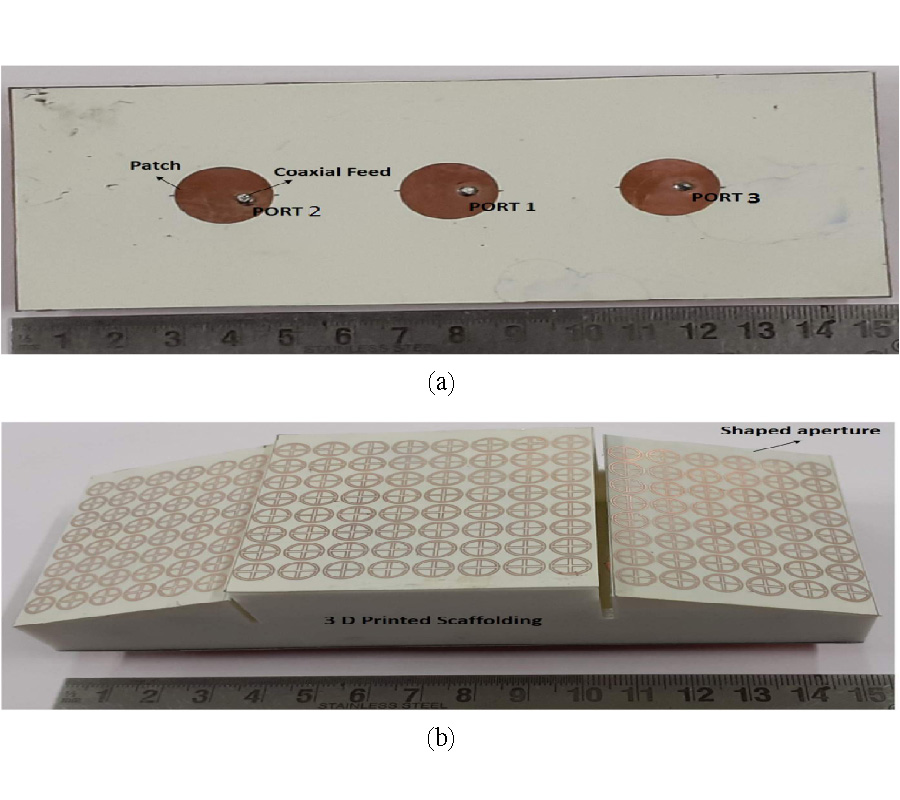
This paper presents the design of an X-band stepped lens-loaded flat reflector (STLR) using reflectarray unit cell approach. A flat reflector of size 15×15 cm2, loaded with a 10×10 dielectric unit cell array, centre-fed by a horn antenna, is evaluated by simulation and measurement. The simulated performance of the proposed structure is compared with a smooth lens loaded plane reflector (SMLR) and microstrip reflectarray (RA), of equivalent cross section. The results are in good agreement for SMLR, whereas a fair match is observed only in the main lobes of RA. It is worth to note that the reported STLR has a reduced thickness compared to SMLR. Furthermore, a simulation-based study is carried out on the effect of tapering of the dielectric structure in the proposed design, and a similar performance to when stepping is used is noted.
PERFORMANCE COMPARISON OF STEPPED AND SMOOTH DIELECTRIC LENS-LOADED FLAT REFLECTORS
2019-06-18
PIER C
Vol. 93, 185-198
On the Classical Electrodynamics in Dispersive Time-Dependent Linear Isotropic Media
Victor Nijimbere
The goal of this study is to conduct an analytical study of the properties (permittivity and permeability or refractive index) of a dispersive time-dependent linear isotropic medium interacting with electromagnetic fields. It is found that the permittivity and permeability of the time-dependent dispersive medium may either have an exponential profile or a sinusoidal profile. The permittivity and permeability can vanish or can be negative as in metamaterials. Therefore, the refractive index can vanish, so the electromagnetic wave can propagate at an infinite speed (c ≫ 3·10⁸ m/s). It is also shown that the permittivity and permeability can simultaneously be negative as in left-handed metamaterials (LHM). The general electric field and magnetic field solutions are derived, and the electric and magnetic flux densities are evaluated. The wave dispersion relation is also analysed. The obtained solutions can be used to validate experimental results by applying the initial and boundary conditions which are appropriate to the experimental setup. ε
ON THE CLASSICAL ELECTRODYNAMICS IN DISPERSIVE TIME-DEPENDENT LINEAR ISOTROPIC MEDIA
2019-06-18
PIER Letters
Vol. 85, 45-50
Non-Crosstalk Scheme Based on Linear Combination Transformation in High-Speed Interconnects
Yafei Wang , Huifang Sun and Xuehua Li
Aiming at the problem of crosstalk in high-speed interconnects, a non-crosstalk scheme based on coupled transmission lines-channel transmission matrix (CTL-CTM) is proposed. In this scheme, the transmitted signals are linear combination transformed at the transmitting end of the interconnect lines where the transmission signals among the interconnect lines constitute an orthogonal mode. After the signals have synchronously transmitted to the receiving end, second linear combination transformation is performed to restore the transmitted signals. Simulation results show that this low cost circuit proposed is capable of improving the quality of eye diagram and eliminating the crosstalk obviously.
NON-CROSSTALK SCHEME BASED ON LINEAR COMBINATION TRANSFORMATION IN HIGH-SPEED INTERCONNECTS
2019-06-18
PIER M
Vol. 82, 39-48
Enhanced Radio Tomographic Imaging Method for Device-Free Localization Using a Gradual-Changing Weight Model
Wei Ke , Haoran Zuo , Mengling Chen and Yanli Wang
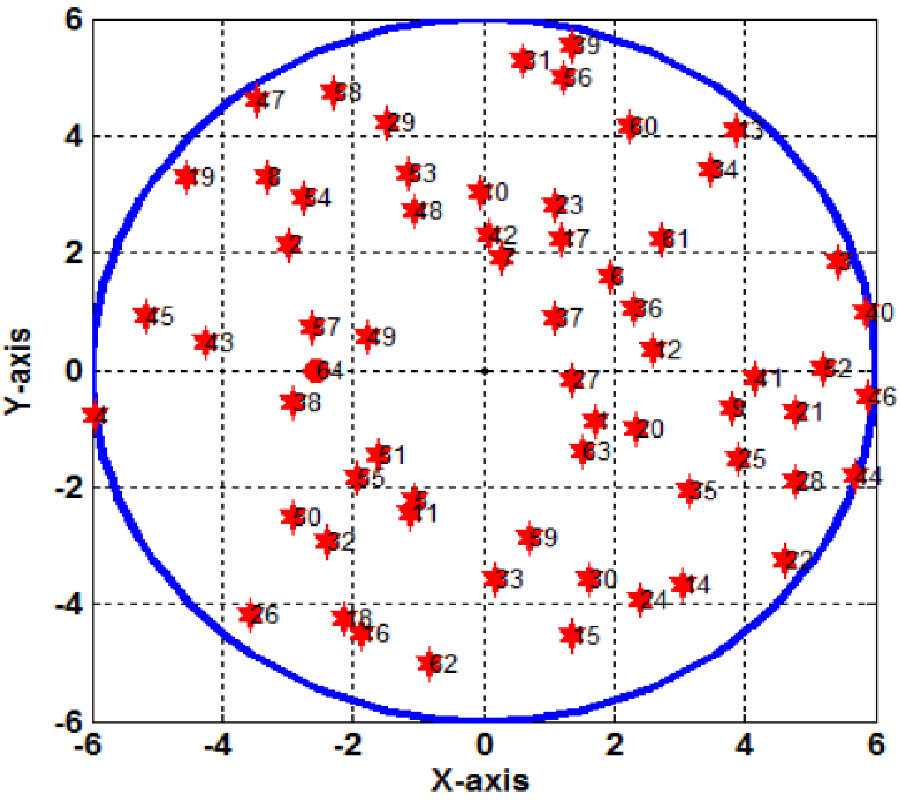
Radio tomographic imaging (RTI) is a main method in device-free localization (DFL) that can locate a target by analyzing its shadowing effect on wireless links, while removing the requirement of equipping the target with a device. The accuracy of RTI method closely depends on the accuracy of shadowing weight model, which represents the relationship between the shadowing effect of the target on wireless links and target location. However, most existing models have not been accurate enough for many applications since they cannot explain some phenomena observed in DFL practices. To overcome the shortcoming of the existing weight model, this paper proposes a gradual-changing weight model to enhance the imaging quality of RTI. Meanwhile, a foreground target detection algorithm based on the shape feature of the target image is proposed to reduce the negative impact of background noises and pseudo-targets, thereby further enhancing the localization accuracy. The indoor and outdoor experimental results highlight the advantages of using the proposed method in improving the imaging quality and the positioning accuracy.
2019-06-18
PIER M
Vol. 82, 29-38
Wave Propagation in RH/LH Periodic Lumped Circuits Using Iterative Method WCIP
Mohamed Karim Azizi , Elbellili Taieb , Ali Gharsallah and Henri Baudrand
The negative refractive property of a meta-material medium modeled by an array of localized elements is demonstrated numerically using the iterative method based on the wave concept. This property is used to show the channeling and control of the electromagnetic beam inside the triangular shaped meta-material supports that are interfaced with the conventional positive refractive index supports. WCIP was used to view the electromagnetic behavior of a source placed in a right-hand medium interfaced with another left-hand medium in order to present the properties of the negative refraction.
2019-06-18
PIER M
Vol. 82, 19-28
Bistatic EM Scattering Analysis of an Object Above a Rough Surface Using a Hybrid Algorithm Accelerated with the Adaptive Cross Approximation Method
Mohammad Kouali and Noor Obead
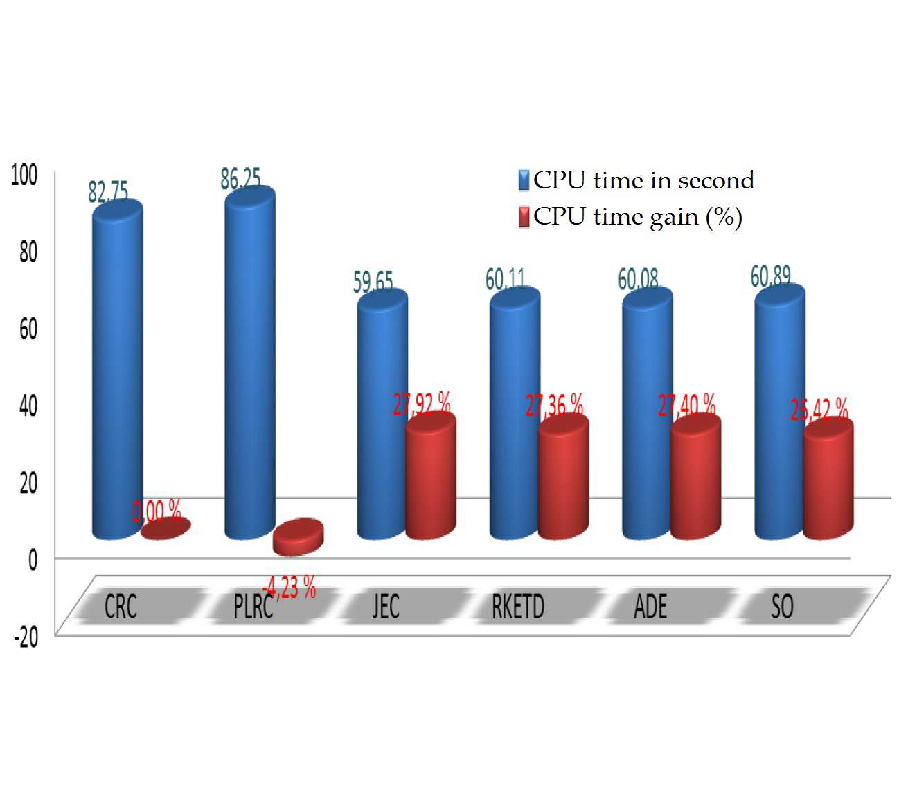
Calculating the RCS (Radar Cross Section) of two 3D scatterers needs to numerically solve a set of integral equations involving numerous unknowns. Such a 3D problem can not be solved easily with a conventional Method of Moments (MoM) by using a direct LU inversion. Thus, a hybridization between the Extended Propagation-Inside-Layer Expansion (E-PILE) and the Physical Optics approximation (PO) reduces signi cantly the memory requirements and CPU time. The resulting method called E-PILE+PO. In this work, we take advantage of the rank-de cient nature of the coupling matrices, corresponding to scatterer 1 (the object) and scatterer 2 (the rough surface) interactions, to further reduce the complexity of the method by using the Adaptive Cross Approximation (ACA).
2019-06-17
PIER C
Vol. 93, 173-183
K-Band 4×4 RHCP Helical Antenna Array Using LTCC Technology
Hao Wei , Hao Wei , Shiwang Jia , Xiaoli Jiang and Weiwei Liu
In this paper, a K-band right hand circularly polarized (RHCP) antenna array with 4×4 elements is designed, fabricated, measured and analyzed. The RHCP pattern is obtained from the helical antenna elements, with a unit cell of every four elements, sequentially counterclockwise by 90 deg. To decrease the profile of the vertical interconnection between the helical antenna and its feeding network, the integration of this RHCP antenna and its feeding networkis realized by low temperature co-fired ceramic (LTCC) technology. The antenna's feeding network consists of eight directional couplers, four circulators, and one power divider. In the feeding network, different RF channels' isolations are improved by the shield structures which are realized by metal filled via holes. For the operating frequency, the measured axial ratio (AR) is better than 1.25 dB. The proposed antenna is small in size, andit is a very good candidate for mobile satellite communications.
K-BAND 4×4 RHCP HELICAL ANTENNA ARRAY USING LTCC TECHNOLOGY
2019-06-17
PIER Letters
Vol. 85, 37-43
Spreading of Four-Petal Lorentz-Gauss Beams Propagating through Atmospheric Turbulence
Shuai Chang , Yansong Song , Yan Dong and Keyan Dong
The analytical propagation equation of a four-petal Lorentz-Gauss (FPLG) beam propagating through atmospheric turbulence is derived, and the spreading of average intensity is analyzed by using numerical examples. It is found that the FPLG beam propagating through atmospheric turbulence will evolve into Gaussian beam due to the influences of atmospheric turbulence, and the atmospheric turbulence will accelerate the spreading of FPLG beam as the propagation distance increases. It is also found that the FPLG beam with different N or Lorentz widths propagating through atmospheric turbulence will have the same beam spot when the FPLG beam evolves into the Gaussian beam at the same propagation distance.
SPREADING OF FOUR-PETAL LORENTZ-GAUSS BEAMS PROPAGATING THROUGH ATMOSPHERIC TURBULENCE
2019-06-17
PIER Letters
Vol. 85, 31-36
Performance Analysis of Refined Induction Machine Models Considering Iron Loss
Ru Li and Tao Wen
In the applications such as induction motor efficiency optimization and electric vehicle speed control, the influence of the iron loss cannot be ignored in order to improve the running efficiency of induction motor, the ordinary differential equations (ODE) and difference equations (DE) of induction motors considering iron loss have been established. The results show that the proposed refined ordinary differential equations and difference equations of induction motors considering iron loss and its simulation models are believable, and simulated and experiment results have demonstrated that the models perform well.
PERFORMANCE ANALYSIS OF REFINED INDUCTION MACHINE MODELS CONSIDERING IRON LOSS
2019-06-17
PIER M
Vol. 82, 9-18
Diffraction by a Dielectric Wedge on a Ground Plane
Marcello Frongillo , Gianluca Gennarelli and Giovanni Riccio
The plane wave diffraction by an acute-angled wedge located on a perfect electric conducting plane is studied in the frequency and time domains. Only a TMz polarization is explicitly considered in the manuscript since the case of a TEz polarization can be solved in a similar way. At first, the uniform asymptotic physical optics approach is used to obtain the diffraction coefficients in the framework of the uniform geometrical theory of diffraction. The analytical procedure allows one to obtain closed form expressions that are easy to handle and provide reliable results from the engineering viewpoint. The time domain diffraction coefficients are successively determined by applying the inverse Laplace transform to the frequency domain counterparts. The effectiveness of the proposed solutions is proved by means of numerical tests and comparisons with full-wave numerical techniques.
2019-06-14
PIER C
Vol. 93, 157-172
Optimization Study of Radar Cross Section Reduction by an Inhomogeneous Collisional Magnetized Plasma
Vahid Foroutan , Mohammad Naghi Azarmanesh and Gholamreza Foroutan
Recursive convolution FDTD method is employed to study the bistatic radar cross section (RCS) of a conductive plate covered with an inhomogeneous magnetized plasma shroud. The results of numerical simulations reveal that for a plasma of number density 5×10¹⁷ m-3 and collision frequency of 1 GHz, RCS reduction (RCSR) is improved i.e., its maximum reduction, bandwidth, and angular width are enhanced, when a perpendicular magnetic field of intensity B=0.25 T is applied. However, increase of the magnetic field to 0.4 T leads to a much lower RCSR specially for the backscattered wave. As the collision frequency is increased to 10 GHz, the RCSR is enhanced both in the presence and absence of the magnetic field. However, with further increase of collision frequency to 60 GHz, the RCSR is significantly reduced and the problem is more severe in the backward direction. The resonant absorption is dominant at low to moderate collision frequencies, for magnetic field intensity above 0.1 T, but becomes almost inefficient when the collision frequency is increased to 60 GHz. The RCSR is considerably weakened when the plasma number density is reduced and the effect is prominent for small angles. A plasma inhomogeneity length scale of 5 cm provides the maximum RCSR in the presence of the magnetic field. With increase of the length scale, the maximum RCSR, the corresponding wave frequency, and bandwidth all are reduced. Therefore, it is conclude that a plasma with number density of 5×10¹⁷ m-3, collision frequency of 10 GHz, and length scale of 5 cm, with a perpendicular magnetic field of 0.25 T is the best choice for optimum RCSR of a conductive plate.
OPTIMIZATION STUDY OF RADAR CROSS SECTION REDUCTION BY AN INHOMOGENEOUS COLLISIONAL MAGNETIZED PLASMA
2019-06-14
PIER C
Vol. 93, 143-156
A Quantum MIMO Architecture for Antenna Wireless Digital Communications
Said Mikki
A general theoetical framework for MIMO digital wireless communications is proposed for sending classical M-ary information over quantum states instead of classical electromagnetic waves. The basic theory of quantum MIMO architecture suitable for spatial diversity application is proposed and analyzed. The fundamental design equations are derived and shown to be equivalent to a special constrained nonlinear optimization problem. The main advantage of the MIMO architecture is that it provides new resources for the system designer since using multiple Tx quantum antennas coupled with judicious choice of optimum positions for the multiple Rx quantum measurement operators can enhance the ability to realize quantum communication systems. Therefore, additional degrees of freedom are expected to become available in the proposed quantum MIMO systems. The proposed system is expected to be best physically realized using electromagnetic process in second-quantized (photon) states, ideally coherent or squeezed radiation states.
A QUANTUM MIMO ARCHITECTURE FOR ANTENNA WIRELESS DIGITAL COMMUNICATIONS
2019-06-14
PIER B
Vol. 84, 79-96
Radiation Pattern Analysis and Modelling of Coplanar Vivaldi Antenna Element for Linear Array Pattern Evaluation
Nurhayati Nurhayati , Eko Setijadi and Gamantyo Hendrantoro
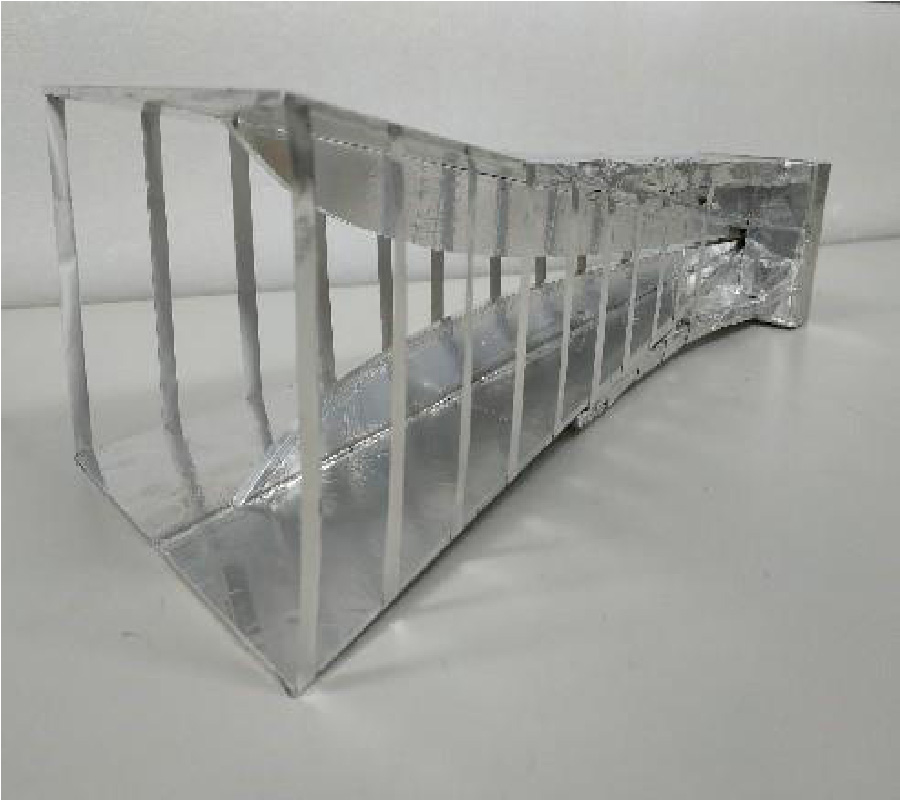
This paper reports an electric field approximation model of the Coplanar Vivaldi antenna on the E-plane. The study is conducted in three stages, i.e., (i) evaluating the impact of various geometrical parameters to the Vivaldi's element performance at different frequencies, (ii) modeling the electric field patterns, and (iii) applying the model to evaluate the linear total array pattern. The examination of the Coplanar Vivaldi element with fractional bandwidth of 133% in the 2-10 GHz band shows the individual roles of the antenna width, the tapered slot length, the opening width and the slope of the tapered slot in determining the VSWR, resistance, reactance and E-Field performance. The Vivaldi element should be designed with element width more than 0.5λ and less than λ to reach better performance of VSWR and E-field. The longer the tapered slot (>λ) with the high value of opening rate of tapered slot, the smaller the E-field. The E-field increases with increasing opening width of the tapered slot. Knowledge of the influence of each geometry parameter is then used as a reference in developing the E-field pattern approximation model of the Vivaldi element. The derivation of the Vivaldi approximation model is started from the pattern of a horn antenna because both antennas share a similar feature, i.e., the enclosure of the E-field propagation within a tapered slot resulting in a directional radiation pattern. The result of Coplanar Vivaldi modeling is verified against the results of electromagnetic computational simulation and measurement. The Vivaldi element model is useful for total array pattern analysis to save computation time and to provide flexibility in the evaluation of array design.
RADIATION PATTERN ANALYSIS AND MODELLING OF COPLANAR VIVALDI ANTENNA ELEMENT FOR LINEAR ARRAY PATTERN EVALUATION
2019-06-13
PIER Letters
Vol. 85, 25-30
Monthly Cloud Free LOS Time Series Generator for Optical Satellite Links
Nikolaos K. Lyras , Theodore T. Kapsis and Athanasios Panagopoulos
In this letter, a space time synthesizer for the generation of monthly cloud free line of sight (CFLOS) statistics is presented. The proposed monthly time series generator is based on the synthesis of 3D cloud fields using Stochastic Differential Equations. Monthly Integrated Liquid Water Content (ILWC) statistics are used as inputs, and the temporal and spatial correlation of clouds is considered. The monthly variability of the cloud coverage is predicted, and the CFLOS is estimated taking into account the elevation angle of the slant path and the altitude of the station for high altitude optical ground stations. Finally, CFLOS numerical results are reported, and some significant conclusions are drawn.
MONTHLY CLOUD FREE LOS TIME SERIES GENERATOR FOR OPTICAL SATELLITE LINKS
2019-06-13
PIER M
Vol. 82, 1-8
Suppression of IMD3 in CMOS Power Amplifier Using Bias Circuit of Common-Gate Transistor with Cascode Structure
Jinwon Kim , Changhyun Lee , Jinho Yoo and Changkun Park
In this study, we propose a technique to improve the linearity of complementary metal-oxide semiconductor (CMOS) power amplifiers with a cascode structure. From the investigation of the influence of the impedance of an envelope signal on the linearity, we find that the load impedance of the envelope signal of the common-source transistor should be reduced. To obtain alow load impedance of the envelope signal, we reduce the value of the gate resistor of the common-gate transistor. After investigating the influences of the value of the resistance on the third-order intermodulation distortion (IMD3), we extract the optimum value of the resistance. We also consider the electrostatic discharge protection issue and the effects of the variations in the parasitic components of bond-wires, in the process of the extraction of the optimum value. To verify the feasibility of the optimization technique of the resistance ofthe bias circuit of the common-gate transistor of the amplifier, we design a power amplifier using a 180-nm RFCMOS process for wireless local area network (WLAN) 802.11n applications. We obtain the measured maximum linear output power of 22.2 dBm with a 26.7% power-added efficiency and a 3.72% error vector magnitude. We use an 802.11n modulated signal with 64-QAM (MCS7) at 65 Mb/s. From the measured results, we successfully verify the feasibility of the proposed optimization technique of the resistance of the bias circuit of the common-gate transistor.