Search Results(13790)

2019-05-22
PIER M
Vol. 81, 67-73
A Broadband Optical Isolator Based on Chiral Plasmonic-Metamaterial Design
Andon Rangelov , Sotiris Droulias and Vassilios Yannopapas
We theoretically propose a novel achromatic optical isolator based on circular dichroism in metamaterials of twisted chains of metallic nanoparticles. The suggested optical isolator consists of an input polarizer, followed by quarter-wave plate, then a circular dichroism material, another quarter-wave plate, and an output polarizer. In contrast to the most commonly used optical isolators, the current scheme does not use magnetic field and does not change the polarization plane.
A BROADBAND OPTICAL ISOLATOR BASED ON CHIRAL PLASMONIC-METAMATERIAL DESIGN
2019-05-21
PIER Letters
Vol. 84, 59-65
A Compact Multiband MIMO Antenna for IEEE 802.11 a/b/g/n Applications
Wenying Wu , Ruixing Zhi , Yingjian Chen , Han Li , Yanhua Tan and Gui Liu
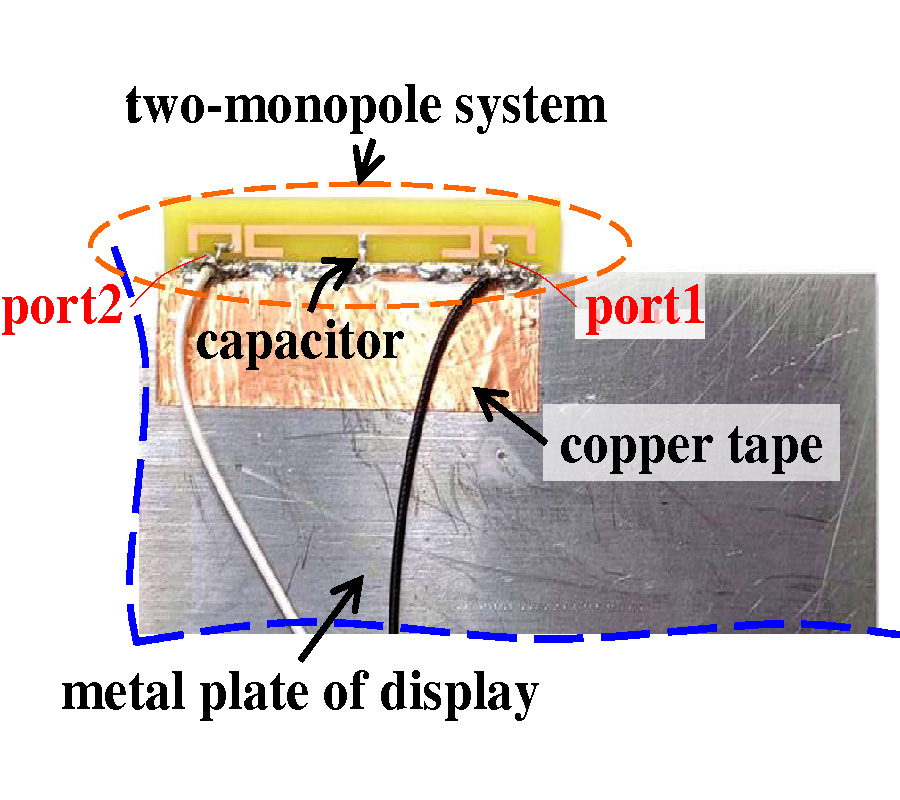
A compact multiband multiple-input-multiple-output (MIMO) antenna for WLAN applications is presented in this paper. The proposed MIMO antenna consists of two symmetric monopole radiating elements designed to operate over 2.45, 5.2, and 5.8 GHz bands. The isolation is enhanced by using several techniques such as parasitic elements and defected ground structure. The measured S11 < -10 dB is obtained over 2.36-2.68 GHz and 4.81-5.95 GHz, which can cover IEEE 802.11 a/b/g/n frequency bands (2.4-2.4835 GHz, 5.15-5.35 GHz, and 5.725-5.875 GHz). The measured isolation values S21 are less than -24 dB and -27 dB over the lower and higher frequency bands, respectively. The envelope correlation coefficient (ECC) of the proposed antenna is less than 0.027 and 0.005 over the lower and higher operating bands, respectively. The overall size of the proposed antenna is 50×30×1.59 mm3. The proposed antenna is a good candidate for IEEE 802.11 a/b/g/n applications.
A COMPACT MULTIBAND MIMO ANTENNA FOR IEEE 802.11 A/B/G/N APPLICATIONS
2019-05-20
PIER C
Vol. 92, 239-250
A Dual-Band Planar Quasi Yagi-Uda Antenna with Optimized Gain for LTE Applications
Manzoor Elahi , Irfanullah , Rizwan Khan , Azremi Abdullah Al-Hadi , Saeeda Usman and Ping Jack Soh
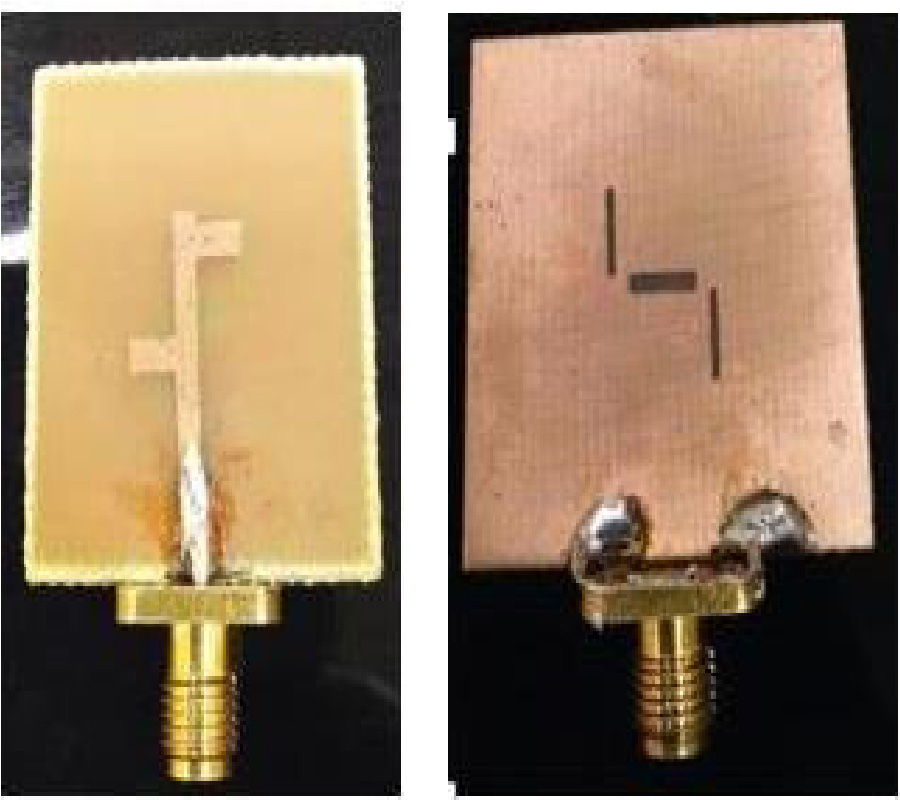
A printed Yagi-Uda antenna with two closely-spaced driven dipole elements and truncated ground plane is presented for dual-band operation. It is designed on a low-cost FR4 substrate with a dielectric constant 4.6, loss tangent of 0.02, and thickness of 1.6 mm. The dipole, operating in the lower band (centered at 1.8 GHz), is elliptical-bow-tiein shape with rounded edges, whereas a J-shaped dipole enables its operation in the upper band (centered at 2.6 GHz). A trapezoid-shaped director is employed to achieve maximum gain over the required frequency bands. Measurements indicate that the antenna operates from 1.71 to 1.9 GHz and from 2.5 to 2.7 GHz with |S11| < -10 dB. The behavior of the proposed antenna has been investigated by studying different parameters to achieve the maximum gains of 6 and 7.7 dB in LTE band 3 and band 7, respectively, with optimal size. It is found that the experimental results of the final packaged antenna agree with the simulated ones in terms of reflection coefficients, gain, and radiation patterns.
A DUAL-BAND PLANAR QUASI YAGI-UDA ANTENNA WITH OPTIMIZED GAIN FOR LTE APPLICATIONS
2019-05-17
PIER C
Vol. 92, 227-238
Design of a High-Efficiency Broadband Asymmetric Doherty Power Amplifier
Bin Wang , Jiang Teng , Debao Zhang and Dong Su
This study proposes a broadband asymmetric Doherty power amplifier (A-DPA) with a broadband matching network and an improved power combination network (PCN). A broadband matching network in the form of a low-pass filter is analyzed and applied in this work. With the narrowband characteristic of a 1/4 wavelength transmission line, an improved PCN is also analyzed and applied to decrease the impedance transformation ratio of the 1/4 wavelength transmission line and then extend the working bandwidth of the DPA. In the design process, GaN HEMTs from Cree are selected to be the main and auxiliary power amplifier transistors, and the ADS software is used to complete the entire design process. In the working frequency band of 3.3-3.6 GHz, simulated results show that the gain is approximately 13 dB when the output power is lower than 40 dBm and that the power-added efficiency (PAE) is 39%-51% within the 9 dB power back-off (PBO) region. Measured results indicate that the proposed A-DPA exhibits a 36%-45% PAE within the 9 dB PBO region. The saturated PAE is between 58% and 62%, and the saturated output power is approximately 42 dBm.
DESIGN OF A HIGH-EFFICIENCY BROADBAND ASYMMETRIC DOHERTY POWER AMPLIFIER
2019-05-16
PIER Letters
Vol. 84, 53-57
Investigation of Surface PIN Diodes for a Novel Reconfigurable Antenna
Han Su , Huiyong Hu , Heming Zhang and Pedram Mousavi
Solid state plasma antenna based on surface PiN diodes is characterized by its wide radiation range, good stealth characteristics, compatibility with traditional microelectronic technology, and dynamic reconfiguration, which has very broad application prospects in the fields of wireless communication, radar, and remote sensing. To improve carrier concentration and uniformity within theintrinsic region, a novel SPiN diode with a double-layer structure is described in this paper. This structure can compensate the concentration attenuation at the midpoint of the `i' region, which makes carriers have a more uniform distribution with high concentration, and carrier concentration within the `i' region twice of the traditional SPiN diode. A Si/Ge/Si heterojunction diode is also researched in this paper. These results indicate that a fully reconfigurable semiconductor plasma antenna based on this novel surface PiN diode is achieved to meet the currently-growing communication requirements.
INVESTIGATION OF SURFACE PIN DIODES FOR A NOVEL RECONFIGURABLE ANTENNA
2019-05-16
PIER M
Vol. 81, 55-66
Broadbeam Coplanar-Parasitic Rectangular Dielectric Resonator Antenna
Syeda Hiba Hussain Mashhadi , Muhammad Wasif Niaz , Yong-Chang Jiao and Jingdong Chen
A novel broadbeam aperture-coupled coplanar parasitic rectangular dielectric resonator antenna is proposed which yields broadbeam in both working planes simultaneously. The antenna consists of a main radiating rectangular dielectric element centered over a wide feed slot and two parasitic rectangular dielectric elements one on each side of the main radiating element with an optimum gap in between. The dielectric height and wide slot both play an important role in enhancing the beamwidth in two principal planes simultaneously. It is validated that inclusion of parasitic elements enhances the broadbeam bandwidth in addition to frequency bandwidth. First three azimuthal modes are excited out of which first two modes TEx111 and TEx112 are desired. The proposed antenna is compared with single element rectangular dielectric resonator antenna. To validate the proposed design, a prototype is fabricated and measured. The simulated and measured operating frequency bands of the proposed antenna respectively are 4.8 to 6.9 GHz and 5 to 6.8 GHz. The measured E- and H-plane beamwidths range from 115° to 144° and from 115° to 124°, respectively, yielding a wider coverage area.
BROADBEAM COPLANAR-PARASITIC RECTANGULAR DIELECTRIC RESONATOR ANTENNA
2019-05-15
PIER C
Vol. 92, 215-226
Auto Angular Tracking of UAV Based on Mixed Phased/Retrodirective Array
Alaa Salman , Shokri Almekdad and Mohamad Alhariri
A mixed phased array and retrodirective array providing auto tracking of the angular position of the unmanned aerial vehicle (UAV) is presented. The phase conjugation technique and complex vector multiplication are used together to find the geometric phase of each channel canceling the need to use direction finding algorithm (DOA). After generating the phase conjugated version of the received signal on each channel, its complex vector representation will be multiplied by the complex vector representation of the received signal on the reference channel. The UAV will stay on the beak of the array factor during its movement within the field of view (FOV), and a permanent high gain data link is obtained without the need of the tracking algorithm. The beamwidth of the resulted array is widened to be equal to the FOV. The computational cost of the tracking system will be reduced due to canceling the need of using the complex processing algorithms (DOA, and tracking) used in smart antenna. Direction finding algorithm, beamforming algorithm, and tracking algorithm are combined in one algorithm. The least square error pattern synthesis with nulls method is used to eliminate the predefined interference signals and add null steering ability to the resulted array. The effect of the phase errors is reduced to the case of single antenna due to including the phase errors of each channel in its complex weights. The beam pointing error is taken as a metric to evaluate the performance of the resulted array compared with the BPE of a phased array using the monopulse tracking method.
AUTO ANGULAR TRACKING OF UAV  BASED ON MIXED PHASED/RETRODIRECTIVE ARRAY
2019-05-15
PIER C
Vol. 92, 201-213
High-Precision Phase Shifting and Real-Time Calibration of Phased Arrays for Passive Millimeter-Wave Imaging Applications
Canwei Xin , Anyong Hu , Kai Liu , Wenjie Lv and Jungang Miao
The design and calibration of high-precision analog phase shifters are crucial issues for phased arrays interferometric passive millimeter-wave imaging systems. In this paper, a high-precision analog phase shifter is presented for phased arrays interferometric passive millimeter-wave security sensing applications, which realizes analog phase shifting function by controlling high-precision DAC (digital to analog conversion) with FPGA. It is known that pre-measured phase delay of a phased array channel is a prerequisite for beam pointing control. However, since many active devices are included in phased array channel link, the phase delay would be affected by various factors such as device moving and ambient temperature. So, high-precision phase shifting of phased arrays could be achieved only by measuring and calibrating phases when all components of the system are under normal working conditions. The algorithm proposed in this paper makes it possible to measure and calibrate phases when all sub-modules are integrated into the system, and each component is under normal working state, thus effectively avoiding the errors caused by environmental changes when the laboratory-measured results are put into practical use. Meanwhile, the algorithm is tested on Ka-band phased arrays interferometric passive millimeter-wave imaging system. It turns out that the phase accuracy of phased array channel can reach 5°±1.5°, and it only takes 2 minutes to complete the phase calibrationof 256 arrays.
HIGH-PRECISION PHASE SHIFTING AND REAL-TIME CALIBRATION OF PHASED ARRAYS FOR PASSIVE MILLIMETER-WAVE IMAGING APPLICATIONS
2019-05-14
PIER C
Vol. 92, 71-85
A Gegenbauer Polynomial Solution for the Electromagnetic Scattering by a Subwavelength Circular Aperture in an Infinite Conducting Screen
Marios Andreas Christou and Anastasis C. Polycarpou
In this paper, we use magnetic vector potential formulation, along with equivalence principle and image theory, to solve the electromagnetic scattering of a polarized incident plane wave by a subwavelength circular aperture in a conducting screen. The underlined analytical formulation yields a closed-form solution that is accurate for any angle of incidence or polarization and valid for the near-, intermediate- and far-field regions of observation. The formulation is based on Bouwkamp's diffraction model that uses dominant quasi-static magnetic current modes to represent the governing magnetic current distribution in the circular aperture for any incident wave. Taylor series expansion was implemented on the free-space Green's function, and the individual Taylor terms were integrated analytically to produce closed-form expressions for the scattered fields in all regions. In doing so, the Gegenbauer polynomial expansion was applied in order to allow evaluation of the resulting integrals for any observation point in the lower half space. The results obtained from the proposed analytical approach were compared with data generated through a direct application of a numerical integration technique. The comparison illustrates the validity and accuracy of the proposed analytical formulation.
A GEGENBAUER POLYNOMIAL SOLUTION FOR THE ELECTROMAGNETIC SCATTERING BY A SUBWAVELENGTH CIRCULAR APERTURE IN AN INFINITE CONDUCTING SCREEN
2019-05-13
PIER C
Vol. 92, 191-200
Wideband-Notched Miniaturized UWB Polygon-Slot Antenna Using Rectangular CSRR
Bihui Xu , Yan-Wen Zhao , Yuteng Zheng , Li Gu , Qiang-Ming Cai and Zai-Ping Nie
A miniaturized planar ultra-wideband (UWB) polygon-slot antenna with wideband-notched property is presented in this paper. With coplanar waveguide (CPW)-fed structure and miniaturized dimensions of 18.5×20.5 mm2, the antenna is easy to be integrated with microwave circuitry. By using one rectangular CSRR on rectangular patch, the WLAN band from 4.8 to 5.9 GHz is rejected. By cutting off two small rectangles in the lower corners of the rectangular patch, Antenna 2 is finally proposed, and UWB impedance matching from 3.1 to 12.6 GHz is achieved. The final proposed antenna is fabricated on a low-cost FR4 substrate and measured, and the measured and simulated results show an acceptable agreement. The antenna is validated to perform good radiation properties such as nearly stable radiation patterns, high gain, and high radiation efficiency.
WIDEBAND-NOTCHED MINIATURIZED UWB POLYGON-SLOT ANTENNA USING RECTANGULAR CSRR
2019-05-13
PIER C
Vol. 92, 177-189
Miniaturized Multistubs Loaded Rectangular Monopole Antenna for Multiband Applications Based on Theory of Characteristics Modes
Ashok Kumar , Jitendra Kumar Deegwal and Mahendra Mohan Sharma
A miniaturized rectangular monopole antenna (RMA) integrated with a T-shaped stub, inverted long and short L-shaped stub resonators based on application of the theory of characteristic modes (CMs) is investigated for multiband operation. CMs of embedded multistubs resonators on the RMA are examined and perceived that the entire structure is able to excite magnetic and electric CMs, in which three valuable CMs at 2.69/3.68/5.35 GHz are attained to cover WiMAX and WLAN bands. Based on CM analysis, the design formulation of multistubs resonators loaded antenna is presented. The proposed multiband antenna has been fabricated, tested, and experimentally characterized. The measured fractional bandwidths (FBWs) are 7.03% (180 MHz, 2.47-2.65 GHz), 10.43% (360 MHz, 3.27-3.63 GHz), and 11.42% (630 MHz, 5.20-5.83 GHz). The antenna exhibits isolated multiple frequency bands, stable monopole-like radiation patterns, and flat realized gains over the operating resonance bands while maintaining the small antenna size.
MINIATURIZED MULTISTUBS LOADED RECTANGULAR MONOPOLE ANTENNA FOR MULTIBAND APPLICATIONS BASED ON THEORY OF CHARACTERISTICS MODES
2019-05-13
PIER Letters
Vol. 84, 47-52
Image Intensity of a Gaussian Rough-Surface in Atmospheric Turbulence
Ningjing Xiang , Xin-Fang Wang and Qun-Feng Dong
Based on Huygens-Fresnel principle, a general expression for the average image intensity of a heterodyne and a direct-detection imaging system in turbulent media is derived under the assumption of a Gaussian rough-surface model. From the formulation, we find that the object size, turbulence strength, wavelength, and object roughness affect image intensity dramatically in the image plane.
IMAGE INTENSITY OF A GAUSSIAN ROUGH-SURFACE IN ATMOSPHERIC TURBULENCE
2019-05-09
PIER M
Vol. 80, 215-225
Novel Method for Generating Electromagnetic Vortex Wave
Gengqi Zheng , Bao-Hua Sun and Shuhong Gong
Electromagnetic (EM) vortex wave carries orbital angular momentum (OAM), which has been proposed for improve anti-interference performance, spectral efficiency, and message capacity in radio communications. Multiple sub-channels of propagation are achieved by different twisting degrees of EM wave. In order to develop the theory and technique of the OAM, works must be done to study the generation of vortex wave. There exist several devices to generate vortex wave, such as phase plate, holographic diffraction gratings, spiral reflectors, and antenna arrays. In this paper, based on typical parabolic antenna, a new approach to generate vortex wave carrying OAM in radio frequency through coating specific controllable complex dielectric constant material on parabolic antenna is introduced. From the results of the proposed antenna, we conclude that parabolic antenna with materials arranged by a specific rule on the reflector has capacity of generating an EM wave with clockwise and anti-clockwise phase distributions around beam-axis. The new method generating OAM is simple and suitable to be well applied in wireless electronic technology.
NOVEL METHOD FOR GENERATING ELECTROMAGNETIC VORTEX WAVE
2019-05-08
PIER Letters
Vol. 84, 39-46
Multi-Band Printed Antenna for Portable Wireless Communication Applications
Nazih Khaddaj Mallat and Amjad Iqbal
A compact, triple-band (WiMAX, WLAN and X-Band uplink satellite communication) monopole antenna is reported in this paper. The geometry of the proposed antenna consists of a pentagon-shaped patch along with symmetrical hook-shaped resonators and one vertical slot. The reported antenna works at three unique frequencies centered at 3.5 GHz, 5.4 GHz, and 8 GHz, covering absolute bandwidth of 900 MHz (3.2-4.1 GHz), 800 MHz (5.1-5.9 GHz), and 1.6 GHz (7.3-8.9 GHz), respectively. This antenna possesses good gain and high efficiency at all operating bands. The presented antenna has simulated gain (efficiency) of 4 dBi (78%), 4.2 dBi (79.95%), and 4.2 dBi (85.8%) at 3.5, 5.4, and 8 GHz, respectively. The operating bands of the presented antenna can be tuned independently by varying certain correlated parameters. All the simulations are carried out using High Frequency Structure Simulator (HFSS 13.0). The hardware of the simulated antenna is successfully constructed and tested for validation of simulation results. A reasonable match between the simulated and measured results is observed at the operating bands.
MULTI-BAND PRINTED ANTENNA FOR PORTABLE WIRELESS COMMUNICATION APPLICATIONS
2019-05-08
PIER Letters
Vol. 84, 31-38
Wideband Probe-Fed Rectangular Patch with Defected Ground Structure for Cross Polarization Suppression
Xuanli Fu , Chunhong Chen , Chengqiang Li and Wenwei Wang
In this paper, a new method of improving cross-polarization (XP) performance on a wideband microstrip antenna is proposed, by adopting a defected ground structure (DGS). This F-slot shaped defected ground structure (F-DGS) exhibits considerable improvement in terms of XP properties, broad boresight angular suppression, and impedance bandwidth (S11 < -10 dB). Lower than -26 dB XP level is achieved over 206˚ angular range, while the impedance bandwidth is broadened to 15.5%. Both wideband rectangular patches with and without F-DGS have been fabricated and experimented.
WIDEBAND PROBE-FED RECTANGULAR PATCH WITH DEFECTED GROUND STRUCTURE FOR CROSS POLARIZATION SUPPRESSION
2019-05-08
PIER Letters
Vol. 84, 23-29
Compact Wilkinson Power Divider with Higher Order Harmonics Suppression for LTE Application
Mukesh Kumar , Sk. Nurul Islam , Gobinda Sen , Susanta Kumar Parui and Santanu Das
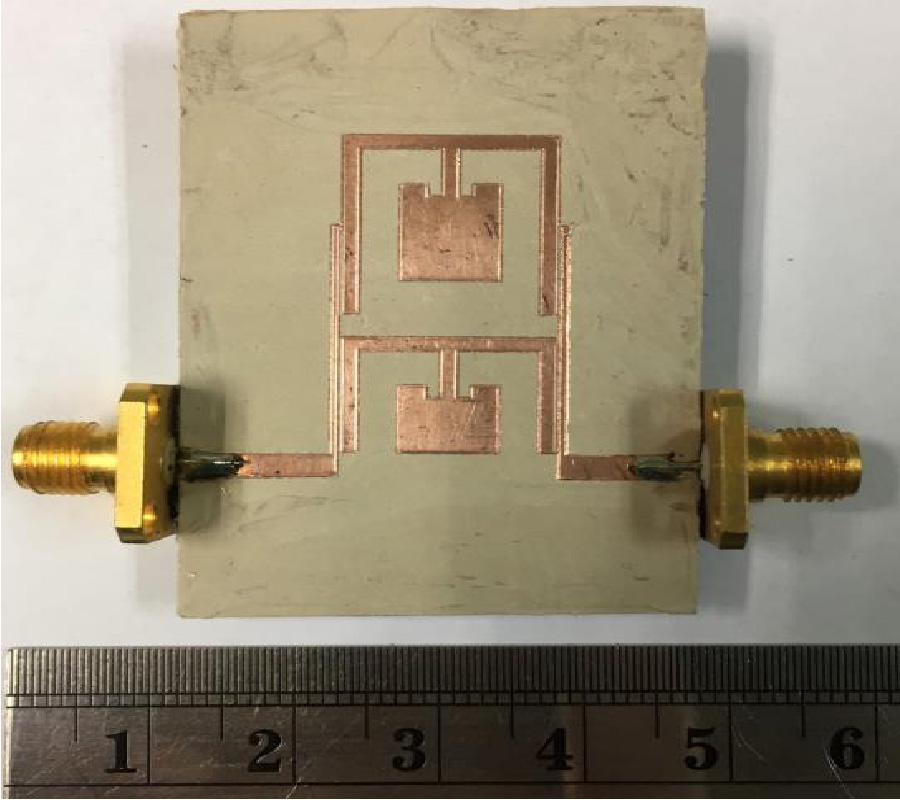
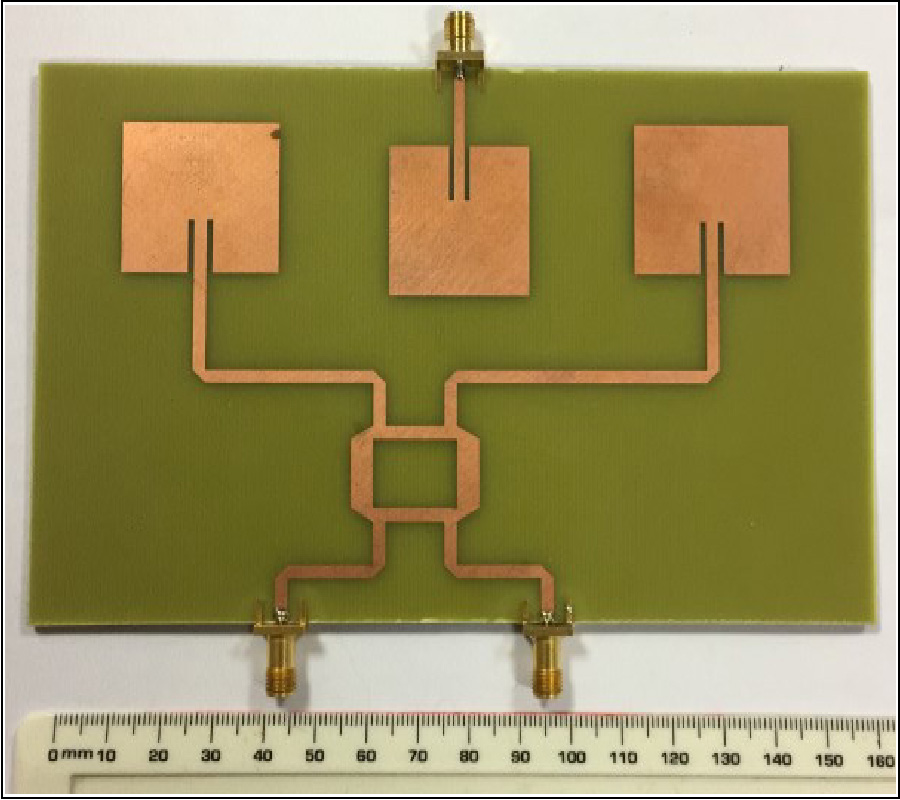
This paper presents a compact Wilkinson power divider (WPD) operating at 0.7 GHz (LTE band) with higher order harmonics suppression based on step impedance shunt stubs (SISSs) and defected ground structure (DGS). The quarter wavelength lines of conventional WPD are replaced by a host line loaded with a DGS and a pair of SISSs. The DGS and SISS of the proposed line serve as a high series inductance and shunt capacitance, respectively. Therefore, a compact quarter wavelength line is designed compared to conventional one. A prototype of the proposed power divider is designed based on the proposed line, which provides a size reduction of 71% as compared to conventional WPD (CWPD) at 0.7 GHz. In addition, upper edge selectivity is found to be 40 dB/GHz along with higher order harmonics suppression up to the 10th order (7GHz) by a level better than 20 dB. The proposed power divider is experimentally verified with the simulated one and found to be same.
COMPACT WILKINSON POWER DIVIDER WITH HIGHER ORDER HARMONICS SUPPRESSION FOR LTE APPLICATION
2019-05-07
PIER C
Vol. 92, 165-175
An RF Transceiver for Wireless Chip-to-Chip Communication Using a Cross-Coupled Oscillator
Hooyoung Shin , Milim Lee , Changhyun Lee and Changkun Park
In this study, we propose a transceiver architecture for wireless chip-to-chip communication using on/off keying (OOK) modulation. The proposed transceiver is composed of an oscillator, coils, an envelope detector, and a Schmitt trigger. Given that the oscillator itself acts as an OOK modulator, the transmitter is simplified. Additionally, because the oscillating signal is coupled between the transmitter and receiver coils, the reliability of the chip-to-chip communication is improved compared to a pulse-type transceiver. To verify the feasibility of the proposed transceiver, we design a transceiver using a 180 nm CMOS process. For a design with a 1.5 GHz oscillation frequency and 1 MHz digital input signal, we verify that the proposed transceiver successfully recovers the original digital signal.
AN RF TRANSCEIVER FOR WIRELESS CHIP-TO-CHIP COMMUNICATION USING A CROSS-COUPLED OSCILLATOR
2019-05-06
PIER Letters
Vol. 84, 15-21
Runge-Kutta Exponential Time Differencing Scheme for Incorporating Graphene Dispersion in the FDTD Simulations
Omar Ramadan
In this paper, the Runge-Kutta exponential time differencing (RK-ETD) scheme is used for incorporating Graphene dispersion in the finite difference time domain (FDTD) simulations. The Graphene dispersion is described in the gigahertz and terahertz frequency regimes by Drude model, and the stability of the implementation is studied by means of the von Neumann method combined with the Routh-Hurwitz criterion. It is shown that the presented implementation retains the standard non- dispersive FDTD time step stability constraint. In addition, the RK-ETD scheme is used for the FDTD implementation of the complex-frequency shifted perfectly matched layer (CFS-PML) to truncated open region simulation domains. A numerical example is included to validate both the stability and accuracy of the given implementation.
RUNGE-KUTTA EXPONENTIAL TIME DIFFERENCING SCHEME FOR INCORPORATING GRAPHENE DISPERSION IN THE FDTD SIMULATIONS
2019-05-06
PIER M
Vol. 81, 43-54
A Novel Method for ISAR Imaging of Multiple Maneuvering Targets
Jia Zhao , Yunqi Zhang , Xin Wang , Sheng Wang and Feng Shang
For inverse synthetic aperture radar (ISAR) imaging of multiple targets, range profiles of different targets are sometimes coupled together, resulting in the ineffectiveness of traditional imaging method, while the couplings in range domain may behave differently in time-frequency domain, and the Doppler histories of different targets are potentially separable. Then the time-frequency analysis method can be utilized for signal separation of multiple targets. Notice that the nonuniform motions of targets may make the time-frequency curves changeful, and accordingly, some preprocessing are needed. In this paper, a novel ISAR imaging method based on modified keystone transform (MKT), short-time Fourier transform (STFT), and Hough transform (HT) is proposed. The radar echoes of multiple targets are approximated to a second-order polynomial. The MKT is firstly utilized to correct the range curvatures. Secondly, the signal in each range cell is transformed into time-frequency domain through the STFT. Meanwhile, HT theory and mask matrix are adopted in time-frequency curves' separation of different targets. Thirdly, after inverse STFT, the separated time-frequency curves are respectively back to the range domain, and the range profiles of different targets are successfully separated. Eventually, with further motion compensation and precise imaging, focused ISAR images of different targets are achieved. Simulation results demonstrate the validity of the proposed method.
A NOVEL METHOD FOR ISAR IMAGING OF MULTIPLE MANEUVERING TARGETS
2019-05-06
PIER
Vol. 165, 1-12
A Reconfigurable Chaotic Cavity with Fluorescent Lamps for Microwave Computational Imaging
Ariel Christopher Tondo Yoya , Benjamin Fuchs , Cecile Leconte and Matthieu Davy
Several computational imaging systems have recently been proposed at microwave and millimeter-wave frequencies enabling a fast and low cost reconstruction of the scattering strength of a scene. The quality of the reconstructed images is directly linked to the degrees of freedom of the system which are the number of uncorrelated radiated patterns that sequentially sample the scene. Frequency diverse antennas such as leaky chaotic cavities and metamaterial apertures take advantage of the spectral decorrelation of transmitted speckle patterns that stems from the reverberation within a medium. We present a reconfigurable chaotic cavity for which the boundary conditions can be tuned by exciting plasma elements, here commercial fluorescent lamps. The interaction of electromagnetic waves with a cold plasma is strongly modified as it is ionized. Instead of being transparent to incident waves, it behaves theoretically as a metallic material. The independent states of the cavity obtained using a differential approach further enhance the degrees of freedom. This relaxes the need of a cavity with a large bandwidth and/or high quality factor. Experimental results validate the use of fluorescent lamps, and its limitations are discussed. Images of various metallic objects are provided to illustrate the potentialities of this promising solution.
A RECONFIGURABLE CHAOTIC CAVITY WITH FLUORESCENT LAMPS FOR MICROWAVE COMPUTATIONAL IMAGING