Search Results(13790)

2018-04-11
PIER Letters
Vol. 75, 25-31
Spectrum Relation of Linear MIMO Structure in Short Range Imaging
Xiaozhou Shang , Jing Yang and Zhi-Ping Li
This paper discusses the spectrum relation in Multiple-Input-Multiple-Output (MIMO) structures and presents an imaging algorithm for sparse linear MIMO array for short range imaging. This algorithm is available for MIMO array consisted by transmit and receive arrays separated from each other. The wave propagation process is used to interpret the spectrum relation in linear MIMO structures; therefore, the convolution relation of spectrum can be clearly understood. Moreover, the spectrum shift effect in linear MIMO structure with separated transmit and receive arrays is discussed and solved according to the spectrum relation. Above all, the imaging algorithm for sparse linear MIMO structure is presented, and the image performance is demonstrated by simulation results.
SPECTRUM RELATION OF LINEAR MIMO STRUCTURE IN SHORT RANGE IMAGING
2018-04-11
PIER M
Vol. 67, 129-136
Thermal Energy Based Resonant Inductively Coupled Wireless Energization Method for Implantable Biomedical Sensor
Biswaranjan Swain , Durga Prasanna Kar , Praveen Priyaranjan Nayak and Satyanarayan Bhuyan
In order to energize the biomedical implantable electronic devices wirelessly for in vivo health monitoring of patients in remote and inaccessible areas, an alternate driving energy source is highly desirable and increasingly important. In pertinent to this, a thermal energy driven resonant inductively coupled wireless energizing scheme has been developed for powering biomedical implantable devices. The system is designed to convert the generated heat energy to a high frequency energy source so as to facilitate energy transfer through resonant inductive link to the automated biomedical sensing system allied with the receiver unit. The automated biomedical smart sensor is competent to acquire the body parameter and transmit the consequent telemetry data from the body to the data recording segment. The real-time body temperature parameter in different conditions has been experimented. To ensure its accuracy, the sensed data have been matched with the observations carried out by a calibrated device. The intended scheme can be utilized for wireless monitoring of other health parameters like physiological signals and bladder as well as blood pressure of the patients.
THERMAL ENERGY BASED RESONANT INDUCTIVELY COUPLED WIRELESS ENERGIZATION METHOD FOR IMPLANTABLE BIOMEDICAL SENSOR
2018-04-11
PIER M
Vol. 67, 119-128
3D Computation of Electric Field by a Stochastic Method
Jean Lévêque , Melika Hinaje , Kevin Berger and Michel Panfilov
This paper deals with the calculation of electric field in a copper piece of cubic shape which is submitted to a sinusoidal magnetic field. This 3D problem is set into equation and solved by means of two different approaches. A stochastic method for 3-D electric field computations is presented and compared to a finite element method. The main goal of this paper is to compare these two methods on a classical problem putting forward the advantages of the chosen method. First of all, we present the problem modelling. Then, the Monte-Carlo method used to solve 3D time dependent problem is described and is compared to the finite element method, in the last part.
3D COMPUTATION OF ELECTRIC FIELD BY A STOCHASTIC METHOD
2018-04-11
PIER M
Vol. 67, 105-117
Design of Grounding Grid Conductor Positioning Device on the Magnetic Field Method
Xiaokuo Kou , Manling Dong , Fan Yang , Sheng Han , Ke Zhang , Lei Guo and Guojun Ding
The location and topology of grounding grid conductors are necessary to corrosion diagnosis and digging in most cases. In this paper, an integrated detecting device for grounding conductor buried position is designed. Based on the principle of magnetic field method, a multi-layer cascade PCB hollow coil sensor is designed. AC excitation current source, 16-channel control circuit, lock-in amplifier (LIA) circuit and 4-channel synchronous acquisition circuit are realized. The experimental test is completed for the integrated detection device, and results verify the feasibility of the system.
DESIGN OF GROUNDING GRID CONDUCTOR POSITIONING DEVICE ON THE MAGNETIC FIELD METHOD
2018-04-11
PIER M
Vol. 67, 95-104
Research on a Superconducting Synchronous Generator for Wind Power
Cheng Wen and Xiaoyun Sun
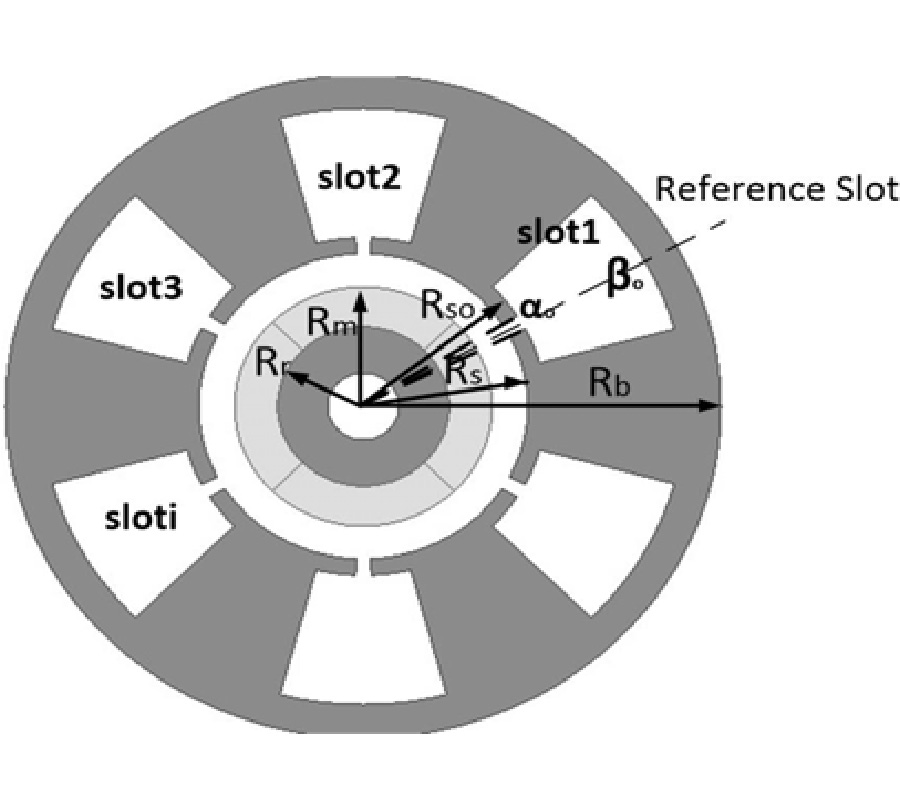
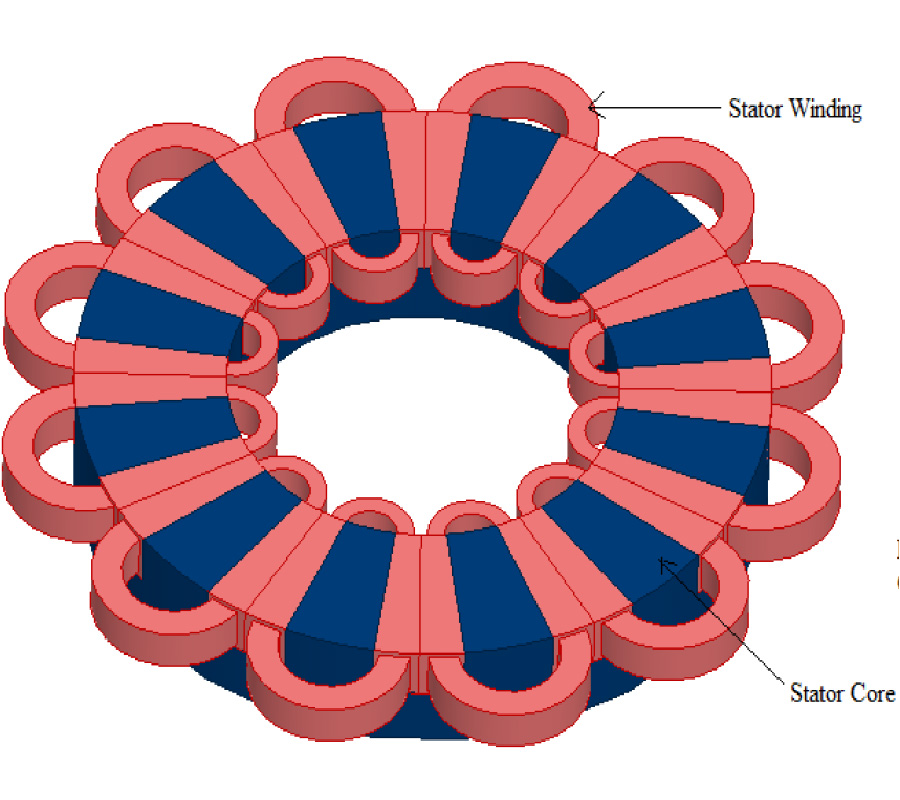
A superconducting synchronous generator (SSG) is proposed for wind power, in which magnesium diboride (MgB2) superconducting coils are employed as field windings. The stator is composed of conventional copper coils and iron core, while the rotor has no iron core. The whole refrigeration method is adopted in this paper. The thermal barrier is not placed in between the stator and the rotor as compared with the prior HTS generators, so a small air gap width would be possible. In order to study the electromagnetic characteristics of the SSG, finite element method (FEM) is implemented to optimize the SSG and obtain the no-load and load performance of the initial and optimized SSG. Finally, the optimized SSG is compared with a traditional synchronous generator (TSG) of the same power. The results indicate that the optimized SSG has many merits such as small size, light weight, high efficiency and high power factor.
RESEARCH ON A SUPERCONDUCTING SYNCHRONOUS GENERATOR FOR WIND POWER
2018-04-10
PIER C
Vol. 83, 83-96
An Efficient Algorithm for the Analysis and Design of Carbon Nanotube Photonic Crystals
Said Mikki and Ahmed A. Kishk
In this part, we develop an efficient algorithm for the computation of the complete transmitted and reflected electromagnetic fields in generic 2D arrays of carbon nanotubes (CNTs). The method relies on first approaching individual CNTs using an effective-boundary condition based on a proper quantum conductivity model. An exact eigenmode solution is obtained for this problem for both single-wall and multi-wall CNTs, which then is integrated with Floquet mode theory to handle periodic arrays of CNTs. The algorithm's convergence rate is accelerated using special methods and then applied to the analysis and design of various multi-layered CNT-based photonic crystals. It is shown that the proposed method can clearly demarcate the intrinsic resonances due to electronic transitions in individual CNTS and new sets of geometric resonances produced by the array environment. The algorithm can be used to analyze measured optical spectra of CNT composites and to design new optical bandgap devices.
AN EFFICIENT ALGORITHM FOR THE ANALYSIS AND DESIGN OF CARBON NANOTUBE PHOTONIC CRYSTALS
2018-04-10
PIER B
Vol. 80, 101-112
Fast Calculation and Analysis of the Equivalent Impedance of a Wireless Power Transfer System Using an Array of Magnetically Coupled Resonators
Jose Alberto , Ugo Reggiani , Leonardo Sandrolini and Helena Albuquerque
In this paper the equivalent impedance of resonator arrays for wireless power transfer systems is obtained in closed-form from a continued fraction expression. Using the theory of difference equations, the continued fraction is described as the general term of a complex sequence de fined by recurrence, and its convergence is analyzed. It is shown that the equivalent impedance can be easily found in closed-form in terms of the system parameters. In this way, the obtained closed-form expressions may help electrical engineers to quickly predict the behaviour of a system with the changes of its parameters. Some numerical examples of the theoretical results are given and discussed. Finally, the analytical formulae obtained in this work are validated with measurements and a good agreement is observed.
FAST CALCULATION AND ANALYSIS OF THE EQUIVALENT IMPEDANCE OF A WIRELESS POWER TRANSFER SYSTEM USING AN ARRAY OF MAGNETICALLY COUPLED RESONATORS
2018-04-10
PIER Letters
Vol. 74, 137-143
Development of Large Aperture Microstrip Antenna for Radio Wave Energy Harvesting
Intan Savitri , Radial Anwar , Yahya Syukri Amrullah and Dwi Andi Nurmantris
Radio wave energy harvesting has become one of the most fascinating fields of research, especially in developing antenna for its front end subsystem. This paper presents the development of a single large aperture antenna for energy harvesting system. Three substrate layers FR4-air-FR4 are employed to increase the antenna gain. Measurement result shows that the proposed antenna is able to obtain gain of about 9.61 dBi at 1.575 GHz (GPS L1 frequency), with low return loss of about -17.12 dB. The achieved bandwidth is about 128 MHz. The antenna characteristic is suitable for energy harvesting application.
DEVELOPMENT OF LARGE APERTURE MICROSTRIP ANTENNA FOR RADIO WAVE ENERGY HARVESTING
2018-04-09
PIER C
Vol. 83, 71-82
Miniaturized Multiband Microstrip Patch Antenna Using Metamaterial Loading for Wireless Application
Amit Kumar Singh , Mahesh Pandurang Abegaonkar and Shiban Kishen Koul
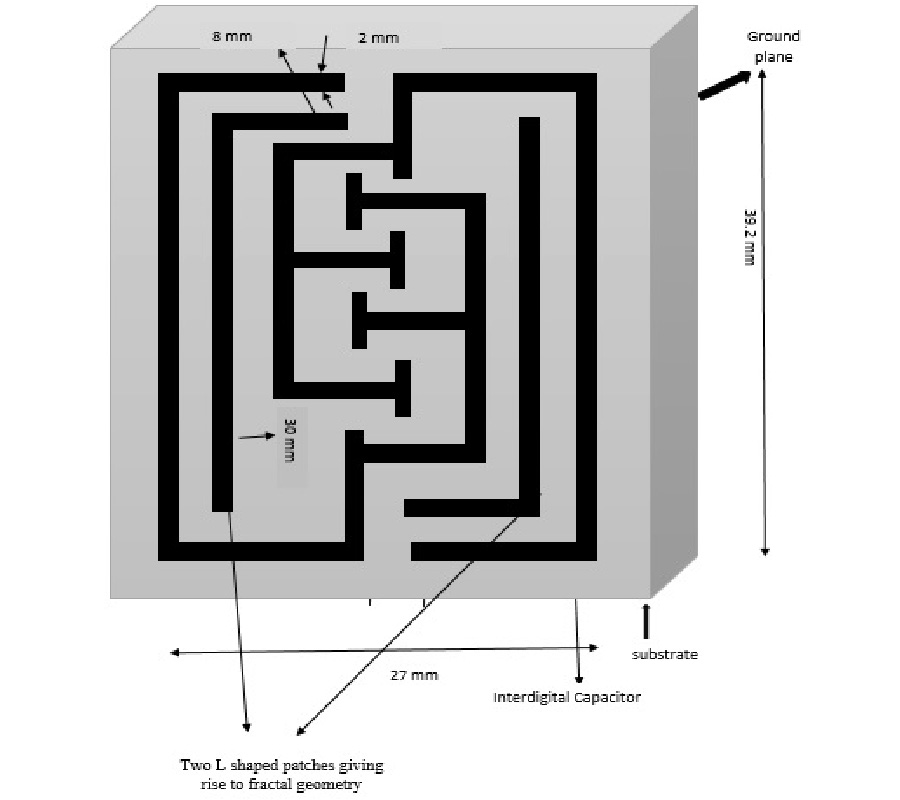
A highly miniaturized significant gain triple band patch antenna loaded with a new modified double circular slot ring resonator (MDCsRR) metamaterial unit cell is presented in this paper. Novel MDCsRR is a compact low frequency slot ring resonator. The principle of the proposed patch antenna element is based on adding series capacitance to decrease the half wavelength resonance frequency, thus reducing the electrical size of the proposed patch antenna. The transmission line model is used to analyze passband and stopband characteristics of the radiating bands. Circulating current distribution around MDCsRR slot with increased interdigital capacitor finger length causes multiple modes to propagate. The MDCsRR metamaterial unit cell consists of a new modified circular slot ring resonator (MCsRR) with metallic strip finger. The proposed structure is compact in size with radiating element dimensions of 0.20λ × 0.20λ × 0.008λ at first resonating frequency. The proposed antenna offers triple band operation with significant calculated antenna gain of 3.28 dBi at first center frequency of 3.2 GHz, 2.76 dBi at second center frequency of 5.4 GHz and 3.1 dBi at third center frequency of 5.8 GHz. The electrical size of the proposed antenna is miniaturized by about 68.83% as compared to the conventional patch antenna operating at first resonating frequency.
MINIATURIZED MULTIBAND MICROSTRIP PATCH ANTENNA USING METAMATERIAL LOADING FOR WIRELESS APPLICATION
2018-04-09
PIER C
Vol. 83, 57-70
Design of a Novel Compact and Efficient Rectenna for WiFi Energy Harvesting
Yanyan Shi , Jianwei Jing , Yue Fan , Lan Yang and Meng Wang
With the increase of low power devices, the design of a compact and efficient rectenna is essential for supplying energy to the devices. This paper presents a compact rectenna for high efficient WiFi energy harvesting. A novel fractal geometry is introduced in the design of antenna for miniaturization, and the ability to harvest WiFi energy is enhanced due to its characteristics of self-similarity and space filling. Besides, a single stub matching network is designed to achieve high conversion efficiency with a relatively low input power ranging from -20 dBm to 0 dBm. Simulation and experiments have been carried out. The results show that the proposed antenna features a good characteristic of reflection coefficient and realized gain at WiFi band. The highest RF to DC conversion efficiency of the rectenna is up to 52% at 2.48 GHz with the input power of 0 dBm. This study demonstrates that the proposed rectenna can be applied to a range of low power electronic applications.
DESIGN OF A NOVEL COMPACT AND EFFICIENT RECTENNA FOR WIFI ENERGY HARVESTING
2018-04-09
PIER Letters
Vol. 75, 19-24
Quasi-Millimeter Wave Technique Used for Image of Wood
Dan Zhang , Chujing Zong and Atsushi Mase
A quasi-millimeter electromagnetic wave with the frequency of 22-30 GHz is applied to detect knots and holes in wood samples. It has better spatial resolution while keeping good transmission properties compared to microwave region used in the previous experiments. The images of knots and holes in wood are clearly obtained by analyzing the phase and amplitude of the transmitted wave. And the phase measurement results are all better than amplitude results according to phase values changing much more than amplitude.
QUASI-MILLIMETER WAVE TECHNIQUE USED FOR IMAGE OF WOOD
2018-04-09
PIER Letters
Vol. 75, 1-6
Routing with Classical Corrugated Waveguide Low-Pass Filters with Embedded Bends
Fernando Teberio , Jon Mikel Percaz , Ivan Arregui , Petronilo Martin-Iglesias , Txema Lopetegi , Miguel Laso and Israel Arnedo
A very simple design method to embed routing capabilities in classical corrugated filters is presented in this paper. The method is based on the calculation of the heights and lengths of the so-called filters design building blocks, by means of a consecutive and separate extraction of their local reflection coefficients along the device. The proposed technique is proved with a 17th-order Zolotarev-filter whose topology is bent twice so that the input and output ports are in the same plane while preserving the in-line filters behaviour. This new filter allows the possibility of eliminating subsequent bending structures, reducing the insertion loss, weight, and PIM.
ROUTING WITH CLASSICAL CORRUGATED WAVEGUIDE LOW-PASS FILTERS WITH EMBEDDED BENDS
2018-04-08
PIER C
Vol. 83, 45-56
Surface Plasmon Effects and Resonance State on Square Lattice of Metallic Photonic Crystals and Defect Mode in h Polarization
Khee Lam Low , Mohd Zubir Mat Jafri , Sohail A. Khan and Donald G. S. Chuah
The surface plasmon effect in metallic photonic crystals has been investigated. Band structure graph is the only graph that can be used to explain the characteristics of photonic crystals. In this work, band structure graphs have been used to describe these characteristics, which include the surface plasmon effect of photonic crystals. Recently, band structure graphs for frequency-dependent materials have been analyzed by several researchers. The surface plasmon effect has been found for these materials. This article reports the effect of surface plasmons which cause resonance state in the metallic photonic crystals when the relative permittivity is changed from band structure graphs. The numerical results from the commercial software show the magnetic field distribution of waves on the normal photonic crystals, and defect mode is added for each frequency.
SURFACE PLASMON EFFECTS AND RESONANCE STATE ON SQUARE LATTICE OF METALLIC PHOTONIC CRYSTALS AND DEFECT MODE IN H POLARIZATION
2018-04-08
PIER C
Vol. 83, 33-44
Beam Focusing Compact Wideband Antenna Loaded with MU-Negative Metamaterial for Wireless LAN Application
Sourav Roy , Krishna Lal Baishnab and Ujjal Chakraborty
This article proposes a beam focusing compact wideband microstrip antenna loaded with mu negative (MNG) metamaterial. The antenna is designed to operate in the frequency spectra of IEEE 802.11a wireless LAN 5.15-5.85 GHz. The controlling of the beam direction has been investigated using eight different switching combinations of 12 PIN diodes which are integrated in the metamaterial unit cells. The main beam is found to be focused in -ve y, +ve y and omnidirectional in yz plane in agreement with switching condition of the metamaterial unit cell. The maximum gain enhancement of 7 dB is obtained at 4.9 GHz as the beam of the power pattern is focused in the negative y direction. The basic antenna with patch dimension (0.14λ × 0.14λ) provides wide impedance bandwidth of about 40%. Two prototypes of basic and proposed antennas have been developed using a low profile FR-4 substrate. The simulation results are found in good agreement with the measurement ones.
BEAM FOCUSING COMPACT WIDEBAND ANTENNA LOADED WITH MU-NEGATIVE METAMATERIAL FOR WIRELESS LAN APPLICATION
2018-04-08
PIER Letters
Vol. 75, 13-18
Miniature Multiband Antenna for WLAN and X-Band Satellite Communication Applications
Ruixing Zhi , Mengqi Han , Jing Bai , Wenying Wu and Gui Liu
A novel miniature microstrip-fed multiband antenna for wireless local area network (WLAN) and X-band satellite communication applications is presented in this paper. The proposed antenna consists of two arc-shaped strips, dual inverted L-shaped parasitic stubs and a partial ground plane. The proposed antenna can excite multi-resonant modes while achieving a compact size of 18×34.5×0.8 mm3. The measurement results show that -10 dB impedance bandwidths are 290 MHz (2.28-2.57 GHz), 1.27 GHz (5.0-6.27 GHz), and 850 MHz (7.11-7.96 GHz), which can cover the entire operation frequencies of WLAN (2.48-2.4835 GHz, 5.15-5.875 GHz) and X-band satellite communication system (7.25-7.75 GHz) applications.
MINIATURE MULTIBAND ANTENNA FOR WLAN AND X-BAND SATELLITE COMMUNICATION APPLICATIONS
2018-04-07
PIER Letters
Vol. 75, 7-12
Compact Microstrip Balanced-to-Balanced Diplexer Using Stub-Loaded Triple-Mode Resonators
Chao Zhang , Li Zhu and Yuehua Li
In this paper, a new microstrip balanced-to-balanced diplexer is presented and investigated. The proposed diplexer primarily consists of two balanced bandpass filter paths, and each balanced filter path can be designed independently based on two identical stub-loaded triple-mode resonators. It should be mentioned that no extra matching networks are required at the common balanced input port in the design. For demonstration, a prototype balanced-to-balanced diplexer operating at 2.30 and 2.83 GHz is designed, fabricated and measured with 3-dB fractional bandwidths of 13.0% and 13.4%. Both simulated and measured results are provided in satisfactory agreement.
COMPACT MICROSTRIP BALANCED-TO-BALANCED DIPLEXER USING STUB-LOADED TRIPLE-MODE RESONATORS
2018-04-06
PIER M
Vol. 67, 85-93
Accurate Parameter Estimation of Over-the-Horizon Radar Signals Using RANSAC and MUSIC Algorithms
Igor Djurovic and Yimin D. Zhang
Processing over-the-horizon radar (OTHR) signals is challenging due to appearance of several very close components in the time-frequency plane, strong noise and clutter, multipath propagation, and aliasing. We propose a two-stage procedure for estimating multipath signal components from the received mixture. In the first stage, the instantaneous frequency is estimated from the time-frequency representation of the received signal. The random samples consensus algorithm is applied to the instantaneous frequency estimate to improve the robustness of the procedure against various effects in the underlying signals. In the second stage, the MUSIC algorithm is applied to the dechirped and downsampled signal. The effectiveness of the proposed approach is verified using real-life signals.
ACCURATE PARAMETER ESTIMATION OF OVER-THE-HORIZON RADAR SIGNALS USING RANSAC AND MUSIC ALGORITHMS
2018-04-06
PIER M
Vol. 67, 75-84
Substrate Integrated Waveguide (SIW) Diplexer with Novel Input/Output Coupling and No Separate Junction
Augustine O. Nwajana , Amadu Dainkeh and Kenneth Siok Kiam Yeo
A microwave diplexer implemented by using the twenty-first century substrate integrated waveguide (SIW) transmission line technology is presented. No separate junction (be it resonant or non-resonant) was used in achieving the diplexer, as the use of an external junction for energy distribution in a diplexer normally increases design complexity and leads to a bulky device. The design also featured a novel input/output coupling technique at the transmit and receive sides of the diplexer. The proposed SIW diplexer has been simulated using the full-wave finite element method (FEM), Keysight electromagnetic professional (EMPro) 3D simulator. The design has also been validated experimentally and results presented. Simulated and measured results show good agreement. The measured minimum insertion losses achieved on transmit and receive channels of the diplexer are 2.86 dB and 2.91 dB, respectively. The measured band isolation between the two channels is better than 50 dB.
SUBSTRATE INTEGRATED WAVEGUIDE (SIW) DIPLEXER WITH NOVEL INPUT/OUTPUT COUPLING AND NO SEPARATE JUNCTION
2018-04-06
PIER M
Vol. 67, 65-73
Compact CPW-Fed Circularly Polarized Antenna for WLAN Application
Manas Midya , Shankar Bhattacharjee and Monojit Mitra
A novel compact CPW (coplanar waveguide-fed) CPSS (Circularly polarized square slot) antenna is presented. The proposed single-layer antenna is composed of a rectangular ground plane embedded with two equal-size patches along two orthogonal directions. Equal amplitudes with 90˚ phase difference values of two patches is capable are generating a resonant mode for exciting two orthogonal E vectors. Axial ratio (AR) bandwidth is significantly enhanced due to slot corner modification. The designed CPSS antenna is compact in nature with volume of 0.37λ0× 0.34λ0 × 0.012λ0 mm30= free space wavelength at centre frequency of the CP bandwidth). It has impedance bandwidth between 4.65-6.72 GHz (36.41%) and 3-dB axial-ratio bandwidth of 520 MHz (4.85-5.37 GHz), which covers 4.9 GHz (802.11j) WLAN for public safety ranging from 4.94 GHz to 4.99 GHz and WLAN (U-NII-1 and U-NII-2A) ranging from 5.150-5.350 GHz for indoor use. The gain variation for the frequencies within the CP bandwidth is also observed to be less than 0.6 dBic. The design is successfully implemented, and measured results are compared with the simulated ones, which are found in good agreement.
COMPACT CPW-FED CIRCULARLY POLARIZED ANTENNA FOR WLAN APPLICATION
2018-04-05
PIER C
Vol. 82, 237-249
Enhanced HF RFID Detection Area of Mobile Small Tag via Distributed Diameter Coil Resonator
Marjorie Grzeskowiak , Antoine Diet , Megdouda Benamara , Christophe Conessa , Stephane Protat , Marc Biancheri-Astier , Francisco de Oliviera Alves , Yann Le Bihan and Gaelle Lissorgues
To improve HF detection of small RFID tags, a Distributed Diameter Coil (DDC) resonator is included in the reader coil. The key ideas of detection improvement are twofold: using a resonator with Magnetic Resonant Coupling (MRC) and modifying the distribution of diameter and current for each loop of the DDC resonator. These factors allow the magnetic coupling to increase between the reader and the smaller tag, especially in our case where the effective area of the tag is below 0,1% of the reader coil surface. Numerical simulations are carried out using HFSS to confirm the enhancement of the mutual coupling between the tag and the reader coil: the coupling coefficient is used in double-loop coupling (the case of the coupling of two loops), when a third loop (resonator) is inserted. The optimization of the magnetic coupling between a large reader and a small tag with resonator could be realized in changing first the sub-coil diameters, and then the sub-coil number of turns. One figure of merit to quantify the ability of surface detection is defined. A 15% improvement of detection surface in Horizontal Mode is measured at 1 cm of the reader plane in comparison with a conventional coil. Experimental detection measurements on real structures are described to validate statements.
ENHANCED HF RFID DETECTION AREA OF MOBILE SMALL TAG VIA DISTRIBUTED DIAMETER COIL RESONATOR