Search Results(13794)

2017-08-02
PIER Letters
Vol. 69, 105-111
Ultra Wide Bandwidth High Gain Vivaldi Antenna for Wireless Communications
Dalia Mohammed Nasha Elsheakh , Nermeen A. Eltresy and Esmat A. F. Abdallah
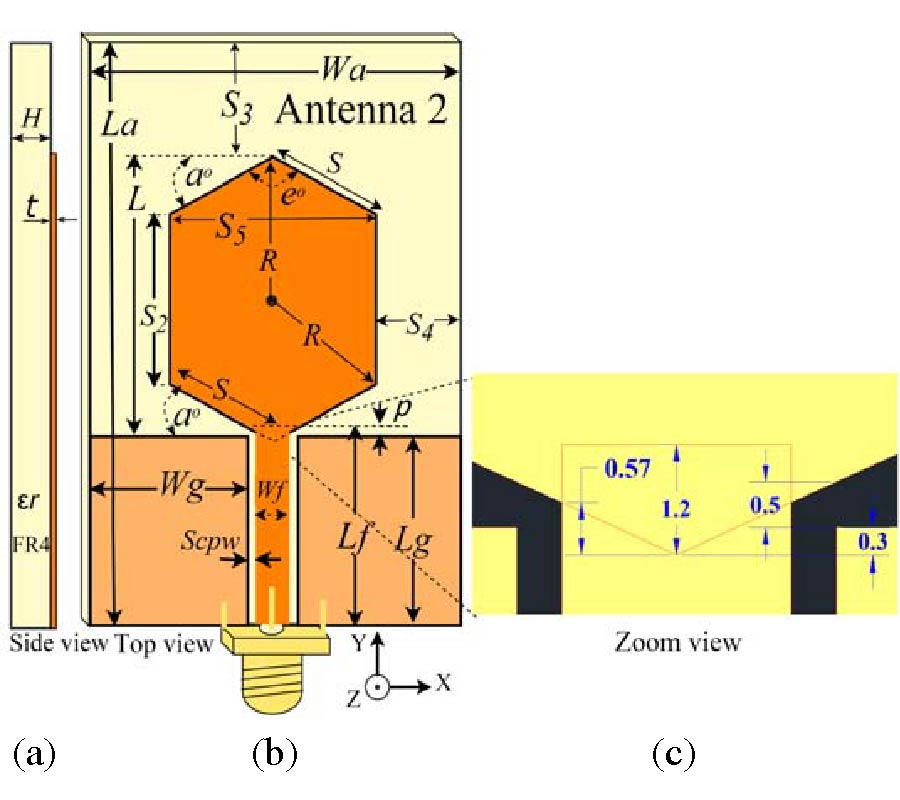
In this paper an ultra-wide bandwidth double-layered Vivaldi antenna (DLVA) integrated in Radome housing is proposed. First the conventional Vivaldi antenna is designed with bandwidth extended from 1.8 to 6 GHz at VSWR (3:1). Then for wider bandwidth, two slots are etched in the antenna ground plane to extend the antenna bandwidth from 1.7 to 9 GHz. For more improvement in antenna bandwidth, circular slots as electromagnetic band-gap structure (EBG) are etched to further extend the antenna bandwidth from 1.45 to 10 GHz. For gain enhancement double layers of Vivaldi antenna ground plane are designed with the same feeding line to reach 29 dBi peak. High frequency structure simulator (HFSS) ANSYS is used to design to simulated all the design steps. The proposed antenna is fabricated and measured. Finally, DLVA is integrated inside the Radome to improve the antenna gain and protect the proposed antenna from environmental factors. The antenna is fabricated and tested, and a good agreement between simulated and measured results is found.
ULTRA WIDE BANDWIDTH HIGH GAIN VIVALDI ANTENNA FOR WIRELESS COMMUNICATIONS
2017-08-02
PIER M
Vol. 59, 33-43
A New Technique Based on Grey Model for Forecasting of Ionospheric GPS Signal Delay Using GAGAN Data
Ginkala Venkateswarlu and Achanta Dattatreya Sarma
The ionospheric GPS signal delay which is a function of TEC plays a major role in the estimation positional accuracy of satellite based navigation systems and detrimental to position estimation especially in strategic applications. Ionospheric TEC is a function of geographical location (Latitude, Longitude), time, season, etc. In this paper, we propose a system theory based Grey Model (GM(1,1)) which uses past and present data for forecasting TEC (GPS signal delay). In this model, data of nine sequential days data from five stations of a GPS Aided Geo Augmented Navigation (GAGAN) system network located at different places representing different latitudes, longitudes and equatorial anomaly regions are used to forecast the 10th day TEC values of each of these stations. The performance of the model is assessed by comparing the statistical parameters such as Standard Deviation (SD) and Mean Square Deviation (MSD). The forecasted results are very encouraging. For all the considered five stations, forecasting is better for post sunset time than day time. Also, the results indicate that SD and MSD values are comparatively more for Trivandrum (near geomagnetic equator) and Ahmedabad (near the crest of the equatorial anomaly region). These results indicate that the proposed model is useful for forecasting of GPS signal delay both for civil aviation and strategic applications.
A NEW TECHNIQUE BASED ON GREY MODEL FOR FORECASTING OF IONOSPHERIC GPS SIGNAL DELAY USING GAGAN DATA
2017-08-01
PIER C
Vol. 76, 119-127
Wide-Angle Polarization Independent Triple Band Absorber Based on Metamaterial Structure for Microwave Frequency Applications
Khusboo Kumari , Naveen Mishra and Raghvendra Kumar Chaudhary
This paper presents a wide-angle polarization independent triple-band absorber based on a metamaterial structure for microwave frequency applications. The designed absorber structure is the combination of two resonators (resonator-I and resonator-II). The proposed absorber is ultra-thin in thickness (0.012λo at lowest resonance frequency and 0.027λo at highest resonance frequency). The proposed absorber structure offers three absorption bands with peak absorptivities of 99.95%, 95.32% and 99.47% at 4.48, 5.34 and 10.43 GHz, respectively. Additionally, it also offers the full width at half maximum (FWHM) bandwidth of 167.2 MHz (4.40 - 4.56 GHz), 178.1 MHz (5.25 - 5.43 GHz) and 393.8 MHz (10.24 - 10.63 GHz), respectively. The metamaterial property of the designed absorber structure has been discussed by using dispersion diagram plot. The designed absorber structure exhibits wide-angle absorption at various oblique incidence angle for both TM and TE polarizations. The absorption mechanism of the designed absorber structure has been analyzed through electric field and surface current distribution plots. The input impedance of the designed absorber (375.67 Ω at 4.48 GHz and 346.73 Ω at 10.43 GHz), nearly matches the free space impedance. The proposed absorber structure is fabricated and measured. Simulated and measured results are in good agreement with each other.
WIDE-ANGLE POLARIZATION INDEPENDENT TRIPLE BAND ABSORBER BASED ON METAMATERIAL STRUCTURE FOR MICROWAVE FREQUENCY APPLICATIONS
2017-07-31
PIER B
Vol. 77, 137-154
Reduction of PCB PDN Impedance and Radiated Emissions Using a Hybrid Technique with Absorbing Materials and Decoupling Capacitors
Shaowu Huang , Gary Charles , Kai Xiao and Beomtaek Lee
In this paper we present an approach to reduce the cavity resonant edge effects in printed circuit boards (PCBs) and semiconductor packages. Power supply noise, in the form of fast changing currents (di/dt), traverses the power-return paths of PCBs and semiconductor packages using power vias. The cavity effects produce considerable level of noise along the edges of PCB and integrated circuit (IC) package power planes due to signal coupling between vias and reflection from PCB edges with transient currents. The cavity effects also amplify the electromagnetic radiation from PCB edges, which are major sources of EMI/EMC problems in electronic devices. By using absorbing material and decoupling capacitors (de-caps) on power distribution networks (PDNs), we observe considerable mitigation in impedance noise, signal noise and electromagnetic interference/compatibility (EMI/EMC) issues caused by the cavity effects. In particular, simulation results show notable reduction of upper peak (anti-resonant) impedance noise and reduction in radiated emissions by as much as 20 dB. This article presents a comparative case-study using various models (Section 3) and report on their effectiveness to reduce the cavity effects. The models are listed as (1) "Original" model, (2) "Absorbing material along the edge" model, (3) "MURATA based De-cap only" model and (4) "Absorbing material along the edge w/ De-cap" model. The used capacitance ranges between 0.1 μF and 22 μF. The ESR and ESL range between 2 mOhm-20 mOhm and 238 pH-368 pH, respectively. Conclusively, we learn by adding absorbing material along the PCB edges with a few decoupling capacitors. The PDN impedance noise is improved, and EMI issues in PCBs and semiconductor packages suppress the cavity effects.
REDUCTION OF PCB PDN IMPEDANCE AND RADIATED EMISSIONS USING A HYBRID TECHNIQUE WITH ABSORBING MATERIALS AND DECOUPLING CAPACITORS
2017-07-31
PIER C
Vol. 76, 109-118
Very Compact 5.5 GHz Band-Notched UWB-MIMO Antennas with High Isolation
Zhiwei Liu , Xiliang Wu , Yueyuan Zhang , Peng Ye , Zhiqing Ding and Cheng Hu
In this letter, two different types of band-notch UWB-MIMO antennas are presented. the filtering effect can be achieved by integrating slot resonators to a UWB antenna. Both of the proposed antennas have very compact size and are smaller than most of the other band-notch UWB-MIMO antennas. The ultra-wideband is achieved by etching stepped slots on the ground. The band-notch characteristic can greatly reduce the potential interference between the UWB and WIMAX/WLAN system. Our proposed antennas can also possess a wide bandwidth from 3.3 GHz to 11 GHz with |S11| < -10 dB. Some effective measures have been taken and illustrated to reduce the isolation. Measurements demonstrate that the mutual coupling between the antenna elements is good enough for a MIMO system. Their stable radiation patterns are simulated, designed and measured successfully. The good performance and compact size make the antennas good candidates for UWB applications.
VERY COMPACT 5.5 GHZ BAND-NOTCHED UWB-MIMO ANTENNAS WITH HIGH ISOLATION
2017-07-31
PIER C
Vol. 76, 99-108
A Miniaturized Bandpass Frequency Selective Surface with High Selectivity Base on Slot Coupling
Shiling Yang , Qiang Chen , Jiajun Bai and Yunqi Fu
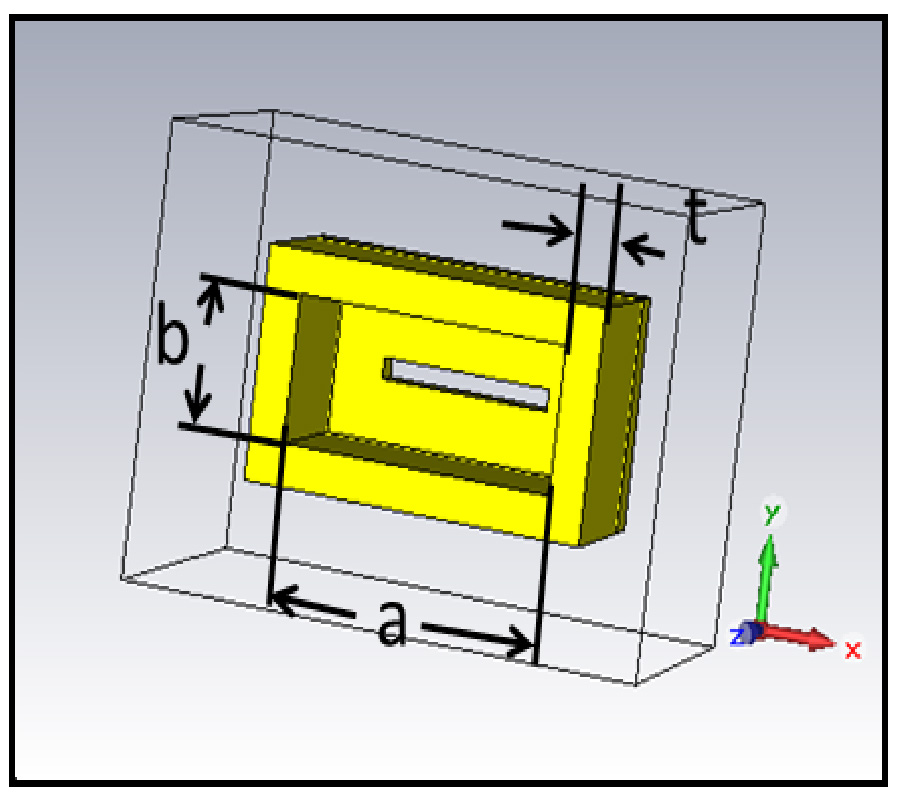
A Ku-band bandpass frequency selective surface (FSS) with high selectivity and miniaturization is proposed in this paper. We use two metallic strips and one slot to design the frequency selective surface structure which contains both electrical and magnetic couplings. A metallic via is introduced in the FSS element for miniaturization. With the via inserted at the end of the metallic strip, the FSS unit size is reduced to half compared to that without via inserted. To investigate the operating principle of the slot-coupled FSS, an equivalent-circuit model is given and analysed using the odd- and even-mode method. The constructed out-of-phase signal path causes two transmission zeros (TZs) near the skirts of the narrow pass band, thereby enhancing the selectivity. A prototype of the proposed FSS operating at 16GHz is fabricated and measured. The measured results agree well with the full-wave and circuit simulation results, thus verifying the FSS design.
A MINIATURIZED BANDPASS FREQUENCY SELECTIVE SURFACE WITH HIGH SELECTIVITY BASE ON SLOT COUPLING
2017-07-30
PIER M
Vol. 59, 25-31
An Optimized PLRC-FDTD Model of Wave Propagation in Anisotropic Magnetized Plasma
Jinchao Ding , Zhiqin Zhao , Yue Yang , Yulang Liu and Zai-Ping Nie
Numerical dispersion is the main error source of the finite-difference time-domain (FDTD) method. In this paper, an optimized piecewise linear recursive convolution (PLRC) FDTD method with low numerical dispersion is presented first time for electromagnetic-wave propagation in anisotropic magnetized plasma. An optimized difference item which can achieve better approximation to the partial differential operator from transform domain is induced in this algorithm which decreases numerical dispersion. The item can be regarded as adding a correcting coefficient to conventional central difference format. And it is easy for programming and implementation. Numerical examples of electromagnetic pulse wave propagating in plasma demonstrate that the proposed optimized PLRC-FDTD method can not only reduce the numerical dispersion, but also improve precision, saving computational memory and computational time compared with the conventional PLRC-FDTD method. Same accuracy can be achieved when the spatial mesh size for the optimized PLRC-FDTD method is 2 times coarser as that in the conventional PLRC-FDTD method, corresponding to the computation time consumed in the optimized method is only 1/2 as that in the conventional one.
AN OPTIMIZED PLRC-FDTD MODEL OF WAVE PROPAGATION IN ANISOTROPIC MAGNETIZED PLASMA
2017-07-29
PIER B
Vol. 77, 117-136
Harmonically Time Varying, Traveling Electromagnetic Fields Along a Plate and a Laminate with a Rectangular Cross Section, Isotropic Materials and Infinite Length
Birger Marcusson and Claes Urban Lundin
This article contains derivation of propagation factors and Fourier series for harmonically time varying, traveling electromagnetic fields in a plate and a laminate with rectangular cross sections, isotropic materials and infinite length. Different and quite general fields are taken into account on all boundaries. Choices of boundary conditions and continuity conditions are discussed. Certain combinations of types of boundary conditions make the derivation possible for a laminate. Comparisons are made between results of Fourier series and finite element calculations.
HARMONICALLY TIME VARYING, TRAVELING ELECTROMAGNETIC FIELDS ALONG A PLATE AND A LAMINATE WITH A RECTANGULAR CROSS SECTION, ISOTROPIC MATERIALS AND INFINITE LENGTH
2017-07-28
PIER B
Vol. 77, 103-116
Frequency and Time Domain Design, Analysis and Implementation of a Multi-Gbps UWB Wilkinson Power Divider for 5G New Spectrum and Car Applications
Gholamreza Askari and Mohamad Khalil
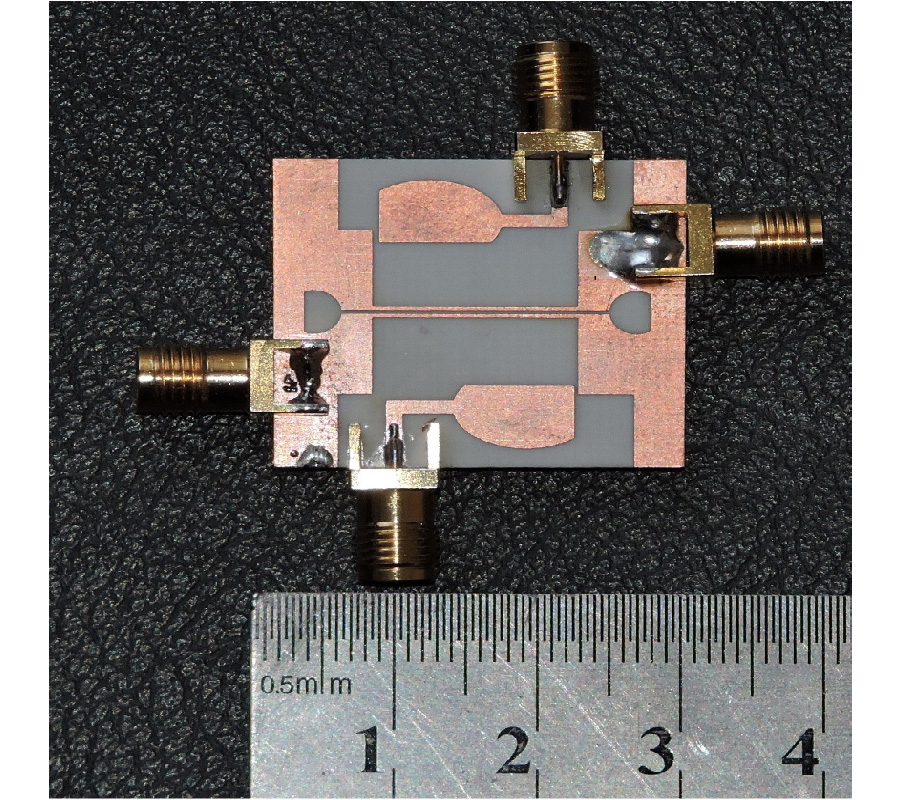
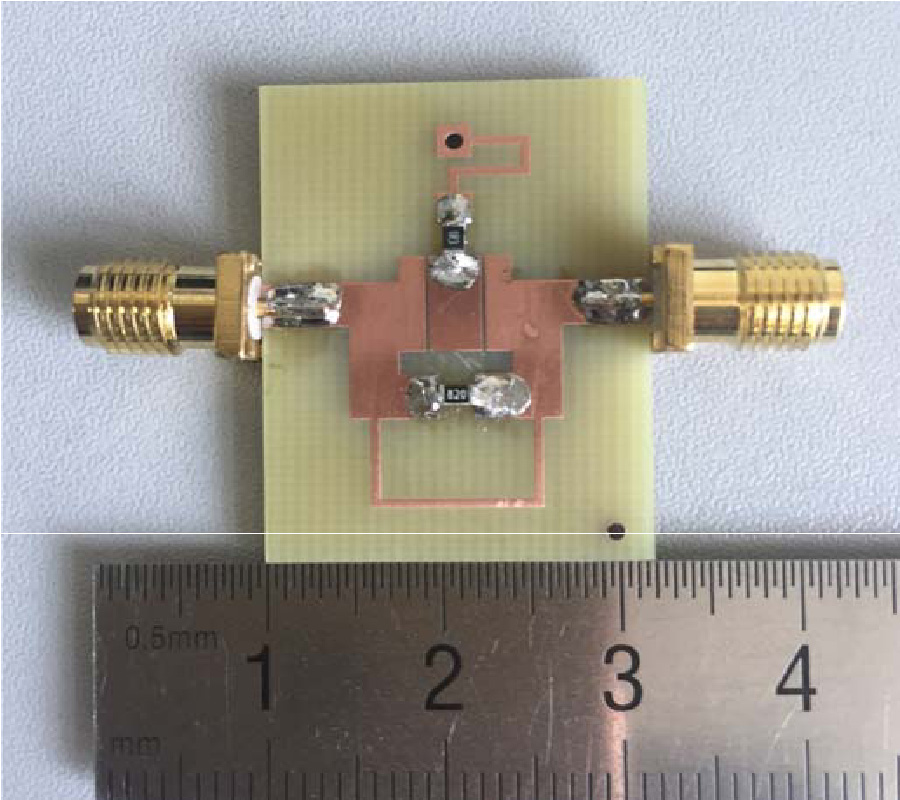
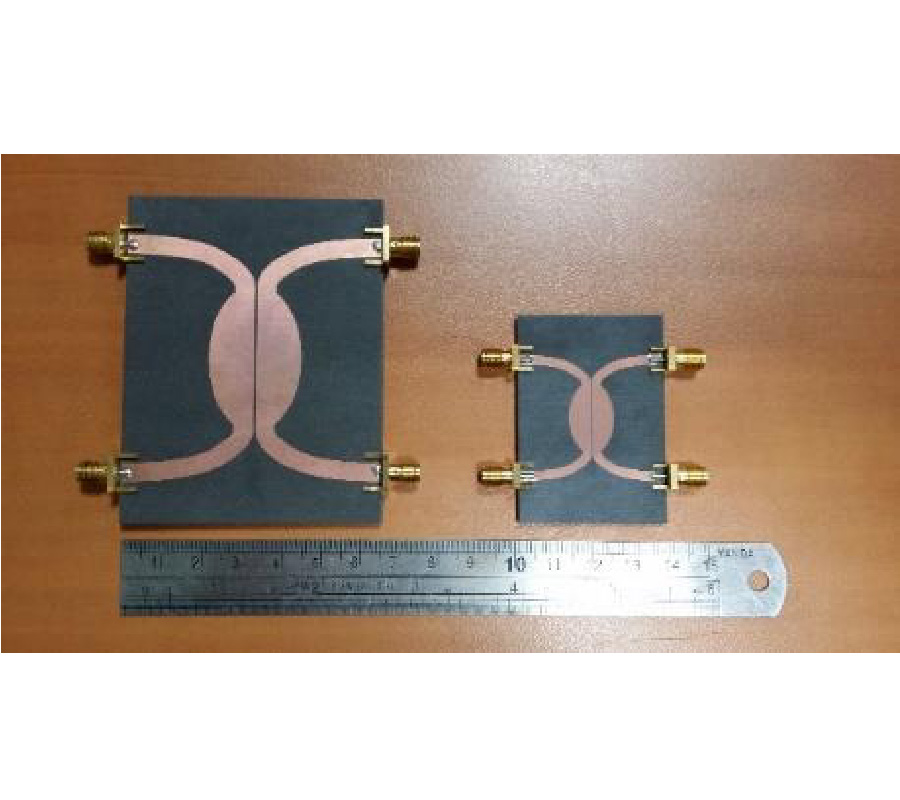
5G new spectrum radio access should support data rates exceeding 10 Gbps in most of its applications. An Ultra Wide Band (UWB) Ultra-high data rate Wilkinson power divider up to 6.9 Gbps for 5G new spectrum and CAR applications is presented in this paper. The step by step design procedure, optimization and implementation of this Wilkinson power divider in 20-30 GHz are completely done to achieve the optimum performance. The final fabrication results show the average of -14 dB of input matching, -20 dB of isolation of isolated Ports, -4.2 dB of coupling in output ports (considering 2 SMA connectors and transitions in each path), and linear phase variation of outputs in the whole bandwidth of 20-30 GHz. During the design procedure, a new and very useful coaxial to microstrip transition in K-band is designed, analyzed, developed and fabricated to achieve the best results. Also a complete study of time domain analysis with ultra-high data rate signal is presented to minimize the total reflection coefficient caused by the partial reflections from several discontinuities. To complete and validate the final fabricated Wilkinson power divider in ultra-high data rate application in 5G new spectrum, the extracted results of UWB-IR impulse radio with modulated ultra-high data rate signal up to 7 Gbps and in 20-30 GHz bandwidth is completely done. The measured results show that this fabricated Wilkinson power divider can handle a periodic modulated signal up to 7 Gbps which are valuable results for many applications in 5G and CAR systems.
FREQUENCY AND TIME DOMAIN DESIGN, ANALYSIS AND IMPLEMENTATION OF A MULTI-GBPS UWB WILKINSON POWER DIVIDER FOR 5G NEW SPECTRUM AND CAR APPLICATIONS
2017-07-28
PIER C
Vol. 76, 87-98
A Compact MIMO Antenna with Improved Isolation for 3G, 4G, Wi-Fi, Bluetooth and UWB Applications
Pratima Chabbilal Nirmal , Anil Nandgaonkar , Sanjay Laxmikant Nalbalwar and Rajiv Kumar Gupta
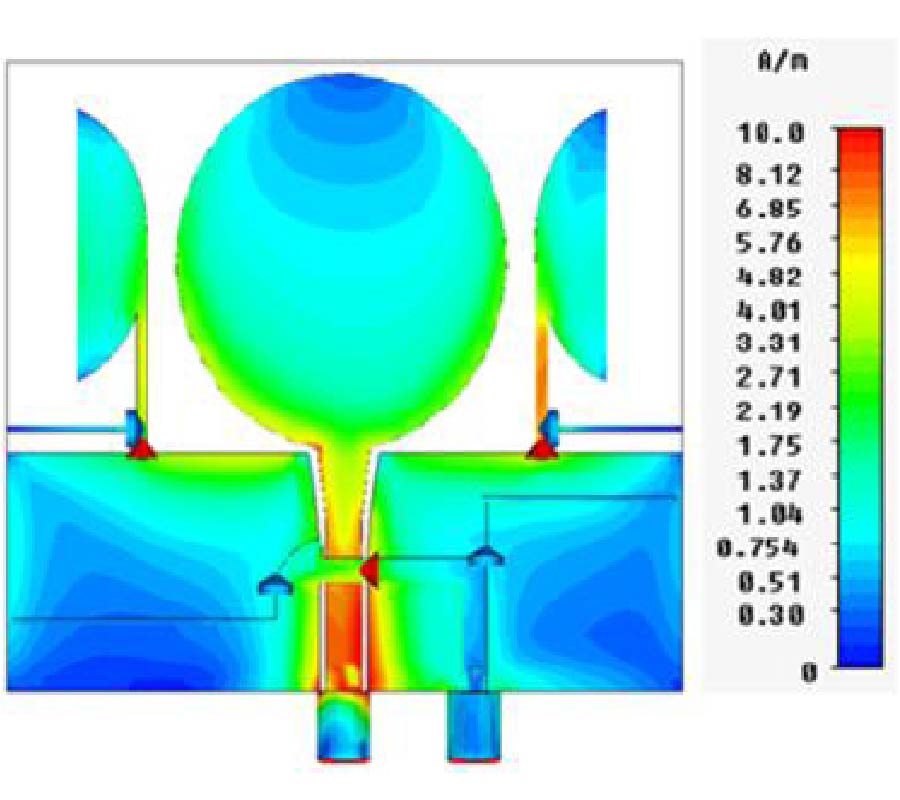
In this paper, a compact MIMO antenna with improved isolation is proposed. Elliptical slots and an SRR like structure are employed to improve the isolation. The proposed MIMO antenna structure consists of two semi-circular radiators attached to a rectangular monopole which are mirror images of each other with edge to edge spacing of 0.125 λ0, where λ0 is the free space wavelength corresponding to the lowest operating frequency of the structure. Two square steps are added to the above semi-circular monopole to increase the effective path length to cover the lower frequencies. Thereafter, a semi-annular ring slot is introduced, and square steps above the semi-circular monopole are modified to curved steps to further improve the impedance bandwidth of the antenna. The mutual coupling over the wideband is reduced by placing elliptical slots and SRR like structure in the ground plane. The proposed antenna has impedance bandwidth of 2.1- 12 GHz with |S21| < -20 dB over the entire frequency range. The antenna is designed and fabricated on an FR-4 substrate having overall dimensions of 38 mm × 33.4 mm× 1.6 mm. The measured results show a good correlation with the simulated ones. The envelope correlation coefficient (ECC) of the antenna is less than 0.02 over the entire band. The proposed MIMO antenna is an appropriate candidate for 3G, 4G, Wi-Fi, Bluetooth and UWB applications.
A COMPACT MIMO ANTENNA WITH IMPROVED ISOLATION FOR 3G, 4G, WI-FI, BLUETOOTH AND UWB APPLICATIONS
2017-07-28
PIER C
Vol. 76, 75-86
A Moment-Based Study on the Impedance Effect of Mutual Coupling for VLF Umbrella Antenna Arrays
Bin Li , Chao Liu and Huaning Wu
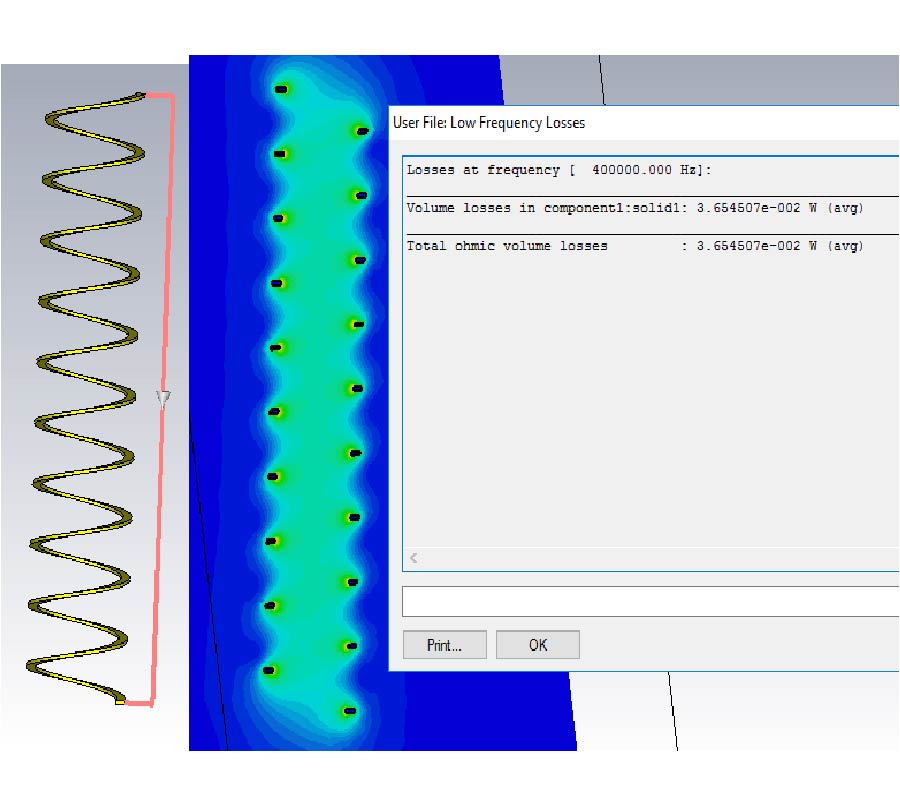
The mutual coupling between very low frequency (VLF) antenna elements is an important factor affecting the radiation performance of umbrella antenna arrays. This study evaluates the factors influencing the mutual coupling between the elements of an umbrella antenna array. We develop a mutual coupling analysis method for calculating the input impedances of a VLF antenna based on the impedance effect of mutual coupling. The radiation resistance of the VLF umbrella antenna can be obtained using numeric integral from Method of Moments (MoM) solution. Using the FEKO simulation software, a model of a trideco-tower umbrella antenna array is established. The electrical parameters of the VLF umbrella antenna array on inhomogeneous ground are calculated for both single and dual feeding modes. The impedance characteristics of the umbrella antenna arrays are also simulated for different array inter-element spacings on homogeneous ground. Representative numerical results are reported and discussed to assess the mutual coupling effect of the proposed method in comparison with full-wave simulations.
A MOMENT-BASED STUDY ON THE IMPEDANCE EFFECT OF MUTUAL COUPLING FOR VLF UMBRELLA ANTENNA ARRAYS
2017-07-28
PIER M
Vol. 59, 9-24
An Investigation on End-Fire Radiation from Linearly Polarized Microstrip Antenna for Airborne Systems
Debajit De and Prasanna Kumar Sahu
In airborne systems, where low aerodynamic drag is urgently required, an end-fire antenna is suitable to be used. An effort to develop such an antenna, using planar elements, is described in this paper. Here, a new kind of Microstrip Slotted Antenna with end-fire properties is presented. For investigating the end-fire radiation from microstrip antenna, three antenna elements are proposed during the study - 1) Single Patch Single Feed Microstrip Slotted Antenna, 2) Dual Patch Single Feed Microstrip Slotted Antenna and 3) Dual Patch Dual Feed Microstrip Slotted Antenna. All these proposed antennas are designed and simulated in two different EM tools, which are - CST Microwave Studio (MWS) based on time domain solver and ANSYS HFSS based on frequency domain solver. Thereafter, these antenna prototype models have been fabricated and tested. Good agreement is obtained between the simulated and measured results.
AN INVESTIGATION ON END-FIRE RADIATION FROM LINEARLY POLARIZED MICROSTRIP ANTENNA FOR AIRBORNE SYSTEMS
2017-07-28
PIER M
Vol. 58, 205-213
Energy-Efficient Communication in Large Scale Antenna Systems: Impact of Variable User Capacity and Number of Transmission Antennas
Joseph Isabona and Viranjay M. Srivastava
Energy-efficient transmission is fast becoming a critical factor in designing future mobile broadband cellular communication systems. This research work examines the constraints with regard to the achievable throughput and energy efficiency that can be attained on the use of precoding-based massive MIMO systems, bearing in mind the effect of some key performance impacting parameters. We first introduced an absolute energy efficiency-based model to evaluate the deep-down relationship among the packet length, the Bit error rate (BER) and throughput. Then, by means of simulation with cyclic coordinated search algorithm, optimal achievable throughput and energy efficiency performance have been shown and demonstrated for variable capacity of users and number of transmission antennas. This work is expected to be of enormous importance to practical system design on the use of massive MIMO antenna technology for data throughput and energy efficiency maximization in future 5G systems.
ENERGY-EFFICIENT COMMUNICATION IN LARGE SCALE ANTENNA SYSTEMS: IMPACT OF VARIABLE USER CAPACITY AND NUMBER OF TRANSMISSION ANTENNAS
2017-07-27
PIER B
Vol. 77, 85-101
Semi-Analytical Modeling of Spoke-Type Permanent-Magnet Machines Considering the Iron Core Relative Permeability: Subdomain Technique and Taylor Polynomial
Lazhar Roubache , Kamel Boughrara , Frederic Dubas and Rachid Ibtiouen
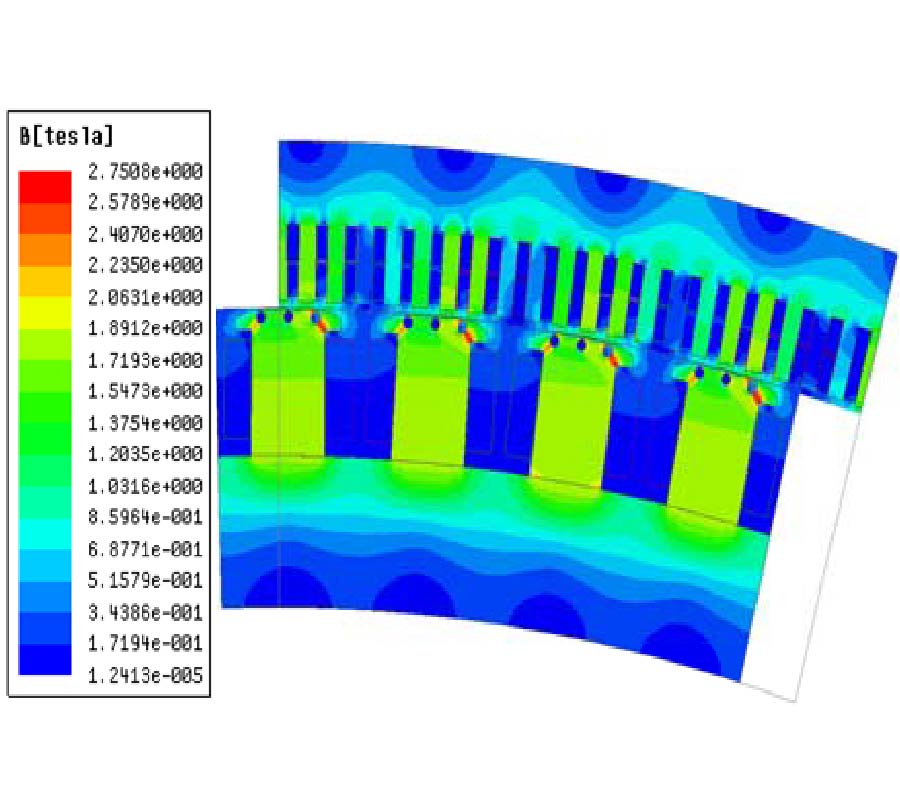
This article presents a novel contribution to the improvement of the analytic modeling of electrical machines using two-dimensional (2-D) subdomain technique with Taylor polynomial. To validate this novel method, the semi-analytical model has been implemented for spoke-type permanent-magnet (PM) machines (STPMM). Magnetostatic Maxwell's equations are solved in polar coordinates, and in all parts of the machine. The global solution is obtained using the traditional boundary conditions (BCs), in addition to new radial BCs (e.g., between the PMs and the rotor teeth) which are traduced into a system of linear equations according to Taylor series expansion. The magnetic field calculations are performed for two different values of iron core relative permeability (viz., 10 and 1,000) and compared to finite-element method (FEM) predictions. The results show that a very good agreement is obtained.
SEMI-ANALYTICAL MODELING OF SPOKE-TYPE PERMANENT-MAGNET MACHINES CONSIDERING THE IRON CORE RELATIVE PERMEABILITY: SUBDOMAIN TECHNIQUE AND TAYLOR POLYNOMIAL
2017-07-27
PIER M
Vol. 59, 1-7
Sub-Diffraction Holographic Imaging with Resonant Scatterers
Abhishek Patel and Reza K. Amineh
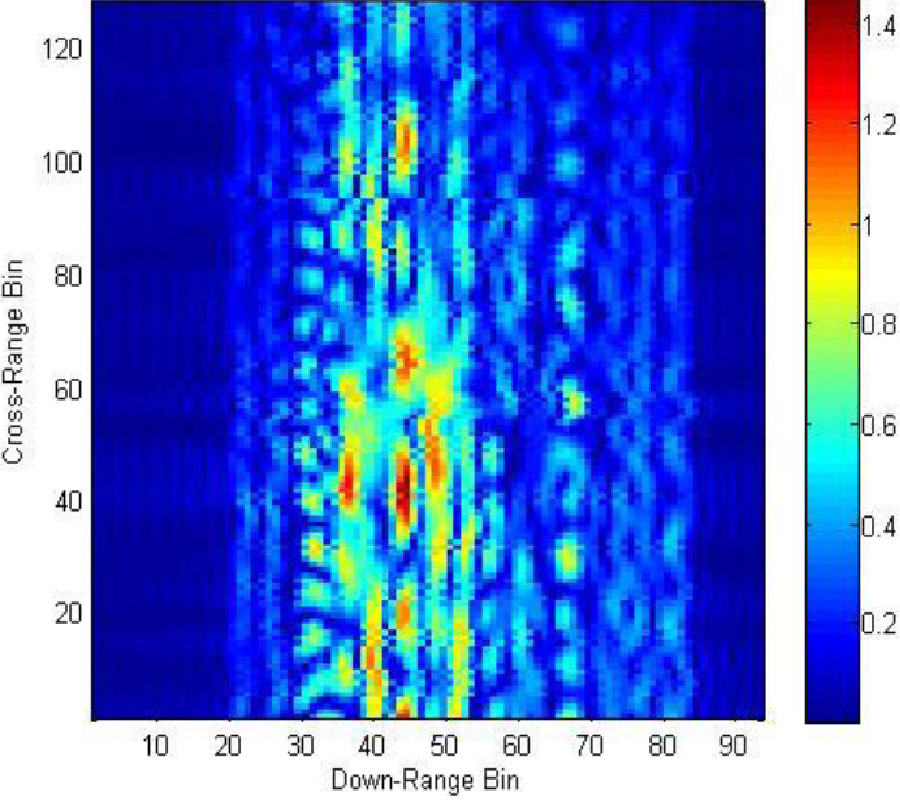
Imaging with electromagnetic waves has a wide range of applications from remote sensing of earth to concealed weapon detection, among the others. When data are collected in the far-field (imaging distance in the order of one wavelength or larger), linear electromagnetic imaging techniques mainly suffer a fundamental limit in the resolution called "diffraction limit". To overcome this limit, we propose the use of resonant near-field scatterers incorporated in the holographic imaging techniques. These scatterers convert part of the evanescent spectrum in the vicinity of the object to propagating spectrum that is measured by the antenna in the far-field. Here, we study the improvement in the resolution with decreasing the object-scatterer distance. We also investigate the effect of using multiple scatterers along the range and cross-range directions.
SUB-DIFFRACTION HOLOGRAPHIC IMAGING WITH RESONANT SCATTERERS
2017-07-26
PIER C
Vol. 76, 63-73
A 6.6 GHz Quadrature Frequency Synthesizer with -78 Dbc Reference Spur for UWB Application
Minghua Wang , Xiaosong Wang , Yu Liu and Haiying Zhang
An integer-N quadrature frequency synthesizer for single-band UWB application was designed in 0.18 μm CMOS technology. A modified bottom-series quadrature voltage-controlled oscillator (QVCO) based on reconfigurable LC tank is employed to provide quadrature signals and cover a range from 6.48 GHz to 7.07 GHz. In order to suppress the reference spur levels, an improved charge-averaging charge pump and a highly linear phase-frequency detector (PFD) are used. From the carrier of 6.6 GHz, the measured reference spur is -78.2 dBc, and the measured phase noise is -115.4 dBc/Hz at 1MHz offset. The frequency synthesizer including buffers consumes a total power of 99 mW from a 1.8 V power supply. Chip size is 1.6 mm×0.9 mm.
A 6.6 GHZ QUADRATURE FREQUENCY SYNTHESIZER WITH -78 DBC REFERENCE SPUR FOR UWB APPLICATION
2017-07-26
PIER C
Vol. 76, 55-62
High Impedance Properties of Two-Dimensional Composite Right/Left-Handed Transmission Lines
Eiichi Sano and Masayuki Ikebe
The electromagnetic characteristics of two-dimensional composite right/left-handed transmission lines (2D CRLH TLs) were investigated for the normal incidence of plane waves. The measured characteristic impedance and reflection phases exhibited resonant high impedance properties (equivalent to zero reflection phase) at a frequency within the left-handed mode for one-dimensional CRLH TL. An equivalent circuit was proposed to explain the measured characteristics. The relationship between the resonant frequency and the circuit parameters for 2D CRLH TLs was clarified by deriving an approximate equation for the resonant frequency. The surface-wave transmission characteristics for the 2D CRLH TLs were compared with those for a mushroom structure.
HIGH IMPEDANCE PROPERTIES OF TWO-DIMENSIONAL COMPOSITE RIGHT/LEFT-HANDED TRANSMISSION LINES
2017-07-26
PIER Letters
Vol. 69, 99-104
Tri-Mode Bandwidth-Tunable Filter Based on Microstrip-to-CPW Resonator
Jian-Quan Huang and Zhi-Han Chen
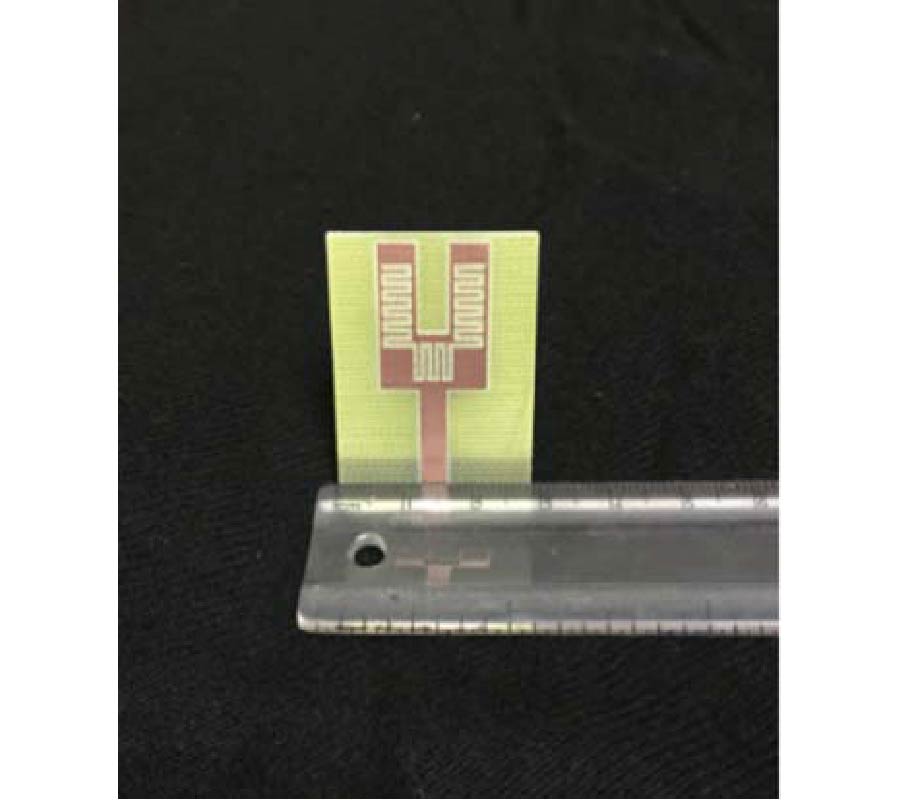
A novel microstrip-to-CPW resonator is presented, which can be employed to design bandwidth-tunable bandpass filter. The tri-mode resonator is composed of a dual-mode microstrip resonator and a CPW stub printed on a single piece of substrate. Two varactors embedded in the resonator are utilized to adjust the frequencies of the first and third resonant modes independently, thus flexible bandwidth control can be achieved. For demonstration, a prototypical filter is implemented with fixed center frequency of 1.72 GHz and 9.3%-32.6% fractional bandwidth (FBW) tuning range. Good agreement is obtained between the simulated and experimental results.
TRI-MODE BANDWIDTH-TUNABLE FILTER BASED ON MICROSTRIP-TO-CPW RESONATOR
2017-07-25
PIER B
Vol. 77, 71-84
Radiation Fields of a System of Two Impedance Crossed Vibrators Excited in-Phase and Placed Over a Rectangular Screen
Nadezhda P. Yeliseyeva , Aleksey N. Gorobets , Victor A. Katrich and Mikhail Nesterenko
An asymptotic solution of a 3D vector diffraction problem for a vibrator system placed over a rectangular perfectly conducting screen of finite dimensions is obtained in the framework of the uniform geometrical theory of diffraction (UGTD) using the asymptotic expressions for the impedance vibrator currents. The system consists of two orthogonally crossed vibrators with equal dimensions but different surface impedances. The vibrators are excited in-phase. An algorithm and respective software for computing the directional, power and polarization characteristics of the radiation field of this antennas system are developed. The conditions required to form a circularly polarized radiation with a maximally attainable directivity in the normal direction to the screen are determined depending on the screen dimensions and the distance between the vibrators and the screen.
RADIATION FIELDS OF A SYSTEM OF TWO IMPEDANCE CROSSED VIBRATORS EXCITED IN-PHASE AND PLACED OVER A RECTANGULAR SCREEN
2017-07-24
PIER B
Vol. 77, 57-69
Loop Antennas with Uniform Current in Close Proximity to the Earth: Canonical Solution to the Surface-to-Surface Propagation Problem
Mauro Parise , Marco Muzi and Giulio Antonini
In a recent study, the classical problem of a large circular loop antenna carrying uniform current and situated at the Earth's surface has been revisited, with the scope to derive a totally analytical explicit expression for the radial distribution of the generated magnetic field. Yet, the solution arising from the study exhibits two major drawbacks. First, it describes the vertical magnetic field component only. Second, it is a valid subject to the quasi-static field assumption, which limits its applicability to the low-frequency range. The purpose of the present work is to provide the exact canonical solution to the problem, describing all the generated electromagnetic field components and valid in both the quasi-static and non-quasi-static frequency regions. These two features constitute an improvement with respect to the preceding solution. The canonical solution, which is obtained by reducing the field integrals to combinations of known Sommerfeld integrals, is seen to be also advantageous over the previous numerical and analytical-numerical approaches, since its usage takes negligible computation time. Numerical simulations are performed to show the accuracy of the obtained field expressions and to investigate the behavior of the above surface ground- and lateral-wave contributions to the fields in a wide frequency range. It is shown that in the near-zone the two waves do not predominate over each other, while the effect of the lateral wave becomes negligible only when the source-receiver distance is far greater than the skin depth in the Earth.
LOOP ANTENNAS WITH UNIFORM CURRENT IN CLOSE PROXIMITY TO THE EARTH: CANONICAL SOLUTION TO THE SURFACE-TO-SURFACE PROPAGATION PROBLEM