Search Results(13794)

2017-08-14
PIER Letters
Vol. 69, 127-132
A Compact Ultra-Wideband Bandpass Filter with Sharp Roll-off Based on CPW-to-Microstrip Coupling Structure
Qiong Wang , Chunhui Shi , Xinlin Xia , Zhong Wang and Yu Huang
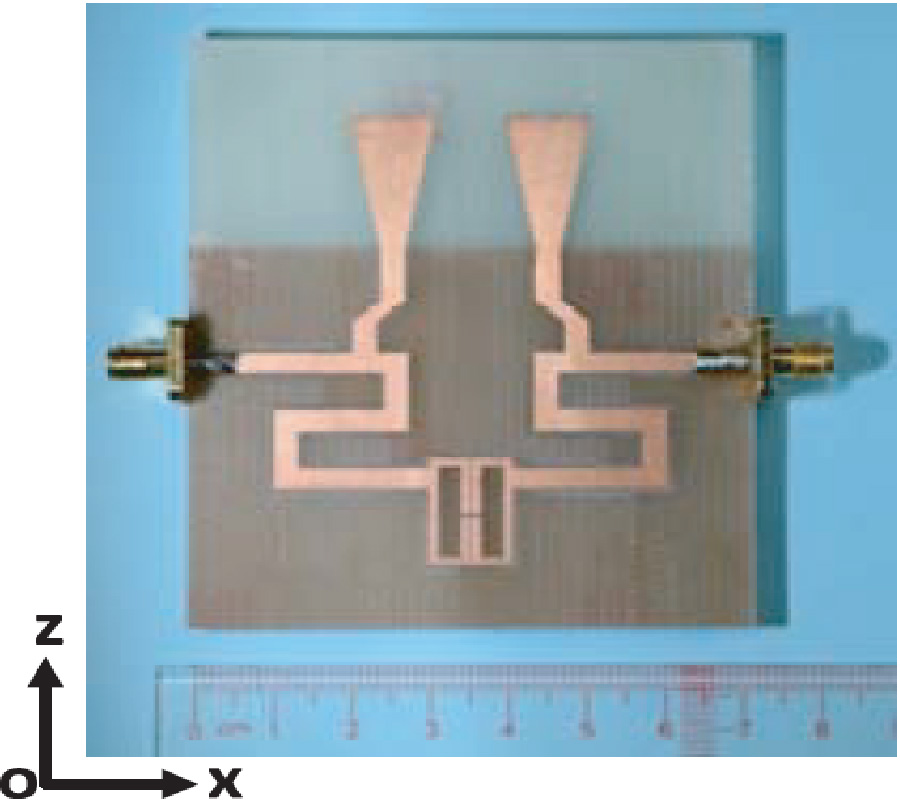
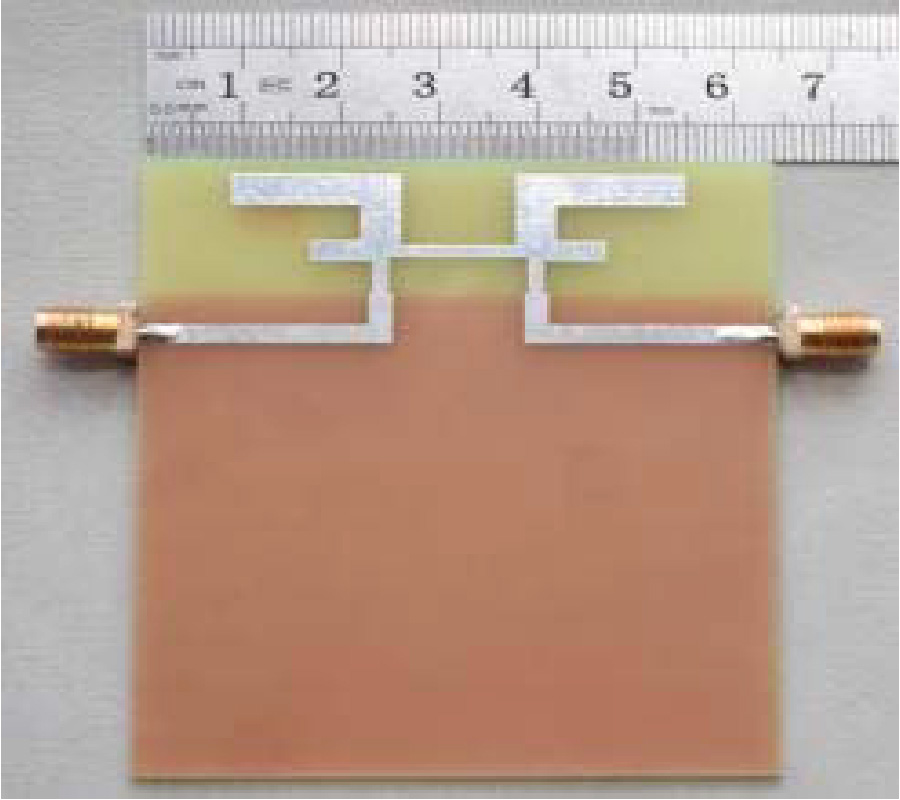
In this paper, a compact ultra-wideband bandpass filter using a back to back Coplanar Waveguide (CPW)-to-microstrip transition structure is proposed. Compared with traditional ultra-wideband bandpass filters using hybrid structures, the proposed filter has a sharper selectivity because of two transmission zeros located at the lower and upper edges of the passband, respectively, generated by a modified T-shaped stub. Moreover, to further improve its out-of-band performance open stubs are introduced to produce extra transmission zeros at high frequency. A prototype of the proposed filter is fabricated and measured. The results show that the proposed filter achieves a bandwidth of 133% from 2.4 to 11.9 GHz, and the selectivity (skirt factor) is optimized from 50% to 92% compared to a former ultra-wideband (UWB) bandpass filter (BPF) with a similar structure. Besides, the proposed filter can offer some other advantages such as good return loss, low insertion loss, stable group delay, and compact size (16×7.55mm2). This filter can be a good candidate for UWB applications.
A COMPACT ULTRA-WIDEBAND BANDPASS FILTER WITH SHARP ROLL-OFF BASED ON CPW-TO-MICROSTRIP COUPLING STRUCTURE
2017-08-14
PIER M
Vol. 59, 123-133
Transients in Ultra-High-Speed Generators of Micro-Sized Gas Turbines
Flur Rashitovich Ismagilov , Viacheslav Vavilov , Ilnar I. Yamalov and Valentina V. Ayguzina
The article presents a research of the effect of different types of short circuits (SC) on the performance of the gas turbine and ultra-high-speed microgenerator (MG) in a wide frequency range (from 200 000 rpm to 1,000,000 rpm) at a power from 10 W to 1 kW. The studies are carried out on a specific two-pole 100 W, 500,000 rpm microgenerator with permanent magnets with a toroidal winding. The research is carried out by finite element method using Ansys Maxwell software. Numerical study by the finite element method is performed at the rated operation mode and various types of short circuits: single-phase, two-phase, three-phase circuits coil inside MG. By the results of these studies, we estimate a negative impact of different types of faults on the parameters of MG and the mechanical characteristics of the gas turbine. Also we consider various options MG with SC for various types of bearings. Then, using the full-sized 100 W sample we carried out experimental studies of the MG operation in nominal operation mode at the 500,000 rpm. That allows to verify the developed computer model and confirm the results of our practice research. The obtained results can be used in the aerospace industry for design the high reliability complexes such as new energy systems for satellite power supply, unmanned aerial vehicles and microturbines. In addition, it can be used to design the ultra-high-voltage electric machines with a high fault tolerance for the compressor plants, air supply systems of hydrogen fuel cells, new medical tools and machine tools.
TRANSIENTS IN ULTRA-HIGH-SPEED GENERATORS OF MICRO-SIZED GAS TURBINES
2017-08-12
PIER B
Vol. 78, 31-46
Measurement Methodologies for Reducing Errors in the Assessment of EMF by Exposimeter
Rodrigues Kwate Kwate , Chakib Taybi , Bachir Elmagroud , Veronique Beauvois , Christophe Geuzaine , Dominique Picard and Abdelhak Ziyyat
Objective: As well known, using a single body worn sensor exposimeter introduces systematic errors on the measurement of the incident free space electric field strength. This is because the body creates around it high, intermediate and low level field zones, which depend on the direction of arrival of the incident field. The goal of this work is to propose an efficient method for the reduction of these errors. Methods: After classifying the perturbations induced by the body on the measured electric and magnetic fields thanks to realistic numerical simulations, we then propose a two-sensor setup in conjunction with simple semi-empirical correction formulas, in order to compensate these perturbations. Results: At 942 MHz, when the two sensors are placed in any opposite sides of the body at chest height, the worst case, maximum and average errors respectively decrease to 12% and 3% compared to 83% and 22% for measurement techniques using a single sensor, or 32% and 11% when using the average value of the measurements. Conclusion: The error related to the measurement in the presence of the body was significantly reduced by the proposed method making use of two opposite sensors, E-field and H-field at the chest. Significance: The conformity of exposure to EMF in terms of reference values according to the ICNIRP is given in the abscence of the human body. The interest of this work lies in the reduction of the errors made when measuring the field in the presence of the body.
MEASUREMENT METHODOLOGIES FOR REDUCING ERRORS IN THE ASSESSMENT OF EMF BY EXPOSIMETER
2017-08-12
PIER C
Vol. 76, 185-195
Using Open Stubs and Tuning the Width of Output Microstrip Lines of a Balun Diplexer to Obtain the Matching Output Impendence with RF Output Transceiver
Guoxiang Peng , Chia-Mao Chen , Yi-Xiong Zhang , Cheng-Yi Chen and Cheng-Fu Yang
Two novel compact 2.6/5.2 GHz diplexers with high common-mode suppression were designed and fabricated on the FR4 substrate. The diplexers were designed based on two open loop rectangle ring (OLRR) resonators and the two different resonant frequencies could be easily obtained by tuning the lengths of OLRRs. In the past, the traditional balun diplexer needed matching circuit to transfer signal to radio frequency (RF) transceiver with low loss because of the existence of unmatched impendences between the balun diplexer and RF transceiver. In order to improve their efficiency and low down the cost of the fabricated circuits, we would propose a method to tune the output impendence of the balun diplexer and the diplexer could have matching output impendence with the RF transceiver. The proposed balun diplexer had the structure of two stub-loaded microstrip lines, and the needed output impendence could be changed by tuning the widths of microstrip lines and stubs and by changing the length and position of stubs. For that, if the output impendence is well tuned, the designed balun diplexer will have the higher efficiency and low cost because the matching circuit is not necessary.
USING OPEN STUBS AND TUNING THE WIDTH OF OUTPUT MICROSTRIP LINES OF A BALUN DIPLEXER TO OBTAIN THE MATCHING OUTPUT IMPENDENCE WITH RF OUTPUT TRANSCEIVER
2017-08-11
PIER B
Vol. 78, 15-30
Target Recognition Method for Support Vector Machine on Stomach Tumor Imaging
Gong Chen , Ye-Rong Zhang and Fang-Fang Wang
In stomach tumor imaging, traditional time domain algorithm, i.e., back projection (BP) algorithm, and traditional frequency domain algorithm, i.e., frequency wave number migration (F-K) algorithm, can locate tumor target accurately. However, BP and F-K algorithms perform poorly in identifying tumor sizes and shapes. The algorithms must consider the influence of various tissues in the human body: the attenuation of the signal strength of electromagnetic waves, the decrease in speed and the refraction due to the different permittivities between different organs of the body. These factors will eventually lead to image offset and even generate a virtual image. It is effective to refrain the displacement of image with modifying the time element of the imaging algorithm by iteration. This paper proposes a method based on combination of support vector machine (SVM) with BP and F-K algorithms to solve problems in recognizing tumor shape. The method uses field strength obtained by BP and F-K algorithms as input in SVM to establish the SVM model. Based on BP algorithm, recognition method for SVM includes the following characteristics: short prediction time of SVM and good virtual elimination effect. However, the algorithm requires long periods and possibly misses tumor targets. Except the same characteristics as BP algorithm: short prediction time of SVM and good virtual elimination effect, F-K algorithm also works more efficiently, does not miss any tumor targets, and conforms more with requirements of real-time imaging. When the data are contaminated by noises, the tumor shape in the stomach can still be suitably predicted, which demonstrates the robustness of the method.
TARGET RECOGNITION METHOD FOR SUPPORT VECTOR MACHINE ON STOMACH TUMOR IMAGING
2017-08-11
PIER Letters
Vol. 69, 119-125
A Compact Quadruple-Mode Ultra-Wideband Bandpass Filter with a Broad Upper Stopband Based on Transversal-Signal Interaction Concepts
Xiuping Li , Qi Xia and Junjie Zeng
In this article, a compact ultra-wideband (UWB) band-pass filter (BPF) with wide upper stopband is presented. The filter is designed with a UWB response from 3.2 GHz to 10.8 GHz with low insertion loss of 0.9 dB and less than 0.19 dB at the center frequency (6.67 GHz). The filter is also designed with a broad upper stopband with high rejection level of 20 dB. The group delay is flat with maximum of 0.4 ns. The proposed UWB filter is constructed by using a pair of parallel coupled lines and two ring resonators. In this design, the ring resonators provide two new excited modes to widen the desired UWB passband and also create two tunable transmission zeros to achieve a wide stopband. Good agreement is observed between simulated and measured performances of the UWB filter.
A COMPACT QUADRUPLE-MODE ULTRA-WIDEBAND BANDPASS FILTER WITH A BROAD UPPER STOPBAND BASED ON TRANSVERSAL-SIGNAL INTERACTION CONCEPTS
2017-08-11
PIER M
Vol. 59, 111-121
Investigations of SAR Distributions and Temperature Elevation on Human Body at 60 GHz with Corrugated Antipodal Linear Tapered Slot Antenna
Purva Shrivastava and Thipparaju Rama Rao
New generation wireless communications are expected to provide new services over the existing variety of wireless applications in the coming years. In this perspective, advances in utilization of computational electromagnetics (EM) and millimeter-waves (mmW) frequency bands make them as candidates for ultra-high-resolution and ultra-high-speed wireless communications. With the deployment of mmW wireless technologies, brinks of potential mmW induced biological and health effects should be evaluated carefully. The EM exposure is usually measured in terms of absorbed power from any user operating wireless devices. The exposure varies with the part of the body and location of the source that is exposed to the radio frequency waves. The purpose of this study is to observe EM exposure in terms of Specific Absorption Rate (SAR) and temperature elevations at mmWs from the designed Antipodal Linear Tapered Slot Antenna (ALTSA) at 60 GHz on different body parts utilizing EM computations and experiments with Infrared Thermal Camera.
INVESTIGATIONS OF SAR DISTRIBUTIONS AND TEMPERATURE ELEVATION ON HUMAN BODY AT 60 GHZ WITH CORRUGATED ANTIPODAL LINEAR TAPERED SLOT ANTENNA
2017-08-09
PIER C
Vol. 76, 171-183
A Compact Microstrip Lowpass Filter with Sharp Roll-off Rate and Ultra-Wide Stopband Employing Coupled Polygon Patches
Ashkan Abdipour , Arash Abdipour and Fereshteh Lorestani
In this paper, a microstrip lowpass filter with -3 dB cutoff frequency of 1.8 GHz composed of two resonators with different polygon patches and six symmetric suppressing cells is presented. To design the proposed filter, the impact of each microstrip transmission line on the scattering parameters of the employed resonators is separately determined by extracting the equations of the insertion loss (S21) and return loss (S11) on the basis of their equivalent LC circuit. The designed filter is fabricated and measured, and a good agreement between the results of simulation and measurement is obtained. In the whole stopband region, a return loss better than -0.35 dB and an acceptable suppression level of -22 dB from 1.87 to 19.75 GHz are achieved. Furthermore, a flat insertion loss in the passband and an acceptable return loss (-19.32 dB) in this band can verify desired in-band performance. The designed lowpass filter has a high figure of merit about 36969.34.
A COMPACT MICROSTRIP LOWPASS FILTER WITH SHARP ROLL-OFF RATE AND ULTRA-WIDE STOPBAND EMPLOYING COUPLED POLYGON PATCHES
2017-08-08
PIER Letters
Vol. 69, 113-118
A Simple Bandpass Filter with Independently Tunable Center Frequency and Bandwidth
Bo Zhou , Jing-Pan Song , Feng Wei and Xiao-Wei Shi
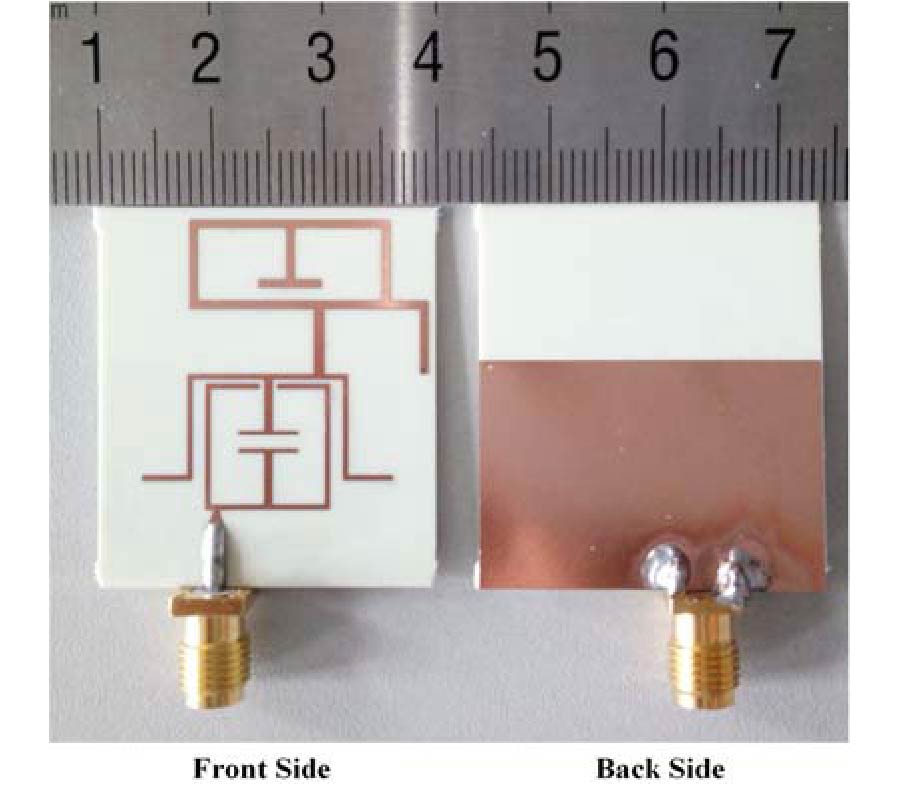
A varactor-tuned microstrip bandpass filter (BPF) with independently tunable center frequency and bandwidth is proposed in this paper. The proposed BPF with a simple configuration is composed of a half-wavelength transmission line with both ends short-ended and a T-shaped transmission line. Meanwhile, two varactors are inserted symmetrically in the middle section of the half-wavelength transmission line to adjust the resonant frequency. The T-shaped transmission line is connected to the half-wavelength transmission line by a lumped capacitor. In addition, two inductors loaded symmetrically in the feed line are employed to control the coupling coefficient. It is convenient to adjust the frequency and bandwidth of the filter independently by using only three varactors, which simplifies the circuit structure greatly. The predicted results on S parameters are compared with the measured ones, and a reasonable agreement is achieved.
A SIMPLE BANDPASS FILTER WITH INDEPENDENTLY TUNABLE CENTER FREQUENCY AND BANDWIDTH
2017-08-07
PIER B
Vol. 78, 1-14
An X-Band 100 W GaN HEMT Power Amplifier Using a Hybrid Switching Method for Fast Pulse Switching
Hyo-Jong Kim , Woo-Jin Cho , Jun-Hyung Kwon and Jong-Wook Lee
This paper presents a new hybrid switching technique for enhanced pulse mode solid-state power amplifiers (SSPAs). In the proposed technique, pulse timing for bias stabilization is effectively decoupled from pulse amplification. The decoupling allows fast pulse switching by reducing the pulse width and increasing the pulse repetition frequency (PRF). The new switching method is applied to an X-band SSPA using GaN HEMT. The advantage of the proposed method is demonstrated by its excellent pulse characteristic. The proposed technique achieves a fast PRF of 100 kHz and a narrow pulse width of 1 μsec. The measured rise/fall time (RFT) is 12.5/11.1 nsec, which is more than four times less than that of previous works. In addition, an excellent pulse droop of 0.43 dB is achieved with an output power of 51.3 dBm at 9.9 GHz. The fabricated SSPA shows a maximum output power of 135 W, a small-signal gain of 47 dB, and power added efficiency (PAE) of 28.2% at 9.9 GHz. These results show that the proposed pulse switching technique provides a promising solution for SSPAs using a high-power GaN HEMT.
AN X-BAND 100 W GAN HEMT POWER AMPLIFIER USING A HYBRID SWITCHING METHOD FOR FAST PULSE SWITCHING
2017-08-06
PIER M
Vol. 59, 103-109
The Weakened Weibel Electromagnetic Instability of Ultra-Intense MeV Electron Beams in Multi-Layer Solid Structure
Leng Liao and Ruiqiang Zhao
The Weibel instability of intense and collimated MeV fast electron beams in multi-layer structure is investigated. It is found that the electromagnetic instability of fast electron beams can be significantly suppressed by this structure. A strong magnetic field will be created at the interfaces between materials with different resistivities as these fast electrons are injected into this structure. It obstructs the transverse movement of the fast electrons and confines them to propagate along the interfaces. In consequence, the positive feedback loop between magnetic field perturbation and electrons density perturbation is broken, and the Weibel instability is thus weakened. Furthermore, the calculated results for Au/Si multi-layer structure by a hybrid Particle in Cell code have proven this weakening effect on the Weibel instability of intense fast electron beams. Because of the high energy-density delivered by the MeV electrons, these results indicate applications in high-energy physics, such as radiography, fast electron beam focusing, and perhaps fast ignition.
THE WEAKENED WEIBEL ELECTROMAGNETIC INSTABILITY OF ULTRA-INTENSE MEV ELECTRON BEAMS IN MULTI-LAYER SOLID STRUCTURE
2017-08-06
PIER M
Vol. 59, 85-102
A Lexicographic Approach for Multi-Objective Optimization in Antenna Array Design
Daniele Pinchera , Stefano Perna and Marco Donald Migliore
In this paper we focus on multi-objective optimization in electromagnetic problems with given priorities among the targets. The approach proposed in this paper is able to build a proper cost function capable to correctly implementing the design criteria and their priorities avoiding the evaluation of the Pareto front of the solutions, which is a very time consuming task required in the classic a-posteriori methods. The resulting function, named Quantized Lexicographic Weighted Sum (QLWS), can be used as cost function in a very large class of electromagnetic problems. In this paper we demonstrate its usefulness in two common situations in antenna array design: the synthesis of a sparse linear array and a sparse isophoric ring array.
A LEXICOGRAPHIC APPROACH FOR MULTI-OBJECTIVE OPTIMIZATION IN ANTENNA ARRAY DESIGN
2017-08-05
PIER C
Vol. 76, 159-170
A 5.8-GHz Planar Beam Tracking Antenna Using a Magic-T
Rimi Rashid , Eisuke Nishiyama and Ichihiko Toyoda
This paper proposes a novel planar beam tracking antenna and brings a new prototype antenna in wireless communication systems. The proposed antenna consists of a magic-T, two antenna elements and two phase shifters. The main idea for the antenna is to adjust the phase shifter using the difference of the signals received by the two antenna elements to tilt the beam in the direction of the arrival wave. Theoretical discussion is presented to explain the concept. Both-sided MIC technology is effectively used to integrate the magic-T and the phase shifters with the antenna elements in a simple structure. A prototype antenna of the new design for E-plane beam tracking is fabricated, and the radiation pattern and return loss are measured. Simulated and experimental results of the beam direction vs. applied voltage are successfully compared, and the proposed concept is experimentally demonstrated. An antenna structure for beam tracking in H-plane is also demonstrated in this paper.
A 5.8-GHZ PLANAR BEAM TRACKING ANTENNA USING A MAGIC-T
2017-08-05
PIER M
Vol. 59, 75-83
A Corrected Method to Extract Dielectric Parameters from Transmission Lines with Conductor Surface Roughness at Terahertz Frequencies
Bin-Ke Huang , Qi Jia and Xubing Wang
``Curve-fitting'' method is an important method to extract dielectric parameters of substrate materials from planar transmission lines. At gigahertz frequencies, effective conductivity concept is adopted to model the conductor's surface roughness effects in planar transmission lines, and differential extrapolation method is used to remove surface roughness effects. However, such a concept and method lose their accuracy at extremely high frequency such as terahertz waves. This paper details some new limitations in the terahertz regime and proposes corrections in calculating effective conductivity with rough conductor and curve-fitting method for transmission performance characterization in eliminating the effects of surface roughness. The proposed method is validated by simulation data for conductivity with parallel plate waveguide model, and the corrected method presented here can effectively extract dielectric parameters with an error less than 7% .
A CORRECTED METHOD TO EXTRACT DIELECTRIC PARAMETERS FROM TRANSMISSION LINES WITH CONDUCTOR SURFACE ROUGHNESS AT TERAHERTZ FREQUENCIES
2017-08-05
PIER M
Vol. 59, 65-73
Investigation of a Metamaterial Absorber by Using Reflection Theory Model
Cheng Yang , Han Xiong and Xiao Pan Li
Metamaterial absorber (MMA), as a kind of new-style artificial absorption material, has been extensively researched and discussed. Currently, however, the research focuses mainly on the development and application of the novel structure MMA, and only little work is aimed at the physical mechanism of the MMA. In order to deeply understand the absorption mechanism, in this paper, the numerical simulation results of an MMA are given. Then, based on the reflection theory modal, the numerical simulation results are well discussed and explained in detail. It is found that the theoretical results agree well with that of the simulation, which suggests that the reflection theory modal is effective for analyzing the absorption mechanism of the MMA. The main contributions of this paper are to quantitatively discuss and explain the absorption mechanism of the MMA by using the reflection theory and thus offer a consultation in design and fabrication of the advanced MMA for engineers.
INVESTIGATION OF A METAMATERIAL ABSORBER BY USING REFLECTION THEORY MODEL
2017-08-04
PIER C
Vol. 76, 149-157
Design of a Simple Structured NFC Loop Antenna for Mobile Phones Applications
Byungje Lee and Frances Harackiewicz
A novel structure of a near-field communication (NFC) loop antenna for mobile phones with a metal back case is proposed. The proposed structure of the metal back case itself can operate as an NFC loop antenna through the design of a simple single turn loop antenna on the top portion of the metal back case, so that the simple structure of the proposed NFC loop antenna can reduce the overall thickness of the NFC antenna for slim mobile phones. Since a sintered ferrite sheet with generally higher relative permeability (μr ≈ 200) must be used to reduce the performance deterioration of the conventional NFC loop antennas due to the eddy current in the battery pack of a mobile handset, the cost of these conventional NFC antennas is high, and they are considerably fragile. In this paper, the proposed NFC antenna is designed without the ferrite sheet and in the optimal location to ensure minimum interference from the adjacent metallic components.
DESIGN OF A SIMPLE STRUCTURED NFC LOOP ANTENNA FOR MOBILE PHONES APPLICATIONS
2017-08-04
PIER C
Vol. 76, 139-147
Further Wideband RCS Reduction on Metasurface by Introducing a Phasor Interference Element
Tong Han , Xiang-Yu Cao and Jun Gao
A novel method for further wideband RCS reduction on metasurface (MS) is proposed in this paper. By introducing a phasor interference element to the original MS composed of two elements, RCS of the proposed MS constructed by three elements can be further remarkably decreased in broadband. The measurement procedure on scattering performances of samples is conducted in an anechoic chamber, in which the experimental results indicate that the proposed MS can achieve further 3-dB RCS reduction from 6.94GHz to 15.35GHz compared to the original MS, and the maximum further reduction reaches 24.9dB. As a result, compared with a same-size metallic plate illuminated by a normal plane wave, RCS of the proposed MS can be reduced by more than 8.5-dB from 6.68GHz to 15.38GHz with the relative bandwidth of 78.9%.
FURTHER WIDEBAND RCS REDUCTION ON METASURFACE 	BY INTRODUCING A PHASOR INTERFERENCE ELEMENT
2017-08-04
PIER M
Vol. 59, 55-64
Electromagnetic Scattering from 1-d Sea Surface with Large Windspeed by Using Iterative Physical Optics Algorithm
Juan Li , Ke Li and Li-Xin Guo
In the paper, the electromagnetic scattering (EM) from a one-dimensional (1-D) perfectly electric conducting (PEC) randomly rough sea surface with large windspeed is investigated by the iterative physical optics (IPO) algorithm. In this method the multiple coupling interactions among points on sea surface are considered. To improve computational efficiency, the local coupling technique is adopted to accelerate the iterative process. In numerical results, the EM scattering by 1-D sea surface for different polarizations is calculated and compared with that by the conventional method of moments (MOM), as well as the computing time and memory requirements. In addition, the influence of some parameters on the scattering of sea surface are investigated and discussed in detail, such as the threshold of coupling distance, iteration numbers, and windspeed.
ELECTROMAGNETIC SCATTERING FROM 1-D SEA SURFACE WITH LARGE WINDSPEED BY USING ITERATIVE PHYSICAL OPTICS ALGORITHM
2017-08-03
PIER C
Vol. 76, 129-137
Interference Analysis and Experimental Results of Passive UHF RFID Systems in Sub-1 GHz Wireless Communications Systems
Ji-Hong Kim , Jong-Won Kwon , Jin-Yong Kim , Min-Gyo Jeong , Sang-Hyeon Bae and Wang-Sang Lee
As ultra high frequency (UHF) radio frequency identification (RFID) technology, a smart recognition technology, has been gradually spreading to various applications, and several sub-1 GHz wireless technologies are being standardized and developed. As such technologies operate at a specific frequency band (902-928 MHz industrial, scientific, and medical (ISM) bands), the impact of RF interference due to performance degradation of UHF RFID technology on the interference signal is emerging as a new obstacle. In this paper, we investigate the interference analysis and experimental results of passive UHF RFID systems in sub-1GHz wireless communications systems. By considering interference signal frequency and power, interference deployment, antenna polarization, RF system-level analysis, and experimental verification are conducted to evaluate the impact of performance degradation in the UHF RFID system on the interference signal.
INTERFERENCE ANALYSIS AND EXPERIMENTAL RESULTS OF PASSIVE UHF RFID SYSTEMS IN SUB-1 GHZ WIRELESS COMMUNICATIONS SYSTEMS
2017-08-03
PIER M
Vol. 59, 45-54
Wide Slot Antenna with Y Shape Tuning Element for Wireless Applications
Bhupendra Kumar Shukla , Nitesh Kashyap and Rajendra Kumar Baghel
A wide slot antenna with a Y shape tuning element for wireless applications (GSM 1800, WiMAX, PCS and ITM-2000) is presented. The proposed antenna is fabricated on an FR-4 substrate (tan(δ)=0.02, εr=4.3) with the thickness of 1.6 mm. On the top layer of the substrate, a 50 ohm microstrip line is fabricated which is terminated in Y shape tuning element. On ground plane, an irregular wide slot and triangular notch are etched. In addition, for performance improvement two triangular shaped parasitic slots are embedded on the ground plane. The proposed antenna is energized by the microstrip line. It exhibited the bandwidth of 127.55% from 1.15 GHz to 5.2 GHz for |S11| < -10 dB. Surface current distribution and radiation pattern at resonating frequencies 1.15, 1.25, 1.9 and 4.2 GHz are analyzed. Impact of parameters on S11 characteristic is also studied to know the behavior of the antenna.
WIDE SLOT ANTENNA WITH Y SHAPE TUNING ELEMENT FOR WIRELESS APPLICATIONS