Search Results(13794)

2017-09-14
PIER B
Vol. 78, 125-142
Stomach Tumor Localization Method of a Support Vector Machine Based on Capsule Endoscopy
Gong Chen , Ye-Rong Zhang and Bi-Yun Chen
This study proposes a real-time method to solve the electromagnetic inverse scattering problem. This technique converts this problem into a regression problem using a support vector machine (SVM). The SVM-based solution successfully deals with the nonlinearity and ill-posedness inherent in thisproblem. Simulation results show the feasibility and effectiveness of the proposed method. The method can effectively locate the tumor target of the stomach regardless of the presence of noise. The positioning effect of the method improves as SNR increases. When the SNR is higher than 50 dB, noise minimally affects the results. Finally, the SVM prediction model is utilized to study the effect of the number of sampling locations on the prediction results. The results show that the more sampling locations, the better the prediction results.
STOMACH TUMOR LOCALIZATION METHOD OF A SUPPORT VECTOR MACHINE BASED ON CAPSULE ENDOSCOPY
2017-09-14
PIER C
Vol. 78, 19-31
Compact Antennas with Reduced Self Interference for Simultaneous Transmit and Receive
Gregory Makar , Daniel Kim , Nghi Tran and Tutku Karacolak
A microstrip antenna system operating in the 2.4 GHz WLAN band is presented for in-band full-duplex operation. The design includes a patch antenna fed by a 180° hybrid. Two feeding methods are presented, probe and aperture. The measured bandwidths are 2.5% (60 MHz) and 2.1% (50 MHz) for the probe fed and aperture fed, respectively. The probe fed system reaches measured isolation (S21) < -50 dB and the aperture fed < -45 dB in a reflective environment. The design also has an omnidirectional radiation pattern, reasonable gain values, and a very low envelope correlation coefficient (<0.01).
COMPACT ANTENNAS WITH REDUCED SELF INTERFERENCE FOR SIMULTANEOUS TRANSMIT AND RECEIVE
2017-09-14
PIER Letters
Vol. 70, 67-73
Design of Radiated Comb Generator Using Single-Ended Positive Emitter Coupled Logic (PECL) d Flip-Flop
Yoppy and Muhammad Imam Sudrajat
Comb generator has been an indispensable tool in the electromagnetic compatibility (EMC) testing field. It is used for calibration and self checking of the test systems. This paper presents a rarely explored yet promising radiated comb generator that makes use of a single-ended PECL D Flip-Flop as the pulse forming component. Measurements show that the generated pulses typically possess fall time and rise time of 330 ps and 410 ps, respectively. Its frequency accuracy is offset by +24 ppm, which is common for crystal oscillators. When being connected to a monopole rod antenna, the comb generator is able to generate radiated emissions that have smooth envelope profile up to 1000 MHz frequency range.
DESIGN OF RADIATED COMB GENERATOR USING SINGLE-ENDED POSITIVE EMITTER COUPLED LOGIC (PECL) D FLIP-FLOP
2017-09-14
PIER
Vol. 159, 125-138
Magneto-Inductive Magnetic Resonance Imaging Duodenoscope
Richard R. A. Syms , Evdokia Kardoulaki , Marc Rea , Kaushal Choonee , Simon Taylor-Robinson , Christopher Wadsworth and Ian R. Young
A magnetic resonance imaging (MRI) duodenoscope is demonstrated, by combining non-magnetic endoscope components with a thin-film receiver based on a magneto-inductive waveguide. The waveguide elements consist of figure-of-eight shaped inductors formed on either side of a flexible substrate and parallel plate capacitors that use the substrate as a dielectric. Operation is simulated using equivalent circuit models and by computation of two- and three-dimensional sensitivity patterns. Circuits are fabricated for operation at 127.7 MHz by double-sided patterning of copper-clad Kapton and assembled onto non-magnetic flexible endoscope insertion tubes. Operation is verified by bench testing and by 1H MRI at 3T using phantoms. The receiver can form a segmented coaxial image along the length of the endoscope, even when bent, and shows a signal-to-noise-ratio advantage over a surface array coil up to three times the tube diameter at the tip. Initial immersion imaging experiments have been carried out and confirm an encouraging lack of sensitivity to RF heating.
MAGNETO-INDUCTIVE MAGNETIC RESONANCE IMAGING DUODENOSCOPE
2017-09-13
PIER Letters
Vol. 70, 59-66
A UHF RFID Antenna Using Double-Tuned Impedance Matching for Bandwidth Enhancement
Ziyang Wang , Jinhai Liu , Hui Li and Ying-Zeng Yin
A broadband ultra-high-frequency (UHF) Radio Frequency Identification (RFID) antenna using double-tuned impedance matching theory is proposed. This paper presents a proximity coupled vertical meandered strip feed technique based on double-tuned impedance match which results in a wide bandwidth. This antenna mainly consists of a rectangular ground plane, a U-shaped radiation patch, and a suspended vertical meandered strip (VMS) by mesas of rotated г-shaped strip. The U-shaped radiation patch is fed by the VMS. The simulated and measured results show that the antenna has a very wide impedance matching bandwidth of 150MHz (820-970 MHz) or 16.8% with the voltage standing wave ration (VSWR) less than 1.5 and achieves a high gain level about 8.5 dBi. Therefore, the proposed antenna can cover the entire UHF band of 840-960 MHz and is a good candidate for universal UHF RFID applications.
A UHF RFID ANTENNA USING DOUBLE-TUNED IMPEDANCE MATCHING FOR BANDWIDTH ENHANCEMENT
2017-09-12
PIER Letters
Vol. 70, 53-58
Coplanar Waveguide Band Reject Filter Using Electromagnetic Band Gap Structure
Makarand G. Kulkarni , Alice N. Cheeran , Kamla Prasan Ray and Sandeepak Sadashiv Kakatkar
This paper presents design and analysis of six different configurations of Coplanar Waveguide Band Reject Filters (CPW-BRF) using Rectangular Dumbbell Electromagnetic Band Gap (RDEBG) cell structures. The performance in terms of rejection bandwidth, attenuation, cutoff characteristics of the proposed design are found superior to the earlier reported CPW-BRF. Using cascading of six RDEBG cells, rejection bandwidth has been improved up to 2.8 GHz with attenuation of -38.8 dB and filter selectivity of 26.9 dB/GHz. In addition, the radiation losses have also been analyzed by extracting equivalent R, L and C values from electromagnetic (EM) simulation results. Fabricated CPW-BRF using four RDEBG cells has been analyzed. For the fabricated CPW-BRF simulated and measured results are found in good agreement.
COPLANAR WAVEGUIDE BAND REJECT FILTER USING ELECTROMAGNETIC BAND GAP STRUCTURE
2017-09-11
PIER C
Vol. 77, 195-203
Bagley Power Divider with Uniform Transmission Lines for Arbitrary Power Ratio and Terminated in Different Impedances
Youngchul Yoon and Young Kim
This paper presents an unequal-split Bagley power divider that consists of uniform transmission lines and is terminated at different impedances. This divider should be only adjusted by altering the length of the transmission lines. Such alteration of the transmission lines will result in an arbitrary power ratio between output ports. The Bagley divider consists of uniform transmission lines of same characteristic impedance value despite different impedances for input and output port termination. For analysis, two Bagley dividers are considered, one 3-way and one 5-way divider, both with arbitrary power ratio and arbitrary termination impedances. A good agreement can be observed between the simulated and measured results.
BAGLEY POWER DIVIDER WITH UNIFORM TRANSMISSION LINES FOR ARBITRARY POWER RATIO AND TERMINATED IN DIFFERENT IMPEDANCES
2017-09-09
PIER M
Vol. 60, 85-92
Equivalent Circuit Analysis of Artificial Dielectric Layers
Eiichi Sano and Masayuki Ikebe
On the basis of equivalent circuit analysis, we investigated the electromagnetic characteristics of artificial dielectric layers (ADLs) having arrays of square metal patches for the normal incidence of plane waves, where the electromagnetic wavelength ranges from p/10 to p/2 (p: period). A good agreement was obtained between measured and calculated S parameters and electromagnetic parameters (permittivity and permeability) for a fabricated ADL except at around 5.2 and 9.2 GHz. A possible cause of the discrepancy between the measured and calculated electromagnetic characteristics is discussed by investigating the electromagnetic wave propagating along the surface of the ADL. Applications of the equivalent circuit analysis to ADLs with other geometries are also discussed.
EQUIVALENT CIRCUIT ANALYSIS OF ARTIFICIAL DIELECTRIC LAYERS
2017-09-08
PIER C
Vol. 78, 11-18
Prediction of Electromagnetic Interference Between Antennas on Vehicles
Jiawei Zang , Xuetian Wang and Hongmin Gao
A simple but efficient method is investigated for predicting electromagnetic interference between antennas on vehicles. By modeling the vehicle body with a conducting wedge, the geometrical optics and uniform theory of diffraction are used to predict the interference power. Comparisons show that the interference power can be accurately predicted with only four dominating rays taken into account. The presented method is validated by measurements in typical environments. A further investigation of various parameters considered in predictions is also presented. Based on the proposed method, the interference power can be easily predicted just in MATLAB instead of the time-consuming full-wave simulation of the entire large-scale structure.
PREDICTION OF ELECTROMAGNETIC INTERFERENCE BETWEEN ANTENNAS ON VEHICLES
2017-09-07
PIER M
Vol. 60, 75-84
Design of a Magneto-Electric Dipole Antenna for FM Radio Broadcasting Base Station Antenna Implementation
Thunyawat Limpiti , Ajalawit Chantaveerod and Wijittra Petchakit
This work presents the design of a magneto-electric dipole (MED) antenna for the base station antenna of FM radio broadcasting implementation. The advantages of MED antenna are high gain, stable and symmetrical radiation patterns in both electric and magnetic planes, and low back lobe radiation pattern. The antenna was designed and studied to achieve the optimal dimensions of configuration parameters. The prototype antenna was fabricated and measured to validate its S11, radiation patterns, and gain. The impedance bandwidth was 33.49%, and the average gain was 7.78 dBi at the entire operating frequency (88-108 MHz). The measured results are in good agreement with the simulated ones.
DESIGN OF A MAGNETO-ELECTRIC DIPOLE ANTENNA FOR FM RADIO BROADCASTING BASE STATION ANTENNA IMPLEMENTATION
2017-09-06
PIER C
Vol. 78, 1-10
Carrier Aggregation Compatible MIMO Antenna for LTE Handset
Kimmo Rasilainen , Anu Lehtovuori , Amine Boussada and Ville Viikari
This paper proposes a two-element LTE MIMO handset antenna with physically different main and diversity antennas. The performance of the design is studied theoretically and experimentally. The investigated design utilizes physically different main and diversity antennas to improve especially the low-band MIMO performance. A Combined Parasitic-coupled, Aperture-Matched (CPAM) antenna is used as the main antenna, and the diversity antenna is a simple Capacitive Coupling Element (CCE) design. The antenna covers the LTE bands from 698-960MHz and 1710-2690MHz with fixed matching circuits suitable for low-band (LB) Carrier Aggregation (CA). Measured total efficiency of the antennas is from -3 to -6 dB and -2 to -5 dB at the low and high bands, respectively. In the MIMO case, envelope correlation (ECC) and multiplexing efficiency are studied also from measurements.
CARRIER AGGREGATION COMPATIBLE MIMO ANTENNA FOR LTE HANDSET
2017-09-06
PIER C
Vol. 77, 185-193
Compact 3D Monopole Antenna for Different Wireless Communication Applications
Dalia Mohammed Nasha Elsheakh and Esmat A. F. Abdallah
A 3D compact printed monopole antenna for most of the wireless communication applications is proposed in this paper. The proposed antenna has dimensions 40×10 ×1.6 mm³; it is based on multi different length arms of E-shaped monopole with modified ground plane coupled with meander line. The performance of the 3D antenna is almost the same as a 2D antenna with reduction in size, and it could be fit in a wireless transceiver device. The size reduction about 25% compared to the 2D planar proposed antenna is realized on a printed circuit board to reduce the fabrication cost. The coupling between the antenna elements broadens the operating bandwidth, which includes most of the wireless commercial service bands, GSM850/ GSM900/ UMTS/ GSM1800/GSM1900/WCDMA2100 802.11b/g/LTE2600 (82 -2690 MHz) as well as 802.11a/n (5150-5825 MHz). The antenna's simulated and experimental results are in good agreement. It is fabricated on a low-cost FR4 substrate and measured to validate the simulation performances. Measured results display that the proposed antenna produces omnidirectional radiation pattern of -6 dB impedance bandwidth at multi operating bands and average gain of 2 dBi over the operating band.
COMPACT 3D MONOPOLE ANTENNA FOR DIFFERENT WIRELESS COMMUNICATION APPLICATIONS
2017-09-06
PIER C
Vol. 77, 175-184
Low-Profile Dual-Band Superstrate Antenna Using Metasurface
Jae-Gon Lee and Jeong-Hae Lee
A low-profile superstrate antenna operated at dual-band is proposed using a metasurface (MTS). In order to design the proposed antenna, the MTS as a partially reflective surface (PRS) has a zero degree reflection phase at dual-band and is composed of a substrate, periodic metallic square patches, and rings on one side and periodic metallic meshes on the other side. To satisfy the resonance condition of Fabry-Perot cavity (FPC) at a certain frequency and height of PRS from the ground plane, the reflection phase of the MTS should be controlled by the dimension of the substrate, square patch, square ring, and mesh. In this paper, the planar radiator having a ring patch and a rectangular patch is employed and designed to operate at 2.1 GHz and 5.8 GHz. Also, the height of MTS from the ground plane is 12 mm, which corresponds to about 0.08λ0 and 0.23λ0 at operation frequencies of radiator, respectively. As a result, the gain improvements at 2.1 GHz and 5.8 GHz are measured to be 4.1 dB and 3.2 dB, respectively.
LOW-PROFILE DUAL-BAND SUPERSTRATE ANTENNA USING METASURFACE
2017-09-05
PIER C
Vol. 77, 167-173
Wide-Angle Frequency Selective Surface with Ultra-Wideband Response for Aircraft Stealth Designs
Boyu Hua , Xiaochun Liu , Xiaoxiang He and Yang Yang
An ultra-wideband frequency selective surface (FSS) for wide incident angles is proposed. Its -3dB bandwidth is from 3.49GHz to 12.13GHz, and the fractional bandwidth exceeds 110%. Some parasitic patches are appended to reduce the deviation of resonant frequency under wide-angle incidence. The proposed FSS exhibits an improved stability when the incident angles are in the range from 0° to 60°. The relative simulated and measured results are provided to validate its effectiveness.
WIDE-ANGLE FREQUENCY SELECTIVE SURFACE WITH ULTRA-WIDEBAND RESPONSE FOR AIRCRAFT STEALTH DESIGNS
2017-09-05
PIER M
Vol. 60, 67-73
Experimental Studies of Passive Intermodulation in Metal-to-Metal Contacts
Gilles Duteil , Franck Colombel , Stephane Avrillon , Patrick Le Cam and Jean Pierre Harel
This paper describes experimental studies of passive intermodulation due to metal-metal contacts. These studies cover the in uence of roughness surface pro le and of the thin native oxide layer on PIM value versus contact axial forces. A complete description of a dedicated test bench used during di erent studies is done. Moreover, obtained results are compared to observations published earlier.
EXPERIMENTAL STUDIES OF PASSIVE INTERMODULATION IN METAL-TO-METAL CONTACTS
2017-09-03
PIER C
Vol. 77, 155-165
Design of a Microwave Time Reversal Mirror for Imaging Applications
Saptarshi Mukherjee , Lalita Udpa , Yiming Deng , Premjeet Chahal and Edward J. Rothwell
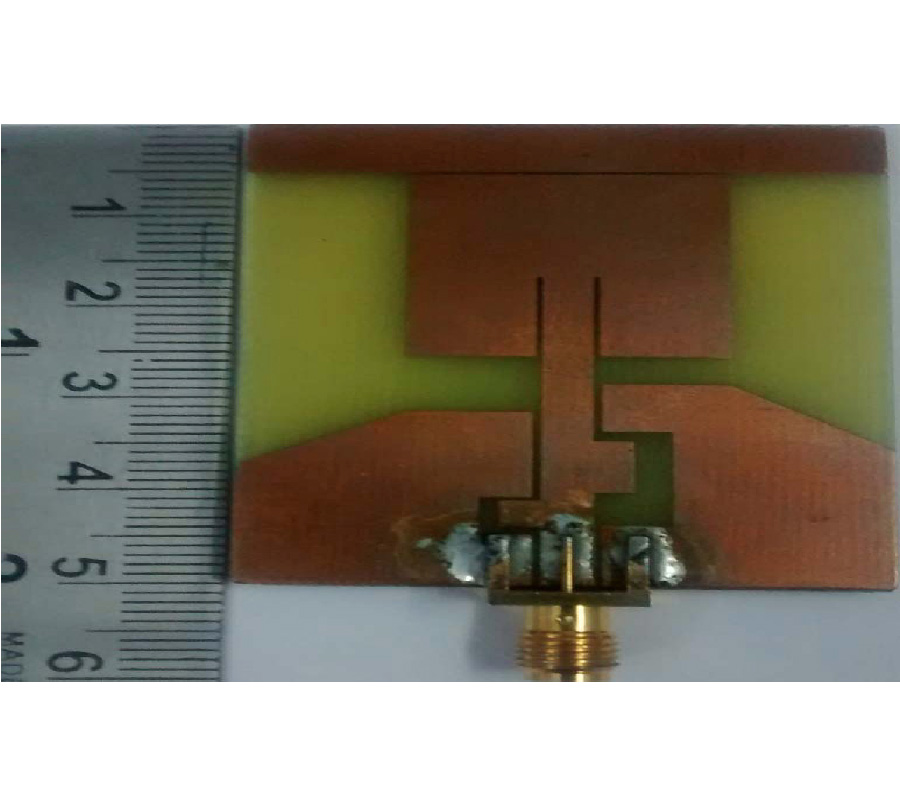
This paper presents a design of microstrip transmitting and receiving antennas to be used for time reversal ultra-wideband imaging applications. The transmitter and receiver arrays are together known as a time reversal mirror (TRM). Based on the properties of time reversal and its imaging applications, an antipodal Vivaldi antenna and a monopole antenna are proposed for the transmitter and receiver designs, respectively. Simulation and measurement results demonstrate the efficiency of the antennas for a time reversal mirror. The overall system is demonstrated for source and target imaging applications.
DESIGN OF A MICROWAVE TIME REVERSAL MIRROR FOR IMAGING APPLICATIONS
2017-08-31
PIER C
Vol. 77, 145-153
A Novel Frequency Reconfigurable Monopole Antenna with Switchable Characteristics Between Band-Notched UWB and WLAN Applications
Dinesh Yadav , Mahesh Pandurang Abegaonkar , Shiban K. Koul , Vivekanand N. Tiwari and Deepak Bhatnagar
This paper presents a novel frequency reconfigurable monopole antenna that has switchable notch characteristic at center frequency of 5.3 GHz. The proposed antenna consists of a defective ground structure (DGS) to enhance the impedance bandwidth from 3.17 to 13 GHz. The F-shaped parasitic element with three stubs (two vertical and one horizontal) are located on the back side of the radiating patch to achieve the band rejection characteristics from 4.9 GHz to 5.7 GHz. The metallic ground plane structure is connected or disconnected to the F-shape parasitic element through stubs by means of p-i-n diodes. Experimental demonstration of applications of the proposed antenna structure as 5.3 GHz notched band ultra-wideband (UWB) antenna with all diodes in the OFF-state and as 5.3 GHz radiator for wireless local area network (WLAN) with all diodes in the ON-state is reported. In both the cases, good agreements between measured and simulated return losses, radiation patterns and realized gains are observed.
A NOVEL FREQUENCY RECONFIGURABLE MONOPOLE ANTENNA WITH SWITCHABLE CHARACTERISTICS BETWEEN BAND-NOTCHED UWB AND WLAN APPLICATIONS
2017-08-31
PIER Letters
Vol. 70, 45-51
Design of Dual-Band Bandpass Filter with Closely Spaced Passbands and Multiple Transmission Zeros
Yang Xiong , Li Tian Wang , Wei Zhang , Fan Zhang , Doudou Pang , Ming He , Xinjie Zhao and Lu Ji
Two compact dual-band bandpass filters (BPFs) with closely spaced passbands are presented in this paper. Each of the filters consists of a stub loaded resonator, to which shorted lines are coupled. The ratio of the center frequencies of two passbands can be easily adjusted from 1.2 to 1.1 by changing the gap of the coupled line. In addition, seven transmission zeros (TZs) can be yielded to obtain high passband selectivity and enhance the out of band performances. As an example, two filters are designed, fabricated and measured. Both filters exhibit the merits of high passband selectivity, very low center frequency ratio, and wide stopband suppression.
DESIGN OF DUAL-BAND BANDPASS FILTER WITH CLOSELY SPACED PASSBANDS AND MULTIPLE TRANSMISSION ZEROS
2017-08-30
PIER Letters
Vol. 70, 39-44
A Coupled-Fed Reconfigurable Antenna for Internal LTE Mobile Phone Applications
Xinxing Zhong
In this paper, a multi-frequency broadband planar reconfigurable antenna is designed for smart mobile phone applications. The antenna comprises two monopole strips and a parasitic shorting strip, and generates several independent resonant modes through this kind of stub loading. The miniaturization and broadbandization of the antenna is achieved by bending the strip line and using coupling feed. In addition, loading the matching circuit at the feeding point, the bandwidth can completely cover 824-960 and 1710-2690 MHz. In order to cover a lower band LTE band 20 (800 MHz), a RF switch at shorting point is used to switch low frequency to 791 MHz. So the proposed antenna can work at GSM850,900; DCS1800; PCS1900; WCDMA bands 1, 2, 4, 5, 8; TD-SCDMA bands A, F; CDMA BC0,BC1 and LTE bands 1, 3, 5, 7,8, 20, 38, 39, 40, 41. Also, the total size of the antenna is 15 mm×30 mm×0.8 mm, which is very suitable for 4G slim smart mobile phone applications.
A COUPLED-FED RECONFIGURABLE ANTENNA FOR INTERNAL LTE MOBILE PHONE APPLICATIONS
2017-08-29
PIER M
Vol. 60, 57-65
Horn Antenna Generating Electromagnetic Field with Orbital Angular Momentum
Min Huang , Xianzheng Zong and Zai-Ping Nie
A novel method for generating electromagnetic field with orbital angular momentum (OAM) and correspondingly a practical design based on conical horn antenna are proposed in this paper. The OAM modes of ±m for r/φ field components and ±(m-1) for x/y ones can be generated by superposing the two orthogonal polarization degenerate TEmn modes in circular waveguide through a mode-transformation section, and then radiated from the horn in the far end. The effectiveness of the proposed method is analyzed from physical mechanisms and demonstrated by both simulation and experiment for the presented new-typed OAM horn antenna.
HORN ANTENNA GENERATING ELECTROMAGNETIC FIELD WITH ORBITAL ANGULAR MOMENTUM