Search Results(13793)

2017-10-20
PIER B
Vol. 78, 155-173
A Large and Quick Induction Field Scanner for Examining the Interior of Extended Objects or Humans
Martin Klein and Dirk Rueter
This study describes the techniques and signal properties of a large, powerful, and linear-scanning 1.5 MHz induction field scanner. The mechanical system is capable of quickly reading the volume of relative large objects, e.g., a test person. The general approach mirrors Magnetic Induction Tomography (MIT), but the details differ considerably from currently-described MIT systems: the setup is asymmetrical, and it operates in gradiometric modalities, either with coaxial excitation with destructive interference or with a single excitation loop and tilted receivers. Following this approach, the primary signals were almost completely nulled, and test objects' real or imaginary imprint was obtained directly. The coaxial gradiometer appeared advantageous: exposure to strong fields was reduced due to destructive interference. Meanwhile, the signals included enhanced components at higher spatial frequencies, thereby obtaining a gradually improved capability for localization. For robust signals, the excitation field can be powered towards the rated limits of human exposure to time-varying magnetic fields. Repeated measurements assessed the important signal integrity, which is affected by the scanner´s imperfections, particularly any motions or respiratory changes in living beings during or between repeated scans. The currently achieved and overall figure of merit for artifacts was 58 dB for inanimate test objects and 44 dB for a test person. Both numbers should be understood as worst case levels: a repeated scan with intermediate breathing and drift/dislocations requires 50 seconds, whereas a single measurement (with respiratory arrest) takes only about 5 seconds.
A LARGE AND QUICK INDUCTION FIELD SCANNER FOR EXAMINING THE INTERIOR OF EXTENDED OBJECTS OR HUMANS
2017-10-20
PIER Letters
Vol. 71, 53-60
Synthesis of a Broadband Rat-Race Hybrid Using Transmission Lines and Lumped-Element Components
Ryo Ueda and Hitoshi Hayashi
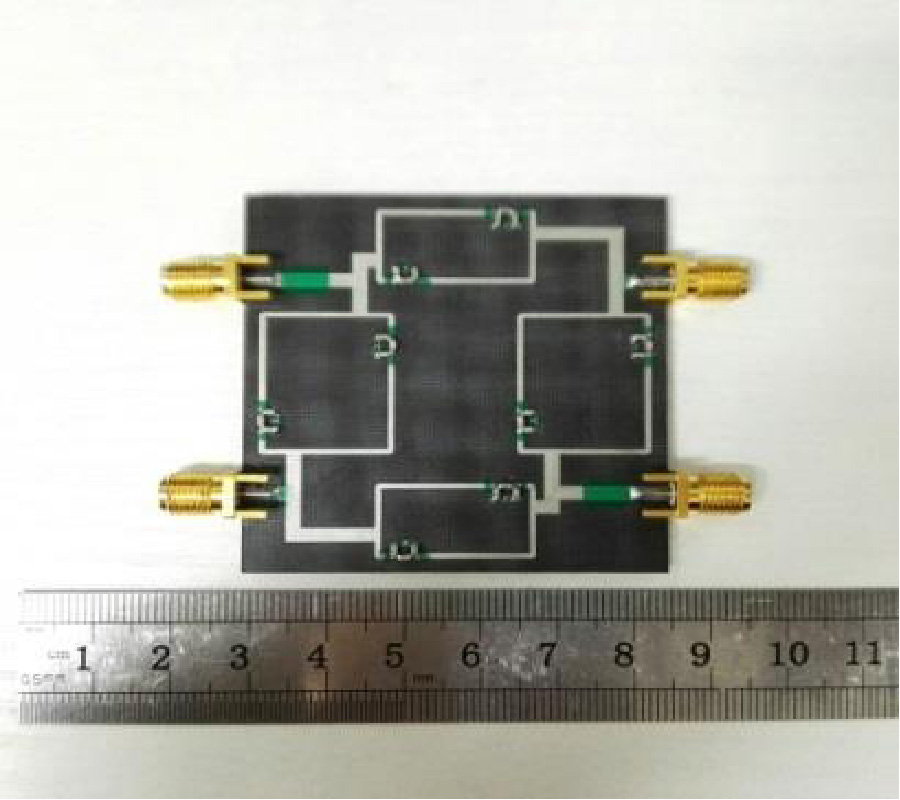
This letter presents the synthesis of a broadband rat-race consisting of a miniaturized broadband rat-race hybrid and transmission line cascades. This broadband technique involves connecting a cascade of transmission lines with lengths equal to a quarter of the wavelength at the design frequency to each port of a previously proposed rat-race hybrid. Butterworth and Chebyshev performances of the broadband rat-race hybrid are also reported. The broadband rat-race hybrid was implemented on an FR4 substrate using spiral inductors and chip capacitors. For the frequency range of 420-800 MHz, which corresponds to a relative bandwidth of more than 62%, the broadband rat-race hybrid exhibited power splits of -3.8 ± 1.0 dB, return losses of greater than 19 dB, and isolation between output ports of greater than 20 dB. The phase difference between S21 and S41 was 180° ± 3°.
SYNTHESIS OF A BROADBAND RAT-RACE HYBRID USING TRANSMISSION LINES AND LUMPED-ELEMENT COMPONENTS
2017-10-19
PIER M
Vol. 61, 75-84
Failure Correction of Linear Antenna Array by Changing Length and Spacing of Failed Elements
Hemant Patidar and Gautam Mahanti
This paper presents a new approach for linear antenna array failure correction using geometry optimization of the failed antenna elements. It is done by changing the length and spacing of failed elements while the spacing and length of remaining elements are fixed. The flower pollination algorithm based on the characteristic of flowering plants has been used to correct the radiation pattern of linear antenna array with desired side lobe level and minimum return loss. Simulations are performed using Matlab. Two examples are given to show the effectiveness of the proposed method. In addition, the obtained results from simulation on Matlab are also validated by the results obtained from FEKO analysis.
FAILURE CORRECTION OF LINEAR ANTENNA ARRAY BY CHANGING LENGTH AND SPACING OF FAILED ELEMENTS
2017-10-18
PIER C
Vol. 79, 31-38
Further Propagation Investigation of a Low Density Urban Environment with Drains
Chi Ken Lim , Soo Yong Lim , David Wee Gin Lim , Zhengqing Yun and Magdy F. Iskander
In South East Asian countries, particularly in a developed Asian city, open-trench drains systems are prominent due to climatic differences. Open-trench drain structures occupy a great part of the terrain topography in Malaysia, and therefore this project aims to further investigate the impacts that open-trench drain systems have on radio propagation prediction in a low density urban environment. Towards that end, we have engaged an interactive 3D ray-tracing tool to build the environment depicting a low density setting with clusters of low rise building structures oriented far apart from each other. The existence of open-trench drains is incorporated into a mock city model to obtain propagation prediction results for different operating frequencies. One of the primary differences this study in comparison to the existing studies on ray-tracing modeling of an urban city with open-trench drains is that the quantity of building models and open-trench drain structures are generated over a wider area to mimic actual low dense city settings. When such scenarios are considered, the impacts of open-trench drain structures fade away.
FURTHER PROPAGATION INVESTIGATION OF A LOW DENSITY URBAN ENVIRONMENT WITH DRAINS
2017-10-17
PIER C
Vol. 79, 17-29
Optimization of Micromachined Millimeter-Wave Planar Silicon Lens Antennas with Concentric and Shifted Matching Regions
Henrik Frid , Shreyasi Bhowmik , Sergey Dudorov and Joachim Oberhammer
This paper presents a study of planar silicon lens antennas with up to three steppedimpedance matching regions. The e ective permittivity of the matching regions is tailor-made by etching periodic holes in the silicon substrate. The optimal thickness and permittivity of the matching regions were determined by numerical optimization to obtain the maximum wide-band aperture eciency and smallest side-lobes. We introduce a new geometry for the matching regions, referred to as shifted matching regions. The simulation results indicate that using three shifted matching regions results in twice as large aperture eciency as compared to using three conventional concentric matching regions. By increasing the number of matching regions from one to three, the band-averaged gain is increased by 0.3 dB when using concentric matching regions, and by 3.7 dB when using shifted matching regions, which illustrates the advantage of the proposed shifted matching region design.
OPTIMIZATION OF MICROMACHINED MILLIMETER-WAVE PLANAR SILICON LENS ANTENNAS WITH CONCENTRIC AND SHIFTED MATCHING REGIONS
2017-10-17
PIER C
Vol. 79, 1-15
Simulation Design and Testing of a Dielectric Embedded Tapered Slot UWB Antenna for Breast Cancer Detection
Dheyaa T. Al-Zuhairi , John M. Gahl , Adil Al-Azzawi and Naz E. Islam
A distortion-less ultra-wideband tapered slot antenna is designed to achieve wide band impedance matching and high gain without requiring coupling liquids. The antenna is embedded in a suitable dielectric material for compact size and performance improvement. The near-field test is simulated by placing several field probes near the antenna to plot the radiation pattern and polarization isolation. The antenna exhibits a highly directive pattern and polarization isolation in near field. The time domain antenna distortion is tested by calculating the fidelity and group delay. The results show low distortion and also show the importance of covering the antenna by dielectric layers for bandwidth increment and distortion reduction. To evaluate the antenna performance in breast cancer detection, three breast phantoms are imaged by using the raster scan imaging method. Two approaches are proposed to detect tumors without the need of breast background data. The approaches based on the effect of the tumor on transmission and reflection parameters on the frequency band allowed for medical applications. The obtained images show the antenna to be a strong candidate for breast imaging as well as in tumor detection for different scenarios that include complex multi-layer phantom and small tumor.
SIMULATION DESIGN AND TESTING OF A DIELECTRIC EMBEDDED TAPERED SLOT UWB ANTENNA FOR BREAST CANCER DETECTION
2017-10-17
PIER C
Vol. 78, 225-239
A Proposed Protocol to Enhance the Performance of Wireless Sensor Networks Based on the Reduction of Power Consumption
Walid Saber El-Deeb , Mahmoud Ibrahim and Mahmoud I. Abdullah
This paper represents the analysis and study of selecting the highest power node in the wireless sensor networks as a cluster head. The study assumes that the sensors are fixed and uniformly distributed, and the position of the sink and the dimensions of the sensor are known. The paper introduced a proposed protocol to prolong the time interval before the death of the first node (stability period), which is critical for many applications. The aim of this paper is also to improve the performance of the network by increasing the overall throughput of the network. The proposed protocol selects the cluster head depending on the power level of the node which is the most important factor of the behavior of the nodes. The simulation is made by MATLAB, and the results are compared with two other protocols, LEACH and SEP. It is found that the selection of the highest power node as a cluster head increases the stability region and throughput of the network compared to other protocols.
A PROPOSED PROTOCOL TO ENHANCE THE PERFORMANCE OF WIRELESS SENSOR NETWORKS BASED ON THE REDUCTION OF POWER CONSUMPTION
2017-10-17
PIER C
Vol. 78, 217-224
Ultra-Broadband Absorption with Gradient Pyramidal Metamaterials
Yuexia Liu , Wenliang Guo and Tiancheng Han
We propose a novel absorber by integrating four different-sized pyramidal metamaterials into a unit cell, which leads to a super broadband absorption by properly selecting the geometrical parameters for each pyramid. It is found that in such a design strategy, the high-order modes may be excited and further enhanced by multi-layer overlapping between adjacent unit cells. The as-designed MA, which consists of 13 pairs of alternating metal-dielectric layers with a total thickness of 4.13 mm, shows an absorption of above 90% in the whole frequency range of 7-21.5 GHz. The full width at half maximum is 101.8%, and the ratio of operational bandwidth to thickness achieves 7. The proposed MA is 30% broader and 5.2% thinner than previously reported absorbers working in the same spectral region. Numerical result shows that the proposed absorber is independent of the polarization. The absorption decreases with fluctuations as the incident angle increases but remains quasi-constant up to relatively large angles. Such a design shows great promise for a broad range of applications at microwave frequencies, and the proposed scheme may be extended to the visible, infrared, terahertz spectral regions.
ULTRA-BROADBAND ABSORPTION WITH GRADIENT PYRAMIDAL METAMATERIALS
2017-10-17
PIER C
Vol. 78, 209-216
Eight-Element Antenna Array at 3.5 GHz for MIMO Wireless Application
Mujeeb Abdullah , Yong-Ling Ban , Kai Kang , Ming-Yang Li and Muhammad Amin
A multiple-input-multiple-output (MIMO) antenna array with eight printed coplanar waveguide (CPW)-fed monopole antennas operating at 3.5 GHz (3.4-3.6 GHz) is presented. Each antenna is an Inverted-L (IL) monopole surrounded by a parasitic IL-shorted stripe and attains compact configuration. Both the IL-monopole and parasitic IL-shorted stripe contribute their fundamental resonant modes to operate in the desired frequency band. The neutralization line (NL) and ground middle slot are used for decoupling the antenna elements in the array. The measurement results for the prototype reasonably agree with electromagnetic simulations. Measured results for the proposed MIMO antenna array demonstrate that it has impedance bandwidth more than 200 MHz with (S11 < 6 dB), and with effective antenna decoupling mechanism the mutual coupling is better than 10 dB for the required band (3.4-3.6 GHz). In addition, envelope correlation coefficient (ECC) for the proposed MIMO antenna array is less than 0.2 for any two antennas to realize independent prorogation path for a channel. The average channel capacity of the proposed MIMO antenna array is approximately 35 to 38 bps/Hz for a reference signal to noise ratio (SNR) of 20 dB.
EIGHT-ELEMENT ANTENNA ARRAY AT 3.5 GHZ FOR MIMO WIRELESS APPLICATION
2017-10-14
PIER B
Vol. 79, 21-44
Design and Development of Coax-Fed Electromagnetically Coupled Stacked Rectangular Patch Antenna for Broad Band Application
Manotosh Biswas and Mausumi Sen
In this article, a set of closed-form expressions is proposed to predict the resonant frequency, quality factor, input impedance, bandwidth efficiency, directivity and gain for a coax-fed electromagnetically coupled rectangular patch antenna. The computed results obtained with the present model are compared with the experimental and HFSS simulated results. The present model shows less error against the experimental and simulated results.
DESIGN AND DEVELOPMENT OF COAX-FED ELECTROMAGNETICALLY COUPLED STACKED RECTANGULAR PATCH ANTENNA FOR BROAD BAND APPLICATION
2017-10-14
PIER C
Vol. 78, 193-208
A New Method of Stomach Tumor Recognition Based on Ultra Wideband Capsule Endoscopy
Gong Chen , Ye-Rong Zhang and Bi-Yun Chen
In this paper, a new kind of capsule endoscopy with through-body radar is utilized for the first time. Finite difference time domain (FDTD) method is used to establish an electromagnetic simulation model of stomach. A technique based on the combination of improved back-projection (BP) algorithm and support vector machine (SVM) is proposed to solve the problems of rapidly recognizing tumor shapes in the stomach. In this technique, imaging data can be obtained using the improved BP algorithm and are classified by the SVM. The algorithm must consider the influence of various tissues in the human body: the attenuation of the signal strength of electromagnetic waves, the decrease in speed and the refraction due to the different permittivity between the different organs of the body. These factors will eventually lead to image offset, and even generate a virtual image. It is effective to refrain the displacement of image with modifying the time element of the imaging algorithm by iteration. Simulation results based on data from the model verify its feasibility and validity. Results further demonstrate that the resolution is extremely high. Tumor shapes, which have different sizes, positions, and quantities, can be reconstructed using this approach. When the data are contaminated by noises, the tumor shape in the stomach can still be suitably predicted, which demonstrates the robustness of the method. Finally, classification accuracy analysis for different sampling distances and sampling intervals shows that the effects of changing the distance and intervals on shape recognition are limited. The classification accuracy can also be improved by decreasing the sampling intervals or increasing the sampling distance.
A NEW METHOD OF STOMACH TUMOR RECOGNITION BASED ON ULTRA WIDEBAND CAPSULE ENDOSCOPY
2017-10-14
PIER C
Vol. 78, 183-192
Square-Shaped Fractal Antenna Under Metamaterial Loaded Condition for Bandwidth Enhancement
Pushkar Mishra , Shaym Sunder Pattnaik and Balwinder Singh Dhaliwal
In this paper, a metamaterial loaded square-shaped fractal antenna with two iterations is presented and discussed. A metamaterial loading consistsof split ring resonators (SRRs) which enhances the bandwidth of the antenna keeping the dimensions and size of the antenna same. The square-shaped fractal antenna, which is in the form of three concentric rings, was simulated and fabricated, and the results were shown and discussed. The antenna resonates at three distinct frequency bands 4.3719 GHz, 7.7437 GHz and 10.6374 GHz with the gains of 1.1974 dB, 4.2745 dB and 4.7233 dB, respectively for resonant frequencies. The bandwidths for the antenna are 185 MHz, 198 MHz and 386 MHz for distinct resonant frequencies. The antenna is fabricated using an FR-4 substrate, and the measured resonant frequencies are 4.08 GHz, 7.545 GHz and 10.24 GHz. In metamaterial loading condition, the dimension of the antenna resonates at 4.0105 GHz, 6.8474 GHz and 8.0632 GHz with bandwidths of 636 MHz, 347 MHz and 1.33 GHz at resonant frequencies. The appreciable bandwidth is achieved in such a small antenna without changing dimensions and size of the antenna. The simulated, experimental results and comparison are also presented in this paper.The results show that the proposed method can be used to design high bandwidth and compact fractal microstrip patch antennas without increasing dimensions.
SQUARE-SHAPED FRACTAL ANTENNA UNDER METAMATERIAL LOADED CONDITION FOR BANDWIDTH ENHANCEMENT
2017-10-12
PIER C
Vol. 78, 173-182
Design and Analysis of Metamaterial Inspired Open Complementary Split Ring Resonators for Multiband Operation
Raphael Samson Daniel , Ramasamy Pandeeswari and Singaravelu Raghavan
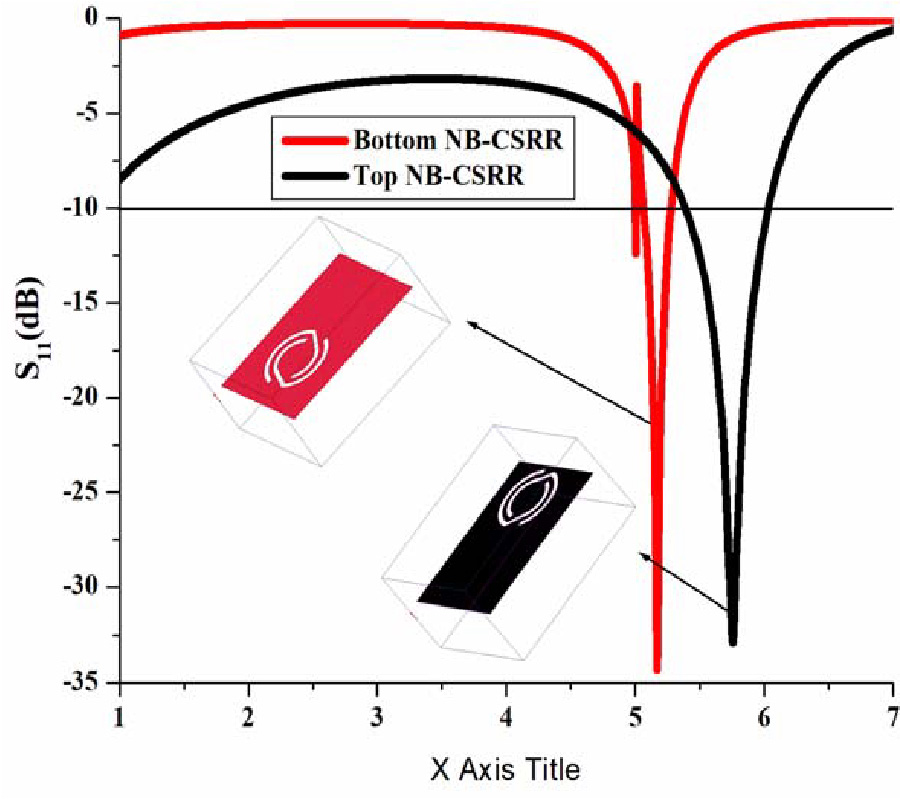
This paper describes a compact triple-band monopole antenna based on metamaterial inspired Open Complementary Split Ring Resonators (OCSRRs) for Wireless Local Area Network (WLAN) and Worldwide interoperability Microwave Access (WiMAX) applications. The monopole antenna with engraved ground plane is used to cover WLAN frequencies (2.67 GHz and 5.47 GHz). The resonant frequency of WiMAX (3.43 GHz) is achieved by introducing metamaterial inspired OCSRR in the monopole antenna. To realize good impedance matching, one more OCSRR is introduced in the monopole antenna. This paper includes the pass band characteristics of OCSRRs as well as negative permittivity details. The prototype antenna is fabricated on an FR-4 substrate having dimension of 29.4 × 26 × 1.6 mm3. Simulated and measured results are shown in good equivalence. The dipole radiation pattern is obtained in the elevation plane (E-Plane), and omnidirectional radiation pattern is obtained in the azimuthal plane (H-Plane). Parametric analysis of OCSRRs is studied to attain the best results. The proposed antenna has adequate advantages, including compact size, multiband, and impedance matching.
DESIGN AND ANALYSIS OF METAMATERIAL INSPIRED OPEN COMPLEMENTARY SPLIT RING RESONATORS FOR MULTIBAND OPERATION
2017-10-12
PIER M
Vol. 61, 61-73
Design of Double-Sided Linear Permanent Magnet Eddy Current Braking System
Qiang Chen , Ying Tan , Guanchun Li , Jie Li and Iven M. Y. Mareels
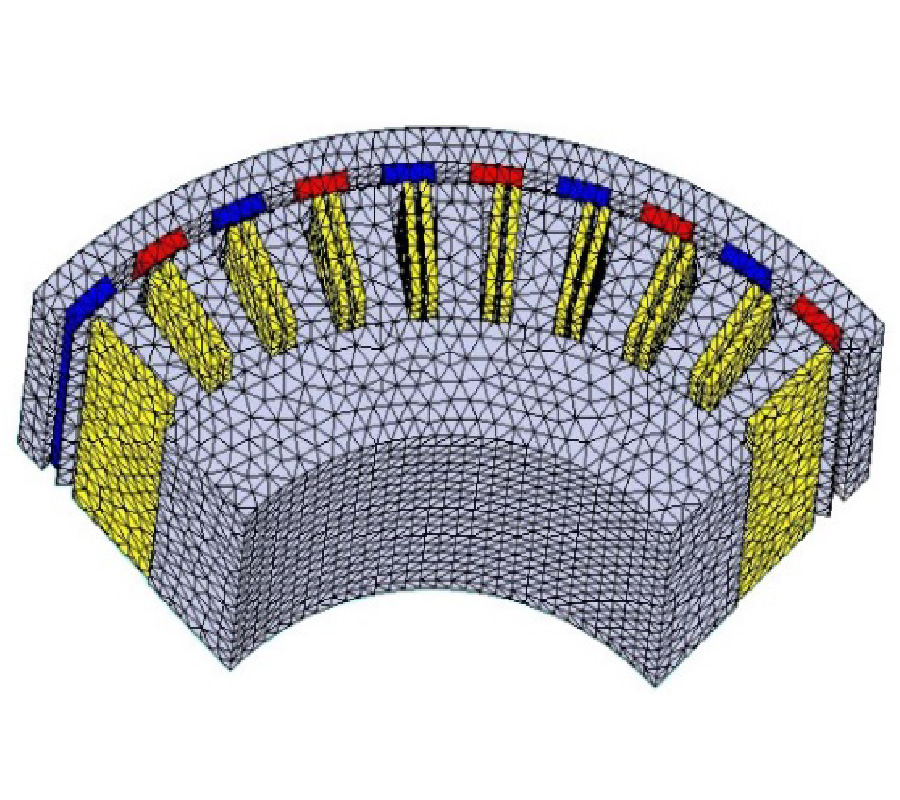
This work tries to design an Eddy current braking system that can brake at a very high speed within a short time or a short distance. In order to maximize the braking force and reduce lateral forces that can cause track deformation or damage, a double-sided linear permanent magnet Halbach array is proposed in this paper. Two possible designs (Type I and Type II) have been investigated. By using mathematic models, Finite Element Method (FEM) and experimental results, Type I design of a double-sided linear permanent magnet Halbach array is selected. Compared with the other design, Type I design can provide a much larger braking force. Moreover, the analysis also shows that the mathematic models can well capture the characteristic of Type I design. Thus these models are used to design a set of optimal design parameters such as the length and thickness of permanent magnet block to maximize flux density and braking force per unit mass of permanent magnets. The optimal performance is validated by using FEM.
DESIGN OF DOUBLE-SIDED LINEAR PERMANENT MAGNET EDDY CURRENT BRAKING SYSTEM
2017-10-11
PIER C
Vol. 78, 159-171
Design and Performance Analysis of Millimetre-Wave Rotman Lens-Based Array Beamforming Networks for Large-Scale Antenna Subsystems
Ardavan Rahimian , Yasir Alfadhl and Akram Alomainy
This paper presents the comprehensive analytical design and numerical performance evaluation of novel millimetrewave (mm-wave) switched-beam networks, based on the Rotman lens (RL) array feeding concept. These passive array devices have been designed for operation in the 28-GHz frequency band, covering the whole 18-38 GHz frequency range. The primary objective of the work is to conduct a thorough feasibility study of designing wideband mm-wave beamformers based on liquid-crystal polymer (LCP) substrates, to be potentially employed as low-cost and high-performance subsystems for the advanced transceiver units and large-scale antennas. The presented RLs exhibit significant output behaviours for electronic beam steering, in terms of the scattering (S) parameters, phase characteristics, and surface current distributions, as the feeding systems' primary functionality indicators.
DESIGN AND PERFORMANCE ANALYSIS OF MILLIMETRE-WAVE ROTMAN LENS-BASED ARRAY BEAMFORMING NETWORKS FOR LARGE-SCALE ANTENNA SUBSYSTEMS
2017-10-11
PIER Letters
Vol. 71, 45-52
A Hexagonal Fractal Antenna for Navigation Application
Enchen Wang and Shao-Jie Cheng
A hexagonal fractal antenna is presented for satellite navigation applications in this paper. The geometry of the antenna is inspired by the Sierpinski carpet and has compact dimensions, improved bandwidth, good radiation pattern due to the self-similar property of fractal geometry. The bandwidth ranging from 1.54 GHz to 1.61 GHz can work at L1 band of GPS and B1 band of Beidou satellite navigation system. The simulated and measured gains show a good agreement over the bandwidth.
A HEXAGONAL FRACTAL ANTENNA FOR NAVIGATION APPLICATION
2017-10-10
PIER Letters
Vol. 71, 37-43
Miniaturized Gysel Power Dividers Using Lumped-Element Components
Ryo Ueda and Hitoshi Hayashi
This letter presents miniaturized Gysel power dividers using lumped-element components. The characteristic impedances of all the equivalent transmission lines in these dividers are fixed to the same values based on even and odd mode analysis, thus simplifying the design procedure and miniaturizing the Gysel power dividers. The ideal divider designed at a frequency of 590 MHz exhibits power splits of -3.2±0.2 dB and return losses of greater than 15 dB for the frequency range of 460 to 650 MHz. Furthermore, isolation between output ports is greater than 15 dB for the frequency range of 500 to 680 MHz. The fabricated miniaturized Gysel power divider achieves broadband characteristics and is very compact, occupying only about 15% of the area of a conventional Gysel power divider.
MINIATURIZED GYSEL POWER DIVIDERS USING LUMPED-ELEMENT COMPONENTS
2017-10-10
PIER M
Vol. 61, 51-60
A Study of Scattering from Snow Embedded with Non-Spherical Shapes of Scatterers with Relaxed Hierarchical Equivalent Source Algorithm (RHESA)
Chan-Fai Lum , Xin Fu , Hong-Tat Ewe and Li Jun Jiang
Remote sensing has been used widely in studying the earth terrain such as snow or sea ice due to its fast, convenient and long-term monitoring capabilities. SAR images acquired could be used to analyze the condition of snow, snow water equivalent (SWE), surface roughness and others. Theoretical models have also been developed to understand how microwave interacts with the snow medium and the scatterers embedded inside the medium. Conventionally, spherical shape of scatterers is commonly used to represent the ice particles embedded inside snow where the actual shape of scatterers can vary. This paper is to present a theoretical model based on radiative transfer formulation that utilizes computational electromagnetics in the modelling of scattering from arbitrary shape of scatterers. The paper also studies the effect of scatterer shape on scattering mechanisms and total backscattering coefficient. Numerical solution of Relaxed Hierarchical Equivalent Source Algorithm (RHESA) was integrated with existing radiative transfer theoretical model to simulate a layer of random discrete snow medium. Several shapes of scatterers were simulated, and theoretical simulation were compared with ground truth measurement data with promising results.
A STUDY OF SCATTERING FROM SNOW EMBEDDED WITH NON-SPHERICAL SHAPES OF SCATTERERS WITH RELAXED HIERARCHICAL EQUIVALENT SOURCE ALGORITHM (RHESA)
2017-10-10
PIER M
Vol. 61, 43-50
Design of 2D Metal Photonic Crystal Array of Directional Radiation in Microwave Band
Yanming Zhang , Guizhen Lu and Dongdong Zeng
A 2D metal photonic crystal structure with a rectangular lattice is designed for directed wave propagation in the microwave frequency band. The dispersion curve of EPC is computed for designing the directed period array.In order to favor the computing ,the rectangular period array is studied,which is differenr from the refrerence that is designed in optical range and uses the dielectric rods and hexagonal structure to compose the period array. The computed dispersion curves are combined with the theory of finite thick period array for obtainning the directed wave propagation structure. The influence of the number of metal rods on the antenna directionality is investigated, and the simulation results are compared and analyzed. It is found that when the number of transverse metal rods increases, the directionality of the antenna is enhanced, and the radiant power of the sidelobe radiation can be reduced. Based on the simulation results, the actual 2D metal photonic crystal array is constructed for the measurement validation.According to measurement results, the antenna located in the center of the array can get good directionality at 3.1 GHz.
DESIGN OF 2D METAL PHOTONIC CRYSTAL ARRAY OF DIRECTIONAL RADIATION IN MICROWAVE BAND
2017-10-09
PIER Letters
Vol. 71, 29-36
A Novel Wideband Phase Shifter Using T- and Pi-Networks
Md Hedayatullah Maktoomi , Rahul Gupta , Mohammad A. Maktoomi and Mohammad S. Hashmi
In this paper, a wideband differential phase shifter based on modified T- and Pi- networks is proposed. Invoking the even-odd mode analysis in this symmetric phase shifter, closed-form equations of its S-parameters are derived. The derived equations enable a generic design scheme of the phase shifter, that is, ideally the phase shifter can be designed for any differential phase requirements. To illustrate the proposed idea, design parameters for differential phases of 45˚, 60˚, 75˚, 90˚, 105˚ and 120˚ are evaluated and tabulated considering a center frequency of 3 GHz. Simulation of these examples using the Keysight ADS exhibits the intended performance. For validation, a 90˚ phase shifter has been fabricated and tested. The measurement results show a return loss better that 10 dB, an insertion loss of less than 1 dB, and a ± 7° of phase deviation from 1.18 GHz to 5.44 GHz, which is equivalent to a fractional bandwidth of 142%.
A NOVEL WIDEBAND PHASE SHIFTER USING T- AND PI-NETWORKS