Search Results(13796)

2016-07-20
PIER M
Vol. 49, 69-80
A Novel Double-Stator Permanent Magnet Generator Integrated with a Magnetic Gear
Shehu Salihu Mustafa , Norhisam Misron , Norman Mariun , Mohammad Lutfi Othman and Tsuyoshi Hanamoto
This paper presents a double-stator permanent magnet generator (DSPMG) integrated with a novel magnetic gear structure which is proposed to be used as a direct drive generator for low speed applications. Torque transmission is based on three rotors consisting of prime permanent magnet poles on the middle rotor and field permanent magnet poles on the inner and outer rotors, respectively. The proposed machine combines the function of a triple rotor magnetic gear and electrical power generator. The operating principle of the generator is discussed, and its performance characteristics are analyzed using 2-dimensional finite-element method (2D-FEM). Analysis results about its magnetic gear ratio, transmission torque, cogging torque and electrical power performance are reported. The 2-D finite element analysis results verify the proposed generator design.
A NOVEL DOUBLE-STATOR PERMANENT MAGNET GENERATOR INTEGRATED WITH A MAGNETIC GEAR
2016-07-19
PIER B
Vol. 69, 1-15
Modelling and Simulation of Conducted Emissions in the Powertrain of Electric Vehicles
Giordano Spadacini , Flavia Grassi and Sergio A. Pignari
In the general framework of intelligent transportation, the increasing use of information communication technology in full or hybrid electric vehicles requires careful assessment of electromagnetic compatibility, with specific reference to the conducted emissions (CE) generated by the inverter in a broad frequency range (10 kHz-100 MHz). To this aim, this work reports a modelling approach for the prediction of CE in electric powertrains, which is based on circuit representation of each single subsystem, that is, the battery, the inverter, the three-phase synchronous motor, and the power buses composed of shielded cables. The proposed models are able to represent both low-frequency functional aspects and high-frequency parasitic effects of paramount importance for CE analysis, and can be implemented into a Simulation-Programme-with-Integrated-Circuit-Emphasis (SPICE) solver. The proposed modelling approach is exploited to simulate virtual CE measurements according to international standard CISPR 25, and to investigate the impact of setup features, including grounding connections of shields, the propagation of CE in electrically long power buses, the operating point (power, torque, speed) of the motor-drive system.
MODELLING AND SIMULATION OF CONDUCTED EMISSIONS IN THE POWERTRAIN OF ELECTRIC VEHICLES
2016-07-19
PIER C
Vol. 66, 87-95
Small-Size Coupled-Fed Two Opposite-Direction Spiral Branches for Handset Antenna
Ping Wang and Can Cui
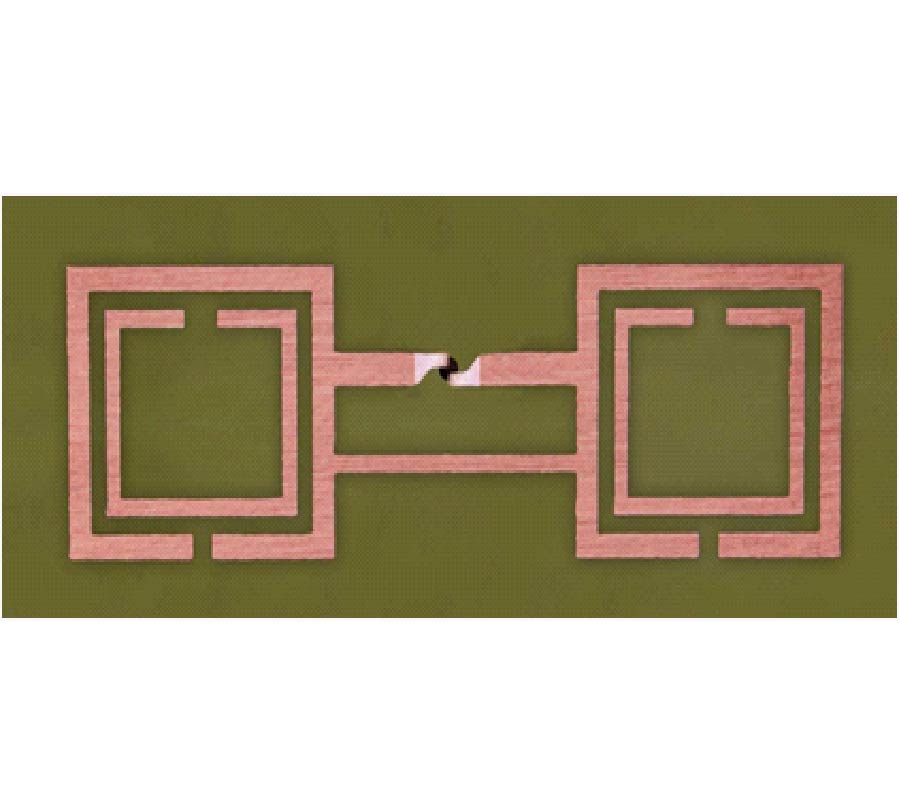
A compact coupled-fed monopole handset antenna with multi-frequency band operation is proposed in this paper. It occupies a no-ground space of only 26×14mm2, and two wideband operations can be achieved by the coupled-fed two opposite-direction spiral branches. The low frequency bands of LTE700 operation are achieved by two spiral branches' 0.25-wavelength monopole modes, which generate a dual-resonance mode at 740 and 780 MHz. At around high frequency ranges, a 0.25-wavelength monopole mode of a T-shaped monopole is generated at 1.75 GHz, and combined with two 0.75-wavelength high-order monopole modes of the left and right side spiral branches to cover the DCS1800/PCS1900/UMTS2100/LTE2300/2500 bands. In addition, the proposed antenna is easily printed on the dielectric surface of a low cost FR4 substrate, which makes it suitable for practical mobile applications. The proposed antenna is successfully simulated, fabricated, and measured to validate the design.
SMALL-SIZE COUPLED-FED TWO OPPOSITE-DIRECTION SPIRAL BRANCHES FOR HANDSET ANTENNA
2016-07-19
PIER Letters
Vol. 61, 91-97
S-Parameters Extraction of a Desired Network with Time-Domain Gates
Lingyu Deng , Xiao-Long Chen and Yajun Li
A method for extracting a desired network from the composite measurement of a desired and undesired networks combination is proposed. The desired network is required to be a reciprocal and passive network. Time-domain responses are chosen by time-domain gates according to the signal flow diagram of the measured networks. This method can be used to characterize fixtures and de-embed of fixtures effects from the composite measurement of a device under test (DUT) and fixtures combination. This method can also compensate for masking errors. Extraction for the S-parameters of the desired network are described in detail, and the extraction result is validated with two simulations.
S-PARAMETERS EXTRACTION OF A DESIRED NETWORK WITH TIME-DOMAIN GATES
2016-07-18
PIER C
Vol. 66, 77-85
Exploring Carbon Nanotubes/BaTiO3/Fe3O4 Nanocomposites as Microwave Absorbers
Dzmitry Bychanok , Gleb Gorokhov , Darya Meisak , Artyom Plyushch , Polina Kuzhir , Alexey Sokal , Konstantin Lapko , Angela Sanchez-Sanchez , Vanessa Fierro , Alain Celzard , Cameron Gallagher , Alastair P. Hibbins , Feodor Y. Ogrin and Christian Brosseau
We report the modelling and characterization of microwave absorbing materials specially designed for 26-37 GHz frequency range (Ka-band). Composite materials based on carbon nanotubes/BaTiO3/Fe3O4 in a phosphate ceramic matrix were produced, and their electromagnetic response was investigated. Both theoretical and experimental results demonstrate that this material can absorb up to 100% of the power of an incident plane wave at a normal incidence angle. The physics underlying such absorption level is discussed in terms of refractive index of the material.
EXPLORING CARBON NANOTUBES/BATIO3/FE3O4 NANOCOMPOSITES AS MICROWAVE ABSORBERS
2016-07-18
PIER M
Vol. 49, 61-68
Preliminary Results on Estimation of the Dispersive Dielectric Properties of an Object Utilizing Frequency-Dependent Forward-Backward Time-Stepping Technique
Shi Wei Ng , Kismet Anak Hong Ping , Shafrida Sahrani , Mohamad Hamiruce Marhaban , Mohd Iqbal Sariphn , Toshifumi Moriyama and Takashi Takenaka
In this paper, a Frequency-Dependent Forward-Backward Time-Stepping (FD-FBTS) inverse scattering technique is used for reconstruction of homogeneous dispersive object. The aim of the technique is to reconstruct the relative permittivity at infinite frequency, static relative permittivity and static conductivity of the homogeneous dispersive object simultaneously. The technique utilizes iterative finite-difference time-domain (FDTD) method for solving inverse scattering problem in time domain. The minimization of the cost functional is carried out utilizing Dai-Yuan nonlinear conjugate-gradient algorithm. The Fréchet derivatives of the augmented cost functional are derived analytically with respect to scatterer properties. Numerical results for reconstruction of two-dimensional homogeneous dispersive illustrate the performance of the proposed technique.
PRELIMINARY RESULTS ON ESTIMATION OF THE DISPERSIVE DIELECTRIC PROPERTIES OF AN OBJECT UTILIZING FREQUENCY-DEPENDENT FORWARD-BACKWARD TIME-STEPPING TECHNIQUE
2016-07-16
PIER C
Vol. 66, 63-76
Single/Dual-Band BPFs with Spurious Band Suppression by Using Non-Uniform Coupled Resonators
Nagendra Kumar and Yatendra Kumar Singh
Transmission zero behavior of two coupled sections - interdigital and combline - is investigated. It is shown that the shifting of transmission zero of any coupled-section of a particular length depends on the width of various parts and the orientation of coupled-section. Mathematical formulation has been performed to show the effect of stepped discontinuity on the transmission zero. Further, this transmission zero allocation property is used in suppression of harmonics. The idea is implemented in two types of resonators - first in parallel-coupled resonators and second in open-loop resonators. Two parallel coupled resonator based bandpass filters (BPFs) with second harmonic suppression - one of second-order and the other of fourth-order - using different coupled-sections have been fabricated, and suppression up to -30 dB and -54 dB respectively has been achieved. A fourth-order open-loop resonators based BPF with suppression of undesired passbands up to 6.3fo has been fabricated. Further, the above property is also used to design a dual-band BPF with wide stopband without increasing the size of the filter.
SINGLE/DUAL-BAND BPFS WITH SPURIOUS BAND SUPPRESSION BY USING NON-UNIFORM COUPLED RESONATORS
2016-07-16
PIER C
Vol. 66, 55-61
Wireless Power Transfer at Sub-GHz Frequency for Capsule Endoscope
Keke Ding , Ying Yu , Hong Lin and Jingming Xie
Wireless power transfer system to capsule endoscope at sub-gigahertz (GHz) frequency is presented. Compact self-resonant antennas are designed to realize the transcutaneous power transfer. Experiment shows that at a distance of 5 cm, the designed system operating at 433.9 MHz can realize 1.21% power transfer efficiency (PTE) through duck intestine and porcine multilayered tissues, that is, 47.55 mW power delivered to load (PDL) at the specific absorption rate (SAR) occupational exposure limitation.
WIRELESS POWER TRANSFER AT SUB-GHZ FREQUENCY FOR CAPSULE ENDOSCOPE
2016-07-15
PIER C
Vol. 66, 47-54
A 1.8-2.8 GHz Highly Linear Broadband Power Amplifier for LTE-a Application
Chun-Qing Chen , Ming-Li Hao , Zhi-Qiang Li , Zebao Du and Hao Yang
This paper proposes a fully integrated broadband power amplifier for LTE-A application using GaAs HBT process. To improve the linearity and broadband performance, RC feedback structures and dynamic bias circuits are employed and designed through optimization. With careful design of the broadband matching networks in the proposed 3-stage power amplifier topology, a power gain above 21.6 dB is achieved from 1.8 GHz to 2.8 GHz. Driven by an 80 MHz wideband LTE-A signal with PAPR of 7.5 dB, the designed RF power amplifier achieves an average output power about 22 dBm at ACLR=-30 dBc over the entire 1 GHz frequency band. Considering the broad bandwidth of the driven signal and wide frequency coverage bandwidth, the performance merits of the proposed design compare favorably with the state-of-the-art.
A 1.8-2.8 GHZ HIGHLY LINEAR BROADBAND POWER AMPLIFIER FOR LTE-A APPLICATION
2016-07-15
PIER Letters
Vol. 61, 85-89
A Compact Circularly Polarized Microstrip Antenna with Bandwidth Enhancement
Lumei Li , Jianxing Li , Bin He , Songlin Zhang and Anxue Zhang
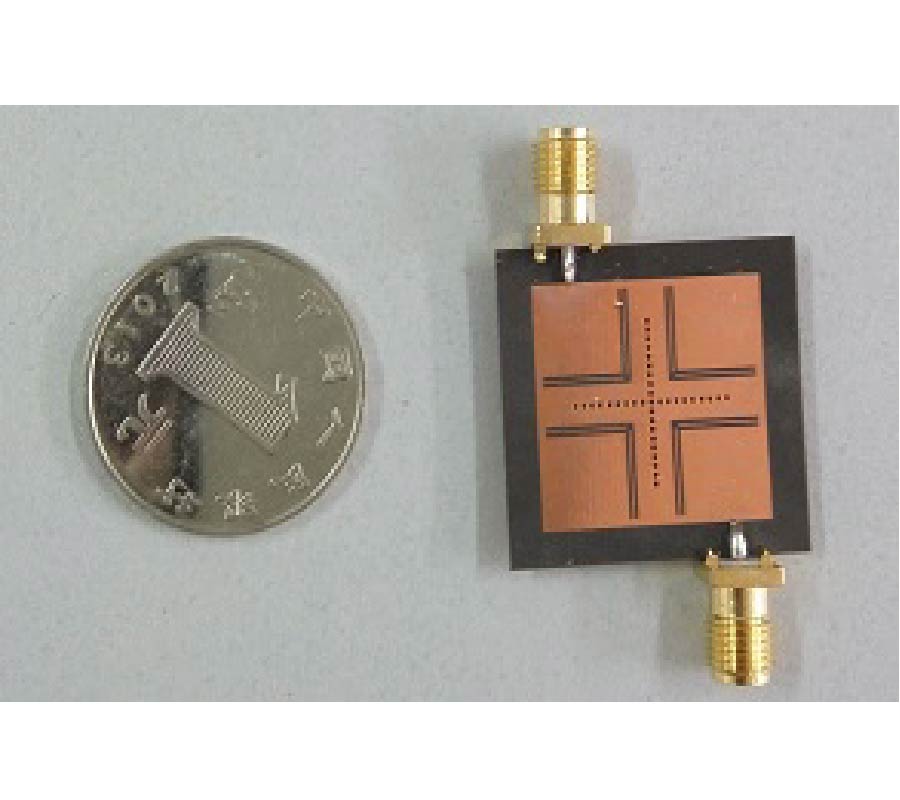
ƒA novel compact circularly polarized microstrip antenna (CPMA) with bandwidth enhancement is proposed and studied. By employing capacitive loading and inductive loading, the size miniaturization is achieved. The cross-shaped aperture in the ground plane is able to excite two orthogonal modes. The near-equal amplitudes and 90° phase difference between these two modes are realized by properly designing the feed network, i.e., a 0°-90° hybrid comprising a 3-dB Wilkinson power divider cascaded with a 90° phase shifter. The proposed antenna exhibits a global bandwidth of 11.5% ranging from 1.88 GHz to 2.11 GHz with an overall size 50 mm × 50 mm × 6.8 mm (0.33λ0 × 0.33λ0 × 0.045λ0). The global bandwidth is defined where return loss is larger than 10 dB, broadside axial ratio (AR) smaller than 3 dB, and gain above 0 dBic.
A COMPACT CIRCULARLY POLARIZED MICROSTRIP ANTENNA WITH BANDWIDTH ENHANCEMENT
2016-07-15
PIER Letters
Vol. 61, 77-83
A CPW-Fed Dual-Band Slot Antenna with Circular Polarization
Yonghao Xin , Quanyuan Feng and Jun Tao
In this paper, a coplanar waveguide (CPW)-fed dual-band slot antenna with circular polarization (CP) is presented. In order to achieve CP characteristic, an asymmetric slot and F-shaped end patch are introduced to a conventional rectangular slot antenna. Moreover, by cutting a T-shaped notch on the ground plane, the axial ratio (AR) bandwidth (ARBW) can be extended. The antenna shows left-hand CP (LHCP) radiation in the boresight direction (i.e. +Z direction) at both ARBWs. The proposed antenna is fabricated and measured. The measured results have a good agreement with the simulated ones. The measured impedance bandwidths (|S11| < -10 dB) are 1.08 GHz (2.02 to 3.10 GHz, 40% at 2.70 GHz) and 2.31 GHz (4.57 to 6.88 GHz, 39.8% at 5.8 GHz). The two measured ARBWs are 600 MHz (2.60 to 3.20 GHz, 22.2% at 2.70 GHz) and at least 1.15 GHz (4.85 to 6.0 GHz, 19.8% at 5.8 GHz) at the lower and upper bands, respectively.
A CPW-FED DUAL-BAND SLOT ANTENNA WITH CIRCULAR POLARIZATION
2016-07-15
PIER M
Vol. 49, 51-60
Extracting Surface Macro Basis Functions from Low-Rank Scattering Operators with the ACA Algorithm
Vito Lancellotti
The Adaptive Cross Approximation (ACA) algorithm has been used to compress the rank-deficient sub-blocks of the matrices that arise in the numerical solution of integral equations (IEs) with the Method of Moments. In the context of the linear embedding via Green's operator (LEGO) method - a domain decomposition technique based on IEs - an electromagnetic problem is modelled by combining ``bricks'' in turn described by scattering operators which, in many situations, are singular. As a result, macro basis functions defined on the boundary of a brick can be generated by applying the ACA to a scattering operator. Said functions allow compressing the weak form of the LEGO functional equations which then use up less computer memory and are faster to invert.
EXTRACTING SURFACE MACRO BASIS FUNCTIONS FROM LOW-RANK SCATTERING OPERATORS WITH THE ACA ALGORITHM
2016-07-14
PIER C
Vol. 66, 39-46
High Efficiency and High Power Staggered Double Vane TWT Amplifier Enhanced by Velocity-Taper Design
Xianbao Shi , Laxma Reddy Billa , Yu-Bin Gong , Muhammad Nadeem Akram and Xuyuan Chen
Previously reported staggered double vane (SDV) slow wave structure (SWS) traveling wave tube (TWT) gave electron efficiency as low as 3.4% at 220 GHz, which needs to be improved. One easy method to improve the electron efficiency and the output power is to reuse the spent electron beam energy, by resynchronizing electron velocity to the phase velocity of the terahertz (THz) signal at the second section of the TWT. In this article, we have modified the pitch of the SWS to realize the tapered phase velocity, which is for the first time to our knowledge applied to the SDV SWS at 220 GHz. By varying the geometry configuration, an optimized structure of tapered pitch SWS has been successfully developed. The results reported in this paper show a significant improvement of the output power, gain and electron efficiency. At 220 GHz, the output power has increased by about 65% with respect to the previous reported value reaching 111 W, and the electron efficiency has improved from 3.4% to 5.6%. In order to simplify the microfabrication process, an input/output coupler with E-plane bending has been designed, which can be fabricated by using only one mask UV-LIGA process.
HIGH EFFICIENCY AND HIGH POWER STAGGERED DOUBLE VANE TWT AMPLIFIER ENHANCED BY VELOCITY-TAPER DESIGN
2016-07-14
PIER C
Vol. 66, 29-38
Integrated Filtering Antenna Based on d-CRLH Transmission Lines for Ultra-Compact Wireless Applications
Mahmoud Abdelrahman Abdalla and Ahmed Fouad
This paper presents an ultra-compact filtering integrated antenna for GPS (1.57 GHz) and LTE (2.65 GHz) applications. The antenna comprises integration between dual composite right/left-handed antenna and band stop filter in one platform. The whole integrated antenna size is only 30×28.5 mm2. Compared to conventional antenna with the same dimensions, the proposed antenna is only 6.5% at GPS band and 16.5% at LTE band. The deign procedures of individual antennas, bandstop filter and the filtering integrated antennas are explained in details. The full wave simulations supporting the design procedures and experimental measurements for all introduced components are introduced with good agreement. Finally, as a consequence of the proposed antenna ultra small size and its filtering capability, the antenna is a good candidate for implanted antenna applications.
INTEGRATED FILTERING ANTENNA BASED ON D-CRLH TRANSMISSION LINES FOR ULTRA-COMPACT WIRELESS APPLICATIONS
2016-07-14
PIER C
Vol. 66, 21-28
Magnetically Tunable Ferrite-Dielectric Left-Handed Metamaterial
Bai Du , Zhuo Xu , Jun Wang and Song Xia
In this paper, a magnetically tunable metamaterial is proposed and studied. The metamaterial is based on the combination of ferrite sheets and dielectric rods. The tunable property is originated from the ferromagnetic resonance and electric response of dielectric rods. The retrieved electromagnetic parameters and transmission characteristic showed that by simultaneously inspiring the ferromagnetic resonance and electric resonance, composite metamaterial can possess double-negative band in the resonant state. Moreover, this band was tunable by adjusting applied magnetic fields. The simulations and experiments verified that the composite metamaterial clearly displayed a tunable feature. The proposed method is simple in designing tunable metamaterials.
MAGNETICALLY TUNABLE FERRITE-DIELECTRIC LEFT-HANDED METAMATERIAL
2016-07-14
PIER Letters
Vol. 61, 71-76
Dual Broadband Metamaterial Polarization Converter in Microwave Regime
Dong Yang , Hai Lin and Xiaojun Huang
Polarization converters based on metamaterial have broad application in imaging, sensing and communication from microwave to optical frequency. However, its performance is limited by single function and narrowband. In this paper, a new type of polarization converter based on square loop shaped metamaterial has been presented. It works in the reflection mode to achieve broadband polarization conversion for both circular and x/y linear polarization waves. The incident linearly polarized wave will be converted to its cross-polarized state with a polarization conversion ratio (PCR) lager than 0.9 in two distinct broad frequency ranges; on the other hand, circularly polarized wave will be reflected to its co-polarized state efficiently in the same spectrum regimes. Good agreements have been observed for both simulation and measurement results. This work offers a further step in developing high performance multi-function microwave or optical devices.
DUAL BROADBAND METAMATERIAL POLARIZATION CONVERTER IN MICROWAVE REGIME
2016-07-13
PIER C
Vol. 66, 11-20
Design of X/Ku Dual-Band Dual-Linear Polarization Reflectarray Using Double Parallel Dipole Elements
Fei Xue , Hongjian Wang and Min Yi
Two single-layer X/Ku dual-band dual-polarization reflectarray antennas of different sizes with double parallel dipole elements are presented. Elements of the two bands are set to two orthogonal linear polarizations and placed in interlaced grid. The proposed reflectarrays operate in two frequency-bands within X-band centered at 10 GHz and Ku-band centered at 13.58 GHz. The smaller size reflectarray with elements arranged in a 13×13 grid for X-band and in a 12×12 grid for Ku-band is designed and simulated first. Based on the excellent dual-band performance of the small size reflectarray, then a larger size prototype has been designed, manufactured and measured. Measured results demonstrate the maximum gain of 28.54 dB with 50.93% radiation efficiency at 10 GHz and 31.06 dB with 51.34% radiation efficiency at 13.58 GHz, which show desirable dual-band dual-polarization radiation performance.
DESIGN OF X/KU DUAL-BAND DUAL-LINEAR POLARIZATION REFLECTARRAY USING DOUBLE PARALLEL DIPOLE ELEMENTS
2016-07-13
PIER Letters
Vol. 61, 63-69
A Design of Quasi-Arbitrary Phase Difference Unequal Microstrip Power Divider
Qing He , Xiaochen Meng , Xiaoping Lou and Lianqing Zhu
An unequal power divider which features quasi-arbitrary output phase difference is proposed in this paper. The circuit consists of four microstrip lines and a resister. By the even- and odd-mode analysis technique, the closed-form design equations of this structure are derived. The characteristic impedances, electrical length and bandwidth variations with power division ratio and phase difference are analyzed. For proving its validity, a prototype with this proposed structure is designed and implemented at 1 GHz. The results of simulation and measurement show that the pro-posed power divider can effectively produce two outputs with controllable power division and phase difference.
A DESIGN OF QUASI-ARBITRARY PHASE DIFFERENCE UNEQUAL MICROSTRIP POWER DIVIDER
2016-07-13
PIER M
Vol. 49, 41-50
Novel Finite Airy Array Beams Generated from Gaussian Array Beams Illuminating an Optical Airy Transform System
Lahcen EZ-ZARIY , Zoubir Hricha and Abdelmajid Belafhal
In this work, a novel family of Finite Airy array beams have been produced by an optical Airy transform system illuminated by Gaussian Array beams. Based on the generalized Huygens- Fresnel integral, an analytical expression is developed to describe the pattern properties of the beam generated at the output plan of the optical system. The well-known Finite Airy beam generated from the fundamental Gaussian beam using an optical Airy transform system is deduced, here, as a particular case of the main result of the actual study. Numerical calculations are performed to show the possibility to create a multitude of Finite Airy array beams with controllable parameters depending on the number of beamlets, the distance between the adjacent modules and the positions and orientations of the beamlets.
NOVEL FINITE AIRY ARRAY BEAMS GENERATED FROM GAUSSIAN ARRAY BEAMS ILLUMINATING AN OPTICAL AIRY TRANSFORM SYSTEM
2016-07-13
PIER M
Vol. 49, 33-39
Millimeter-Wave Holographic Imaging Algorithm with Amplitude Corrections
Yu-Kun Zhu , Ming-Hui Yang , Liang Wu , Yun Sun and Xiao-Wei Sun
Security detection is becoming extremely important with the growing threat of terrorism in recent years. An effective millimeter-wave (mmw) holographic imaging system is presented in this paper, which can be applied in nondestructive detection such as security detection in airport or other public locations. The imaging algorithm is an extension of the work before as it takes the decay of the amplitude with range into account. The experiment result of an imaging system working at 28-33 GHz frequencies indicates good quality of the algorithm.
MILLIMETER-WAVE HOLOGRAPHIC IMAGING ALGORITHM WITH AMPLITUDE CORRECTIONS