Search Results(13796)

2016-07-12
PIER C
Vol. 66, 1-10
Conformal Hyperthermia of Superficial Tumor with Cylindrical Left-Handed Metamaterial Lens Applicator
Yonghui Tao and Gang Wang
In earlier time, we proposed a flat LHM-based hyperthermia scheme for conformal hyperthermia of a large superficial tumor. It is demonstrated that in this scheme by de-ploying multiple microwave sources in a specific array to shape the heating zone and properly setting the source-to-lens distance or phases of sources to adjust the inclination of heating zone, a heating zone better fit to large superficial tumor can be generated. In this paper, we propose a new hyperthermia scheme based on a cylindrical LHM lens which would be more maneuverable for tumors located in tissues with curved surface. It is shown that the same way adopted in the flat LHM-based scheme can be used in this new scheme to acquire desired heating zone for better fitting to tumor region. And larger critical source intervals defined in this new applicator greatly relax the restriction to the size of practical antennas applied in this scheme.
CONFORMAL HYPERTHERMIA OF SUPERFICIAL TUMOR WITH CYLINDRICAL LEFT-HANDED METAMATERIAL LENS APPLICATOR
2016-07-12
PIER Letters
Vol. 61, 55-62
Compact Filtering Power Divider Based on Half Mode Substrate Integrated Waveguide
Ali-Reza Moznebi and Kambiz Afrooz
In this paper, a compact filtering power divider (PD) based on half mode substrate integrated waveguide (HMSIW) is presented. The proposed structure is realized by etching slots on the top layer of the HMSIW PD. Accordingly, two resonators are embedded in each patch, as a second order filter. The slots dimensions are obtained by the relationship between them and the extracted external quality factor and coupling coefficient. A good agreement between the simulated and measured results is reported. The measured 3 dB fractional bandwidth is 25% (6.3-8.1 GHz). The maximum insertion loss is 0.9 dB, and the return loss is above 20 dB in the passband. This design has the advantages of low insertion loss, improved out-of-band rejection, compact size, controllable bandwidth, and high selectivity.
COMPACT FILTERING POWER DIVIDER BASED ON HALF MODE SUBSTRATE INTEGRATED WAVEGUIDE
2016-07-11
PIER C
Vol. 65, 201-209
CPW and Microstrip Line-Fed Compact Fractal Antenna for UWB-RFID Applications
Hafid Tizyi , Fatima Riouch , Abdelwahed Tribak , Abdellah Najid and Angel Mediavilla Sanchez
In this study, we present an implementation of Ultra wide band (UWB) Koch Snowflake antenna for Radio Frequency Identification (RFID) applications. The compact antenna, based on the Koch Snowflake shape, is fed by coplanar waveguide (CPW) and microstrip line with an overall size of 31x27x1.6 mm3. The simulation analysis is performed by CST Microwave Studio and compared with HFSS software. The antenna design exhibits a very wide operating bandwidth of 13 GHz (3.4-16.4 GHz) and 11 GHz (3.5-14.577 GHz) with return loss better than 10 dB for microstrip line antenna and CPW antenna respectively. A prototype of CPW and microstrip antenna was fabricated on an FR4 substrate and measured. Simulated and measured results are in close agreement. The small size of the antenna and the obtained results show that the proposed antenna is an excellent candidate for UWB-RFID localization system applications.
CPW AND MICROSTRIP LINE-FED COMPACT FRACTAL ANTENNA FOR UWB-RFID APPLICATIONS
2016-07-10
PIER M
Vol. 49, 21-31
The Performance Improvement of THz Antenna via Modeling and Characterization of Doped Graphene
Mohammed Taih Gatte , Ping Jack Soh , Hasliza A. Rahim , Raad Badlishah Ahmad and Fareq Malek
The improvement of Terahertz (THz) antenna requires efficient (nano)materials to operate within the millimeter wave and THz spectrum. In this paper, doped graphene is used to improve the performance of two types of patch antennas, a rectangular and an elliptical antenna. The surface conductivity of conventional (non-doped) graphene is first modeled prior to the design and simulation of the two graphene based antennas in an electromagnetic solver. Next, different graphene models and their corresponding surface conductivities are computed based on different bias voltages or chemical doping. These configurations are then benchmarked against a similar antenna based on conventional metallic (copper) conductor to quantify their levels of performance improvement. The graphene based antennas showed significant improvements for most parameters of antenna than that of the conventional antenna. Besides that, the higher chemical potentials resulting from higher biasing voltages also resulted in this trend. Finally, the elliptical patch graphene antenna indicated better reflection performance, radiation efficiency and gain than a rectangular patch operating at the same resonant frequency.
THE PERFORMANCE IMPROVEMENT OF THZ ANTENNA VIA MODELING AND CHARACTERIZATION OF DOPED GRAPHENE
2016-07-08
PIER C
Vol. 65, 191-200
Generation, Application and Analysis of a Novel Family of m-Segment Quadratic Fractal Curves to Antennas
Rajas Prakash Khokle
A novel family of fractal curves is proposed which provides the designer a systematic way of miniaturizing the microwave components with the freedom of choosing among form factor, design complexity and achieved miniaturization. The proposed fractal curve is characterized by two integer values m and n. The m value determines the form factor of the fractal while n value governs the iteration number. The equations governing the geometry of fractals are also presented. The proposed fractal is characterized for miniaturization by designing a printed monopole antenna for various values of m and n. The results from the full wave simulations and experiments are analysed and explained. The effect of fractal on reducing the resonant frequency is quantified by an equation based on its physical interpretation. Based on this analysis, saturation point for miniaturization is established. The curves being symmetric around a straight line, distortionless radiation patterns are seen.
GENERATION, APPLICATION AND ANALYSIS OF A NOVEL FAMILY OF M-SEGMENT QUADRATIC FRACTAL CURVES TO ANTENNAS
2016-07-08
PIER Letters
Vol. 61, 47-53
Bandwidth and Gain Enhancement for Probe-Fed CP Microstrip Antenna by Loading with Parasitical Patches
Wen-Quan Cao and Wei Hong
A novel probe-fed single-layer circularly polarized (CP) truncated microstrip antenna with enhanced CP bandwidth and gain is presented in this paper. The axial ratio (AR) bandwidth is broadened by loading with a circle of truncated square parasitical patches. Parameter analysis is made to investigate the effect of the loading structures on the AR property. For comparisons, both the unloaded and loaded truncated patch antennas with the same size are designed, fabricated and measured. The measurement results show that by adding the parasitical patches, the -10 dB impedance bandwidth was increased from 0.98 GHz (15.9%) to 1.42 GHz (21.5%), among which the 3-dB RHCP AR bandwidth has been increased from 200 MHz (3.3% at the center frequency of 6.04 GHz) to 780 MHz (12.6% at the center frequency of 6.19 GHz). The gain enhancement is about 0.5 dB~1.5 dB around the operating frequency range, and the maximum gain of the proposed antenna is about 9.1 dB. With the advantages of simple structure, wide CP bandwidth and considerable gain property, this antenna has potential application in wireless communications.
BANDWIDTH AND GAIN ENHANCEMENT FOR PROBE-FED CP MICROSTRIP ANTENNA BY LOADING WITH PARASITICAL PATCHES
2016-07-07
PIER C
Vol. 65, 183-190
New Compact High Gain Radiating Element for Base Station Antenna
Loic Martin , Bruno Froppier , Eduardo Motta Cruz and Tchanguiz Razban-Haghighi
Development of new network standards leads to the use of bulky base station antennas. Their wide surfaces are not compatible with integration constraints in urban areas. As the antenna is composed of a high number of radiating elements, reducing the surface of each element is a way to reduce the antenna surface. Compact radiating element would allow integration of several antennas on the initial surface. In this paper, a new compact antenna is designed in order to obtain up to four antennas at the place of one. The antenna gain and horizontal Half Power Beamwidth (HPBW) should be maintained. The size reduction is obtained by dielectric embedding. In order to determine the dielectric characteristics in which the antenna must be immersed, a theoretical model is proposed in this paper. Simulations and measurements are provided to show the evolution of the antenna's performances in order to achieve manufacturer's specifications.
NEW COMPACT HIGH GAIN RADIATING ELEMENT FOR BASE STATION ANTENNA
2016-07-07
PIER M
Vol. 49, 9-19
Coupling of Two Rectangular Waveguides through a Diaphragm with a Dielectric Slab in the Slot
Ludmila P. Yatsuk , Anatoly F. Lyakhovsky , Victor A. Katrich and Andrey A. Lyakhovsky
A scattering problem for two semi-infinite rectangular waveguides coupling through a narrow slot cut in the common end wall of the two waveguides is solved. The slot is partially filled with a dissipative or perfect dielectric insert. A mathematical model based on continuity of tangential components of magnetic field vectors on both surfaces of the diaphragm in the coupling waveguides is proposed. The magnetic field in the slot is represented by a set of slot eigenwaves. The electrical field distribution function is used as a basis function in the Galerkin's procedure allowing to find unknown amplitude coefficients. Simulation and experimental measurement have been carried out. Dependences of scattering parameters upon the wavelength were studied for various geometric parameters, insert position in the slot, and insert material permittivity and losses. A good agreement between simulation results and experimental data is obtained. It was shown that an estimate of the insert permittivity and losses can be done for unknown materials using experimental and simulated data.
COUPLING OF TWO RECTANGULAR WAVEGUIDES THROUGH A DIAPHRAGM WITH A DIELECTRIC SLAB IN THE SLOT
2016-07-06
PIER C
Vol. 65, 175-182
Reshaping Electromagnetic Emissions with Meta-Substrate Based on Spoof Plasmons
Yao Gao , Agnes Maurel and Abdelwaheb Ourir
We investigate the efficiency of a metasurface supporting spoof plasmons to control the electro-magnetic emission of a radiating element. The three-dimensional metasurface is made of an array of metallic grounded rods, and it is used as the substrate of a printed antenna. Such a substrate provides a transmission band at low frequencies, corresponding to spoof plasmon propagation, and a total electromagnetic band gap above the cut-off frequency. We show how an efficient and directive emission with low side-lobe levels and backward radiation can be obtained when the operating frequency of the antenna is considered in the band gap. The role of the spoof plasmons is further demonstrated by tuning the transmission band at the operating frequency. The proposed meta-substrate is an original and efficient alternative to reshape the emission of electromagnetic sources.
RESHAPING ELECTROMAGNETIC EMISSIONS WITH META-SUBSTRATE BASED ON SPOOF PLASMONS
2016-07-05
PIER C
Vol. 65, 163-173
Dual Band-Notched WiMAX/WLAN of a Compact Ultrawideband Antenna with Spectral and Time Domains Analysis for Breast Cancer Detection
Abdelmoumen Kaabal , Mustapha El Halaoui , Saida Ahyoud and Adel Asselman
A compact Ultra Wideband (UWB) antenna with Worldwide Interoperability for Microwave Access (WiMAX) and Wireless Local Area Network (WLAN) with dual band-notched characteristics is presented in this article. The antenna design parameters have been optimized by the High Frequency Structural Simulator (HFSS) and CST Microwave Studio to be in contact with biological breast tissues over 3-13 GHz frequency range with dual band-notched characteristics. The proposed antenna is a polygon printed on a low dielectric FR4 substrate fed by a 50-Ω feed line and a partial ground plane in other side. The results exhibit that the proposed antenna shows a wide bandwidth covering from 3 GHz to at least 13 GHz with VSWR<2 and observing band elimination of WiMAX and WLAN bands. The proposed UWB antenna has omnidirectional radiation patterns with a gain variation of 0.5 dBi to 5.2 dBi and low distortion group delay less than 1 ns over the operating frequency range. The simulation and the measurement results show a good agreement. And good ultra-wideband linear transmission performance has been achieved in time domain with a compact dimension of 28×20 mm2.
DUAL BAND-NOTCHED WIMAX/WLAN OF A COMPACT ULTRAWIDEBAND ANTENNA WITH SPECTRAL AND TIME DOMAINS ANALYSIS FOR BREAST CANCER DETECTION
2016-07-05
PIER C
Vol. 65, 153-162
Application of Ultra-Thin Assembled Planar Metamaterial for Wireless Power Transfer System
Jun-Feng Chen , Zhaoyang Hu , Shengming Wang , Minghai Liu , Yongzhi Cheng , Zhixia Ding , Bin Wei and Songcen Wang
Magnetically coupled resonant wireless power transfer (WPT) has been employed in many applications, including wireless charging of portable electronic devices, electric vehicles, etc. However, the power transfer efficiency (PTE) decreases sharply due to divergence of magnetic field. Electromagnetic (EM) metamaterial (MM) can control the direction of magnetic fields due to its nega-tive effective permeability. In this paper, MMs with negative effective permeability at radio frequencies (RF) are applied to a WPT system operating at around 16.30 MHz for improvement of PTE. This ul-tra-thin and assembled planar MM structure consists of a single-sided periodic array of the capaci-tively loaded split ring resonators (CLSRRs). Both simulation and experiment are performed to cha-racterize the WPT system with and without MMs. The results indicate that the contribution of high PTE is due to the property of negative effective permeability. By integrating MM in the WPT system, the experimental results verify that the measured PTE with one and two MM slabs have respectively 10% and 17% improvement compared to the case without MM. The measured PTEs of the system at different transmission distances are also investigated. Finally, the proposed MM slabs are applied in a more practical WPT system (with a light bulb load) to reveal its effects. The results verify the efficiency improvement by the realized power received the load.
APPLICATION OF ULTRA-THIN ASSEMBLED PLANAR METAMATERIAL FOR WIRELESS POWER TRANSFER SYSTEM
2016-07-03
PIER C
Vol. 65, 139-151
New Implementation of mm-Wave Heterodyne Receiver Based on Six-Port Technology: Circuit Characterization and High Data-Rate Demodulation Results
Djilali Hammou , Mourad Nedil and Serioja Ovidiu Tatu
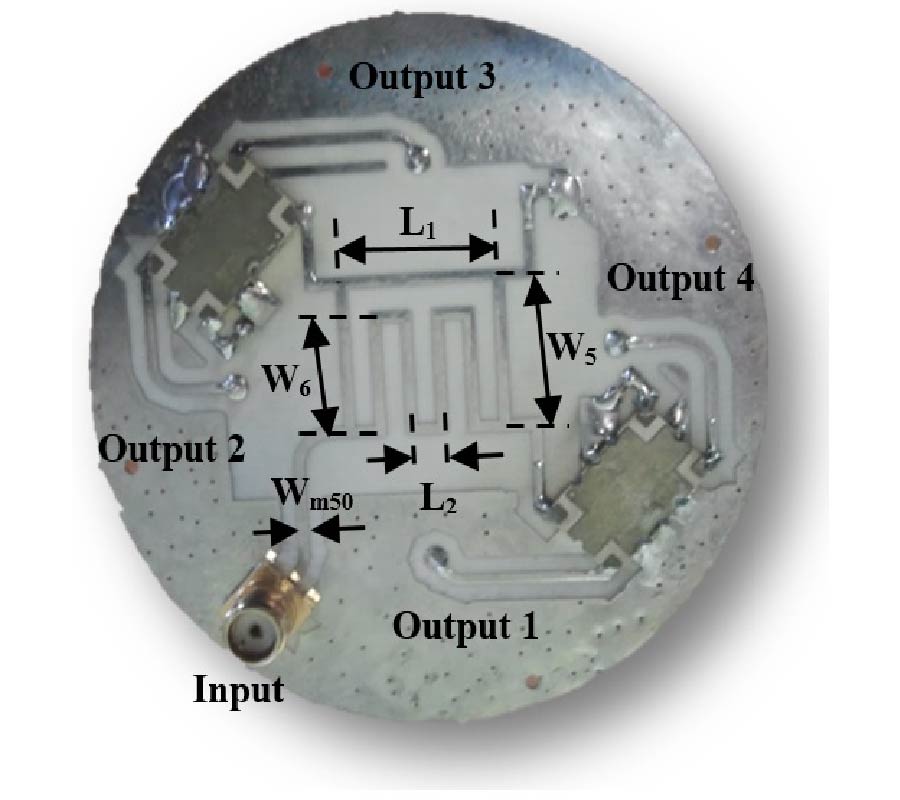
This paper presents a new implementation of a millimeter wave heterodyne receiver based on six-port technology. The six-port circuit is designed using three hybrid couplers H-90º and a new ring power divider. For the characterization of the circuit, several six-port two-port measurement configurations were designed and fabricated on the same wafer along with calibration standards. The new six-port architecture evaluation based on qi points location demonstrates wideband performances and high coupled-port phase and amplitude balance in the 57-65 GHz frequency band. The six-port model based on S-parameter measurements is then implemented in ADS software, for realistic advanced simulation systems of a short-range 60 GHz wireless link. The millimeter wave frequency conversion is performed using a six-port down-converter. The second frequency conversion uses conventional means due to the low IF frequency value. The demodulation results of a V-band QPSK signal for high data rate from 100 to 1000 MBits/s are presented and discussed. The results of the Bit Error Rate (BER) analysis demonstrate that the proposed architecture can be successfully used for high speed wireless link transmission at 60 GHz.
NEW IMPLEMENTATION OF MM-WAVE HETERODYNE RECEIVER BASED ON SIX-PORT TECHNOLOGY: CIRCUIT CHARACTERIZATION AND HIGH DATA-RATE DEMODULATION RESULTS
2016-06-30
PIER B
Vol. 68, 159-171
A Complex Mix-Shifted Parallel QR Algorithm for the C-Method
Cihui Pan , Richard Dusséaux and Nahid Emad
The C-method is an exact method for analyzing gratings and rough surfaces. This method leads to large-size dense complex non-Hermitian eigenvalue. In this paper, we introduce a parallel QR algorithm that is specifically designed for the C-method. We define the ``early shift'' for the matrix according to the observed properties. We propose a combination of the ``early shift'', Wilkinson's shift and exceptional shift together to accelerate convergence. First, we use the ``early shift'' in order to have quick deflation of some eigenvalues. The multi-window bulge chain chasing and parallel aggressive early deflation are used. This approach ensures that most computations are performed in level 3 BLAS operations. The aggressive early deflation approach can detect deflation much quicker and accelerate convergence. Mixed MPI-OpenMP techniques are used for performing the codes to hybrid shared and distributed memory platforms. We validate our approach by comparison with experimental data for scattering patterns of two-dimensional rough surfaces.
A COMPLEX MIX-SHIFTED PARALLEL QR ALGORITHM FOR THE C-METHOD
2016-06-30
PIER Letters
Vol. 61, 39-46
A Compact Quad-Band Bandpass Filter Using Multi-Mode Stub-Loaded Resonator
Lakhindar Murmu and Sushrut Das
This paper presents a compact shorted stub-loaded quad-band bandpass filter. The proposed filter simultaneously operates at GSM (0.83-0.97 GHz), LTE2300 (2300-2400 MHz), WiMAX (3.3-3.7 GHz), and WLAN (5.725-5.825 GHz) bands. The filter has been designed using the technique of stub-loaded resonator (SLR). By changing the length of the center-loaded stub, the resonant frequency of the even-mode can be varied without affecting that of the odd-mode. This simplifies the design and tuning of the quad-band filter. Eight transmission zeros (TZs) around the three passband make the pass bands highly isolated. In order to validate its practicability, a quad-band bandpass filter (BPF) has been designed, fabricated and measured. Good agreement between simulated and measured results is observed.
A COMPACT QUAD-BAND BANDPASS FILTER USING MULTI-MODE STUB-LOADED RESONATOR
2016-06-30
PIER M
Vol. 49, 1-8
Cumulative Distributions of Rainfall Rate Over Sumatra
Marzuki Marzuki , Hiroyuki Hashiguchi , Toyoshi Shimomai and Walter L. Randeu
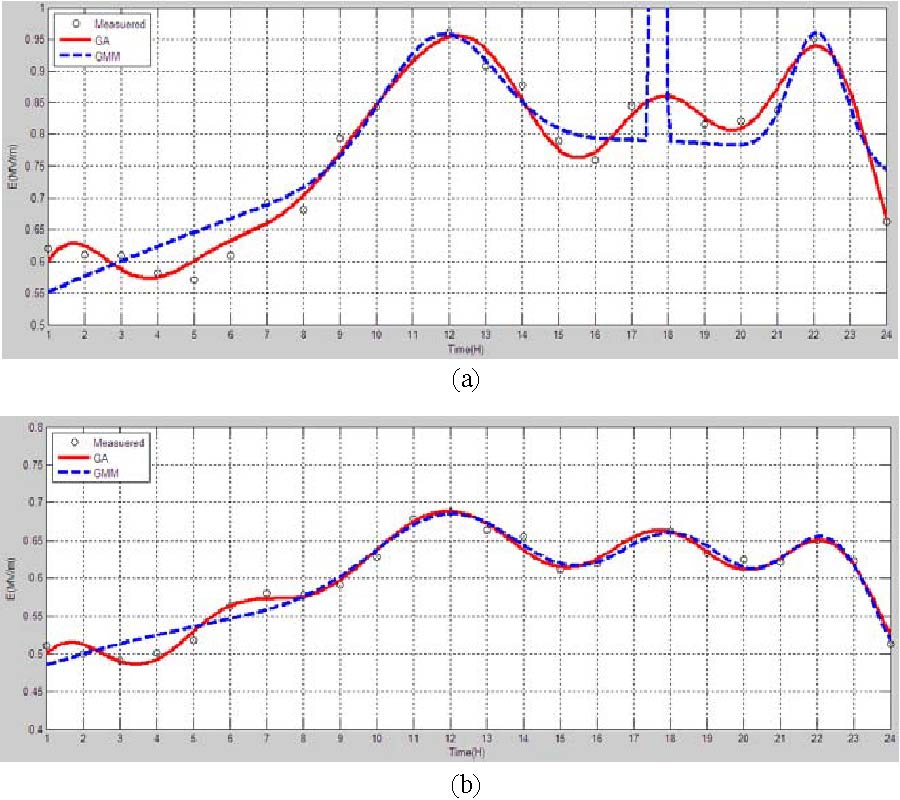
The microwave radio links above 5 GHz suffer from attenuation due to precipitation. The need for employing higher frequencies has therefore encouraged research into rain attenuation due to precipitation. The natural variations of tropical precipitation occur in a wide range of time-scales, so does probably the behavior of radio communication links. This paper examines the variations of cumulative distribution of rainfall in Sumatra from an optical rain gauge measurement with a near continuous record of operation over eleven consecutive years (2002-2012). The worst month statistics were also examined and all results were compared with the ITU-R model. Of some natural variations of rainfall rate investigated, the diurnal variation had the most significant effect on the cumulative distribution of rainfall rate. The ITU-R model overestimated the rainfall rate for the first half of the day (00:00-11:59 LT) whereas it underestimated the rainfall rate until 0.01% of time for the second half of the day (12:00-23:59 LT) before the model starts to overestimate. The ITU model overestimated 52.85% of rainfall rate at 0.01% of time for the first half of the day and underestimates 7.59% for the second half. Considerable differences between the recorded data and the ITU-R model for the annual, seasonal, and intreaseasonal variations are only significant at small time percentage (≤ 0.01%). The relationship of worst month statistics was also slightly different from the ITU-R model. This result reinforces the previous studies on the limitation of the ITU-R model for the tropical region.
CUMULATIVE DISTRIBUTIONS OF RAINFALL RATE OVER SUMATRA
2016-06-28
PIER M
Vol. 48, 195-203
Length Estimation of Ballistic Targets Based on Full-Polarization Range Profiles
Yongzhen Li and Xiaofeng Ai
This study focuses on the length estimation of ballistic targets based on the full-polarization range profiles measured by the wideband full-polarization radar system. Firstly, the mathematical model of full-polarization range profiles is introduced, and the full-polarization range profiles characteristics of typical ballistic targets are analyzed by using the microwave anechoic chamber measurement data. Secondly, three methods are proposed for target length estimation based on single-channel detection synthesis, SPAN power synthesis and target characteristic polarization, respectively. Then, comparison experiments among the proposed methods and the method based on single-polarization range profile are carried out. The results demonstrate that the extraction accuracy and the anti-noise performance of the method based on target characteristic polarization are better than the others. Furthermore, the influence of the signal-to-noise ratio (SNR) on the length estimation is also discussed.
LENGTH ESTIMATION OF BALLISTIC TARGETS BASED ON FULL-POLARIZATION RANGE PROFILES
2016-06-27
PIER C
Vol. 65, 131-138
Small-Size Folded Monopole Antenna with Switchable Matching Circuit for Ultra-Thin Mobile Applications
Hao Wang , Zheqiang Wu , Yibo Wang , Chow-Yen-Desmond Sim and Guangli Yang
A small-size ultra-thin and narrow frame antenna with a switchable matching network to achieve LTE dual-wide band operation in the 700-980 and 1710-2500 MHz bands is presented for mobile phone applications. The highlight of the antenna is that it has a low profile of only 2 mm and occupies a small ground clearance of 45 × 4.5 mm2, which are very attractive for ultra-thin mobile antenna applications. A folded monopole is used as a radiator fed via a switchable two-state matching circuit controlled by a PIN diode. The PIN type switchable matching network is mainly designed to tune the low band (700-980 MHz). By combining the two working states of the PIN diode, the proposed antenna can cover GSM850/GSM900/DCS1800/PCS1900/UMTS2100 and two LTE bands, LTE700/LTE2300. Details of the antenna are described in this study.
SMALL-SIZE FOLDED MONOPOLE ANTENNA WITH SWITCHABLE MATCHING CIRCUIT FOR ULTRA-THIN MOBILE APPLICATIONS
2016-06-27
PIER
Vol. 156, 83-103
Fast, Phase-Only Synthesis of Aperiodic Reflectarrays Using NUFFTs and CUDA
Amedeo Capozzoli , Claudio Curcio , Angelo Liseno and Giovanni Toso
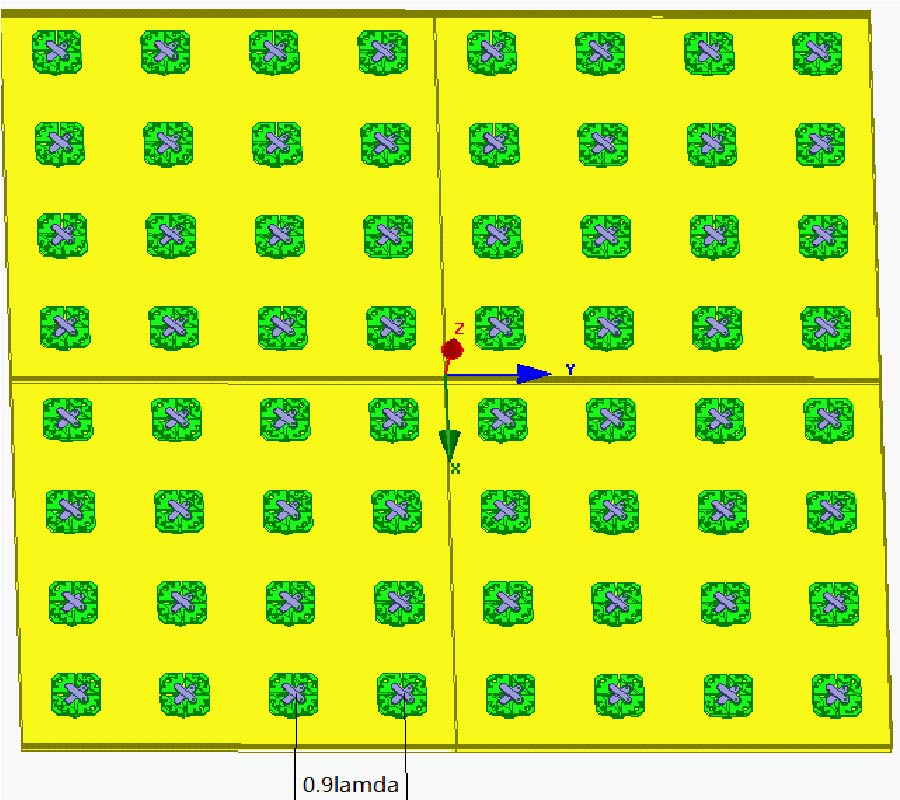
We deal with one of the computationally most critical steps of the Phase-Only synthesis of aperiodic reflectarrays, namely the fast evaluation of the radiation operator. We present an approach exploiting the use of a fast numerical algorithm using 2D Non-Uniform FFTs (NUFFTs) of NED (Non-Equispaced Data) and NER (non equispaced results) type and of parallel processing on Graphic Processing Units (GPUs). We extend the approach in K. Fourmont, J. Fourier Anal. Appl., vol. 9, n. 5, pp. 431-540, 2013 for implementing NUFFT routines to the 2D case and illustrate the parallel strategies to accelerate the approach. In particular, we show how the two levels of parallelism intrinsic in the interpolation step of the 2D NED-NUFFT can be fruitfully exploited by adopting dynamic parallelism, a feature made available in one of the latest architecture of NVIDIA cards. The presented synthesis results show that the introduction of further degrees of freedom (positions) allows improving the performance with respect to periodic reflectarrays. Also, the possibility of adopting aperiodic reflectarrays of reduced number of elements for fixed performance is demonstrated.
FAST, PHASE-ONLY SYNTHESIS OF APERIODIC REFLECTARRAYS USING NUFFTS AND CUDA
2016-06-26
PIER C
Vol. 65, 121-129
CPW-Fed Circularly Polarized Square Slot Antenna with Enhanced Bandwidth and Reduced Size for Wideband Wireless Applications
Tian Li , Fu-Shun Zhang , Fei Gao and Yan-Li Guo
A coplanar waveguide-fed circularly polarized square slot antenna with the feasibility of obtaining a wider bandwidth and a relatively smaller size is proposed and demonstrated. The proposed antenna, consisting of a stepped feeding strip, a modified grounded L-shaped radiating patch, an inverted-L grounded strip and an asymmetric ground with an L-shaped slot as well as two horizontal slots, is designed, analyzed and fabricated. Good agreement between simulated and measured results is observed. Simulation and measurement results reveal that the proposed antenna can provide an impedance bandwidth of 106.3% (2.3-7.52 GHz) and a 3-dB axial ratio (AR) bandwidth of 90.2% (2.25-5.95 GHz). Additionally, within the effective circular polarization (CP) bandwidth of 88.5% (2.3-5.95 GHz), the proposed antenna has gains from 1.9 dBic to 5.2 dBic with an average gain of 3.9 dBic.
CPW-FED CIRCULARLY POLARIZED SQUARE SLOT ANTENNA WITH ENHANCED BANDWIDTH AND REDUCED SIZE FOR WIDEBAND WIRELESS APPLICATIONS
2016-06-26
PIER C
Vol. 65, 111-119
Dual Notch UWB Fork Monopole Antenna with CRLH Metamaterial Load
Zahra Mansouri , Afsaneh Saee Arezoomand , Samaneh Heydari and Ferdows B. Zarrabi
A novel fork monopole antenna is presented using metamaterial structures. The prototype monopole antenna consists of split-ring-resonators (SRR) as an electric-LC resonator and small ground. To prove the concept, the prototype antenna is designed and fabricated for wireless communication systems. The monopole structure makes UWB impedance bandwidth condition for 2-12 GHz. On the other hand, the prototype antenna shows dual notch band characteristics at 3.5-4.5 GHz and 5.3-6 GHz for WiMAX and WLAN rejection. The prototype antenna radiates omnidirectionally and has a gain altered between -4.5 and 6.2 dBi in 2.5-12 GHz, with an average gain of 4.2 dBi. The metamaterial model is suggested for the CRLH (ELC) resonator, and in addition, the parametric study for CRLH (ELC) resonator is presented for clarification of its manner on resonance controlling. Here, the final model antenna is fabricated on an FR-4, and experimental results are compared with simulations.
DUAL NOTCH UWB FORK MONOPOLE ANTENNA WITH CRLH METAMATERIAL LOAD