Search Results(13796)

2016-09-08
PIER M
Vol. 49, 195-202
A Set of Simple Numerical Pattern Synthesis Algorithms for Anti-Jamming with Superdirective Receiving Array
Huajun Zhang , Huotao Gao , Huaqiao Zhao , Ting Cao and Boya Li
Although a superdirective array can acquire maximum directive gain with electrically small array, in some practical applications, low sidelobe and deep nulls are also important, which can effectively inhibit directional interferences. In this work, a set of simple superdirective pattern synthesis methods are proposed. By introducing diagonal loading factor and adding virtual jamming constraints, they can keep suitable tradeoff among directive gain, efficiency and anti-jamming performance. Besides, easy realization is another good feature of the proposed methods.
A SET OF SIMPLE NUMERICAL PATTERN SYNTHESIS ALGORITHMS FOR ANTI-JAMMING WITH SUPERDIRECTIVE RECEIVING ARRAY
2016-09-04
PIER C
Vol. 67, 41-48
Design of a Wideband Unidirectional Slot Antenna with Stepped Reflector for Front to Back Ratio Enhancement
Liang Lu , Yong-Chang Jiao , Zibin Weng and Lei Zhou
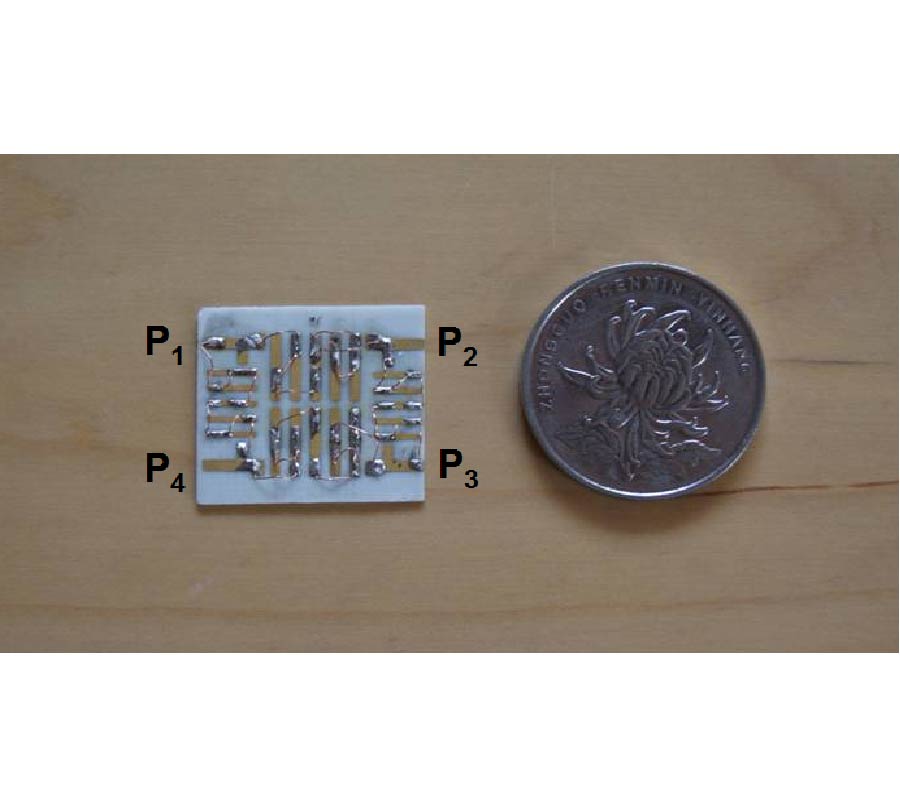
A compact unidirectional slot antenna with front to back ratio (FBR) enhancement is proposed. The antenna consists of a novel compact slot driven antenna, a stepped reflector and a vertical balun from a microstrip to a parallel strip line. Better FBRs are obtained by optimizing the stepped reflector. Impedance bandwidths are enhanced by applying the balun and a pair of microstrip stub etched on the opposite side of the slot. Then, the antenna is manufactured and measured. Measured results show that the proposed antenna has a bandwidth of 76% (1.53-3.41 GHz) for VSWR ≤ 1.5. In addition, from 1.7 to 3.2 GHz, the antenna gains are higher than 8.6 dBi, and the FBRs are greater than 22 dB. Good agreement between the simulated and measured results is obtained. All above indicates that the proposed antenna can be widely used in wireless communications.
DESIGN OF A WIDEBAND UNIDIRECTIONAL SLOT ANTENNA WITH STEPPED REFLECTOR FOR FRONT TO BACK RATIO ENHANCEMENT
2016-09-04
PIER Letters
Vol. 62, 35-40
A Compact Differential-Fed Half-Elliptic Monopole Antenna with Triple Band-Notched Function
Yuan Xu , Hui Li , Ying-Zeng Yin and Zhichao Deng
A compact half-elliptic monopole antenna with triple notched-bands for UWB application, which is driven with differential feeding systems, is proposed. The basic antenna consists of two symmetrical half-elliptic patches and a modified ground plane. To reject the 5.5-GHz WLAN band effectively, two pairs of Ω-shaped strips are placed as parasitic elements close to the feedline. By introducing rectangular SRRs and an Ω-shaped slot on the radiators, the operating bands of 3.5-GHz WiMAX and 8-GHz ITU can be notched, respectively. Compared with conventional singleended feed antennas, the proposed differential-fed antenna can achieve better polarization purity, especially in the high-frequency band.
A COMPACT DIFFERENTIAL-FED HALF-ELLIPTIC MONOPOLE ANTENNA WITH TRIPLE BAND-NOTCHED FUNCTION
2016-09-02
PIER C
Vol. 67, 31-40
An Independently Tunable Dual-Band Bandpass Filter Using a Center Shorting-Stub-Loaded Resonator
Fei Liang , Weiwei Cai , Wenzhong Lu , Li Deng and Xiaofei Zhai
This paper presents an independently tunable dual-band bandpass filter based on center shorting-stub-loaded resonators. The center shorting-stub-loaded resonator is a dual-mode resonator that generates odd-even modes approximately equal and coupled when the shorting stub is very short. Two different sizes of center shorting-stub-loaded resonators produce two separated resonant frequencies, which are mutually independent. The coupling between the source and load is introduced in the circuit by designing an appropriate coupling structure, and the skirt selectivity of the filter is greatly improved. Four varactor diodes are placed at the two open-circuit ends of the center shorting-stub-loaded resonator to control the two separated resonant frequencies. A prototype of a tunable dual-band filter with Chebyshev response is designed and fabricated. The measured results are in good agreement with the full-wave simulated results. Results show that the first passband varies in a frequency range from 0.81 GHz to 0.95 GHz with a 3 dB fractional bandwidth of 4.2% to 5%, whereas the second passband can be tuned from 1.51 GHz to 1.79 GHz with a 3 dB fractional bandwidth of 6.8% to 8%.
AN INDEPENDENTLY TUNABLE DUAL-BAND BANDPASS FILTER USING A CENTER SHORTING-STUB-LOADED RESONATOR
2016-09-02
PIER Letters
Vol. 62, 29-34
Quasi-Static Vertical Magnetic Field of a Large Horizontal Circular Loop Located at the Earth's Surface
Mauro Parise
In this work, an analytical expression is derived for the radial distribution of the quasi-static vertical magnetic field of a current-carrying large circular loop placed on a homogeneous earth. The obtained expression results from applying a rigorous procedure, which leads to cast the Hankel transform describing the vertical magnetic field component into a form consisting of two elliptic integrals and a fast-convergent sum of spherical Hankel functions. The derived solution ensures the same degree of accuracy as the finite difference time domain method, but, as a purely analytical formula, has the advantage of requiring less computational time. Numerical results are presented to illustrate the validity of the developed formulation.
QUASI-STATIC VERTICAL MAGNETIC FIELD OF A LARGE HORIZONTAL CIRCULAR LOOP LOCATED AT THE EARTH'S SURFACE
2016-09-01
PIER Letters
Vol. 62, 23-28
Wideband Bandpass Filter with Multiple Transmission Zeros Using a Shorted Stub-Loaded Stepped-Impedance Ring Resonator
Qian Yang , Yong-Chang Jiao , Zheng Zhang and Nan Wang
A wideband bandpass filter with multiple transmission zeros using a shorted stub-loaded stepped-impedance ring resonator is proposed. The resonant characteristics are investigated by even- and odd-mode analysis. In order to obtain a wideband response, the even resonant frequencies can be lowered by the shorted stub and the stepped-impedance ring. The transmission line theory is used to analyze the transmission zeros. Besides the parameters of the shorted stub and stepped-impedance ring, the transmission zeros can also be adjusted by the port separation angle. To verify the proposed design concept, a filter with 132% 3 dB fractional bandwidth and five transmission zeros in the upper stopband is designed, simulated, and fabricated. Good agreement is observed between the simulated and measured results.
WIDEBAND BANDPASS FILTER WITH MULTIPLE TRANSMISSION ZEROS USING A SHORTED STUB-LOADED STEPPED-IMPEDANCE RING RESONATOR
2016-08-30
PIER C
Vol. 67, 21-29
Design of Circularly Polarized Planar Magneto-Electric Dipole Antenna
Neetu , Ganga Prasad Pandey and Vivekanand N. Tiwari
A new design of a circularly polarized planar magneto-electric dipole antenna is proposed and presented. This antenna consists of dual horizontal T-shaped electric dipole and an inverted U-shaped feed line. The antenna possesses 21.1% impedance bandwidth, from 8.9 GHz-11.0 GHz, provides 3-dB axial ratio bandwidth of 9.52% ranging 10.0 GHz-11.0 GHz, exhibits stable omnidirectional radiation pattern with almost equal E-plane and H-plane radiation patterns and provides a peak gain of 6.2 dBi. Due to its good electrical characteristics and radiation parameters, the antenna is suitable for satellite and RADAR communication in X-band.
DESIGN OF CIRCULARLY POLARIZED PLANAR MAGNETO-ELECTRIC DIPOLE ANTENNA
2016-08-30
PIER Letters
Vol. 62, 17-22
A Compact Miniaturized Frequency Selective Surface with Stable Resonant Frequency
Ning Liu , Xian-Jun Sheng and Jing-Jing Fan
A compact miniaturized frequency selective surface (FSS) withstable resonant frequency is proposed in this letter. The proposed FSS is composed of four spiral triangles connected in the middle of the unit cell, symmetrically. Simulated results show that the dimension of the element is only 0.0558λ0×0.0558λ0, and reduction in FSS size is up to 97.7% with respect to conventional cross-dipole FSS operating at the same frequency of 2.7 GHz. Also, the proposed FSS has great angular stability, and the resonant frequency deviation keeps below 0.4% for both TM and TE polarizations of 60° incident angle.
A COMPACT MINIATURIZED FREQUENCY SELECTIVE SURFACE WITH STABLE RESONANT FREQUENCY
2016-08-30
PIER M
Vol. 49, 181-193
Calculation of Force Between Two Ring Magnets Using Adaptive Monte Carlo Technique with Experimental Verification
Tapan Santra , Debabrata Roy and Sotoshi Yamada
This paper represents a new simple technique to calculate force between two ring magnets using adaptive Monte Carlo integration technique. Elementary magnetic force is calculated by discretizing the pole faces of the passive magnets into tiny surfaces. To obtain the resultant force this elementary force equation is integrated over the dimensions of the ring magnets, which incur a multidimensional integration with complicated integral function. This multidimensional integration is solved using adaptive Monte Carlo technique considering singularity treatment and importance sampling. This method is advantageous over existing analytical or quasi analytical methods regarding singularity treatment and computational burden. It is more flexible, especially for using in digital computer. The result of the proposed technique is verified with finite element method and also validated by laboratory experiment. It is observed that the proposed result matches very well with the practical test result, particularly if self demagnetization is considered. So taking into account of simplicity, less computational burden and usefulness, the proposed method may be an alternative choice for magnetic force calculation.
CALCULATION OF FORCE BETWEEN TWO RING MAGNETS USING ADAPTIVE MONTE CARLO TECHNIQUE WITH EXPERIMENTAL VERIFICATION
2016-08-29
PIER Letters
Vol. 62, 9-15
Polarization Conversion Metasurface for Broadband Radar Cross Section Reduction
Wen Jiang , Yu Xue and Shu-Xi Gong
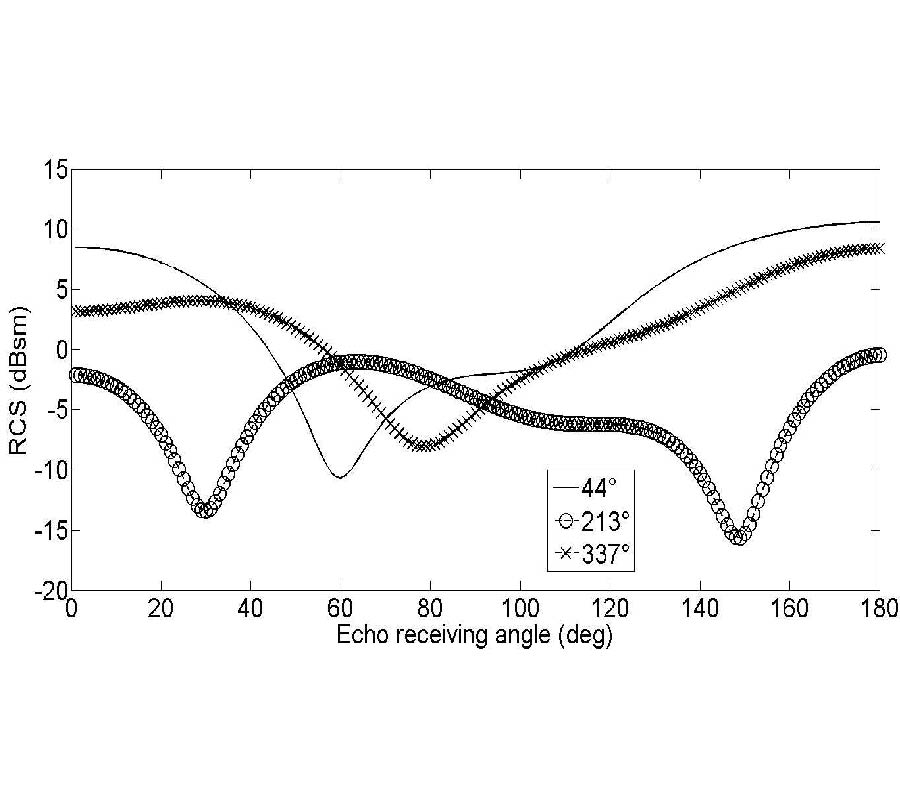
A novel polarization conversion metasurface (PCM) is proposed and applied to radar cross section (RCS) reduction. The proposed design has the advantage of simple geometry while simultaneously reducing RCS over broadband. The metasurface is created by the combination of an oblique split ring resonator (SRR) and a cut-wire resonator, which is capable of converting a linear polarization state into its orthogonal one. The simulation results show that the 10 dB bandwidth of polarization conversion is obtained in wideband from 9.4 to 19.2 GHz, with an average polarization conversion ratio (PCR) of nearly 100%. Due to the high PCR, RCS reduction of 10 dB can be realized over 60% frequency bandwidth with respect to the equal-sized PEC ground plane. The maximum reduction is 32.8 dB. To validate the simulation results, prototypes of the PCM are fabricated and measured. Excellent agreement between simulations and measurements is achieved.
POLARIZATION CONVERSION METASURFACE FOR BROADBAND RADAR CROSS SECTION REDUCTION
2016-08-26
PIER C
Vol. 67, 11-20
A Wide Spectrum Sensing and Frequency Reconfigurable Antenna for Cognitive Radio
Sonia Sharma and Chandra Charu Tripathi
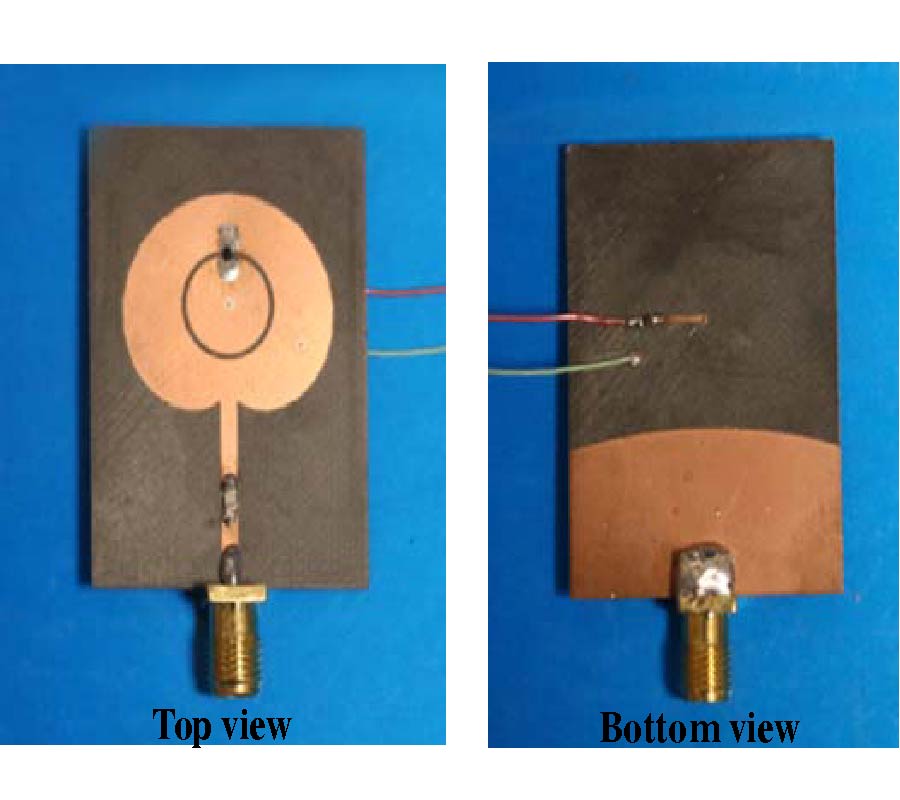
A novel hybrid antenna capable of both spectrum sensing and frequency reconfigurability is proposed in this paper. The proposed hybrid antenna senses spectrum over a wide frequency range from 1 GHz-12 GHz and accordingly reconfigures its operating frequency in any of the four different frequencies i.e., 2.1 GHz, 2.96 GHz, 3.5 GHz and 5 GHz. Since wideband response for spectrum sensing and each frequency state works independently, there is no interference among various signals. The wideband response for spectrum sensing is obtained by exciting semicircular arc having staircase-shaped slot in the ground plane. Frequency reconfiguration is achieved by electronic switching among various matching stubs. Both simulated and experimental results for the return loss, gain and radiation patterns are presented. The proposed hybrid antenna shows a measured return loss better than -20 dB in all the operating bands, a bidirectional radiation pattern and 4.8 dB gain in θ = 20˚ and 120˚ in E plane.
A WIDE SPECTRUM SENSING AND FREQUENCY RECONFIGURABLE ANTENNA FOR COGNITIVE RADIO
2016-08-26
PIER C
Vol. 67, 1-10
Interaction Between Human and Near-Field of Wireless Power Transfer System
Maja Skiljo , Zoran Blazevic and Dragan Poljak
In this paper we provide new recommendations for a type of antenna design in applications where a human is present in the vicinity of a wireless power transfer (WPT) system by means of power transfer efficiency (PTE) and specific absorption rate (SAR). The interaction between a homogenous human model and different WPT systems is investigated at 13.56 MHz using spherical mode theory antenna model (SMT-AM) and full-wave numerical analysis. The human model exposure and the performance of the proposed WPT system are analyzed further for some typical scenarios. It is shown that the position in which the human model is closer to the receiver is favorable over the position closer to the transmitter, concerning both PTE and SAR. Also, the consideration of variable receiver load indicates that different levels of SAR coupled by degraded PTE can be expected. The proposed antennas are designed and proof of concept WPT measurements are carried out.
INTERACTION BETWEEN HUMAN AND NEAR-FIELD OF WIRELESS POWER TRANSFER SYSTEM
2016-08-25
PIER M
Vol. 49, 167-179
Modeling the Effect of Periodic Wall Roughness on the Indoor Radio Propagation Channel
Vincent Adelphe Fono and Larbi Talbi
A deterministic model based on ray tracing and dealing with periodic roughness is developed, for an indoor radio propagation channel and experimentally validated at a frequency of 10 GHz. Two different scenarios are studied, namely a smooth corridor and a corridor having artificial periodic roughness. The periodic roughness consists of a set of conductive semi-cylinders attached to the corridor sidewalls. Two different antenna setups are considered during the measurements, horn-horn antennas and patch-patch antennas, in transmitter-receiver configurations. Excellent agreement is achieved in terms of the received powers versus distance and the power delay profiles. The signal fading is analyzed. The statistical parameters are also generated, and a fair agreement is observed between the simulation and measurement results.
MODELING THE EFFECT OF PERIODIC WALL ROUGHNESS ON THE INDOOR RADIO PROPAGATION CHANNEL
2016-08-23
PIER M
Vol. 49, 153-165
Statistical Design Centering Optimization of 1D Photonic Crystal Filters
Abdel-Karim S. O. Hassan , Ahmed Sayed Mohamed , Mahmoud M. Taha and Nadia H. Rafat
A statistical design centering approach is introduced, to achieve the optimal design center point of one-dimensional photonic crystal-based filters which are parts of several optoelectronic systems. Up to our knowledge, it is the first time that a design centering approach is applied to such a design problem. The proposed approach seeks nominal designable parameter values that maximize the probability of satisfying the design specifications (yield function). Thus, the achieved optimal design center point is much more robust to unavoidable designable parameter variations, occurring during fabrication process, for example. The yield maximization problem is formulated as an unconstrained optimization problem solved by derivative-free based-algorithm (NEWUOA) coupled with a variance reduction yield estimator to reduce large number of required system simulations. The flexibility and efficiency of the proposed design centering approach are demonstrated by two practical examples: band pass optical filter and spectral control filter. A comparison with Minimax optimization technique is also given.
STATISTICAL DESIGN CENTERING OPTIMIZATION OF 1D PHOTONIC CRYSTAL FILTERS
2016-08-23
PIER
Vol. 156, 105-133
Pathological Brain Detection by Artificial Intelligence in Magnetic Resonance Imaging Scanning (Invited Review)
Shuihua Wang , Yin Zhang , Tianmin Zhan , Preetha Phillips , Yudong Zhang , Ge Liu , Siyuan Lu and Xueyan Wu
(Aim) Pathological brain detection (PBD) systems aim to assist and even replace neuroradiologists to make decisions for patients. This review offers a comprehensive and quantitative comparison for PBD systems by artificial intelligence in magnetic resonance imaging (MRI) scanning. (Method) We first investigated four categories of brain diseases, including neoplastic disease, neurodegenerative disease, cerebrovascular disease, and inflammation. Next, we introduced important MRI techniques, such as the shimming, water and fat suppression, and three advanced imaging modalities (functional MRI, diffusion tensor imaging, and magnetic resonance spectroscopic imaging). Then, we discussed four image preprocessing techniques (image denoising, slice selection, brain extraction, spatial normalization, and intensity normalization), seven feature representation techniques (shape, moment, wavelet, statistics, entropy, gray level co-occurrence matrix, and Fourier transform), and two dimension reduction techniques (feature selection and feature extraction). Afterwards, we studied classification related methods: six learning models (decision tree, extreme learning machine, k-nearest neighbors, naive Bayes classifier, support vector machine, feed-forward neural network), five kernel functions (linear, homogeneous and inhomogeneous polynomial, radial basis function, and sigmoid), and three types of optimization methods (evolutionary algorithm, stochastic optimization, and swarm intelligence). (Results) We introduced three benchmark datasets and used Kfold stratified cross validation to avoid overfitting. We presented a detailed quantitative comparison among 44 state-of-the-art PBD algorithms and discussed their advantages and limitations. (Discussions) Artificial intelligence is now making stride in the PBD field and enjoys a fair amount of success. In the future, semi-supervised learning and transfer learning techniques may be potential breakthroughs to develop PBD systems.
PATHOLOGICAL BRAIN DETECTION BY ARTIFICIAL INTELLIGENCE IN MAGNETIC RESONANCE IMAGING SCANNING (INVITED REVIEW)
2016-08-21
PIER M
Vol. 49, 141-151
An Extension of the Linear Embedding via Green's Operators Method for the Analysis of Disconnected Finite Antenna Arrays
Salman Mokhlespour , Vito Lancellotti and Antonius G. Tijhuis
We describe an extension of the linear embedding via Green's operators (LEGO) method to the solution of finite antenna arrays comprised of disconnected elements in a homogeneous medium. The ultimate goal is the calculation of the admittance matrix and the radiation pattern of the array. As the basic idea is the inclusion of an array element inside a LEGO electromagnetic brick, the first step towards the solution consists of the definition and numerical calculation of hybrid scattering-admittance operators which extend the notion of scattering operators of equivalent currents introduced in the past. Then again, the combination of many bricks involves the usual transfer operators for the description of the multiple scattering between the bricks. Moreover, to reduce the size of the problem we implement the eigencurrents expansion. With the aid of a numerical example we discuss the validation of the approach and the behaviour of the total CPU time as a function of the elements forming the array.
AN EXTENSION OF THE LINEAR EMBEDDING VIA GREEN'S OPERATORS METHOD FOR THE ANALYSIS OF DISCONNECTED FINITE ANTENNA ARRAYS
2016-08-19
PIER Letters
Vol. 62, 1-8
A Novel Wideband Circularly Polarized Patch Array with Meta-Surface
Ruiqi Wang , Yongchang Jiao , Liang Lu and Huan Zhang
A wideband sequential-phase-feeding circularly polarized (CP) patch array is proposed in this paper. A well-designed meta-surface is placed above the array to enhance its impedance and axial ratio (AR) bandwidths. The proposed patch array has an overall size of 1.275λo×1.275λo×0.0935λo at 5.1 GHz. Measured results show that the impedance bandwidth (|S11|<-10 dB) of the array is 24.26% from 4.74 GHz to 6.05 GHz, and its 3 dB axial ratio bandwidth is 19% from 4.75 GHz to 5.75 GHz. The measured gain of the array at 5.7 GHz is 10.8 dBic. The measured results agree well with the simulated ones.
A NOVEL WIDEBAND CIRCULARLY POLARIZED PATCH ARRAY WITH META-SURFACE
2016-08-19
PIER Letters
Vol. 61, 131-137
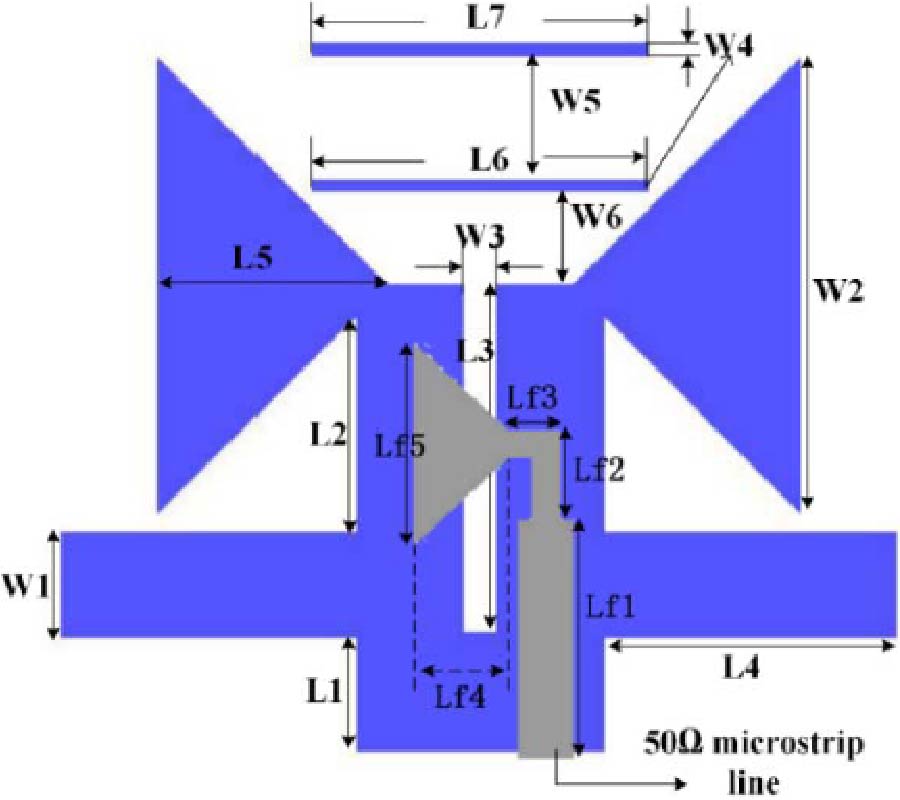
A Wideband Dual-Polarized Modified Bowtie Antenna for 2G/3G/LTE Base-Station Applications
Zhao Yang , Cilei Zhang , Ying-Zeng Yin and Yong Wang
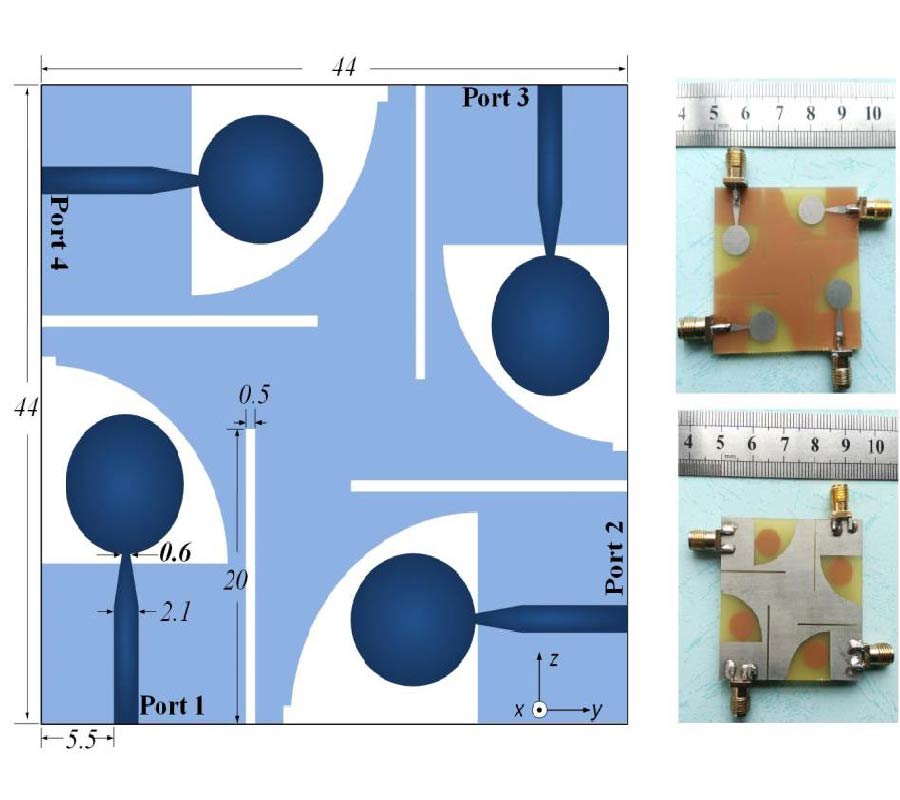
A novel wideband dual-polarized antenna is presented for 2G/3G/LTE base-station applications. The proposed antenna consists of two orthogonal modified bowtie dipoles, parasitic elements and a cavity. By using parasitic elements and compact cavity, the antenna achieves a wide impedance bandwidth about 77.3% (VSWR<1.5) for both ports. Both simulated and measured results show that the proposed antenna has a port isolation higher than 31 dB and high gain (>8.5 dBi) over the entire operating band. Moreover, good cross-polarization (>25 dB) performance and a front-to-back ratio better than 20 dB are also verified by measured results.
A WIDEBAND DUAL-POLARIZED MODIFIED BOWTIE ANTENNA FOR 2G/3G/LTE BASE-STATION APPLICATIONS
2016-08-17
PIER C
Vol. 66, 191-199
Power-Combined Multipliers at 60 GHz Based on Fundamental Frequency Vector Modulation
Pengfei Sun , Liang Wu , Jinyi Ding and Xiao-Wei Sun
High output power multiplier is necessary for local oscillator (LO) source of millimeter-wave and terahertz applications. However, single multiplier chip power-handling capability is limited by understandably low efficiency level and other technical constraints. Conventional in-phase power-combined structures are sensitive to the fabrication and assembly errors. In order to circumvent these limits, we propose a power-combined multiplier architecture at 60 GHz based on fundamental frequency vector modulation at 30 GHz. The fundamental vector modulator adjustment can compensate the phase deviation at the two doubler output ports despite fabrication and assembly tolerances. We can increase the output power by approximately 3 dB compared with single multiplier without sacrificing the bandwidth.
POWER-COMBINED MULTIPLIERS AT 60 GHZ BASED ON FUNDAMENTAL FREQUENCY VECTOR MODULATION
2016-08-12
PIER M
Vol. 49, 131-140
A Comparative Study of Flux Cancellation Among Multiple Interconnected Modular Pads in Lumped IPT System
Chun Qiu , Kwok-Tong Chau , Zhen Zhang and Tze Wood Ching
A lumped inductive power transfer system (IPT) with multiple modular pads differs from a stand-alone system. The magnetic coupling between adjacent modules is affected by the flux cancelation which further affects the power transmission. Thus, it is important to investigate the relationship between flux cancelation and system configuration. In this paper, the basic connection and operating mechanism for a modular IPT system are first discussed. Six cases are designed for two scenarios, including single and multiple secondary modules. Performances are compared in various primary excitation modes and secondary connection modes. Results show that the direction of canceled flux is determined by these modes. Matched modes will bring either a higher or a more stable coupling. And unmatched modes between primary and secondary sides tend to have the lowest coupling performance due to severe flux cancelation. Results provide a guidance for system design aiming at different power transfer characteristics.
A COMPARATIVE STUDY OF FLUX CANCELLATION AMONG MULTIPLE INTERCONNECTED MODULAR PADS IN LUMPED IPT SYSTEM