Search Results(13981)

2016-12-20
PIER C
Vol. 70, 91-98
Quadrifilar Helix Antenna Using Compact Low-Cost Planar Feeding Circuit in Array Configuration
Mohammad Saeid Ghaffarian , Somayeh Khajepour and Gholamreza Moradi
A wideband printed quadrifilar helical antenna (PQHA) using a novel single-layer compact feeding circuit is proposed in this paper. A low-cost single-layer feeding circuit which consists of a 180° compact rat race coupler and two 3 dB hybrid commercial couplers is incorporated at the bottom of the quadrifilar antenna. The antenna arms are tapered at the feeding point to improve impedance matching between the antenna and feeding circuit. The operating frequency band ranges from 1.9 to 2.3 GHz which shows that the proposed antenna is a good candidate for various applications such as satellite communication and broadcasting satellite systems. Therefore, the array of the proposed antenna on the simple cube satellite mock-up is investigated. By this antenna array configuration, a fully spherical radiation coverage is obtained around the structure. The bandwidth of the axial ratio (AR) with a wide beamwidth (160º) is 20% in operating frequency band. The measured peak gain of the proposed antenna varies between 2.6 and 3.2 dBic in the frequency band of interest. The measured 3 dB AR half-power beamwidth is 160º.
QUADRIFILAR HELIX ANTENNA USING COMPACT LOW-COST PLANAR FEEDING CIRCUIT IN ARRAY CONFIGURATION
2016-12-20
PIER Letters
Vol. 65, 15-21
A Method for Analyzing Broadcast Beamforming of Massive MIMO Antenna Array
Hong-Wei Yuan , Guan-Feng Cui and Jin Fan
In this paper, a new analysis method of broadcast beamforming for a massive MIMO antenna array, targeting at the fifth generation mobile communication, is introduced. In order to solve the problem of narrow broadcast beam coverage, the element phase of massive MIMO antenna array is optimized using a method, which combines both numerical electromagnetic analysis method and global optimization algorithm. The analysis results show that the optimal value of 3 dB broadcast beam width for 64 elements in the horizontal plane is 36 degree, which is 0.55 times of that of the 4G base station. In addition, the optimal value of gain loss increases to about 13 dB compared with the gain of the antenna fed with equal amplitude and in phase. So it is also necessary to take the system link budget of the broadcast channel into consideration. The proposed analysis method and design solution can provide reference for the research of the next generation mobile communication.
A METHOD FOR ANALYZING BROADCAST BEAMFORMING OF MASSIVE MIMO ANTENNA ARRAY
2016-12-18
PIER C
Vol. 70, 83-90
Development of a Cyber-Secured Zone with Directive Antennas and Noise Generation
Joshua Haney , Jinxi Chen and Sungkyun Lim
A wireless cyber secure zone has been created by controlling RF propagation using directive antennas and noise generation to establish a functional boundary for a wireless network. Directive microstrip patch antennas were constructed in the 2.4-GHz ISM band, and a commercial router was used to generate a wireless network on a specified channel. The FM transmitters for noise generation were set to the same channel in the 2.4-GHz ISM band, and the directive microstrip patch antennas were arranged facing outward creating an inner cyber secure zone for the wireless network. Outside the cyber secure zone, the wireless network was undetectable.
DEVELOPMENT OF A CYBER-SECURED ZONE WITH DIRECTIVE ANTENNAS AND NOISE GENERATION
2016-12-18
PIER Letters
Vol. 65, 9-14
Compact CPW-Fed Multiband Antenna for TD-LTE/WLAN/WiMAX Applications
Gui Liu , Mengli Fang , Ruixing Zhi , Jing Bai and Zhe Zeng
A compact coplanar waveguide fed multiband antenna is proposed and investigated. The proposed antenna consists of a rectangular radiating patch and dual meander strips with a defected ground plane. The size of the fabricated prototype is 28.3 × 24 × 1.59 mm3. The proposed antenna radiates at three different resonant modes, which cover 2.29-2.63 GHz, 3.26-3.96 GHz, and 4.97-6.10 GHz. The proposed antenna can be used for TD-LTE 2300/2500 (2.305-2.4 GHz), WLAN (2.4-2.4835 GHz and 5.15-5.875 GHz) and WiMAX (2.3-2.4 GHz and 3.3-3.7 GHz) applications. The proposed antenna exhibits an omnidirectional radiation pattern in the H-plane and a dipole-like radiation pattern in the E-plane. The measured peak gains are 2.64/4.48/6.08 dBi at the 2.4/3.5/5.5 GHz operating frequency bands, respectively.
COMPACT CPW-FED MULTIBAND ANTENNA FOR TD-LTE/WLAN/WIMAX APPLICATIONS
2016-12-18
PIER Letters
Vol. 65, 1-7
Gain Enhancement of Slot Antenna Using Grooved Structure and FSS Layer
Bilal El Jaafari and Jean-Marie Floc'h
This letter presents a high gain slot antenna for K-band non-contact measurement systems. The proposed antenna consists of a slot antenna on a grooved metal structure with a single frequency selective surface. In addition to a high-gain characteristic, a reduced size is strongly required for easy embedding. These features are the main objectives of this antenna design. To achieve these two objectives, an optimization procedure, based on a global algorithm, is used. Both simulation and optimization are carried out by means a full-wave electromagnetic simulation tool. Eventually, to validate the proposed design, a prototype of the antenna has been manufactured and tested. More than 15 dB of gain is measured over the operating frequency range, while optimal gain can reach 17 dB at frequency 25.5 GHz. These characteristics make this antenna very suitable for non-contact measurement i.e. radar systems.
GAIN ENHANCEMENT OF SLOT ANTENNA USING GROOVED STRUCTURE AND FSS LAYER
2016-12-18
PIER M
Vol. 53, 1-8
Three-Dimensional Analysis of Ferrite-Loaded Waveguide Discontinuity by Transverse Operator Method Combined with Mode-Matching Method
Faten Chaabane , Hafedh Benzina , Lassaad El Mir and Junwu Tao
In this paper, a rigorous study of rectangular waveguide partially filled with longitudinally magnetized ferrite is presented. The propagation constant as a function of frequency is first obtained by the use of Transverse Operator Method. We show the existence of the complex modes in this type of structures with ferrite. In these problems, the interface between an air filled rectangular waveguide and E-plane ferrite slab loaded rectangular waveguide represent a discontinuity problem. The analysis is based on the Mode Matching Method and the Transverse Operator Method which are combined in such a way as to determine the scattering parameters. The proposed approach is validated by comparing the presented results with the published data and numerical ones obtained from commercial software.
THREE-DIMENSIONAL ANALYSIS OF FERRITE-LOADED WAVEGUIDE DISCONTINUITY BY TRANSVERSE OPERATOR METHOD COMBINED WITH MODE-MATCHING METHOD
2016-12-16
PIER Letters
Vol. 64, 133-139
High Selectivity Wideband Bandpass Filter Based on Transversal Signal-Interaction Concepts Loaded with Open and Shorted Stubs
Liwei Cui , Weimin Wang , Zheng Zhuang , Shulan Li , Yongle Wu and Yuan'an Liu
A new design of high selectivity wideband bandpass filter based on transversal signal-interaction concepts loaded with open and shorted stubs is proposed in this paper. Two transmission paths are used to realize signal transmission. Path 1 is composed of a T-shaped structure with shorted stub, and Path 2 consists of two open coupled lines loaded with open stubs. A wide five-order passband and high selectivity stopband with four transmission zeros can be achieved in the proposed filter. Finally, a wideband bandpass filter operating at 3 GHz with 3-dB fractional bandwidth of 83.3% (1.55 to 4.05 GHz) is designed, fabricated, and measured. Good agreement between the simulation and experiment is obtained.
HIGH SELECTIVITY WIDEBAND BANDPASS FILTER BASED ON TRANSVERSAL SIGNAL-INTERACTION CONCEPTS LOADED WITH OPEN AND SHORTED STUBS
2016-12-15
PIER B
Vol. 72, 17-30
Metamaterial-Based High-Efficiency Wireless Power Transfer System at 13.56 MHz for Low Power Applications
Jun-Feng Chen , Zhixia Ding , Zhaoyang Hu , Shengming Wang , Yongzhi Cheng , Minghai Liu , Bin Wei and Songcen Wang
Magnetically coupled resonant wireless power transfer (WPT) has been employed in many applications, including wireless charging of portable electronic devices, electric vehicles and powering of implanted biomedical devices. However, transmission efficiency decreases sharply due to divergence of magnetic field, especially in under coupled region. Electromagnetic (EM) metamaterial (MM) can manipulate the direction of EM fields due to its abnormal effective permittivity or permeability. In this paper, an ultra-thin and extremely sub-wavelength magnetic MM is designed for a 13.56 MHz WPT system to enhance magnetic field and its power transfer efficiency (PTE). The WPT systems are investigated theoretically, experimentally and by simulation. A relatively high maximum efficiency improvement of 41.7% is obtained, and the range of efficient power transfer can be greatly extended. The proposed MM structure is very compact and ultra-thin in size compared with early publications for some miniaturized applications. In addition, large area, homogeneous magnetic field is obtained and discussed using the proposed MM. Finally, the proposed MM is applied in a more practical WPT system (with a low power light bulb load) to reveal its effects. The bulb brightness intuitively verifies the efficiency improvement in the WPT system with the MM.
2016-12-15
PIER C
Vol. 70, 73-81
Online-Calibrated CS-Based Indoor Localization Over IEEE 802.11 Wireless Infrastructure
Wei Ke , Jie Jin , Hengkuan Xu , Kunliang Yu and Jianhua Shao
Recent technological achievements have made it low cost to realize indoor localization using the received signal strength (RSS) information from Wi-Fi signals. However, the current RSS-based indoor localization techniques have two major challenges: one is that the RSS signal is quite sensitive to channel conditions, and the other is that sufficient number of access points (APs) is needed to provide enough RSS measurements for guaranteeing good performance. To solve these problems, this paper proposes an adaptive compressive sensing (CS) based indoor localization method based on the IEEE 802.11 Wi-Fi standard. The novel feature of this method is to dynamically adjust both the dictionary and the sparse solution using an online dictionary learning (DL) technology so that the location solution can better match the real-time RSS scenario. Meanwhile, an improved approximate l0 norm minimization algorithm is presented to enhance sparse recovery speed and reduce the number of APs required by indoor localization systems. The effectiveness of the proposed scheme is demonstrated by experimental results where the proposed algorithm yields substantial improvement for localization performance and reduces computation complexity.
ONLINE-CALIBRATED CS-BASED INDOOR LOCALIZATION OVER IEEE 802.11 WIRELESS INFRASTRUCTURE
2016-12-13
PIER Letters
Vol. 64, 127-131
Compact Hexa-Mode Resonator and Its Application on WiFi Dual-Band Filter
Jian-Quan Huang , Feng Qiu , Dajun Lei , Zhenhua Tang and Min Yao
This letter presents a compact hexa-mode microstrip resonator which is originated from a traditional stub-load resonator (SLR). Stub in SLR isreplaced by a couple of square-loops in the proposed resonator. The advantage of this replacement is that six modes emerge to realize a compact size, and more transmission zeros are generated in its application on filter to enhance the frequency selectivity. For demonstration, a compact dual-band microstrip filter using the proposed resonator is designed in 2.4 GHz/5.2 GHz of WIFI channel, and six transmission zeros are generated to enhance the frequency selectivity.
COMPACT HEXA-MODE RESONATOR AND ITS APPLICATION ON WIFI DUAL-BAND FILTER
2016-12-13
PIER Letters
Vol. 64, 119-126
Subspace Pattern Recognition Method for Brain Stroke Detection
Yizhi Wu , Xieyun Xu and Ming-Da Zhu
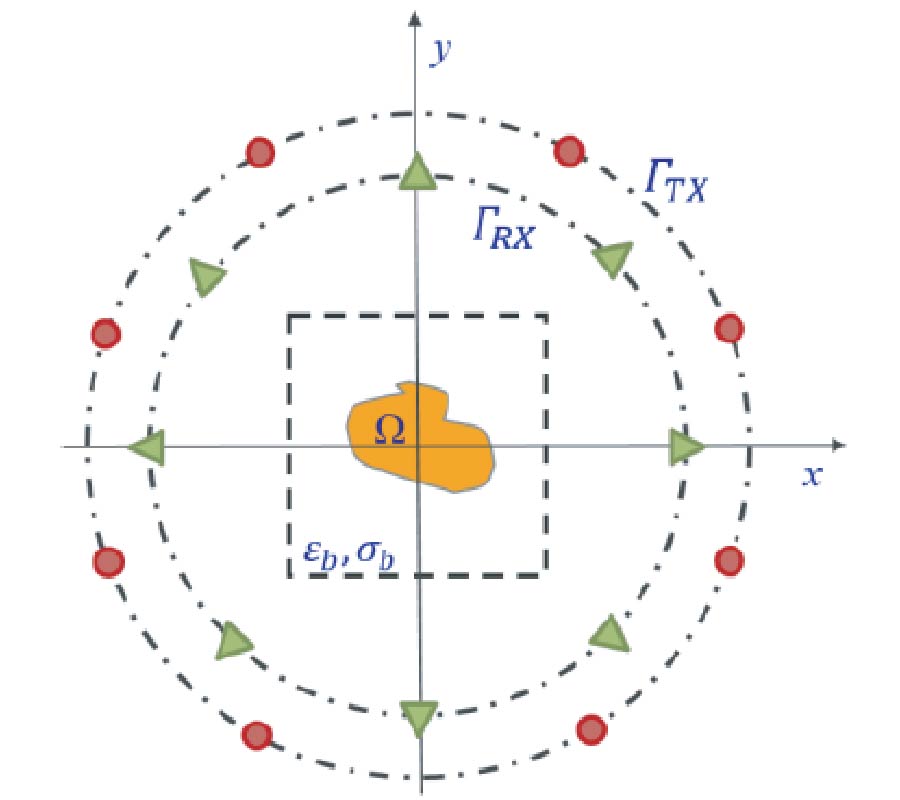
Brain stroke is a serious disease and one of the major causes of death. Stroke detection based on the frequently studied microwave imaging method is computation-intensive and not always reliable. This paper presents a stroke-detection scheme based on subspace classification technique. Specifically, the stroke is detected and located using the intersection of the positive antenna lines, i.e. connecting the transmitter and receiver. The numerical results show that the proposed method can detect and locate blood clots efficiently.
SUBSPACE PATTERN RECOGNITION METHOD FOR BRAIN STROKE DETECTION
2016-12-13
PIER Letters
Vol. 64, 111-117
Range Migration Techniques for Short-Range MIMO Array Imaging
Jing Yang , Xiaozhou Shang and Zhi-Ping Li
This paper presents a short-range imaging algorithm for multiple-input-multiple-output (MIMO) array. One of the steps in a previous method utilizes 2-D STOLT interpolation to transform 3-D data into 2-D data, which is not strict in the view of mathematical derivation and lack of physical meaning. The convolution operation which is analyzed by physical process of angular spectrum propagation is used to explain multi-static configuration and reduce the 3-D data into 2-D ones. This paper gives the physical phenomena of the whole process of imaging. We also explain the different physical meanings of FFT between transmitters and receivers. Numerical simulations show the consequence of STOLT interpolation in the previous algorithm and demonstrate the performance of the proposed algorithm.
RANGE MIGRATION TECHNIQUES FOR SHORT-RANGE MIMO ARRAY IMAGING
2016-12-13
PIER M
Vol. 52, 191-200
Specific RCS for Describing the Scattering Characteristic of Complex Shape Objects
Mariya S. Antyufeyeva , Alexander Butrym , Nikolay N. Kolchigin , Maxim N. Legenkiy , Alexander A. Maslovskiy and Gennady G. Osinovy
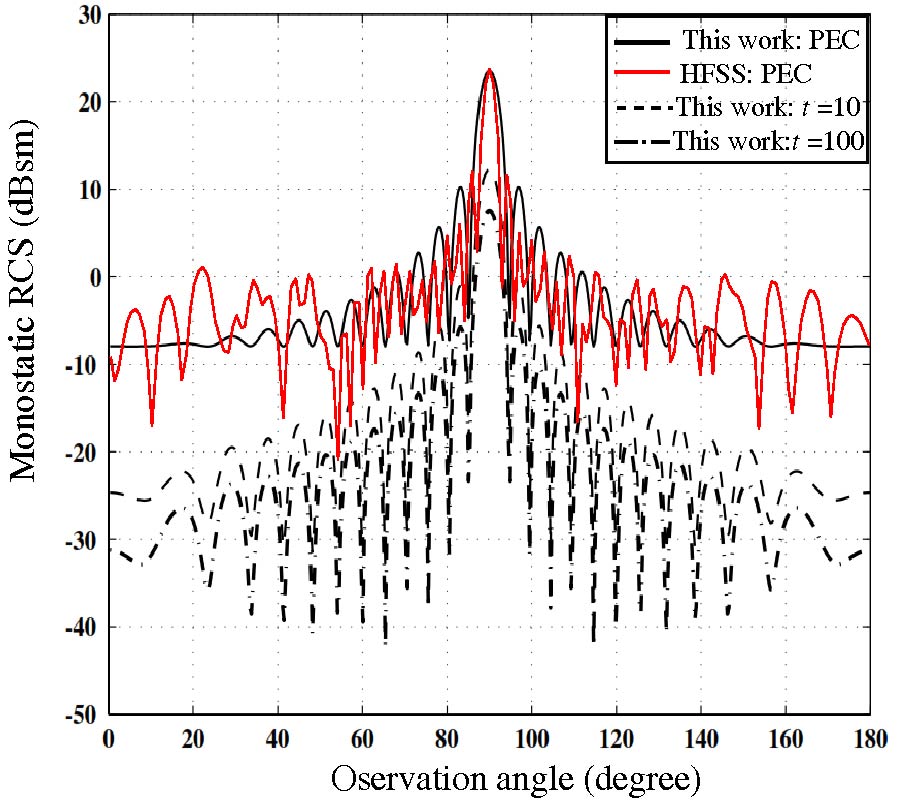
Nowadays it is important to create military and civilian vehicles which would be invisible to radar (or homing precision weapons). Such a task requires using high amount of radio-absorbing materials and high cost of finished samples of re-engineering. So it is very useful to have some methods for mathematical modeling of electromagnetic waves scattering on the object in order to take into account various techniques to reduce the object visibility at the stage of design. After the mathematical modeling for each case (specified wavelength, polarization, background surface, etc.), we obtain the angular RCS dependence. We obtain such dependencies for two different models. Based on the comparison of these two dependencies for different objects, it is very difficult to determine which one of the objects is more detectable. This paper presents a new calculation method which allows characterizing the scattering properties of each object only with a few numbers: specific RCS (same as normalized RCS) and RCS dispersion. The presented method can be simply used to assess the visibility of the objects placed on different background surfaces.
SPECIFIC RCS FOR DESCRIBING THE SCATTERING CHARACTERISTIC OF COMPLEX SHAPE OBJECTS
2016-12-12
PIER C
Vol. 70, 63-72
Design of a Microstrip Filtering Balun with a Wide Stopband
Jun-Mei Yan , Liangzu Cao and Hai-Ying Zhou
A microstrip filtering balun with a wide stopband is presented. Its filtering function is realized by four meandering stepped impedance resonators (SIRs). Except for an identical fundamental-mode resonant frequency, the SIRs have different high-order resonant frequencies. Thus, the parasitic passbands are suppressed, and a wide stopband is achieved. The unbalance-to-balance transition is accomplished by introducing two coupling output ports at two symmetry positions of the output SIR. The voltages at symmetrical positions have equal magnitudes and opposite phases, thus, signals coupled from the symmetry positions also have equal magnitude and opposite phase, i.e., balanced output signals are achieved. A more general design approach is discussed in detail, and the proposed approach is similar to the design method of the conventional filter except that a small modification is made. Additionally, two kinds of external coupling structures, microstrip coupling lines and tapped line, are compared in terms of stopband performance. The comparison shows that better stopband performance is observed when utilizing the microstrip coupling lines as the external coupling structure. A filtering balun with central frequency of 2.4 GHz and Chebyshev frequency response is designed, fabricated and measured. The measured results give a reasonable agreement with the simulated ones, which verifies the effectiveness of the filtering balun.
DESIGN OF A MICROSTRIP FILTERING BALUN WITH A WIDE STOPBAND
2016-12-12
PIER Letters
Vol. 64, 105-110
Design of an Interdigital Band-Pass Filter for Out-of-Band Rejection Improvement
Weiping Li , Xin Cao , Haodong Lin and Zong-Xi Tang
In this letter, an interdigital band-pass filter is proposed for out-of-band rejection improvement. Seven quarter-wavelength resonators are employed to form the passband. Three extra transmission zeros (TZs) on both sides of the passband are implemented by introducing source-load coupling and dumbbell defected ground structures (DGS). As demonstrated by the measured results, out-of-band rejection and selectivity are improved by these three TZs, and good performances are achieved. The proposed method of increasing out-of-band rejection is feasible and applicable in the design of modern microstrip filters.
DESIGN OF AN INTERDIGITAL BAND-PASS FILTER FOR OUT-OF-BAND REJECTION IMPROVEMENT
2016-12-12
PIER Letters
Vol. 64, 99-104
A Dual Band E-CRLH Frequency Multiplier with Two Multiplication Factors
Rasool Keshavarz , Abbas Mohammadi , Abdolali Abdipour and Rashid Mirzavand
A dual-band microstrip distributed multiplier with two multiplication factors based on the extended composite right- and left-handed (E-CRLH) transmission lines (TLs) is presented. Dual-band operation for distributed multiplier is achieved by three cells, and each cell consists of a transistor, microstrip TL and E-CRLH transmission line. The distributed multiplier exhibits two multiplication factors in two different frequencies: one multiplication factor in reverse direction and the other multiplication factor in forward direction. The excellent agreement between proposed technique and measurement results confirms the accuracy and efficiency of the method.
A DUAL BAND E-CRLH FREQUENCY MULTIPLIER WITH TWO MULTIPLICATION FACTORS
2016-12-12
PIER Letters
Vol. 64, 93-98
Mechanically Tunable Wire Medium Metamaterial in the Millimeter Wave Band
Liubov Ivzhenko , Eugene Odarenko and Sergey I. Tarapov
The paper is devoted to experimental and theoretical study of spectra zone characteristics of the wire medium metamaterial with mechanically tunable unit cell. We experimentally demonstrated the effective control possibility of the spectral characteristics of wire medium metamaterial by varying its elementary unit-cell geometry. We established conditions under which the experimental implementation of the wire medium metamaterial at microwaves possesses the properties of a plasma-like medium and the properties band gap structure. A good agreement between the experiment and theory is demonstrated.
MECHANICALLY TUNABLE WIRE MEDIUM METAMATERIAL IN THE MILLIMETER WAVE BAND
2016-12-12
PIER M
Vol. 52, 181-190
A New Diode-Clamped Multilevel Inverter for Capacitor Voltage Balancing
Shunji Shi , Xiangzhou Wang , Shuhua Zheng and Fei Xia
In this paper, a new diode-clamped multilevel inverter for capacitor voltage with inserted inductors is proposed. The key is to solve the voltage unbalance of diode-clamped multilevel inverter (DCMLI), which utilizes fewer switches and adopts a simpler control strategy. In this way, the cost and volume of the DCMLI can be effectively reduced. Firstly, the new five-level inverter topology is analyzed in detail under different operation modes. Then, the proposed topology extended to (2n+1) level inverter is introduced and discussed. Finally, both simulation and experiment results are demonstrated to verify the validity of the proposed topology.
A NEW DIODE-CLAMPED MULTILEVEL INVERTER FOR CAPACITOR VOLTAGE BALANCING
2016-12-10
PIER C
Vol. 70, 53-62
Improved Meandered Gysel Combiner/Divider Design with Stepped-Impedance Load Line for High-Power Applications
Mehrdad Gholami , Rony E. Amaya and Mustapha Yagoub
This paper presents an improved structure of a Gysel combiner/divider suitable for high-power applications. The proposed structure makes use of stepped-impedance load line features to implement a simple, compact, low loss and sufficiently wideband Gysel configuration. It also improves isolation and facilitates design flexibility for the load location. Measurements agree with expected simulated results thus, demonstrating the proposed structure with a 10% fractional bandwidth while maintaining 20 dB of return loss and 0.25 dB of insertion loss.
IMPROVED MEANDERED GYSEL COMBINER/DIVIDER DESIGN WITH STEPPED-IMPEDANCE LOAD LINE FOR HIGH-POWER APPLICATIONS
2016-12-09
PIER M
Vol. 52, 169-179
Alternative Representation of Green's Function for Electric Field on Surfaces of Thin Vibrators
Yuriy M. Penkin , Viktor A. Katrich and Mikhail Nesterenko
An alternative representation of a Green function for electric fields on surfaces of thin impedance vibrators is proposed. The representation can be applied in software packages for simulation of RF and microwave devices. Advantages of the approach were demonstrated by analyzing the well-known problem of a thin symmetrical horizontal vibrator above a perfectly conducting plane. For a half-wave vibrator, numerical estimates of an effective external induced impedance were made for various distances between the vibrator and the plane. A possibility to realize a distribution of intrinsic impedance on the vibrator capable to compensate of the plane influence was also analyzed.
ALTERNATIVE REPRESENTATION OF GREEN'S FUNCTION FOR ELECTRIC FIELD ON SURFACES OF THIN VIBRATORS