Search Results(13796)

2016-10-11
PIER Letters
Vol. 63, 59-64
Dual-Wideband Bandpass Filter Using Open and Shorted Stubs Loaded Ring Resonator
Qian Yang , Yong-Chang Jiao , Zheng Zhang and Nan Wang
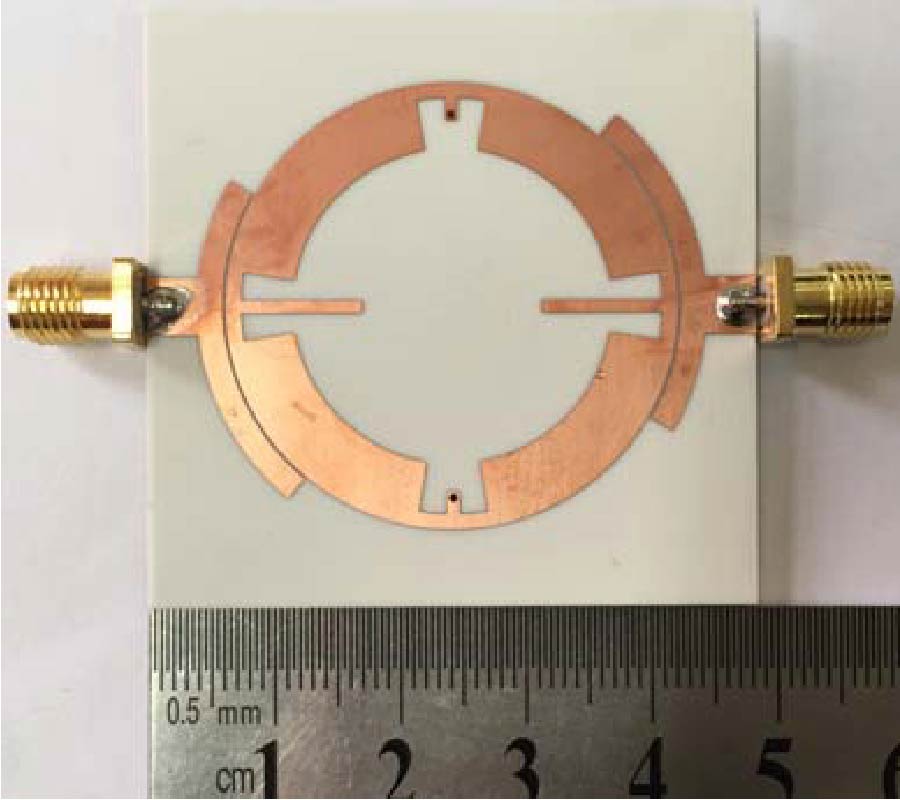
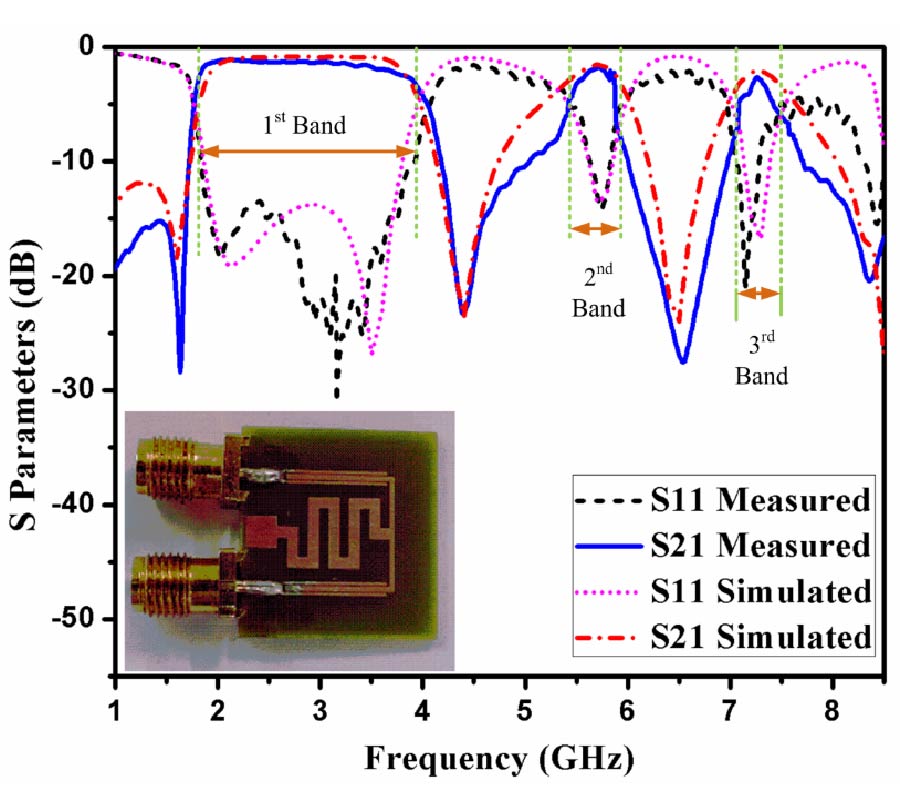
This letter presents a dual-wideband bandpass filter (BPF) by using open and shorted stubs loaded ring resonator. The resonator can excite multiple resonant modes. The transmission zeros (TZs) analyzed by the transversal signal interference concepts can divide the resonant modes into two groups that form dual-wide passband. The even-mode resonant frequencies can be controlled by the stubs parameters, and the TZs can be tuned by the port angle independently. So the center frequency (CF) and the bandwidth of each passband can be flexibly controlled. An experimental dual-wideband BPF with CF of 1.48/5.7 GHz and 3 dB FBW of 137.8%/49.3% is implemented, and the experimental results are presented for validation.
DUAL-WIDEBAND BANDPASS FILTER USING OPEN AND SHORTED STUBS LOADED RING RESONATOR
2016-10-11
PIER M
Vol. 51, 1-8
Spectral Domain Analysis of Gyrotropic Anisotropy Chiral Effect on the Input Impedance of a Printed Dipole Antenna
Djamel Sayad , Fatiha Benabdelaziz , Chemseddine Zebiri , Samiha Daoudi and Raed A. Abd-Alhameed
A theoretical analysis of a printed dipole antenna on a gyrotropic-anisotropy chiral dielectric substrate is presented. The study is based on numerical techniques for the characterization of electromagnetic propagation in chiral media. The general complex wave equation and the dispersion relation for such a medium are derived in the spectral domain. The spectral Green's function of a grounded dielectric chiral slab is developed, and the spectral domain moment method impedance matrix elements are calculated. The effect of the chiral gyrotropy element on the input impedance of a dipole antenna printed on a grounded chiral substrate is analyzed using the Galerkin-based Method of Moments.
SPECTRAL DOMAIN ANALYSIS OF GYROTROPIC ANISOTROPY CHIRAL EFFECT ON THE INPUT IMPEDANCE OF A PRINTED DIPOLE ANTENNA
2016-10-11
PIER M
Vol. 50, 195-204
Simulation of High-Altitude Electromagnetic Pulse (HEMP) Above Sea Surface
Hong-Cheng Wei and Jean-Fu Kiang
High-altitude electromagnetic pulse (HEMP) radiated from both primary and secondary currents, which are induced by a nuclear explosion, is computed by using the Jefimenko's equation. The effects of geomagnetic field is considered in computing the primary current, and the rough sea surface is considered in computing the reflected electric field in the frequency domain. The waveforms of HEMP near sea surface and a few km above it are simulated. The impulse and pulse characteristics are discussed, as well as the variation of peak field magnitude when the observation point is moved away from beneath the burst point.
SIMULATION OF HIGH-ALTITUDE ELECTROMAGNETIC PULSE (HEMP) ABOVE SEA SURFACE
2016-10-10
PIER C
Vol. 68, 85-93
Circularly Polarized Substrate Integrated Waveguide Cavity-Backed Antenna with Enhanced Bandwidth for Wideband Wireless Applications
Tian Li , Fu-Shun Zhang , Fei Gao and Yan-Li Guo
A circularly polarized substrate integrated waveguide (SIW) cavity-backed antenna with the feasibility of obtaining a wide bandwidth is proposed and demonstrated. Fed by a modified inverted-T stripline, the proposed double-layered stacked antenna, consisting of an improved circular SIW cavity and a conventional perturbed circular patch radiator, is designed, analyzed and fabricated. Good agreement between simulated and measured results is observed. Simulation and measurement results reveal that the proposed antenna can provide an impedance bandwidth of 22.1% (4.94-6.17 GHz) and a 3-dB axial ratio (AR) bandwidth of 18.7% (5-6.03 GHz). Additionally, within the effective circular polarization (CP) bandwidth of 18.7% (5-6.03 GHz), the proposed antenna has gains from 4.3 dBic to 7.1 dBic with an average gain of 5.9 dBic. The measured CP bandwidth of 18.7% (5-6.03 GHz) not only meets the need for certain Wi-Fi (5.2/5.8 GHz) or WiMAX (5.5 GHz) band communication application, but also provides the potential to implement multiservice transmission.
CIRCULARLY POLARIZED SUBSTRATE INTEGRATED WAVEGUIDE CAVITY-BACKED ANTENNA WITH ENHANCED BANDWIDTH FOR WIDEBAND WIRELESS APPLICATIONS
2016-10-10
PIER Letters
Vol. 63, 53-57
A Miniaturized Directional Coupler Using Complementary Split Ring Resonator and Dumbbell-Like Defected Ground Structure
Lizhong Song and Yuming Nie
A novel microstrip coupled-line directional coupler is proposed in this paper. It is based on the introduction of a complementary split ring resonator and dumbbell-like defected ground structure on the coupled lines to strongly enhance the designed backward coupling. The designed frequency band is from 1.2 to 1.5 GHz. The coupler is fabricated and tested. The insertion loss is less than 3.5 dB. The simulated and measured return losses are better than -13.5 dB, and the isolation is higher than 20 dB across the operating band. The overall size of the coupler is 80 mm×70 mm, which is about 0.36λ×0.32λ at the central frequency 1.35 GHz.
A MINIATURIZED DIRECTIONAL COUPLER USING COMPLEMENTARY SPLIT RING RESONATOR AND DUMBBELL-LIKE DEFECTED GROUND STRUCTURE
2016-10-10
PIER
Vol. 157, 31-47
Analysis of the Nicolson-Ross-Weir Method for Characterizing the Electromagnetic Properties of Engineered Materials
Edward J. Rothwell , Jonathan L. Frasch , Sean M. Ellison , Premjeet Chahal and Raoul O. Ouedraogo
A method for predicting the behavior of the permittivity and permeability of an engineered material by examining the measured S-parameters of a material sample is devised, assuming that the sample is lossless and symmetric. The S-parameter conditions under which the material parameters extracted using the Nicolson-Ross-Weir method may be associated with a lossless homogeneous material are described. Also, the relationship between the signs of the real and imaginary parts of the permittivity and permeability are determined, both when the extracted material parameters are real and when they are complex. In particular, the conditions under which metamaterials exhibit double-negative properties may be predicted from the S-parameters of a metamaterial sample. The relationships between material characteristics and the S-parameters should prove useful when synthesizing materials to have certain desired properties. Examples, both from experiment and simulation, demonstrate that the relationships may be used to understand the behavior of several different categories of engineered materials, even when the materials have appreciable loss.
ANALYSIS OF THE NICOLSON-ROSS-WEIR METHOD FOR CHARACTERIZING THE ELECTROMAGNETIC PROPERTIES OF ENGINEERED MATERIALS
2016-10-09
PIER Letters
Vol. 63, 45-51
A Simple Dual-Wideband Magneto-Electric Dipole Directional Antenna
Lei Yang , Zibin Weng and Xinshuai Luo
A simple dual-wideband magneto-electric (ME) dipole directional antenna is proposed in this letter. The antenna is composed of a ground plane, four Γ-shaped parasitic strips and an ME dipole fed by a Γ-shaped feed strip. Simulated results show that the ME dipole can only work in the higher frequency band from 1.7 to 2.7 GHz. By adding four Γ-shaped parasitic strips at each corner of the ground plane, the lower frequency band (0.788~1.17 GHz) impedance matching is improved. The antenna is prototyped and measured. Measured results show that the antenna obtains -10 dB impedance bandwidths of 39% (0.788~1.17 GHz) and 51.7% (1.62~2.75 GHz) for the lower and higher bands. The achieved gains are 5.5±0.5 dBi in the lower frequency band and 7±1 dBi in the higher frequency band. The proposed antenna has good impedance and directional radiation characteristics in the whole frequency band. It can be widely used for 2G, 3G, LTE, WLAN, etc. communication systems.
A SIMPLE DUAL-WIDEBAND MAGNETO-ELECTRIC DIPOLE DIRECTIONAL ANTENNA
2016-10-09
PIER Letters
Vol. 63, 37-43
A Planar Out-of-Phase Power Divider with Unequal Power Dividing Ratio
Shiyong Chen , Tianlin Zhang , Tianchong Huang and Yantao Yu
A planar power divider with unequal power division and out-of-phase feature is presented. Firstly, the principle of the proposed power divider containing transmission lines with the same characteristic impedance is analyzed. The power dividing ratio can be adjusted by only the elctrical lengths of the transmission lines. Design equations of the proposed circuit are derived. Secondly, the method to reduce the size of the power divider is discussed. For illustration, a 2:1 prototype operating at 1.5 GHz is designed, fabricated and measured. The measured results show that S21, S31, and S11 are about -1.84, -4.96 and -28.4 dB at 1.5 GHz, respectively, that the isolation S23 is better than -20 dB from 1.44 to 1.56 GHz and that the phase difference between two output ports is about 180.54˚ at the center frenquency.
A PLANAR OUT-OF-PHASE POWER DIVIDER WITH UNEQUAL POWER DIVIDING RATIO
2016-10-07
PIER C
Vol. 68, 75-83
A Vivaldi Antenna with Switchable and Tunable Band-Notch Characteristic
Deqiang Yang , Huiling Zeng , Sihao Liu and Jin Pan
This paper proposes an ultrawideband (UWB) Vivaldi antenna with switchable and tunable band-notch characteristics. One stepped-impedance resonator (SIR), which has high quality factor Q and small size, is introduced to create band-notched characteristic with narrow notch band and high notch band edge selectivity. By loading two varactor diodes, a wide tunable notched band is achieved. The center frequency of notch band can tune from 3.1 GHz-6.8 GHz. In order to make the full use of UWB spectrum when there is on coexisting narrow-band applications, switchable band-notch characteristic is desired. Through rational parameters design, the center frequency of notched band is out of UWB range when the DC bias voltage of the varactor diode is 0 V. In this way, switchable band-notch characteristic is achieved.
A VIVALDI ANTENNA WITH SWITCHABLE AND TUNABLE BAND-NOTCH CHARACTERISTIC
2016-10-07
PIER C
Vol. 68, 57-73
Bandwidth Enhancement of UWB Dual-Polarized Antennas
Nina Lorho , William Hubert , Sebastien Lestieux , Anne Chousseaud and Tchanguiz Razban-Haghighi
In this paper, we discuss the impedance and radiation properties of planar UWB (any ultra wide frequency band) dual-polarized antennas. While their performance is usually defined using the impedance bandwidth, some applications require pattern stability over broad frequency bands. An analysis of the behaviour of three UWB dual-polarized antennas (Bowtie Antenna, Toothed Log-Periodic Antenna and Sinuous Antenna) showed interesting conclusions in terms of impedance matching bandwidth and radiation pattern steadiness. Starting from there, we then developed a method that consists in meandering the original structure. This method allows for miniaturization as well as radiation bandwidth enhancement. As a final result, an electrically small antenna with an impedance bandwidth of more than a decade and a steady radiation pattern over it has been developed.
BANDWIDTH ENHANCEMENT OF UWB DUAL-POLARIZED ANTENNAS
2016-10-07
PIER Letters
Vol. 63, 29-36
A Compact Nine-Band Frequency Reconfigurable Antenna for LTE/WWAN/WLAN Handset Applications
Cheng-Chi Yu , Jiin-Hwa Yang and Hao-Tien Lo
A frequency reconfigurable antenna suitable for handset is proposed in this research. The antenna structure includes an inverted-L shaped monopole and two meandered shorting strips. A wide high frequency band is excited from the inverted-L shaped strip monopole by direct feeding, and then the low and middle frequency bands are excited from two meandered shorting strips. Furthermore, a PIN switch diode is added at the end of shorting strip1 to implement the frequency reconfigurable property. The antenna was fabricated on an FR4 substrate and with a volume of only 9×50×5 mm3. It can cover the operation bands of LTE700/2300/2500, GSM850/900/1800/1900, UMTS2100, and WLAN2400. The detailed considerations and analyses of the design are studied in this paper.
A COMPACT NINE-BAND FREQUENCY RECONFIGURABLE ANTENNA FOR LTE/WWAN/WLAN HANDSET APPLICATIONS
2016-10-06
PIER
Vol. 157, 21-29
Studies of Terahertz Wave Propagation in Realistic Reentry Plasma Sheath
Jiamin Chen , Kai Yuan , Linfang Shen , Xiaohua Deng , Lujun Hong and Ming Yao
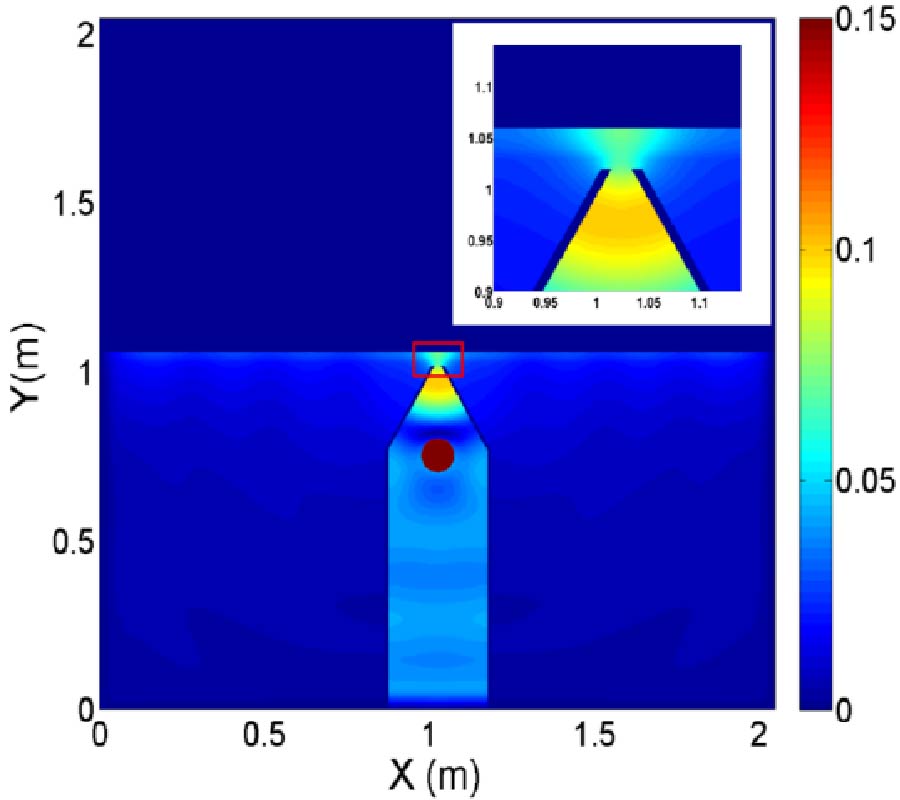
Communication `blackout' is a big challenge for modern space engineering. In the recent decade, the terahertz (THz) technology is believed to be an effective solution for the `blackout' problem. Many research works about the transmission of THz waves in plasma slabs have been carried out. According to those works, the radio attenuation of THz waves in plasma slabs strongly depends on thickness of the slab, electron density, electron collision frequency and temperature. However, few previous works have paid attention to realistic reentry plasma sheath. In the present paper, a hypersonic fluid model is introduced in order to investigate the structure of the realistic plasma sheath which covers a blunt coned vehicle. The scattering matrix method is employed to study the transmission of THz waves in realistic plasma sheath. According to the present study, the wave frequency, electron density and collision frequency are the most significant factors which determine the attenuation of the THz waves in the plasma sheath. Since the whole plasma sheath is inhomogeneous, to install the antenna at an appropriate position helps mitigate the `blackout'. For the blunt coned reentry vehicle, installing the antenna on the wall close to the bottom is helpful for mitigating the `blackout' problem.
STUDIES OF TERAHERTZ WAVE PROPAGATION IN REALISTIC REENTRY PLASMA SHEATH
2016-10-05
PIER C
Vol. 68, 45-55
High-Gain Planar Lens Antennas Based on Transformation Optics and Substrate-Integrated Waveguide (SIW) Technology
Iman Aghanejad , Habibollah Abiri and Alireza Yahaghi
Transformation of space coordinates is a tool to synthesize material properties in view of obtaining a controlled electromagnetic field pattern. Also, substrate-integrated waveguide (SIW) technology can well be exploited to develop microwave and millimeter-wave components. In this paper, by combining these features, high-gain SIW planar lens antennas are proposed. Using the embedded transformation-optics lenses, both narrow beamwidth of 12˚ and low sidelobe levels of -23 dB are achieved for the H-plane radiation patterns by a single antenna. The designed transformation-optics lenses can be realized by drilling spatially varying cylindrical holes in an ordinary dielectric substrate. The E-plane radiation patterns can also be improved through the dielectric slabs in front of the antenna aperture integrated in the same substrate. Therefore, using SIW technology, the lens antennas can be fabricated on a single substrate. An H-plane sectoral horn and a Maxwell-fisheye-based lens antenna are designed using the proposed method. Simulation results confirm the validity of the proposed idea and the advantages of these lens antennas.
HIGH-GAIN PLANAR LENS ANTENNAS BASED ON TRANSFORMATION OPTICS AND SUBSTRATE-INTEGRATED WAVEGUIDE (SIW) TECHNOLOGY
2016-10-05
PIER Letters
Vol. 63, 23-28
Wideband Double-Layered Dielectric-Loaded Dual-Polarized Magneto-Electric Dipole Antenna
Changqing Wang , Zhaoxian Zeng , Jianxing Li , Hongyu Shi and Anxue Zhang
This paper proposes a wideband dual-polarized magneto-electric dipole antenna composed of two pairs of vertical shorted patches and two pairs of horizontal double-layered planar dipoles. To achieve dual-polarization radiation, two orthogonal Γ-shaped stepped-impedance strip feed lines are designed to excite the antenna. The regions between the vertical shorted patches are loaded by dielectric materials to reduce the antenna profile. In addition, the antenna is backed with a rectangular cavity-shaped reflector to improve radiation pattern stability and diminish back radiation. Experimental results demonstrate that the proposed antenna has obtained a wide impedance bandwidth of 57.1% from 1.5 to 2.7 GHz and high port isolation of better than 30 dB within the bandwidth. The average antenna gain is about 9.7 dBi with a variation of below ±1.5 dB and the radiation patterns are unidirectional, symmetric with low back radiation, and low cross-polarization radiation across the entire operating band.
WIDEBAND DOUBLE-LAYERED DIELECTRIC-LOADED DUAL-POLARIZED MAGNETO-ELECTRIC DIPOLE ANTENNA
2016-10-05
PIER M
Vol. 50, 183-193
Analysis of the Static and Dynamic Behavior of a Non Hysteretic Superconductive Passive Magnetic Linear Bearing by Using an Electromagnetic Integral Formulation
Efren Diez-Jimenez , Antonino Musolino , Rocco Rizzo and Ernesto Tripodi
In this paper the analysis of the static and dynamic behavior of a non-hysteretic superconductive passive linear bearing is described. The high translational symmetry of the magnetic field seen by the superconductor assures a usable long stroke in the order of several tens of millimeters. The linear bearing in combination with an actuating system for only one degree of freedom can be used for accurate long-stroke precision positioning systems for cryogenic environments with zero hysteresis in the movement. The dynamics of the system is investigated using an integral formulation which transforms the solution of the field equations in the solution of an equivalent electric network. The knowledge of the currents in the equivalent network allows to evaluate all the electromagnetic quantities (fields, forces, eddy currents, ...) in the system. Finally, the coupling with the equation of the rigid body permits to simulate the electro/mechanical behavior of the system with six degree of freedom (6 DOF).
ANALYSIS OF THE STATIC AND DYNAMIC BEHAVIOR OF A NON HYSTERETIC SUPERCONDUCTIVE PASSIVE MAGNETIC LINEAR BEARING BY USING AN ELECTROMAGNETIC INTEGRAL FORMULATION
2016-10-05
PIER M
Vol. 50, 169-181
Multi-Beam Ring Antenna Arrays Synthesis by the Application of Adaptive Particle Swarm Optimization
Hichem Chaker , Mehadji Abri and Hadjira Abri Badaoui
This paper describes the original results obtained in the field of multi-beam annular ring antenna array pattern synthesis for the modes TM11 and TM12, by applying an iterative algorithm for phased arrays, which is able to produce low side-lobe levels patterns with multiple prescribed main lobes. The ring antenna analysis builds on the modified cavity model; this letter permits to take account of the fringing field effects by virtue of the dynamic permittivity. The proposed method is based on the adaptive particle swarm optimization algorithm. This solution is characterized by its simple implementation and a reduced computational time to achieve the desired radiation patterns. These advantages make the presented algorithm suitable for a wide range of communication systems. The original results obtained in the field of antenna array pattern synthesis are presented to illustrate the performance of the proposed method.
MULTI-BEAM RING ANTENNA ARRAYS SYNTHESIS BY THE APPLICATION OF ADAPTIVE PARTICLE SWARM OPTIMIZATION
2016-10-04
PIER C
Vol. 68, 31-44
Design of Single-Band to Hexa-Band Bandstop Filters
Ashwani Kumar , Anand Kumar Verma , Qingfeng Zhang , Parmod Kumar , Praduman Prasad Singh , Rajendar Prashad Rishishwar , Abhishek Singh , Ankita Bansal and Ritu
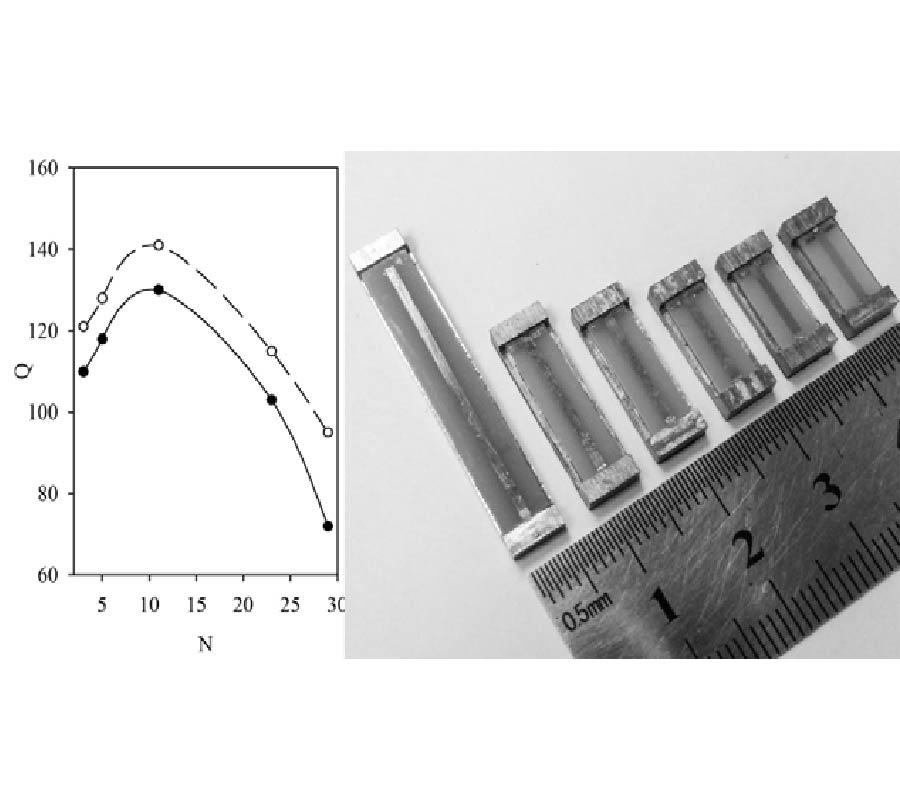
This paper presents a systematic design process to design Bandstop Filters from Single-Band (SB-BSF) to Hexa-Band (HB-BSF). The presented BSFs are useful to suppressing the unwanted signal frequencies from 1.98 GHz to 7.75 GHz. Single-Band BSF suppress the frequency 1.98 GHz; Dual-Band BSF suppress 2 GHz and 3.4 GHz (WiMax Band); Triple-Band BSF suppress 2.0 GHz, 3.4 GHz, and 4.75 GHz; Quad-Band BSF suppress 2.0 GHz, 3.4 GHz, 4.75 GHz, and 6.4 GHz; Penta-Band suppress 2.0 GHz, 3.4 GHz, 4.0 GHz, 4.85 GHz, and 6.75 GHz; however Hexa-Band suppress 2.0 GHz, 3.4 GHz, 4.2 GHz, 4.75 GHz, 6.5 GHz, and 7.75 GHz. The attenuation level for the suppressed frequencies varies from 19 dB to 62 dB, and the quality factor varies from 17 to 384.5. The simulated and measured results are presented to validate the design process. Such compact BSFs could be useful in modern communication systems to stop the potential interference of the unwanted signal frequencies in WLAN and UWB bands.
DESIGN OF SINGLE-BAND TO HEXA-BAND BANDSTOP FILTERS
2016-10-04
PIER C
Vol. 68, 21-30
A Novel Rectangle Tree Fractal UWB Antenna with Dual Band Notch Characteristics
Zhangfang Hu , Yinping Hu , Yuan Luo and Wei Xin
A novel rectangle tree fractal antenna (RTFA) for ultra-wideband(UWB) application with dual band notch characteristics is proposed. The radiating path is the tree fractal structure which is formed by the superposition of a number of rectangular patches, and multi-frequency resonance characteristics are obtained by only increasing the tree fractal iterations. UWB operation(3.1-10.6GHz) is achieved by using defected ground structure(DGS) on the ground plane to improve the impedance characteristics between adjacent resonant frequencies. The dual notch bands characteristics are realized by three U-slot on the tree fractal path and effectively suppress the interferences of WiMAX and WLAN. The measurement and simulation results have an acceptable agreement, and indicate that the antenna is suitable for UWB applications.
A NOVEL RECTANGLE TREE FRACTAL UWB ANTENNA WITH DUAL BAND NOTCH CHARACTERISTICS
2016-10-03
PIER C
Vol. 68, 11-19
Efficiency Enhancement of Wireless Power Transfer System Using MNZ Metamaterials
Tarakeswar Shaw , Aritra Roy and Debasis Mitra
In this paper, a simple approach for efficiency enhancement of a wireless power transfer system by using mu near zero (MNZ) type of metamaterial is proposed. A single slab containing one-sided periodic structures of 3×3 array of meander-line unit cell has been placed between transmitting and receiving coils in the wireless power transfer system. The presented metamaterial structure is less complex than other reported metamaterial structures in the area of wireless power transfer system. The simulation and measurement have been performed with and without metamaterial slab. Using metamaterial slab, the maximum efficiency has been obtained about 55.3%, i.e. an improvement of efficiency around 15.7% is obtained compared to a wireless power transfer system without metamaterials. Interestingly, the proposed wireless power transfer system shows a steady improvement of efficiency even if the distance between the transmitting and receiving coil is increased.
EFFICIENCY ENHANCEMENT OF WIRELESS POWER TRANSFER SYSTEM USING MNZ METAMATERIALS
2016-10-02
PIER C
Vol. 68, 1-10
On Instabilities in Time Marching Methods
Juan Becerra , Felix Vega and Farhad Rachidi
We discuss in this paper the stability of the time marching (TM) method. We identify one cause of instability in the method associated with the calculation of variables involved in the convolution operation. We provide a solution to this problem, preventing the appearance of unstable poles in the Z-domain. This solution is fundamentally different from other previously presented approaches in the sense that it is not based on filtering or predictive techniques. Instead, it consists of preprocessing the known variable in the convolution equations.
ON INSTABILITIES IN TIME MARCHING METHODS