Search Results(13797)

2015-03-16
PIER Letters
Vol. 52, 57-62
Rigorous Approach of the Constitutive Relations for Nonlinear Chiral Media
Zinelabiddine Mezache and Fatiha Benabdelaziz
A new mathematical approach is proposed to highlight the nonlinear effect in a chiral medium, which is due to the magnetization vector under the influence of a strong electric field. In a chiral media, one can notice the coupling between the electric and magnetic quantities, which appears in the constitutive relations of the medium. According to our proposed approach, we illustrate the existence of the difference between a nonlinear achiral medium and a nonlinear chiral medium, where not only the polarization vector has a nonlinear form but also the magnetization vector. Thus, the nonlinear chiral medium is described by the new constitutive relations DgE0μ0ξEHH and BH0μ0ξHEgE. Therefore, a better fundamental understanding of the interaction between the electromagnetic waves and chiral media can be contemplated.
RIGOROUS APPROACH OF THE CONSTITUTIVE RELATIONS FOR NONLINEAR CHIRAL MEDIA
2015-03-16
PIER Letters
Vol. 52, 51-56
High-Selectivity UWB Filters with Adjustable Transmission Zeros
Liang Wang , Zhao-Jun Zhu and Shang-Yang Li
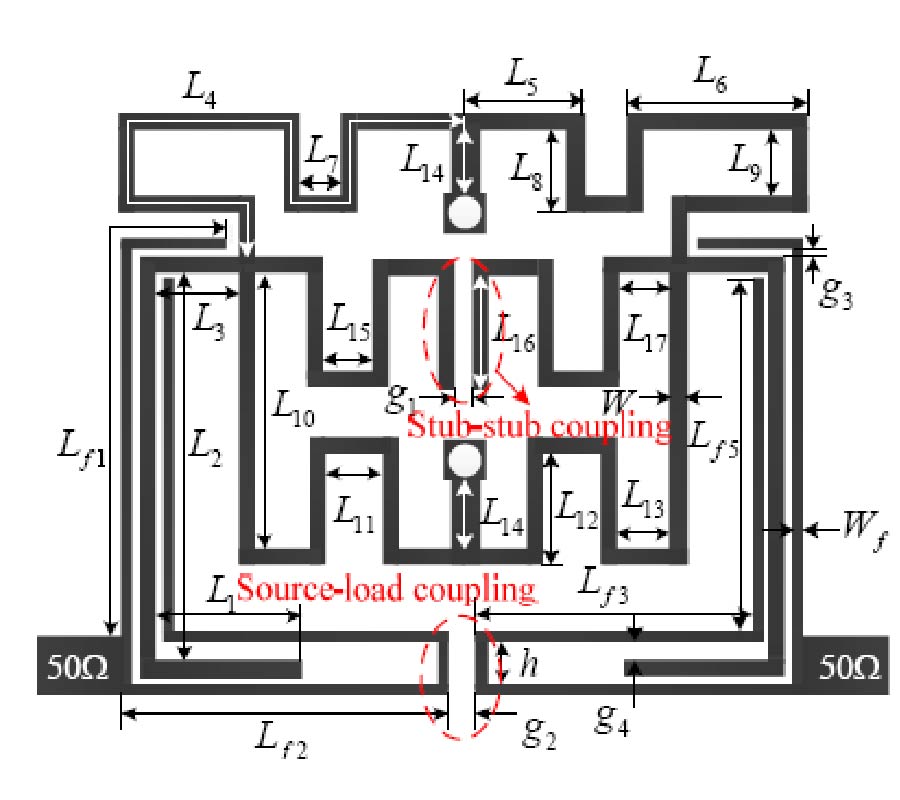
This letter proposes a novel ultra-wideband (UWB) bandpass filter with compact size and high-selectivity performance. The filter has been studied and implemented through multiple-mode resonator (MMR) using new coupling schemes such as capacitive source-load (S-L) coupling/inductive source-load (S-L) coupling. By properly adjusting the length and width of these stubs, its first four resonant modes can be allocated within the 3.1-10.6 GHz passband, whereas its fifth resonant mode is placed above 16.0 GHz. Two transmission zeros (an inherent transmission zero and an additional transmission zero) can be produced. Moreover, the position of the additional zero can be controlled by adjusting the direct coupling inductance/capacitance. Simulated and measured results are in good agreement indicating that the proposed BPF has a passband (3.0-11.0 GHz)/(2.92-10.6 GHz) and a wide stopband width with 23 dB/25 dB attenuation up to 27.0 GHz. The group delay of the filter is relatively constant and less than 0.65 ns/0.52 ns over the operating pass band.
HIGH-SELECTIVITY UWB FILTERS WITH ADJUSTABLE TRANSMISSION ZEROS
2015-03-14
PIER B
Vol. 62, 181-193
On the Near-Field Sampling and Truncation Errors in Planar Time-Domain Near-Field to Far-Field Transformation
Mohammed Serhir
This paper studies the effect of three important parameters in planar time-domain (TD) near-field (NF) to far-field (FF) transformation. These parameters are the NF spatial sampling, NF measurement distance and scan surface truncation. The effect of these parameters over the TD FF accuracy are difficult to predict for Ultra Wide Band antennas. In this paper we aim to choose the optimum NF measurement parameters guaranteeing accurate calculation of the time-domain far-field. This allows the optimization of the computation time and memory requirements. Computations using analytic array of elementary dipoles radiation pattern are used to study the impact of each parameter in time-domain near-field antenna measurement. The comparison of the far-field results are presented in time and frequency domains. In particular, it is shown that the choice of the measurement distance and the size of the scan surface decide predominantly on the frequency band of accurate FF calculation. The used formalism in this paper for the NF to FF transformation is based on the Green's function.
ON THE NEAR-FIELD SAMPLING AND TRUNCATION ERRORS IN PLANAR TIME-DOMAIN NEAR-FIELD TO FAR-FIELD TRANSFORMATION
2015-03-14
PIER B
Vol. 62, 167-180
Split-Ring Resonator Arrays for Electromagnetic Energy Harvesting
Thamer Almoneef and Omar M. Ramahi
By virtue of their ability to resonate at a wavelength much larger than the maximum dimension, Split-Ring Resonator (SRR) cells can be densely stacked to create energy harvesting arrays having per-unit-area power efficiency higher than a single SRR cell. While the concept of using metamaterial particles for electromagnetic energy harvesting had been demonstrated in our earlier work, the overall efficiency of an SRR array in comparison to classical antenna arrays is fundamental to the viability of this technology. In this work, we focus on a comparative study based on numerical full-wave simulations where an array of SRRs is compared to an array of microstrip antennas. We show that an SRR array can provide significant enhancement in power efficiency and bandwidth in comparison to the classical microstrip patch antenna. Experimental validation is provided showing SRR arrays can provide significant energy-absorption enhancement.
SPLIT-RING RESONATOR ARRAYS FOR ELECTROMAGNETIC ENERGY HARVESTING
2015-03-14
PIER Letters
Vol. 52, 45-50
Crosstalk Cancellation Method Based on Unitary Transformation of Coupled Transmission Lines-Channel Transmission Matrix
Yafei Wang and Xuehua Li
Crosstalk is one of the bottlenecks for high-speed circuits to increase its rate and density. In order to make tradeoff between complexity and effect of the crosstalk cancellation circuit, a crosstalk cancellation method based on unitary transformation is proposed. In the method, two unitary matrixes are obtained by Singular Value Decomposition (SVD) of coupled transmission lines-channel transmission matrix (CTL-CTM), and then according to the form of the unitary matrixes, the crosstalk canceling circuits are built at both ends of the transmission line, which could transform the CTMes into unit ones and crosstalk would be cancelled out. Circuit simulation results show that at the signaling rate of 5 Gbit/s, jitter performance of eye diagram improves 85% and vertical performance improves 67.5%, which means the method achieves better crosstalk canceling effect with lower circuit cost.
CROSSTALK CANCELLATION METHOD BASED ON UNITARY TRANSFORMATION OF COUPLED TRANSMISSION LINES-CHANNEL TRANSMISSION MATRIX
2015-03-13
PIER B
Vol. 62, 153-165
Modern Antenna Design Using Mode Analysis Techniques
George Shaker , Safieddin Safavi-Naeini and Nagula Sangary
In this paper, the modal theory of antennas is re-visited, believing that it brings invaluable information towards facilitating the design of multi-feed multi-band antennas. First, some subtle changes are proposed to enhance the applicability of thetheory. Next, using some efficient computational techniques, the proposed formulations are shown to predict, to a very high accuracy, the input impedance of any antenna under study. This greatly simplifies the antenna problem and focuses design efforts on finding the appropriate complex resonance frequency to cover a required band. Finding the appropriate feed location is then a matter of extracting the corresponding impedance map for this antenna through simple field manipulations.
MODERN ANTENNA DESIGN USING MODE ANALYSIS TECHNIQUES
2015-03-11
PIER Letters
Vol. 52, 37-43
Flexible VHF/UHF Vivaldi Antenna for Broadband Applications
Anthony Presse , Jean-Marie Floc'h and Anne-Claude Tarot
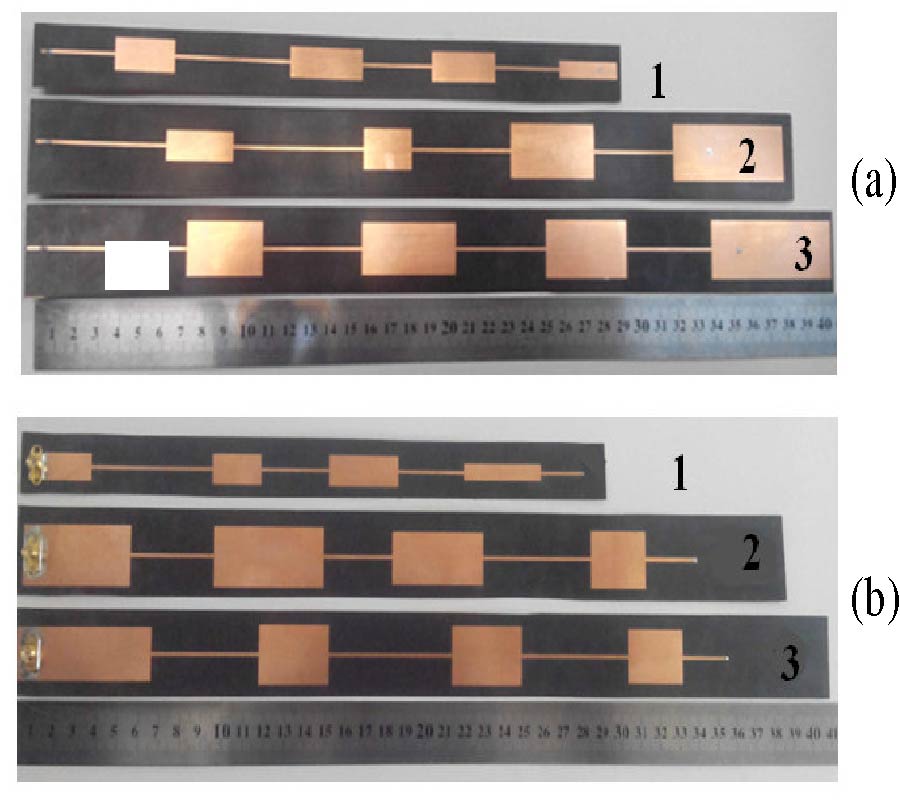
A flexible VHF/UHF Vivaldi antenna is proposed. The antenna is realized on 600 × 600 mm2 silicone substrate with a thickness of 1.5 mm. The silicone substrate is used due to its low cost, its robustness and its flexibility. The antenna has a 6-dB impedance bandwidth from 150 MHz to 10 GHz. The measurements have shown that the bending slightly affect the impedance and the radiation patterns of the antenna. This last one is used for military applications to receive and find the source of VHF/UHF micro-wave emissions.
FLEXIBLE VHF/UHF VIVALDI ANTENNA FOR BROADBAND APPLICATIONS
2015-03-11
PIER
Vol. 151, 9-16
Realization of a Conductive Bridging RF Switch Integrated onto Printed Circuit Board
Etienne Perret , Thais Luana Vidal , Arnaud Vena and Patrice Gonon
This paper presents a new approach for the realization of RF switches based on the Conductive Bridging Random Access Memory technology (CBRAM). This promising approach allows the realization of RF switches in an extremely simple manner at low cost. For the first time, an RF switch based on a MIM structure is realized with an insulator layer obtained from a commonly used resin deposited by spin coating. The paper reports a RF switch based on CBRAM and demonstrates a device integration onto plastic circuit board (PCB). The realized switch is validated by experimental measurements for a frequency range up to 1.5 GHz with an activation voltage less than 1 V.
REALIZATION OF A CONDUCTIVE BRIDGING RF SWITCH INTEGRATED ONTO PRINTED CIRCUIT BOARD
2015-03-10
PIER M
Vol. 41, 159-166
The Second Order Finite Element Analysis of Eddy Currents Based on the T-Ω Method
Bo He , Ping Zhou , Dingsheng Lin and Chuan Lu
Based on a proposed inexact Hodge decomposition, this paper describes a viable scheme using the second order finite elements in the T-Ω method considering multiply-connected regions for the eddy current problems. Several numerical examples have been presented to demonstrate the effectiveness of this scheme.
THE SECOND ORDER FINITE ELEMENT ANALYSIS OF EDDY CURRENTS BASED ON THE T-Ω METHOD
2015-03-08
PIER C
Vol. 56, 137-144
Frequency Selective Surface with Improvised Ring-Resonator for Flexible Design
Gargi Saha , Chandrakanta Kumar and Venkataraman Veragur Srinivasan
Ring resonators are very commonly used for the design of frequency selective surfaces (FSSs). But, for some particular design, the spacing between the resonators becomes very small. So it leaves no space to shift the reflection band towards the lower side of the spectrum. It also becomes very difficult to realize large PCBs. In this paper, an improvised design of the ring resonator using stubs is reported. This provides the designer with some flexibility. Two different configurations using this concept have been fabricated. Measured results are compared with the configuration using conventional ring resonators. These results indicate good performance with tune-ability in the response without major change in the design or in the substrate.
FREQUENCY SELECTIVE SURFACE WITH IMPROVISED RING-RESONATOR FOR FLEXIBLE DESIGN
2015-03-08
PIER M
Vol. 41, 149-158
A Semi-Analytical Method to Calculate the Entries of the Method of Moments Matrix for the Mixed Potential Integral Equation of a Source Reconstruction Problem
Saffet Sen
In this article, the mixed potential integral equation is discretized using the Rao-Wilton-Glisson basis functions in order to obtain a method of moments matrix equation for a source reconstruction problem. The weighting functions used in the setup of the moments equation are Dirac delta functions. The entries of the moments matrix are computed using a semi-analytical method which is applicable to any method of moments problem with point matching. The analytical calculation is made possible by employing a differentiation property of the scalar Green function and the properties of the mesh elements of the source plane. The semi-analytical method makes it easier to increase the accuracy of the moments matrix elements. The accuracy of the method is shown by comparing the results obtained using the semi-analytical method to those obtained by a fully numerical procedure.
A SEMI-ANALYTICAL METHOD TO CALCULATE THE ENTRIES OF THE METHOD OF MOMENTS MATRIX FOR THE MIXED POTENTIAL INTEGRAL EQUATION OF A SOURCE RECONSTRUCTION PROBLEM
2015-03-08
PIER
Vol. 151, 1-8
New Efficient Implicit Time Integration Method for DGTD Applied to Sequential Multidomain and Multiscale Problems
Luis E. Tobon , Qiang Ren , Qingtao Sun , Jiefu Chen and Qing Huo Liu
The discontinuous Galerkin's (DG) method is an efficient technique for packaging problems. It divides an original computational region into several subdomains, i.e., splits a large linear system into several smaller and balanced matrices. Once the spatial discretization is solved, an optimal time integration method is necessary. For explicit time stepping schemes, the smallest edge length in the entire discretized domain determines the maximal time step interval allowed by the stability criterion, thus they require a large number of time steps for packaging problems. Implicit time stepping schemes are unconditionally stable, thus domains with small structures can use a large time step interval. However, this approach requires inversion of matrices which are generally not positive definite as in explicit shemes for the first-order Maxwell's equations and thus becomes costly to solve for large problems. This work presents an algorithm that exploits the sequential way in which the subdomains are usually placed for layered structures in packaging problems. Specifically, a reordering of interface and volume unknowns combined with a block LDU (Lower-Diagonal-Upper) decomposition allows improvements in terms of memory cost and time of execution, with respect to previous DGTD implementations.
NEW EFFICIENT IMPLICIT TIME INTEGRATION METHOD FOR DGTD APPLIED TO SEQUENTIAL MULTIDOMAIN AND MULTISCALE PROBLEMS
2015-03-07
PIER M
Vol. 41, 139-147
Harmonic Transponders: Performance and Challenges
Kimmo Rasilainen , Janne Ilvonen , Anu Lehtovuori , Jari-Matti Hannula and Ville Viikari
Performance of a harmonic transponder strongly depends on the properties of the antenna and diode used, which makes finding a good combination of them very important. For a transponder with a fixed antenna geometry, the effect of different diodes is analyzed through electromagnetic simulations and theoretical calculations. The antenna used in the transponder is directly matched to the impedance properties of a particular diode. Effects of both detector and varactor diodes on the return loss characteristics of the antenna and the obtainable transponder response are observed. Criteria for selecting a suitable diode are given. Benefits and drawbacks of using different antenna matching techniques are discussed, and principal design steps are given both for transponders matched directly to the antenna and for transponders with external matching circuits.
HARMONIC TRANSPONDERS: PERFORMANCE AND CHALLENGES
2015-03-05
PIER Letters
Vol. 52, 31-36
Wideband Circular Polarization Cavitay-Backed Slot Antenna for GNSS Applications
Chunhong Chen , Xinpeng Zhang , Shishan Qi and Wen Wu
This paper presents a wideband circular polarization antenna for Global Navigation Satellite System (GNSS). By exciting four slots etched along each edge of a square ground with equal amplitude and 90° phase difference, good circular polarization performance is achieved. A novel radiation element, composed of back-side slot and front-side monopole, is proposed to realize a wideband radiation. Meanwhile, the feed network composed of Schiffman phase shifters and Wilkinson power dividers maintains this wideband performance. A backed cavity is used to suppress the backward radiation, therefore enhances the frontward gain. Measured results of the fabricated antenna show good agreement with the simulated ones. The main advantages of this antenna include its wide bandwidth, good circular polarization, high front to back ratio, low cost, and easy fabrication, which make it very attractive for GNSS terrestrial applications.
WIDEBAND CIRCULAR POLARIZATION CAVITAY-BACKED SLOT ANTENNA FOR GNSS APPLICATIONS
2015-03-05
PIER Letters
Vol. 52, 23-30
A Dual-Frequency Matching Network for FDCLs Using Dual-Band λ/4-Lines
Mohammad A. Maktoomi , Mohammad S. Hashmi and Vipul Panwar
A new approach to design a dual-band matching network using a dual-band quarter-wave line is presented. The proposed matching network is capable of simultaneously matching frequency-dependent complex loads (FDCLs) having different values at two arbitrary frequencies to a real source impedance, Z0. A very simple step-wise design procedure is discussed for the transformer along with closed-form design equations which are very simple in nature. For experimental verification, two PCB prototypes have been fabricated using FR-4 material, operating at 1 GHz and 2.42 GHz. The measurements results matches well with that obtained from simulation, exhibiting good performance.
A DUAL-FREQUENCY MATCHING NETWORK FOR FDCLS USING DUAL-BAND λ/4-LINES
2015-03-05
PIER Letters
Vol. 52, 17-21
Resonator Type for the Creation of a Potentially Reconfigurable Filtering Band in a UWB Antenna
Sajjad Abazari Aghdam and Jonathan S. Bagby
In this letter, a novel frequency-reconfigurable monopole antenna with several switchable states including an ultra wideband (UWB) state, filtering narrowband states, and a tunable filtering band state is presented. The antenna, which supports most applicable overlook narrowband frequencies between the 2-6 GHz, can be used in multiradio wireless systems. Moreover, the proposed antenna, which can avoid UWB interference and has narrowband functionality, has good potential for use in cognitive radio.
RESONATOR TYPE FOR THE CREATION OF A POTENTIALLY RECONFIGURABLE FILTERING BAND IN A UWB ANTENNA
2015-03-04
PIER Letters
Vol. 52, 11-16
Dual Frequency Selective Transparent Front Doors for Microwave Oven with Different Opening Areas
Jaganathan Thirumal Murugan , T R Suresh Kumar , Peedikakkandy Salil and Chakrapani Venkatesh
Microwave oven generates a harmful electromagnetic wave at 2.45 GHz of 1000 Watts. The generated microwave is confined within the cavity of the oven for efficient heating and secured operation. To prevent microwave leakage through the front glass door, a special construction of Faraday Cage is involved. In this paper, Faraday Cage is replaced with Transparent Frequency Selective Surface Front Door, which provides better visibility and avoids microwave energy to escape from the oven. Two works are proposed in this paper. The first one is band pass response which has been achieved for 10 GHz by printing array of Greek cross aperture (FSS) on the front glass door, and the second work is band stop response which has been achieved for 2.4 GHz frequency by printing the array of circular ring patch (FSS) on the front glass door. Design of two different FSS arrays and the simulation results were discussed.
DUAL FREQUENCY SELECTIVE TRANSPARENT FRONT DOORS FOR MICROWAVE OVEN WITH DIFFERENT OPENING AREAS
2015-03-04
PIER Letters
Vol. 52, 1-9
An Open-Sleeve Folded U-Shaped Multiband Antenna
Elodie Georget , Redha Abdeddaim , Franck Garde and Pierre Sabouroux
In this paper, a multiband flexible antenna is presented. This antenna was realized on a flexible substrate in order to realize a deployable system for a distress beacon. We used the concept of open-sleeve antenna to change a quadrupole mode into a dipole mode. The main radiating element of the antenna is a dual-band folded U-shaped antenna. The operating frequencies of this antenna are studied depending on the length of the parasitic elements. In order to understand the matching and the radiation patterns in far field of both antennas (U-shaped and open-sleeve), their magnetic behaviors in near field are studied in simulation and in measurement. The simulated and measured radiation patterns are also presented to check the study in near field.
AN OPEN-SLEEVE FOLDED U-SHAPED MULTIBAND ANTENNA
2015-03-04
PIER Letters
Vol. 51, 127-133
Novel Tri-Band Bandpass Filter with High Selectivity
Liangzu Cao and Lixia Yin
This paper presents a tri-band bandpass filter (BPF) consisting of a wide BPF and two narrow bandstop filters (BSFs). BPF is a ninth-order interdigital structure, and BSFs are designed fifth-order series resonators with quarter wavelength transmission line connected. The selectivity of BPF and the bandwidth of BSF are analyzed using simulation software. A tri-band BPF, made of metal cavities, is designed and measured. Three passbands are located in 1.332~1.401 GHz, 1.443~1.458 GHz, 1.506~1.660 GHz, and insertion losses in passbands are less than 2.1 dB. Ratios of Δf40 dBf3 dB are 1.9, 2.67 and 1.33, respectively, and isolation between passbands is more than 75 dB. The good agreement between the simulated and measured results validated the proposed structure.
NOVEL TRI-BAND BANDPASS FILTER WITH HIGH SELECTIVITY
2015-03-04
PIER
Vol. 150, 197-203
An Omnidirectional Triple-Band Circular Patch Antenna Based on Open Elliptical-Ring Slots and the Shorting Vias
Wen-Feng Chen , Dan Yu and Shu-Xi Gong
A circular patch antenna based on open elliptical-ring slots and shorting vias with conical radiation patterns is proposed. Fed by the coaxial probe at the center of the circular patch, the proposed antenna is excited at three resonant modes simultaneously. The first resonant mode (monopolar patch mode) is achieved by six shorting vias, each of which is placed at the center of the open elliptical-ring slot. By embedding six open elliptical-ring slots on the patch, the other two resonant modes of the open elliptical-ring slot resonator, TE110 and TE210, can also be excited. Due to symmetrical slots on the patch, these two modes can produce conical patterns, and their frequency ratio can also be tuned by adjusting the size of the slots. The proposed antenna is fabricated and measured. The measured results show that the proposed antenna can provide three operating bands which meet the required bandwidth specifications of 2.4/5.8 GHz WLAN and 3.5/5.5 GHz WiMAX standards. Detailed design considerations of the proposed antenna are described, and both the simulated and measured results are given. Moreover, the effects of the vital parameters on the performance of the proposed antenna are analyzed in this paper.
AN OMNIDIRECTIONAL TRIPLE-BAND CIRCULAR PATCH ANTENNA BASED ON OPEN ELLIPTICAL-RING SLOTS AND THE SHORTING VIAS