Search Results(13797)

2014-08-20
PIER
Vol. 148, 223-231
Investigation of Wireless Power Transfer Using Planarized, Capacitor-Loaded Coupled Loops
Chenchen Jimmy Li and Hao Ling
A capacitor-loaded coupled loop structure is investigated for wireless power transfer at 6.78 MHz for a target transmission distance of 1 m. It is shown that the optimal configuration for this structure occurs when the coupled loops are coplanar. Therefore, by converting thick wires into wide strips, a planarized configuration can be achieved. Simulation results are verified in measurement, which shows a 60% overall power transfer efficiency at 1 m. The contribution of different loss mechanisms is examined. Next, power transfer efficiency in the presence of dielectric materials is investigated in simulation and measurement. Additionally, tuning capabilities that arise from the implementation of variable capacitors are shown. Finally, design space exploration is performed to examine design tradeoffs.
INVESTIGATION OF WIRELESS POWER TRANSFER USING PLANARIZED, CAPACITOR-LOADED COUPLED LOOPS
2014-08-20
PIER
Vol. 148, 209-221
A Differential DPSM Based Modeling Applied to Eddy Current Imaging Problems
Thierry Bore , Pierre-Yves Joubert and Dominique Placko
This paper deals with an innovative implementation of a semi-analytical modeling method, called the Distributed Points Source Method (DPSM), in the case of an eddy current problem. The DPSM has already shown great potentialities for the versatile and computationally efficient modeling of complex electrostatic, electromagnetic or ultrasonic problems. In this paper, we report a new implementation of the DPSM, called differential DPSM, which shows interesting prospects for the modeling of complex eddy current problems such as met in the non-destructive imaging of metallic parts. In this paper, the used eddy current imaging device is firstly presented. It is composed of an eddy current (EC) inducer and a magneto optical set-up used to translate the magnetic field distribution appearing at the surface of the imaged part, into a recordable optical image. In this study, the device is implemented for the time-harmonics (900 Hz) imaging of a two-layer aluminum based assembly, featuring surface-breaking and buried defects. Then, the basics of the time-harmonics DPSM modeling are recalled, and the differential approach is presented. It is implemented for the modeling of the interactions of the eddy current imaging device with the considered flawed assembly in the same operating conditions as the experimental implementation. The comparison between experimental and computed data obtained for millimetric surface and buried defects is presented in the form of complex magnetic cartographies and Lissajous plots. The obtained results show good agreement and open the way to the modeling of complex EC problems. Furthermore, the low computational complexity of the differential DPSM modelings makes it promising to consider for the solving of EC inverse problems.
A DIFFERENTIAL DPSM BASED MODELING APPLIED TO EDDY CURRENT IMAGING PROBLEMS
2014-08-19
PIER
Vol. 148, 193-207
Human Body as Antenna and Its Effect on Human Body Communications
Behailu Kibret , Assefa K. Teshome and Daniel Lai
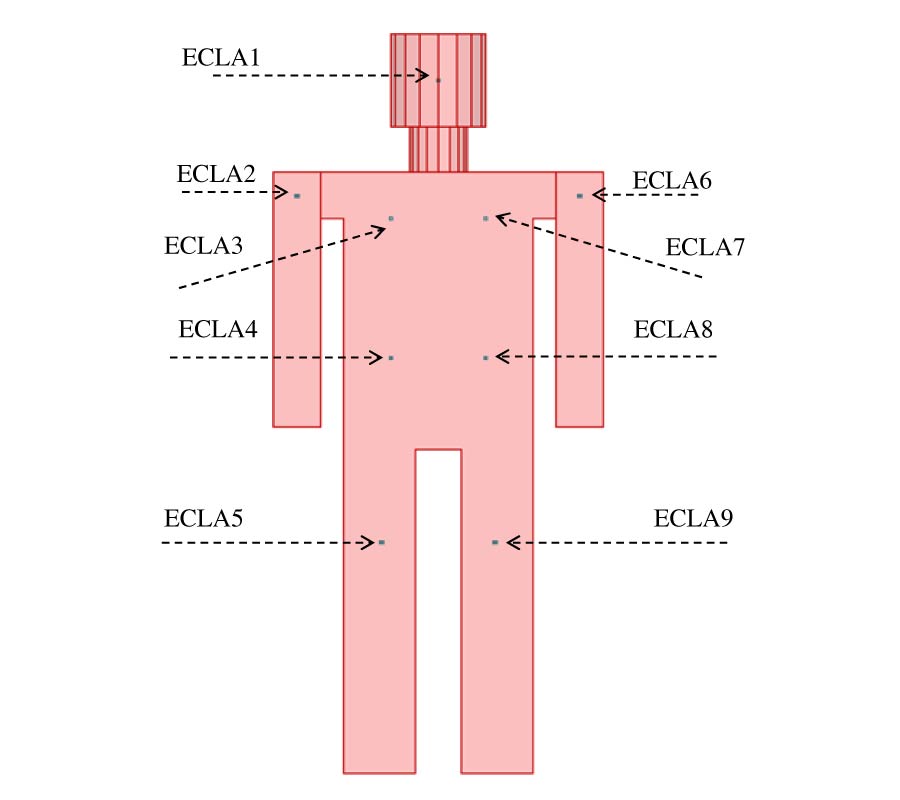
Human body communication (HBC) is a promising wireless technology that uses the human body as part of the communication channel. HBC operates in the near-field of the high frequency (HF) band and in the lower frequencies of the very high frequency (VHF) band, where the electromagnetic field has the tendency to be confined inside the human body. Electromagnetic interference poses a serious reliability issue in HBC; consequently, it has been given increasing attention in regard to adapting techniques to curtail its degrading effect. Nevertheless, there is a gap in knowledge on the mechanism of HBC interference that is prompted when the human body is exposed to electromagnetic fields as well as the effect of the human body as an antenna on HBC. This paper narrows the gap by introducing the mechanisms of HBC interference caused by electromagnetic field exposure of human body. We derived analytic expressions for induced total axial current in the body and associated fields in the vicinity of the body when an imperfectly conducting cylindrical antenna model of the human body is illuminated by a vertically polarized plane wave within the 1-200 MHz frequency range. Also, fields in the vicinity of the human body model from an on-body HBC transmitter are calculated. Furthermore, conducted electromagnetic interference on externally embedded HBC receivers is also addressed. The results show that the maximum HBC gain near 50 MHz is due to whole-body resonance, and the maximum at 80 MHz is due to the resonance of the arm. Similarly, the results also suggest that the magnitude of induced axial current in the body due to electromagnetic field exposure of human body is higher near 50 MHz.
HUMAN BODY AS ANTENNA AND ITS EFFECT ON HUMAN BODY COMMUNICATIONS
2014-08-18
PIER C
Vol. 53, 19-26
Design and Implementation of a 3 X 3 Orthogonal Beam-Forming Network for Pattern-Diversity Applications
Guanxi Zhang , Bao-Hua Sun , Li Sun , Jian-Ping Zhao , Yang Geng and Ruina Lian
An orthogonal beam-forming network (BFN) is proposed for 4G pattern-diversity applications. Different from the traditional Butler beam-forming networks with 2N orthogonal beams, the orthogonal BFN, composed of three 180° hybrids and a 90° phase shifter, provides three orthogonal beams. Design procedure of the orthogonal BFN based on the factorization of its transmission matrix is derived. Moreover, in order to implement the proposed orthogonal BFN with low insertion loss, a rat-race has been used to realize unequal power distribution between its two output ports. The measured scattering parameters of the orthogonal BFN are compared with the analytical and the simulated scattering parameters, validating the expected behavior. In addition, by varying the output power ratio of the non-equi-amplitude 180° hybrid, the performance of the orthogonal BFN is improved when the proposed orthogonal BFN is used in an antenna array.
DESIGN AND IMPLEMENTATION OF A 3 X 3 ORTHOGONAL BEAM-FORMING NETWORK FOR PATTERN-DIVERSITY APPLICATIONS
2014-08-18
PIER C
Vol. 53, 11-18
A Compact Dual Sharp Band-Notched UWB Antenna with Open-Ended Slots
Jiabin Xu , Dacheng Dong , Shaojian Chen , Zhouying Liao and Gui Liu
A compact microstrip-fed antenna with dual band-notched characteristics for ultrawideband (UWB) applications is presented. By introducing two open-ended inverted L-shaped slots, two sharp notches are achieved at frequencies of 3.16-3.70 GHz and 5.10-5.95 GHz for VSWR < 2. A rectangular slot in the ground plane can improve the impedance bandwidth of the proposed antenna. The prototype occupies a compact area of 22 × 26 mm2. The measurement results indicate that the proposed antenna can reject the interference with coexisting worldwide interoperability for microwave access (WiMAX) and wireless local area network (WLAN) systems. The proposed antenna shows relatively omnidirectional radiation patterns in the pass band.
A COMPACT DUAL SHARP BAND-NOTCHED UWB ANTENNA WITH OPEN-ENDED SLOTS
2014-08-18
PIER C
Vol. 53, 1-10
Ultra-Wideband (UWB) Differential-Fed Antenna with Improved Radiation Patterns
Jun Hui Wang and Ying-Zeng Yin
This study proposes a differential-fed microstrip antenna, which is characterized with an ultra-wideband of 120% (3-12 GHz), improved radiation patterns, stable gains, and compact size. Two symmetrical trapezoid shaped slots and four triangle-cut corners on the ground are used to improve the impedance matching over the UWB frequency band. To clarify the improved radiation characteristics, the simulated radiation patterns of the proposed antenna are compared with the conventional single-ended feed UWB antennas. The measured results show that, in the entire frequency band, the designed antenna exhibits a stable radiation patterns and the gain variation is less than 2 dB. Furthermore, the polarization purity are increased compared with the conventional ones, especially in the high frequency band.
ULTRA-WIDEBAND (UWB) DIFFERENTIAL-FED ANTENNA WITH IMPROVED RADIATION PATTERNS
2014-08-17
PIER M
Vol. 38, 53-61
A Novel of Surface Reflection Method Using Radio-Wave for Soil Density Estimation
Mardeni Roslee , Intan Suraya Shahdan and Khazaimatol Shima Subari
Soil density is one of the important parameters to be investigated in civil, geological and agricultural works. Unfortunately, the challenging issue is found on the suitable model in determining accurately the soil density. In this article, a new soil density model based on radio-wave surface reflection method is presented. The development of the model is based on result analysis collected from the experiment. Then, comparisons with related theoretical models, Hallikainen and Topp, are performed. The experiment is performed by using a vector network analyzer (VNA) that generates radar signal and recording return loss (S11) from a horn antenna. In the analysis, two new proposed soil density models have shown good agreement for soil density from 1.1 g/cm3 to 1.7 g/cm3 for sand and silty sand samples. This is verified when the model able to predict real samples as the one used in the experiment and result shows a very small relative error within 0.05% and 6.87%. Additionally, spectrograms in real time were produced in this study in order to observe more on the soil density. By using the proposed developed models, soil density estimation can be easily determined with minimal data input such as soil type, return loss and reflection coefficient by using regular radio-wave devices.
A NOVEL OF SURFACE REFLECTION METHOD USING RADIO-WAVE FOR SOIL DENSITY ESTIMATION
2014-08-16
PIER B
Vol. 60, 259-274
Effects of Resonance-Based Phase Shifters on Ka-Band Phased Array Antenna Performance for Satellite Communications
Mehrbod Mohajer , Mohammadsadegh Faraji-Dana and Safieddin Safavi-Naeini
Phase shifters are the key components of phased array systems which provide a low-profile solution for Ka-band satellite communications. In the transmitting mode, it is crucial for the phased array antenna system to meet the standard radiation masks, and any imperfections of phase shifters can yield into radiation mask violation. In this paper, we present the analytical approach to model the non-linear phase-frequency characteristics of Resonance-Based phase shifters, which constitute one of the most widely used class of phase shifters for Ka-band satellite communications. Furthermore, it has been investigated how the phase-frequency response non-linearity affects the phased array radiation patterns, gain, and the beam pointing direction. The simulation results show that, depending on the phase shifter phase-frequency response profile, the radiation mask satisfaction is an important factor in determining the system bandwidth.
EFFECTS OF RESONANCE-BASED PHASE SHIFTERS ON KA-BAND PHASED ARRAY ANTENNA PERFORMANCE FOR SATELLITE COMMUNICATIONS
2014-08-16
PIER C
Vol. 52, 173-181
Sinrd Circuits Analysis with WCIP
Ahmad Ismail Alhzzoury , Nathalie Raveu , Olivier Pigaglio and Henri Baudrand
This article presents the Wave Concept Iterative Procedure, an efficient method for characterization of substrate integrated Non-Radiative Dielectric passive circuits based on wave concept formulation and its iterative solution. WCIP simulations are compared to measurements and Finite Element Method simulations. A good agreement is achieved with computation time saving.
SINRD CIRCUITS ANALYSIS WITH WCIP
2014-08-16
PIER M
Vol. 38, 45-52
Simulations and Effects of Natural Environments on Low Frequency Antennas with Three-Dimensional FDTD Method
Julien Vincent , Pierre Borderies , Jean-René Poirier and Vincent Gobin
Three-dimensional Finite-Difference in Time-Domain method is applied to simulate Low Frequency antennas in the presence of natural environments. All antennas are made up of wires set down on a square shaped ground plane and their dimensions depend on the wavelength of the source. Both monopole and inverted L antennas are considered in this paper. The antenna systems are computed in the presence of two examples of natural elements: a large forest and then on the top of a hill. The main aim of this paper is to show the effects of these environments on the properties of the antennas and on the efficiency of the ground wave excitation. The outcome of these investigations shows a power ratio enhancement of several decibels when the two kinds of antenna described in this paper are located on the top of a hill. On the other hand, the effects of a large forest depend on the geometry of the antenna. It doesn't affect the radiation of a quarter-wave monopole antenna, on the contrary losses disrupt radiation when an inverted L antenna is built in the middle of a large forest.
SIMULATIONS AND EFFECTS OF NATURAL ENVIRONMENTS ON LOW FREQUENCY ANTENNAS WITH THREE-DIMENSIONAL FDTD METHOD
2014-08-15
PIER Letters
Vol. 48, 51-57
Dual-Band Dual-Sense Circularly Polarized Slot Antenna with an Open-Slot and a Vertical Stub
Bo Chen and Fu-Shun Zhang
A new dual-band dual-sense circularly polarized (CP) slot antenna is designed in this paper. The proposed antenna is composed of a rectangle patch and a modified ground plane. By opening a U-shaped open-slot and loading a vertical stub to the ground plane, a dual-sense CP performance is achieved for two frequency bands. A bevel is cut on the patch to improve the impedance matching. The antenna is fabricated on a low-cost FR4 substrate and fed by a coplanar waveguide (CPW) structure. The antenna has been investigated numerically, and a prototype was experimentally measured. Experimental results show that the measured 10-dB return loss impedance bandwidths are 18.3% (2.72-3.27 GHz) for the lower band and 23.7% (4.65-5.90 GHz) for the upper band, and the measured 3-dB axial ratio (AR) bandwidths for the lower and upper bands can be up to 28.4% (2.48-3.30 GHz) and 26.3% (4.63-6.03 GHz), respectively.
DUAL-BAND DUAL-SENSE CIRCULARLY POLARIZED SLOT ANTENNA WITH AN OPEN-SLOT AND A VERTICAL STUB
2014-08-15
PIER Letters
Vol. 48, 45-49
Design of a Wideband Differential Phase Shifter with the Application of Genetic Algorithm
Jianxiao Wang , Lin Yang , Yue Liu , Yi Wang and Shu-Xi Gong
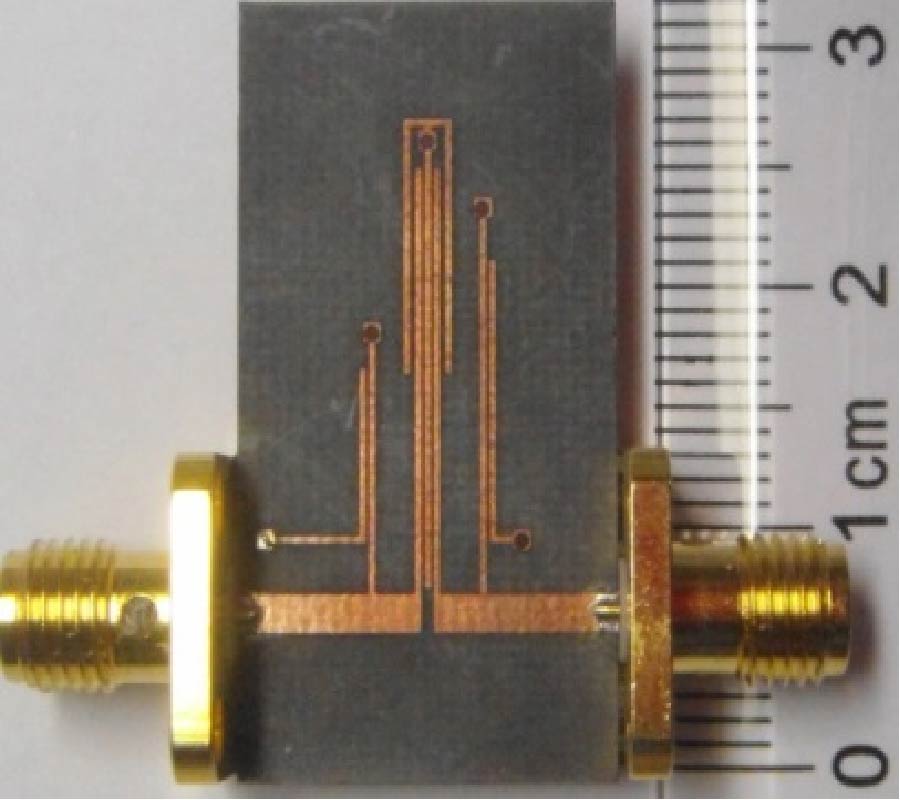
In this paper, a wideband differential phase shifter has been analyzed and designed using Genetic Algorithm (GA). The differential phase shifter consists of two fixed main lines of length λ/2, and parallel open and short stubs of length λ/8, which are shunted at the edge points of the main lines, respectively. With the application of GA, an impedance match and minimum phase deviation for the desired phase shift over a wide frequency band are obtained. In order to verify the optimum results, simulation experiments are made and a 45° phase shifter is fabricated and measured. The phase shifter exhibits an impedance bandwidth (|S11|<-10 dB) and a consistent 45° (±2°) phase difference bandwidth around 66%.
DESIGN OF A WIDEBAND DIFFERENTIAL PHASE SHIFTER WITH THE APPLICATION OF GENETIC ALGORITHM
2014-08-15
PIER
Vol. 148, 183-191
Microwave Resonators for Weak Light Detection at Telecom Wavelength
Pin-Jia Zhou , Yiwen Wang , Qiang Wei and Lian-Fu Wei
We report the experimental measurements of weak light signal at 1550 nm wavelength with a high-quality factor microwave coplanar waveguide (CPW) resonators. The quality factor of this niobium λ/4 CPW resonator is measured as Q = 7.4×10⁵ at ultra-low temperature (20 mK). With this device, we developed a technique to implement the proper fiber-resonator coupling, and realized the desirable weak light detection at telecommunication wavelength with 35 pW resolution by probing the shift of resonance frequency (f0). We found that the resonator shift increases with the increasing light power (from 11.7 pW to 9.77 nW), similar to the effects of increasing the system temperature (from 20 mK to 800 mK). The observed blue shifts of f0 (with the increasing of either the temperature and the applied light powers) are thoroughly deviated from the usual Mattis-Bardeen theory prediction, and could be explained by the effects relating to the two-level system existed on surface of the CPW device.
MICROWAVE RESONATORS FOR WEAK LIGHT DETECTION AT TELECOM WAVELENGTH
2014-08-13
PIER Letters
Vol. 48, 39-43
A Compact Triple-Mode Bandpass HMSIW Filter
Zicheng Wang , Tao Yang and Jun Dong
A simple method for designing a triple-mode bandpass filter is presented in this paper. Triple-mode is achieved by using half-mode substrate integrated waveguide (HMSIW) cavity.Three perturbation metal vias were introduced for shifting resonant modes.The resonant frequencies of these modes can be adjusted by the location and the diameter of perturbation vias properly. In order to improve the out-of-band rejection, the CPW-to-SIW transition was added. A triple-mode HMSIW filter with the center frequency of 13 GHz was designed and fabricated. The measured fractional bandwidth is 35% with a transmission zero located at 20.4 GHz. Good agreement is observed between simulation and measurement.
A COMPACT TRIPLE-MODE BANDPASS HMSIW FILTER
2014-08-13
PIER Letters
Vol. 48, 33-37
Compact Ultra-Wideband in-Phase Multilayer Power Divider
Long Xiao , Hao Peng and Tao Yang
A novel compact ultra-wideband (UWB) in-phase multilayer slotline power divider with high isolation is presented as a complement in slotline power divider field. The new structure proposed in this paper overcomes the shortcoming that power divider based on slotline almost cannot obtain high isolation between output ports. Based on the equivalent-circuit of microstrip-to-slotline transition and the method of odd-mode and even-mode analysis, the designing expressions of the proposed compact power divider have been obtained. The simulated and measured results have shown good agreement, and both of which have also shown that all the ports of the novel compact in-phase power divider have good impedance matching, and shown high isolation between the output ports over the band 3.4 GHz-12 GHz.
COMPACT ULTRA-WIDEBAND IN-PHASE MULTILAYER POWER DIVIDER
2014-08-13
PIER M
Vol. 38, 37-44
Investigation of Ultra-Wide Reflection Bands in UV Region by Using One-Dimensional Multi Quantum Well Photonic Crystal
Sanjeev Srivastava
Enhancement of the reflection bands in ultraviolet region by using one-dimensional multi quantum well (MQW) photonic crystal (PC) structure has been investigated theoretically. The proposed structure is composed of three MgF2/SrTiO3 MQWs. The range of reflection band is investigated from the reflectance spectra of the one-dimensional MQW photonic crystal structure obtained by Transfer Matrix Method (TMM). From the numerical analysis it is observed that a range of reflection band for a single MQW PC is very narrow though it increases as the thickness of layers increases. But when three MQWs of MgF2/SrTiO3 are used we get much enlarged reflection band covering the range 119.8 nm-311.3 nm (reflectivity > 99%) with bandwidth 191.5 nm, for normal incidence. Further, we see that when the angle of incidence is increased, the width of reflection band increases in case of TE wave with a decrease for TM wave, because this omnidirectional reflection (ODR) band is very much narrow in UV region. We have computed ODR band upto incidence angle 50˚ for single as well as combined MQW PC. Analyzing the reflectance curve for incidence angle up to 50˚ for both TE and TM polarizations we find that by applying the combine MQW PC, omnidirectional reflection band increases significantly in comparison to single MQW structure. The proposed MQW photonic crystal structure is very useful in designing ultraviolet shielding for drugs, ultraviolet reflector for protecting damage of DNA and in skin diseases especially for skin cancer.
INVESTIGATION OF ULTRA-WIDE REFLECTION BANDS IN UV REGION BY USING ONE-DIMENSIONAL MULTI QUANTUM WELL PHOTONIC CRYSTAL
2014-08-13
PIER M
Vol. 38, 25-35
Photonic Analysis of Semiconductor Fibonacci Superlattices: Properties and Applications
Hadi Rahimi
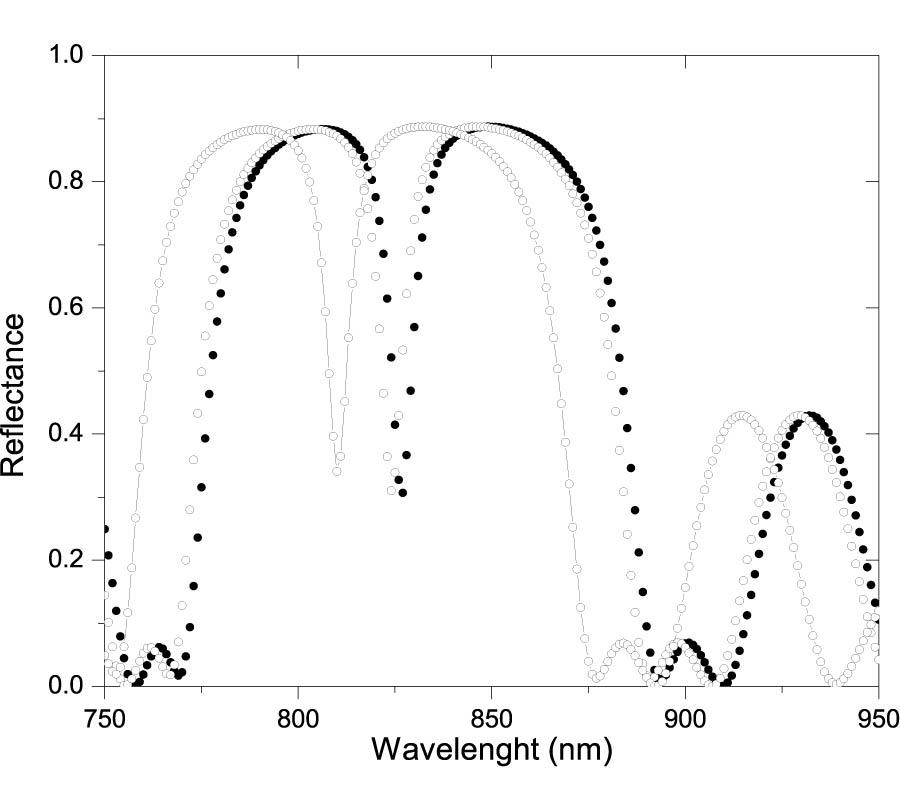
In this paper, we theoretically study the phase treatment of reflected waves in one-dimensional Fibonacci photonic quasicrystals composed of nano-scale fullerene and semiconductor layers. The dependence of the phase shift of reflected waves for TE mode and TM mode on the wavelength and incident angle is calculated by using the theoretical model based on the transfer matrix method in the infrared wavelength region. In the band gaps of supposed structures, it is found that the phase shift of reflected wave changes more slowly than within the transmission band gaps. Furthermore, the phase shift decreases with the incident angle increasing for TE mode, and increases with the incident angle increasing for TM mode. Also, for the supposed structures it is found that there is a band gap which is insensitive to the order of the Fibonacci sequence. These structures open a promising way to fabricate subwavelength tunable phase compensators, very compact wave plates and phase-sensitive interferometry for TE and TM waves.
PHOTONIC ANALYSIS OF SEMICONDUCTOR FIBONACCI SUPERLATTICES: PROPERTIES AND APPLICATIONS
2014-08-12
PIER C
Vol. 52, 163-172
Robust Adaptive Wideband Beamforming Using Probability-Constrained Optimization
Chengcheng Liu , Yaqi Liu , Yongjun Zhao and Dexiu Hu
The existing robust narrowband beamformers based on probability-constrained optimization have an excellent performance as compared to several state-of-the-art robust beamforming algorithms. However, they always assume that the steering vector errors are small enough. Without this assumption, we extend the probability-constrained approach to a wideband beamformer. In addition, a novel robust wideband beamformer with frequency invariance constraints is proposed by introducing the response variation (RV) element. Our problems can be reformulated in a convex form as the iterative second order cone programming (SOCP) problem and solved effectively using well-established interior point method. Compared with existing robust wideband beamformers, a more efficient control over the beamformer's response against the steering vector errors is achieved with an improved output signal-to-interference-plus-noise ratio (SINR).
ROBUST ADAPTIVE WIDEBAND BEAMFORMING USING PROBABILITY-CONSTRAINED OPTIMIZATION
2014-08-12
PIER Letters
Vol. 48, 27-32
Design of a Compact Two Element MIMO Antenna System with Improved Isolation
Jagadeesh Babu Kamili , Rabah Wasel Aldhaheri , Mohammed Younus Talha and Ibrahim S. Alruhaili
A novel compact two-element MIMO (Multiple Input Multiple Output) antenna system operating from 6.1-7.8 GHz is proposed for wireless applications. The developed antenna system resonates at 6.8 GHz frequency, giving an impedance bandwidth of 25% (based on S11<-10 dB). An efficient technique is proposed to reduce the mutual coupling developed in the antenna system by employing a simple microstrip patch element in between the antennas. Using the proposed method, the mutual coupling is reduced to around -33 dB at the resonant frequency and maintaining the overall mutual coupling less than -20 dB in the operating band. The experimental models are developed for both the MIMO systems i.e. without and with patch element between the antennas and the results are compared with simulated results. Also, Enveloped Correlation Coefficient (ECC) between the two antennas is calculated and compared.
DESIGN OF A COMPACT TWO ELEMENT MIMO ANTENNA SYSTEM WITH IMPROVED ISOLATION
2014-08-12
PIER Letters
Vol. 48, 21-26
Low-Profile Wideband Circularly Polarized Patch Antenna Using Asymmetric Feeding
Yang-Tao Wan , Fu-Shun Zhang , Dan Yu , Wen-Feng Chen and Tian Li
A low-profile wideband circularly polarized aperture stacked patch (ASP) antenna without air dielectric layers is presented. The new circular ASP antenna, which is fed by two orthogonal dual-offset lines through an asymmetric crossed slot, delivers a wide bandwidth of 80% for the 10-dB return loss and similar input impedance characteristics for the two ports. Then, a novel broadband 90° hybrid feed network is employed to achieve good impedance matching, balanced power splitting and consistent 90° (±9°) phase shifting across the wide operating band. The two unbalanced feed lines are connected to the respective ports of the feed network comprising a three-section Wilkinson power divider and a broadband 90° phase shifter. It is found that the proposed antenna can achieve a measured impedance bandwidth of 91.3% (2.44-6.54 GHz), a measured 3-dB axial ratio (AR) bandwidth of 86.4% (2.5-6.3 GHz), and a measured gain bandwidth of 60.9% from 3.2 to 6.0 GHz for the gain >4 dBic. In addition, a comparison between the proposed wideband CP antenna and related wideband CP and ASP antennas in the literature is made.
LOW-PROFILE WIDEBAND CIRCULARLY POLARIZED PATCH ANTENNA USING ASYMMETRIC FEEDING