Search Results(13798)

2013-05-19
PIER Letters
Vol. 40, 107-117
Computation of the Resonant Frequency and Quality Factor of Lossy Substrate Integrated Waveguide Resonators by Method of Moments
Giandomenico Amendola , Giovanni Angiulli , Emilio Arnieri and Luigi Boccia
This paper presents a technique for the efficient and accurate determination of resonant frequencies and quality factors of Substrate Integrated Waveguide (SIW) resonators. To consider resonators of a general shape the SIW structure is modelled as a parallel plate waveguide populated with metalized via holes. The field into the SIW cavity is found solving the scattering problem for the set of vias into the parallel plate. Resonances are determined searching for the complex frequencies for which the determinant of the system of equations pertinent to the scattering is zero. To speed up the search, a first guess for the resonance frequency is found using an estimate of the minimum singular value of the system of equations. A Muller search in the complex plane is later used to accurately determine both frequencies and quality factors. Results relevant to resonators of various shapes are presented and compared with results obtained with a commercial code.
COMPUTATION OF THE RESONANT FREQUENCY AND QUALITY FACTOR OF LOSSY SUBSTRATE INTEGRATED WAVEGUIDE RESONATORS BY METHOD OF MOMENTS
2013-05-19
PIER Letters
Vol. 40, 93-105
Periodic Transmission of Circular Binary Fresnel Zone Plates with Etching Depth and Substrate
Yaoju Zhang , Shilei Li , Yan Zhu , Youyi Zhuang , Taikei Suyama , Chongwei Zheng and Yoichi Okuno
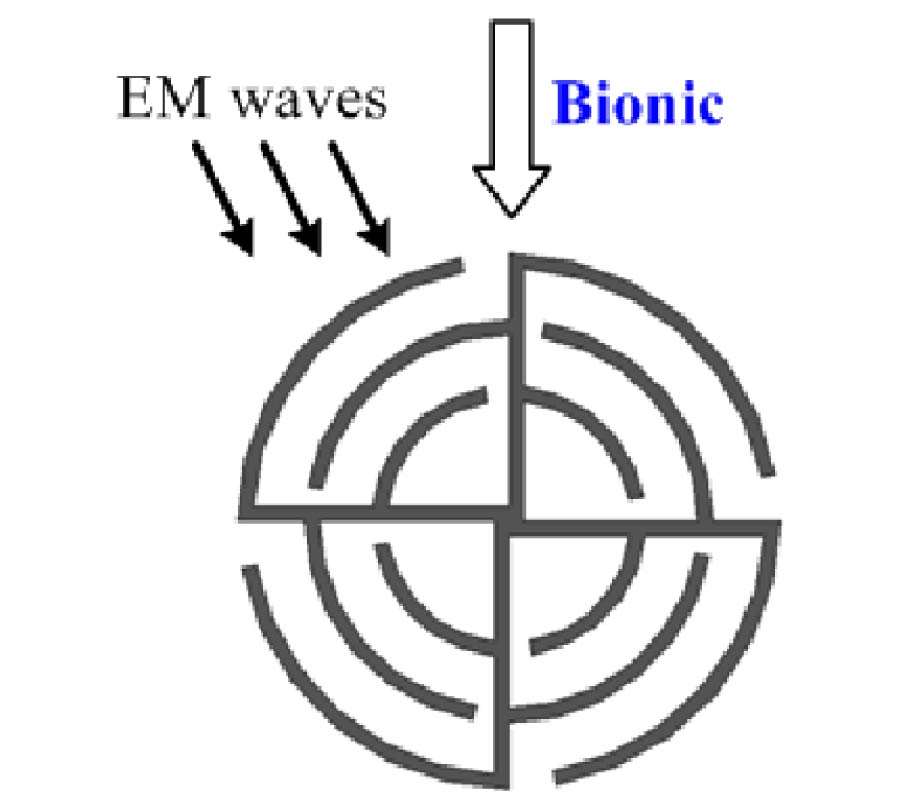
Based on the scattering theory and the Green function method, a dynamical theory is given for calculating the diffraction of deeply-etched gratings with a stratified structure substrate. The key of our method is that the patterned grating structure is considered as a perturbation to the unpatterned stratified structure rather than to vacuum. Using the first-order Born approximation and in the Fresnel diffraction region, we obtain a simple analytical expression, which can be used to calculating the scattering intensity of deeply-etched circular binary Fresnel zone plates with a stratified substrate (MDECBFZPs). The numerical results show that the focusing intensity at the foci of the MDCBFZP changes periodically with the etching depth and the thickness of the substrate film. Our results are in good agreement with FDTD simulations.
PERIODIC TRANSMISSION OF CIRCULAR BINARY FRESNEL ZONE PLATES WITH ETCHING DEPTH AND SUBSTRATE
2013-05-19
PIER M
Vol. 31, 13-27
A Loop-Type End-Launcher for Carbon Fiber Reinforced Polymer Waveguides
Alexe Bojovschi , Derek Gray and Kamran Ghorbani
The analysis of an end-launcher type transition from coaxial to WR90 waveguides is presented. This transition is tuned to have the highest performance at the radar frequency of 9.375 GHz. The characteristics of the transducer are investigated comparatively in 30 cm aluminum and carbon fiber reinforced polymer waveguides. The advantage of the proposed feed is that it does not require grounding to the broad wall of the waveguide compared to the traditional end-launcher loop feeds. This departure from the current loop feeds makes the proposed feed suitable for carbon fiber reinforced polymer waveguides where a disruption in the broad wall would be undesirable.
A LOOP-TYPE END-LAUNCHER FOR CARBON FIBER REINFORCED POLYMER WAVEGUIDES
2013-05-19
PIER
Vol. 139, 743-759
Multilevel Model Order Reduction with Generalized Compression of Boundaries for 3-D FEM Electromagnetic Analysis
Grzegorz Fotyga , Krzysztof Nyka and Michal Mrozowski
This paper presents a multilevel Model Order Reduction technique for a 3-D electromagnetic Finite Element Method analysis. The reduction process is carried out in a hierarchical way and involves several steps which are repeated at each level. This approach brings about versatility and allows one to efficiently analyze complex electromagnetic structures. In the proposed multilevel reduction the entire computational domain is covered with macro-elements which are subsequently nested, in such a way that size of the problem which has to be reduced at each level is relatively small. In order to increase the speed of the reduction at each level, the electric field at the macro-elements' boundaries is projected onto the subspace spanned by Legendre polynomials and trigonometric functions. The results of the numerical experiments confirm the validity and efficiency of the presented approach.
MULTILEVEL MODEL ORDER REDUCTION WITH GENERALIZED COMPRESSION OF BOUNDARIES FOR 3-D FEM ELECTROMAGNETIC ANALYSIS
2013-05-19
PIER
Vol. 139, 721-742
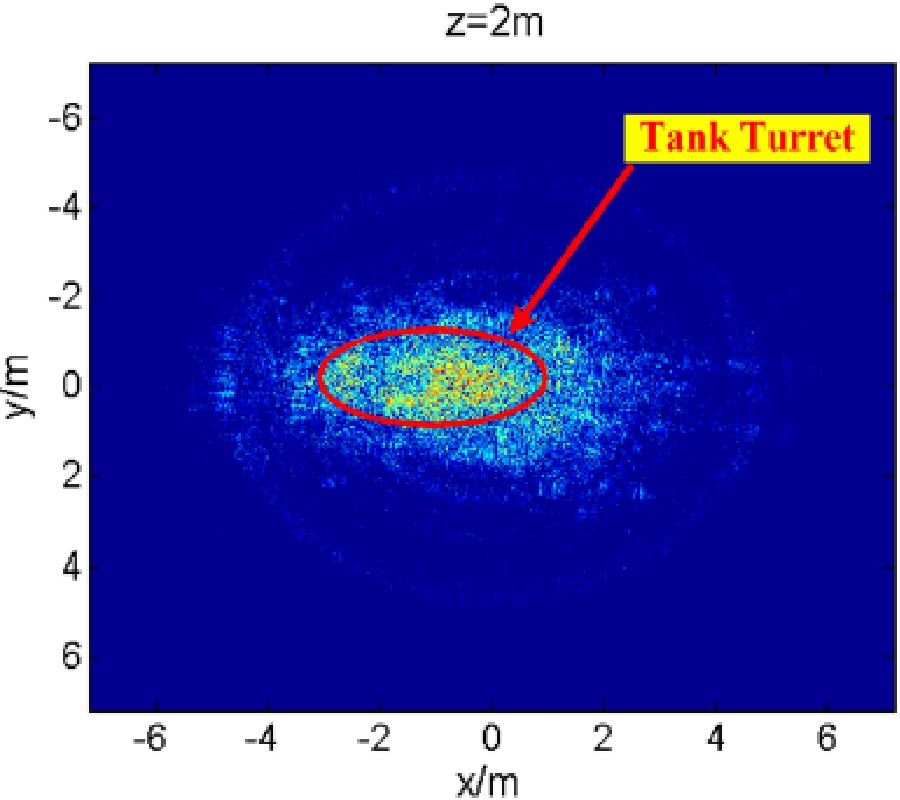
CFAR Target Detection in Ground SAR Image Based on Kk Distribution
Yanzhao Gao , Ronghui Zhan , Jianwei Wan , Jiemin Hu and Jun Zhang
This paper deals with the problem of constant false alarm rate (CFAR) target detection in high-resolution ground synthetic aperture radar (SAR) images based on KK distribution. For the parameter estimation of KK distribution, the semi-experiential algorithm is analyzed firstly. Then a new estimation algorithm based on the particle swarm optimization (PSO) is proposed, which takes the discrepancies between the histogram of the clutter data and probability density function (PDF) of KK distribution at some selected points as the cost function to search for the optimal parameter values using PSO algorithm. The performance of the two algorithms is compared using Monte-Carlo simulation using the simulated data sets generated under different conditions; and the estimation results validate the better performance of the new algorithm. Then the KK distribution, which is proposed for spiky sea clutter originally, is applied to model the real ground SAR clutter data. The goodness-of-fit test clearly show that the KK distribution is able to model the ground SAR clutter much better than some common used model, such as standard K-distribution and Gamma, etc. On this basis, a global CFAR target detection algorithm is presented. The detection threshold is calculated numerically through the cumulative density function (CDF) of KK distribution. Comparing the amplitude of every SAR image pixel with this threshold, the potential targets in ground SAR images can be located effectively. Then target clustering is implemented to eliminate the false alarm and obtain more accurate target regions. The detection results of the proposed algorithm in a typical ground SAR image show that it has better performance than the detector based on G0 distribution.
CFAR TARGET DETECTION IN GROUND SAR IMAGE BASED ON KK DISTRIBUTION
2013-05-19
PIER
Vol. 139, 689-720
Critical Model Components and Their Fingerprint Features in the Simulated Conducted Radio Frequency Immunity of Complex Integrated Circuits
Tao Su , Yehua Yang and Zixin Wang
To analyze and to handle the radio frequency immunity of microcontrollers requires understanding the origins of the complex frequency response of the immunity. This paper assumes that the frequency response of the immunity can be characterized with a set of fingerprint features in the immunity curves. Positions and shapes of those fingerprint features are determined by certain components in the disturbance propagation network. In order to prove that assumption, a series of models are created and simulated. The roles of various model components on the immunity are analyzed by comparing the simulation results from different model structures. The fingerprint features on the immunity curves are identified. The paper shows how to treat a wide-range immunity curve with separated features. It also shows the responsible model components for those separated features. With the awareness of those features and their origins, researchers can concentrate on extracting the models of the most important components in the disturbance propagation network when modeling the immunity of the complex integrated circuits like microcontrollers.
CRITICAL MODEL COMPONENTS AND THEIR FINGERPRINT FEATURES IN THE SIMULATED CONDUCTED RADIO FREQUENCY IMMUNITY OF COMPLEX INTEGRATED CIRCUITS
2013-05-19
PIER
Vol. 139, 671-687
On-Road Magnetic Emissions Prediction of Electric Cars in Terms of Driving Dynamics Using Neural Networks
Ahmed Wefky , Felipe Espinosa , Frank Leferink , Alfredo Gardel and Robert Vogt-Ardatjew
This paper presents a novel artificial neural network (ANN) model estimating vehicle-level radiated magnetic emissions of an electric car as a function of the corresponding driving pattern. Real world electromagnetic interference (EMI) experiments have been realized in a semi-anechoic chamber using Renault Twizy. Time-domain electromagnetic interference (TDEMI) measurement techniques have been employed to record the radiated disturbances in the 150 kHz-30 MHz range. Interesting emissions have been found in the range 150 kHz-3.8 MHz approximately. The instantaneous vehicle speed and acceleration have been chosen to represent the vehicle operational modes. A comparative study of the prediction performance between different static and dynamic neural networks has been done. Results showed that a Multilayer Perceptron (MLP) model trained with extreme learning machines (ELM) has achieved the best prediction results. The proposed model has been used to estimate the radiated magnetic field levels of an urban trip carried out with a Think City electric car.
ON-ROAD MAGNETIC EMISSIONS PREDICTION OF ELECTRIC CARS IN TERMS OF DRIVING DYNAMICS USING NEURAL NETWORKS
2013-05-19
PIER
Vol. 139, 655-670
Performance of FDTD Method Cpu Implementations for Simulation of Electromagnetic Processes
Dmitry L. Markovich , Konstantin S. Ladutenko and Pavel A. Belov
We analyze the performance of finite-difference time-domain (FDTD) method implementations for 2D and 3D problems. Implementations in Fortran, C and C++ (with Blitz++ library) languages and performance tests on several hardware setups (AMD, Intel i5, Intel Xeon) are considered. The performance of implementations using traditional FDTD algorithm for the largest size of test problem is limited by the bandwidth of computer random-accessed memory (RAM). Our implementations are compared with a commercial simulation software package Lumerical FDTD Solutions and an open source project Meep.
PERFORMANCE OF FDTD METHOD CPU IMPLEMENTATIONS FOR SIMULATION OF ELECTROMAGNETIC PROCESSES
2013-05-17
PIER B
Vol. 52, 1-18
Optical Modes of a Dispersive Periodic Nanostructure
Gandhi Alagappan and Alexei Deinega
We show that the optical modes of a periodic nanostructure with frequency dependent dielectric constant (i.e., a dispersive optical nanostructure), in general can be written as an ordinary eigenvalue problem of a "dielectric function operator", for each distinct symmetry representation of the periodic nanostructure. For a frequency dependence in the form of polynomial rational function, the problem translates to a polynomial eigenvalue equation in the frequency of the mode. The resulting problem can be solved using the basis functions of a dielectric backbone structure, which has a frequency independent dielectric constant. Rapid convergence is achieved when the basis functions are selected to be the modes of a dielectric backbone structure that minimizes the frequency perturbation of the dielectric function of the optical nanostructure. In particular, using a two dimensional photonic crystal constructed with a polar crystal as an example, we demonstrate that, remarkable simple cubic equations are sufficient to obtain accurate descriptions of eigenfrequencies.
OPTICAL MODES OF A DISPERSIVE PERIODIC NANOSTRUCTURE
2013-05-17
PIER C
Vol. 40, 25-35
Compact Interdigital Capacitor Coupled Dual-Behavior Resonator (Icdbr) Filter with Suppression of Spurious Responses
Sheng-Jie Wang , Tao Su , Li-Juan Zhang , Zhi-Peng Li and Yong-Liang Zhang
A compact interdigital capacitor coupled dual-behavior resonator (DBR) filter with high spurious responses suppression is proposed in this paper. The technique is based on two equivalent topologies of J-inverter and dual-line equivalent circuit of open-circuited stubs. The first compact equivalent topology capacitive inverter is a high pass structure, and consequently, the spurious responses can be suppressed effectively at low frequencies. The second equivalent topology π-network is employed in realizing a compact size and adding new transmission zeros dedicated to the spurious responses suppression at high frequencies. Further compactness is achieved with a dual-line equivalent circuit of open-circuited stubs. The relevant equations are given in the paper. Finally, a 3rd-order compact DBR filter is designed and measured. This structure has a high degree of miniaturization(83%) in comparison to the classical one. Measurement results show good agreement with the simulated ones.
COMPACT INTERDIGITAL CAPACITOR COUPLED DUAL-BEHAVIOR RESONATOR (ICDBR) FILTER WITH SUPPRESSION OF SPURIOUS RESPONSES
2013-05-15
PIER B
Vol. 51, 407-425
A Pareto Elite Selection Genetic Algorithm for Random Antenna Array Beamforming with Low Sidelobe Level
Suhanya Jayaprakasam , Sharul Kamal Bin Abd Rahim and Chee Yen Leow
Random antenna array (RAA) that uses the conventional beamforming method produces a poor beam pattern with high sidelobe level. This greatly reduces the performance and the efficiency of the antenna. The use of Genetic Algorithm (GA) to find the best positions for the antenna elements in RAA to lower the sidelobes has been widely researched. However, there has been no solution proposed for the reduction of sidelobes when the user has no autonomy over the position of the radiating elements, for instance in cases such as emergency communications. This paper proposes a novel Pareto Elite Selection Genetic Algorithm (PESGA) optimization method to reduce the sidelobes in an RAA that has fixed elements' position. The proposed method uses a single fitness function (peak sidelobe level) for parent selection while an additional function (number of sidelobes above a threshold level) is introduced to select the elitist in every generation via Pareto Front (PF) selection. Results indicate that the proposed PESGA method is best used for scenarios where the array size is small. In such cases, the proposed method provides much reduced sidelobe compared to the conventional RAA beamforming method and up to 200% improvements in terms of mainlobe to peak sidelobe ratio compared to GA weight optimized beamforming method.
A PARETO ELITE SELECTION GENETIC ALGORITHM FOR RANDOM ANTENNA ARRAY BEAMFORMING WITH LOW SIDELOBE LEVEL
2013-05-15
PIER B
Vol. 51, 389-406
Improving Convergence Time of the Electromagnetic Inverse Method Based on Genetic Algorithm Using the Pzmi and Neural Network
Sofiene Saidi and Jaleleddine Ben Hadj Slama
In this paper we present a methodology to guarantee the convergence of the electromagnetic inverse method. This method is applied to electromagnetic compatibility (EMC) in order to overcome the difficulties of measuring the radiated electromagnetic field and to reduce the cost of the EMC analysis. It consists in using Genetic Algorithms (GA) to identify a model that will be used to estimate the electric and magnetic field radiated by the device under test. This method is based on the recognition of the equivalent radiation sources using the Near Field (NF) cartography radiated by the device. Our contribution in this field is to improve the ability and the convergence of the electromagnetic inverse method by using the Pseudo Zernike Moment Invariant (PZMI) descriptor and the Artificial Neural Network (ANN). The validation of the proposed method is performed using the NF emitted by known electric and magnetic dipoles. Our results have proved that the proposed method guarantees the convergence of the electromagnetic inverse method and that the convergence speeds up while retaining all the other performances.
IMPROVING CONVERGENCE TIME OF THE ELECTROMAGNETIC INVERSE METHOD BASED ON GENETIC ALGORITHM USING THE PZMI AND NEURAL NETWORK
2013-05-15
PIER C
Vol. 40, 15-24
A Novel Triple-Band Rectangular Ring Antenna with Two L-Shaped Strips for WiMAX and WLAN Applications
Bin Yuan , Peng Gao , Shuang He , Liang Xu and Hai Tao Guo
A low-profile microstrip planar monopole antenna with triple-band operation for WiMAX and WLAN applications is proposed in this paper. The antenna has a simple structure which consists of a rectangular ring patch, two inverted L-shaped strips extending from the rectangular ring patch, and a microstrip feed line. By adding two L-shaped strips on the rectangular ring patch, three resonant modes can be excited independently. The antenna has a simple structure and a compact size of 21 × 33 × 1.6 mm3. The measured -10 dB impedance bandwidth of the proposed antenna covers 2.39-2.51 GHz, 3.26-4.15 GHz, and 5.0-6.43 GHz, which can fully cover the 2.4/5.2/5.8 GHz WLAN bands and 3.5/5.5 GHz WiMAX bands. A prototype is fabricated, and then measured. The experimental and simulation results show good impedance bandwidth, radiation pattern and stable gain across the operating bands.
A NOVEL TRIPLE-BAND RECTANGULAR RING ANTENNA WITH TWO L-SHAPED STRIPS FOR WIMAX AND WLAN APPLICATIONS
2013-05-15
PIER C
Vol. 40, 1-13
Compact Multiband Folded Ifa for Mobile Application
Shu-Xi Gong , Pei Duan , Peng-Fei Zhang , Fuwei Wang , Qiaona Qiu and Qian Liu
A compact multiband Inverted-F Antenna (IFA) for the use in a mobile phone is presented. By adopting a novel folded 3-D structure, a quarter-wave resonator and a parasitic strip, the proposed antenna covers eight bands and exhibits reduced electrical size and low profile. S11 less than -6 dB is obtained in the GSM900, GSM1800, DCS, Bluetooth, Wi-Fi, WLAN5.2, WLAN5.8 and the WiMAX bands. The dimensions of the proposed antenna with the 3-D structure are only 39.6×4.3×3.4 mm3, which are very small in respect with other antennas in mobile terminal devices. A prototype of the proposed antenna is fabricated and measured. Measured and simulated results exhibit good bandwidth, radiation patterns and efficiency across all eight bands.
COMPACT MULTIBAND FOLDED IFA FOR MOBILE APPLICATION
2013-05-15
PIER C
Vol. 39, 265-277
Bandstop to Allpass Reconfigurable Filter Technique in SPDT Switch Design
Noor Azwan Shairi , Badrul Hisham Ahmad and Peng Wen Wong
In this paper, a bandstop to allpass reconfigurable filter technique is proposed in Single Pole Double Throw (SPDT) switch design. Proof of concept of the bandstop to allpass reconfigurable filter is presented. It is physically realized using transmission line and radial stub in 3.5 GHz band (3.4 to 3.6 GHz). The isolation, insertion loss and return loss of the SPDT switches are analyzed and to validate this technique the prototypes are fabricated using FR4 substrate with a thickness of 16 mm. A very good agreement is shown between the simulated and measured results. Using this technique, it is able to produce more than 30 dB isolation with minimum number of PIN diodes, thus reducing 42.7% of the total circuit size compared with conventional design. Besides, additional 22.9% of isolation bandwidth can be obtained with the use of radial stub compared with transmission line stub. The potential application of this SPDT switch is Time Division Duplex (TDD) switching for WiMAX and LTE communication system in the 3.5 GHz band.
BANDSTOP TO ALLPASS RECONFIGURABLE FILTER TECHNIQUE IN SPDT SWITCH DESIGN
2013-05-15
PIER M
Vol. 31, 1-11
Terrain Height Estimation Using a Stereo-SAR Technique Aided by a Reference Point
Kung-Yu Lu and Jean-Fu Kiang
A stereo-synthetic aperture radar (stereo-SAR) technique is proposed to estimate the terrain height of a target area. A reference point with known altitude is located within the target area to calibrate the height estimation. The estimated height error can be reduced to one meter. This method requires the processing techniques of conventional SAR, while achieving a fairly fine resolution in height estimation for practical applications.
TERRAIN HEIGHT ESTIMATION USING A STEREO-SAR TECHNIQUE AIDED BY A REFERENCE POINT
2013-05-13
PIER Letters
Vol. 40, 81-92
Novel Tri-Band Bandpass Filter Using Stub-Loaded Short-Ended Resonator
Xiu Zhang , Li Gao , Ze Yu Cai and Xiao-Lan Zhao
This paper presents a tri-band bandpass filter (BPF) using a novel stub-loaded resonator. Different from other stub-loaded resonator, this resonator utilized a short-ended main transmission line and a centerly-loaded open stub. The resonator is theoretically analyzed. The first three resonant frequencies can be individually adjusted and this enables the convenient designs of tri-band BPFs. For demonstration, a tri-band BPF is implemented. Transmission zeros are created close to each passband edge, resulting in high skirt selectivity. Comparisons of the measured and simulated results are presented to verify the theoretical predications.
NOVEL TRI-BAND BANDPASS FILTER USING STUB-LOADED SHORT-ENDED RESONATOR
2013-05-13
PIER Letters
Vol. 40, 71-79
Novel Compact UWB Frequency Selective Surface for Angular and Polarization Independent Operation
Sanjay Baisakhiya , Ramprabhu Sivasamy , Malathi Kanagasabai and Sakthivel Periaswamy
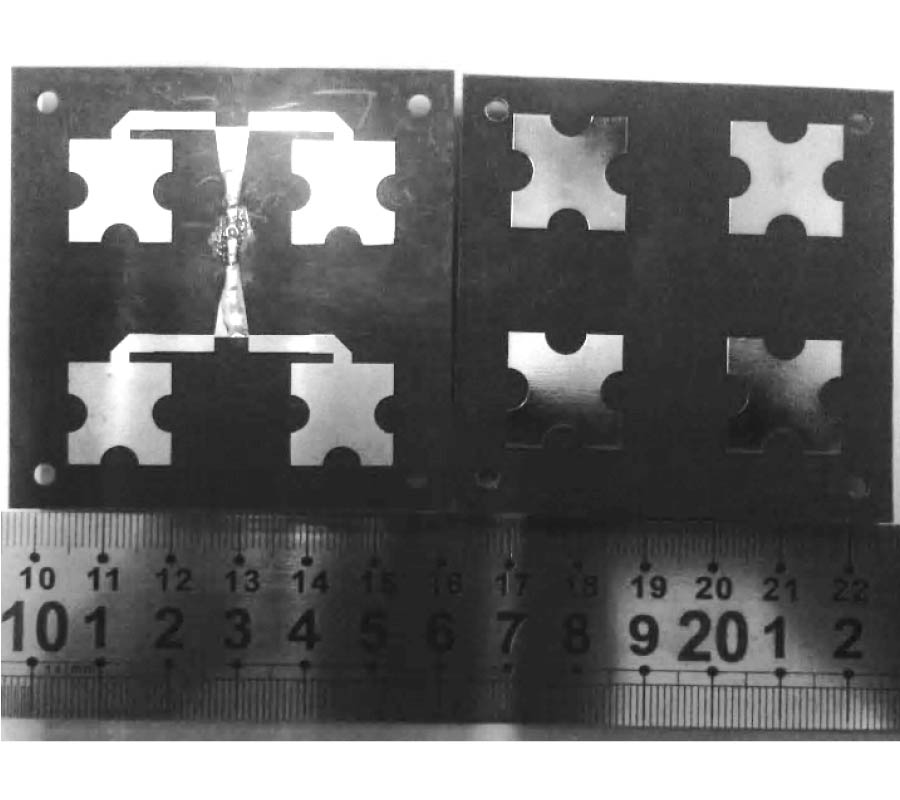
This paper deals with a novel miniaturized FSS with wide stop band characteristics for UWB applications. The proposed FSS consists of garland like design printed on either side of the dielectric substrate. The design provides a bandwidth equal to 3.5 GHz at -20 dB reference level of insertion loss which lies within the UWB range. The design delivers stable response for various angular incidences. In addition to this, the symmetrical nature of the FSS holds identical response for both TE and TM Mode of polarization. The proposed geometry is fabricated and its simulated results are validated with measurements. A comprehensive analysis is made by adjusting various parameters associated with the proposed design.
NOVEL COMPACT UWB FREQUENCY SELECTIVE SURFACE FOR ANGULAR AND POLARIZATION INDEPENDENT OPERATION
2013-05-13
PIER
Vol. 139, 643-654
Effects on the Energy Flux Density Due to Pitch in Twisted Clad Optical Fibers
Muhammad Abuzar Baqir and Pankaj Kumar Choudhury
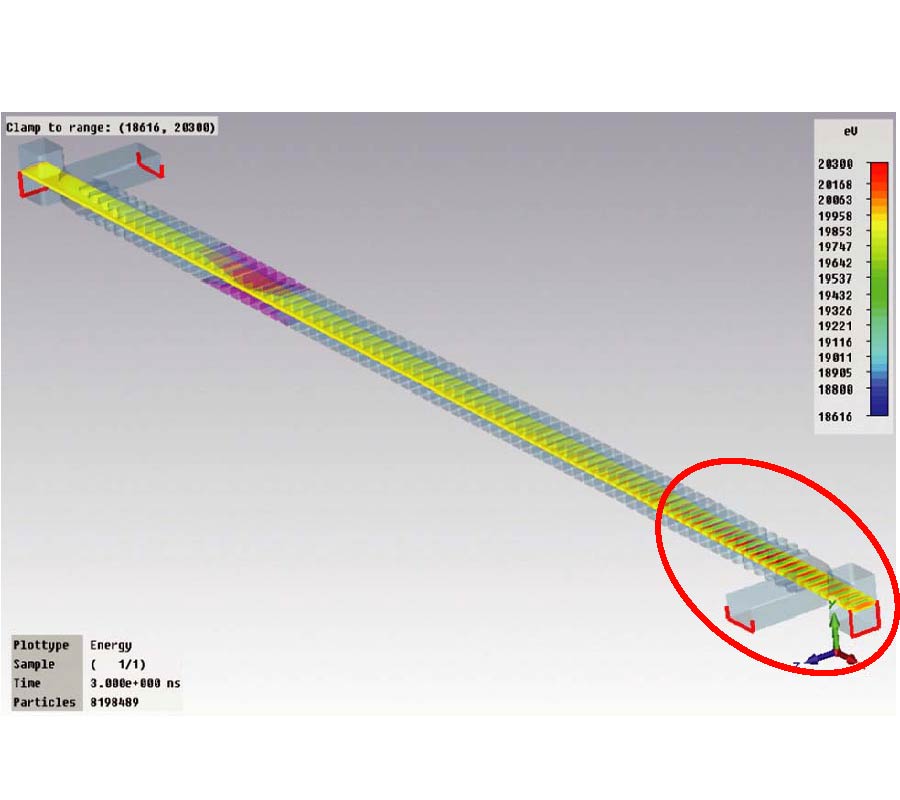
The paper deals with the propagation of electromagnetic waves through twisted clad dielectric optical fibers. The structure of these fibers is analogous to travelling wave tubes used in microwave devices, and the usefulness would be in the areas of optical sensing. This is because the twists in fiber would be affected due to the imposed stress and/or strain, leaving thereby the possibility to alter the propagation characteristics. A rigorous analytical investigation has been carried out with the emphasis on the energy flux density patterns due to the different propagating modes in the fiber. The dispersion relations of the system are deduced and the energy flux densities are evaluated under different pitch angles of twist. The effect due to conducting helix pitch on the electromagnetic wave propagation is emphasized.
EFFECTS ON THE ENERGY FLUX DENSITY DUE TO PITCH IN TWISTED CLAD OPTICAL FIBERS
2013-05-13
PIER
Vol. 139, 627-642
Miniaturized Multilayer Dual-Mode Substrate Integrated Waveguide Filter with Multiple Transmission Zeros
Hong Xia and Ziqiang Xu
A compact multilayer substrate integrated waveguide (SIW) dual-mode filter with multiple transmission zeros for high-selectivity application is presented. By introducing mixed coupling between source and load, the proposed filter could have four transmission zeros which can be controlled flexibly. Owing to the multilayer structure, the proposed filter occupies similar area in comparison with conventional dual-cavity dual mode SIW filters, but exhibits better frequency selectivity. An experimental filter with a center frequency of 10 GHz is designed using low temperature co-fired ceramic (LTCC) technology to validate the proposed structure, and measured results agree well with simulated ones.
MINIATURIZED MULTILAYER DUAL-MODE SUBSTRATE INTEGRATED WAVEGUIDE FILTER WITH MULTIPLE TRANSMISSION ZEROS