Search Results(13800)

2012-12-05
PIER B
Vol. 46, 275-297
The Critical Diameters for Rainfall Attenuation in Southern Africa
OLUWUMI ADETAN and Thomas Joachim Odhiambo Afullo
This paper investigates the influence of critical raindrop diameters on the specific rain attenuation in Durban (29°52'S, 30°58'E), South Africa. The total rainfall attenuation is evaluated by integrating over all the raindrop sizes and the differential change in the attenuation is observed over a given range of drop size diameters. The major contribution to the specific attenuation for the drop size distribution (DSD) models considered is created by the raindrop diameters not exceeding 2 mm especially at higher frequencies. The three parameter lognormal and gamma distribution models are employed for the purpose of analysis. For the DSD models considered in this work, the total percentage fraction created by raindrops in the diameter range 0.5 mm ≤ D ≤ 2.5 mm and 1 mm ≤ D ≤ 3 mm to the total specific attenuation is found to be critical for the overall and seasonal rainfall attenuation at 2.5 GHz-100 GHz in Durban. It is observed that the total specific attenuation increases with increased frequencies and a higher rainfall rate produces high rain attenuation. In this paper, both the overall and seasonal values of R0.01 determined for Durban are used.
THE CRITICAL DIAMETERS FOR RAINFALL ATTENUATION IN SOUTHERN AFRICA
2012-12-05
PIER
Vol. 134, 397-417
A Novel Miniaturized Dual-Band Bandstop Filter Using Dual-Plane Defected Structures
Jun Wang , Huansheng Ning , Qingxu Xiong , Minquan Li and Ling-Feng Mao
A novel miniaturized dual-band bandstop filter (DBBSF) is proposed by using the T-shaped defected microstrip structures (DMSs) and the U-shaped defected ground structures (DGSs) in this paper. The layout of the dual-band bandstop resonator (DBBSR) is presented at first. The dual stopbands of the DBBSR can be separately controlled since the mutual coupling of the defected structures is negligible. The working principles of the T-shaped DMS and U-shaped DGS are then provided and their design process is summarized. On the basis of the DBBSR, the design methodology of the compact DBBSF is proposed before its design procedures are presented. Following the design procedures, a second-order and third-order DBBSFs with Butterworth frequency response are designed, simulated and fabricated. The equivalent circuit models of the designed filters are also developed. Full-wave simulation results of the fabricated DBBSFs are in good agreement with the circuit simulation and measurement results, validating our proposed design methodology.
A NOVEL MINIATURIZED DUAL-BAND BANDSTOP FILTER USING DUAL-PLANE DEFECTED STRUCTURES
2012-12-04
PIER Letters
Vol. 36, 113-120
Improved Bandwidth Waveguide Bandpass Filter Using Sierpinski Fractal Shaped Irises
Abbas Ali Lotfi-Neyestanak , Seyed Majid Seyed-Momeni and Mohammad Reza Haraty
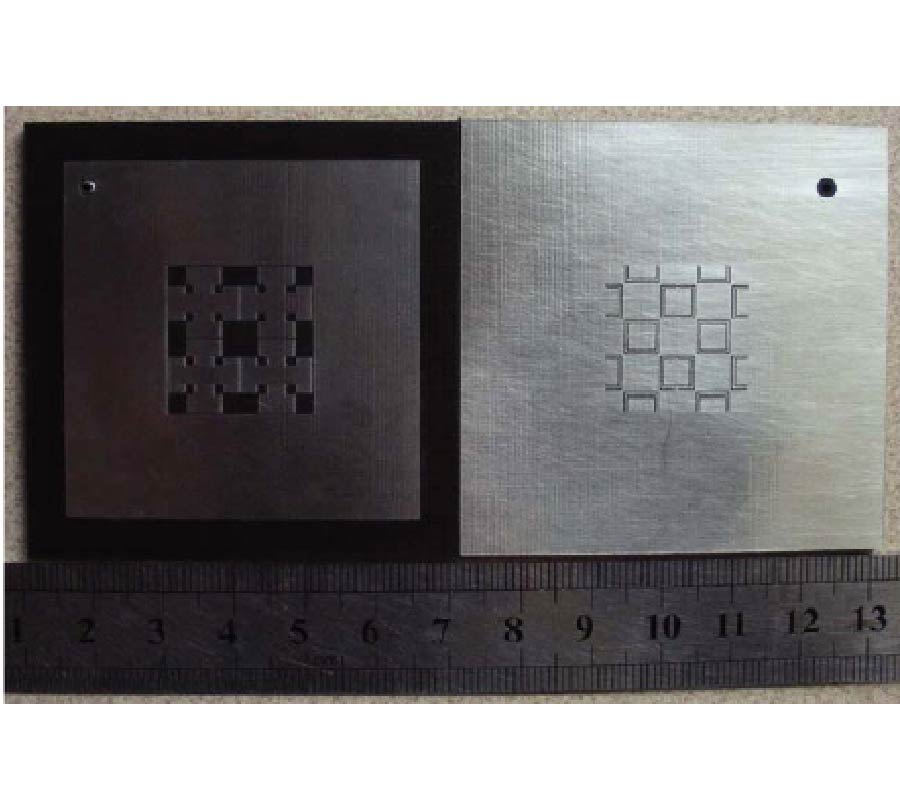
This paper presents a novel waveguide band pass filter using Sierpinski fractal-shaped irises. The bandwidth of the proposed filter is more than 5.5 times in comparison to similar waveguide filter with rectangular shape iris. The offered filter is designed and simulated using Ansoft HFSS and then fabricated. The results show less than 0.5 dB insertion loss and return loss better than 13 dB in operation frequency band for the proposed filter.
IMPROVED BANDWIDTH WAVEGUIDE BANDPASS FILTER USING SIERPINSKI FRACTAL SHAPED IRISES
2012-12-04
PIER Letters
Vol. 36, 103-112
A New Method of Evaluating Reverberation Chamber q-Factor with Experimental Validation
Song Wang , Zhan Cheng Wu , Guang Hui Wei , Yao Zhong Cui and Li Si Fan
Through exploring the relationship between the Q-factor and the normalized electric field strength of a reverberation chamber, this contribution proposes a new kind of methods for the Q-factor estimation, which can simplify the procedure of measuring Q-factor in experiment and raise the e±ciency of calculating Q-factor by simulation. Firstly, the method is validated using measured electric field, then it is verified using data from RC's simulation by FDTD. Satisfactory agreements confirm this kind of methods could act as a reliable tool in evaluating Q-factor by both experimental measurement and numerical simulation.
A NEW METHOD OF EVALUATING REVERBERATION CHAMBER Q-FACTOR WITH EXPERIMENTAL VALIDATION
2012-12-04
PIER C
Vol. 35, 49-61
Planar Microstrip Bandpass Filter with Wide Dual Bands Using Parallel-Coupled Lines and Stepped Impedance Resonators
Jayaseelan Marimuthu , Amin M. Abbosh and Bassem Henin
A dual-band bandpass filter with wide and highly attenuated stopbands is designed using parallel coupled microstrip line (PCML) and stepped-impedance-resonators (SIRs). The proposed filter is composed of a pair of highly coupled PCML-SIR structure and a central resonator using a low impedance rectangular microstrip. Initially, the wide dual-band performance is achieved by creating a transmission zero between those two bands using a tightly coupled PCML-SIR with a suitable impedance ratio. Then, a low impedance resonator is placed between the pair of PCML-SIR to generate multiple resonant frequencies for a broadband performance. The simulated and measured results of those filters agree very well. The bandwidth of the first band in the developed filters extends from 1.75 GHz to 3.75 GHz with less than 0.3 dB insertion loss at the center of the band. The second band has a bandwidth that extends from 6.95 GHz to 8.75 GHz with less than 0.5 dB insertion loss at the center of that band. The stopband separating those two passband has more than 30 dB attenuation with transmission zero at 5.85 GHz.
PLANAR MICROSTRIP BANDPASS FILTER WITH WIDE DUAL BANDS USING PARALLEL-COUPLED LINES AND STEPPED IMPEDANCE RESONATORS
2012-12-03
PIER B
Vol. 46, 251-274
Statistical Estimation of Fade Depth and Outage Probability Due to Multipath Propagation in Southern Africa
Mike Omondi Asiyo and Thomas Joachim Odhiambo Afullo
This study builds on the earlier work by Odedina and Afullo on Multipath fading in Durban. Their work was based on multipath measurements in Durban over a 6.73 km Line-of-Sight (LOS) link. This submission uses the geoclimatic factor approach and ITU-R recommendations P530-14 to obtain the multipath fading occurrence in five cities in South Africa, including Durban. Three-year radiosonde data is used in estimating the percentage of time that a certain fade depth is exceeded and hence outage probability due to atmospheric multipath propagation, assuming the given fade depth leads to the received signal falling below the squelch level. We employ the Inverse Distance Square technique to estimate point refractivity gradient not exceeded for 1% of the time in the lowest 65 m above the ground for five locations within South Africa. Standard error of the mean and confidence interval for both annual averages and seasonal averages of point refractivity gradient is calculated to reflect possible deviation in the given readings. These values of point refractivity gradient obtained are used in determining the geoclimatic factor K. The results presented show monthly, seasonal and annual variation of both point refractivity gradient and geoclimatic factor K. The results confirm that the geoclimatic factor K is region based. The percentage of time a given fade depth is exceeded for a single frequency increases rapidly with increasing path length. This is due to the fact that as the path length increases so do the multiple reflections leading to multipath propagation, which can result in either signal enhancement or multipath fading. A comparison of fade depth and outage probabilities is made with the earlier work in Durban and Rwanda in Central Africa.
STATISTICAL ESTIMATION OF FADE DEPTH AND OUTAGE PROBABILITY DUE TO MULTIPATH PROPAGATION IN SOUTHERN AFRICA
2012-12-03
PIER Letters
Vol. 36, 87-101
Optimization Towards Broadband Cylindrical Cloaks with Layered Magnetic Materials
Wei Song , Rui-Jing Shi and Xin-Qing Sheng
Inhomogeneous anisotropic cloaks can be approximated by more realizable homogeneous and isotropic material layers at the expense of their bandwidth and angular dependence. Aiming at applications to a monostatic Radar, we propose a scheme to design broadband cylindrical cloaks with minimized backscattering RCS. The cloak is composed of a few layers of concentric magnetic materials, with optimized parameters using a genetic algorithm (GA). We also examine extensively the parameters in the optimization, including the initial population and the relationship of required discretization with the operation frequency. It has been demonstrated that, through a proper designed optimization, the bandwidth can exceed 80% for non-dispersive cloaks and 4% for dispersive cloaks.
OPTIMIZATION TOWARDS BROADBAND CYLINDRICAL CLOAKS WITH LAYERED MAGNETIC MATERIALS
2012-12-03
PIER M
Vol. 27, 231-240
A Compact 90° Bent Equal Output Ports of Photonic Crystal Beam Splitter with Complete Band Gap Based on Defect Resonance Interface
Wayne Yang and Yuan-Fong Chau
A compact 90° bent equal output ports of photonic crystal (PC) beam splitter (BS) with complete band gap (CPBG) based on the effect of defect resonance interface (DRI) in PC waveguides is designed and analyzed. The finite-difference time-domain method is adopted to simulate the relevant structures of defect mode in a two dimensional square lattice circular dielectric rods of anisotropic PC. The device size reduction and flexibility in polarization dependence compared with the conventional PCBS can be attributed to the same resonant frequency for both transverse-magnetic and transverse-electric polarization, because the PC structures designed here have a CPBG. The merit of our proposed PCBSs with identical lights at the output ports possess the short coupling length with direct coupling (the coupling length is the same as that of the width of DRI, 3a) and the short distance without cross-talk among the output ports (only three lattice constant, 3a), thus helping the design flexibility of the PCBSs in IOCs.
A COMPACT 90° BENT EQUAL OUTPUT PORTS OF PHOTONIC CRYSTAL BEAM SPLITTER WITH COMPLETE BAND GAP BASED ON DEFECT RESONANCE INTERFACE
2012-12-03
PIER
Vol. 134, 379-395
Investigations of Four-Port Circulator Utilizing Cylindrical Ferrite Coupled Line Junction
Adam Kusiek , Wojciech Marynowski and Jerzy Mazur
In this paper the numerical and experimental investigations of four-port circulator utilizing longitudinally magnetized cylindrical ferrite coupled lines (CFCL) section are presented for the first time. In comparison to earlier models the proposed structure of circulator utilizes multilayer magic-T junction cascaded with cylindrical ferrite section of π/4 Faraday angle. The advantage of utilization of cylindrical section over the planar one is the possibility to design shorter ferrite junctions ensuring lower insertion losses. Moreover, the multilayer magic T-junction allows to improve performance of the proposed circulator by omitting the bandwidth limitation which exists in commonly used hybrid couplers with air-bridges. In the analysis of CFCL junction the full wave hybrid approach combining finite difference frequency domain method with method of moments and mode matching technique is applied. The planar feeding structures of circulator are designed with the use of commercial software. The simulated results of the entire circulator are compared with the measurement results of the fabricated prototype and a good agreement is achieved.
INVESTIGATIONS OF FOUR-PORT CIRCULATOR UTILIZING CYLINDRICAL FERRITE COUPLED LINE JUNCTION
2012-12-03
PIER
Vol. 134, 359-378
Systematic Analysis of Conducted Electromagnetic Interferences for the Electric Drive System in Electric Vehicles
Yanjie Guo , Lifang Wang and Chenglin Liao
There are serious electromagnetic compatibility (EMC) problems in electric vehicles. In order to explain and solve them, a systematic method to analyze conducted interferences of the electric drive system is shown in this paper. This method represents the effects of the power battery which is the most different part between electric drive systems used in electric vehicles and other cases. Also, Equivalent models are established from power electronics devices to the entire system by considering both the working mechanism and stray parameters. Firstly, insulated gate bipolar transistor (IGBT) and inverter are studied as the main interference source. A new expression is put forward to estimate the frequency domain features of the inverter disturbances. Then, power battery and electric motor are discussed as the main propagation paths. Their high frequency circuit models are given with parameters obtained from tests and measurements. Finally, the system model is established. The system interferences are analyzed to get their generation causes, influence factors and frequency domain characteristics. Comparisons between simulations and experiments verify the correctness of the models and the method.
SYSTEMATIC ANALYSIS OF CONDUCTED ELECTROMAGNETIC INTERFERENCES FOR THE ELECTRIC DRIVE SYSTEM IN ELECTRIC VEHICLES
2012-12-01
PIER
Vol. 134, 337-357
Theory of Zero-Power RFID Sensors Based on Harmonic Generation and Orthogonally Polarized Antennas
Federico Alimenti and Luca Roselli
In this paper a novel approach is proposed to solve the issue of the absolute accuracy required by the most of passive chip-less RFID sensors. To this purpose the sensor information is encoded as the phase difference between two signals, one of the two acting as the reference signal for the other one. First the tag receives a carrier at frequency f0, then two equal signals at frequency 2 f0 are generated by means of a diode-based frequency doubler and a power divider. At this point one of the two signals is phase-shifted using a passive sensing element. Finally the 2 f0 signals are re-irradiated by exploiting two orthogonally polarized antennas. With this approach the sensor information can be extracted by a suitable reader equipped with two complex (I/Q) receivers. The idea will be first developed from a theoretical basis and then verified with several particular cases. The novel tag concept is compatible with paper substrate and ink-jet printing technology since antennas diodes and passive sensing elements, i.e. all the main tag components, are going to be developed on paper materials.
THEORY OF ZERO-POWER RFID SENSORS BASED ON HARMONIC GENERATION AND ORTHOGONALLY POLARIZED ANTENNAS
2012-11-30
PIER B
Vol. 46, 233-250
Simulation of the Bearing Voltage in an Inverter-Fed Induction Motor by a Full Three Phase Multi Conductor Transmission Line Model
Biagio De Vivo , Patrizia Lamberti , Vincenzo Tucci and Carlo Petrarca
An accurate numerical model, based on multiconductor transmission lines (MTL) able to evaluate the voltage dynamics across the motor bearings and associated currents of an inverter-fed motor is presented. A full three phase stator winding of the wound type of a high power traction motor is considered in the proposed analysis. The different regions of the motor are modeled as suitable connections of lossy MTL which are then studied in the time domain. The per unit length characteristic matrices describing the MTL are accurately calculated by a FEM based software. The effects of the rise time of the input voltage and the length of the feeder cables are discussed. The reliability of the numerical results achieved by means of the MTL model is checked by performing a comparison with those obtained by considering a lumped parameter equivalent circuit.
SIMULATION OF THE BEARING VOLTAGE IN AN INVERTER-FED INDUCTION MOTOR BY A FULL THREE PHASE MULTI CONDUCTOR TRANSMISSION LINE MODEL
2012-11-30
PIER C
Vol. 35, 35-48
FPGA Implementation of Space-Time Adaptive Processing (STAP) Algorithm for Target Detection in Passive Radars
Zia Ul Mahmood , Mubashir Alam , Khalid Jamil and Zeyad O. Al-Hekail
Space-Time Adaptive Processing (STAP) algorithm has recently been used in Passive Bi-static Radars (PBR) because it removes the clutter and non-cooperative transmitter effectively making the target detection easy in harsh environments like air-ground. Real-time implementation of STAP is a very challenging task as it is computationally-intensive, time-critical and resource-hungry process. This paper focuses on the Field-Programmable Gate Array (FPGA) implementation of STAP algorithm for passive radar using FM radio as transmitter of opportunity. The signals of interest were collected using an eight-channel software-defined radar with a uniform circular array (UCA). The STAP processing was simulated using MATLAB and hardware implementation was carried out on a Xilinx Virtex-6 FPGA. The system is tested using experimental radar data. Timing and Power analysis of hardware implementation justifies that FPGA provides a fast and reliable platform for STAP real-time radar processing.
FPGA IMPLEMENTATION OF SPACE-TIME ADAPTIVE PROCESSING (STAP) ALGORITHM FOR TARGET DETECTION IN PASSIVE RADARS
2012-11-30
PIER C
Vol. 35, 23-33
A Band-Notched UWB Printed Elliptical-Ring Monopole Antenna
Xiaole Kang , Hui Zhang , Zengrui Li , Qing-Xin Guo , Xueqin Zhang , Jun-Hong Wang and Yaoqing Lamar Yang
In this paper, a compact ultra wideband (UWB) monopole antenna with a band-notched characteristic is presented. The bandnotched characteristic is achieved by inserting a U-shaped slot in the half elliptical-ring radiating patch. The measured bandwidth of the designed antenna for S11≤-10 dB spans 3.1 GHz to 9.3 GHz with a notched band (S11>-10 dB) spanning 5.12 GHz to 5.99 GHz. A quasi-omnidirectional radiation pattern in the x-z plane and quasisymmetrical radiation patterns in the x-y and y-z planes are obtained throughout the operating band. The antenna is suitable for UWB communication applications and also reduces the interference with wireless local area network (WLAN) systems. The parameters which affect the performance of the antenna in terms of its frequency domain characteristics are investigated in this paper.
A BAND-NOTCHED UWB PRINTED ELLIPTICAL-RING MONOPOLE ANTENNA
2012-11-29
PIER B
Vol. 46, 213-231
Refractive Index and Thickness Evaluation of Monomode and Multimode Step-Index Planar Optical Waveguides Using Longitudinal Section Magnetic (Lsm) and Longitudinal Section Electric (Lse) Formulation
Adrian Fernandez Gavela , Silvino Jose Antuna Presa , Miguel García Granda , Isabel Alvarez Martos , Maria Teresa Fernandez Abedul , Agustin Costa Garcia , Maria Rodriguez Lastra and Jose Rodriguez García
In this work, we demonstrate that the LSM and LSE modes formulation is an excellent theoretical tool for determining the refractive index and thickness of the guiding layer in planar optical waveguides with step refractive index profile. Refractive index of transparent materials, capable of being deposited as a solid thin layer on a substrate for confining light, can be evaluated very accurately. The method can be applied to analyze and design monomode and multimode optical waveguides, unlike the methods proposed so far, including cutoff wavelength region. This wave model only requires the experimental evaluation of the effective indices of the guided modes. In order to verify the developed formulation, the commercial software Olympios was used for theoretical comparison. Polymeric planar optical waveguides were fabricated and characterized. A prism coupling method and the Metricon system were used for effective indices measurements and to compare the accuracy. The experimental evaluation of the thickness was carried out by profilometry. In all cases a complete agreement was obtained for refractive index and thickness between theory and experiments.
REFRACTIVE INDEX AND THICKNESS EVALUATION OF MONOMODE AND MULTIMODE STEP-INDEX PLANAR OPTICAL WAVEGUIDES USING LONGITUDINAL SECTION MAGNETIC (LSM) AND LONGITUDINAL SECTION ELECTRIC (LSE) FORMULATION
2012-11-29
PIER B
Vol. 46, 193-212
Symmetrical Six-Port Waveguide Junction with Metallic Post and Dielectric Sleeve in Over-Sized Cavity
Meysam Sabahialshoara and Swee Ping Yeo
The Least-Squares Boundary Residual Method is employed in the present paper to develop a computer model of the symmetrical six-port waveguide junction. The analytical formulation is difficult because of the insertion of a metallic post together with a dielectric sleeve into the over-sized cavity of the junction. Computational and experimental tests confirm that the resultant model is able to compute (with numerical accuracies of ±0.001 and ±0.1° for magnitude and phase respectively) the scattering parameters of such a structurally-complicated component.
SYMMETRICAL SIX-PORT WAVEGUIDE JUNCTION WITH METALLIC POST AND DIELECTRIC SLEEVE IN OVER-SIZED CAVITY
2012-11-29
PIER B
Vol. 46, 177-192
Novel Neural Network Model of Power Amplifier Plus Iq Imbalances
Kai Fu , Choi Look Law and Than Tun Thein
Traditionally, the transmitter (TX) IQ imbalances distortion and power amplifier (PA) distortion are separately modeled. In this paper, the behavior of the two distortions are unified, and characterized by a single model. Rectangular structured Focused Time-Delay Neural Network (RSFTDNN) is proposed to uniformly model IQ imbalances and PA distortions. As a result, the physical distortions in the analog circuits are further abstracted. It also saves computation resources in simulation. Unlike the polynomial based model, which suffers from condition number effects and inaccuracy for deeply nonlinear system, the proposed RSFTDNN shows high accuracy. Two cases of real experiments are carried out, where RSFTDNN model shows much better performance than the polynomial based model in the sense of model accuracy.
NOVEL NEURAL NETWORK MODEL OF POWER AMPLIFIER PLUS IQ IMBALANCES
2012-11-29
PIER B
Vol. 46, 159-175
Excitation of Azimuthal Eigen Modes by Modulated Annular Electron Beam
Volodymyr Girka , Sergey Yu. Puzyrkov and Oleksandr Yu. Nefodov
Excitation of extraordinarily polarized azimuthal eigen modes by modulated annular electron beam is shown to be characterized by the increase of instability growth rates compared with the case of non-modulated electron beam. Interaction between the modulated beam and azimuthal eigen modes happens in the range of electron cyclotron frequency in waveguides with metal walls, which are partially filled with cold magneto-active plasma. Non-linear set of differential equations, which describs excitation of these azimuthal modes by an annular electron beam is derived and analyzed numerically. Different scenarios of the beam-plasma interaction depending on relation between azimuthal mode number of the exited waves and periodicity of azimuthal modulation of the beam density, degree and manner of the beams' modulation are studied numerically.
EXCITATION OF AZIMUTHAL EIGEN MODES BY MODULATED ANNULAR ELECTRON BEAM
2012-11-29
PIER
Vol. 134, 323-336
System Development of Microwave Induced Thermo-Acoustic Tomography and Experiments on Breast Tumor
Zhiqin Zhao , Jian Song , Xiaozhang Zhu , Jinguo Wang , Jiangniu Wu , Yulang Liu , Zai-Ping Nie and Qing Huo Liu
Microwave induced thermo-acoustic tomography (MITAT) has become a keen research topic in recent years due to its great potential in early breast cancer detection. A secure and accurate MITAT system has been established. Some experiments have been made to demonstrate the performance of the MITAT system. Based on an experiment using phantom, some quantitative features of the system have been obtained. Some imaging experiments with real human breast cancer tissues are performed to demonstrate its effectiveness and the potential in clinical diagnosis. Images with both high contrast and fine spatial resolution are achieved by using time reversal mirror (TRM) technique in the imaging processing. Moreover, comparisons between the MITAT system result and an ultrasound imaging system result are made. From the comparison, the MITAT system shows its advantages of better contrast over the ultrasound imaging system. The system and the experiments in this paper verify the mechanism of MITAT for breast cancer detection and provide a prototype basis for clinical practice.
SYSTEM DEVELOPMENT OF MICROWAVE INDUCED THERMO-ACOUSTIC TOMOGRAPHY AND EXPERIMENTS ON BREAST TUMOR
2012-11-27
PIER B
Vol. 46, 139-158
Electromagnetic Waves Radiation into the Space Over a Sphere by a Slot in the End-Wall of a Semi-Infinite Rectangular Waveguide
Sergey L. Berdnik , Yuriy M. Penkin , Victor A. Katrich , Mikhail Nesterenko and Victor I. Kijko
The problem of electromagnetic waves radiation into a space outside a perfectly conducting sphere through a narrow slot, cut in an end-wall of a semi-infinite rectangular waveguide, excited by a fundamental wave of H10 type is solved using a rigorous self-consistent formulation. The starting point for the analysis is the one-dimensional integral equation for the equivalent magnetic current in the slot, obtained by using the effective thickness of the slot. The asymptotic solution of the equation was found by the generalized method of induced magnetomotive forces (MMF). The physical adequacy of the constructed mathematical model to the real physical process is confirmed by experimental data. Influence of the sphere radius upon energy characteristics of the slot radiator was investigated numerically. It was shown that at any frequency of waveguide single-mode range, the radiation coefficient of a spherical antenna can be made close to one by choosing the slot length, the sphere radius and the waveguide height. Conditions for correct application of infinite screen approximation for spherical scatterers with sufficiently large radii are formulated.
ELECTROMAGNETIC WAVES RADIATION INTO THE SPACE OVER A SPHERE BY A SLOT IN THE END-WALL OF A SEMI-INFINITE RECTANGULAR WAVEGUIDE