Search Results(13800)

2012-12-24
PIER C
Vol. 35, 161-175
An Optimal Design of CPW-Fed UWB Aperture Antennas with WiMAX/WLAN Notched Band Characteristics
Tapan Mandal and Santanu Das
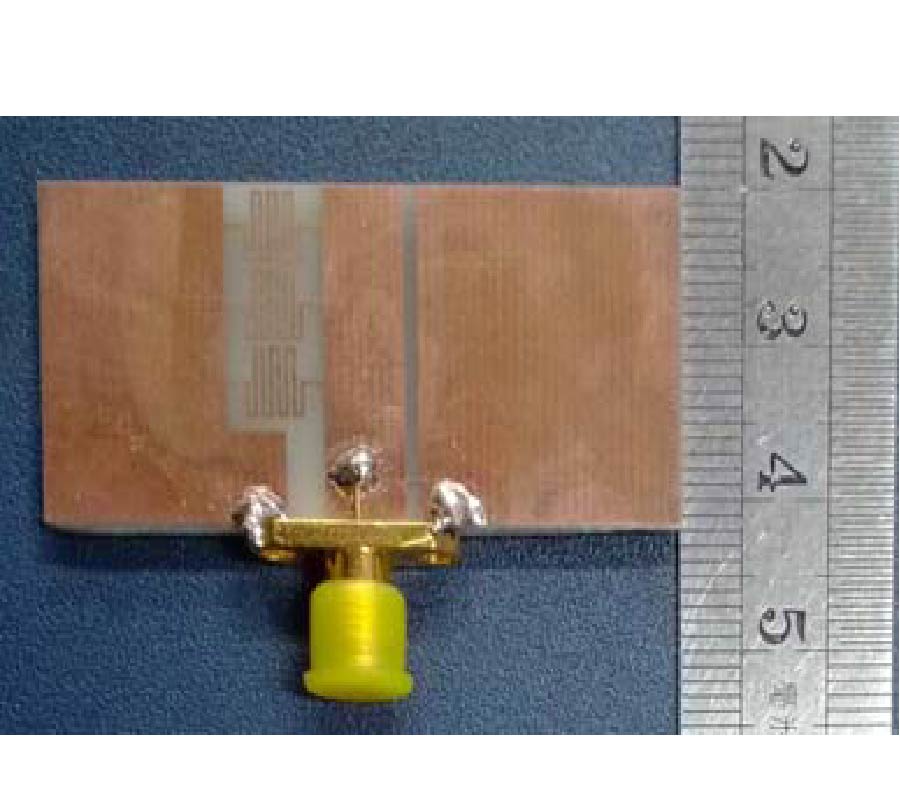
In this paper, a printed slot antenna fed by a co-planar waveguide for ultra wide bandwidth (UWB) with dual notch bands has been presented and discussed. The band notches are realized by etching one C-slot resonator inside a plaque shape exciting stub as well as symmetrically adding a pair of open-circuit stubs at the edge of the slot resulting in dual stop band filtering properties for WiMAX, WLAN application. Surface current distributions are used to analyze the effects of the slot and open circuit stub. The proposed antenna is fabricated and experimental results show that it has an impedance bandwidth of 2.6-14.34 GHz for VSWR ≤ 2, except dual frequency stop-bands of 3.3-3.7, 5.04-6.0 GHz. From the simulation results, it is observed that the radiation patterns are omnidirectional in the H-plane and dipole like nature in the E-plane. The gain varies from 3.7 dB to 5.7 dB over the whole UWB region excluding at notch bands.
AN OPTIMAL DESIGN OF CPW-FED UWB APERTURE ANTENNAS WITH WIMAX/WLAN NOTCHED BAND CHARACTERISTICS
2012-12-24
PIER
Vol. 135, 347-362
A Novel Slotted Helix Slow-Wave Structure for Millimeter-Wave Traveling-Wave Tube
Lu-Wei Liu , Yan-Yu Wei , Jin Xu , Zhi-Gang Lu , Hai-Rong Yin , Ling-Na Yue , Hua-Rong Gong , Guoqing Zhao , Zhaoyun Duan , Wen-Xiang Wang and Yu-Bin Gong
A novel slotted helix slow-wave structure (SWS) is proposed to develop high power, wide-bandwidth, high reliability millimeter-wave traveling-wave tube (TWT). This structure, which can improve the heat dissipation capability of the helix SWS, evolves from conventional helix SWS with three parallel rows of rectangular slots made in the outside of the helix. In this paper, thermal stress analysis, the electromagnetic characteristics and the beam-wave interaction of this structure are investigated. The conclusions of this paper will be a great help for the design of millimeter-wave traveling-wave tube.
A NOVEL SLOTTED HELIX SLOW-WAVE STRUCTURE FOR MILLIMETER-WAVE TRAVELING-WAVE TUBE
2012-12-24
PIER
Vol. 135, 331-346
Comparison of Different Methods for the Experimental Antenna Phase Center Determination Using a Planar Acquisition System
Pablo Padilla , Jose-Manuel Fernandez Gonzalez , Jose Luis Padilla , Gonzalo Exposito-Dominguez , Manuel Sierra-Castaner and Belen Galocha Iraguen
This work provides the comparison of different methods for the experimental determination of the phase center location of an antenna. The phase center position is determined by means of measured data obtained with a planar scanning system and computed with different methods: a least squares fit method with and without weighting coefficients and a directivity-based plane wave spectrum (PWS) analysis method. A study of the phase center position for different microwave antennas is provided. The results of the different methods are presented and compared, along with the confidence interval of the phase center values due to the uncertainties of the acquisition system.
COMPARISON OF DIFFERENT METHODS FOR THE EXPERIMENTAL ANTENNA PHASE CENTER DETERMINATION USING A PLANAR ACQUISITION SYSTEM
2012-12-24
PIER
Vol. 135, 317-330
A 38 to 44 GHz Sub-Harmonic Balanced Hbt Mixer with Integrated Miniature Spiral Type Marchand Balun
Tom Keinicke Johansen and Viktor Krozer
This work presents an active balanced sub-harmonic mixer (SHM) using InP double heterojunction bipolar transistor technology (DHBT) for Q-band applications. A miniature spiral type Marchand balun with five added capacitances for improved control of amplitude and phase balance is integrated with the SHM. The measured results for the SHM demonstrates a conversion gain of 1.2 dB at an RF frequency of 41 GHz with an associated LO power of 5 dBm. The conversion loss remains better than 3 dB from 38 to 44 GHz. The LO to IF isolation is better than 42 dB within the bandwidth of the mixer and confirms the excellent balance of the integrated spiral type Marchand balun. The DC power consumption of the SHM is only 22.5 mW under normal mixer operation.
A 38 TO 44 GHZ SUB-HARMONIC BALANCED HBT MIXER WITH INTEGRATED MINIATURE SPIRAL TYPE MARCHAND BALUN
2012-12-24
PIER
Vol. 135, 297-316
Implementation of FDTD-Compatible Green's Function on Heterogeneous Cpu-GPU Parallel Processing System
Tomasz P. Stefanski
This paper presents an implementation of the FDTD-compatible Green's function on a heterogeneous parallel processing system. The developed implementation simultaneously utilizes computational power of the central processing unit (CPU) and the graphics processing unit (GPU) to the computational tasks best suited to each architecture. Recently, closed-form expression for this discrete Green's function (DGF) was derived, which facilitates its applications in the FDTD simulations of radiation and scattering problems. Unfortunately, implementation of the new DGF formula in software requires a multiple precision arithmetic and may cause long runtimes. Therefore, an acceleration of the DGF computations on a CPU-GPU heterogeneous parallel processing system was developed using the multiple precision arithmetic and the OpenMP and CUDA parallel programming interfaces. The method avoids drawbacks of the CPU- and GPU-only accelerated implementations of the DGF, i.e. long runtime on the CPU and significant overhead of the GPU initialization respectively for long and short lengths of the DGF waveform. As a result, the seven-fold speedup was obtained relative to the reference DGF implementation on a multicore CPU thus applicability of the DGF in FDTD simulations was significantly improved.
IMPLEMENTATION OF FDTD-COMPATIBLE GREEN'S FUNCTION ON HETEROGENEOUS CPU-GPU PARALLEL PROCESSING SYSTEM
2012-12-24
PIER
Vol. 135, 281-296
Simplification Method for Modeling Crosstalk of Multicoaxial Cable Bundles
Liang Liang Liu , Zhuo Li , Jian Yan and Chang Qing Gu
In this work, a new efficient simplification method is proposed for crosstalk prediction of multicoaxial cable bundles (MCCB). The purpose of the new simplification method is to reduce the simulation time by reducing the complexity of the complete cable bundle model. A modified five-step procedure is established to define the electrical and geometrical characteristics of the reduced cable bundle by making the outer and inner conductor of the coaxial cable participate in the equivalence procedure respectively. After a short presentation of the MCCB coupling problem, the theory fundamentals of the new simplification method and numerical simulations performed on a simple MCCB are presented to demonstrate the efficiency and the advantages of the new simplification method.
SIMPLIFICATION METHOD FOR MODELING CROSSTALK OF MULTICOAXIAL CABLE BUNDLES
2012-12-22
PIER
Vol. 135, 271-280
Grating Effects on Sidelobe Suppression in MIM Plasmonic Filters
Ramin Djabery , Saeid Nikmehr and Shahram Hosseinzadeh
In this paper a procedure for sidelobe suppression in the frequency response of a MIM (metal-insulator-metal) plasmonic filter is presented. Using the calculated effective refractive index for various values of the width of dielectric core and Bragg condition, the structural profile of primary filter is obtained. The frequency response for the transmission coefficient of the MIM plasmonic filter is derived by TRC-LOD-FDTD method. The variation in the frequency response of the filter due to changes in the structural parameters is studied. Finally, the usage of Gaussian, sinusoidal and linear types of gratings in suppressing the sidelobes and their effects on the stop-band bandwidth of the MIM plasmonic filter is investigated.
GRATING EFFECTS ON SIDELOBE SUPPRESSION IN MIM PLASMONIC FILTERS
2012-12-21
PIER Letters
Vol. 36, 181-190
A Compact Ka-Band Broadband Waveguide-Based Traveling-Wave Spatial Power Combiner with Low Loss Symmetric Coupling Structure
Zhi-Yong Kang , Qing-Xin Chu and Qiong Sen Wu
A compact Ka-band broadband waveguide-based traveling-wave spatial power combiner is presented. The low loss micro-strip probes are symmetrically inserted into both broadwalls of waveguide, quadrupling the coupling ways but the insertion loss increases little. The measured 16 dB return-loss bandwidth of the eight-way back-to-back structure is from 30 GHz to 39.4 GHz (more than 25%) and the insertion loss is less than 1 dB, which predicts the power-combining efficiency is higher than 90%. Ka
A COMPACT KA-BAND BROADBAND WAVEGUIDE-BASED TRAVELING-WAVE SPATIAL POWER COMBINER WITH LOW LOSS SYMMETRIC COUPLING STRUCTURE
2012-12-21
PIER C
Vol. 35, 147-159
Broadband Substrate Integrated Coaxial Line to Cbcpw Transition for Rat-Race Couplers and Dual-Band Couplers Design
Qiang Liu , Yuan'an Liu , Yongle Wu , Shulan Li , Cuiping Yu and Ming Su
In this paper, broadband transitions from substrate integrated coaxial line (SICL) to a conductor-backed coplanar waveguide (CBCPW) are proposed and designed. Measurement results show that the insertion loss and return loss are better than -0.5 dB and -10 dB, respectively from 0 to 13 GHz. Then, for verifying the performance of SICL and the validity of SICL transition design, a 3 dB SICL rat-race coupler operating at 2.3 GHz is designed, fabricated, and measured. Compared with the conventional microstrip line coupler, this SICL coupler maintains good performance but with a remarkable 24% reduction in size. At last, a 10 dB dual-band coupled SICL coupler operating at 2.4/5.8 GHz is proposed, and the measured results agree well with the schematic and electromagnetic simulated results. The measured results demonstrate that the fabricated bandwidths are 30% and 12.8%, the |S31| are -10.1 dB and -10.3 dB, the directivities are 18 dB and 20 dB at the low (2.4 GHz) and high (5.8 GHz) operating frequencies, respectively. Compare with the dual-band coupled microstrip line coupler, performance of the dual-band coupled SICL coupler is enhanced.
BROADBAND SUBSTRATE INTEGRATED COAXIAL LINE TO CBCPW TRANSITION FOR RAT-RACE COUPLERS AND DUAL-BAND COUPLERS DESIGN
2012-12-21
PIER
Vol. 135, 261-269
A Tunable 1.4-2.5 GHz Bandpass Filter Based on Single Mode
YanYi Wang , Feng Wei , He Xu and Xiao-Wei Shi
A new type of varactor-tuned microstrip bandpass filter (BPF) based on a single 1/2λ resonator is investigated. The proposed resonator is composed of a transmission line with both ends short-ended and two varactors inserted symmetrically in the middle section. The variation of coupling coefficient can be controlled by using an inductor. With the proposed structure, it is easy to adjust the external quality factor of the filter and to control the bandwidth. Extra dc-block capacitors for the input and output ports are not necessary because the design of the proposed tunable 1/2λ resonator makes the varactor act as both a frequency tuning element and a dc-block circuit. The proposed BPF is found to have the advantages of compact size, low insertion loss, large tuning range and good linearity.
A TUNABLE 1.4-2.5 GHZ BANDPASS FILTER BASED ON SINGLE MODE
2012-12-20
PIER Letters
Vol. 36, 171-179
A Novel Microstrip LC Reconfigurable Bandpass Filter
Qian-Yin Xiang , Quanyuan Feng , Xiao-Guo Huang and Ding-Hong Jia
In this paper, we propose and develop a novel reconfigurable bandpass filter based on microstrip LC resonators. The equivalent circuit model of the proposed filter is presented. The filter can be reconfigured by tuning the capacitance of the microstrip LC resonators. A reconfigurable bandpass filter based on semiconductor varactor diode loaded microstrip LC resonators with a tuning range of 2.496 GHz to 2.937 GHz, and a fractional bandwidth of 6.3% to 8.2% is demonstrated, and the measured insertion loss is 1.7 dB to 3.8 dB. The out-band rejection is better than 25 dB up to 10 GHz.
A NOVEL MICROSTRIP LC RECONFIGURABLE BANDPASS FILTER
2012-12-20
PIER
Vol. 135, 245-260
An Unconditional Stable 1D-FDTD Method for Modeling Transmission Lines Based on Precise Split-Step Scheme
Wei Wang , Pei-Guo Liu and Yu-Jian Qin
his paper presented a novel unconditional stable FDTD (US-FDTD) algorithm for solving the transient response of uniform or nonuniform multiconductor transmission line with arbitrary coupling status. Analytical proof of unconditional stability and detailed analysis of numerical dispersion are presented. The precise split-time-step scheme has been introduced to eliminate the restriction of the Courant-Friedrich-Levy (CFL) condition. Compared to the conventional USFDTD methods, the proposed approach generally achieves lower phase velocity error for coarse temporal resolution. So larger time scales can be chosen for the transient simulation to achieve accurate results efficiently. Several examples of coupled uniform and nonuniform lines are presented to demonstrate the accuracy, stability, and efficiency of the proposed model.
AN UNCONDITIONAL STABLE 1D-FDTD METHOD FOR MODELING TRANSMISSION LINES BASED ON PRECISE SPLIT-STEP SCHEME
2012-12-20
PIER
Vol. 135, 231-244
Modeling Radiated Electromagnetic Emissions of Electric Motorcycles in Terms of Driving Profile Using Mlp Neural Networks
Ahmed Wefky , Felipe Espinosa , Luis de Santiago , Alfredo Gardel , Pedro Revenga and Miguel Martinez
Current automotive electromagnetic compatibility (EMC) standards do not discuss the effect of the driving profile on real traffic vehicular radiated emissions. This paper describes a modeling methodology to evaluate the radiated electromagnetic emissions of electric motorcycles in terms of the driving profile signals such as the vehicle velocity remotely controlled by means of a CAN bus. A time domain EMI measurement system has been used to measure the temporal evolution of the radiated emissions in a semi-anechoic chamber. The CAN bus noise has been reduced by means of adaptive frequency domain cancellation techniques. Experimental results demonstrate that there is a temporal relationship between the motorcycle velocity and the radiated emission power in some specific frequency ranges. A Multilayer Perceptron (MLP) neural model has been developed to estimate the radiated emissions power in terms of the motorcycle velocity. Details of the training and testing of the developed neural estimator are described.
MODELING RADIATED ELECTROMAGNETIC EMISSIONS OF ELECTRIC MOTORCYCLES IN TERMS OF DRIVING PROFILE USING MLP NEURAL NETWORKS
2012-12-19
PIER B
Vol. 47, 87-105
Analysis of Radial Magnetized Permanent Magnet Bearing Characteristics
Siddappa Iranna Bekinal , Anil Tumkur Ramakrishna and Soumendu Jana
With an increase in the number of high speed applications, researchers have been concentrating on permanent magnet bearings due to their suitability. This paper presents a mathematical model of a permanent magnet bearing made of ring magnets with radial polarizations. Coulombian model and vector approach are used to estimate the force, moment and stiffness. A MATLAB code is developed for evaluating the envisaged parameters for three degrees (translational) of freedom of the rotor. The proposed model is validated with the available literature. Comparison of force and stiffness results of the presented model with that reported in the literature and also with the results of 3D finite element analysis shows good agreement. Then, it is extended to analyse stacked ring magnets with alternate radial polarizations. Finally, the cross coupled stiffness values in addition to the principal stiffness values are presented for the elementary structure and also for stacked structure with three ring permanent magnets with alternate radial polarizations.
ANALYSIS OF RADIAL MAGNETIZED PERMANENT MAGNET BEARING CHARACTERISTICS
2012-12-19
PIER C
Vol. 35, 135-145
Design of Novel Reconfigurable Frequency Selective Surfaces with Two Control Techniques
Khaled Elmahgoub , Fan Yang and Atef Elsherbeni
Novel reconfigurable frequency selective surfaces (RFSS) are designed using a finite-difference time-domain with periodic boundary condition (FDTD/PBC) algorithm. The FSS are reconfigured using two techniques: the first technique providing a wide frequency tuning range is based on using diodes to change the current distribution over the FSS surface, and the second technique exhibiting a finer frequency tuning resolution is based on changing the grid orientation of the FSS mechanically. Simulation results are provided to validate the concept of RFSS. The results show that these designs provide a wide dynamic range of reconfigurability and a large degree of freedom in controlling the FSS frequency response.
DESIGN OF NOVEL RECONFIGURABLE FREQUENCY SELECTIVE SURFACES WITH TWO CONTROL TECHNIQUES
2012-12-19
PIER M
Vol. 22, 149-162
Dispersion Characteristics and Optimization of Reflectivity of Binary One Dimensional Plasma Photonic Crystal Having Linearly Graded Material
Surendra Prasad , Vivek Singh and Abhay Kumar Singh
The effect of graded permittivity profiles, filling factor and incident angles on the dispersion characteristics and reflectivity of binary one dimensional plasma photonic crystals having linearly graded dielectric materials are investigated by using the transfer matrix method. It is observed that position, width of band gap and high reflectance range can be improvised to desired level by proper choice of filling factor and graded permittivity index. The incident angle is found to affect the band gap and high reflectance range. Our analysis also shows that this plasma photonic crystal may be used for sensing applications.
DISPERSION CHARACTERISTICS AND OPTIMIZATION OF REFLECTIVITY OF BINARY ONE DIMENSIONAL PLASMA PHOTONIC CRYSTAL HAVING LINEARLY GRADED MATERIAL
2012-12-19
PIER
Vol. 135, 215-229
A Variable Prf Imaging Method for High Squint Diving SAR
Huaping Xu , Jing Gao and Jianlong Li
The high squint diving SAR is widely used to provide the information in advance. Large squint angle deduces the deeper coupling of range and azimuth of SAR echoes which makes SAR imaging more difficult. Especially, the large range migration of the deep couple heavily burdens the imaging processing time and storage units. The diving motion of platform worsens the situation. This paper proposes the varied azimuth sample frequency (Pulse Repeat Frequency, PRF) to implement the high squint diving SAR imaging. Based on the signal model of the diving squint SAR, it is analyzed that the range walk is the prominent component of range migration in the high squint SAR. The varied PRF imaging method dramatically decreases the range walk of echoes by shifting the beginning position of transmitted pulses and received echoes and the shift is implemented by the PRF variation. Then the range migration is decreased and the couple of range and azimuth of SAR echoes is reduced. The PRF variation law is deduced and the applicable condition of varied PRF is presented. The simulation results show that the variable PRF method is efficient to reduce range walk of echoes. Comparison to the traditional constant PRF, the novel variable PRF method for high squint needs less storage and less time expense, which is helpful to real time SAR imaging. The non-uniform FFT can be used for the azimuth compressing of the variable PRF SAR. It will simplify the implementation of the variable PRF SAR imaging.
A VARIABLE PRF IMAGING METHOD FOR HIGH SQUINT DIVING SAR
2012-12-19
PIER
Vol. 135, 201-213
A Substrate Integrated Waveguide Bandpass Filter Using Novel Defected Ground Structure Shape
Yong Mao Huang , Zhenhai Shao and Lianfu Liu
In this paper, a X-band wideband bandpass filter based on a novel substrate integrated waveguide-to-defected ground structure (SIW-DGS) cell is proposed. In the cell, the DGS is etched on the top plane of the SIW with high accuracy, so that the performance of the filter can be kept as good as possible. Finally, the filter, consisting of three cascaded cells, is designed and measured to meet compact size, low insertion loss, good return loss as well as smooth group delay. There is good agreement between the measurement and simulation results.
A SUBSTRATE INTEGRATED WAVEGUIDE BANDPASS FILTER USING NOVEL DEFECTED GROUND STRUCTURE SHAPE
2012-12-19
PIER
Vol. 135, 183-199
Estimation of the Atmospheric Duct from Radar Sea Clutter Using Artificial Bee Colony Optimization Algorithm
Chao Yang
In this study, the Artificial Bee Colony Optimization (ABCO) algorithm has been proposed to estimate the atmospheric duct in maritime environment. The radar sea clutter power is calculated by the parabolic equation method. In order to validate the accuracy and robustness of ABCO algorithm, the experimental and simulation study are respectively carried out in the current research. In the simulation study, the statistical analysis of the estimation results in term of the mean squared error (MSE), mean absolute deviation (MAD) and mean relative error (MRE) are presented to analyze the optimization performance with different noise standard deviation, and the comparative study of the performance of ABCO and particle swarm optimization (PSO) algorithm are also shown. The investigation presented indicate that the ABCO algorithm can be accurately and effectively utilized to estimate the evaporation duct and surface-based duct using refractivity from clutter (RFC) technique in maritime environment. In addition, the performance of ABCO algorithm is clearly superior to that of the PSO algorithm according to the statistical analysis results, especially for the four-parameter surface-based duct estimation.
ESTIMATION OF THE ATMOSPHERIC DUCT FROM RADAR SEA CLUTTER USING ARTIFICIAL BEE COLONY OPTIMIZATION ALGORITHM
2012-12-18
PIER
Vol. 135, 161-181
Sparse Array Microwave 3-D Imaging: Compressed Sensing Recovery and Experimental Study
Shun-Jun Wei , Xiao-Ling Zhang , Jun Shi and Ke-Fei Liao
Microwave array 3-D imaging is an emerging technique capable of producing a 3-D map of scattered electric fields. Its all-weather and large scene imaging features make it an attractive powerful tool for target detection and feature extraction. Typically, a microwave array 3-D imaging system based on the classical sampling theory requires a large dense 2-D antenna array, which may suffer from a very high cost. To reduce the number of the antenna array elements, this paper surveys the use of compressed sensing recovery and sparse measurement strategies for microwave array 3-D imaging. Combining with the typical spatial sparsity of the underlying scene, we pose the sparse array microwave 3-D imaging as finding sparse solutions to under-determined linear equations. Further, to reduce the computational of the compressed sensing recovery with the large-scale echoes data, we divide the underlying 3-D scene into a series of equal-range 2-D slices, and deal with these slices separately using the orthogonal matching pursuit (OMP) algorithm. Lastly, the performance of the presented compressed sensing approach is verified by an X-band microwave array 3-D imaging system. The experimental results demonstrate that the compressed sensing approach can produce a better resolution 3-D image of the observed scatterers compared with the conventional method, especially in the case of very sparse activate antenna array.
SPARSE ARRAY MICROWAVE 3-D IMAGING: COMPRESSED SENSING RECOVERY AND EXPERIMENTAL STUDY