Search Results(13800)

2012-04-23
PIER C
Vol. 29, 41-53
Passive Compensation of Beam Shift in a Bending Array
Toby J. Seidel , Wayne Rowe and Kamran Ghorbani
An array of conformal antenna structures mounted on a bending surface exhibits a substantial shift in main beam direction. This paper demonstrates a method to compensate for the induced beam shift by using the change in length of the surface produced by the bend. This change in length modifies the capacitance in a composite right/left-handed transmission (CRLHTL) line, causing a phase shift in the line. A potential implementation is proposed that can correct an 18º beam shift with only an induced change in length of 0.144%. The paper establishes that this passive compensation concept is feasible and provides significant benefits over active compensation systems in terms of weight reduction, cost, simplification and the ability to operate in radio silence.
PASSIVE COMPENSATION OF BEAM SHIFT IN A BENDING ARRAY
2012-04-22
PIER B
Vol. 40, 241-260
A Compact Coplanar Broadband Rectangular Slot Antenna with E-Shaped Feeding Structure for GPR Applications
Florence Sagnard
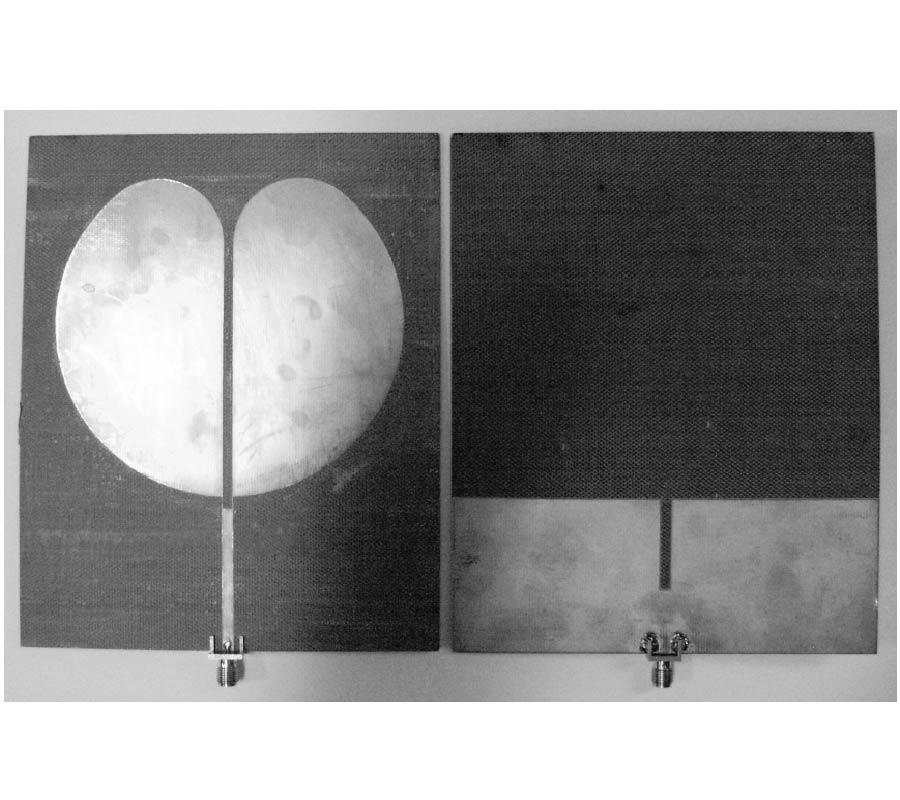
A coplanar rectangular slot antenna operating in the very wide frequency band from 0.27 to 3.1 GHz (bandwidth over 166%) has been designed for GPR applications. The antenna, which is supposed to be positioned on the soil surface, appears particularly compact (34 x 29 cm2) and exhibits a low cross-polarization in the E-plane. 3D FDTD simulations have allowed to make a detailed parametric study associated with the antenna dimensional parameters in order to optimize the radiating performances. The slot antenna has also been studied with a shield to be further integrated in a bistatic subsurface radar positioned on the soil surface. Simulated results of the link in the presence of a homogeneous soil then including buried objects met in civil engineering structures are presented and discussed. First experimental results on a sandy soil have been compared to numerical ones.
A COMPACT COPLANAR BROADBAND RECTANGULAR SLOT ANTENNA WITH E-SHAPED FEEDING STRUCTURE FOR GPR APPLICATIONS
2012-04-22
PIER B
Vol. 40, 221-240
Design of Microwave Devices Exploiting Fibonacci and Hybrid Periodic/Fibonacci One Dimensional Photonic Crystals
Abir Mouldi and Mounir Kanzari
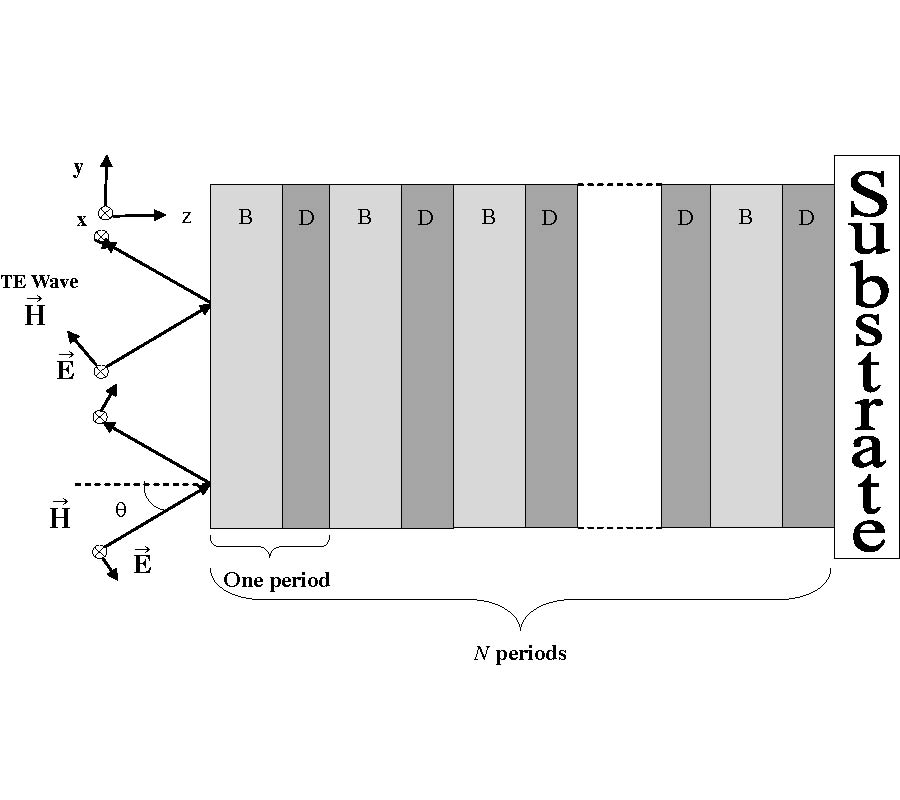
We report the transmission response of generalized Fibonacci photonic crystal Fl(m,n) in microwave domain for normal incidence, where l is the generation number, and m and n are parameters of the Fibonacci distribution. The transmission spectra are calculated through the transfer matrix method and studied by varying the Fibonacci parameters. The structure is exploited to design a microwave mirror with large photonic band gap and polychromatic stop band filters. Therefore, other structure configurations based on the generalized Fibonacci system are proposed. A juxtaposition of p multilayer systems built according to Fibonacci distribution [Fl(m,n)]p makes possible to have switches like property (off-on-off-on-off-on-…). Then, an hybrid structure which is obtained by sandwiching p stacks of generalized Fibonacci photonic crystal between two periodic photonic crystals is proposed to enlarge the photonic band gap in microwave domain.
DESIGN OF MICROWAVE DEVICES EXPLOITING FIBONACCI AND HYBRID PERIODIC/FIBONACCI ONE DIMENSIONAL PHOTONIC CRYSTALS
2012-04-22
PIER Letters
Vol. 31, 159-168
A Compact UWB Monopole Antenna with WiMAX and WLAN Band Rejections
Si-Ming Zhang , Fu-Shun Zhang , Wen-Zhu Li , Ting Quan and Hui-Ying Wu
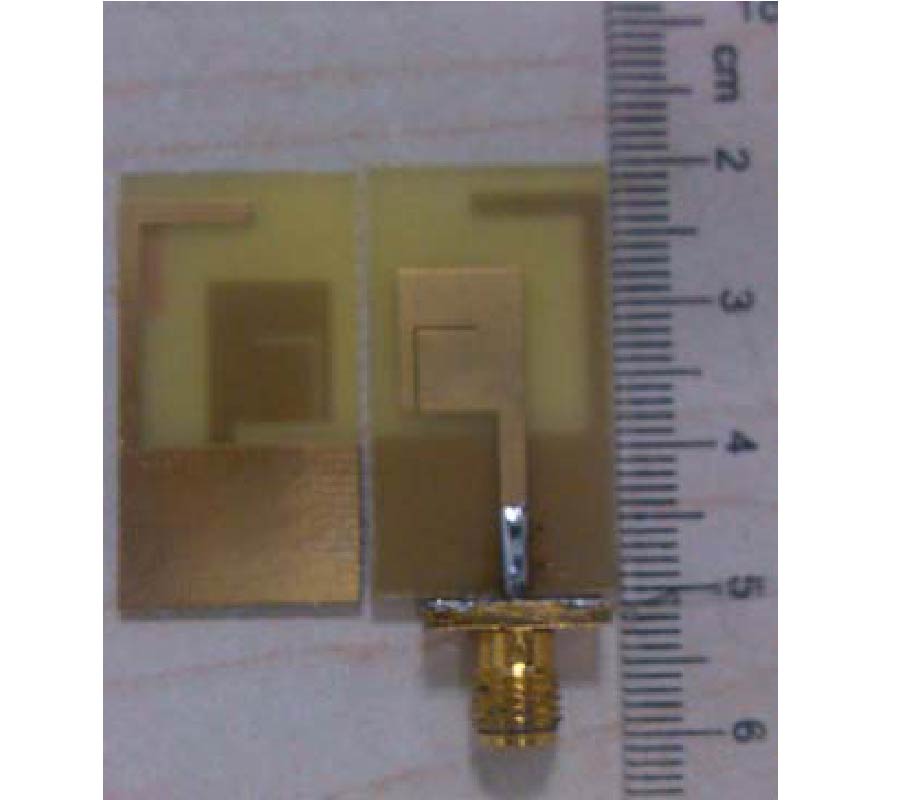
A compact ultrawideband (UWB) monopole antenna with two U-shaped slots for WLAN and WiMAX dual band-notched functions is proposed and experimentally studied. The proposed antenna with the size of 28 mm×24 mm×1.6 mm is excited by a 50Ω microstrip feed line. The band-notch functions are realized by loading two approximate half-wavelength U-shaped slots which change the current distribution on the Y-shaped patch. The obtained results show that the designed antenna has an impedance bandwidth of 2.95 GHz-12 GHz for S11 ≤ -10 dB, except two frequency stop-bands of 3.32 GHz-3.98 GHz for WiMAX and 4.81 GHz-6.68 GHz for WLAN. The antenna has successfully fabricated and measured. The return loss, band-notched characteristic, radiation patterns and peak gains are presented.
A COMPACT UWB MONOPOLE ANTENNA WITH WIMAX AND WLAN BAND REJECTIONS
2012-04-21
PIER C
Vol. 29, 29-39
Miniaturized Substrate Integrated Waveguide Dual-Mode Filters Loaded by a Series of Cross-Slot Structures
Li-Na Chen , Yong-Chang Jiao , Zheng Zhang and Fu-Shun Zhang
A family of miniaturized substrate integrated waveguide (SIW) dual-mode filters with a series of cross-slot structures etched on the waveguide surface are investigated and presented. By introducing the series of cross-slot structures: pure cross-slot, T-shaped loaded cross-slot and H shaped loaded cross-slot in original dual-mode SIW filters, size reductions of 22.15%, 30.56% and 56.25% are achieved, respectively. Moreover, the proposed family of SIW dual-mode filters can produce two controllable transmission zeros. Compared with SIW dual-mode filters in references and original filter, proposed filters exhibit compact size while retain good performance of bandwidth and minimum insertion loss. To verify the presented design, three SIW dual-mode filters are fabricated on the standard printed circuit board process. The measured results are in good agreement with the simulation.
MINIATURIZED SUBSTRATE INTEGRATED WAVEGUIDE DUAL-MODE FILTERS LOADED BY A SERIES OF CROSS-SLOT STRUCTURES
2012-04-21
PIER C
Vol. 29, 17-28
Rectangular Stepped Patch Antenna at GSM 900 for Energy Scavenging
Norashidah Md. Din , Chandan Kumar Chakrabarty , Kavuri Kasi Annapurna Devi and Subbarayan Sadasivam
This paper presents a novel 377 Ω rectangular stepped patch antenna with partial ground plane at downlink radio frequency range of GSM-900 band. Two steps are incorporated into the patch antenna, and bandwidth expansion was investigated by the currents flowing through the patch antenna. The antenna simulation was carried out in the ADS 2009 environment. The fabricated antenna on FR4 substrate indicates an impedance bandwidth of 32.7% (310 MHz) at 947 MHz centre frequency with return loss of -28.12 dB. The simulated, test and field results of the antenna design are discussed.
RECTANGULAR STEPPED PATCH ANTENNA AT GSM 900 FOR ENERGY SCAVENGING
2012-04-21
PIER M
Vol. 24, 167-178
Radar Identification of Hostile Fire by Means of the Electromagnetic Complex Natural Resonances of Projectiles
Stuart William Harmer , Shawn Edward Cole and Nicholas John Bowring
The authors discuss and demonstrate the feasibility of using ultra wide band microwave radar to detect and identify small arms fire. Detection and tracking is by standard radar techniques, but identification is carried out by exciting the projectiles Complex Natural Resonances and using this aspect independent information to assign a caliber to the incoming projectiles. The typical sizes of small arms projectiles (calibers 5.56 mm through to 13 mm) imply that ultra wide band illumination in the microwave region of the spectrum between 1.5-5.5 GHz is required to excite these object's fundamental resonances. The authors give a discussion of the effects of motion on the quality of the complex natural resonance data obtainable and present both simulated and laboratory data for the radar cross section of three different caliber projectiles (5.56 mm, 7.62 mm and 13 mm).
RADAR IDENTIFICATION OF HOSTILE FIRE BY MEANS OF THE ELECTROMAGNETIC COMPLEX NATURAL RESONANCES OF PROJECTILES
2012-04-20
PIER Letters
Vol. 31, 147-157
Material Selection of RF-MEMS Switch Used for Reconfigurable Antenna Using Ashby's Methodology
Ashish Kumar Sharma and Navneet Gupta
This paper reports material selection methodology for radio frequency - micro electro mechanical systems (RF-MEMS) switches used for reconfigurable antennas. As there are variety of materials available to design engineer, a proper technique to select the best possible material is needed. Three primary performance indices, pull-in voltage, RF-loss, and thermal residual stress, are used to obtain the desired performance. The selection chart shows that aluminum is the most suitable material for being used as bridge material in RF-MEMS switches to provide the best performance in reconfigurable antenna.
MATERIAL SELECTION OF RF-MEMS SWITCH USED FOR RECONFIGURABLE ANTENNA USING ASHBY'S METHODOLOGY
2012-04-20
PIER
Vol. 127, 335-350
Efficient Geosynchronous Circular SAR Raw Data Simulation of Extended 3-D Scenes
Qi Liu , Wen Hong , Weixian Tan and Yirong Wu
Geosynchronous Circular Synthetic Aperture Radar (GeoCSAR) has the Circular SAR configuration and undergoes a near-ellipse geosynchronous track rather a ``8''-like track of conventional GeoSAR. It could produce three dimensional (3-D) images of extended Earth scenes. GeoCSAR raw data simulator is of vital for predicting system performance, developing suitable data processing algorithms, etc.. It should include degrading conditions such as motion instability, angular deviations and orbit perturbations in order to approach the real situation. The common generation algorithm of raw data in time domain is precise but time-consuming for extended 3-D scene. In this paper, a novel raw data simulation algorithm based on inverse Improved Polar Format Algorithm (IPFA) for GeoCSAR was proposed, which possessed both the advantages of precision of time domain simulator and efficiency of frequency domain simulator. Implementation details were presented, and several simulation results were provided and analyzed to validate the algorithm.
EFFICIENT GEOSYNCHRONOUS CIRCULAR SAR RAW DATA SIMULATION OF EXTENDED 3-D SCENES
2012-04-20
PIER
Vol. 127, 319-334
Study and Simulation of an Edge Couple Split Ring Resonator (EC-SRR) on Truncated Pyramidal Microwave Absorber
Hassan Nornikman , Badrul Hisham Ahmad , Mohamad Zoinol Abidin Abd Aziz , Mohd Fareq Bin Abd Malek , Hindstan Imran and Abdul Rani Othman
Split ring resonator (SRR) can potentially be used as a design to be incorporated onto the truncated pyramidal microwave absorber. This study considers three different patterns of edge couple split ring resonator (EC-SRR) designs. Each EC-SRR design is then placed onto the truncated pyramidal microwave absorber. Outer split gap dimension widths of the EC-SRR are varied, and the various S21 performances are compared. This EC-SRR truncated pyramidal microwave absorber is simulated using CST Microwave Studio simulation software. The study and simulation are performed in low frequency range (0.01 GHz to 1 GHz) as well as in microwave frequencies range (1 GHz to 20 GHz). Simulation results of this EC SRR show improvement of reflection loss and S11 performance in the high frequency range of the pyramidal truncated microwave absorber.
STUDY AND SIMULATION OF AN EDGE COUPLE SPLIT RING RESONATOR (EC-SRR) ON TRUNCATED PYRAMIDAL MICROWAVE ABSORBER
2012-04-19
PIER B
Vol. 40, 201-220
Contour- and Grid-Based Algorithm for Mixed Triangular-Rectangular Planar Mesh Generation
Tomasz A. Linkowski and Piotr M. Slobodzian
A mesh generation algorithm for the Method of Moments (MoM) is described. The algorithm, named CGSM, can mesh arbitrary planar shapes described with line segments and circular arcs into mixed triangular and rectangular cells. CGSM creates contours of the meshed shape and uses them to provide edge mesh (denser mesh near edges), creates an adaptive grid and uses it to insert axis-aligned rectangles in the interior, and finally, triangulates the remaining area (the Delaunay condition is imposed on the triangulation). CGSM is compared to two commercial applications (Designer® and IE3D™) on the example of a 2-GHz hybrid ring coupler. The same simulation results are obtained. However, with CGSM, simulation time is significantly reduced.
CONTOUR- AND GRID-BASED ALGORITHM FOR MIXED TRIANGULAR-RECTANGULAR PLANAR MESH GENERATION
2012-04-19
PIER M
Vol. 24, 157-165
Statistical Analysis of Electromagnetic Field Inside a Jet Engine Using the Reverberation Chamber Approach
Aya Fekry Abdelaziz , Daniele Trinchero and Tamer Khattab
In this paper, the electromagnetic field distribution inside a jet engine is studied through full wave analysis. Results are statistically analyzed by comparisons to the models used for the reverberation chamber with a mechanical mode stirrer. The jet engine is simulated as an open cylinder containing one set of rotating blades by using 'Ansys R HFSS'. A simple Hertzian dipole illuminates the interior structure as an incident wave excitation representing a transmitting antenna radiating continuous wave fields. The field distribution inside the engine, which results from a distinct set of rotating positions of the blades, is primarily studied through the simulation program. In our case, the mechanical stirrer is represented by the rotating set of blades. The field values are extracted at different planes along the cylindrical engine, and the average field is statistically analyzed. We show that the squared magnitude of the field component along the engine's main axis has an exponential distribution compared to the theoretical exponential distribution proved in a reverberation chamber. This approach promises to act as a novel effective method to analyze the engine system without dealing with the complex details inside the engine cavity.
STATISTICAL ANALYSIS OF ELECTROMAGNETIC FIELD INSIDE A JET ENGINE USING THE REVERBERATION CHAMBER APPROACH
2012-04-19
PIER M
Vol. 24, 141-155
Optimal Synthesis of Thinned Arrays Using Biogeography Based Optimization
Urvinder Singh and Tara Singh Kamal
Thinning of large arrays in order to produce low side lobes is a difficult task. Conventional gradient methods often stuck in local minima and hence are not capable of obtaining optimum solutions. As a result, global optimization methods are required to thin large antenna arrays. In this paper, a global evolutionary method, Biogeography based optimization (BBO) is introduced as a new tool for thinning large linear and planar antenna arrays of uniformly excited isotropic antennas. The aim is to synthesize linear arrays so as to yield the maximum relative sidelobe level (SLL) equal to or below a desired level while also keeping the percentage of thinning equal to or above the desired level. The results obtained by BBO are compared with the previous published results of Genetic Algorithm (GA), Ant Colony Optimization (ACO), Immunity Genetic Algorithm (IGA) and Binary Particle Swarm Optimization (BPSO).
OPTIMAL SYNTHESIS OF THINNED ARRAYS USING BIOGEOGRAPHY BASED OPTIMIZATION
2012-04-18
PIER B
Vol. 40, 185-200
Implementation of RFID and Bluetooth Technology for Data Tagging and Transmission to Point of Sale
Mardeni Roslee and Teik Wei Lee
The design of wireless technology which involves radio frequency identification (RFID) and Bluetooth technology for tagging and transmission of data that will be applied to point of sale (POS) is presented. A complete POS circuitry system has been designed to allow certain item to be a tag easily identified and localized. This is implemented by using RFID technology which will communicate with personal computer (PC) either through Ethernet or Wifi connection. An Impinj RFID reader and Bluetooth mobile phone are selected in the proposed POS system. Matlab simulation has been performed for RFID transceiver part and Bluetooth data transmission. A prototype software is developed to interface the Impinj RFID reader through the Ethernet connection. Additionally, a data encryption from Bluetooth is paired with PC to achieve a secure and simple pairing feature when customer transaction is performed. It involves hardware and software implementation. Moreover, in simulation result, a double side band modulation is used to design the RFID reader for better item tagging. The results show the feasibility of using this design for POS and achieving very good read ranges. Finally, Bluetooth system enables fast transaction and makes purchase securely by using the proposed asymmetric algorithm.
IMPLEMENTATION OF RFID AND BLUETOOTH TECHNOLOGY FOR DATA TAGGING AND TRANSMISSION TO POINT OF SALE
2012-04-18
PIER B
Vol. 40, 159-183
Permittivity Measurements of Biological Samples by an Open-Ended Coaxial Line
Jake S. Bobowski and Thomas Johnson
We previously reported on the complex permittivity and dc conductivity of waste-activated sludge. The measurements, spanning a frequency range of 3 MHz to 40 GHz, were made using an open-ended coaxial transmission line. Although this technique is well established in the literature, we found that it was necessary to combine methods from several papers to use the open-ended coaxial probe to reliably characterize biological samples having a high dc conductivity. Here, we provide a set of detailed and practical guidelines that can be used to determine the permittivity and conductivity of biological samples over a broad frequency range. Due to the electrode polarization effect, low frequency measurements of conducting samples require corrections to extract the intrinsic electrical properties. We describe one practical correction scheme and verify its reliability using a control sample.
PERMITTIVITY MEASUREMENTS OF BIOLOGICAL SAMPLES BY AN OPEN-ENDED COAXIAL LINE
2012-04-18
PIER Letters
Vol. 31, 131-145
Multi-Layer WSN with Power Efficient Buffer Management Policy
Hnin Yu Shwe , Wei Peng , Haris Gacanin and Fumiyuki Adachi
Power efficiency is a key issue in wireless sensor networks due to limited power supply. Buffer management is also crucially important in the scenario where the incoming traffic is higher than the output link capacity of the network since a buffer overflow causes power waste and information loss if a packet is dropped. There are many available buffer management schemes for traditional wireless networks. However, due to limited memory and power supply of sensor nodes, the existing schemes cannot be directly applied in wireless sensor networks (WSNs). In this work, we propose a multi-layer WSN with power efficient buffer management policy which simultaneously reduces the loss of relevant packets. Unlike the conventional WSNs which consider the whole network as single layer, we divide sensor network topology logically into multiple layers and give a three-layer model as an example. In our proposed scheme, the layers are differentiated by the sensors' information. The buffer can then judge the packets from different layers and then make a decision on which packet to be dropped in case of overflow. We show that our proposed multi-layer WSN can reduce the relevant packet loss and power waste for retransmission of lost packets.
MULTI-LAYER WSN WITH POWER EFFICIENT BUFFER MANAGEMENT POLICY
2012-04-18
PIER Letters
Vol. 31, 121-129
Antenna Ultra Wideband Enhancement by Non-Uniform Matching
Mohamed Hayouni , Ahmed El Oualkadi , Fethi Choubani , Tan Hoa Vuong and Jacques David
In this paper, antenna ultra wideband enhancement by non-uniform matching is proposed. The antenna consisted of a rectangular shaped radiator with two convex circled corners. Simulated results using CST Microwave Studio and measured results of a fabricated antenna concord well to prove that it can operate from about 3.5 GHz to 4.6 GHz and from 7.4 GHz to 12.7 GHz for S11 (dB) < -10 dB. In addition, a good impedance matching is noted in the IEEE radar engineering X band range since the return loss coefficient remains below -50 dB value at 9.5 GHz and can reach -45 dB at 11 GHz. A current density comparison at 11 GHz, supporting our argument, between a stepper corner and convex corner demonstrates that the current density can reach 52 A/m with a convex corner whereas it does not exceed 33 A/m for the antenna with a stepper corners. Radiation patterns at various frequencies and peak gains show clearly interesting features of such antennas.
ANTENNA ULTRA WIDEBAND ENHANCEMENT BY NON-UNIFORM MATCHING
2012-04-18
PIER Letters
Vol. 31, 113-120
Novel Star-Junction Coupled-Resonator Multiplexer Structures
Talal Skaik
Star-junction multiplexers are used when the number of channels is relatively small since the resonating junction has to be connected to many filters' outputs. In this paper, novel topologies of star-junction multiplexers with resonating junctions are proposed. The advantage of the proposed topologies is that the number of connections to the resonating junction is reduced and thus allowing multiplexers with more channels to be implemented. An optimization technique is used to synthesize the coupling matrix of the proposed multiplexers, and numerical examples are illustrated in this paper.
NOVEL STAR-JUNCTION COUPLED-RESONATOR MULTIPLEXER STRUCTURES
2012-04-18
PIER C
Vol. 29, 1-16
Optimum Design of Modified Schiffman Multi-Section Wide Band Differential Phase Shifter with Impedance Matching
Homayoon Oraizi and Alireza Shamsafar
In this paper, a new circuit configuration composed of two main and reference paths is proposed for the modified multi-section Schiffman phase shifter, which improves its bandwidth. The method of least squares (MLS) is developed for its design, based on a circuit model including dispersion relations and dissipation effects. The differential phase shift and reflection coefficients from the input ports are obtained by conversions among the impedance, admittance, ABCD and scattering matrices of the circuit model. Then, an error function is constructed, whose minimization is performed by the combination of genetic algorithm and conjugate gradient method, which gives the optimum values of the physical dimensions of the metallic strips. The impedance matching function of the proposed phase shifter circuit makes it a dual action device, leading to some circuit miniaturization. Three phase shifter circuits with single, double and quadruple sections are designed and one prototype model is fabricated and measured. The MLS, full-wave simulation softwares and measurement results agree very well, which validate the proposed circuit configuration and MLS design procedure. The multi-section phase shifters have actually increased the frequency bandwidth.
OPTIMUM DESIGN OF MODIFIED SCHIFFMAN MULTI-SECTION WIDE BAND DIFFERENTIAL PHASE SHIFTER WITH IMPEDANCE MATCHING
2012-04-18
PIER C
Vol. 28, 271-281
High-Speed PIN-Traveling Wave Photodetector Based on a Semiconductor Optical Amplifier Layer Stack on Semi-Insulating InP Substrate
Mahmoud Nikoufard , F. S. Alaei Tabatabaei and S. N. Ghafouri
We present a pin-Traveling wave Photodetector (TWPD) on semi-insulating (SI) InP substrate at 1.55 μm wavelength window with an electrical bandwidth of more than 120 GHz, a line characteristic impedance of about 50 W, and microwave index matched to the optical group index. The internal quantum efficiency more than 99% for a 200μm long device is determined. The layer stack of the TWPD has previously utilized in a semiconductor optical amplifier (SOA). The TWPD can be monolithically integrated with passive and active components such as arrayed waveguide grating (AWG), Mach-Zehnder Interferometer (MZI), laser and modulator.
HIGH-SPEED PIN-TRAVELING WAVE PHOTODETECTOR BASED ON A SEMICONDUCTOR OPTICAL AMPLIFIER LAYER STACK ON SEMI-INSULATING INP SUBSTRATE