Search Results(13802)

2011-10-15
PIER
Vol. 121, 89-101
Integrated Waveguide Structure for Highly Sensitive THz Spectroscopy of Nano-Liter Liquids in Capillary Tubes
Vladimir Matvejev , Cathleen De Tandt , Willy Ranson , Johan Stiens , Roger Vounckx and Debby Mangelings
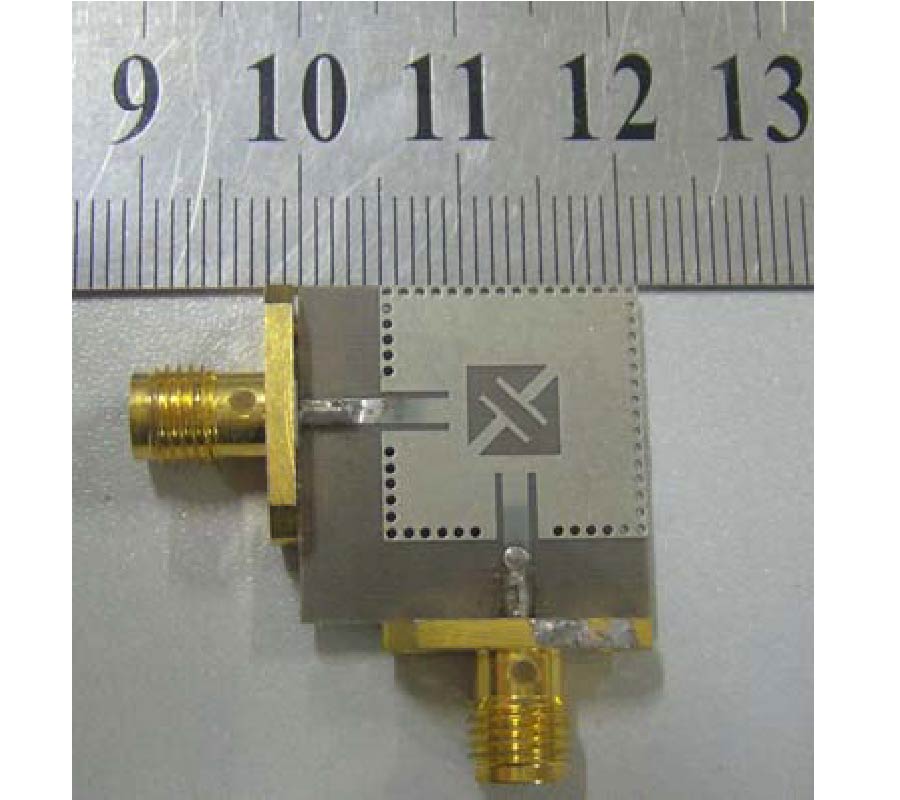
Terahertz dielectric spectroscopy permits the study of biomolecular interactions. However, water induces high attenuation of electromagnetic waves in the THz frequency range, obscuring the response of biomolecules. The developed sensor overcomes this problem by concentrating the THz wave propagating in an integrated waveguide on a small liquid volume contained within a capillary tube. Detailed electromagnetic modeling shows effective interaction between the THz waves and liquids. Transmission measurement results for capillary tubes filled with water and methanol mixtures demonstrate a substantial increase in sensitivity to changes of liquid permittivity. The current integrated sensor facilitates THz spectroscopy of biological liquids: a case study on buffered human serum albumin solution demonstrates a great potential to complement biochemical analytical tools.
INTEGRATED WAVEGUIDE STRUCTURE FOR HIGHLY SENSITIVE THZ SPECTROSCOPY OF NANO-LITER LIQUIDS IN CAPILLARY TUBES
2011-10-14
PIER C
Vol. 24, 221-234
A Circular Shaped Sierpinski Carpet Fractal UWB Monopole Antenna with Band Rejection Capability
Rowdra Ghatak , Anirban Karmakar and Dipak Poddar
A novel planar ultra wideband (UWB) antenna using a second iteration Sierpinski carpet fractal shape with circular boundary is presented in this paper. The antenna covers the frequency band from 3 GHz to 12 GHz (VSWR ≤ 2). The proposed antenna has a meander shaped slot that renders the capability to reject 5.15-5.825 GHz band assigned for IEEE802.11a and HIPERLAN/2. The gain is suppressed very well in the desired WLAN bands. The measured antenna peak gain varies from 1.85 dBi to 6 dBi within the band. The time domain characteristics show that the antenna is not dispersive. A fabricated prototype is developed with close agreement between simulated and measured resonance as well as radiation characteristics.
A CIRCULAR SHAPED SIERPINSKI CARPET FRACTAL UWB MONOPOLE ANTENNA WITH BAND REJECTION CAPABILITY
2011-10-14
PIER M
Vol. 21, 133-148
Estimation and Mitigation of GPS Multipath Interference Using Adaptive Filtering
Kamatham Yedukondalu , Achanta Dattatreya Sarma and Satya Srinivas Vemuri
Estimation and mitigation of multipath error improves the positional accuracy of GPS. The objective of this paper is to estimate the effect of multipath interference at the receiver antenna based on both code and carrier phase measurements using Code minus Carrier (CMC) technique, and suggest a suitable method to mitigate it for static applications. Different adaptive filters such as Least Mean Squares (LMS) and various Recursive Least Squares (RLS) are considered to mitigate the error. The estimated multipath error for a typical signal is 0.8 m and 2.1 m on L1 and L2 carriers, respectively. The results due to adaptive filtering methods are encouraging and significant reduction of error (cm level) is observed. It is found that, when compared with experimental static dual frequency GPS receiver data, LMS and RLS filters give better error minimization on L1 and L2, respectively.
ESTIMATION AND MITIGATION OF GPS MULTIPATH INTERFERENCE USING ADAPTIVE FILTERING
2011-10-13
PIER B
Vol. 35, 87-109
On Some Optimal MIMO Antenna Coefficients in Multipath Channels
Andres Alayon Glazunov and Jie Zhang
This paper derives some optimum transmit and receive antenna coefficients in wireless multipath channels based on the spherical vector wave multimode expansion of the multiple-input multiple-output (MIMO) channel matrix. The derived antenna coefficients satisfy the following specific optimization criteria: (i) maximum MIMO mean effective link gain (link MEG) based on the multimode channel realizations or (ii) maximum MIMO link MEG based on the multimode correlation matrix or (iii) correlation minimization by diagonalization of the MIMO full-correlation matrix. It is shown that the proposed approach leads to matrix equations belonging to the nearest Kronecker product (NKP) problem family, which in general have no trivial solution. However, we show that exact solutions are provided to the posed NKP problems under the assumption of the Kronecker model for the MIMO full-correlation matrix. The results are illustrated by numerical examples. The proposed approach is a complement to existing antenna pattern analysis methods.
ON SOME OPTIMAL MIMO ANTENNA COEFFICIENTS IN MULTIPATH CHANNELS
2011-10-13
PIER M
Vol. 21, 117-131
Diffraction of Plane Wave by Strip with Arbitrary Orientation of Wave Vector
Seil S. Sautbekov
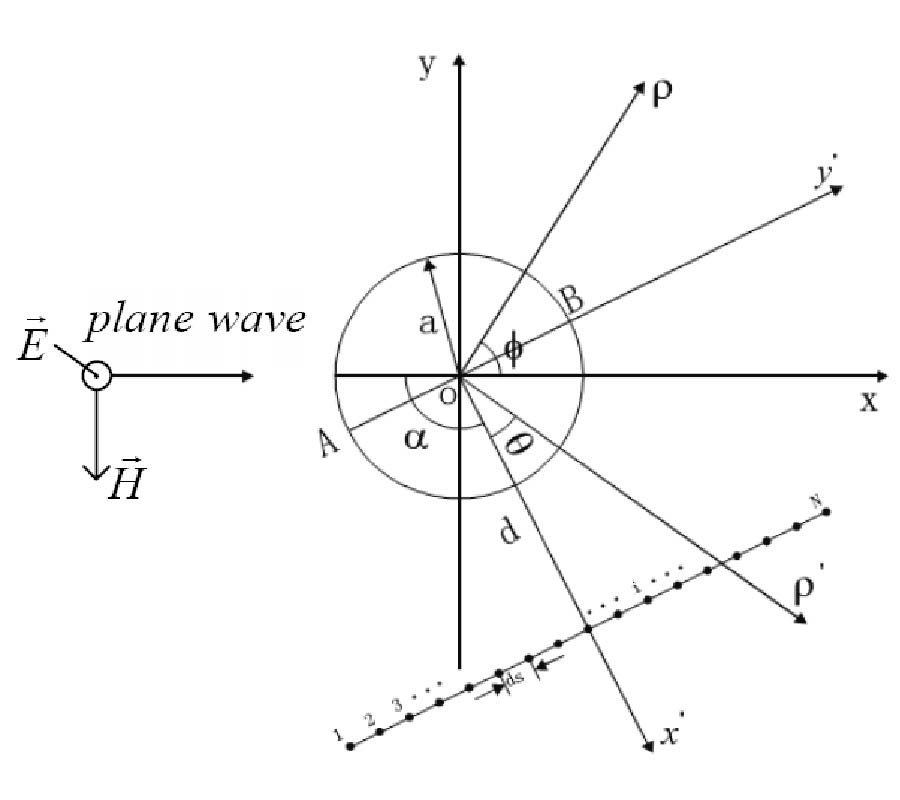
The classical problem for diffraction of a plane wave with an arbitrarily oriented wave vector at a strip is considered asymptotically by Wiener-Hopf method. The boundary-value problem has been broken down into distinct Dirichlet and Neumann problems. Each of these boundary-value problems is consecutively solved by a reduction to a system of singular boundary integral equations and then to a system of Fredholm integral ones of second kind. They are solved effectively by a reduction to a system of linear algebraic equations with the help of the etalon integral and the saddle point method.
DIFFRACTION OF PLANE WAVE BY STRIP WITH ARBITRARY ORIENTATION OF WAVE VECTOR
2011-10-13
PIER
Vol. 121, 75-88
A Novel Low-Profile Wideband UHF Antenna
Ai-Xin Chen , Tie-Hua Jiang , Zhizhang (David) Chen and Donglin Su
In this paper, an ultra high frequency (UHF) low-profile antenna is proposed; it is based on the discone antenna but with addition of a back cavity, a short-circuiting structure and a two-plate top structure in order to achieve both low-profile and wideband. It is simulated and prototyped. The test results show that the antenna has an omni-directional radiation pattern in the horizontal plane, is of low-profile, has a height of less than 0.1λmax, and is wideband with an impedance bandwidth of 65% from 430 MHz to 845MHz for VSWR < 2.5 and an impedance bandwidth of 43% from 440 MHz to 680 MHz for VSWR < 2.0. The proposed antenna can be easily flush-mounted on a planar surface and therefore has great potential for uses on aircrafts and high-speed trains due to its conformal capability.
A NOVEL LOW-PROFILE WIDEBAND UHF ANTENNA
2011-10-13
PIER
Vol. 121, 53-74
Crosstalk and Discontinuities Reduction on Multi-Module Memory Bus by Particle Swarm Optimization
Ding-Bing Lin , Feng-Nan Wu , Wen Sheng Liu , Chen Kuang Wang and Hsin-Yun Shih
Due to high-density routing under the CPU and DIMM areas, the original design of even and odd mode characteristic impedances changes. The occurrence of multi-drop problem between the CPU and memory chip causes over- and under-driven that reduce the eye opening. Furthermore, the different phase velocities of even- and odd-modes cause timing jitter at the receiver end. This paper proposes two steps to solve the complex issue of signal integrity for the multi-module memory bus. First, particle swarm optimization (PSO) is used to tune the characteristic impedance of the transmission line and on-die termination (ODT) values to improve transmission line impedance changes to obtain maximum power delivery. The fitness function of the algorithm is defined by selecting the minimum reflection coefficient at the driver side and maximum the transmission coefficient at the receiver side to reduce the over- and under-driven Second, the timing jitter can be reduced by placing a capacitor to compensate for the velocity difference caused by different propagation modes. Finally, signal integrity enhancements for the DDR3 are verified by measuring S parameters in the frequency domain and postprocessed eye diagrams in the time domain.
CROSSTALK AND DISCONTINUITIES REDUCTION ON MULTI-MODULE MEMORY BUS BY PARTICLE SWARM OPTIMIZATION
2011-10-13
PIER
Vol. 121, 39-52
Evolution and Collapse of a Lorentz Beam in Kerr Medium
Rui Pin Chen and Chong Heng Raymond Ooi
The effect of Kerr nonlinearity on a Lorentz beam is investigated by using the nonlinear Schrődinger (NLS) equation. Based on the variational method, the evolution of a Lorentz beam in a Kerr medium is demonstrated and the critical collapse powers of the Lorentz beam are derived. Numerical simulations of the propagation of a Lorentz beam in a Kerr medium show that the beam becomes quasi-circular in a very short distance. Although the beam width of the Lorentz beam broadens, the central part of the beam give rise to a partial collapse.
EVOLUTION AND COLLAPSE OF A LORENTZ BEAM IN KERR MEDIUM
2011-10-13
PIER
Vol. 121, 19-37
MIMO-Tops Mode for High-Resolution Ultra-Wide-Swath Full Polarimetric Imaging
Wei Xu , Pingping Huang and Yun-Kai Deng
The novel TOPS mode can achieve wide swath imaging coverage at the cost of impaired azimuth resolution. MIMO-SAR systems combined with multi-channel SAR signal reconstruction in azimuth and digital beamforming (DBF) on receive in elevation can overcome the inherent contradiction between swath width and azimuth resolution of conventional SAR systems. This paper derives a novel spaceborne MIMO-TOPS mode for high-resolution ultra-wide-swath full polarimetric imaging. In such an imaging scheme, different polarimetric waveforms with different elevation beam pointing directions and short time delays are transmitted in a single pulse repetition interval (PRI) by different sub-aperture antennas in azimuth. Besides improving the desired signal-to-noise ratio (SNR) and suppressing ambiguous energy in elevation, a novel DBF on receive approach including two steps is adopted to separate different echoes corresponding to sub-pulses with different polarizations. The design example of a full polarimetric MIMO-TOPS SAR system, which allows for the imaging capacity to cover an ultra wide swath of 400 km with a high azimuth resolution of 3 m, is given to validate the proposed imaging scheme.
MIMO-TOPS MODE FOR HIGH-RESOLUTION ULTRA-WIDE-SWATH FULL POLARIMETRIC IMAGING
2011-10-13
PIER
Vol. 121, 1-18
A New Triple Band Circularly Polarized Square Slot Antenna Design with Crooked T and F-Shape Strips for Wireless Applications
Sasan Ahdi and Mesut Kartal
A new design for circularly polarized square slot antenna (CPSSA) is presented. The circular polarization operation in the proposed single-layer antenna is created through two equal sized crooked T-shape and an F-shape strips located on the patch. Compared to most of the previously reported CPSSA structures, the impedance bandwidth and the axial ratio bandwidth of the antenna are increased and also the size of the antenna becomes smaller. The presented CPSSA design has the compact dimensions of 40 x 40 x 0.8 mm3, total impedance matching bandwidth of 8.04 GHz and exhibiting a 28.03% (4.6-6.1 GHz) 3 dB axial ratio bandwidth. A prototype of the antenna is fabricated and tested, and a great agreement with simulated results is obtained.
A NEW TRIPLE BAND CIRCULARLY POLARIZED SQUARE SLOT ANTENNA DESIGN WITH CROOKED T AND F-SHAPE STRIPS FOR WIRELESS APPLICATIONS
2011-10-11
PIER B
Vol. 35, 69-85
Reference Range Correlation (Rrcr) Ranging and Performance Bounds for on-Body UWB-Based Body Sensor Networks
Heba A. Shaban , Mohamad Abou El-Nasr and R. Michael Buehrer
In this paper, we propose a reference range correlation-based (RRcR) ranging technique suitable for low-power on-body wireless body sensor networks (WBSNs) via ultra wideband (UWB) radios. The proposed technique is based on the presence of reference nodes, and is assumed to have line-of-sight (LOS) links. We show that the performance of the proposed technique outperforms matched-filtering-based time-of-arrival (MF-TOA) estimators with no a priori and with perfect channel knowledge. We further show that increasing the number of reference node up to twenty provides significant enhancement in the performance traded for higher overall power consumption. Then, we study the effect of timing-misalignment on the Ziv-Zakai lower bound (ZZLB), and provide numerical results. The presented results are based on simulations in the IEEE 802.15.6a on-body-to-on-body channel (CM3) in the UWB band as well as actual measurements.
REFERENCE RANGE CORRELATION (RRCR) RANGING AND PERFORMANCE BOUNDS FOR ON-BODY UWB-BASED BODY SENSOR NETWORKS
2011-10-11
PIER C
Vol. 24, 207-219
A Novel Conformal End-Fire Antenna Design Using the Competitive Algorithm of Simulating Natural Tree Growth
Lu Dong and Kama Huang
This paper presents a novel conformal end-fire antenna whose design employs the Competitive Algorithm of Simulating Natural Tree Growth. This algorithm is based on the idea of simulating the processes of growth and wilting of natural trees and can search from simple to complicated structures with rapid convergence. Four optimized radiation elements were designed on a cross structure to verify the performance of the algorithm. A prototype of the designed antenna was also fabricated and tested. The antenna resonates at the center frequency of 2.45 GHz, exhibiting an ideal end-fire property. In addition, the measured and simulated results are in good agreement. Finally, we propose a novel end-fire antenna array based on the cross structure, with a radiation gain reaching 17.6 dBi.
A NOVEL CONFORMAL END-FIRE ANTENNA DESIGN USING THE COMPETITIVE ALGORITHM OF SIMULATING NATURAL TREE GROWTH
2011-10-11
PIER
Vol. 120, 513-533
Design of Broadband Circularly Polarized Square Slot Antenna with a Compact Size
Jia-Yi Sze and Shien-Piao Pan
This paper proposes a newly designed compact coplanar-waveguide-fed wideband circularly polarized (CP) printed square slot antenna (PSSA), in the square slot of which are a halberd-shaped feeding signal line and a square ring patch. By placing a specially designed metal reflector behind the bidirectional CP PSSA, one can obtain unidirectional CP patterns with a associated 3-dB axial-ratio bandwidth (ARBW) almost the same as that of the bidirectional antenna. The bidirectional L- and S-band PSSAs designed on FR4 substrates have 3-dB ARBWs as large as 25.3% and 29.1%, respectively. For the L-band antennas, the unidirectional design yields a 3-dB ARBW of 25.7% and a gain of about 3 dB higher than that of the bidirectional counterpart. In all these 3-dB axial-ratio bands, impedance matching with VSWR ≤ 2 is also achieved. Most importantly, the design concepts, procedures, and rules for the proposed antenna are presented in detail.
2011-10-10
PIER M
Vol. 21, 105-115
Reciprocal Invisible Cloak with Homogeneous Metamaterials
Jingjing Yang , Ming Huang , Ya Lin Li , Tinghua Li and Jing Sun
Based on linear optical transformation method, a diamond shaped reciprocal cloak with perfect invisibility in a certain direction is proposed. Compared with traditional cloaks, the object hidden inside the reciprocal cloak is not blind and can receive information from the outer region. Moreover, the reciprocal cloak is constructed of nonsingular homogeneous material parameters with reduced anisotropy that is relatively easy for practical realization. Full wave simulations validate the performance of the cloak.
RECIPROCAL INVISIBLE CLOAK WITH HOMOGENEOUS METAMATERIALS
2011-10-09
PIER
Vol. 120, 499-512
Circular Microstrip Slot Antenna for Dual-Frequency RFID Application
Jun-Jiat Tiang , Mohammad Tariqul Islam , Norbahiah Misran and Mandeep Singh
A compact wideband dual-frequency microstrip antenna is proposed in this paper. By employing an offset microstrip-fed line and a strip close to the radiating edges in the circular slot patch, an antenna operating at dual frequency with the impedance bandwidth of 26.2% and 22.2% respectively is presented. By attaching a strip to the radiating edges opposite to the microstrip-fed line, this alters the current distribution and radiation on the antenna at the second resonant frequency. The second frequency is also tunable by varying the lengths of the microstrip-fed line. It is demonstrated that the proposed antenna covers the widebands of UHF and microwave for RFID application. A good agreement is obtained between the simulated and experimental results.
2011-10-08
PIER B
Vol. 35, 53-67
Planar Inductor Design for High Power Applications
Abdullah Eroglu
Design, simulation, and implementation of low profile microstrip spiral inductors for high power Industrial, Scientific and Medical (ISM) applications at the high frequency (HF-3-30 MHz) range are given for the first time. An accurate analytical model and algorithm have been developed to determine the simplified lumped element equivalent model parameters for spiral inductor and its physical dimensions. Five different spiral inductors are then simulated with a planar electromagnetic simulator using the physical dimensions obtained for the desired inductance values with the analytical method. The implementation method and substrate selection for spiral inductors at the HF range are given in detail for high power applications. The spiral inductors are then constructed on 100 mil Alumina substrate and measured with network analyzer. It is found that analytical, simulation and measurement results are in close agreement and the analytical method and algorithm that have been developed can be used to accurately determine the physical dimensions, and the resonant frequency of the spiral inductor for the desired inductance value.
PLANAR INDUCTOR DESIGN FOR HIGH POWER APPLICATIONS
2011-10-07
PIER B
Vol. 35, 29-51
Design and Implementation of a Planar 4x4 Butler Matrix in SIW Technology for Wide Band High Power Applications
Tarek Djerafi , Nelson J. G. Fonseca and Ke Wu
This paper introduces a novel design of Butler matrix in substrate integrated waveguide (SIW) technology with wide frequency band characteristics. Butler matrices are particularly useful in advanced antenna design and characteristics such as wideband operation, power handling, manufacturing, integration, cost, etc. are typical issues to be addressed in many applications. The proposed planar 4×4 Butler matrix provides an interesting solution to most of these issues. Wideband operation is achieved thanks to improved cross-couplers. These components are also characterized by higher power handling when compared to $E$-plane couplers. The use of SIW technology enables to reduce insertion losses compared to other printed technologies, while maintaining most advantages of such technologies such as high integration, manufacturing simplicity, low weight, etc. The proposed design is fully described, from the elementary building blocks to the full assembly performances. The design is optimized for operation in Ku-band with a center frequency at 12.5 GHz. A prototype of the 4×4 Butler matrix is manufactured, and good performances are confirmed over 24% relative frequency bandwidth. Potential use of this sub-system in multibeam antenna design is also discussed.
DESIGN AND IMPLEMENTATION OF A PLANAR 4x4 BUTLER MATRIX IN SIW TECHNOLOGY FOR WIDE BAND HIGH POWER APPLICATIONS
2011-10-07
PIER M
Vol. 21, 93-104
Electrical Conductivity and Electromagnetic Shielding Effectiveness of Silicone Rubber Filled with Ferrite and Graphite Powders
Cristian Morari , Ionut Balan , Jana Pintea , Elena Chitanu and Iulian Iordache
There is increasing interest in electromagnetic interference (EMI) shielding due to the serious electromagnetic environment pollution caused by the continuously increased use of the electrical products and electronic devices. Electrical conductivity and EMI shielding effectiveness (SE) of composite materials made from silicone rubber with carbon powder and ferrite powder have been studied in microwaves and terahertz frequency ranges and the results are presented in this paper. In microwaves range, samples with higher electrical conductivity show a small variation of shielding performance with frequency, whereas the performance of samples with lower conductivity falls away with increasing frequency. It is shown that the variation of attenuation with frequency relates to the conductivity of the material.
ELECTRICAL CONDUCTIVITY AND ELECTROMAGNETIC SHIELDING EFFECTIVENESS OF SILICONE RUBBER FILLED WITH FERRITE AND GRAPHITE POWDERS
2011-10-06
PIER Letters
Vol. 27, 17-24
Calibration of a Six-Port Receiver for Direction Finding Using the Artificial Neural Network Technique
Hao Peng , Ziqiang Yang and Tao Yang
Because of the asymmetry of six-port junctions and the nonlinearity of diode detectors, the calibration of direction finding receivers have to be carefully considered. It is generally believed that an efficient tool for numerical approximations, the artificial neural network (ANN), may be used for such calibrations. In this paper, a new calibration technique based on the ANN is proposed for direction finding receivers at a bandwidth of 1 GHz. The direction finding system adopts a zero-intermediate frequency receiver architecture, which offers the advantage of fast response times. The key modules of this receiver consist of two six-port networks used to measure phase differences and operating frequencies. The results indicate that the calibration technique achieves a high accuracy of 0.192°.
CALIBRATION OF A SIX-PORT RECEIVER FOR DIRECTION FINDING USING THE ARTIFICIAL NEURAL NETWORK TECHNIQUE
2011-10-06
PIER C
Vol. 24, 197-206
Design of Broadband Circular Polarization Truncated Horn Antenna with Single Feed
Theng Huat Gan and Eng Leong Tan
This paper presents the design of a broadband circular polarization truncated horn antenna with single feed. It does not require any complex feeding structure and uses only a coaxial feed extended with a simple electric field coupling probe. The corners of the horn are truncated to generate circular polarization modes, and a broad axial ratio bandwidth which is insensitive to the probe feed dimension is achieved. Simulated and measured results of an S band truncated horn antenna are presented. The antenna has a broad 3 dB axial ratio bandwidth of 26% with aperture efficiency of 60%.
DESIGN OF BROADBAND CIRCULAR POLARIZATION TRUNCATED HORN ANTENNA WITH SINGLE FEED