Search Results(13802)

2011-06-10
PIER
Vol. 117, 321-337
Embroidered Fully Textile Wearable Antenna for Medical Monitoring Applications
Mai A. R. Osman , Mohamad Kamal Abd Rahim , Noor Asmawati Binti Samsuri , Hashim Ali M. Salim and Mohammed F. Ali
Telecommunication systems integrated within garments and wearable products are such methods by which medical devices are making an impact on enhancing healthcare provisions around the clock. These garments when fully developed will be capable of alerting and demanding attention if and when required along with minimizing hospital resources and labour. Furthermore, they can play a major role in preventative ailments, health irregularities and unforeseen heart or brain disorders in apparently healthy individuals. This work presents the feasibility of investigating an Ultra-WideBand(UWB) antenna made from fully textile materials that were used for the substrate as well as the conducting parts of the designed antenna. Simulated and measured results show that the proposed antenna design meets the requirements of wide working bandwidth and provides 17 GHz bandwidth with compact size, washable and flexible materials. Results in terms of return loss, bandwidth, radiation pattern, current distribution as well as gain and efficiency are presented to validate the usefulness of the current manuscript design. The work presented here has profound implicationsfor future studies of a standalone suite that may one day help to provide wearer (patient) with such reliable and comfortable medical monitoring techniques.
EMBROIDERED FULLY TEXTILE WEARABLE ANTENNA FOR MEDICAL MONITORING APPLICATIONS
2011-06-10
PIER
Vol. 117, 299-319
Linear Array SAR Imaging via Compressed Sensing
Shun-Jun Wei , Xiao-Ling Zhang and Jun Shi
In recent years, various attempts have been undertaken to obtain three-dimensional (3-D) reflectivity of observed scene from synthetic aperture radar (SAR) technique. Linear array SAR (LASAR) has been demonstrated as a promising technique to achieve 3-D imaging of earth surface. The common methods used for LASAR imaging are usually based on matched filter (MF) which obeys the traditional Nyquist sampling theory. However, due to limitation in the length of linear array and the ``Rayleigh'' resolution, the standard MF-based methods suffer from low resolution and high sidelobes. Hence, high resolution imaging algorithms are desired. In LASAR images, dominating scatterers are always sparse compared with the total 3-D illuminated space cells. Combined with this prior knowledge of sparsity property, this paper presents a novel algorithm for LASAR imaging via compressed sensing (CS). The theory of CS indicates that sparse signal can be exactly reconstructed in high Signal-Noise-Ratio (SNR) level by solving a convex optimization problem with a very small number of samples. To overcome strong noise and clutter interference in LASAR raw echo, the new method firstly achieves range focussing by a pulse compression technique, which can greatly improve SNR level of signal in both azimuth and cross-track directions. Then, the resolution enhancement images of sparse targets are reconstructed by L1 norm regularization. High resolution properties and point localization accuracies are tested and verified by simulation and real experimental data. The results show that the CS method outperforms the conventional MF-based methods, even if very small random selected samples are used.
LINEAR ARRAY SAR IMAGING VIA COMPRESSED SENSING
2011-06-10
PIER
Vol. 117, 283-298
Periodic Time-Varying Noise in Current-Commutating CMOS Mixers
Benqing Guo and Guangjun Wen
An analytical approach based on linear periodic time-varying theory, is developed to analyze the noise characteristics of current-commutating CMOS mixers. Based on the derived transfer functions with memory effect of tail capacitance, the frequency-dependent noise transforming factors for individual stages in the mixers are numerically computed to rigorously describe the noise output. A unified noise expression considering both the thermal noise and the flicker noise is proposed. It enables the noise analysis of the mixers particularly for a high LO frequency with different IF characteristics, and is verified by measurements.
PERIODIC TIME-VARYING NOISE IN CURRENT-COMMUTATING CMOS MIXERS
2011-06-09
PIER Letters
Vol. 24, 129-138
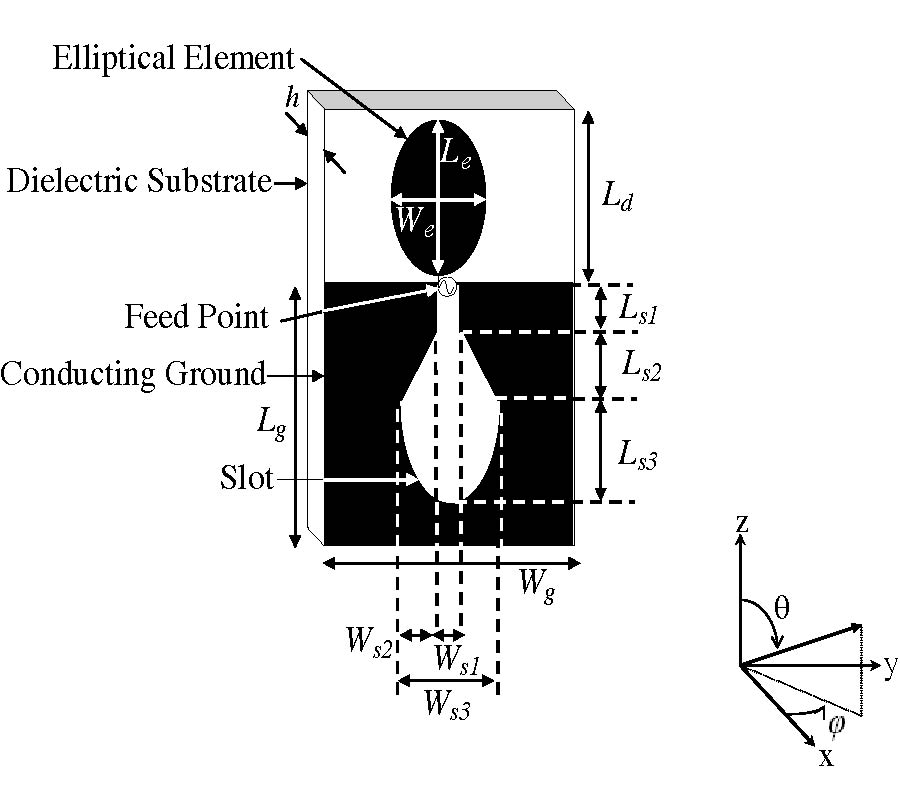
A Compact Band-Notched UWB Planar Monopole Antenna with Parasitic Elements
Mohammad Yazdi and Nader Komjani
In this paper, a planar microstrip UWB monopole antenna with a good band-rejection is presented. By using a pair of arc shaped parasitic elements around the patch, an excellent notched frequency band for rejecting the WLAN band (5--6\,GHz) can be obtained. The arc shaped strips are parametrically studied and the effects of them on the radiation patterns and time domain behaviour of the UWB antenna are investigated.
A COMPACT BAND-NOTCHED UWB PLANAR MONOPOLE ANTENNA WITH PARASITIC ELEMENTS
2011-06-09
PIER
Vol. 117, 267-281
An Improved Cubic Polynomial Method for Interpolating/Extrapolating MoM Matrices Over a Frequency Band
Wei-Dong Li , Jun-Xia Miao , Jun Hu , Zhe Song and Hou-Xing Zhou
The inter/extrapolation accuracy of the cubic polynomial method has been improved by optimizing three frequency samples for frequency-sweeping in the method of moments (MoM). In the method, the frequency samples are optimized by minimizing the global maximum of the polynomial component at the stationary points and two terminal points of the frequency band. The optimal frequency samples can be expressed as analytical forms of the two terminal points. Numerical examples are presented to validate the proposed method through comparison with the Pad\'{e} approximation.
AN IMPROVED CUBIC POLYNOMIAL METHOD FOR INTERPOLATING/EXTRAPOLATING MOM MATRICES OVER A FREQUENCY BAND
2011-06-09
PIER
Vol. 117, 253-265
Enhancement of a Microwave Radiometry Imaging System's Performance Using Left Handed Materials
Melpomeni I. Giamalaki and Irene Karanasiou
Aiming at the enhancement of a non invasive Microwave Radiometry Imaging System's (MiRaIS) attributes, Left Handed Materials (LHM) with negative permittivity and negative permeability simultaneously, have been utilized. The optimization of the system focusing properties is being theoretically explored, implementing a semi-analytical Green's function technique and different matching structures. In the framework of this analysis the head is modeled by a double layered cylinder while a dielectric cylindrical layer consisting of LHM is placed on the surface of the human head model with a view to achieve focusing improvement inside the brain. Numerical code executions have been conducted for two different operating frequencies (0.5\,GHz and 1.0\,GHz) and for matching layers of various values of thicknesses and electromagnetic properties. The numerical results for the electric field distribution inside the head model, presented in this paper, verify that the LHM can provide an increased sensitivity of the system focusing properties and thus improve its overall performance.
ENHANCEMENT OF A MICROWAVE RADIOMETRY IMAGING SYSTEM'S PERFORMANCE USING LEFT HANDED MATERIALS
2011-06-08
PIER Letters
Vol. 24, 119-128
Reflection and Transmission of Electromagnetic Wave Due to a Quasi-Fractional-Space Slab
Ahmed Attiya
A new method is introduced to construct a slab that has electric fields with propagation properties which are equivalent to a fractional-space wave equation in two-coordinate system. While its magnetic fields have propagation properties which are equivalent to the complementary fractional-space wave equation. Analytical forms for the reflection and transmission coefficients of this slab are derived. Results of these reflection and transmission coefficients show that such quasi-fractional-space slab has spatial and frequency selectivity properties.
REFLECTION AND TRANSMISSION OF ELECTROMAGNETIC WAVE DUE TO A QUASI-FRACTIONAL-SPACE SLAB
2011-06-08
PIER Letters
Vol. 24, 109-118
A Compact 2.4/5.2-GHz Rat-Race Coupler on Glass Substrate
Sen Wang and Jie Ying Zhong
This paper presents the design and implementation of a compact 2.4/5.2-GHz rat-race coupler on a glass substrate. Due to the low-loss substrate and thick metal layers, the process provides high-Q capacitors and inductors, and therefore the lumped rat-race coupler is practical. The coupler consists of three bandpass and one bandstop networks to achieve dual-band operations. The measured insertion losses at 2.4 GHz and 5.2 GHz are less than 2.7 dB and 1.9 dB, respectively. The measured return losses at the frequencies of interest are better than 20 dB. Moreover, the phase imbalances at the in-phase and anti-phase output ports are less than 3.9o and 4o at 2.4 GHz and 5.2 GHz, respectively. The chip size including all testing pads is merely 2.87 × 2.1 mm2 which is comparable to on-chip levels.
A COMPACT 2.4/5.2-GHZ RAT-RACE COUPLER ON GLASS SUBSTRATE
2011-06-08
PIER Letters
Vol. 24, 99-107
A Miniaturized Lowpass/Bandpass Filter Using Double Arrow Head Defected Ground Structure with Centered Etched Ellipse
Mohamed Al Sharkawy , Darwish Abd El-Aziz Mohamed and E. Mahmoud
A new double arrow head defected ground structure (DGS) with centered etched ellipse is proposed for designing a multilayer low pass filter (LPF) with wide rejection band and low insertion loss in the stop-band. The prototype LPF consists of three double arrow head DGS with centered etched ellipse in the ground plane and compensated capacitor on the top layer of a 30×40 mm2 Roger RT/Duroid5880 substrate having relative permittivity (εr) of 2.2 and thickness of 0.78 mm. The cutoff frequency is equal to 1.07 GHz .The prototype LPF is then realized as multilayer structure to enhance the filter response and reduce its size. The size reduction of the proposed multi-layer LPF is about 26% more than the conventional one. The proposed filter has been fabricated and measured. Good agreement is achieved between the simulated and measured results. The filter presents the advantages of compact size; low insertion loss and high out-band suppression. Finally, the multilayer LPF is transformed to band pass filter (BPF) using J-inverter method.
A MINIATURIZED LOWPASS/BANDPASS FILTER USING DOUBLE ARROW HEAD DEFECTED GROUND STRUCTURE WITH CENTERED ETCHED ELLIPSE
2011-06-08
PIER M
Vol. 18, 197-207
Determination of Optical Transmission Loss in Poly (3-Methyl Thiophene) Thin Film Planar Waveguide: Effect of Vapour Chopping
Sandip V. Kamat , Sikandar H. Tamboli , Vijaya Puri , R. K. Puri , R. B. Patil and Meng-Fan Luo
This aricle reports the effect of vapour chopping technique on the properties of vacuum evaporated poly (3-methyl thiophene) thin films such as surface morphology, optical transmittance, band gap, refractive index and optical transmission loss. Vapour chopping gives smooth surface morphology with smaller grain size reduced roughness than non chopped thin films, while the transmittance of the thin film increases with simultaneous decrease in the refractive index, band gap and optical transmission loss decreases due to vapour chopping.
DETERMINATION OF OPTICAL TRANSMISSION LOSS IN POLY (3-METHYL THIOPHENE) THIN FILM PLANAR WAVEGUIDE: EFFECT OF VAPOUR CHOPPING
2011-06-07
PIER Letters
Vol. 24, 91-98
Design of Folded Wire Loaded Antennas Using BI-Swarm Differential Evolution
Jian-Ying Li and Yu Yu Kyi
Folded wire load antennas with matching network are designed by using optimization algorithms. The loads are parallel capacitor/inductor/resistor circuits that are adjusted by means of Differential Evolution (DE) optimizers to maximize bandwidth and the matching networks. The measured voltage standing-wave ratio (VSWR) of the load folded dipoles confirms broadband performance and agrees with data obtained from moment method computations. Antennas having bandwidth ratio of 2.5 : 1, with measured VSWR less than 3.5, meets the requirement.
DESIGN OF FOLDED WIRE LOADED ANTENNAS USING BI-SWARM DIFFERENTIAL EVOLUTION
2011-06-07
PIER M
Vol. 18, 179-195
A Three-Dimensional Time Domain Microwave Imaging Method for Breast Cancer Detection Based on an Evolutionary Algorithm
Massimo Donelli , Ian J. Craddock , David Gibbins and Mantalena Sarafianou
This paper presents a novel stochastic microwave method for the detection, location and reconstruction of electric properties of breast cancer in a simplified breast phantom. The method is based on the inversion of time domain data. The problem is recast as an optimization one by defining a suitable cost function which is then minimized using an efficient evolutionary algorithm. Selected numerical simulations of a simplified three dimensional breast model and a realistic numerical phantom based on magnetic resonance images (MRIs) are carried out to assess the capabilities of the method. The results obtained show that the proposed method is able to reconstruct the properties of a tumor-like inclusion to a reasonable degree of accuracy.
A THREE-DIMENSIONAL TIME DOMAIN MICROWAVE IMAGING METHOD FOR BREAST CANCER DETECTION BASED ON AN EVOLUTIONARY ALGORITHM
2011-06-07
PIER
Vol. 117, 237-252
Pattern Synthesis of Conformal Arrays by a Modified Particle Swarm Optimization
Wen-Tao Li , Yong-Qiang Hei and Xiao-Wei Shi
A method of designing a cylindrical conformal array with shaped-beam and reconfigurable dual-beam using a modified particle swarm optimization algorithm is proposed in this paper. The proposed algorithm is easy to implement and efficient to be used in synthesizing conformal arrays with digital attenuators and digital phase shifters. Moreover, the proposed synthesis has taken the actual active element patterns into account, which can reduce the error between computation and realization. Good agreement can be obtained between the desired patterns and the synthesized patterns.
PATTERN SYNTHESIS OF CONFORMAL ARRAYS BY A MODIFIED PARTICLE SWARM OPTIMIZATION
2011-06-06
PIER B
Vol. 31, 117-137
Low-Cost Parameter Extraction and Surrogate Optimization for Space Mapping Design Using EM-Based Coarse Models
Slawomir Koziel and Leifur Leifsson
Space mapping (SM) is one of the most popular surrogate-based optimization techniques in microwave engineering. The most critical component in SM is the low-fidelity (or coarse) model --- a physically-based representation of the structure being optimized (high-fidelity or fine model), typically evaluated using CPU-intensive electromagnetic (EM) simulation. The coarse model should be fast and reasonably accurate. A popular choice for the coarse models are equivalent circuits, which are computationally cheap, but not always accurate, and in many cases even not available, limiting the practical range of applications of SM. Relatively accurate coarse models that are available for all structures can be obtained through coarsely-discretized EM simulations. Unfortunately, such models are typically computationally too expensive to be efficiently used in SM algorithms. Here, a study of SM algorithms with coarsely-discretized EM coarse models is presented. More specifically, novel and efficient parameter extraction and surrogate optimization schemes are proposed that make the use of coarsely-discretized EM models feasible for SM algorithms. Robustness of our approach is demonstrated through the design of three microstrip filters and one double annular ring antenna.
LOW-COST PARAMETER EXTRACTION AND SURROGATE OPTIMIZATION FOR SPACE MAPPING DESIGN USING EM-BASED COARSE MODELS
2011-06-06
PIER Letters
Vol. 24, 77-90
An Efficient Inverse Scattering Algorithm and Its Application to Lossy Electric Transmission Line Synthesis
Huaibin Tang and Qinghua Zhang
As studied by Jaulent in 1982, the inverse problem of lossy electric transmission lines is closely related to the inverse scattering of Zakharov-Shabat equations with two potential functions. Focusing on the numerical solution of this inverse scattering problem, we develop a fast one-shot algorithm based on the Gelfand-Levitan-Marchenko equations and on some differential equations derived from the Zakharov-Shabat equations. Compared to existing results, this new algorithm is computationally more efficient. It is then applied to the synthesis of non uniform lossy electric transmission lines.
AN EFFICIENT INVERSE SCATTERING ALGORITHM AND ITS APPLICATION TO LOSSY ELECTRIC TRANSMISSION LINE SYNTHESIS
2011-06-06
PIER C
Vol. 22, 35-45
An Artificial Neural Network Approach for the Harmonic Design of Annular Ring Dielectric Resonator Antennas
Leonardo Lucci , Giuseppe Pelosi and Stefano Selleri
The design and optimization of an annular ring dielectric resonator antenna (DRA) operating in the C frequency band is addressed. The DRA is intended to be used as the radiating element of a transmitting array of active integrated antennas, its input impedance must exhibit a proper resistive load at the fundamental resonance frequency, as well as a dominant reactive behavior, either inductive or capacitive, at higher harmonics. The configuration here proposed is a slot-coupled annular DRA where harmonic tuning is performed by resorting to a proper shape factor. The design procedure is performed by exploiting artificial neural networks, to find the resonator geometry starting form the desired resonance frequency, and a finite elements based numerical tool for the electromagnetic characterization of the antenna. Samples of simulation results are shown to demonstrate the capabilities of the proposed slot-based harmonic tuning technique for ring DRAs.
AN ARTIFICIAL NEURAL NETWORK APPROACH FOR THE HARMONIC DESIGN OF ANNULAR RING DIELECTRIC RESONATOR ANTENNAS
2011-06-06
PIER
Vol. 117, 209-236
Evaluation of Electromagnetic Fields Associated with Inclined Lightning Channel Using Second Order FDTD-Hybrid Methods
Mahdi Izadi , Mohd Zainal Abidin Ab Kadir and Chandima Gomes
Evaluation of electromagnetic fields caused by the lightning channel is an appealing topic in order to consider the indirect effects of lightning on the power lines. A common assumption for the calculation of electromagnetic fields at the observation point is a vertical lightning channel, but the fact is that in reality the lightning channel is seldom vertical on the ground surface. In this study, the electromagnetic fields due to inclined lightning channel at various observation points with different angles and with respect to the image of lightning channel on the ground surface were explored. This study also proposes general equations that can estimate the electric fields due to inclined lightning channel through the 2nd FDTD method. The proposed method supports the notion of vertical lightning channel, while the channel angle, with respect to z-axis, is assumed to be zero. This method was validated through the data gathered from four fields: three at a close distance from inclined lightning channel and one at an intermediate distance from vertical lightning channel. Similarly, due to inclined lightning channel, the effects of geometrical and current parameters on the electromagnetic fields are considered. This study substantiates different coupling models with FDTD structure directly at the time domain without a need for extra converters.
EVALUATION OF ELECTROMAGNETIC FIELDS ASSOCIATED WITH INCLINED LIGHTNING CHANNEL USING SECOND ORDER FDTD-HYBRID METHODS
2011-06-06
PIER
Vol. 117, 195-208
A Miniature CPW Balun Constructed with Length-Reduced 3db Couples and a Short Redundant Transmission Line
Zeu-Yuan Yeh and Yi-Chyun Chiang
This work presents a new type of CPW balun consisting of 3dB coupled-line sections, which are one eighth wavelength long, and a short redundant transmission line for the applications of the modern wireless communication systems. A set of design equations that can determine the values of the elements of balun is proposed. A new type of coupler constructed with a structure similar to the conventional step impedance resonator is developed to further reduce the size of the balun. An experimental prototype operated at 1.0 GHz was designed and fabricated to verify the proposed design method. The measurement results show quite good correspondences with the theoretical predictions and the EM simulations.
A MINIATURE CPW BALUN CONSTRUCTED WITH LENGTH-REDUCED 3DB COUPLES AND A SHORT REDUNDANT TRANSMISSION LINE
2011-06-06
PIER
Vol. 117, 181-194
An Unequal Coupled-Line Wilkinson Power Divider for Arbitrary Terminated Impedances
Yongle Wu and Yuan'an Liu
A unequal Wilkinson power divider based on asymmetrical coupled line section is presented in this paper. The proposed unequal Wilkinson power divider topology uses asymmetrical coupled-line section and two transmission-line transformers. For simplification, a section asymmetrical coupled line is applied to obtain front compact matching structure. For generalization, three ports terminated impedances are defined as arbitrary values. In particular, the output ports impedances are arbitrary complex values. Design parameters and analysis equations for scattering parameters are also provided. In addition, the theoretical external performances of several examples are illustrated. Finally, the EM simulated results are validated with the characterization of two microstrip unequal power dividers at 2 GHz.
AN UNEQUAL COUPLED-LINE WILKINSON POWER DIVIDER FOR ARBITRARY TERMINATED IMPEDANCES
2011-06-05
PIER
Vol. 117, 165-179
A Novel Adaptive Beamforming Technique Applied on Linear Antenna Arrays Using Adaptive Mutated Boolean PSO
Zaharias D. Zaharis and Traianos V. Yioultsis
The present work introduces a new optimization technique suitable for adaptive beamforming of linear antenna arrays. The proposed technique is a new PSO variant called Adaptive Mutated Boolean PSO (AMBPSO) where the update formulae are implemented exclusively in Boolean form by using an efficiently adaptive mutation process. The AMBPSO aims at estimating the excitation weights applied on the array elements considering that a desired signal and several interference signals are received by the array at respective directions of arrival. In order to exhibit the robustness of the technique, the optimization process does not take into account the interference correlation matrix. A certain power level of additive Gaussian noise is also considered by the technique. The AMBPSO has been applied in several cases of uniform linear antenna arrays with different spacing between adjacent elements and different noise power level and therefore seems to be quite promising in the smart antenna technology.
A NOVEL ADAPTIVE BEAMFORMING TECHNIQUE APPLIED ON LINEAR ANTENNA ARRAYS USING ADAPTIVE MUTATED BOOLEAN PSO