Search Results(13802)

2010-07-09
PIER C
Vol. 14, 185-195
A Stacked Microstrip Patch Antenna with Fractal Shaped Defects
Harshvardhan Tiwari and Machavaram Kartikeyan
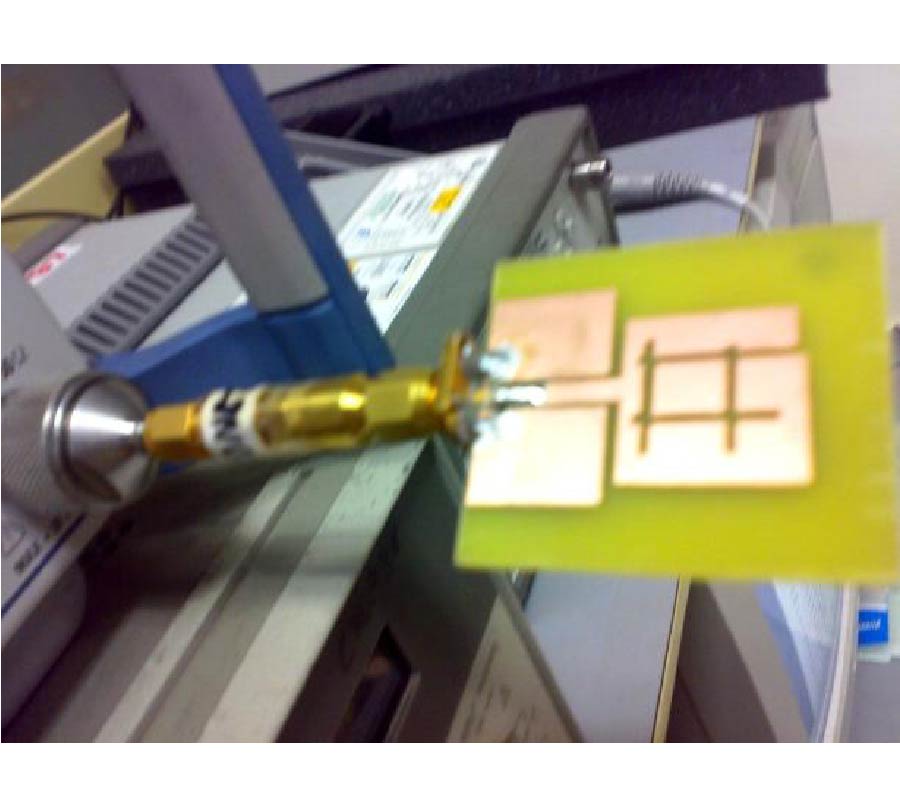
In this paper, a novel type of stacked microstrip patch antenna is presented in which fractal shaped defects have been excoriated from the patch surfaces. The antenna has been designed for dual band operation at the WLAN 2.4 GHz and 5.8 GHz frequency bands and size reduction for both the stacked patches is achieved due to the use of fractal shaped defects. The antenna was simulated using CST Microwave Studio 2010 and optimized using Particle Swarm Optimization (inbuilt in CST). The fabricated antenna's measurement results were found to be in good agreement with the simulated results.
A STACKED MICROSTRIP PATCH ANTENNA WITH FRACTAL SHAPED DEFECTS
2010-07-09
PIER M
Vol. 13, 95-108
SAR and Temperature Elevation in a Multi-Layered Human Head Model Due to an Obliquely Incident Plane Wave
Ayman I. Sabbah , Nihad I. Dib and Moh'd A. Al-Nimr
In this paper, the Specific Absorption Rate (SAR) distribution in a human head irradiated by an obliquely incident electromagnetic plane wave is studied. A simple planar multi-layered structure is used to model the human head. Moreover, the steady state thermal elevation distribution is calculated by solving the bioheat equation using the finite difference time domain (FDTD) method. Both types of wave polarization (perpendicular and parallel) will be discussed. The obtained results confirm the importance of performing a thermal analysis along with the dosimetric one. It is found that the induced temperature elevation in the brain region, in all the examined conditions, never exceeds 0.4℃. This value is well below the threshold for the induction of adverse thermal effects to the neurons which is 3.5℃.
SAR AND TEMPERATURE ELEVATION IN A MULTI-LAYERED HUMAN HEAD MODEL DUE TO AN OBLIQUELY INCIDENT PLANE WAVE
2010-07-09
PIER
Vol. 106, 61-73
Ultra Wideband Power Divider Using Tapered Line
Chun Tong Chiang and Boon-Kuan Chung
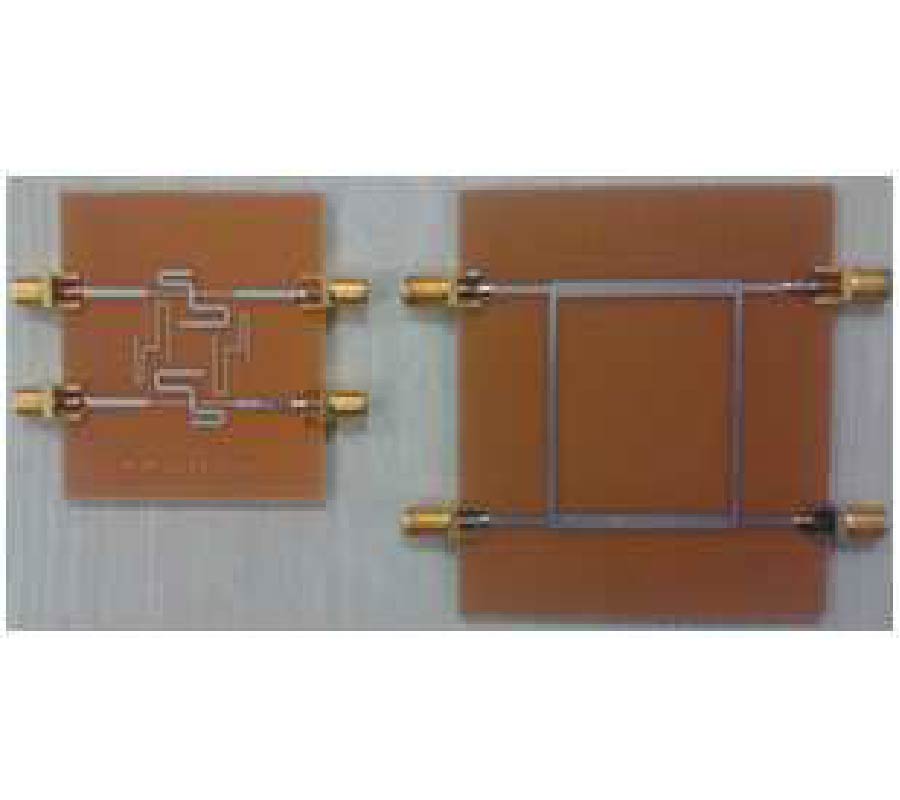
A power divider with ultra-wideband (UWB) performance has been designed. The quarter-wave transformer in the conventional Wilkinson power divider is replaced by an exponentially tapered microstrip line. Since the tapered line provides a consistent impedance transformation across all frequencies, very low amplitude ripple of 0.2 dB peak-to-peak in the transmission coefficient and superior input return loss better than 15 dB are achieved over an ultra-wide bandwidth. Two additional resistors are added along the tapered line to improve the output return loss and isolation. Simulation performed using CST Microwave Studio and measured results confirm the good performance of the proposed circuit. The return loss and the isolation between the output ports are better than 15 dB across the band 2-10.2 GHz. Standard off-the-shelf resistance values can be selected by optimizing the physical locations to mount the resistors. Better performance can be achieved with more isolation resistors added. Hence, the number of isolation resistors to be used may be selected based on the desired bandwidth and level of isolation and return loss specifications.
ULTRA WIDEBAND POWER DIVIDER USING TAPERED LINE
2010-07-09
PIER
Vol. 106, 49-60
Compact Tri-Layer Ultra-Wideband Bandpass Filter with Dual Notch Bands
Pai-Yi Hsiao and Ro-Min Weng
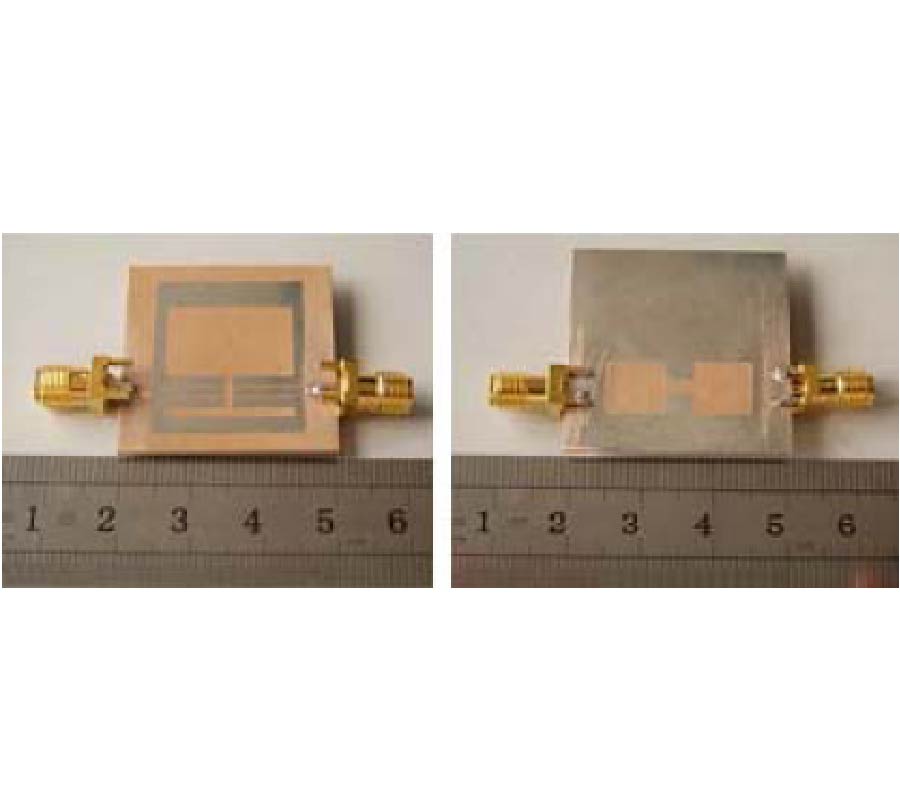
A compact ultra-wideband (UWB) bandpass filter (BPF) with dual notch bands is presented using a tri-layer structure. In the design of UWB BPFs, it is desired to have a uniform 3.1 GHz to 10.6 GHz full-band transmission response. Dual notch bands are generated to filter out the interferences caused by signals transmitted from WLAN and/or WiMAX systems at 5.8 GHz and 3.5 GHz, respectively. The sharp rejection of WiMAX signals is achieved by adding meander open-loop resonators on the middle layer. Another rejection of WLAN signals is introduced by adding a C-shaped resonator on the bottom layer. The proposed filter is not only realized theoretically but also verified by a full-wave electromagnetic simulation. The designed tri-layer UWB BPF with dual notch bands was fabricated by two FR4 printed circuit boards with the permittivity of 4.4 and the thickness of 0.8 mm. The total area is 11 mm×10.5 mm.
COMPACT TRI-LAYER ULTRA-WIDEBAND BANDPASS FILTER WITH DUAL NOTCH BANDS
2010-07-08
PIER M
Vol. 12, 247-257
Cad Model to Compute the Input Impedance of an Equilateral Triangular Microstrip Patch Antenna with Radome
Manotosh Biswas and Anirban Mandal
A very simple and more efficient CAD model is proposed to demonstrate the effect on input impedance characteristics based on cavity model analysis for wide range of variations of superstrate parameters and feed locations of an equilateral triangular microstrip patch antenna having different side lengths. The computed values are compared with different theoretical and experimental values available in open literature, showing close agreement. A Maxwell's equation solver is also used to validate our model.
CAD MODEL TO COMPUTE THE INPUT IMPEDANCE OF AN EQUILATERAL TRIANGULAR MICROSTRIP PATCH ANTENNA WITH RADOME
2010-07-08
PIER
Vol. 106, 33-47
High-Efficiency Wireless Energy Transmission Using Magnetic Resonance Based on Metamaterial with Relative Permeability Equal to 1
Jaewon Choi and Chulhun H. Seo
In this paper, a high-e±ciency wireless energy transmission via magnetic resonance is implemented by using negative permeability metamaterial structures. The metamaterial structure is consisted of a three-dimensional (3D) periodic array of the unit cell that the capacitively loaded split ring resonators (CLSRRs) are periodically arranged in the cubic dielectric surfaces. This metamaterial structure has the negative permeability property that matches free space, which is used as a magnetic flux guide in order to enhance the efficiency of energy transmission between a source and distant receiving coil. The efficiency of energy transmission is improved as reducing the radiation loss by focusing the magnetic field to a distant receiving coil. The distance able to transport the energy with maintaining the same efficiency has been increased by the same mechanism. The efficiency of energy transmission is approximately 80% at a transmission distance of 1.5 m.
HIGH-EFFICIENCY WIRELESS ENERGY TRANSMISSION USING MAGNETIC RESONANCE BASED ON  METAMATERIAL WITH RELATIVE PERMEABILITY  EQUAL TO 1
2010-07-08
PIER
Vol. 106, 17-31
Ultra Wideband CPW-Fed Aperture Antenna with WLAN Band Rejection
Mohamed Adnane Habib , A. Bostani , Azzeddine Djaiz , Mourad Nedil , Mustapha Yagoub and Tayeb Denidni
In this paper, we present a new ultra wideband antenna design with band rejection for UWB applications. A CPW-fed circular patch radiates through a circular aperture, which ensures wideband impedance matching and stable omnidirectional pattern over an UWB frequency range, from 3GHz to 10.6 GHz. In order to avoid interference with WLAN applications, at 5.8 GHz, the antenna is slightly modified to reject undesired band. A semi-circular slot ring is etched on the circular patch at the notch frequency, which creates an open circuit and avoids impedance matching and current propagation. A prototype was fabricated and measured, and the obtained experimental results agree with simulations and show an omnidirectional azimuth pattern over the entire bandwidth.
ULTRA WIDEBAND CPW-FED APERTURE ANTENNA WITH WLAN BAND REJECTION
2010-07-08
PIER
Vol. 106, 1-16
Transient Responses of Coaxial Cables in an Electrically Large Cabin with Slots and Windows Illuminated by an Electromagnetic Pulse
Jian Wang , Wen-Yan Yin , Jin-Peng Fang and Qi-Feng Liu
An improved finite-difference time-domain (FDTD) method is proposed for predicting transient responses of coaxial cables which are placed in an electrically large metallic cabin with arbitrary slots and circular windows on its wall. By integrating nodal analysis, multi-conductor transmission line (MTL) equation and FDTD method, we are able to accurately capture electromagnetic interference (EMI) effects on the cables. Our developed algorithm is verified by calculating frequency-dependent transfer impedance of coaxial cables together with induced currents. Numerical calculations are further performed to show the near-end coupled current responses of braided and tubular cables, respectively, and the effects of incident directions and polarizations of the illuminated electromagnetic pulse are both taken into account.
TRANSIENT RESPONSES OF COAXIAL CABLES IN AN ELECTRICALLY LARGE CABIN WITH SLOTS AND WINDOWS ILLUMINATED BY AN ELECTROMAGNETIC PULSE
2010-07-07
PIER C
Vol. 14, 173-183
Modified Multiband Multiple Ring Monopole Antenna
Ali Mirkamali , Lida Akhoondzadeh-Asl , Peter S. Hall and Kaveh Moussakhani
In this paper a modified version of the multi-band multiple ring monopole antenna is proposed. The height of the new design which consists of multiple half rings is half of the original one. The modified design is more attractive for low profile applications due to its lower height. The antenna is simulated and measured. It is shown that the simulation and measurement results are in good agreement. The performance of the modified version of the antenna is compared with the original design in terms of input characteristic and far field radiation patterns. It is shown that the multiband behaviour of the modified design is similar to the original one. However, there is a frequency shift between the operating bands of the new and the original antennas. The radiation patterns of the both antennas are similar to the conventional monopole antenna in lower operating frequency bands. However, degradation in radiation patterns of the both antennas is observed as frequency increases.
MODIFIED MULTIBAND MULTIPLE RING MONOPOLE ANTENNA
2010-07-07
PIER M
Vol. 13, 83-94
Analytical Pole Residue Calculation in Spectral Method of Moments Formulations for Periodic Structures
Y. Kaganovsky and Reuven Shavit
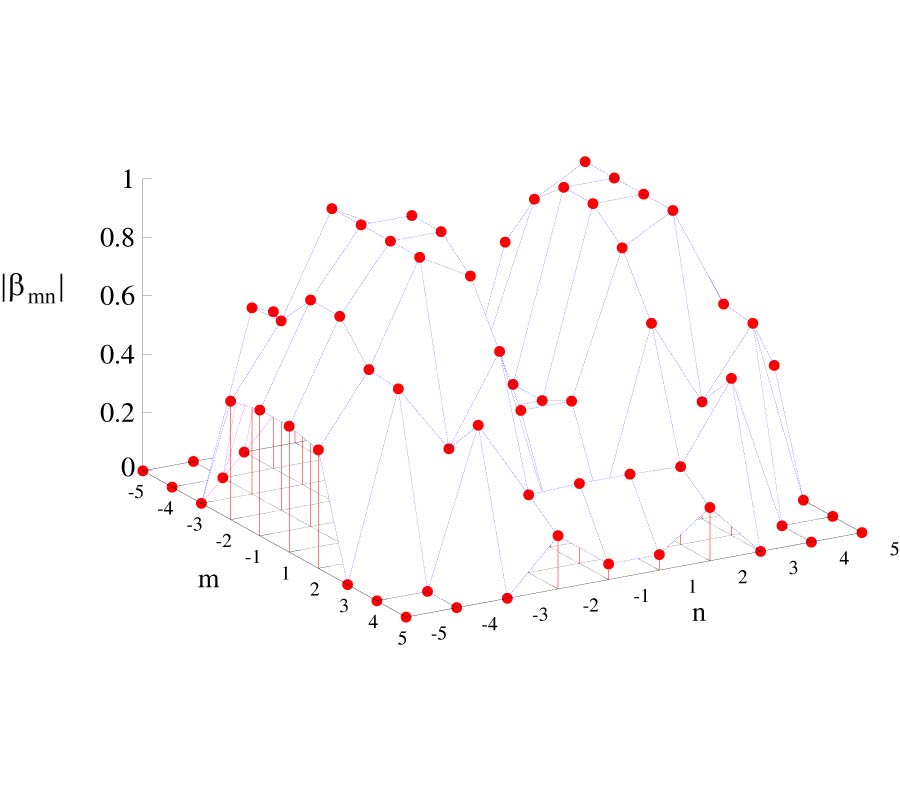
An analytical method for evaluating pole-residues in spectral method of moments (MoM) formulations is presented. Spectral integral formulations for periodic structures involve the inverse of the MoM matrix, which exhibits a periodic set of pole singularities, corresponding to the zeros of the matrix's determinant. So far, these singularities have not been extracted and the corresponding pole-residues were calculated directly from the differential or integral definitions of the residue. In this work, we consider an analytical expression for the solution to the MoM matrix equation, which enables the extraction of pole singularities and the analytical evaluation of pole-residues. We also present a comparison to previous methods.
ANALYTICAL POLE RESIDUE CALCULATION IN SPECTRAL METHOD OF MOMENTS FORMULATIONS FOR PERIODIC STRUCTURES
2010-07-07
PIER M
Vol. 13, 69-82
Loss of Linear Momentum in an Electrodynamics System: from an Analytical Approach to Simulations
Dimitri S. H. Charrier
The classical electrodynamics allows the use of retarded electromagnetic fields. The purpose of this investigation is to predict the useful force in a coil-ring system by electromagnetomechanical conversion. Analytical equations in retarded regime are given and are used to simulate a realistic thruster based on the coil-ring system. It is shown that a net force in the inertial coil-ring system is created. By means of high frequency electronics, analytical and practical tools toward new experiments for electromagnetic thrusters are given.
LOSS OF LINEAR MOMENTUM IN AN ELECTRODYNAMICS SYSTEM: FROM AN ANALYTICAL APPROACH TO SIMULATIONS
2010-07-04
PIER B
Vol. 22, 359-377
Numerical Analysis of Human Head Interaction with PIFA Antennas in Cellular Mobile Communications
Hamid Khodabakhshi and Ahmad Cheldavi
This paper presents a numerical simulation of the human head coupling with a Planar Inverted-F Antenna (PIFA) structure based on the Coupled Integral Equation/Method of Moment (CIE/MoM) approach to study the effects of the EM coupling on the antenna performance. A mix-potential integral equation (MPIE) for the surface current of PIFA structure and a volume electric field integral equation (VEFIE) for the head with mutual coupling terms are obtained. Finally numerical results will be presented at 900 and 1800 MHz for the antenna performance parameters. The validity of the proposed method is evaluated using the XFDTD software.
NUMERICAL ANALYSIS OF HUMAN HEAD INTERACTION WITH PIFA ANTENNAS IN CELLULAR MOBILE COMMUNICATIONS
2010-07-03
PIER Letters
Vol. 15, 175-185
The Influences of Confined Phonons on the Nonlinear Absorption Coefficient of a Strong Electromagnetic Wave by Confined Electrons in Doping Superlattices
Nguyen Quang Bau , Do Manh Hung and Le Thai Hung
The influences of confined phonons on the nonlinear absorption coefficient (NAC) by a strong electromagnetic wave for the case of electron-optical phonon scattering in doped superlattices (DSLs) are theoretically studied by using the quantum transport equation for electrons. The dependence of NAC on the energy (), the amplitude (E0) of external strong electromagnetic wave, the temperature (T) of the system, is obtained. Two cases for the absorption: Close to the absorption threshold ∣khΩ - 0∣<< ε and far away from the absorption threshold ∣khΩ - 0∣>> ε (k = 0, 1, 2..., 0 and ε are the frequency of optical phonon and the average energy of electrons, respectively) are considered. The formula of the NAC contains a quantum number m characterizing confined phonons. The analytic expressions are numerically evaluated, plotted and discussed for a specific of the n-GaAs/p-GaAs DSLs. The computations show that the spectrums of the NAC in case of confined phonon are much different from they are in case of un-confined phonon and strongly depend on a quantum number m characterizing confinement phonon.
THE INFLUENCES OF CONFINED PHONONS ON THE NONLINEAR ABSORPTION COEFFICIENT OF A STRONG ELECTROMAGNETIC WAVE BY CONFINED ELECTRONS IN DOPING SUPERLATTICES
2010-07-03
PIER Letters
Vol. 15, 163-173
T-Strip Fed Patch Antenna with Reconfigurable Polarization
Shun-Yun Lin , Yuan-Chih Lin and Jin-Yan Lee
In this paper, right handed circular polarization (RHCP), left handed circular polarization (LHCP), and linear polarization (LP) reconfigurable antenna is proposed by reconfigured fabrication. The proposed antenna comprising of two square patches, a T-stripline, and a finite ground plane is designed for HiperLAN2 5 GHz operation. The patches are symmetrically placed along the vertical portion of T-strip and coupling fed by the strip. The planar structure is in LP sense while CP sense is achieved as the structure bent. For the bent structure, the vertical and horizontal portions of T-strip not only respectively feed the coplanar patch but also provide a 90° phase difference between the feeds. Two orthogonal E-fields with quadrature are excited to achieve CP sense. Moreover, the switching between RHCP and LHCP is easily achieved by folding the structure along opposite vertical edge of T-strip. Instead of electrically controlling switches, the polarization reconfiguration can be manually constructed.
T-STRIP FED PATCH ANTENNA WITH RECONFIGURABLE POLARIZATION
2010-07-03
PIER
Vol. 105, 445-461
Electromagnetic Optimal Design and Preparation of Broadband Ceramic Radome Material with Graded Porous Structure
Fei Chen , Qiang Shen and Lianmeng Zhang
Silicon nitride (Si3N4) ceramic is a promising ultra-high speed (> 5 mach) broadband (1-18 GHz) radome material because of its excellent high-temperature resistance, good mechanical and dielectric properties. Si3N4 ceramics with A-sandwich wall structure are successfully applied to passive self-direction high transmission efficiency broadband radome (1-18 GHz). In the present study, a novel graded porous wall structure for broadband radome is promoted. The feasibility of using this structure is carried out by a computer aided design for the wall structure based on the microwave equivalent network method. By optimizing the layer number (n), structural coefficient (p), thickness (d) and dielectric constant (ε) of each layer, the power transmission efficiency at 1-18 GHz of graded porous Si3N4 ceramic radome is calculated. Si3N4 ceramics with graded porous structure are then prepared according to the design. The prepared sample exhibits a good graded porous structure with the porosity range from ~ 2% to 63%. The tested power transmission efficiency at 1-18 GHz for the obtained sample matches well with the calculation results, indicating that the graded porous structure is feasible for the broadband radome application.
ELECTROMAGNETIC OPTIMAL DESIGN AND PREPARATION OF BROADBAND CERAMIC RADOME MATERIAL WITH GRADED POROUS STRUCTURE
2010-07-03
PIER
Vol. 105, 425-444
A Tri-Band Bandpass Filter Realized Using Tri-Mode T-Shape Branches
Yun Liu , Wen-Bin Dou and Yong-Jiu Zhao
In this paper, we present a tri-band filter design using tri-mode T-shaped branches connected by λ/4 transmission lines. By analyzing the input admittance of a T-shape branch with commensurate electrical lengths, three resonant modes with two transmission zeros between are found and design formulas are derived. The filter can be regarded as a combination of three bandpass filters with only one set of coupling elements. To realize different bandwidths for each, the admittance slope of each resonating mode is set as required. A genetic algorithm is used in solving related equations to obtain the impedance of each line in a T-shape branch, followed by a final optimization. A three-pole tri-band filter having passbands of 0.6-0.9, 1.35-1.65 and 2.1-2.4 GHz, is designed, fabricated and measured with low passband insertion losses of < 0.7 dB and high rejection of > 60 dB between the passband regions. As a generalization, necessary to achieve a tri-band filter with arbitrary passbands, a non-commensurate version of the T-shape branch is introduced. An example filter design is given with the passbands asymmetrically located at 0.7-1, 1.65-1.95, and 2.2-2.3 GHz. This technique is able to achieve good design flexibility with respect to bandwidth ratios. This is validated by studying the maximum impedance variations of a T-shape branch when the bandwidth ratios vary.
A TRI-BAND BANDPASS FILTER REALIZED USING TRI-MODE T-SHAPE BRANCHES
2010-07-01
PIER B
Vol. 22, 341-357
Tunable Metamaterial Design Composed of Triangular Split Ring Resonator and Wire Strip for S- and C- Microwave Bands
Cumali Sabah
In this paper, we study tunable metamaterial structures whose unit cell has triangular split ring resonator and wire strip for S- and C-microwave bands. Three types of new metamaterials, concentric and non-concentric configurations, are designed, and their electromagnetic response is investigated. Constitutive and S parameters are computed using retrieval algorithm to demonstrate the properties of the proposed new metamaterial designs. In addition, the electric field distribution on the metallic parts of the structure is illustrated for one design of the each sample. It is shown that the studied new metamaterials exhibit double negative properties in the frequency region of interest. The main advantage of this study based on the proposed structures is having the tunability in terms of the substrate thickness and the possibility of pronounce loss reduction.
TUNABLE METAMATERIAL DESIGN COMPOSED OF TRIANGULAR SPLIT RING RESONATOR AND WIRE STRIP FOR S- AND C- MICROWAVE BANDS
2010-07-01
PIER Letters
Vol. 15, 153-161
Frequency-Selective Energy Tunneling in Wire-Loaded Narrow Waveguide Channels
Omar Farooq Siddiqui and Omar M. Ramahi
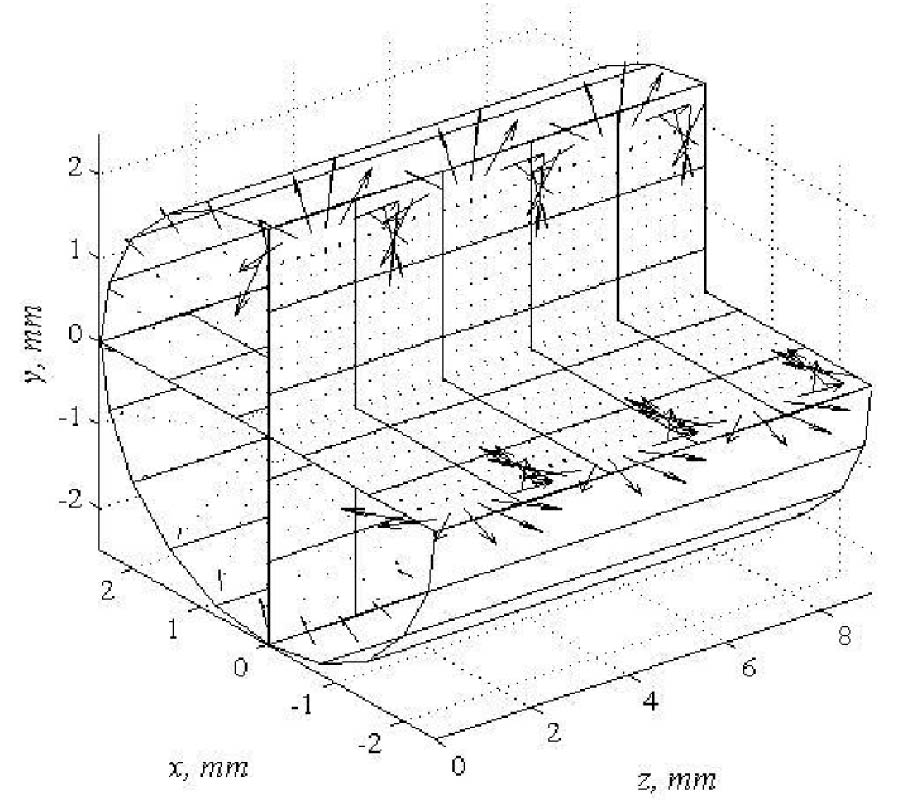
Frequency-dependent energy tunneling that results in full transmission of electromagnetic energy through wire-loaded sharp waveguide bends is demonstrated by full-wave simulations. The frequencies at which the tunneling takes place is predicted by a numerical method that involves a variational impedance formula based on Green function of a probe-excited parallel plate waveguide. Analogous tunneling effects have also been previously observed in waveguide bends filled with epsilon-near-zero media. However, since the frequency response in the wire-loaded waveguides can be tailored by simply modifying the lengths of the wires, the phenomenon is scalable over a broad range of frequencies and can be potentially exploited in various filtering and multiplexing applications.
FREQUENCY-SELECTIVE ENERGY TUNNELING IN WIRE-LOADED NARROW WAVEGUIDE CHANNELS
2010-07-01
PIER C
Vol. 14, 163-171
Simultaneous Detection of Organic and Inorganic Substances in a Mixed Aqueous Solution Using a Microwave Dielectric Sensor
Lijie Li
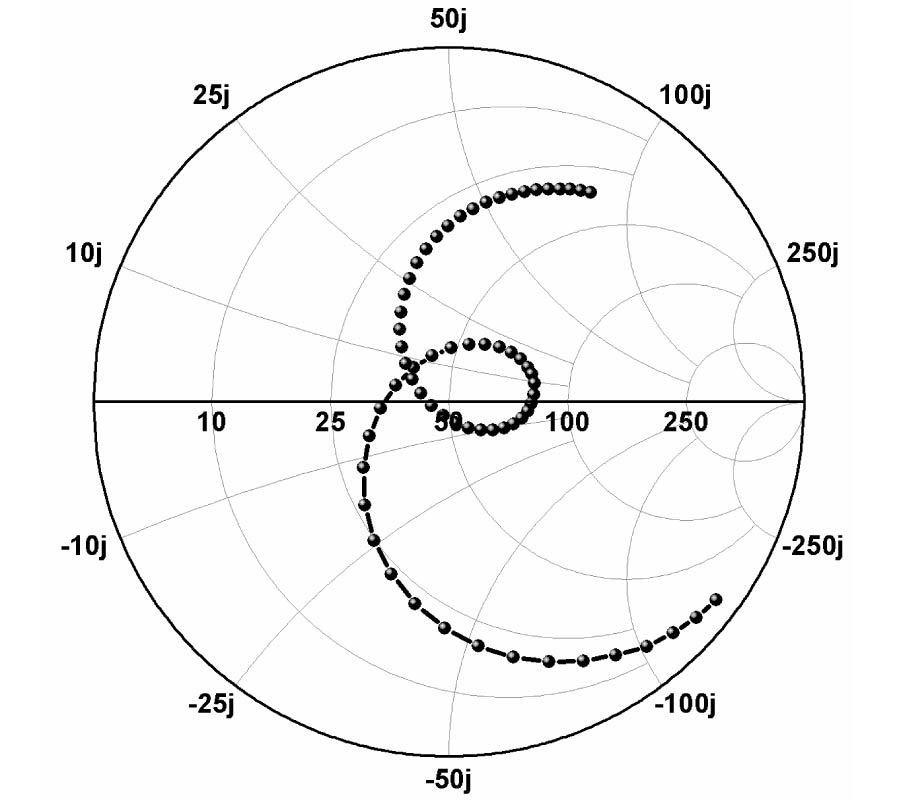
This letter reports a new technique that enables simultaneous detection of concentrations of the organic and inorganic substances in a hybrid fluidic solution. The technique is based on a coplanar microwave distributed MEMS transmission line. Measurement results show that a hybrid aqueous solution with a mixture of 0 M -- 0.2 M NaCl and 0 mg/ml -- 350 mg/ml glucose can be easily detected simultaneously from measured one-port scattering parameter (S11).
SIMULTANEOUS DETECTION OF ORGANIC AND INORGANIC SUBSTANCES IN A MIXED AQUEOUS SOLUTION USING A MICROWAVE DIELECTRIC SENSOR
2010-07-01
PIER C
Vol. 14, 155-161
Multiple-Ring Monopole Antenna with Sleeve-Shaped Ground for DVB-T Applications
Bo-Ming Jeng , Chien-Ming Lee and Ching-Hsing Luo
Abstract-This work presents a novel broadband monopole antenna for digital video broadcasting-terrestrial (DVB-T) application. The proposed antenna consists of a multiple-ring radiating patch and a sleeve-shaped ground plane. The multiple-ring monopole is used to realize the antenna height reduction at a fixed operating frequency. It shows a wide operating 2.5:1 VSWR bandwidth of 408 MHz achieved by using an impedance-matching technique. The technique applies cutting a notch at the ground plane opposite to the microstrip line and adjusting the height of the sleeve-shaped ground. The proposed antenna can operate in the 463-871 MHz frequency range and cover the DVB-T operating bandwidth (470-862 MHz). The radiation pattern of the proposed antenna in the xy-plane is omni-directional with a peak antenna gain of 4.2 dBi.
MULTIPLE-RING MONOPOLE ANTENNA WITH SLEEVE-SHAPED GROUND FOR DVB-T APPLICATIONS