Search Results(13805)

2009-10-14
PIER Letters
Vol. 12, 59-67
Hybrid Microstrip Compact Bandpass Filter Using High Permittivity Substrate
Cheng-Hsing Hsu , Hsuan-An Ho and Chung-I Hsu
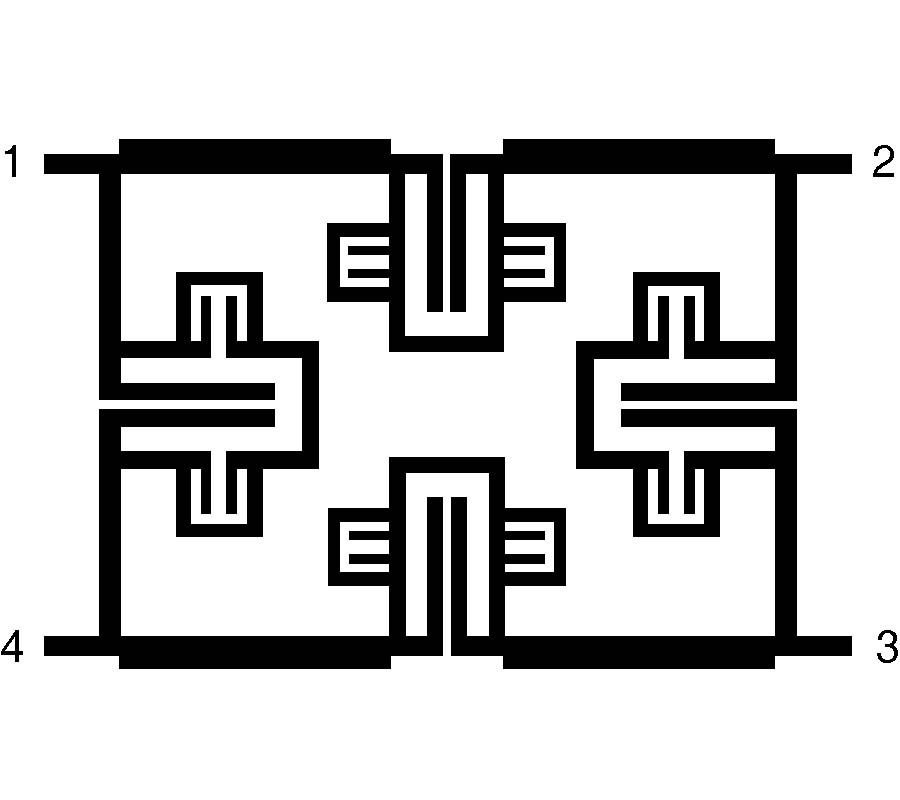
A four-pole elliptic function compact bandpass filter is designed by using interdigital hairpin resonator and step-impedance hairpin resonator. The miniaturized band-pass filter is also implemented using high permittivity dielectric substrate. The full-wave simulator IE3D is used to design the compact hairpin resonator, and to calculate the coupling coefficient of the basic coupling strictures. The responses of the fabricated filters using Al2O3(εr = 9.7, Q×f = 350000 GHz) and 0.6Sm(Co1/2Ti1/2)O3-0.4CaTiO3 (εr=37, Q×f = 43000 GHz) dielectric substrates are designed at a center frequency of 2 GHz. The size of the compact hairpin filter using 0.6Sm(Co1/2Ti1/2)O3-0.4CaTiO3 ceramic substrate, as compared to that of a compact hairpin filter using Al2O3 ceramic substrate, is reduced in size by 45%. The compact size and good agreement have been obtained between simulations and implementation results.
HYBRID MICROSTRIP COMPACT BANDPASS FILTER USING HIGH PERMITTIVITY SUBSTRATE
2009-10-14
PIER C
Vol. 11, 51-60
A Half Hollow Cylindrical Antenna (HHCA) Analysis Using the CFDTD Algorithm
Mohsen Denden , Nabil Ghannay and Abdelaziz Samet
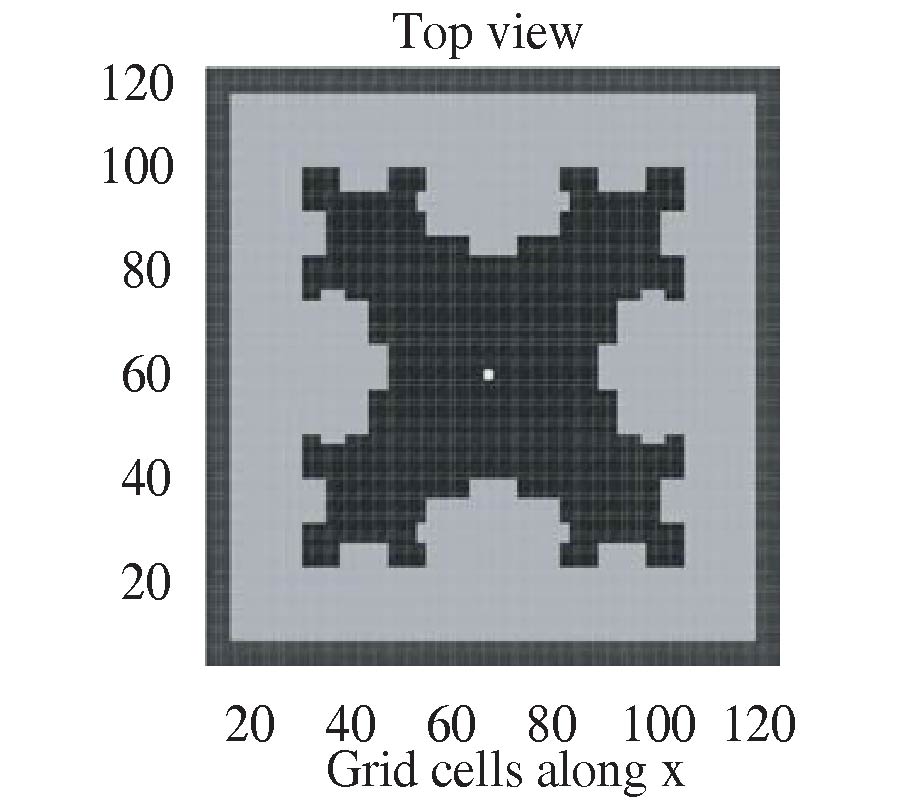
In this paper, a direct three dimensional Finite-Difference Time-Domain (3D-FDTD) approach is implemented to investigate the electromagnetic behavior of a Half Hollow Cylindrical Antenna. The conformal shape of this antenna is studied using the Conformal Finite-Difference Time-Domain (CFDTD). We shall prove that a variation of the antenna shape generates an important shift of the values of the resonant frequency (about 0.467 GHz). Compared with the planar shape, the geometrical shape reduces the space occupied by the antenna of about 36,28%.
A HALF HOLLOW CYLINDRICAL ANTENNA (HHCA) ANALYSIS USING THE CFDTD ALGORITHM
2009-10-13
PIER
Vol. 97, 197-215
A Semi-Physical Simulation System for DBF Transmitter Array on LEO Satellite
Guang Liang , Wenbin Gong , Huijie Liu and Jinpei Yu
This paper presents a semi-physical simulation system for 61-channel DBF array transmitter antenna on LEO satellite. It consists of a hardware platform for digital beamfoming network (BFN) and a software simulation system for DBF array. The background and wideband input interface are described, and the signal process of digital beamforming network is discussed in detail. General DFT filter bank, distributed arithmetic (DA) algorithm and Hartley image rejection structure are adopted to design the digital BFN, which make the calculation of BFN reduced by 98.41% and get the multiplier consumption decreased to 7.11%, compared with conventional algorithms. A novel digital BFN hardware platform with distributed structure is designed, which can complete the high speed array signal processing with maximum throughput of 32.025 Gbps. Ultimately, the measurements of semi-physical simulation system show good agreement with the ideal simulation result. The derivation of radiation pattern from energy distribution of earth's surface demonstrates that the DBF array has good performance on beam coverage with equal flux density and satisfies the application in mobile satellite communication.
A SEMI-PHYSICAL SIMULATION SYSTEM FOR DBF TRANSMITTER ARRAY ON LEO SATELLITE
2009-10-13
PIER
Vol. 97, 177-195
Development of 61-Channel Digital Beamforming (DBF) Transmitter Array for Mobile Satellite Communication
Guang Liang , Wenbin Gong , Huijie Liu and Jinpei Yu
An 61-channel digital beamforming transmitter array antenna used in mobile satellite communication is presented in this paper. It can steer 16 beams simultaneously. The interface, architecture and subunits are described in detail. Standard hexagonal array (SHA) and 61-channel RF front ends are designed. Genetic Algorithm is adopted to realize the pattern synthesis with muti-objective optimization. The signal flow and hardware platform of the digital beamforming network are discussed, which can complete the high speed array signal processing with maximum throughput of 34.16 Gbps. A novel calibration scheme with high feasibility of project implementation is also proposed. The measurements of array antenna match well with simulation result, which validates the rationality and feasibility of the algorithms and project design.
DEVELOPMENT OF 61-CHANNEL DIGITAL BEAMFORMING (DBF) TRANSMITTER ARRAY FOR MOBILE SATELLITE COMMUNICATION
2009-10-13
PIER
Vol. 97, 159-176
Field Analysis of Dielectric Waveguide Devices Based on Coupled Transverse-Mode Integral Equation-Numerical Investigation
Hung-Wen Chang , Yan-Huei Wu , Shih-Min Lu , Wei-Chi Cheng and Meng-Huei Sheng
This is a numerical investigation of a recently proposed formulation, called coupled transverse-mode integral equation (CTMIE), for analyzing EM field properties in general 2-D dielectric waveguide devices. The device is first approximated by stack of piece-wise 1-D horizontally layered structures. Transverse field components on the interface between waveguide slices are unknown functions, which are governed by a coupled integral equation. When unknowns are expanded as a linear combination of given functions, CTMIE is converted to a coupled block matrix equation. We study three waveguide devices, in detail, to understand the relation between modeling parameters and accuracy and convergent rate of the solutions. Examples include a step waveguide junction, a multi-mode interferometer power cross coupler and a linearly tapered waveguide. All results are verified with independent calculations using other proven methods.
FIELD ANALYSIS OF DIELECTRIC WAVEGUIDE DEVICES BASED ON COUPLED TRANSVERSE-MODE INTEGRAL EQUATION-NUMERICAL INVESTIGATION
2009-10-13
PIER M
Vol. 9, 79-91
Retrieving Evaporation Duct Heights from Radar Sea Clutter Using Particle Swarm Optimization (PSO) Algorithm
Bo Wang , Zhen-Sen Wu , Zhenwei Zhao and Hong-Guang Wang
Particle Swarm Optimization algorithm (PSO) is a popular stochastic searching optimization algorithm to solve complicated optimization problems. The approach of retrieving duct parameters from the sea-surface reflected radar clutter is also known as Refractivity From Clutter (RFC) technique. RFC technique provides the near-real-time duct parameters to evaluate the radio system performance, without adding any hardware. Basic principles of PSO and its applications and RFC technique are introduced. Evaporation duct is retrieved based on RFC technique using PSO. The performance of PSO is validated using experiment data launched at East China Sea, and compared with those of genetic algorithm (GA) and ant colony algorithm (ACA). The results indicate that PSO has the advantages of faster convergence and higher retrieval precision than the other two methods.
RETRIEVING EVAPORATION DUCT HEIGHTS FROM RADAR SEA CLUTTER USING PARTICLE SWARM OPTIMIZATION (PSO) ALGORITHM
2009-10-13
PIER C
Vol. 11, 39-49
A Novel Maple-Leaf Shaped UWB Antenna with a 5.0-6.0 GHz Band-Notch Characteristic
Osama Mohamed Haraz Ahmed and Abdel Sebak
A novel microstrip fed ultra-wideband (UWB) antenna with different band rejection techniques is presented in this paper. The antenna consists of a maple-leaf shaped radiator fed by a microstrip line with a finite ground plane on the other side of the substrate. The size of the UWB antenna is 30.5 × 35.5 mm2 which is only about 0.3 × 0.35 λ2 at 3 GHz. The calculated impedance bandwidth of the proposed antenna ranges from 3 GHz to 14 GHz with relatively stable radiation patterns. Two different techniques have been implemented to achieve band-notch characteristic in the 5.0-6.0 GHz WLAN frequency band. The first one uses an H-shaped slot cut away from the radiating patch while the other one uses two rectangular slits in the ground plane creating defected ground structure (DGS).
A NOVEL MAPLE-LEAF SHAPED UWB ANTENNA WITH A 5.0-6.0 GHz BAND-NOTCH CHARACTERISTIC
2009-10-12
PIER
Vol. 97, 141-158
Effects of Fibroglandular Tissue Distribution on Data-Independent Beamforming Algorithms
Martin O'Halloran , Martin Glavin and Edward Jones
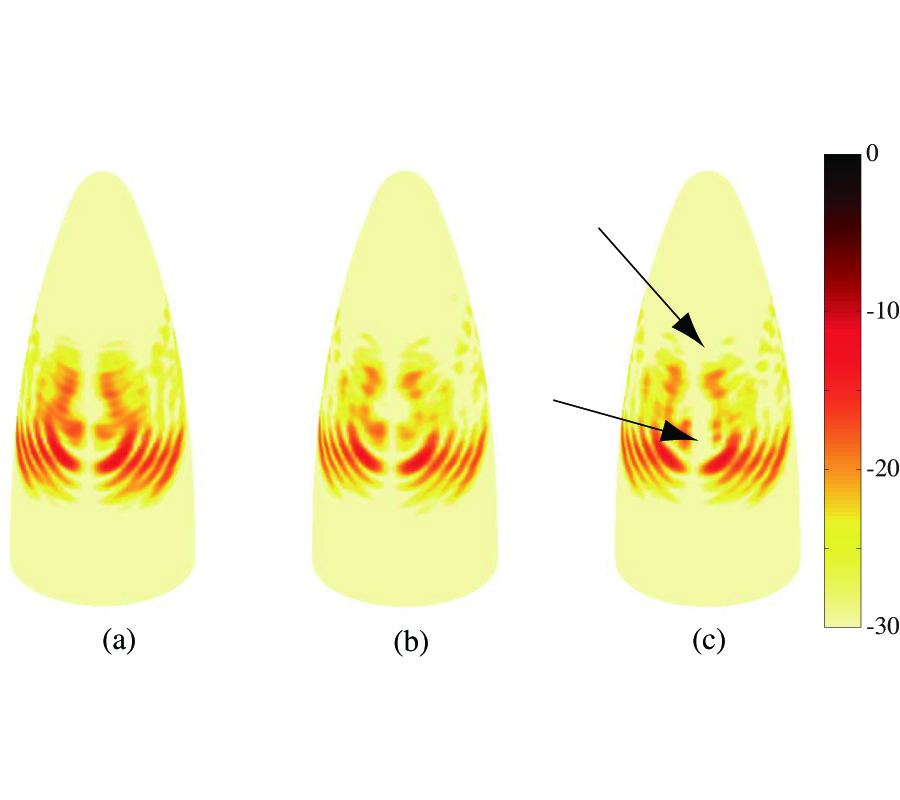
The effects of the fibroglandular tissue distribution of the breast on data-independent microwave imaging algorithms are investigated in this paper. A data-independent beamformer is a beamformer whose weights do not depend on the array data and are chosen, based on a channel model, to compensate for path-dependent attenuation and phase effects. The effectiveness and robustness of data-independent UWB beamforming algorithms relies upon two specific characteristics of breast tissue at microwave frequencies: firstly, that there exists a significant dielectric contrast between cancerous tissue and normal healthy breast tissue; secondly, that the propagation, attenuation and phase characteristics of normal tissue allow for constructive addition of the UWB returns using the Confocal Microwave Imaging (CMI) technique. However, two recent studies by Lazebnik et al. have highlighted a significant dielectric contrast between normal adipose and fibroglandular tissue within the breast. These results suggest a much more difficult imaging scenario where clutter due to fibroglandular tissue is a significant concern and that constructive addition of backscattered signals is potentially much more problematic than previously assumed. In this paper, three existing data-independent beamformers are tested on several different breast models, examining the effect of different fibroglandular tissue distribution on the performance of the data-independent imaging algorithms.
EFFECTS OF FIBROGLANDULAR TISSUE DISTRIBUTION ON DATA-INDEPENDENT BEAMFORMING ALGORITHMS
2009-10-12
PIER
Vol. 97, 129-139
Full-Wave Modeling of Multiple Vias Using Differential Signaling and Shared Antipad in Multilayered High Speed Vertical Interconnects
Boping Wu and Leung Tsang
A 3D full-wave approach, based on the Foldy-Lax multiple scattering equations, is successfully extended to model massively-coupled multiple vias using differential signaling and shared antipad in high speed vertical interconnects. For the first time, this method has been used and tested on via-pair with shared antipad in multilayered structure. The magnetic frill current source on the port is calculated by using the finite difference method. Banded matrix iterative method is applied to accelerate the finite difference calculation. Numerical example of 15 signal via-pairs and 20 ground shielding vias in 6-layer board demonstrates that this approach is able to model the via-pair with shared antipad and to include all the coupling effects among multiple vias. The electrical performances of different signal driving schemes are provided and discussed. The coupling crosstalk on various via-pairs is compared. The improvement of signal integrity is shown by using differential signaling and shared antipad for via-pair in multilayered structure. The results are compared with HFSS and SIwave in accuracy and CPU. The CPU using Foldy-Lax approach is three orders of magnitude faster than using HFSS, and two orders of magnitude faster than using SIwave. The accuracy of Foldy-Lax is within 2% difference from HFSS up to 20 GHz, and outperforms SIwave in accuracy.
FULL-WAVE MODELING OF MULTIPLE VIAS USING DIFFERENTIAL SIGNALING AND SHARED  ANTIPAD IN MULTILAYERED HIGH SPEED VERTICAL INTERCONNECTS
2009-10-12
PIER B
Vol. 18, 225-241
Scattering from Three-Dimensional Dispersive Gyrotropic Bodies Using the TLM Method
Ahmet Fazil Yagli , Jay Kyoon Lee and Ercument Arvas
A three-dimensional scattering field Transmission Line Modeling (TLM) algorithm is established to obtain bistatic radar cross sections of frequency dispersive gyromagnetic objects. Starting from the 1D TLM modeling of gyrotropic materials, a scattering field TLM algorithm is derived for 3D calculations. For verification, the bistatic radar cross section results for several gyromagnetic structures are compared with the single frequency computations, where the permittivity and permeability tensors are made of complex constants at a given frequency.
SCATTERING FROM THREE-DIMENSIONAL DISPERSIVE GYROTROPIC BODIES USING THE TLM METHOD
2009-10-09
PIER
Vol. 97, 105-127
Analysis of Scattering from Arbitrary Configuration of Cylindrical Objects Using Hybrid Finite-Difference Mode-Matching Method
Adam Kusiek and Jerzy Mazur
This paper presents a new hybrid finite-difference frequency domain --- mode-matching method (FDFD-MM) for the analysis of electromagnetic wave scattering from configuration of metallic or dielectric cylindrical posts with arbitrary cross-section. In our approach each scatterer is treated as an effective circular cylinder represented by impedance matrix defined in its local coordinate system. In order to obtain the scattering parameters of arbitrary configuration of objects in global coordinate system an analytical iterative scattering procedure (ISP) is applied. This work is an extension of our previously published results, where our consideration were limited to two dimensional (2D) problems with TM excitation. In this paper we extended our analysis to two-and-a-half dimensional (2.5D) problems. The accuracy of the proposed method is presented and discussed. To verify our approach some numerical examples are presented. The obtained results are compared with the results published in literature and the ones obtained from own measurements and commercial software.
ANALYSIS OF SCATTERING FROM ARBITRARY CONFIGURATION OF CYLINDRICAL OBJECTS USING HYBRID FINITE-DIFFERENCE MODE-MATCHING METHOD
2009-10-09
PIER B
Vol. 18, 205-224
Resonance on Transformers Excited by Square Waves and Explanation of the High Voltage on Tesla Transformer
Eduard Montgomery Meira Costa
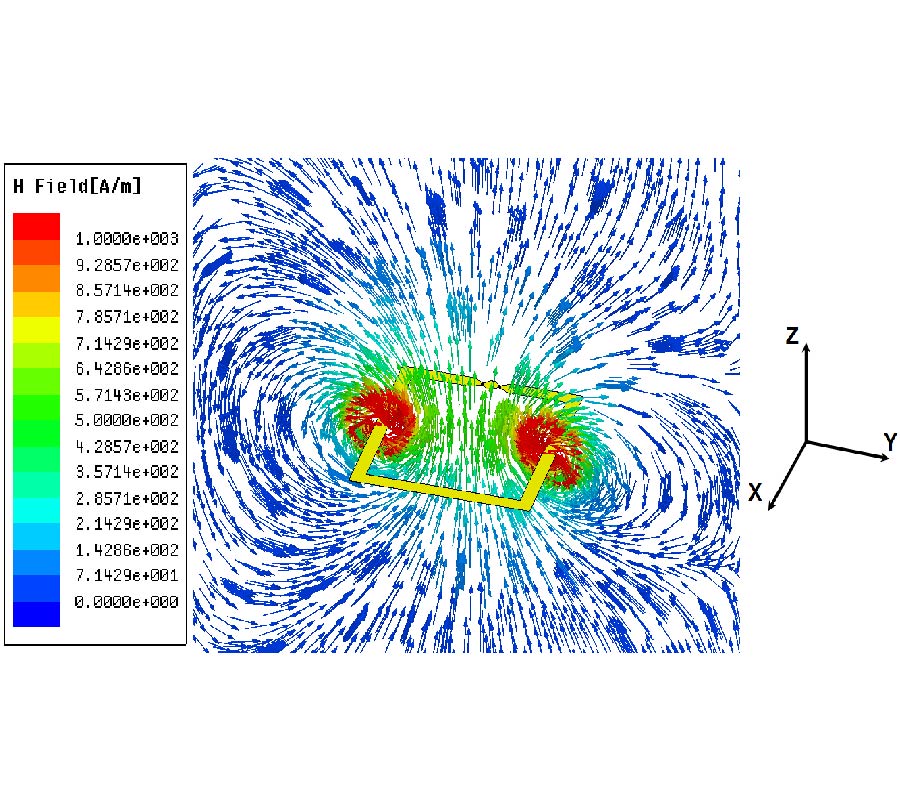
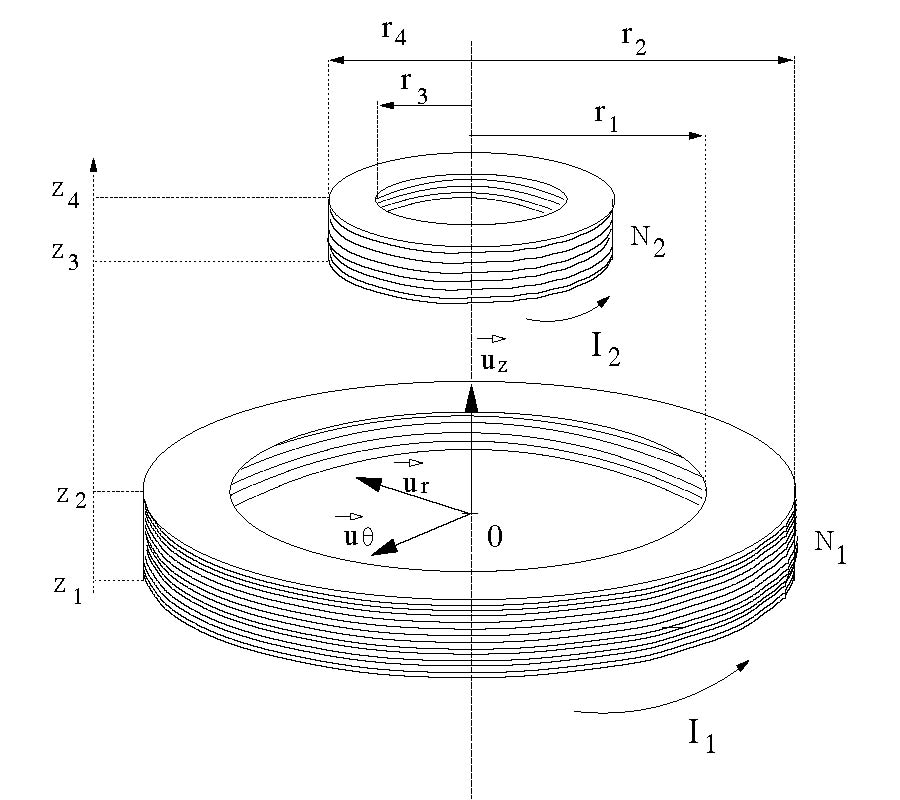
This paper presents an analysis about resonance on coupled systems when excited by square waves, generated through experiments using planar and ring coils. Because of the phenomenon described by its transfer function, a sum of responses appear when the square wave frequency increases, which causes a resonance response with high voltage, in several cases, greater than common turn ratio of the transformer. With parallel capacitances inserted on output, the resonance frequency reduction and change of gain is observed. Due to this effect, explanation of how output of Tesla transformer presents high voltage which is shown, and strategies to reach the maximal value on output are proposed.
RESONANCE ON TRANSFORMERS EXCITED BY SQUARE WAVES AND EXPLANATION OF THE HIGH VOLTAGE ON TESLA TRANSFORMER
2009-10-08
PIER
Vol. 97, 95-104
Microstrip Antenna Design Based on Stacked Patches for Reconfigurable Two Dimensional Planar Array Topologies
Carlos Vazquez-Antuna , George Roberto Hotopan , Samuel Ver-Hoeye , Miguel Fernandez-Garcia , Luis Herran Ontanon and Fernando Las Heras Andres
In this work, a probe fed microstrip antenna design for the implementation of two dimensional arrays with individually fed radiating elements is presented. The performance of the antenna element, both isolated and in a 4×4 fixed array topology, is analysed using ADS and HFSS simulation software. Prototypes of the antenna element and of the array are manufactured and measured for the experimental validation of the design.
MICROSTRIP ANTENNA DESIGN BASED ON STACKED PATCHES FOR RECONFIGURABLE TWO DIMENSIONAL PLANAR ARRAY TOPOLOGIES
2009-10-07
PIER
Vol. 97, 75-93
On Quantitative Microwave Tomography of Female Breast
Ilaria Catapano , Loreto Di Donato , Lorenzo Crocco , Ovidio Mario Bucci , Andrea Francesco Morabito , Tommaso Isernia and Rita Massa
Microwave tomography deserves attention in biomedical imaging, owing to its potential capability of providing a morphological and functional assessment of the inspected tissues. However, such a goal requires the not trivial task of solving a non linear inverse scattering problem. In this paper, the factors affecting the complexity of the inverse problem are exploited to trace guidelines aimed at setting the matching fluid, the frequency range and the number of probes in such a way that the dielectric parameters of female breast tissues can be reliably retrieved. Examples, concerning 2D realistic numerical phantoms obtained by NMR images, are given to asses a osteriori the effectiveness of the proposed guidelines.
ON QUANTITATIVE MICROWAVE TOMOGRAPHY OF FEMALE BREAST
2009-10-07
PIER B
Vol. 18, 185-204
Fet Small Signal Modelling Based on the Dst and Mel Frequency Cepstral Coefficients
Rania R. Elsharkawy , El-Sayed M. El-Rabaie , M. Hindy , Rreda Salama Mohamed Ghoname and Moawad Ibrahim Dessouky
In this paper, a new technique is proposed for field effect transistor (FET) small-signal modelling using neural networks. This technique is based on the combination of the Mel frequency cepstral coefficients (MFCCs) and discrete sine transform (DST) of the inputs to a neural network. The input data sets to traditional neural systems for FET small-signal modelling are the scattering parameters and corresponding frequencies in a certain band, and the outputs are the circuit elements. In the proposed approach, these data are considered as forming random signals. The MFCCs of the random signals are used to generate a small number of features characterizing the signals. In addition, other MFCCs vectors are calculated from the DST of the random signals and appended to the MFCCs vectors calculated from the signals. The new feature vectors are used to train the neural networks. The objective of using these new vectors is to characterize the random input sequences with much more features to be robust against measurement errors. There are two benefits for this approach: a reduction in the number of neural networks inputs and hence a faster convergence of the neural training algorithm and robustness against measurement errors in the testing phase. Experimental results show that the proposed technique is less sensitive to measurement errors than using the actual measured scattering parameters.
FET SMALL SIGNAL MODELLING BASED ON THE DST AND MEL FREQUENCY CEPSTRAL COEFFICIENTS
2009-10-07
PIER C
Vol. 11, 21-38
Digital Amplitude Control for Interference Suppression Using Immunity Genetic Algorithm
Zoubir Hamici and Taisir Ismail
In this paper, we propose a novel genetic algorithm (GA) called immunity GA (IGA) for array pattern synthesis with interference suppression using digital amplitude only control. The IGA is based on crossover evolution where the crossover operator is a variant of the known GA operator. A new formulation of the array factor transform for a specific number of elements N is expressed by a discrete cosine transform (DCT) with pre-computed DCT matrix. Evaluating thousands of candidate solutions generated by the IGA using the precomputed DCT matrix will result in a high speed computation. This high performance allows us to find a good approximation of the absolute minimum SLL of synthesized arrays with digital amplitude control. Simulation results show the effectiveness of this new algorithm for pattern synthesis with low SLL and null steering.
DIGITAL AMPLITUDE CONTROL FOR INTERFERENCE SUPPRESSION USING IMMUNITY GENETIC ALGORITHM
2009-10-06
PIER
Vol. 97, 61-73
A Novel Terahertz Sensing Device Comprising of a Parabolic Reflective Surface and a BI-Conical Structure
Mao Cai and Er Ping Li
A sensing device comprising of a parabolic reflective surface and a bi-conical metal structure is proposed to focus terahertz energy on sample material in the sensing zone to create a strong interaction between terahertz signals and the sample under test. The signal enhancement by the sensing device is confirmed by modeling and simulation results. The proposed sensor is applied to investigate the polarization dependency of a split ring resonator (SRR), and spectral signatures of the SRR under different incident wave polarizations are obtained.
A NOVEL TERAHERTZ SENSING DEVICE COMPRISING OF A PARABOLIC REFLECTIVE SURFACE AND A BI-CONICAL STRUCTURE
2009-10-06
PIER Letters
Vol. 12, 49-58
Planar Multi-Trapezoidal Ultra-Wideband Antenna and Its Parametric Analysis
Xue-Song Yang and Jun-Hua Dou
A compact ultra-wideband (UWB) planar monopole antenna is proposed. Multiple trapezoids and a semicircle are connected to form the patch of the monopole. The compact antenna not only has low return loss, but also has omni-directional radiation pattern over the ultra-wide bandwidth. Both the simulated and measured results are given and they are in reasonable agreement. The group delay, which is an indication of linearity between two proposed antennas, is also good. Parametric analysis on the patch shape has been performed to give some helpful design information.
PLANAR MULTI-TRAPEZOIDAL ULTRA-WIDEBAND ANTENNA AND ITS PARAMETRIC ANALYSIS
2009-10-05
PIER
Vol. 97, 45-60
A Flanged Parallel-Plate Waveguide Probe for Microwave Imaging of Tumors
Huiyu Zhang , Soon Yim Tan and Hong Siang Tan
This paper presents a microwave imaging method for malignant tumors using flanged parallel-plate waveguide probes, based on detecting the significant difference in complex permittivity that exists between the tumor and its surrounding tissues. The presence of a tumor is identified from a frequency scan of the resonant scattering parameters. The tumor location can be estimated using S21 obtained at various positions of the region of concern, e.g. human organ, biological tissues, etc., while another probe transmits at the position yielding maximum resonating response of S11, with triangulation technique. A tumor can also be distinguished from clutter items. With specific reference to the detection of breast cancer, simulation studies are presented to verify the performance of this probe and the proposed detection technique.
A FLANGED PARALLEL-PLATE WAVEGUIDE PROBE FOR MICROWAVE IMAGING OF TUMORS
2009-10-05
PIER B
Vol. 18, 165-183
Electromagnetic Source Transformations and Scalarization in Stratified Gyrotropic Media
Patrick De Visschere
It is known that with restrictions on the type of the constitutive equations, Maxwell's equations in non-uniform media can sometimes be reduced to two 2nd order differential equations for 2 scalar quantities only. These results have previously been obtained in two quite different ways, either by a "scalarization of the sources", where the relevant scalar quantities are essentially vector potential components, and the derivation was limited to isotropic media, or alternatively by using the "scalar Hertz potentials", and this method has been applied to more general media. In this paper it is shown that both methods are equivalent for gyrotropic media. We show that the scalarization can be obtained by a combination of transformations between electric and magnetic sources and gauge transformations. It is shown that the method based on the vector potential, which previously used a non-traditional definition of the vector potentials, can also be obtained using the traditional definition provided a proper gauge condition is applied and this method is then extended from isotropic to gyrotropic media. It is shown that the 2 basic scalar Hertz potentials occurring in the second method are invariant under the source scalarization transformations of the first method and therefore are the natural potentials for obtaining scalarization. Finally it is shown that both methods are also equivalent with a much older third method based on Hertz vectors.