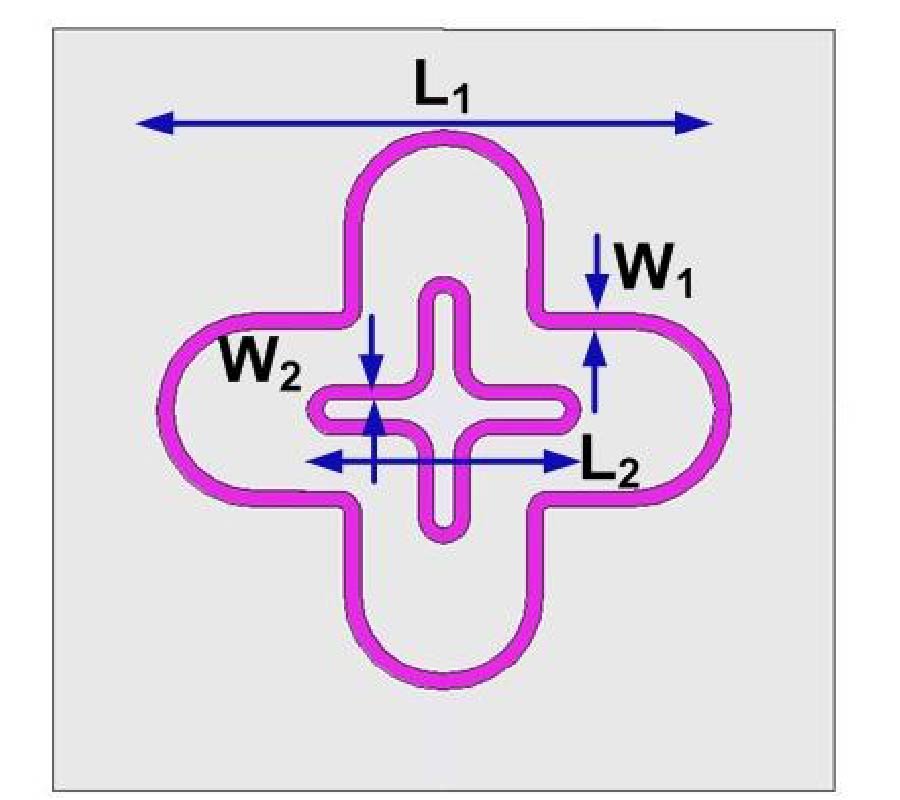
1. Huang, J. and J. Encinar, Reflectarray Antennas, IEEE Press, 2008.
2. Li, H., B. Wang, and W. Shao, "Novel broadband reflectarray antenna with compound-cross-loop elements for millimeter-wave application," Journal of Electromagnetic Waves and Applications, Vol. 21, No. 10, 1333-1340, 2007.
doi:10.1163/156939307783239528 Google Scholar
3. Bialkowski, M. E. and K. H. Sayidmarie, "Bandwidth considerations for a microstrip reflectarray," Progress In Electromagnetics Research B, Vol. 3, 173-187, 2008.
doi:10.2528/PIERB07120405 Google Scholar
4. Venneri, F., S. Costanzo, and G. Di Massa, "Transmission line analysis of aperture-coupled reflectarrays," Progress In Electromagnetics Research C, Vol. 4, 1-12, 2008. Google Scholar
5. Venneri, F., S. Costanzo, G. Di Massa, and G. Amendola, "Aperture-coupled reflectarrays with enhanced bandwidth features," Journal of Electromagnetic Waves and Applications, Vol. 22, No. 11--12, 1527-1537, 2008.
doi:10.1163/156939308786390247 Google Scholar
6. Tahir, F. A., H. Aubert, and E. Girard, "Equivalent electrical circuit for designing MEMS-controlled reflectarray phase shifters," Progress In Electromagnetics Research, Vol. 100, 1-12, 2010.
doi:10.2528/PIER09112506 Google Scholar
7. Huang, J., "Mucrostrip reflectarray," Proc. IEEE Antennas and Propagation Symposium, 612-615, Canada, 1991.
8. Kelkar, A., "Conformal phased reflecting surfaces," Proc. IEEE National Radar Conference, 58-62, Los Angeles, 1991.
9. Huang, J. and R. Pogorzelski, "A Ka-band microstrip reflectarray with elements having variable rotation angles," IEEE Trans. Antennas and Propagation, Vol. 46, 650-656, 1998.
doi:10.1109/8.668907 Google Scholar
10. Encinar, J., "Design of a dual-frequency reflectarray using microstrip stacked patches of variable size," Electronics Letters, Vol. 32, 1049-1050, 1996.
doi:10.1049/el:19960710 Google Scholar
11. Hsu, S. and K. Chang, "A new dual-band reflectarray configuration," Proc. IEEE Antennas and Propagation Symposium, San Diego, 2008.
12. Chaharmir, M., J. Shaker, and N. Gagnon, "Broadband dual-band linear orthogonal polarisation reflectarray," Electronics Letters, Vol. 45, 13-14, 2009.
doi:10.1049/el:20092679 Google Scholar
13. Chaharmir, M., J. Shaker, and H. Legay, "Broadband design of a single layer large reflectarray using multi cross loop elements," IEEE Trans. Antennas and Propagation, Vol. 57, 3363-3366, 2009.
doi:10.1109/TAP.2009.2029600 Google Scholar
14. Bialkowski, M., A. Abbosh, and K. Sayidmarie, "Investigations into phasing characteristics of printed single and double cross elements for use in a single layer microstrip reflectarray," Proc. IEEE Antennas and Propagation Symposium, San Diego, 2008.
15. Abbosh, A., "Dual-band single layer microstrip reflectarray using multiresonance double cross elements," Asia-Pacific Microwave Conference, Hong Kong, 2008.
16. Abbosh, A., "Effect of the conductive coating thickness on performance of the microstrip reflectarray," Microwave and Optical Tech. Letters, Vol. 51, 1288-1290, 2009.
doi:10.1002/mop.24296 Google Scholar