Search Results(13805)

2009-11-10
PIER
Vol. 99, 71-88
FPGA-Based Chirp Generator for High Resolution UAV SAR
Chua Ming Yam and Voon Koo
This paper discusses the design and development of a FPGA-based chirp generator for high resolution Unmanned Aerial Vehicle (UAV) Synthetic Aperture Radar. The desired bandwidth of the chirp signal is 100 MHz (combination of I and Q channels) with a chirp rate of 5 MHz/μs. Two algorithms based on the Memory-based architecture and the Direct Digital Synthesizer (DDS) architecture are presented. The measurement results indicate that the DDS chirp generator is a preferred choice for high-resolution SAR application.
FPGA-BASED CHIRP GENERATOR FOR HIGH RESOLUTION UAV SAR
2009-11-10
PIER
Vol. 99, 53-70
Estimation of Core Temperature Elevation in Humans and Animals for Whole-Body Averaged SAR
Akimasa Hirata , Hironori Sugiyama and Osamu Fujiwara
Biological effects due to whole-body radio-frequency exposure may be induced by core temperature elevation. According to the international safety guidelines/standards for human protection, the whole-body averaged specific absorption rate (WBA-SAR) is used as a metric. In order to understand the relationship between WBA-SAR and core temperature elevation, a theoretical solution or a closed formula for estimating core temperature elevation is essential. In the present study, we derived a formula for simply estimating core temperature elevation in humans and animals due to whole-body radio-frequency exposure. The core temperature elevation estimated with the formula is found to be in reasonable agreement with the computational results of finite-difference time-domain computation incorporated in anatomically-based models. Based on the formula, the WBA-SAR is found to be a good metric for estimating core temperature elevation. The main factors influencing the core temperature elevation are the perspiration rate and the body surface area-to-weight ratio.
ESTIMATION OF CORE TEMPERATURE ELEVATION IN HUMANS AND ANIMALS FOR WHOLE-BODY AVERAGED SAR
2009-11-10
PIER
Vol. 99, 37-52
Resonant Transparency of a Three-Layer Structure Containing the Dense Plasma Region
Natalia Sternberg and Andrei I. Smolyakov
A study of electromagnetic wave propagation in dense plasmas when the wave frequency is below the cut-off frequency is presented. A three-layer symmetric structure consisting of dense plasma nested between two boundary layers is studied analytically and numerically. The permittivity of the dense plasma is negative, while the permittivity of each boundary layer is greater than 1. It is shown that total transmission of an electromagnetic wave can be achieved if an adequate incidence angle, dielectric permittivity of the boundary layers and corresponding boundary layer widths are chosen. It is found that plasma transparency is due to resonance between the evanescent waves in the dense plasma region and the standing waves in the boundary layers. Resonance conditions are derived analytically and the relationship between the corresponding parameters of the problem are studied numerically.
RESONANT TRANSPARENCY OF A THREE-LAYER STRUCTURE CONTAINING THE DENSE PLASMA REGION
2009-11-10
PIER
Vol. 99, 21-36
Analysis of Scattering by Large Inhomogeneous BI-Anisotropic Objects Using AIM
Li Hu , Joshua Le-Wei Li and Tat Yeo
In this paper, electromagnetic scattering of a plane wave by large inhomogeneous arbitrarily shaped bi-anisotropic objects is solved by Adaptive Integral Method (AIM). Based on Maxwell equations and constitutive relationship for general bi-anisotropic media and using Volume Integral Equations (VIE), the electromagnetic fields are derived as functions of equivalent volume sources. Then the integral equations are discretized using Method of Moments (MoM). Because of the dense matrix property, MoM cannot be used to solve electromagnetic scattering by large objects. Therefore, AIM is adopted to reduce the memory requirement and speed up the solution process. Comparison between AIM and MoM with respect to CPU time and memory requirement is done to show the efficiency of AIM in solving electromagnetic scattering by large objects. Numerical results are obtained for some canonical cases and compared with Mie theory, in which excellent agreement is observed. some new numerical results are also presented for the more general bi-anisotropic material media.
ANALYSIS OF SCATTERING BY LARGE INHOMOGENEOUS BI-ANISOTROPIC OBJECTS USING AIM
2009-11-10
PIER
Vol. 99, 1-20
Comparison of Planar and Circular Antenna Configurations for Breast Cancer Detection Using Microwave Imaging
Raquel Cruz Conceicao , Martin O'Halloran , Martin Glavin and Edward Jones
Ultra Wideband (UWB) radar is a promising emerging technology for breast cancer detection based on the dielectric contrast between normal and tumour tissues at microwave frequencies. One of the most important considerations in developing a UWB imaging system is the configuration of the antenna array. Two specfic configurations are currently under investigation, planar and cylindrical. The planar configuration involves placing a conformal array of antennas on the naturally attened breast with the patient lying in the supine position. Conversely, the circular configuration involves the patient lying in the prone position, with the breast surrounded by a circular array of antennas. In order to effectively test the two antenna configurations, two 2D Finite-Difference Time-Domain (FDTD) models of the breast are created, and are used to simulate backscattered signals generated when the breast is illuminated by UWB pulses. The backscattered signals recorded from each antenna configuration are passed through a UWB beamformer and images of the backscattered energy are created. The performance of each imaging approach is evaluated by both quantitative methods and visual inspection, for a number of test conditions. System performance as a function of number of antennas, variation in tissue properties, and tumour location are examined.
COMPARISON OF PLANAR AND CIRCULAR ANTENNA CONFIGURATIONS FOR BREAST CANCER DETECTION USING MICROWAVE IMAGING
2009-11-10
PIER
Vol. 98, 425-443
Effects of Interferences in UHF RFID Systems
Antonio Lazaro , David Girbau and Ramon Villarino
The Radio Frequency Identification (RFID) applications are growing rapidly, especially in the UHF frequency band that is being used in inventory management. Passive UHF tags are preferred for these applications. In this paper, RFID reader-to-reader interference is analyzed. A model to estimate the minimum distance between readers to achieve a desired probability of detection in real multipath environments is derived and compared to the ideal case (AWGN channel). Diversity techniques to combat multipath and interference effects are proposed and studied.
EFFECTS OF INTERFERENCES IN UHF RFID SYSTEMS
2009-11-09
PIER M
Vol. 9, 139-150
Introducing Fictitious Currents for Calculating Analytically the Electric Field in Cylindrical Capacitors
Romain Ravaud , Guy Lemarquand and Slobodan Babic
The aim of this paper is to show the interest of using equivalence models for calculating the electric field produced by cylindrical capacitors with dielectrics. To do so, we use an equivalent model, based on the dual Maxwell's Equations for calculating the two electric field components created inside the capacitor and outside it. This equivalent model uses fictitious currents generating a electric vector potential that allows us to determine the electric field components in all points in space. The electric field produced by charge distributions as capacitor with dielectrics is generally determined by using the coulombian model. Indeed, it is well known that the electric field derives from a scalar potential. By using the Maxwell's equations, this scalar potential is in fact linked to the existence of charge distributions that are generally located on the faces of the capacitors. However, this last model does not allow us to obtain reduced analytical expressions since it involves the calculation of charge volume density appearing in the dielectric material for arcshaped cylindrical topologies. Consequently, it is interesting to look for another approach that gives analytical expressions with a lower computational cost. In this paper, we show that the use of fictitious currents instead of charges allow us to obtain 3D analytical reduced expressions with a lower computational cost. This analytical approach is compared to the coulombian model for showing the equivalence between the two approaches.
INTRODUCING FICTITIOUS CURRENTS FOR CALCULATING ANALYTICALLY THE ELECTRIC FIELD IN CYLINDRICAL CAPACITORS
2009-11-09
PIER Letters
Vol. 12, 111-118
A Compact Balun Based on Microstrip EBG Cell and Interdigital Capacitor
Chih-Ming Lin , Chun-Chi Su , Shih-Han Hung and Yeong-Her Wang
A novel compact balun (balanced-to-unbalanced) that consists of a low-pass network served by a microstrip electromagnetic bandgap (EBG) cell and a high-pass π-network formed with an interdigital capacitor is presented. This proposed approach can effectively operate the compact balun without the use of λ/4 microstrip lines to reduce the circuit area over 50% compared to the conventional Marchand balun. The core dimension of the compact balun is 0.74 cm x 0.7 cm. The planar structure enables an efficient circuit design in printed circuit boards (PCB) without using any bonding wires, defected ground structures (DGS), or surface mounted devices (SMD). A compact balun operating in the 3 GHz band has been implemented in a FR-4 PCB. From the measured results, the return loss of the input port is better than 15 dB over the band from 2.6 to 4 GHz. The amplitude and phase imbalances are less than 1.4 dB and 3° with the 20% operational bandwidth ranging from 2.7 to 3.3 GHz, respectively.
A COMPACT BALUN BASED ON MICROSTRIP EBG CELL AND INTERDIGITAL CAPACITOR
2009-11-08
PIER B
Vol. 18, 327-346
Design of a Beam Forming Dielectric Cylindrical EBG Antenna
Claudio Biancotto and Paul Record
A novel dielectric cylindrical electronic bandgap antenna is presented and analysed using an in-house developed Finite-Difference-Time-Domain software simulator. The design steps and the simulations results of a geometrical parametric study are also presented and discussed, focusing on the design of antennas to operate in the X-band with high directivity patterns on the H-plane. Finally, the measurements results of a set of experiments carried out on a prototype showed very good agreement with simulations: 11% fractional bandwidth at 10 GHz and an average gain of 9.5 dBi are achieved in the impedance bandwidth with 13 dB front-to-back-ratio in the azimuthal plane.
DESIGN OF A BEAM FORMING DIELECTRIC CYLINDRICAL EBG ANTENNA
2009-11-07
PIER M
Vol. 9, 123-138
Evaluation of Mutual Coupling Between Slots from Dipole Expressions
Sandeepak S. Kakatkar and Kamla Prasan Ray
Two closed form approximations are given for mutual coupling between arbitrarily oriented slots with cosinusoidal distribution, using the known results for dipoles along with a new correction factor to account for the piecewise sinusoidal dipole current. Using these approximations, a scheme has been developed for calculating mutual coupling between practically used slots of arbitrary orientation and useful results are obtained from simple closed form expressions for slot separation of 1.2 × slot length or more depending upon the approximation chosen and the length of the slot. These approximations are found to be more accurate than those available in the literature, with a maximum error of less than 1.6% for slots shorter than 0.5 wavelength and separated by 0.85 × wavelength or more. Simple yet accurate expressions for mutual coupling, like the point dipole approximation developed here, result in efficient evaluation of mutual coupling for the design of large arrays of slots or for Electromagnetic Compatibility analysis.
EVALUATION OF MUTUAL COUPLING BETWEEN SLOTS FROM DIPOLE EXPRESSIONS
2009-11-06
PIER C
Vol. 11, 109-120
Down-Link CATV/FTTH and Up-Link FTTH Transport Systems Based on Reflective Semiconductor Optical Amplifier
Cheng-Ling Ying , Ching-Hung Chang , Ya-Ling Houng , Hai-Han Lu , Wen-Shing Tsai and Heng-Sheng Su
A down-link CATV/fiber-to-the-home (FTTH) and up-link FTTH transport system employing a reflective semiconductor optical amplifier (RSOA) as wavelength reuse and remodulation schemes is proposed and experimentally demonstrated. By using -1 side mode injection-locked/optoelectronic feedback techniques, brilliant performances of carrier-to-noise ratio (CNR), composite second-order (CSO), composite triple beat (CTB), and bit error rate (BER) were obtained for down-link transmission; low BER value was also achieved for up-link transmission over a 50-km single-mode fiber (SMF) transmission. Such a CATV/FTTH transport system is suitable for broadband access fiber networks.
DOWN-LINK CATV/FTTH AND UP-LINK FTTH TRANSPORT SYSTEMS BASED ON REFLECTIVE SEMICONDUCTOR OPTICAL AMPLIFIER
2009-11-06
PIER C
Vol. 11, 91-107
A 900-MHz 30-dBm Bulk CMOS Transmit/Receive Switch Using Stacking Architecture, High Substrate Isolation, and RF Floated Body
Yih-Hsia Lin , Chun-Hsueh Chu , Da-Chiang Chang , Jeng Gong and Ying-Zong Juang
This paper presents comprehensive methods for the design of a 900-MHz CMOS transmit/receive (T/R) switch with high power-handling capability. Techniques such as RF floated body to extend the bandwidth and decrease the insertion loss, and stacking architecture with high substrate isolation to enhance the power-handling capability are used for the design of a T/R switch on a standard 0.18um triple-well CMOS process. The measured performance of the T/R switch demonstrates the effectiveness of the methods presented in this paper such that insertion loss less than 1.0 dB, isolation up to 35.2 dB, and input 1-dB compression point of 30-dBm can be achieved at 900-MHz.
A 900-MHZ 30-DBM BULK CMOS TRANSMIT/RECEIVE SWITCH USING STACKING ARCHITECTURE, HIGH SUBSTRATE ISOLATION, AND RF FLOATED BODY
2009-11-03
PIER
Vol. 98, 389-405
Superficial Tumor Hyperthermia with Flat Left-Handed Metamaterial Lens
Yu Gong and Gang Wang
Flat left-handed metamaterial (LHM) lens can generate appropriate focusing spot in biological tissue as required in microwave tumor hyperthermia treatment. By using single flat LHM lens to concentrate microwave in a mass of tissue covered by water bolus, microwave hyperthermia scheme is proposed for superficial tumor hyperthermia. The power distribution in tissue is simulated by finite-difference time-domain method, and the thermal pattern is calculated by solving the bio-heat transfer equation. It is demonstrated that, by using a flat LHM lens of thickness of 4 cm to concentrate microwave of 2.45 GHz, a temperature above 42oC can be achieved and maintained in one hour in a tissue region of about 1.0 cm in width and 1.2 cm in depth in tissue with the source amplitude of 43.40 V/cm, which is suitable for superficial tumor hyperthermia. By adjusting the position of microwave source, the heating zone in tissue can be adjusted in both the lateral and depth direction in tissue. The effects of fat layer and water bolus on the performance of hyperthermia are investigated as well.
SUPERFICIAL TUMOR HYPERTHERMIA WITH FLAT LEFT-HANDED METAMATERIAL LENS
2009-11-03
PIER
Vol. 98, 375-388
Laboratory Tests Assessing the Effectiveness of the Nf-Ff Transformation with Helicoidal Scanning for Electrically Long Antennas
Francesco D'Agostino , Flaminio Ferrara , Claudio Gennarelli , Rocco Guerriero and Massimo Migliozzi
This paper deals with the experimental validation of an effective near-field-far-field transformation technique with helicoidal scanning particularly suitable for electrically long antennas, whose validity has been numerically assessed in a previous authors' paper. Such a technique relies on the results relevant to the nonredundant sampling representations of the electromagnetic fields and makes use of an optimal sampling interpolation algorithm, which allows the reconstruction of the near-field data needed by the near-field-far-field transformation with cylindrical scan. The use of a prolate ellipsoid instead of a sphere to model an elongated antenna allows one to consider measurement cylinders with a diameter smaller than the antenna height, thus reducing the error related to the truncation of the scanning zone. Moreover, a significant reduction of the needed near-field data is also obtained. The comparison of the far-field patterns reconstructed from the acquired helicoidal measurements with those obtained from the data directly measured on the classical cylindrical grid assesses the effectiveness of the near-field-far-field transformation using this innovative scanning technique. At last, its validity is further confirmed by the very good agreement with the direct far-field measurements.
LABORATORY TESTS ASSESSING THE EFFECTIVENESS OF THE NF-FF TRANSFORMATION WITH HELICOIDAL SCANNING FOR ELECTRICALLY LONG ANTENNAS
2009-11-03
PIER
Vol. 98, 359-373
Numerical Calculations on Inclusion Removal from Liquid Metals Under Strong Magnetic Fields
Zhi Sun , Muxing Guo , Jef Vleugels , Omer Van der Biest and Bart Blanpain
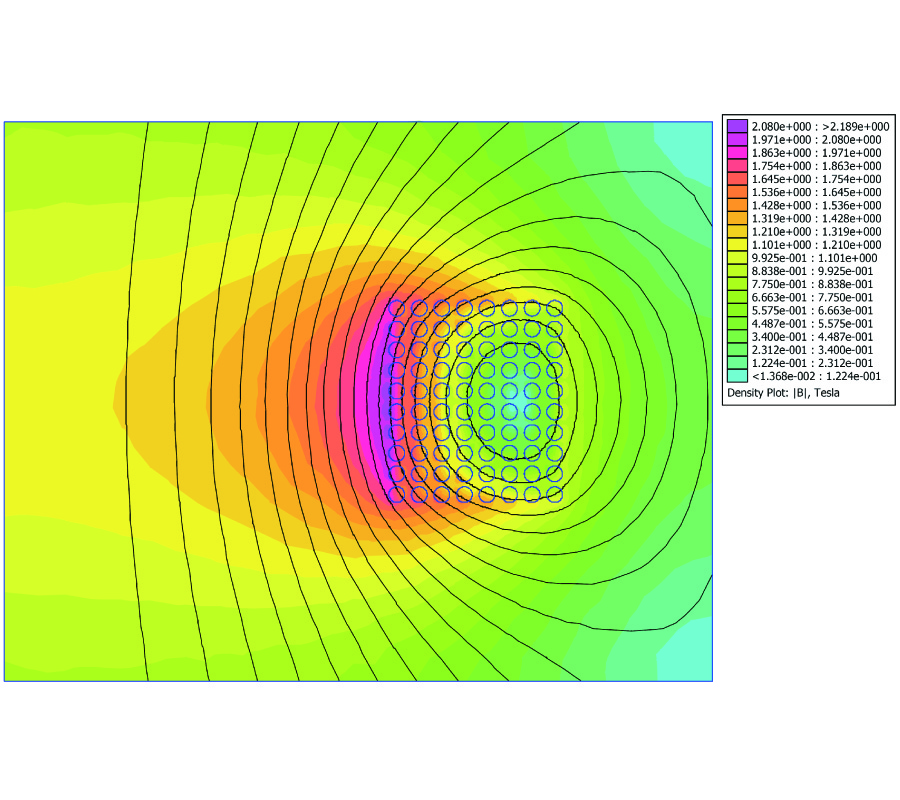
A numerical method is developed to calculate/simulate the separation of non-metallic inclusions from an aluminum melt by using a strong magnetic field (e.g., 10 Tesla) with high gradient generated via a superconducting magnet. The cases with and without imposed DC current on liquid aluminum in a cylindrical channel are discussed and compared. The migrating velocities of the non-metallic inclusions in an aluminum melt are calculated through force analysis and Navier-Stokes equations. In addition, the trajectories and removal efficiencies of the inclusions are evaluated. It is found that particle trajectories are influenced by the imposed flow rate and inclusion particle size. In addition, the removal efficiency is improved significantly, especially for small inclusions, e.g., <10 μm, by an imposed DC current on liquid aluminum in the high gradient area of a magnetic field.
NUMERICAL CALCULATIONS ON INCLUSION REMOVAL FROM LIQUID METALS UNDER STRONG MAGNETIC FIELDS
2009-11-03
PIER B
Vol. 18, 311-325
Photonic Bandgaps in Quasiperiodic Multilayer Structures Using Fourier Transform of the Refractive Index Profile
Saeed Golmohammadi , Y. Rouhani , Karim Abbasian and Ali Rostami
In this paper, photonic bandgaps (PBGs) of the quasiperiodic structures is calculated using the Fourier transform of the refractive index profile. Comparing the reflectivity and Fourier spectrum of multilayer structure refractive index, we find that a peak in the Fourier spectrum is equivalent to a sinusoidal term in the refractive index. The wavelength of the peak location in the Fourier spectrum is half the wavelength where a PBG is located. Using Fourier transform analysis of the refractive index of any multilayer structure, we can determine the location of the PBGs of that structure. Peaks in the Fourier spectrum can be used to design reflective band optical filters in optical communication systems. The filtering wavelengths are twice the peaks in the Fourier spectrum.
PHOTONIC BANDGAPS IN QUASIPERIODIC MULTILAYER STRUCTURES USING FOURIER TRANSFORM OF THE REFRACTIVE INDEX PROFILE
2009-11-02
PIER
Vol. 98, 333-358
Influence of Noise on Subwavelength Imaging of Two Close Scatterers Using Time Reversal Method: Theory and Experiments
Matthieu Davy , Jean-Gabriel Minonzio , Julien de Rosny , Claire Prada and Mathias Fink
Although classical imaging is limited by the Rayleigh criterion, it has been demonstrated that subwavelength imaging of two point-like scatterers can be achieved with probing sensors arrays, even if the scatterers are located in the far field of the sensors. However, the role of noise is crucial to determine the resolution limit. This paper proposes a quantitative study of the influence of noise on the subwavelength resolution obtained with the DORT-MUSIC method. The DORT method, French acronym for decomposition of the time reversal operator, consists in studying the invariants of the time reversal operator. The method is combined here with the estimator MUSIC (MUltiple SIgnal Classification) to detect and image two close metallic wires. The microwaves measurements are performed between 2.6 GHz and 4 GHz. Two wires of λ/100 diameters separated by λ/6 are imaged and separated experimentally. To interpret this result in terms of noise level, the analytical expression of the eigenvectors of the time reversal operator perturbed by the noise is established. We then deduce the noise level above which the subwavelength resolution fails. Numerical simulations and experimental results validate the theoretical developments.
INFLUENCE OF NOISE ON SUBWAVELENGTH IMAGING OF TWO CLOSE SCATTERERS USING TIME REVERSAL METHOD: THEORY AND EXPERIMENTS
2009-11-02
PIER
Vol. 98, 315-331
Electromagnetic Subsurface Detection Using Subspace Signal Processing and Half-Space Dyadic Green's Function
Xiao-Fei Liu , Bing-Zhong Wang and Shao-Qiu Xiao
In this paper, one of the subspace signal processing methods, namely time reversal multiple signal classification (TR-MUSIC), is firstly employed for electromagnetic subsurface detection where the multilayered dyadic Green's function is used. Therewith, one obtains the improved location and superresolution imaging for underground detecting application. The imaging pseudo-spectrum is accordingly defined for both the echo-mode and transmit-mode TR-MUSIC methods, by analyzing the obtained multistatic response matrix. Based on the theoretical formula, we carry out the numerical simulation using the half-space dyadic Green's function in noisy scenario. The results show that the MUSIC imaging algorithm achieves the enhanced resolution and the transmit-mode method gives more robust output when performance comparison of the four methods is made, therefore indicate the TR-MUSIC could be a good candidate for subsurface detection.
ELECTROMAGNETIC SUBSURFACE DETECTION USING SUBSPACE SIGNAL PROCESSING AND HALF-SPACE DYADIC GREEN'S FUNCTION
2009-11-02
PIER
Vol. 98, 299-314
Frequency Domain Skin Artifact Removal Method for Ultra-Wideband Breast Cancer Detection
Arash Maskooki , Erry Gunawan , Cheong Boon Soh and Kay Soon Low
Using ultra-wide band (UWB) microwave pulse for breast cancer detection has been greatly investigated recently since it does not impose the patient to any harmful radiation and the implementation is relatively cheaper than other methods such as MRI or X-ray. An issue in UWB imaging of breast cancer is the strong backscatter from the breast skin which is in orders of magnitude larger than the pulse backscattered from the tumor and should be eliminated before processing the signal for the tumor detection and imaging. At present no existing method can effectively remove this artifact without introducing corruption to the tumor signature. In this paper, a novel method to eliminate this artifact is proposed which employs a frequency domain model to isolate and remove skin related information from the signal. This method is compared with the existing methods of the skin artifact removal in different scenarios. The results show that the new method can overcome the shortcomings of the previous methods and improve the detection of the tumor in the sense of the tumor to clutter response ratio.
FREQUENCY DOMAIN SKIN ARTIFACT REMOVAL METHOD FOR ULTRA-WIDEBAND BREAST CANCER DETECTION
2009-11-02
PIER
Vol. 98, 283-298
Far Field Imaging Research Based on Multilayer Positive- and Negative-Refractive-Index Media Under off-Axis Illumination
Pengfei Cao , Xiaoping Zhang , Lin Cheng and Qingqing Meng
In this work, a far field imaging model based on the array structure of positive- and negative-refractive-index media and modulation subwavelength-gratings is firstly presented and is named as the multilayer far field superlens (MLFSL). This new lens is capable of producing optical images by enhancing evanescent waves to the far field. The principle of MLFSL is discussed in detail, and the necessary and sufficient condition for designing MLFSL is obtained. Simultaneously, off-axis illumination technology is introduced to MLFSL system to further improve super-resolution, and the transfer matrix which contains the incidence angles is obtained. The results demonstrate that, compared with other far field superlens, the subwavelength resolution of MLFSL has been enhanced. Such remarkable imaging capability of MLFSL promises new potential for nanoscale imaging and lithography.
FAR FIELD IMAGING RESEARCH BASED ON MULTILAYER POSITIVE- AND NEGATIVE-REFRACTIVE-INDEX MEDIA UNDER OFF-AXIS ILLUMINATION