Search Results(13805)

2009-12-01
PIER
Vol. 99, 339-354
Effect of Temperature and Multiple Scattering on Rain Attenuation of Electromagnetic Waves by a Simple Spherical Model
Eko Setijadi , Akira Matsushima , Naoki Tanaka and Gamantyo Hendrantoro
Specific rain attenuation is discussed from the viewpoint of numerical solution for scattering and absorption of electromagnetic waves related to dielectric spheres. Special attention is paid to the quantitative evaluations considering the change of temperature and the existence of multiple scattering effect. The analysis is based on the set of Stratton's vector spherical wave functions and its addition theorem, which lead to the simultaneous linear equations for the expansion coefficients with adaptively selected truncation numbers. Computed extinction cross sections lead directly to the specific rain attenuation, where the Weibull raindrop distribution model is used. It is discussed how the dependence of the permittivity of water on temperature and frequency affects the attenuation property. Furthermore, the effect of multiple scattering is evaluated in terms of the root mean square of attenuation deviation from the simple superposition of single scattering (Mie's) coefficients. Contrary to general belief, this deviation is the highest at around the boundary between microwave and millimeter wave bands.
EFFECT OF TEMPERATURE AND MULTIPLE SCATTERING ON RAIN ATTENUATION OF ELECTROMAGNETIC WAVES BY A SIMPLE SPHERICAL MODEL
2009-12-01
PIER
Vol. 99, 323-338
Analytical and Numerical Analyses of a Current Sensor Using Non Linear Effects in a Flexible Magnetic Transducer
Eric Vourc'h , Pierre-Yves Joubert and Lionel Cima
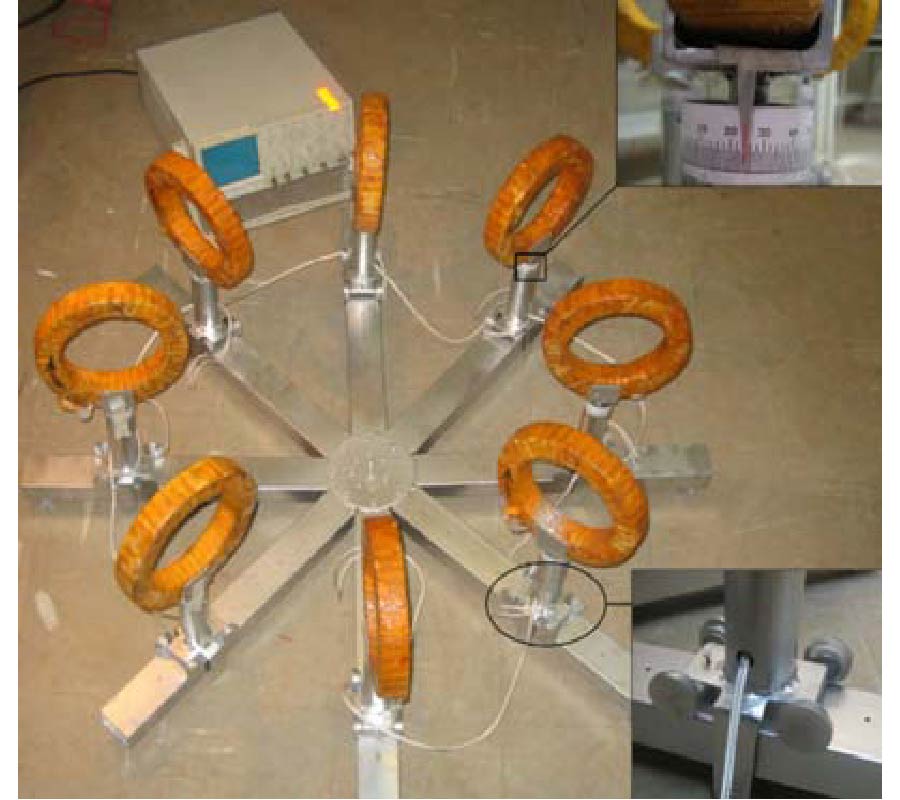
A theoretical study and a simulation method are proposed for superparamagnetic current sensors implementing a uniformly wound toroidal core topology. So as to be easy to implement, this sensor topology can be made flexible thanks to the use of a core made up of a superparamagnetic powder embedded in a flexible plastic matrix. The measurement of DC and AC currents is possible provided that a sinusoidal magnetic field excitation is applied to the superparamagnetic transducer. An analytical model is proposed for computing the sensor output signal and we demonstrate that when the detection of the component at the second order harmonic of the excitation frequency is used, the measurement is independent of the conductor position in a given current range. For simulating the dynamic response of the sensor, we propose to combine the analytical model, or a finite elements model, with a time-discretization method. Furthermore, simulations are carried out considering a ring shaped sensor and the real magnetization characteristics of a superparamagnetic material. Simulations are provided over the [-10 kA 10 kA] range and for various amplitudes of the excitation signal. The results obtained with the analytical model, which is computationally efficient, are within 4% to 12.7% from the numerical results.
ANALYTICAL AND NUMERICAL ANALYSES OF A CURRENT SENSOR USING NON LINEAR EFFECTS IN A FLEXIBLE MAGNETIC TRANSDUCER
2009-12-01
PIER
Vol. 99, 307-322
Signal Processing for Noise Cancellation in Actual Electromagnetic Environment
Hisako Orimoto and Akira Ikuta
The observed phenomena in actual electromagnetic environment are inevitably contaminated by the background noise of arbitrary distribution type. Therefore, in order to evaluate the electromagnetic environment, it is necessary to establish some signal processing methods to remove the undesirable effects of the background noise. In this paper, we propose a noise cancellation method for estimating a specific signal with the existence of background noise of non-Gaussian distribution. By applying the well-known least mean squared method for the moment statistics with several orders, a practical method for estimating the specific signal is derived. The effectiveness of the proposed theoretical method is experimentally confirmed by applying it to an estimation problem in actual magnetic field environment.
SIGNAL PROCESSING FOR NOISE CANCELLATION IN ACTUAL ELECTROMAGNETIC ENVIRONMENT
2009-12-01
PIER Letters
Vol. 12, 161-170
The Effect of Loss-Tangent on Laddering Behavior in Delay Lines
Ali Kabiri , Mohammed M. Bait-Suwailam , Mohammad H. Kermani and Omar M. Ramahi
Delay lines come in varying topologies such as the simple meander line or the spiral delay lines. The major characteristic of these delay lines is their introduction of a laddering behavior at the output. Such laddering behavior can render the predictability of the delay very difficult unless time-consuming full-wave simulation is used. In previous works, delay lines were considered with minimal attention to the effect of the loss tangent. In this paper we have studied the effect of loss- tangent on the laddering behavior in delay lines and found that by considering the loss-tangent of the dielectric of the host medium, the laddering behavior is no longer present, thus eliminating the possibility of over- or under shooting logic levels at the output.
THE EFFECT OF LOSS-TANGENT ON LADDERING BEHAVIOR IN DELAY LINES
2009-12-01
PIER M
Vol. 10, 25-38
Comparative Analysis of Split-Ring Resonators for Tunable Negative Permeability Metamaterials Based on Anisotropic Dielectric Substrates
Jiun-Yeu Chen , Wang-Lin Chen , Jia-Yi Yeh , Lien-Wen Chen and Ching-Cheng Wang
The magnetic resonance of various split ring resonators (SRRs) is numerically investigated to analyze the dependence of the resonance frequency on their parameter designs. The behavior of the magnetic resonance frequency in the configuration of the 2-cut single-ring SRR (2C-SRR) shows a larger shift in relation to the changes of the SRR size scaling, split width and substrate permittivity. A new magnetic particle formed by the 2C-SRR structure incorporating nematic liquid crystals (LCs) into the multilayered substrate is proposed for the realization of a tunable magnetic metamaterial. When using such inclusions, the tuning range of the magnetic resonance conditions could be as wide as ~1.1 GHz via changing the orientation of LC molecules by 90°.
COMPARATIVE ANALYSIS OF SPLIT-RING RESONATORS FOR TUNABLE NEGATIVE PERMEABILITY METAMATERIALS BASED ON ANISOTROPIC DIELECTRIC SUBSTRATES
2009-12-01
PIER M
Vol. 10, 13-24
An External Cloak with Arbitrary Cross Section Based on Complementary Medium
Chengfu Yang , Ming Huang , Jingjing Yang , Zhe Xiao and Jinhui Peng
Electromagnetic cloak is a device which makes an object "invisible" for electromagnetic irradiation in a certain frequency range. Material parameters for the complementary medium-assisted external cylindrical cloak with arbitrary cross section are derived based on combining the concepts of complementary media and transformation optics. It can make the object with arbitrary shape outside the cloaking domain invisible, as long as an "antiobject" is embedded in the complementary layer. The external cloaking effect has been verified by full-wave simulation. Moreover, the effect of metamaterial losses is studied, and small losses less than or equal to 0.01 do not disturb the cloaking effect.
AN EXTERNAL CLOAK WITH ARBITRARY CROSS SECTION BASED ON COMPLEMENTARY MEDIUM
2009-12-01
PIER M
Vol. 10, 1-12
Grid- Based Global Electromagnetic Simulation Tool for Parametric Distributed Analysis of Array Antennas
Fadi Khalil , Herve Aubert , Fabio Coccetti , Petr Lorenz and Robert Plana
Full-wave electromagnetic solver based on the Transmission Line Matrix Method has been deployed on Grid test-bed. This Grid-based electromagnetic approach exploits the availability of computing node at disposal through the Grid to face the demand of arbitrary large simulations by allocating a corresponding amount of resources hence minimizing the overall elapse time. In order to highlight the benefits of using computing Grids in electromagnetic simulations, a parametric study of planar reflectarray antennas based on microstrip technology has been carried out. The efficiency of distributed computing when a very large number of computation units (nodes) are involved in the computation of large and non-uniform reflectarray antennas is reported.
GRID- BASED GLOBAL ELECTROMAGNETIC SIMULATION TOOL FOR PARAMETRIC DISTRIBUTED ANALYSIS OF ARRAY ANTENNAS
2009-11-30
PIER M
Vol. 9, 243-255
To Compact Waveguide Devices by Dielectric and Ferrite Layers
Mohammad Khalaj-Amirhosseini and Habib Ghorbaninejad-Foumani
In this paper, a method is proposed to compact waveguide devices at a desired frequency. In this method a previously designed hollow waveguide is filled with several dielectric and ferrite layers alternately so that the characteristic impedance of the waveguide is not changed. First, the permittivity and permeability of a fictitiously mixed material is obtained. Then, the required permittivity and permeability of dielectric and ferrite layers are obtained at desired frequency. The usefulness of the proposed method is verified using some theoretical and simulation examples.
TO COMPACT WAVEGUIDE DEVICES BY DIELECTRIC AND FERRITE LAYERS
2009-11-28
PIER M
Vol. 9, 227-241
Band Structure, Reflection Properties and Abnormal Behaviour of One-Dimensional Plasma Photonic Crystals
Vipin Kumar , Khundrakpam Saratchandra Singh and Sant Ojha
In this paper, some studies on one-dimensional plasma photonic crystal (PPC) containing alternate layers of dielectric and micro-plasma have been presented. The band structures, reflectivity, group velocities and effective group index of such photonic crystals have been studied. For the purpose of computation, we have used transfer matrix method. In this study, we take two PPC structures named PPC1 and PPC2. In PPC1, we take SiO2 as the material for the dielectric layers whereas in PPC2, we take TiO2 as the material for the dielectric layers. It is found that the forbidden band gap(s) can be increased by increasing the thickness of plasma layers. The ranges of 100% reflection is found to be in the higher normalized frequency region in the case of PPC1 whereas in PPC2 the ranges of 100% reflection is found in the lower normalized frequency region. It is also found that for a certain normalized frequency, the group velocity becomes negative in both PPCs. However, the range of normalized frequency for which the group velocity is negative is larger in the case PPC1 than in PPC2. This abnormal behaviour of group velocities of both PPCs results in superluminal propagation (speed of EM wave in PPC greater than speed of light) of electromagnetic waves. Also, because of the abnormal behaviour of group velocity, effective group index becomes negative and possesses ultra high values. uch structures may be considered as a flip flop as there is positive and negative symmetry of effective group velocity. Also, PPC2 exhibits superluminal propagation for wider range of normalized frequency where there is superluminal propagation inside the structure as compared to that of PPC1.
BAND STRUCTURE, REFLECTION PROPERTIES AND ABNORMAL BEHAVIOUR OF ONE-DIMENSIONAL PLASMA PHOTONIC CRYSTALS
2009-11-28
PIER B
Vol. 18, 381-399
Ased-AIM Analysis of Scattering by Large-Scale Finite Periodic Arrays
Li Hu , Joshua Le-Wei Li and Tat Yeo
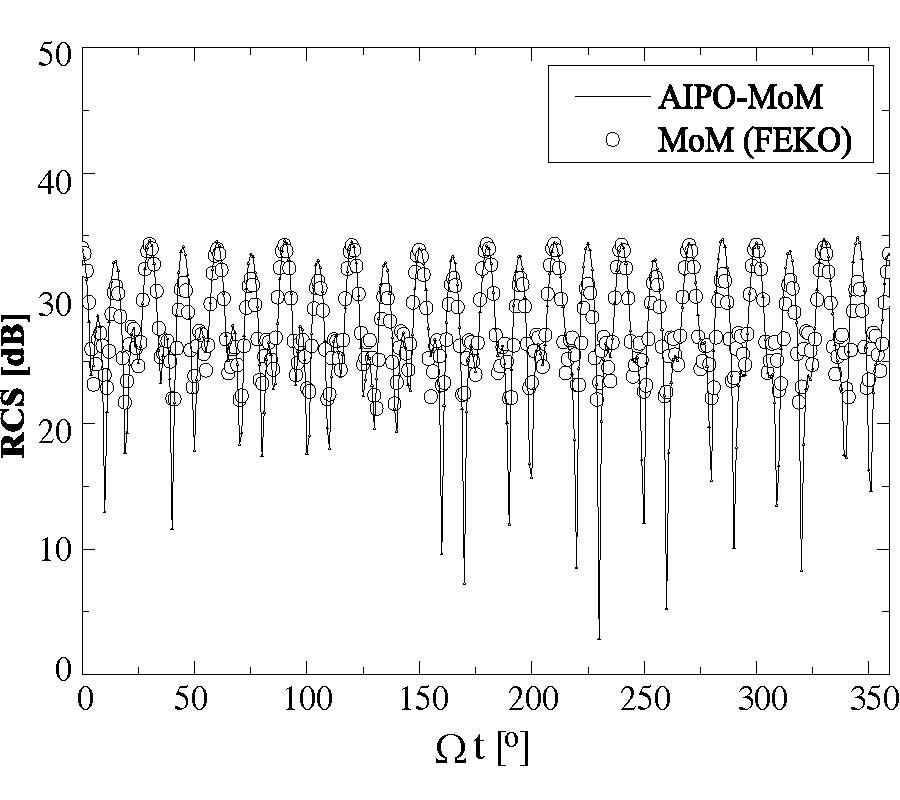
In this paper, the Adaptive Integral Method (AIM) has been extended to characterizing electromagnetic scattering by large scale finite periodic arrays with each cell comprising of either dielectric or metallic objects, by utilizing accurate sub-entire-domain (ASED) basis function. The solution process can be carried out in two steps. In the first step, a small problem is solved in order to construct ASED basis functions to be implemented for the second step. When dielectric materials are involved in the cell which results in a large number of unknowns for the small problem, the AIM can be used to accelerate the solution process and reduce the memory requirement. In the second step, the entire problem is solved using the ASED basis function constructed in the first step. The AIM can be enhanced with the ASED basis function implemented to solve the entire problem more efficiently. When calculating the near interaction impedance matrix, computation time can be significantly reduced by using the near impedance matrix in the first step. The complexity analysis shows that the computational time is O(N0 logN0) + O(M logM) and memory requirement is O(N0) + O(M), where N0 denotes the number of cells and M stands for the number of elements in one cell. The results calculated respectively by the ASED-AIM and the existing AIM are then compared and an excellent agreement has been observed, which demonstrates the accuracy of the proposed method. In the meantime, memory and computational time requirements have been considerably reduced using the ASED-AIM as compared to the existing AIM. Finally, an example with over 10 million unknowns is given to demonstrate the efficiency of the proposed method.
ASED-AIM ANALYSIS OF SCATTERING BY LARGE-SCALE FINITE PERIODIC ARRAYS
2009-11-28
PIER Letters
Vol. 12, 151-159
A Hexagonal Ring Antenna with Dual Tunable Band-Notches for Ultra-Wideband Applications
Jing-Xiu Huang , Fu-Shun Zhang , Huan-Huan Xie , Li Zhang and Yang Zhu
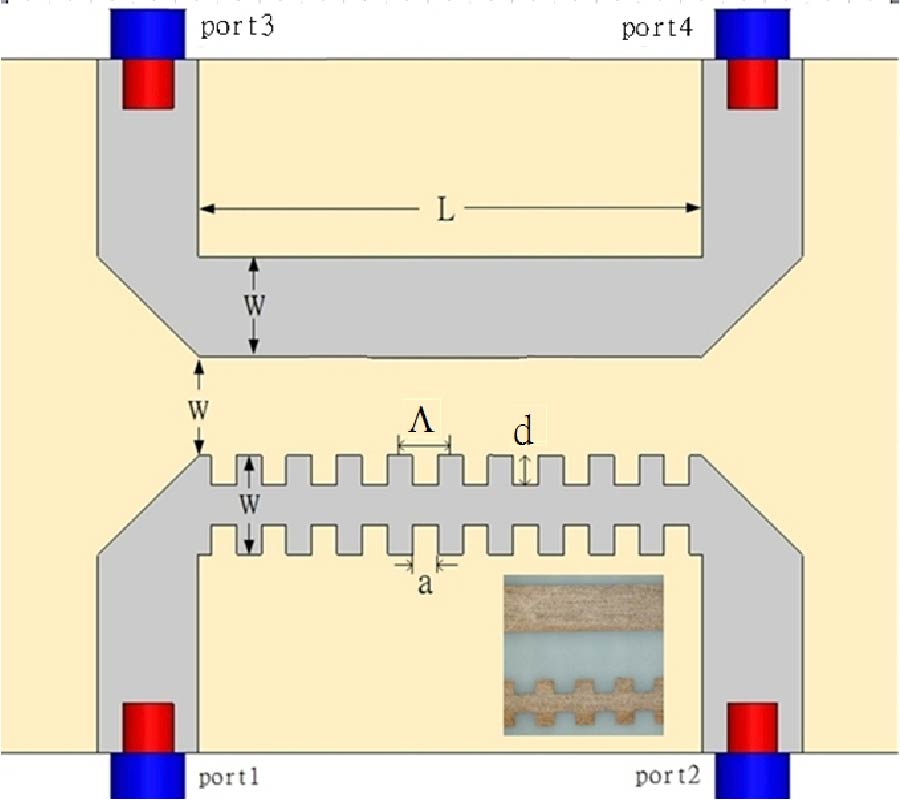
An ultra-wideband hexagonal ring antenna with dual tunable band-notches is presented in this paper. The proposed antenna achieves a good impedance match (VSWR≤2) covering the range of 2.5-10.6 GHz, except for the bandwidths of 3.1-3.8 GHz for WiMAX and 5.15-6 GHz for WLAN. The band-notch function is evolved by a stub and two pairs of parasitic elements for WiMAX and WLAN, respectively. The experimental results show that the band-notched characteristics can be tuned by adjusting the lengths of the stub and the two pairs of parasitic elements.
A HEXAGONAL RING ANTENNA WITH DUAL TUNABLE BAND-NOTCHES FOR ULTRA-WIDEBAND APPLICATIONS
2009-11-28
PIER Letters
Vol. 12, 141-150
Ultra-Wideband Metamaterial Filter Based on Electroinductive-Wave Coupling Between Microstrips
Miguel Navarro-Cia , Joss Miguel Carrasco , Miguel Beruete and Francisco J. Falcone
In this work, we analyse the frequency response of microstrip lines coupled by complementary split ring resonators (CSRRs) etched on the ground plane supporting electroinductive waves (EIWs). The single-particle configurations demonstrate the principle of operation whose bandwidths reach 67% of the central frequency. A double configuration is afterwards investigated as a further improvement of the filtering response, such as the level of the spurious lower frequency band. Finally, an ultimate prototype comprising different CSRRs along the access line, together with the aforementioned EIW-coupling is proposed for filtering undesired higher bands. Experimental results confirm numerical analysis.
ULTRA-WIDEBAND METAMATERIAL FILTER BASED ON ELECTROINDUCTIVE-WAVE COUPLING BETWEEN MICROSTRIPS
2009-11-28
PIER C
Vol. 11, 155-170
Radiation from Cavity-Backed Fractal Aperture Antennas
Basudeb Ghosh , Sachendra N. Sinha and Machavaram Kartikeyan
This paper investigates the properties of probe fed cavity-backed fractal aperture antennas. The problem is formulated using the finite element-boundary integral (FE-BI) method in which the field inside the cavity is formulated using the finite element method, and the mesh is truncated at cavity aperture surface using the boundary integral method. Several dual-band cavity-backed fractal aperture antennas based on Sierpinski gasket, Sierpinski carpet, plus shape fractal and Minkowski fractal are investigated. The numerical results obtained from the FE-BI code have been validated with simulations on HFSS.
RADIATION FROM CAVITY-BACKED FRACTAL APERTURE ANTENNAS
2009-11-28
PIER C
Vol. 11, 147-154
Compact Size and Dual Band Semicircle Shaped Antenna for MIMO Aplications
R. Sadeghy Fakhr , Abbas Ali Lotfi-Neyestanak and Mohammad Naser-Moghadasi
A planar dual-band semicircle shaped antenna for multi-input multi-output (MIMO) systems is introduced. The antenna was studied experimentally regarding bandwidth and radiation patterns. The measured -10 dB return loss bandwidth is from 2.27 to 2.53 GHz and 5.03 to 5.58 GHz, covering all the 2.4/5.2 GHz WLAN bands. Details of the antenna design, simulated and measured results on the return loss and the E- and H-plane radiation patterns of the proposed antenna are presented. The multi-feed 4-elements planar array is simulated using the commercially available software Ansoft HFSS and fabricated that are verified by good agreement between simulated and measured results. The enhanced performance is obtained by placing antennas uniquely to suppress mutual coupling and utilizing supplemental structure to miniaturize the size of the antennas.
COMPACT SIZE AND DUAL BAND SEMICIRCLE SHAPED ANTENNA FOR MIMO APLICATIONS
2009-11-27
PIER
Vol. 99, 289-306
Numerical Analysis of Apodized Fiber Bragg Gratings Using Coupled Mode Theory
Nai-Hsiang Sun , Jiun-Jie Liau , Yean-Woei Kiang , Shih-Chiang Lin , Ru-Yen Ro , Jung-Sheng Chiang and Hung-Wen Chang
In this paper, the coupled mode theory is used to analyze apodized fiber Bragg gratings (FBGs). Since the profile of gratings varies with the propagation distance, the coupled mode equations (CMEs) of apodized FBGs are solved by the fourth-order Runge-Kutta method (RKM) and piecewise-uniform approach (PUA). We present two discretization techniques of PUA to analyze the apodization profile of gratings. A uniform profile FBG can be expressed as a system of first-order ordinary differential equations with constant coefficients. The eigenvalue and eigenvector technique as well as the transfer matrix method is applied to analyze apodized FBGs by using PUAs. The transmission and reflection efficiencies calculated by two PUAs are compared with those computed by RKM. The results show that the order of the local truncation error of RKM is h-4, while both PUAs have the same order of the local truncation error of h-2. We find that RKM, capable of providing fast-convergent and accurate numerical results, is a preferred method in solving apodized FBG problems.
NUMERICAL ANALYSIS OF APODIZED FIBER BRAGG GRATINGS USING COUPLED MODE THEORY
2009-11-27
PIER B
Vol. 18, 365-380
Prediction of Probability Distribution of Electromagnetic Wave in Vdt Environment Based on Fuzzy Measurement Data Under Existence of Background Noise
Hisako Orimoto and Akira Ikuta
In this paper, based on fuzzy measurement data, a prediction method for probability distribution of electromagnetic wave leaked from electronic information equipment is proposed. More specifically, by applying the well-known probability measure of fuzzy events to the probability distribution in an orthogonal expansion series form reflecting systematically various types of correlation information, a method to estimate precisely the correlation information between the electromagnetic and sound waves from the conditional moment statistics of fuzzy variables is proposed under actual situation in the existence of a background noise. The effectiveness of the proposed theory is experimentally confirmed by applying it to the observation data leaked from VDT in the actual work environment.
PREDICTION OF PROBABILITY DISTRIBUTION OF ELECTROMAGNETIC WAVE IN VDT ENVIRONMENT BASED ON FUZZY MEASUREMENT DATA UNDER EXISTENCE OF BACKGROUND NOISE
2009-11-27
PIER Letters
Vol. 12, 133-139
A Novel Dual-Band Bandstop Waveguide Filter Using Split Ring Resonators
Saeed Fallahzadeh , Hadi Bahrami and Majid Tayarani
In this paper, the potential use of split ring resonators (SRRs) to design very compact dual-band bandstop waveguide filters is proposed. Two square SRRs are placed on a same transverse plane realizing two independent reject bands. By adjusting the SRRs length, the stopbands can be targeted at the desired frequencies. In addition, a simple circuit model for this resonator is introduced. Good agreement between the experimental and full-wave simulated results has been achieved.
A NOVEL DUAL-BAND BANDSTOP WAVEGUIDE FILTER USING SPLIT RING RESONATORS
2009-11-27
PIER C
Vol. 11, 137-146
Spurious Response Suppression in Hairpin Filter Using CSRR Merged in the Filter Structure
Ana Afkhami and Majid Tayarani
In this paper CSRRs (complementary split-ring resonators) are used to suppress the first spurious response in microstrip hairpin filters. The CSRRs are merged in the filter structure, and therefore the filter size is not increased. The design methodology is presented, and a filter with center frequency at 3 GHz is designed, fabricated and tested as an example. The characterization of this new filter shows the efficiency of the proposed approach to improve filter response with spurious rejection up to 20dB while the size is even slightly reduced.
SPURIOUS RESPONSE SUPPRESSION IN HAIRPIN FILTER USING CSRR MERGED IN THE FILTER STRUCTURE
2009-11-26
PIER
Vol. 99, 273-287
Tunable Lateral Shift through Nonlinear Composites of Nonspherical Particles
Dongliang Gao and Lei Gao
The Goos-Hanchen (GH) shift of the reflected waves from nonlinear nanocomposites of interleaved nonspherical metal and dielectric particles are investigated both theoretically and numerically. First, based on spectral representation theory and effective medium approximation, we derive the field-dependent effective permittivity of the nonlinear composites. Then the stationary phase method is adopted to study the GH shifts from nonlinear composites. It is found that for a given volume fraction, there exist two critical polarization factors Lc1 and Lc2, and bistable GH shifts appear only when L < Lc1 or L < Lc2. Moreover, both giant negative and positive GH shifts accompanied with large reflectivity are found, hence they can be easily observed in experiments. The reversal of the GH shift may be controlled by adjusting both the incident angle and the applied field. Numerical simulations for Gaussian-type incident beam are performed, and good agreement between simulated data and theoretical ones is found especially for large waist width.
TUNABLE LATERAL SHIFT THROUGH NONLINEAR COMPOSITES OF NONSPHERICAL PARTICLES
2009-11-24
PIER
Vol. 99, 261-272
Conductive Medium Modeling with an Augmented GIBC Formulation
Zhiguo Qian , Mei Song Tong and Weng Cho Chew
This paper describes an augmented generalized impedance boundary condition (AGIBC) formulation for accurate and efficient modeling of conductive media. It is a surface integral equation method, so that it uses a smaller number of unknowns. The underlying GIBC provides a rigorous way to account for the skin effect. Combining with the novel augmentation technique, the AGIBC formulation works stably in the low-frequency regime. No looptree search is required. The formulation also allows for its easy incorporation of fast algorithms to enable the solving of large problems with many unknowns. Numerical examples are presented to validate the formulation.
CONDUCTIVE MEDIUM MODELING WITH AN AUGMENTED GIBC FORMULATION