Search Results(13787)

2023-02-19
PIER Letters
Vol. 109, 41-48
Three 24 GHz End-Fire Dipole Antennas
Yanfei Mao , Chungeng Zhu , Shiju E and Jiancheng Cai
An end fire antenna architecture based on transmission line (TML) theory is suggested. N element end fire antenna array could be constructed with N-1 elements of full wave dipole antennas and one half wave dipole antenna without additional impedance matching network. The N dipole antennas are placed with each other with a distance of quarter wave length, while the one half wave dipole antenna is at the outer most of the array, the farthest from the feeding point of the antenna array. And three 24 GHz dipole end-fire antenna arrays with gains of 7.1, 8.4 and 9.4 dB respectively are presented to explain and verify this end fire antenna architecture based on transmission line theory. Simulation and measurement results of the three end-fire antennas are given and compared. This 24 GHz end-fire antenna architecture could be utilized in 24 GHz planar end-fire antenna arrays to increase the effective isotropic radiated power (EIRP) of the transmitter.
THREE 24 GHZ END-FIRE DIPOLE ANTENNAS
2023-02-18
PIER M
Vol. 115, 83-92
Tripartite Correlations in Quantum Radar and Communication Systems
Rory A. Bowell , Matthew J. Brandsema , Ram M. Narayanan , Stephen W. Howell and Jonathan M. Dilger
Quantum-based systems are an emerging topic of research due to their potential for increasing performance in a variety of classical systems. In radar and communication systems, quantum technologies have been explored in an effort to increase the correlation performance in the low signal-to-noise ratio (SNR) regime. While this increase has been shown both mathematically and in the laboratory using bipartite states, systems utilizing multi-partite squeezing and entanglement may lead to an even further performance increase. We investigate this by analyzing the correlation coefficient for a tripartite system electric field measurement to determine how it compares to the bipartite systems in the current literature for the same transmit powers. This is done by defining a tripartite wave function in terms of the mean photon number per mode then determining the covariance matrix from this wave function. This work is important in understanding how alternative states of light can be used for quantum radar applications.
Tripartite Correlations in Quantum Radar and Communication Systems
2023-02-17
PIER C
Vol. 129, 273-287
Textile Dual Band Antenna Printed on Artificial Heart Bag for WBAN Communications
Walaa Hassan
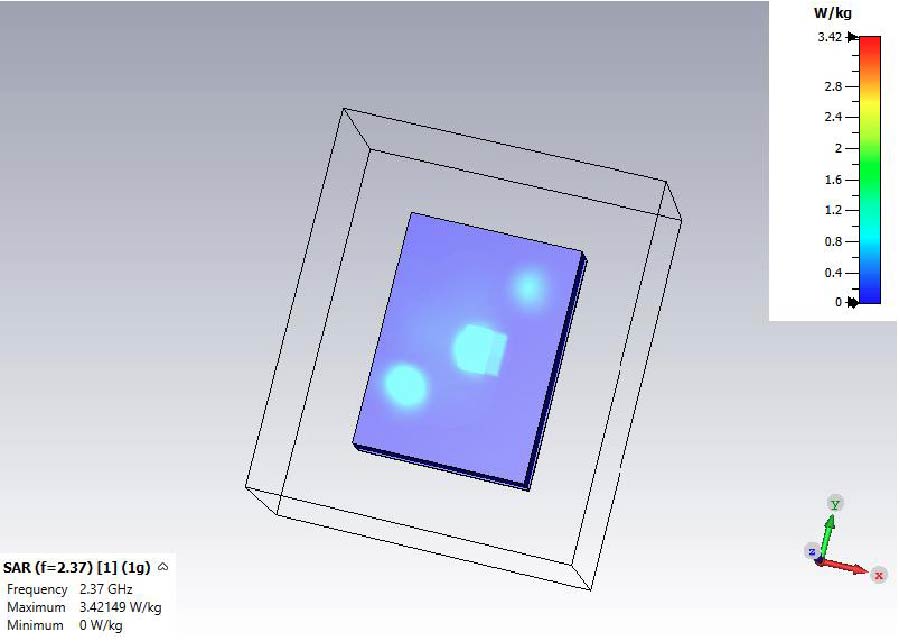
This article presents a textile dual band antenna printed on an artificial heart (AH) bag for various Wireless Body Area Network (WBAN) communications. The textile dual band antenna operates at two different operating frequencies 2.4 GHz and 5 GHz. The two operating frequencies are reserved for IEEE 802.11b/g/n/ax and IEEE 802.11j WLAN standard. The designed antenna has a frequency bandwidth of (2.3642-2.5375 GHz) for the lower frequency of 2.4 GHz and (4.598-5.1683 GHz) for the upper frequency of 5 GHz. The dual band antenna is integrated with the proposed AH bag that is made from textile material. The effects of both different materials and dimensions of the proposed AH bag in the characteristics of the proposed antenna are investigated. The effect of the human body on the electrical performance of the proposed antenna integrated with the AH bag is presented. The amount of electromagnetic absorbed energy through the human body is also determined in terms of the specific absorption rate (SAR). The obtained SAR value is less than 0.12 W/Kg. This value meets the IEEE standards. Experimental verification for antenna integrated with AH bag and human body is presented.
Textile Dual Band Antenna Printed on Artificial Heart Bag for WBAN Communications
2023-02-17
PIER M
Vol. 115, 71-81
Experimental Based Blood Glucose Monitoring with a Noninvasive Cylindrical Biosensor Antenna
Yusnita Rahayu , Wahid Nova Nugraha , Teguh Praludi , Mudrik Alaydrus , Anhar and Huriatul Masdar
In this work, we have designed and fabricated a non-invasive flexible biosensor with a simple and printable structure for blood glucose monitoring. The proposed sensor has been experimentally proven to monitor blood sugar levels through frequency shifts. A cylindrical design with a coplanar waveguide (CPW) feeding technique has been proposed. A targeted frequency of 2.4 GHz with the best S11 at -22.623 dB and a bandwidth of 323 MHz was obtained. However, after propagating through the finger phantom, the signal is sensitive to the blood glucose levels with a significant frequency shift. The biosensor worked well at 1.55-1.88 GHz, representing a finger, without a phantom in the ISM band of 2.4 GHz. There is a bit of shifted frequency during the biosensor measurement with less than a 1.41% error. The overall size of the biosensor is 50.66 mm x 60.31 mm. The biosensor uses a flexible Dupont Pyralux substrate; thus, the index finger is easy to insert. 25 volunteers were involved in this experimental blood glucose. For this, we use an invasive device to measure the volunteers' blood glucose levels. The invasive measurement results obtained are used as a reference for the blood sugar levels of each sample. The test results using a cylindrical biosensor show a frequency shift at 7.5 MHz for every mg/dl of blood sugar levels, with a sensitivity of 0.43 1/(mg/dL). This frequency shift can be used to observe changes in the concentration of sugar levels in the blood. This flexible sensor is a good alternative biosensor for measuring blood glucose levels due to its low cost and printable structure.
Experimental Based Blood Glucose Monitoring with a Noninvasive Cylindrical Biosensor Antenna
2023-02-16
PIER B
Vol. 98, 125-145
Diffraction by a Semi-Infinite Parallel-Plate Waveguide with Five-Layer Material Loading: Rigorous Wiener-Hopf Analysis
Kewen He and Kazuya Kobayashi
In this paper, the Wiener-Hopf technique is used to analyze the plane wave diffraction rigorously by a semi-infinite parallel-plate waveguide with five-layer material loading for E polarization. Introducing the Fourier transform of the unknown scattered field and applying boundary conditions in the transform domain, the problem is formulated in terms of the simultaneous Wiener-Hopf equations satisfied by unknown spectral functions. The Wiener-Hopf equations are solved exactly via the factorization and decomposition procedures leading to exact and approximate solutions. Taking the Fourier inverse of the solution in the transform domain, the scattered field in the real space is explicitly derived. For the region inside the waveguide, the scattered field is expressed in terms of the waveguide TE modes, whereas the field outside the waveguide is evaluated asymptotically with the aid of the saddle point method leading to a far field expression. Numerical examples of the radar cross section (RCS) are presented for various physical parameters and farfield scattering characteristics of the waveguide are discussed in detail.
Diffraction by a Semi-Infinite Parallel-Plate Waveguide with Five-Layer Material Loading: Rigorous Wiener-Hopf Analysis
2023-02-16
PIER C
Vol. 130, 31-42
Modeling and Optimization of CPW-Fed E-Textile Antenna Using Machine Learning Algorithms
Arpan H. Shah , Kalyanbrata Ghosh and Piyush N. Patel
In this paper, an electronic textile (E-textile) antenna design using machine learning (ML) algorithms such as polynomial regression, k-nearest neighbor (kNN), random forest regression, and deep neural network (DNN) is proposed for achieving the optimized solution. These ML techniques, including DNN, have been implemented on a python framework and support in selecting efficient optimum design parameters for a co-planar waveguide fed textile antenna to attain the maximum impedance bandwidth performance in 3-24 GHz band, respectively. Moreover, the accuracy of the predicted response values obtained by these ML methods has also been validated by verifying with the CST simulation software tool.
MODELING AND OPTIMIZATION OF CPW-FED E-TEXTILE ANTENNA USING MACHINE LEARNING ALGORITHMS
2023-02-16
PIER C
Vol. 130, 15-30
Damping System for an Optimized Rotation Magnetized Direction Permanent Magnet Thrust Bearing
Amarsh Jalaik , Supreeth Dinesh Kumar , Gireesha R. Chalageri , Siddappa Iranna Bekinal , Mrityunjay Doddamani and Shivamurthy Rokkad Chandranna
An eddy current damper for an optimized rotation magnetized direction (RMD) permanent magnet thrust bearing (PMTB) was analyzed in this paper. Initially, optimization of critical design variables was performed for a particular bearing volume for maximum force as well as stiffness. Then, generalized curve fit equations were established to obtain a correlation between different geometrical parameters concerning the outer diameter and airgap. Furthermore, the axial force of the optimized RMD configuration calculated using mathematical model was validated using the results of FEA in ANSYS. Finally, finite element simulation was performed to evaluate the damping forces generated by an eddy current damper (ECD) for an optimized thrust bearing. Analysis has shown that eddy current dampers can improve system damping.
Damping System for an Optimized Rotation Magnetized Direction Permanent Magnet Thrust Bearing
2023-02-16
PIER C
Vol. 130, 1-14
Wideband Designs of U-Slot Cut Square Microstrip Antenna Using Modified Ground Plane Profile
Amit A. Deshmukh , Aarti G. Ambekar and Venkata A. P. Chavali
Wideband designs of a U-slot cut square microstrip antenna using bow-tie and H-shape ground plane profiles are proposed on an electrically thinner substrate. The modified ground plane optimizes the input impedance at patch resonant modes on the thinner substrate, which yields wider bandwidth. Against the conventional ground plane design on substrate thickness > 0.06λg, the bow-tie shape ground plane offers 0.03λg reduction in total substrate thickness, 10% increment in the bandwidth with a peak broadside gain of 6.1 dBi. The design methodology to realize a similar configuration as per a specific frequency spectrum is presented, which yields similar response.
Wideband Designs of U-slot Cut Square Microstrip Antenna Using Modified Ground Plane Profile
2023-02-16
PIER Letters
Vol. 109, 31-39
Approximate Simulation of Low Frequency Magnetic Shielding of a Rectangular Shielding Box with All Walls Perforated Periodical Holes
Zelai Sun , Wei Dong , Dingyu Qin , Lin Zheng , Peng Qiu , Chao Ding , Xiaochen Yang and Chongqing Jiao
This article proposes an approximate analytical formulation to calculate the low-frequency magnetic shielding of a rectangular metallic box, with all walls perforated periodical holes. The solution is obtained by the combination of two submodels: the finite conductivity box with the holes covered and the perfect conductor box with the holes present. The first submodel represents the diffusion effect of magnetic field penetration through the conducting shell, and the second one denotes the aperture effect of magnetic field leakage through the holes. The total shielded magnetic field is the superposition of these from the two submodels. For the diffusion effect, an existing empirical formula based on the shape factor is used. To solve the second submodel, we employ two approximate methods: the method of images and the surface-impedance method. The method of images models each hole in the walls as an equivalent magnetic dipole and its images based on Bethe's small aperture coupling theory. A PEC box is first considered. Comparisons with finite element simulations show that the method of images has better accuracy than the surface-impedance method. Then, a cubic aluminum box of 0.2 m in length is treated, which verifies that combining the two submodels can produce results in good agreement with finite element simulations for frequencies up to 10 MHz. In addition, the dependence of the shielding effectiveness on frequency is also analyzed.
Approximate Simulation of Low Frequency Magnetic Shielding of a Rectangular Shielding Box with All Walls Perforated Periodical Holes
2023-02-15
PIER B
Vol. 98, 107-123
Dual Stopband Type NGD Network Design for True Time-Delay Based Multi-Beam Steerer Application
Blaise Ravelo , Glauco Fontgalland , Ana Paula B. Dos Santos , Hugerles S. Silva , Nour Mohammad Murad , Fayrouz Haddad , Mathieu Guerin and Wenceslas Rahajandraibe
An original application of stopband (SB) type negative group delay (NGD) electronic function is introduced. The unfamiliar SB-NGD circuit is designed with RLC-network lumped passive topology. The SB-NGD circuit is exploited to operate as a true-time delay (TTD) device for smart dual-beam phased array design. The two-port passive topology for designing an SB-NGD circuit constituted by an RLC-network is described. The theory and design method of the employed SB-NGD passive circuit are detailed. The microwave theory of the SB-NGD topology is elaborated from S-matrix modelling. The SB-NGD canonical form is innovatively introduced in function of the expected specifications. The synthesis design equations allowing to determine the R, L and C component values in function of the NGD specifications are formulated. The SB-NGD behavior is verified by comparison of calculated and simulated S-parameters from two different proofs-of-concept (POC). Illustrative results with a very good agreement showing SB-NGD behavior are observed around the arbitrarily chosen central frequencies f1 = 0.7 GHz and f2 = 1 GHz over a bandwidth of 50 MHz. The design principle of TTD-based smart dual-beam is described. The dual-band SB-NGD circuit is designed to operate as a dual-band TTD device with fixed delays at t1(f1) = 357 ps and t2(f2) = 875 ps, respectively. A radiation pattern showing the smart dual-beam steering operating system at f1 and f2 frequencies is discussed.
Dual Stopband Type NGD Network Design for True Time-delay Based Multi-beam Steerer Application
2023-02-13
PIER
Vol. 177, 1-20
Topological Edge Modes in One-Dimensional Photonic Artificial Structures (Invited)
Jiajun Zheng , Zhiwei Guo , Yong Sun , Haitao Jiang , Yunhui Li and Hong Chen
In recent years, topological states in photonic artificial structures have attracted great attention due to their robustness against certain disorders and perturbations. To readily understand the underlying principles, topological edge modes in one-dimensional (1D) system have been widely investigated, which bring aboutthe discovery of novel optical phenomena and devices. In this article, we review our recent advances in topological edge modes. We introduce the connection between topological orders and effective electromagnetic parameters of photonic artificial structures in band gaps, discuss experimental demonstration of robust topological modes and their potential applications in wireless power transfer, sensing and field of optics, and give a brief introduction of future opportunities in 1D topological photonics.
Topological Edge Modes in One-dimensional Photonic Artificial Structures (Invited)
2023-02-12
PIER C
Vol. 129, 257-271
Multi-Objective Optimization Design of ERSRM with Asymmetric Stator Poles
Chaozhi Huang , Hongwei Yuan , Wensheng Cao and Yuliang Wu
This paper proposes a novel asymmetric interior stator topology for torque enhancement and torque ripple reduction in external rotor switched reluctance motor (ERSRM). The new topology and operational principle are first investigated using a simplified linear model. Then, the parametric model of the ERSRM and the comprehensive sensitive analysis that evaluates the influence of each design variable on optimization objectives are presented. Thirdly, the optimal design is selected from the Pareto front which is generated by NSGA-II (fast non-dominated sorting genetic algorithm) and validated by finite element analysis. Finally, the optimal prototype motor is manufactured, and experimental results confirm the validity and superiority of the optimized design.
Multi-objective Optimization Design of ERSRM with Asymmetric Stator Poles
2023-02-10
PIER B
Vol. 98, 87-105
A Miniaturized Antenna for Breast Cancer Detection at the 5.72-5.82 GHz ISM Band Based on the DGS Technique
Lala Aicha El Vadel , Dominic Bernard Onyango Konditi and Franck Moukanda Mbango
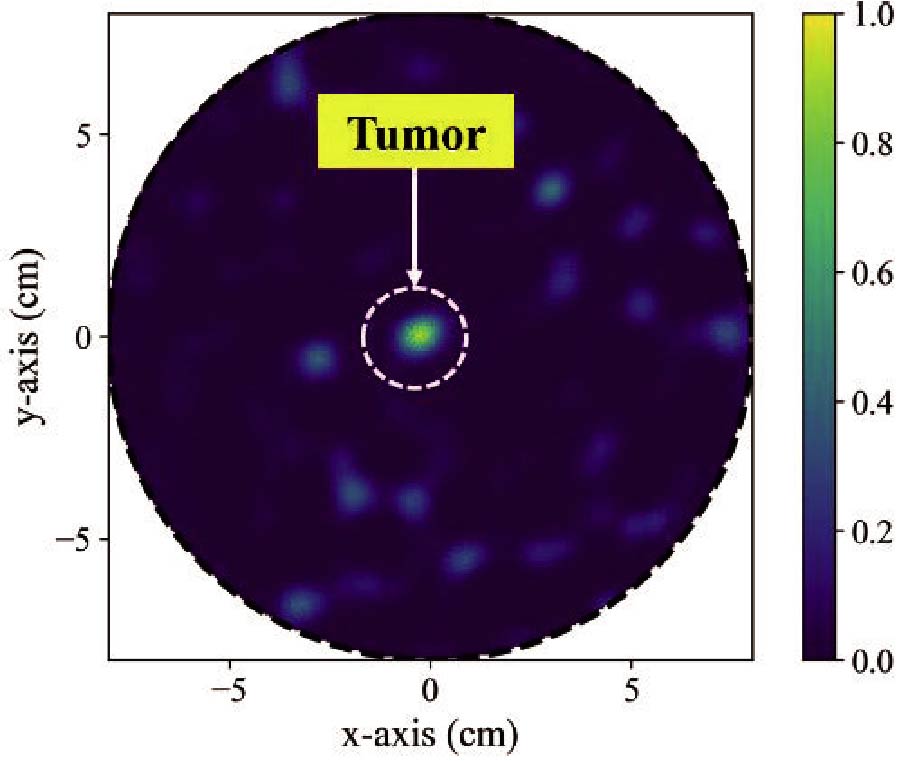
This paper presents an alternative solution for detecting breast cancer through planar antennas. The designed antenna electric parameters are the best gain for tiny radiation elements, along with the suitable characteristic impedance and bandwidth focusing on a specific application. Antennas are deployed nowadays to provide access to the detection of malignant tumors. That solution coexists with those in the hospitals (X-ray Mammography, Biopsy, Ultrasound, and Tomography), as breast cancer is a worldwide health concern because many women die yearly. Unfortunately, none of these methods are efficient as microwave imaging techniques. In terms of rapidity, efficiency, sensitivity, and accuracy, a small microstrip patch antenna operating at the Industrial, Scientific, Medical (ISM) band (5.72-5.82 GHz) is proposed in this paper for early breast tumor screening. Designed from the High-Frequency Structure Simulator (HFSS), the rectangular microstrip patch-antenna of 12x12x1 mm3, etched on an FR4 HTG-175 dielectric material (relative permittivity of 4.4 and 0.02 of loss tangent) has been simulated, prototyped, and experimentally measured with ZVA50 Vector Network Analyzer (VNA). The defective ground structure technique has been used to achieve the goals of the final prototype. The proposed antenna has 51.22 dB of return loss, 230 MHz of bandwidth, with a radiation efficiency of 82% and a gain of 1.45 dBi at the resonance frequency of 5.73 GHz. Simulation results have been well-concluded through different tumor positions on the breast to take comprehensive precautions. Furthermore, a comparison with other antenna designs has been made. Due to the available laboratory equipment, the suggested work focused on the research part.
A Miniaturized Antenna for Breast Cancer Detection at the 5.72-5.82 GHz ISM Band Based on the DGS Technique
2023-02-09
PIER C
Vol. 129, 245-256
High-Power Ka-Band Extended Interaction Klystron Design Based on Internal Coupling Cavity
Bingchuan Xie , Rui Zhang , Yong Wang , Xu Zhang , Xiudong Yang , Yunfeng Liao and Zhihui Geng
A high-efficiency interaction circuit for Ka-band klystron has been proposed based on a novel internal coupling cavity. Driven by a 25 kV, 5 A pencil beam, the interaction circuit can produce a peak output power of 38.4 kW at Ka-band, and the electronic efficiency is 30.7%. The electromagnetic properties of the unequal slot multi-gap cavity and internal coupling cavity have been studied and compared. The internal coupling cavity demonstrated a higher coupling coefficient and characteristic impedance than the unequal slot multi-gap cavity, which can improve the circuit efficiency. Stability and pattern analysis have been performed on the output cavity. A four-gap output cavity has been designed. Simulation results show that there is no mode competition and oscillation in the output cavity. The corresponding beam optics has also been designed to produce the required beam. Compared with the existing work, the interaction circuit can produce almost twice the output power with the same beam voltage and Brillouin focusing magnetic field. The efficiency is also improved by 6 percent.
High-power Ka-band Extended Interaction Klystron Design Based on Internal Coupling Cavity
2023-02-08
PIER C
Vol. 129, 231-243
Design and Analysis of a 4-Port MIMO Microstrip Patch Antenna for 5G Mid Band Applications
Suman Sharma and Mukesh Arora
This article proposes a 4-port MIMO antenna for 5G mid band application resonating from 4.5-5.1 GHz which comes under n79 band, an FR1 5G NR band used in smart phones. The first design involves a single-element microstrip patch antenna with a diamond shaped slots and partial ground structure of size 30 × 43 × 1.6 mm3. Using this single element antenna as reference, a 4 port MIMO antenna is presented which operates at 4.9 GHz resonance frequency with proper spacing, resulting in much improved isolation between the elements. The proposed 4 port MIMO antenna is designed and fabricated over a commercially available low-cost FR-4 substrate having a relative dielectric permittivity of 4.4 and thickness of 1.6 mm. The W × L dimension of this MIMO antenna is 56 × 56 mm2. Simulation of the S-parameters and radiation pattern of all purposed designs is performed using the CST studio suite, and test results of the return loss are presented using the Keysight N9916A 14 GHz vector network analyzer. Antenna gain is 3.8 dB, and efficiency is 87% with a low (less than 0.1) envelope correlation coefficient (ECC) between any two radiating elements, paired with a positive diversity gain (DG), indicating that the proposed antenna is well designed. As a result, the proposed antenna is an excellent candidate for deployment in 5G networks.
Design and Analysis of a 4-port MIMO Microstrip Patch Antenna for 5G Mid Band Applications
2023-02-08
PIER M
Vol. 115, 59-69
Fundamental Study on Comb-Line Antennas Modified with Loop Elements for Increased Axial Ratio Bandwidth
Kazuhide Hirose , Yuto Kikkawa , Susumu Tsubouchi and Hisamatsu Nakano
We study three comb-line antennas to increase the bandwidth for a 3 dB axial ratio criterion. Each antenna comprises linear radiation elements with loops and a coplanar feedline above the ground plane. First, we analyze a reference antenna with a straight feedline using the method of moments. Next, the straight feedline is transformed into a round one for a sequential rotation technique. It is found that the antenna has an increased bandwidth of 30%, which is three times as wide as that of the reference antenna. Last, we propose a novel antenna with a straight feedline. It is revealed that the antenna shows a 3 dB gain drop bandwidth of 29% (40% for the axial ratio bandwidth). The simulated results are validated by experimental work.
Fundamental Study on Comb-Line Antennas Modified with Loop Elements for Increased Axial Ratio Bandwidth
2023-02-07
PIER B
Vol. 98, 77-86
Theoretical Study of Electromagnetic Field, Diffracted by Two Slots in a Conducting Screen
Vladimir Serdyuk
A rigorous solution is presented for description of the plane electromagnetic wave diffraction by two parallel slots in a perfectly conducting screen of finite thickness, placed before a dielectric layer, operating as a receiver of radiation in the near zone. The field in this layer is studied for the case of small obstacle dimensions being of the order of the wavelength. It is shown that the best spatial resolution of images from two slots in a dielectric layer is reached together with their optimal focusing, which can be determined by the method proposed earlier for one-slot diffraction.
Theoretical Study of Electromagnetic Field, Diffracted by Two Slots in a Conducting Screen
2023-02-07
PIER C
Vol. 129, 221-230
Two-Port Silicon-Based MIMO Nano-Dielectric Resonator Antenna with Polarization Diversity for Photonics Applications
Shailza Gotra and Vinay Shanker Pandey
This paper demonstrates a compact two-port multi-input multi-output optical nano-antenna with polarization diversity. The proposed antenna consists of a silicon-based radiating element that explores the possibilities of using a highly efficient dielectric resonator over the conventional metallic antennas at THz regime The specific position of the Gaussian pulse excitation generates the 90° phase difference between the field components travelling across the edges of the silver nanostrip feedlines. This generates the orthogonal field components which results in the achievement of circular polarization. Furthermore, any deviation in the excitation position at the port disturbs the field components resulting in linear polarization. This approach provides the polarization diversity using different excitation positions at ports. Considering the analytical stage of this proposed work, the detailed design guidelines and analysis are also discussed. The antenna provides circularly polarized radiations having 6.78% of 3 dB axial-ratio bandwidth and linearly polarized response using the optimized feeding positions at the respective ports for obtaining the polarization diversity performance. The isolation of more than 15 dB is maintained between the ports over the entire operating passband of the antenna. The proposed antenna with the optimized dimensions can be utilized for the optical C- and L-band applications.
Two-port Silicon-based MIMO Nano-dielectric Resonator Antenna with Polarization Diversity for Photonics Applications
2023-02-07
PIER C
Vol. 129, 187-201
Design of Wideband 8-Element MIMO Mobile Phone Antenna Based on Sub-6 GHz NR Band
Zhonggen Wang , Mingzhong Li , Ming Yang , Wenyan Nie , Weidong Mu , Han Lin and Zhongyuan Lu
For the research of 5G NR band mobile phone bezel antenna, this paper proposes an 8-Element Multiple-Input Multiple-Output (MIMO) handset bezel antenna design for 5G New Radio (5G NR) bands. Moreover, the MIMO antenna's array is implemented by loading 8 identical antennas (Ant1-Ant8) into the metal bezel of the smartphone to form an 8-antenna array for a sub-6 GHz 8×8 MIMO system. In this setting, each antenna unit is a slot antenna type consisting of a Chinese character ``卫''-shaped slot, as well as a 50 Ω micro-strip feeder; note that a satisfactory impedance matching is achievable in the upper-frequency band by loading a tuning stub on the feeder. The proposed 8-element antenna array covers 5G new radio (NR) band including N77 (3.3-4.2 GHz), N78 (3.3-3.8 GHz), N79 (4.4-5.0 GHz), and a Wi-Fi (2.4 GHz) band with a 10 dB impedance bandwidth. It is important to note that in addition to exhibiting ideal antenna efficiency and envelope correlation, the isolation between adjacent array elements is >10 dB, and the peak gain is 3 dBi. In summary, the influence of the user's hand on the antenna is analyzed to ensure the robustness of the MIMO antenna system in practical applications.
Design of Wideband 8-element MIMO Mobile Phone Antenna Based on Sub-6 GHz NR Band
2023-02-06
PIER C
Vol. 129, 203-219
Low Profile Design of Regular Shape Microstrip Antennas Backed by Fractal Slots Cut Ground Plane for Circular Polarized Response
Aarti G. Ambekar and Amit A. Deshmukh
Thinner substrate designs of square and circular microstrip antennas using fractal variations of U-shape and half U-shape slot cut ground plane are proposed for circularly polarized response. The 1st, 2nd, and 3rd order fractal variations of slots on the ground plane are studied. The fractal slot cut variations degenerate patch fundamental mode into dual orthogonal resonant modes, and an optimum spacing between them yields circularly polarized characteristics. Amongst all the designs, circular microstrip antenna using the 1st order fractal U-slot design yields optimum result. It offers axial ratio bandwidth of 60 MHz (2.14%) with a broadside radiation pattern and peak gain of 5.5 dBi, on a substrate of 0.02λg thickness and patch area 1.44λg. Against the reported designs, the current work presents a low profile single patch circularly polarized configuration.
LOW PROFILE DESIGN OF REGULAR SHAPE MICROSTRIP ANTENNAS BACKED BY FRACTAL SLOTS CUT GROUND PLANE FOR CIRCULAR POLARIZED RESPONSE