Search Results(13979)

2022-02-15
PIER M
Vol. 108, 65-77
Sparse Bayesian Learning Based DOA Estimation and Array Gain-Phase Error Self-Calibration
Zili Li and Zhao Huang
This paper proposes a joint estimation algorithm based on sparse-Bayesian learning (SBL) for the gain-phase problem between array antenna channels. The algorithm uses the idea of the iterative method to jointly estimate the direction-of-arrival (DOA) and gain-phase error calibration coefficients in the iterative process, combining self-calibration and calibration with a calibration source. At each iteration, the rough value of DOA is first estimated using SBL, and then the DOA estimate is used to calculate the gain-phase error calibration coefficient. The value obtained in each iteration is brought into the error cost function, which is constructed based on the principle of signal and noise subspace orthogonality. Iterations are continued until convergence to find the minimum value of the cost function. The algorithm does not require a priori knowledge of array perturbations and has good performance in DOA and array gain and phase error estimation. Simulations and experimental measurements show that the method has better calibration performance than other methods based on optimization algorithms, and the algorithm effectively improves the antenna gain.
SPARSE BAYESIAN LEARNING BASED DOA ESTIMATION AND ARRAY GAIN-PHASE ERROR SELF-CALIBRATION
2022-02-14
PIER Letters
Vol. 103, 7-14
A W-Band High Isolation Single-Balanced Mixer in GaN HEMT Technology
Ping Xiang , Weibo Wang , Shaobing Wu and Hongqi Tao
A W-band high isolation single-balanced mixer using a 0.1-um GaN high-electron mobility transistor process is proposed in this paper. The diode is biased near the threshold voltage to reduce drive level, and the needed LO power is only 3 dBm. Moreover, the reasonable diode layout and phase compensation structure are used in the proposed mixer to enhance the LO-to-RF isolation. The measured results of the proposed mixer demonstrate a single-sideband conversion loss of 9-10.6 dB and a LO-RF isolation of 40 dB from 75 to 110 GHz with 7 dBm LO power. Moreover, a DC-to-18 GHz IF bandwidth is achieved with the LO frequency fixed at 110 GHz. The 1 dB compression point of the proposed mixer is 11 dBm with 16 dBm LO power. The measurement results indicate that GaN mixer has great potential for W-band transceiver system applications.
A W-BAND HIGH ISOLATION SINGLE-BALANCED MIXER IN GAN HEMT TECHNOLOGY
2022-02-14
PIER Letters
Vol. 103, 1-6
A CMOS Compatible Broadband Ruthroff 1:2 TLT Balun Using Broadside-Coupled Lines and Stacked Microstrip Lines
Zeyneb Cheraiet , Mohamed Toufik Benhabiles , Tarek Djerafi , Farouk Grine and Mohamed Lahdi Riabi
Implementation of a broadband Ruthroff-type transmission line transformer balun with a 1:2 step-up impedance transformation ratio is presented in this letter. The proposed Transmission Line Transformer (TLT) balun was investigated with broadside-coupled lines using three stacked microstrip lines. The proposed balun was formed by cascading one section of modified Ruthroff-type 2:1 unbalanced-to-unbalanced TLT with one section of Ruthroff-type 1:4 TLT balun in series. The achieved fractional bandwidth of the balun is 192.17% over the frequency range from 1.2 to 6.6 GHz, which covers the IEEE 802.11 a/b/g WLAN, WiMAX applications. The measured amplitude and phase imbalances are less than 1 dB and less than 4.51˚, respectively at this frequency range.
A CMOS COMPATIBLE BROADBAND RUTHROFF 1:2 TLT BALUN USING BROADSIDE-COUPLED LINES AND STACKED MICROSTRIP LINES
2022-02-11
PIER B
Vol. 95, 1-22
Investigation of Plasmonic Metal Conductors and Dielectric Substrates on Nano-Antenna for Optical Wireless Communication
Shekhara Kavitha , Kanduri Venkata Sairam and Ashish Singh
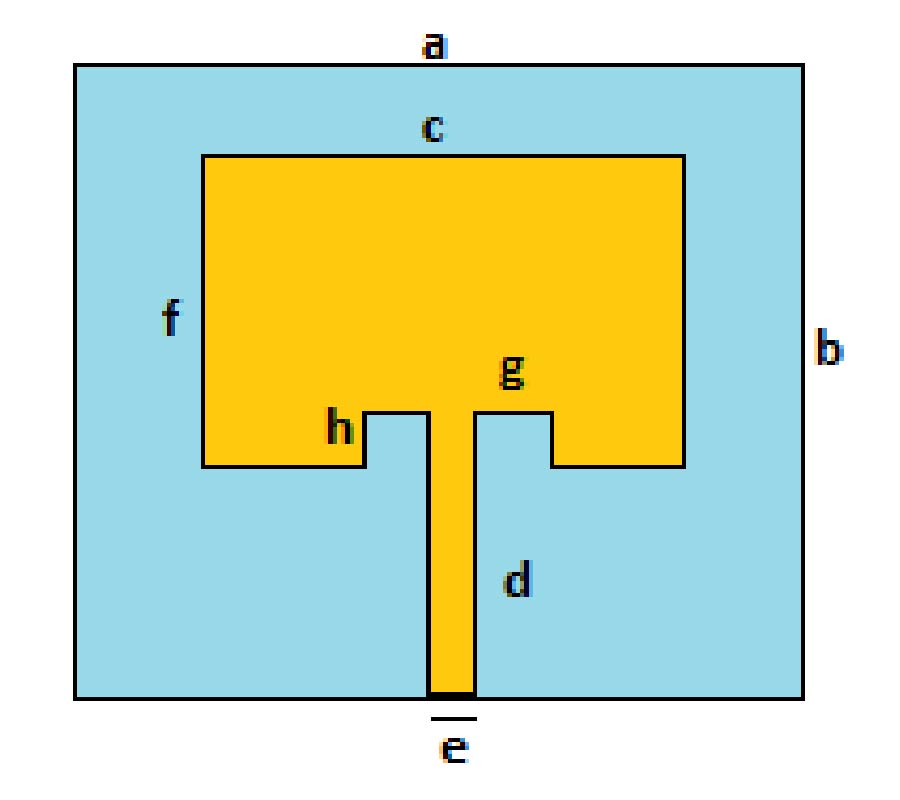
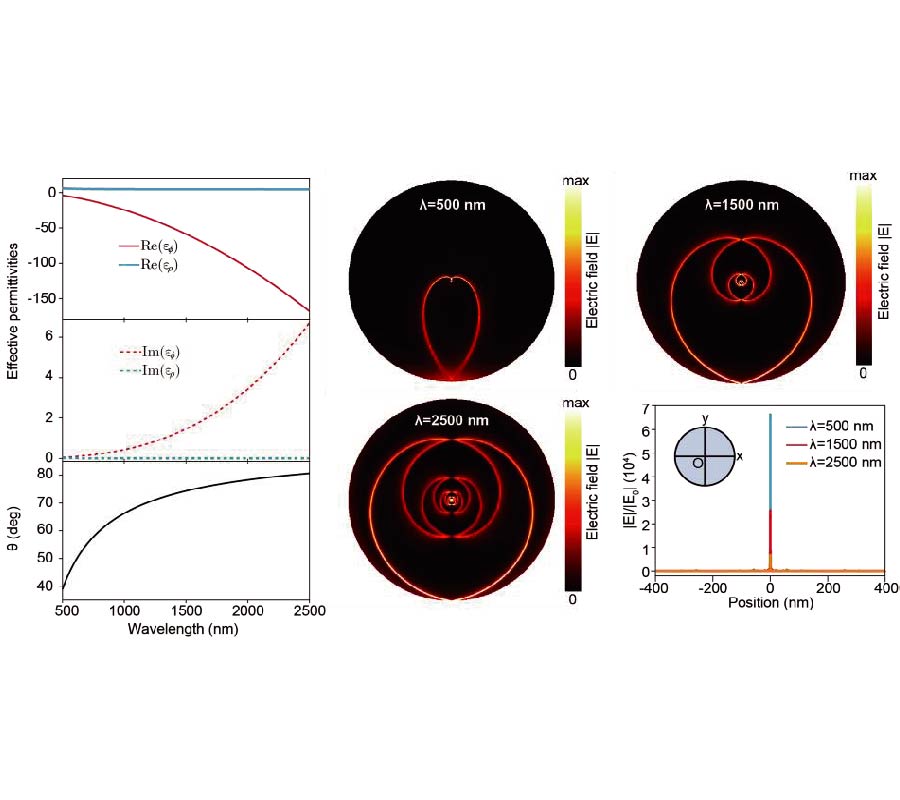
In this manuscript, plasmonic metal conductors such as Silver, Gold, Aluminum, Copper, Chromium, Tungsten, Titanium, and Nickel are investigated on a T-shaped nano dipole antenna using dielectric materials such as Silicon Dioxide, Zinc Oxide, Indium Tin Oxide, and Silicon Nitride. The optical properties of the conductors and dielectric materials are modeled using Drude and Lorentz dispersive models, respectively. It is observed that the Aluminium metal supports high quality plasmonic oscillations for a wide range of Terahertz frequencies. The Aluminium metal also shows high losses occurring at the Terahertz frequency among the other metals. The Gold and Silver can resonate in the visible region and have moderate losses compared to the other plasmonic metals. It is noticed that the near-zero permittivity point of the Silicon Dioxide substrate occurs at 2875 THz which is much greater than the other three substrates. Further, it is observed that on the Silicon Dioxide, Zinc Oxide, and Silicon Nitride substrates the Silver Nano dipole antenna shows the maximum directivity of 6.615 dBi, 5.671 dBi, and 5.709 dBi, respectively. The Aluminium nano-antenna gives the maximum directivity of 5.066 dBi on the Indium Tin Oxide substrate. The Silver-Silicon Dioxide Nano-antenna will be suitable for the terahertz optical wireless communication.
INVESTIGATION OF PLASMONIC METAL CONDUCTORS AND DIELECTRIC SUBSTRATES ON NANO-ANTENNA FOR OPTICAL WIRELESS COMMUNICATION
2022-02-11
PIER C
Vol. 118, 135-145
Strategies for Selecting Common Elements Excitations to Configure Multiple Array Patterns
Duaa Alys Karim and Jafar Ramadhan Mohammed
In this paper, a single linear antenna array with partially common element excitation amplitudes is used to reconfigure between Taylor-pencil beam and flat-top beam patterns. Two strategies are suggested to properly select the common elements while still satisfying the desired constraints on both patterns. The first strategy uses the central elements of the array as the common elements for the reconfiguration between the required two patterns, while the other one uses the side elements. Since the element excitation amplitudes of the corresponding Taylor and flat-top patterns usually tend to be maximum and similar at the array center, the central common elements approach outperforms the sided one. Compared with the conventional array pattern synthesized methods with completely two separable elements excitations arrays, only a single linear array with a number of common element excitations is needed in the proposed method. Hence, it has advantages of simple structure, low cost, and compact size. Simulation results show that the proposed array with the central common elements approach has the capability to efficiently reconfigure between Taylor and flat-top beams by modifying only 24 elements out of a total 40 array elements with all sidelobe levels of both patterns below -20 dB.
STRATEGIES FOR SELECTING COMMON ELEMENTS EXCITATIONS TO CONFIGURE MULTIPLE ARRAY PATTERNS
2022-02-11
PIER Letters
Vol. 102, 161-166
Loads Estimation for Multi-Receiver Wireless Power Transfer System
Suraj Kumar Panigrahi , Pradyumna K. Sahoo , Durga Prasanna Kar , Renu Sharma and Satyanarayan Bhuyan
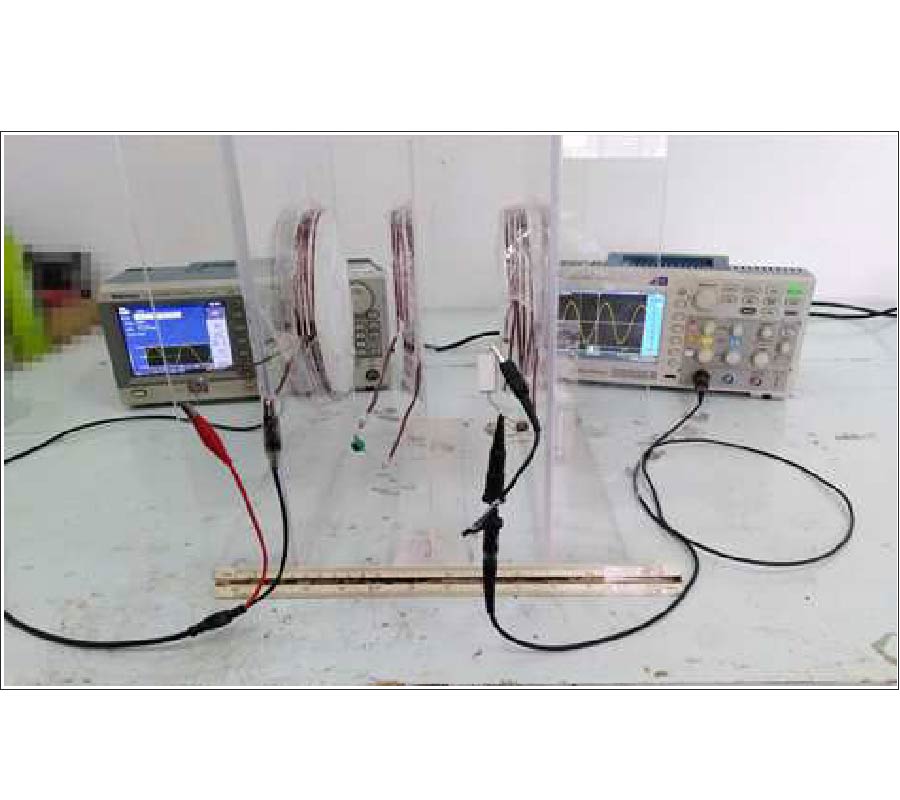
It is still a delusion that the transmitter coil is able to drive multiple loads (electrical/electronic devices) in multi-receiver Wireless Power Transfer (WPT) system. Nevertheless, it is found that for a fixed design, the number of receiver load coils that can be driven with their stipulated power level is not selected randomly rather with definite number. The circuit model analysis of series-series compensated multiple-receiver WPT system is proposed in order to estimate the number of loads with respect to the transmitter coil. Both theoretical simulation and experimental studies have proven this finding, and the results obtained are important for designing an effective multiple-receiver WPT system.
LOADS ESTIMATION FOR MULTI-RECEIVER WIRELESS POWER TRANSFER SYSTEM
2022-02-10
PIER Letters
Vol. 102, 151-159
Analysis for Six-Pole Outer Rotor Hybrid Magnetic Bearing
Gai Liu and Huangqiu Zhu
In order to solve the nonlinear and coupling problems of three-pole hybrid magnetic bearing, a six-pole outer rotor hybrid magnetic bearing (HMB) is proposed. Firstly, the structure and working principle of the six-pole outer rotor HMB are introduced. Secondly, the linearity and coupling characteristics curves between radial suspension force and control current are analyzed and verified by the finite element method. In comparison with the analysis results of the three-pole HMB, there is no electromagnetic coupling between radial two degrees of freedom of the six-pole outer rotor HMB, and the nonlinear problem of force-current characteristic is solved. Finally, an experimental platform is built. The research results show that the maximum bearing capacity of the six-pole outer rotor HMB is 32.3% higher than that of the three-pole HMB. The suspension force-current characteristic experiment shows that the suspension force-current properties of the six pole outer rotor hybrid magnetic bearing can be considered linear near the equilibrium position, and there is no magnetic coupling between two radial degrees of freedom of the six pole outer rotor HMB near the equilibrium position.
ANALYSIS FOR SIX-POLE OUTER ROTOR HYBRID MAGNETIC BEARING
2022-02-09
PIER M
Vol. 108, 53-63
Analysis of Electrically Low Profile Wideband Microwave Absorber for C Band Applications
Nitinkumar J. Bathani and Jagdish M. Rathod
In this paper, a wideband polarization-independent broad angular insensitive absorber is proposed with miniaturization novelty. A 12*12 octagon element with parasitic elements interconnected by lumped resister has been fabricated on an FR4 structure with an air gap. Large air gap and lower thickness of substrate material as well as corner notched rectangular with octagonal shape causes the improvement of bandwidth. The proposed wideband absorber exhibits absorptivity above 90%. The same has been achieved from 2.84 GHz to 9.12 GHz with 6.27 GHz fractional bandwidth in TE and TM configurations with an angle from 0˚ to 30˚. The design is λ/6.67 in size and λ/3.33 in thickness miniaturization at the highest cutoff wavelength. The outcome from the proposed model is highly promising and closely matches the simulated configuration. This design has a vital application in absorbing the signal from aircraft, missiles, submarines, satellites, and radar, termed stealth technology.
ANALYSIS OF ELECTRICALLY LOW PROFILE WIDEBAND MICROWAVE ABSORBER FOR C BAND APPLICATIONS
2022-02-09
PIER Letters
Vol. 102, 145-149
A Low-Profile Cylindrical Conformal Transmitarray Antenna
Ben Fu , Shixing Yu , Na Kou , Zhao Ding and Zhengping Zhang
In this paper, we present the design of a cylindrical conformal transmitarray antenna for generating high-gain beam. A low-profile transmitted element with 3-bit quantization is designed. It can cover 360˚ transmission phase shift range with transmission magnitude below -2 dB. A prototype of the cylindrical conformal transmitarray antenna is fabricated and measured. The measured gain is 21.75 dBi with aperture efficiency of 42.7%, and the thickness of the transmitarray is only 0.1 wavelengths at operating frequency.
A LOW-PROFILE CYLINDRICAL CONFORMAL TRANSMITARRAY ANTENNA
2022-02-08
PIER
Vol. 173, 1-8
An Ultra-Thin Wideband Reflection Reduction Metasurface Based on Polarization Conversion
Tiancheng Han , Kaihuai Wen , Zixuan Xie and Xiuli Yue
Reflection reduction metasurface is capable of suppressing the radar cross section of a target, which is of great importance in stealth technology. However, it is still a challenge to realize broadband and low-profile simultaneously within a simple design. Here, we experimentally demonstrate an ultra-thin wideband reflection reduction metasurface, which is achieved by utilizing polarization conversion instead of resonant absorption. The simple cut-wire unit cell is adopted to perform efficient cross polarization conversion, which leads to a polarization conversion ratio above 90% ranging from 8.4 to 14.7 GHz. By arranging the 0/1 units in chessboard layout, the reflection reduction reaches 10\,dB from 8.1 GHz to 14.6 GHz. Measured results agree well with simulated ones, which validates the effectiveness of the proposed structure. The ratio of thickness to maximum wavelength reaches 0.56 while the relative bandwidth reaches 57.3%, demonstrating an excellent comprehensive performance. Since our structure consists of refractory ceramic materials, it is promising for radar cross section reduction in high temperature environment.
AN ULTRA-THIN WIDEBAND REFLECTION REDUCTION METASURFACE BASED ON POLARIZATION CONVERSION
2022-02-08
PIER C
Vol. 118, 125-134
Design and Fabrication of COVID-19 Microstrip Patch Antenna for Wireless Applications
Jihan Salah Abdaljabar , Mervat Madi , Asaad Al-Hindawi and Karim Youssef Kabalan
This paper presents a novel unique microstrip fractal patch antenna with a COVID-19 shape designed for wireless applications. The COVID-19 antenna is a compact, miniature size, multiband, low weight, and low-cost patch antenna; the demonstrated patch antenna, simulated using the HFSS software program, consists of a circular printed patch with a radius of 0.4 cm surrounded by 5 pairs of crowns. The antenna is implemented on a double-sided copper plate with an FR4-epoxy substrate of 1x1 cm2 area and 1.6 mm thickness. This small patch operates and resonates on two frequencies 7.5 GHz and 17 GHz within C and Ku bands, respectively. The simulated and measured gains were respectively 0.8 dB and 0.2 dB at the lower frequency and 2.21 dB and 2 dB at the higher frequency. A coaxial probe feeding method is used in the simulation, and printed prototypes showed excellent consistency between measured and simulated resonance frequencies.
DESIGN AND FABRICATION OF COVID-19 MICROSTRIP PATCH ANTENNA FOR WIRELESS APPLICATIONS
2022-02-08
PIER M
Vol. 108, 39-51
Low-Pass Negative Group Delay Modelling and Experimentation with Tri-Port Resistorless Passive Cross-Circuit
Eric Jean Roy Sambatra , Antonio Jaomiary , Samuel Ngoho , Samar S. Yazdani , Nour Mohammad Murad , George Chan and Blaise Ravelo
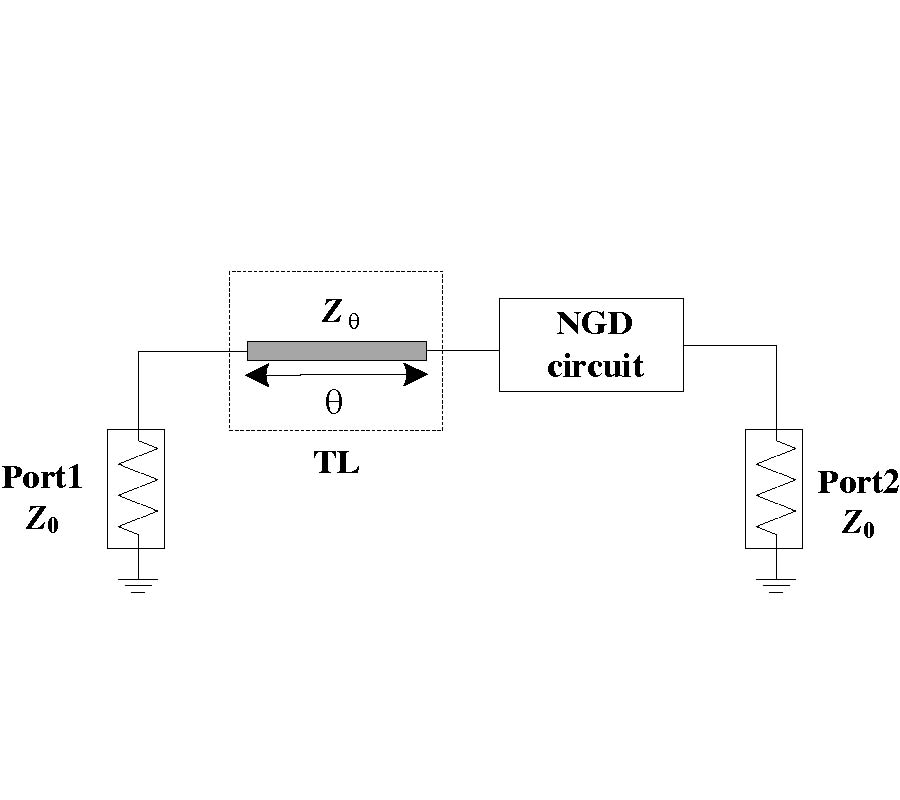
This paper introduces an original study of low-pass (LP) negative group delay (NGD) circuit. The family of the proposed passive network cross-topology was rarely investigated in the literature. It acts as a tri-port passive circuit presenting a cross-shaped topology. The present study of tri-port passive circuit is originally based on S-matrix modelling. The identification method of LP-NGD function type is established. The considered passive tri-port topology is innovatively constituted by a resistorless LC-passive network. Thanks to the impedance 3-D matrix modelling, the cross-circuit S-parameters are analytically expressed. Then, the NGD analysis at very low-frequencies is presented. The LP-NGD behavior existence condition of the cross-circuit in function of the L and C components is established. The relevance of the tri-port NGD circuit theory is verified by a proof-of-concept of resistorless cross-circuit. Analytical modelling, simulation, and experimentation confirmed the LP-NGD design feasibility with NGD value of about -2 ns and 6.67 MHz cut-off frequency.
LOW-PASS NEGATIVE GROUP DELAY MODELLING AND EXPERIMENTATION WITH TRI-PORT RESISTORLESS PASSIVE CROSS-CIRCUIT
2022-02-08
PIER M
Vol. 108, 27-38
Ultra-Wideband CPW Fed Band-Notched Monopole Antenna Optimization Using Machine Learning
Pinku Ranjan , Ankit Maurya , Harshit Gupta , Swati Yadav and Anand Sharma
In this article, a compact Coplanar Waveguide (CPW) fed band-notched monopole antenna is designed and optimized. The unique feature of this article is to provide an approach for designing an antenna in the best way using machine learning techniques. Machine Learning can be used to speed up the antenna design process. There are five algorithms employed: Decision Tree, Random Forest, XGB Regression, K-Nearest Neighbor (KNN), and Artificial Neural Network (ANN). Among all algorithms, KNN gives the best result with accuracy up to 98%. From the obtained result, we can estimate the dimensions of the desired parameters, which could not be done previously by High Frequency Structure Simulator (HFSS) Electromagnetic (EM) simulator. The optimized antenna design is also fabricated and tested, which confirms its frequency range between 2.9 and 21.6 GHz. Stable radiation features in between the operating frequency range makes it suitable for Ultra-Wideband (UWB) applications.
ULTRA-WIDEBAND CPW FED BAND-NOTCHED MONOPOLE ANTENNA OPTIMIZATION USING MACHINE LEARNING
2022-02-06
PIER C
Vol. 118, 113-123
A New Tunable Dual-Mode Dual-Band Square Cavity SIW Bandpass Filter
Mohammed Fadihl Abbas and Ali J. Salim
A tunable dual-mode dual-band square cavity substrate integrated waveguide (SIW) bandpass filter is proposed. Metalized via-holes are inserted into the center of the cavity as perturbations to move and control the four resonant modes to create the dual passband filter. The first passband is formed by the perturbed TE201 and TE202 modes, while the second passband is formed by the perturbed TE301 and TE302 modes. Moreover, moving the perturbed via-holes on the SIW cavity allows the first passband to be tuned separately while the second passband is almost fixed. A dual-band filter prototype with frequencies of 17 GHz and 19.36 GHz and three transmission zeros (TZs) has been designed, fabricated and measured. The measured and simulated results are in good agreement, confirming the proposed dual-band filter design concept.
A NEW TUNABLE DUAL-MODE DUAL-BAND SQUARE CAVITY SIW BANDPASS FILTER
2022-02-04
PIER C
Vol. 118, 99-112
Dual Band Compact Square Microstrip Antenna for GSM and GPS Applications
Aarti G. Ambekar and Amit A. Deshmukh
The design of a half U-slot loaded square microstrip antenna is proposed for the dual band response offering circular polarization in the second band. On a substrate with thickness of 0.06λg, the half U-slot tunes the spacing in between TM10, TM01 and TM11 resonant modes of the square patch to achieve dual band characteristics. In the two bands, measured impedance bandwidths of 6.49% and 17.36% with a broadside gain > 7.0 dBi are achieved. Against the equivalent square patch, the proposed dual band antenna offers 8% reduction in the patch area. With the achieved antenna characteristics, the proposed configurations satisfy the requirements of GSM 750/GPS L5 band applications.
DUAL BAND COMPACT SQUARE MICROSTRIP ANTENNA FOR GSM AND GPS APPLICATIONS
2022-02-04
PIER M
Vol. 108, 17-26
A Parametric Analysis of Modified Complementary Split Ring Resonator Low-Pass Notch Filter Suitable for the Coexistence of 5.8 GHz DSRC and 5.9 GHz ITS Applications
Alessandro Cidronali , Giovanni Collodi , Stefano Maddio , Lorenzo Pagnini , Marco Passafiume and Giuseppe Pelosi
We present a parametric analysis for a compact notch filter based on meta-material elements, suitable for the mitigation of interferences occurring at 5.9 GHz and impacting a 5.8 GHz DSRC receiver. The filter adopts a defected ground plane structure, which is derived by the class of complementary split ring resonator (CSRR) structures and further developed to improve the selectivity. The designed filter preserves the 5.8 GHz DSRC signal and attenuates the 5.9 GHz ITS-G5 signal of more than 20 dB, thus suited to improve dynamic range of DSRC vehicular receivers. This work introduces the new filter structure characteristics, its design principles, and the corresponding experimental validation.
A PARAMETRIC ANALYSIS OF MODIFIED COMPLEMENTARY SPLIT RING RESONATOR LOW-PASS NOTCH FILTER SUITABLE FOR THE COEXISTENCE OF 5.8 GHZ DSRC AND 5.9 GHZ ITS_ APPLICATIONS
2022-02-04
PIER M
Vol. 107, 243-257
Optimizing Turn-on Angle and External Rotor Pole Shape to Suppress Torque Ripple of a Novel Switched Reluctance Motor
Chaozhi Huang , Jinfeng Duan , Wei Liu and Yuliang Wu
The large vibration and noise of switched reluctance motor (SRM) limits development in the field of electric bicycles. The innovation of the paper lies in reducing torque ripple by advancing the turn-on angle and increasing air-gap permeability in the first half of two phase exchange region. The torque ripple of a novel Multi-Teeth External Rotor SRM (MTER-SRM) is studied in the paper. Firstly, the topology structure, working principle and optimized process of the MTER-SRM are introduced. Secondly, the method to suppress the torque ripple by advancing turn-on angle is proved theoretically. The effect of advancing turn-on angle on torque ripple is analyzed, and turn-on angle is optimized by Finite Element Method (FEM). Thirdly, the mathematical model is built to analyze the change of air-gap permeability in the aligned and unaligned position. The effect of different angles and heights of pole shoe on the torque characteristics is analyzed by FEM, and optimized parameters of single pole shoe size are obtained. Finally, the results show that torque ripple has dropped from 1.5 to 0.4, with the decrease of 73.3%. The multi-physical field results show that the vibration displacement, velocity, acceleration and noise pressure of stator decrease by 83.3%, 52.5%, 52.2%, and 54.2%, respectively. Meanwhile, the vibration test of the prototype also shows that the maximum vibration acceleration has dropped from 0.4 to 0.1, with the decrease of 75%. The vibration and noise of the MTER-SRM is decreased significantly by this method, which can provide a demonstration for developing high performance motor applied in electric bicycle.
OPTIMIZING TURN-ON ANGLE AND EXTERNAL ROTOR POLE SHAPE TO SUPPRESS TORQUE RIPPLE OF A NOVEL SWITCHED RELUCTANCE MOTOR
2022-02-04
PIER Letters
Vol. 102, 135-143
A Compact Circularly Polarized Rotated L-Shaped Antenna with j -Shaped Defected Ground Strucutre for WLAN and V2X Applications
Jayshri Kulkarni , Chow-Yen-Desmond Sim , Ajay K. Poddar , Ulrich L. Rohde and Abdullah G. Alharbi
A novel and compact microstrip-line fed printed antenna for wideband circular polarization (CP) radiation is proposed. The designed antenna utilizes a crescent-shaped substrate, rotated L-shaped monopole, and defected ground structure (DGS) to achieve a wide 3-dB axial ratio (AR) bandwidth and 10-dB impedance bandwidth (ZBW) across the entire 5 GHz Wireless Local Area Network (WLAN) and Vehicle to Everything (V2X) operational bands. As the substrate of the proposed antenna is only 0.8 mm thick, it has a very low profile of 0.014λ in terms of free space wavelength (λ) at 5.5 GHz. The proposed CP antenna exhibits overlapping 10-dB ZBW and 3-dB AR bandwidth (ARBW) of 22.05% (4.80-5.99 GHz), along with broadside far-field patterns, gain greater than 2.5 dBi and efficiency above 85%throughout the desired operating band. Therefore, it is a good candidate for WLAN and V2X communication applications.
A COMPACT CIRCULARLY POLARIZED ROTATED L-SHAPED ANTENNA WITH J-SHAPED DEFECTED GROUND STRUCUTRE FOR WLAN AND V2X APPLICATIONS
2022-02-04
PIER Letters
Vol. 102, 127-134
Noninvasive Continuous Glucose Monitoring on Aqueous Solutions Using Microwave Sensor with Machine Learning
Saeed M. Bamatraf , Maged A. Aldhaeebi and Omar M. Ramahi
In this paper, an electrically-small microwave dipole sensor is used with machine learning algorithms to build a noninvasive continuous glucose monitoring (CGM) system. As a proof of concept, the sensor is used on aqueous (water-glucose) solutions with different glucose concentrations to check the sensitivity of the sensor. Knowledge-driven and data-driven approaches are used to extract features from the sensor's signals reflected from the aqueous glucose solution. Machine learning is used to build the regression model in order to predict the actual glucose levels. Using more than 19 regression models, the results show a good accuracy with Root Mean Square Error of 1.6 and 1.7 by Matern 5/2 Gaussian Process Regression (GPR) algorithm using the reflection coefficient's magnitude and phase.
NONINVASIVE CONTINUOUS GLUCOSE MONITORING ON AQUEOUS SOLUTIONS USING MICROWAVE SENSOR WITH MACHINE LEARNING
2022-02-02
PIER C
Vol. 118, 83-97
High Gain Array Antenna Using Electromagnetic Band Gap Structures for 5G Applications
Sanae Dellaoui , Abdelmoumen Kaabal , Mustapha El Halaoui , Adel Asselman , Saida Ahyoud and Loubna Rmili
This paper proposes a high gain array antenna operating in the Ku-band at 17.5 GHz for 5G applications. This new antenna is printed on an FR-4 substrate of thickness h = 0.8 mm and realized by changing the geometric shape of a rectangular patch, obtained by inserting an L-shaped slot to enlarge the bandwidth (1.5 GHz) and to increase the gain. To further enhance the gain, we used a 1×2 patch antenna array closely spaced and powered by a 1-to-2 Wilkinson power divider. We inserted two high-impedance surface (HIS) structures between the radiating elements and added two electromagnetic band gap (EBG) layers above the antenna. The antenna gain increases from 7.56 dB to 14.8 dB. The design and simulation have been performed by CST Microwave. A minor difference was noted between the measured and simulated data, where a slight shift was observed in the antenna's resonance frequency, which can be caused by fabrication tolerances or measurement error, uncertainty of the thickness of the FR-4 substrate, and quality of SMA connector used. The final array antenna shows a directional radiation pattern with a gain of 14.8 dB and good radiation efficiency over the operating band.
HIGH GAIN ARRAY ANTENNA USING ELECTROMAGNETIC BAND GAP STRUCTURES FOR 5G APPLICATIONS