Search Results(13789)

2021-10-15
PIER Letters
Vol. 100, 117-125
Wideband MIMO Antenna with Compact Decoupling Structure for 5G Wireless Communication Applications
Mohammed M. Bait-Suwailam , Thamer S. Almoneef and Saud M. Saeed
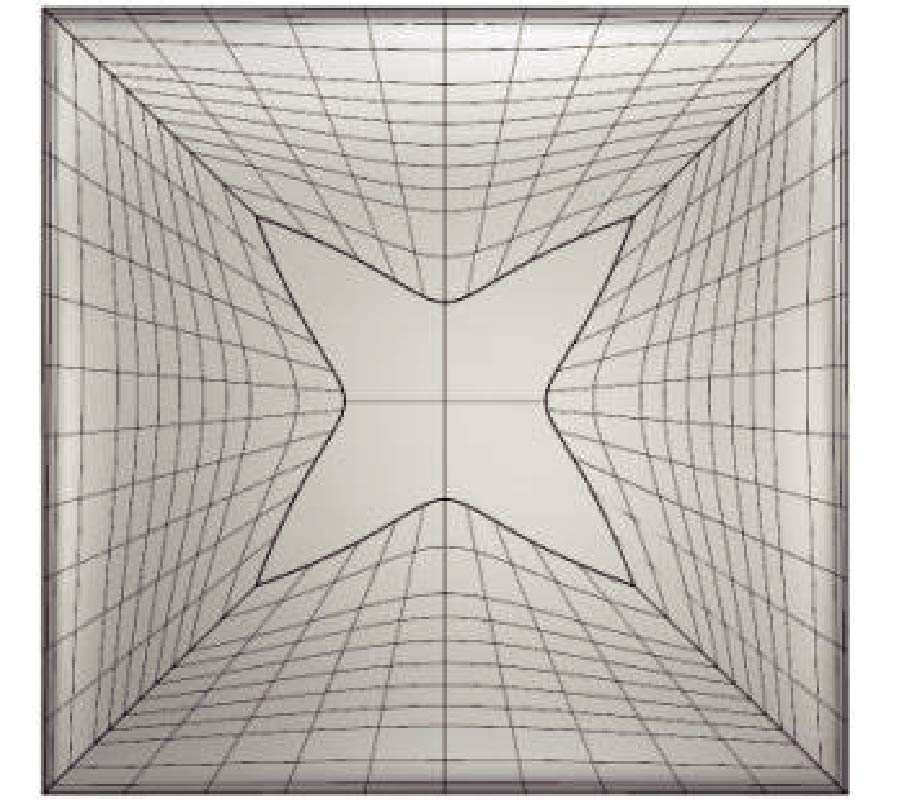
This letter proposes a two element multiple-input multiple-output (MIMO) antenna with compact decoupling structure for 5G wireless communication applications. A compact decoupling structure was developed based on the elliptic curve, achieving isolation between the two antenna elements with a wideband response. The proposed concept is discussed and verified numerically and experimentally. The MIMO antenna system has demonstrated a wideband impedance matching with high isolation capability, while maintaining a good far-field and MIMO performance.
WIDEBAND MIMO ANTENNA WITH COMPACT DECOUPLING STRUCTURE FOR 5G WIRELESS COMMUNICATION APPLICATIONS
2021-10-15
PIER Letters
Vol. 100, 109-116
High Gain and Wide Bandwidth Array Antenna for Sector Beam Pattern Synthesis
Ayyadevara Murali Maruti and Bhavan S. Naga Kishore
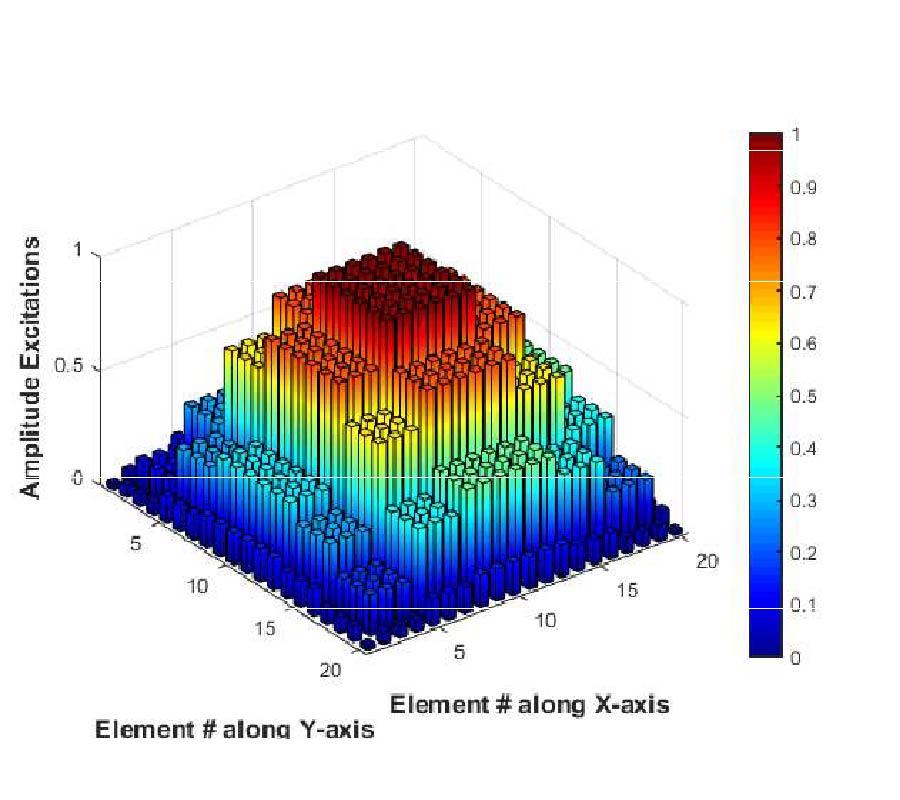
This paper presents a novel design structure of a series fed array antenna for desired shaped beam pattern synthesis. The desired beam shape is obtained by varying the width of patch elements. A uniform array is designed for the desired frequency, and then the proportionate values of the widths are calculated using amplitude coefficients obtained from the Woodward Lawson array synthesis method, while keeping excitation phase and inter element spacing constant. The proposed antenna is designed and simulated in HFSS. A prototype is fabricated on FR-4 epoxy dielectric material and tested at 12.5 GHz. The overall antenna has a compact size of 112 mm x 34 mm x 0.8 mm. The array structure exhibits impedance bandwidth of 1.8 GHz from 11 GHz to 12.8 GHz frequency range with return loss of -27.1 dB and high gain 14.2 dBi. The series fed configuration results in a VSWR of 1.38 and considerably low side lobe level of -24 dB in H-plane. There is a fine similarity between simulation and fabrication measurement parameter values such as return loss, VSWR, gain, and bandwidth.
HIGH GAIN AND WIDE BANDWIDTH ARRAY ANTENNA FOR SECTOR BEAM PATTERN SYNTHESIS
2021-10-13
PIER M
Vol. 105, 79-88
Design of Electromagnetic Wave Multi-Type Focusing Based on 1-Bit Metasurface
Honggang Hao , Sen Zheng , Yihao Tang and Xuehong Ran
Aiming at the focusing of near-field electromagnetic (EM) energy, a design approach of multi-type focusing (MTF) based on 1-bit metasurface is proposed in this paper. The surface electric field required for multi-focus is actually obtained by the superposition of the surface electric field of each single focus. This method can flexibly design the number, position, and energy distribution ratio of the focus according to the phase arrangement of the metasurface. Dipole structure is used as ``0'' and ``1'' unit of 1-bit metasurface. The phase difference of reflection is 180°, and the reflection coefficient is over 90% in 7.4-21.9 GHz. Using this 1-bit unit, the linear focus metasurface, multi-focus metasurface and metasurface generating two foci with different energy distribution are realized respectively. The energy distribution metasurface was manufactured and measured, and the measured results are consistent with the simulations. The design method used in this paper is simple and effective to realize multi-focus metasurface design and has potential application value in microwave imaging, radio frequency identification (RFID), and wireless power transmission.
DESIGN OF ELECTROMAGNETIC WAVE MULTI-TYPE FOCUSING BASED ON 1-BIT METASURFACE
2021-10-12
PIER Letters
Vol. 18, 51-59
A RFID Tag Metal Antenna on a Compact HIS Substrate
Yan Liu , Kwai-Man Luk and Hong-Cheng Yin
Utilizing the special physical characteristic of a high impedance surface, a radio frequency identification tag antenna working at 920 MHz for metallic ground is proposed. The antenna not only overcomes the problem of impedance mismatching when placing on a metallic object, but also exhibits a low-profile antenna structure.
A RFID TAG METAL ANTENNA ON A COMPACT HIS SUBSTRATE
2021-10-12
PIER C
Vol. 116, 129-144
Improved Neighborhood-Based Algorithm to Facilitate the Reduction of Skin Reflections in Radar-Based Microwave Imaging
Michael R. Smith and Elise C. Fear
Low power, near-field (NF) radar imaging techniques have been proposed for breast cancer detection and long-term monitoring. It is important to optimize the data processing paths required for NF image reconstruction given the inherent resolution limitations of microwave compared to MRI or X-ray imaging. A key limitation in obtaining internal tumour and breast feature information is the reflection from the skin surface physically close to the antenna. Typically, algorithms to remove this dominant reflection involve subtracting an estimate of the time domain signal for the skin reflection from one antenna location using information from other locations. A key challenge in these approaches is determining the portion of the signal, the skin dominant window (SDW), to use to determinethe weights applied to nearby antenna signals when calculating the skin reflection estimate. Equipment limitations and breast characteristics impact the amount of data that can be captured, leading to the well-known Gibbs' ringing distortionsin the time domain signals. We suggestthat the Gibbs' ringing from the magnitude larger skin reflection has caused the length of the SDW to be over-estimated in previous determinations. Since this distorted signal now overlaps the time signals from the tumour and breast responses, removing the skin reflection estimatemay result in attenuation of tumour responses. In this contribution, two alternative strategies for designing the SDW are proposed. One minimized the first skin peak in the SDW, i.e., the furthest from the breast feature signals, and the other minimized the main, i.e., largest, skin peak within the SDW. Both new approaches were shown to effectively suppress the skin signal on simulated and patient data while allowing recovery of the missing portions of the desired internal breast feature signals leading to an increase in the overall intensity of the images and preserving the tumour response. However, we provided reasons why we considered that basing the suppression on the largest skin signal peak would provide a more consistent improvement in the breast feature signals.
IMPROVED NEIGHBORHOOD-BASED ALGORITHM TO FACILITATE THE REDUCTION OF SKIN REFLECTIONS IN RADAR-BASED MICROWAVE IMAGING
2021-10-12
PIER C
Vol. 116, 113-128
Influence of 3D Printing Process Parameters on the Radiation Characteristics of Dense Dielectric Lens Antennas
Fikret Tokan , Selami Demir and Alper Çalışkan
In recent years, additive manufacturing has found increasing interest in fabrication of dielectric antennas. Using additive manufacturing brings significant advantages such as design flexibility, compactness, fast and low-cost manufacturing compared to traditional fabrication methods. Dielectric antennas having dense material allow high power transfer efficiency through the lens. However, a successful 3D printing process with dense dielectric materials is a great challenge. In this paper, impact of main process parameters during 3D printing; namely printing speed, process temperature and layer height on the resulted relative electrical permittivity values of a dense dielectric material is investigated. Test samples are printed with a dielectric material having εr = 10, and relative permittivity variations of these samples are measured with a vector network analyzer in X-band (8.2-12.4 GHz). In this way, optimum printing parameters are determined. Influence of dielectric constants of printed materials on the antenna radiation characteristics are inspected for an extended hemispherical lens antenna by a full-wave computer-aided design tool. Results demonstrate that an additively manufactured dense dielectric antenna will act as a traditionally manufactured dielectric antenna if and only if it is manufactured with optimum printing parameters.
INFLUENCE OF 3D PRINTING PROCESS PARAMETERS ON THE RADIATION CHARACTERISTICS OF DENSE DIELECTRIC LENS ANTENNAS
2021-10-12
PIER M
Vol. 105, 67-78
Quasi-Optical Beamforming Approach Using Vertically Oriented Dielectric Wedges
Pratik Ghate and Jonathan Bredow
Beamforming at mm-Wave and beyond is expected to be a critical need for many emerging applications such as Internet of Things (IoT), vehicular networking systems, and unmanned aerial navigation systems as well as 5G/6G backhaul communications. A new technique is proposed using quasi-optical beamforming that will address the shortcomings of existing beamforming approaches. These structures are passive (or nearly passive) having low cost, low power consumption, compact size and weight, have bandwidth advantages, and are expected to be able to operate at higher frequencies. The proposed structures give sufficient degrees of freedom to control the beamsteering angles by varying the dielectric constants and geometries of these structures and can form simultaneous multiple low overlapping beams. This approach increases the gain of the radiating source resulting in highly directive beams; our studies suggest that sufficient dielectric and shape parameters are available so that electrical tuning of beamformer parameters is possible. These structures are designed for a 1x3 microstrip patch antenna to demonstrate the formation of three simultaneous low overlapping beams. The effects on bandwidth are negligible upto 4.4%, and scanning angle of 180° has been achieved by using vertically oriented dielectric wedges. 6 dB gain enhancement and the capability to scale to larger 2D arrays have also been demonstrated. Full wave simulation results in Ansys HFSS are provided to demonstrate the proposed techniques, and validation is done in CST MWS.
QUASI-OPTICAL BEAMFORMING APPROACH USING VERTICALLY ORIENTED DIELECTRIC WEDGES
2021-10-10
PIER B
Vol. 94, 19-36
Inversion of Electrical and Geometrical Parameters of a Stratified Medium from Data Derived from the Small Perturbation Method and the Small Slope Approximation
Nada Djedouani , Saddek Afifi and Richard Dusséaux
The goal of the present paper is on retrieving the electrical and geometrical parameters of a stratified medium with two rough interfaces. The inversion problem is formulated as a cost function optimization problem, and it is solved using the simulated annealing algorithm. The cost function consists in the integrated squared deviation between the co-polarized incoherent intensities obtained from the Small Slope Approximation and those obtained from the Small Perturbation Method. The inversion scheme is applied to the electrical and geometrical parameters involved into the analytical expressions of the incoherent intensities given by the SPM. We study the influence of the shape of the autocorrelation function and the isotropy factor upon the estimation of parameters. We test the sensitivity of the inversion scheme to noisy synthetic data. The study is applied to snow-covered soils in L-band. For the configurations under study, we show that the inverse method is efficient for eight-parameter or ten-parameter predicting problems.
INVERSION OF ELECTRICAL AND GEOMETRICAL PARAMETERS OF A STRATIFIED MEDIUM FROM DATA DERIVED FROM THE SMALL PERTURBATION METHOD AND THE SMALL SLOPE APPROXIMATION
2021-10-10
PIER C
Vol. 116, 95-112
Design and Implementation of Long-Distance Dual PIFA Antenna Structure of Small Embedded Metal UHF RFID Tag
Zhidan Yan , Shuchao Lu , Chao Zhang and Zhengyu Yang
As the advanced technology in the Internet of Things (IoT), ultra-high frequency radio frequency identification (UHF RFID) tag has broad application prospects and significant research value. However, the transmission performance of UHF RFID on the metal surface and embedded in metal is severely impaired, bringing new challenges to its application for long-distance reading and writing. On this basis, an embedded metal UHF RFID tag design method is proposed in this paper. A planar inverted F antenna (PIFA) structure is optimized to enhance the anti-metal performance of the tag. The embedded feed design is adopted to achieve preferable impedance matching between antenna and chip. Besides, a series of electromagnetic simulations were investigated to optimize the performance of the tag, which can ultimately achieve the maximum gain of -9.7 dB in the metal groove, with the reduced volume of 19.8 mm×25.8 mm×2 mm by employing the meandering technology and the method of adding metal via holes. Finally, when the self-made tag is embedded in the metal groove, the experimental results demonstrate that the maximum reading distance can reach 1.26 m, indicating that the tag developed in this paper has significant practical value in the case of embedded metal.
DESIGN AND IMPLEMENTATION OF LONG-DISTANCE DUAL PIFA ANTENNA STRUCTURE OF SMALL EMBEDDED METAL UHF RFID TAG
2021-10-10
PIER C
Vol. 116, 81-93
Complementary Split Ring Resonator Based Massive MIMO Antenna System for 5G Wireless Applications
Surendra Loya and Habibulla Khan
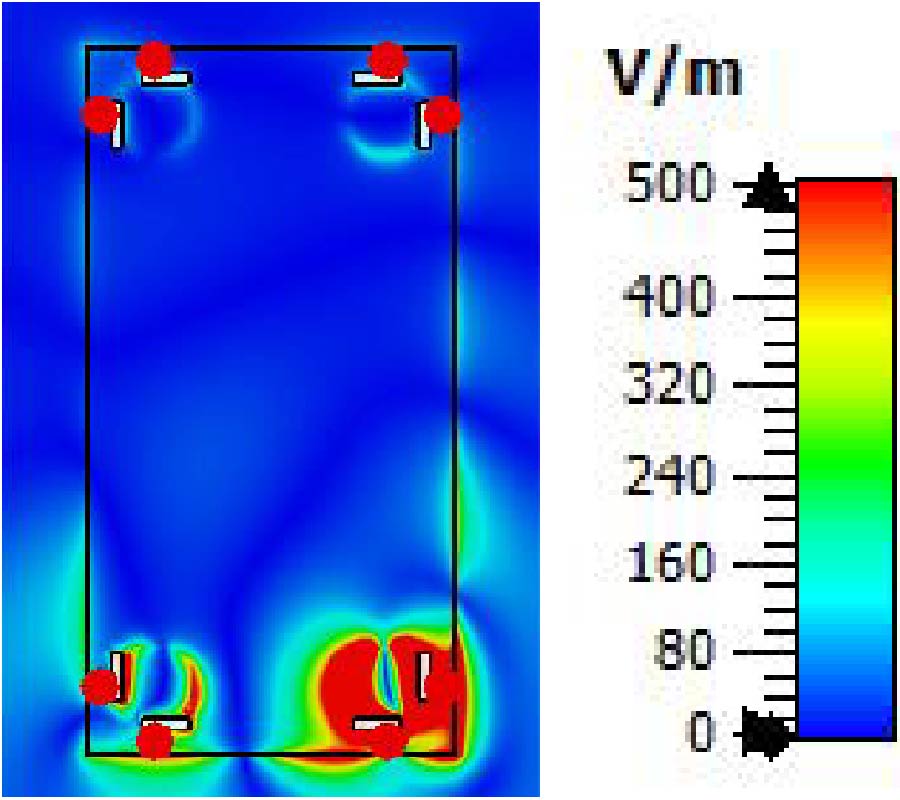
A MIMO antenna for smartphones with radiation diversity is presented in this article. The proposed design consists of dual-fed Complementary Split Ring Resonator metamaterial antenna components design, which is located at the edges of an FR-4 substrate. The total dimension is 75 mm x 150 mm x 1.6 mm. 50-ohm dual microstrip feed lines placed orthogonal to each other are used to feed the SRR. Due to this orthogonality, radiation diversity is easily achieved. The proposed structure is operated in dual bands from 3.43 GHz to 3.62 GHz and 4.78 GHz to 5.04 GHz. In both, the band's good impedance bandwidth with a reasonable gain is achieved. The entire structure is simulated using CST EM software. All the simulated results are presented, which clearly show that the proposed structure is a good candidate for the future smartphone massive MIMO application.
COMPLEMENTARY SPLIT RING RESONATOR BASED MASSIVE MIMO ANTENNA SYSTEM FOR 5G WIRELESS APPLICATIONS
2021-10-10
PIER C
Vol. 116, 65-80
Multiband Circularly Polarised Microstrip Patch Antenna with Minkowski Fractal Slot for Wireless Communications
Vijayankutty Radhamony Remya , Manju Abraham , Ambalath Parvathy and Thomaskutty Mathew
A multiband circularly polarized microstrip patch antenna including a Minkowski fractal slot for wireless communication applications in the frequency bands 1.39 GHz, 2.45 GHz (WLAN band), 3.48 GHz (Mobile Wi-Max), 5.8 GHz (U-NII high-band) and 6.29 GHz has been proposed. The proposed antenna consists of two substrates mounted on top of the ground plane. The antenna has been fed with a 50 Ω microstripline which is etched on top of the lower substrate. The second iteration Minkowski fractal slot is etched on the truncated square patch which is on top of the upper substrate. The substrate has a size of 80 mm x 82 mm x 1.6 mm. The measured results show that the proposed antenna could excite for five resonant bands of 1.35 GHz, 2.45 GHz, 3.5 GHz, 5.8 GHz and 6.25 GHz and has reflection coefficients of -15 dB for 1.35 GHz, -16 dB for 2.45 GHz, -22 dB for 3.5 GHz, -23 dB for 5.8 GHz and -13 dB for 6.25 GHz as well as an axial ratio bandwidth of 3.42 GHz-3.47 GHz. The maximum gains of the antenna are 5.92 dBi for 1.39 GHz, 6.15 dBi for 2.45 GHz, 8.36 dBi for 3.48 GHz, 9.64 dBi for 5.8 GHz and 6.69 dBi for 6. 29 GHz. The simulations and optimizations have been carried through Computer Simulation Technology Microwave Studio (CST-MWS) software.
2021-10-10
PIER C
Vol. 116, 51-64
Design and Experimental Validation of UWB MIMO Antenna with Triple Band-Notched Characteristics
Muhammad Kabir Khan and Quanyuan Feng
A compact pot-shaped Multiple Input Multiple Output (MIMO) Antenna with Triple notched band characteristics is presented for Ultra Wide Band (UWB) Applications. The comprehensive dimension of the presented antenna is 17×32 mm2. The presented antenna has two identical pot-shaped radiators, 7-shaped stubs, T-shaped strips, M and C-shaped slots. Two novel 7-shaped stubs are connected to the antenna ground plane to obtain -22 dB enhanced isolation. The presented antenna works from 2.95 to 12.1 GHz with triple stopped WiMAX, WLAN, and X bands. A novel T-shaped strip is connected to the antenna ground plane to stop the WiMAX band (3.3-4.4) GHz. C and M-shaped slots are etched in the antenna radiators to stop WLAN (5.20-6.12) GHz and X (7.6-8.15) GHz bands respectively. The peak gain of the proposed antenna is from 1.5 to 5 dB with a radiation efficiency of 80-90%. The Envelope Correlation Coefficient (ECC) of the proposed antenna is less than 0.01 with a Diversity Gain greater than 9.99 except for the notched bands.
2021-10-10
PIER C
Vol. 116, 37-49
Eight Shape Electromagnetic Band Gap Structure for Bandwidth Improvement of Wearable Antenna
Vidya R. Keshwani , Pramod P. Bhavarthe and Surendra Singh Rathod
In this paper, a rectangular eight shaped Electromagnetic Band Gap (EBG) structure at 5.8 GHz Industrial, Scientific and Medical (ISM) band for wearable application is proposed with intent to improve impedance bandwidth of antenna. The unit cell of an EBG structure is formed using eight shape on outer ring with inner square patches. The simulation of the eight shape EBG unit cell is carried out using eigen mode solution of Ansys High Frequency Structure Simulator (HFSS). Simulated results are validated by experimental results. The application of proposed EBG for an inverse E-shape monopole antenna at 5.8 GHz is also demonstrated. Band stop property of EBG structure reduces surface waves, and therefore, the back lobe of a wearable antenna is reduced. The frequency detuning of antenna takes place due to high losses in human body. Suitably designed EBG structure reduces this undesirable effect and also improves front to back ratio. The proposed compact antenna with designed EBG has observed the impedance bandwidth of 5.60 GHz to 6.15 GHz which covers 5.8 GHz ISM band. Evaluation of antenna performance under bending condition and on-body condition is carried out. Effectiveness of EBG array structure for Specific Absorption Rate (SAR) reduction on three layer body model is demonstrated by simulations. Calculated values of SAR for tissue in 1 g and 10 g are both less than the limitations. In conclusion, it is appropriate to use the proposed antenna in wearable applications.
EIGHT SHAPE ELECTROMAGNETIC BAND GAP STRUCTURE FOR BANDWIDTH IMPROVEMENT OF WEARABLE ANTENNA
2021-10-10
PIER M
Vol. 105, 55-65
Performance Comparison of Spoke Array Fault Tolerant PM Vernier Rim Driven Machine with Different Numbers of Flux Modulation Poles
Tianhuai Qiao , Jingwei Zhu and Xiaoyi Wang
In this paper, the effect of flux modulation pole (FMP) number on the performance of a spoke array fault tolerant permanent magnet vernier rim driven machine (SA-FTPMV-RDM) is studied. Firstly, a hybrid stator is adopted in this machine in which armature teeth and isolation teeth are arranged alternatively, and the winding type is single-layer fractional slot concentrated winding (SL-FSCW). Spoke array magnet is employed in the rotor of the machine to achieve flux focusing effect. Then the parameter scanning method is used to optimize the FMP pitch ratio, isolation tooth width ratio, FMP height, and permanent magnet thickness under different numbers of FMPs. It is concluded that there is an optimal FMP number for 12 slots SA-FTPMV-RDM to maximize the torque. Finally, the electromagnetic performances of the optimized machines with different number of FMP are compared by using the finite element analysis (FEA). The results show that the machine with the optimal number of FMPs has the highest torque density and efficiency, strong fault tolerance, but relatively large torque ripple.
2021-10-10
PIER Letters
Vol. 100, 99-107
A Compact Dual-Band Wideband Circularly Polarized Microstrip Antenna for Sub-6G Application
Zhong Yu , Leiyan Huang , Qi Gao and Bingwen He
A dual-band wideband circularly polarized (CP) microstrip antenna is proposed for sub-6G application. The antenna consists of an upper L-shaped radiator and two circular strips on the ground. This produces the right-handed circular polarization (RHCP) in the Wi-Fi (2.4-2.48 GHz) and n77 (3.3-4.2 GHz) band with the help of two circular strips at the left and right corners on the lower ground. The antenna occupies a small radiating area of 45×45×1.0 mm3. The measured results show wide -10 dB reflection coefficient bandwidths of 46.4%(1.82-2.92 GHz)and 40.5% (3.15-4.75 GHz). The 3-dB axial ratio bandwidths of the antenna are 25.1% (1.88-2.42 GHz) and 40.6% (3.20-4.83 GHz). The measured peak gains are 4.8 and 7.5 dBi at the lower and higher bands, respectively. Therefore, the proposed antenna in this study is suitable for the dual-band wideband CP antenna as a reference.
2021-10-09
PIER C
Vol. 116, 25-35
Slots and Complementary Split Ring Resonators Loaded Miniaturized Microstrip Antenna (S-CSRR-MHMSA) with Reduced Cross Polarization
Uday Anandrao Patil and Anandrao Bajirao Kakade
Cross polarization (X-pol) effect is the undesired radiation of an antenna which wastes bandwidth (BW) and power of the communication system. Especially in the miniaturized microstrip antenna (MSA) the X-pol level is more. The observed X-pol level of the classical MSA at the direction of maximum radiation (φ =0˚) is -49.72 dB, whereas X-pol level of miniaturized H shaped MSA (MHMSA) is -39.96 dB. This paper presents miniaturized complementary split ring resonators loaded H shaped microstrip antenna (CSRR-MHMSA) and slots and CSRRs loaded MHMSA (S-CSRR-MHMSA) with reduced X-pol level. An array of CSRRs and slots are placed at the ground of the proposed antenna. Due to slots, the antenna is miniaturized and the polarizability of the electric field along the desired direction is increased by CSRRs. The CP-XP (Co-pol X-pol) isolation of CSRR-MHMSA and S-CSRR-MHMSA at φ =0˚ are measured. The measured E plane CP-XP isolation for CSRR-MHMSA and S-CSRR-MHMSA is 29.00 dB and 26.73 dB respectively. The measured CP-XP H plane isolation for CSRR-MHMSA and S-CSRR-MHMSA is 27.00 dB and 24.5 dB, respectively. While bandwidth (BW), gain G and radiation efficiency η are improved.
SLOTS AND COMPLEMENTARY SPLIT RING RESONATORS LOADED MINIATURIZED MICROSTRIP ANTENNA (S-CSRR-MHMSA) WITH REDUCED CROSS POLARIZATION
2021-10-09
PIER C
Vol. 116, 13-24
Highly Isolated Two-Elements Ultra-Wideband MIMO Fractal Antenna with Multi Band-Notched Characteristics
Yong Cai , Guangshang Cheng , Xingang Ren , Jie Wu , Hao Ren , Kaihong Song , Zhixiang Huang and Xian-Liang Wu
This work presents high isolation UWB-MIMO antenna with a bandwidth of up to 8.6 GHz based on a Minkowski fractal structure. The proposed antenna is fed by microstrip and be comprises two orthogonal monopole antennas, which delivers a decent isolation effect. Moreover, the ground is designed as two separated blocks with an I-shaped branch for improving the isolation degree between the units. The resultant isolation degree of this antenna is greater than 25 dB. Besides, the electromagnetic interference in the partial frequency band (such as Wi-Max band (3.45-4.45 GHz), WLAN band (5.1-5.8 GHz) and X-band (7.25-7.75 GHz)) is further prevented through etching a split-ring resonator (SRR) and C-slot on the unit. The antenna reflection coefficient of the UWB-MIMO antenna at the notch is 3.5 dB, which indicates that the antenna has a conspicuousness anti-interference effect. Through the above judicious design, the proposed UWB-MIMO antenna possesses a relative bandwidth of 113% (up to 8.6 GHz), and the envelope correlation coefficient between antenna units is less than 0.005, and the antenna radiation efficiency is up to 80%. The results indicate that the proposed MIMO antenna meets UWB applications.
HIGHLY ISOLATED TWO-ELEMENTS ULTRA-WIDEBAND MIMO FRACTAL ANTENNA WITH MULTI BAND-NOTCHED CHARACTERISTICS
2021-10-09
PIER C
Vol. 116, 1-12
Design and Realization of Dual Band Notch UWB MIMO Antenna in 5G and Wi-Fi 6E by Using Hybrid Technique
Hamza El Omari El Bakali , Alia Zakriti , Abdelkrim Farkhsi , Aziz Dkiouak and Mohssine El Ouahabi
In this paper, a novel design of a small printed Ultra-Wideband (UWB) Multi-Input Multi-Output (MIMO) antenna with a wide impedance bandwidth from 3.05 GHz to 11.65 GHz is introduced. The newly designed UWB MIMO antenna has an isolation enhancement of more than -15 dB between the two elements. This isolation is achieved by inserting a three-line stub on the ground plane between the two radiating elements. In addition, these parallel lines improve the impedance matching and the bandwidth of this structure. Dual band notched characteristics are achieved for the 5G band (3.6 GHz) and the Wi-fi 6E application (6 GHz), by loading the split ring resonator (SRR) on the ground plane at the back of antenna and etching a complementary split ring resonator (CSRR) in both the truncated square patch elements, respectively. The SRR and its complement are metamaterials structures, showing the behavior of an LC resonator circuit. The hybrid technique improves impedance matching, bandwidth, minimizes the mutual coupling in UWB frequency range, and delivers dual-notch characteristics. The simulation and measurement results of the proposed antenna with a good agreement are presented. The proposed structure exhibits high performances in terms of envelope correlation coefficient (ECC), diversity gain (DG), efficiency, total active reflection coefficient (TARC), and channel capacity loss (CCL) except the notched band.
DESIGN AND REALIZATION OF DUAL BAND NOTCH UWB MIMO ANTENNA IN 5G AND WI-FI 6E BY USING HYBRID TECHNIQUE
2021-10-09
PIER C
Vol. 115, 277-289
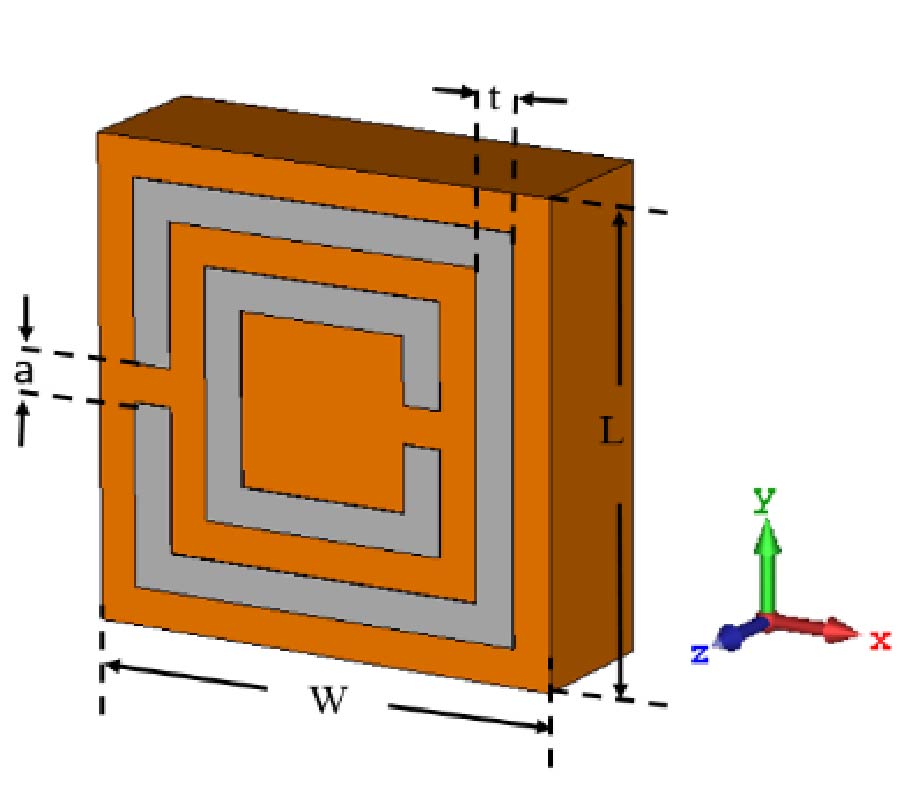
Artificial Neural Network Based SIW Bandpass Filter Design Using Complementary Split Ring Resonators
Ranjit Kumar Rayala and Singaravelu Raghavan
A novel Artificial Neural Network (ANN) based two Substrate integrated waveguide (SIW) bandpass filters comprising Complementary Split Ring Resonators (CSRRs) are proposed in this paper. These CSRRs are modelled on the upper layer of the SIW cavity. A feed forward multilayer perceptron (FF-MLP) neural network is used to optimize the physical dimensions of the proposed filters. To validate the analytical results, physical prototypes of the proposed filters are fabricated, and a measurement is carried out with a Combinational Network Analyzer (Anritsu-MS2037C), and the obtained experimental results agree well with the estimated results using full wave analysis. Within the passband from 8.22 to 8.95 GHz, S12 of the first filter shows better than -0.5 dB insertion loss (IL) and a fractional bandwidth of 8.5%, and within the passband from 8.21 to 8.73 GHz, the second filter shows IL about -0.8 dB and a fractional bandwidth of 6.1%.
ARTIFICIAL NEURAL NETWORK BASED SIW BANDPASS FILTER DESIGN USING COMPLEMENTARY SPLIT RING RESONATORS
2021-10-01
PIER M
Vol. 105, 45-54
High-Sensitive Mid-Infrared Photonic Crystal Sensor Using Slotted-Waveguide Coupled-Cavity
Hadjira Tayoub , Abdesselam Hocini and Ahlam Harhouz
In this paper, a novel high-sensitive mid-infrared photonic crystal-based slotted-waveguide coupled-cavity sensor to behave as a refractive index sensing device is proposed at mid-infrared wavelength of 3.9 µm. We determine the sensitivity of our sensor by detecting the shift in the resonance wavelength as a function of the refractive index variations in the region around the cavity. Comparison between mid-infrared photonic crystal-based slotted-waveguide coupled-cavity with mid-infrared photonic crystal-based slotted-waveguide shows a higher sensitivity to refractive index changes. The sensitivity can be improved from 938 nm/per refractive index unit (RIU) to 1161 nm/RIU within the range of n = 1 - 1.05 with an increment of 0.01 RIU in the wavelength range of 3.3651 µm to 4.1198 µm by creating a microcavity within the proposed structure, calculated quality factor (Q-factor) of 1.0821 x 10⁷ giving a sensor figure of merit (FOM) up to 2.917 x 10⁶, and a low detection limit of 3.9 × 10⁻⁶ RIU. Furthermore, an overall sensitivity is calculated to be around S = 1343.2 nm/RIU for the case of higher refractive indices of analytes within the range of n = 1 - 1.2 with an increment of 0.05 RIU. The described work and the achieved results by performing 2D-finite-difference time-domain (2D-FDTD) simulations confirm the capability to realize a commercially viable miniaturized and highly sensitive mid-infrared photonic crystal based slotted-waveguide coupled cavity sensor.
HIGH-SENSITIVE MID-INFRARED PHOTONIC CRYSTAL SENSOR USING SLOTTED-WAVEGUIDE COUPLED-CAVITY