Search Results(13790)

2020-08-04
PIER B
Vol. 88, 1-18
Moment Method Treatment of Corrugations with Fins Over Ridges and Stratified Covers Using Dyadic Cavity and Multilayer Green's Functions for Studies of Higher-Order Diffraction Modes
Malcolm Ng Mou Kehn
There has been a presented modal approach for analyzing the scattering of plane waves that are incident on penetrable gratings with metallic fins lined over both exterior surfaces of each conducting bar to create flanged apertures, which altogether is covered on both sides by multiple dielectric layers. The new degrees of freedom afforded by the special complex geometry offer ways to improve the capabilities of various applications such as beam deflectors, resolution of spectroscopic gratings, grating couplers, and grating pulse compression/decompression, as shall be demonstrated herein for the latter two. All of these entail higher-order diffraction modes, which are advantageously studied by the aforementioned analytical tool. Outcomes of measurements on a fabricated prototype that agree well with expectations from theory are also presented.
MOMENT METHOD TREATMENT OF CORRUGATIONS WITH FINS OVER RIDGES AND STRATIFIED COVERS USING DYADIC CAVITY AND MULTILAYER GREEN'S FUNCTIONS FOR STUDIES OF HIGHER-ORDER DIFFRACTION MODES
2020-08-04
PIER B
Vol. 87, 151-170
Waveguide Radiation of the Combined Vibrator-Slot Structures
Sergey L. Berdnik , Viktor A. Katrich , Mikhail Nesterenko and Yuriy M. Penkin
A problem of electromagnetic wave diffraction by a longitudinal slot cut in a waveguide wide wall is solved by a generalized method of induced electro-magneto-motive forces (EMMF). The slot radiates in a half-space above a perfectly conducting plane where two vertical impedance monopoles are arbitrarily located. To control electrodynamic characteristics of the radiator, a passive impedance monopole is placed in the waveguide. The paper is aimed at the study of the electrodynamic characteristics of waveguide vibrator-slot structures, analogous to the known Clavin element, with two identical impedance monopoles on both sides of the narrow half-wave slot. The influence of the geometric structure parameters on the directional characteristic of Clavin type element: relative level of sidelobes in the E-plane and the RP width differences in the main polarization plane at 3 dB level was analyzed. It was shown that the directional and energy characteristics of the radiators: radiation and reflection coefficients, antenna directivity, and gain can be varied within wide limits by changing the electrical length and/or distributed surface impedance of the vibrators.
WAVEGUIDE RADIATION OF THE COMBINED VIBRATOR-SLOT STRUCTURES
2020-08-04
PIER C
Vol. 104, 129-141
Half U-Slot and Rectangular Slot Loaded Nearly Square Microstrip Antennas for Wideband Response
Venkata A. P. Chavali and Amit A. Deshmukh
Wideband designs of nearly square microstrip antenna using two half U-slots and rectangular slots are proposed. The slots optimize the spacing in between the patch modified TM11, TM20, TM02, and TM30 resonant modes, to yield wideband response. The design with two half U-slots yields bandwidth of around 1000 MHz (~50%) whereas that with an additional rectangular slot yields bandwidth of 1345 MHz (~61%). Due to the presence of higher order modes, the proposed design offers higher cross polar radiation pattern across the entire bandwidth with the gain greater than 5 dBi. The formulations for the modified patch modes and subsequent redesign procedure are presented, which serve as a guideline in the designing of similar antennas around specific resonance frequency. With the given antenna characteristics, the proposed antennas will find applications in personal and mobile communication systems.
HALF U-SLOT AND RECTANGULAR SLOT LOADED NEARLY SQUARE MICROSTRIP ANTENNAS FOR WIDEBAND RESPONSE
2020-08-03
PIER M
Vol. 95, 25-34
Energy Efficiency Optimization for Wireless Powered Relay Networks
Jinxin Zhu and Jun Shao
In this paper, we focus on the energy efficiency (EE) optimization for an amplify-and-forward (AF) relay network, where the energy-constrained relay harvests energy from a transmitter using power splitting (PS) scheme. We aim to maximize the EE of the network via jointly optimizing the transmit precoding, relay beamforming, and PS ratio, under the constraints of transmit power and the spectral efficiency. To solve the formulated fractional programming, we approximate the problem via two layer optimization, where the outer problem is handled by the Dinkelbach method, and the inner problem is solved by penalized difference-of-convex (DC) and constrained concave-convex procedure (CCCP). Finally, an iterative method is proposed. Simulation results demonstrate the performance of the proposed design.
ENERGY EFFICIENCY OPTIMIZATION FOR WIRELESS POWERED RELAY NETWORKS
2020-08-03
PIER M
Vol. 95, 13-23
A Small Form Factor Impedance Tuned Microstrip Antenna with Improved Gain Response
Seshadri Binaya Behera , Debaprasad Barad and Subhrakanta Behera
This research work adopts an open-circuited-series stub-tuning in sequence with unmatched antenna radiator to bring out a small form factor. Thereby, the effective antenna radiator size has been shrunk up to 0.2λ, where similar efficiency and beam pattern has been maintained. The antenna is conceptualized with symmetrical slots, which indicates a multi-ring structure to contribute multiband miniaturization. This consists a loop based rectangular-ring connected with an E-shaped patch, which is excited through a microstrip stepper impedance transmission line followed by an equally distributed strip-line. It enables enhanced impedance-matching at 2.76 GHz and 6.34 GHz by a stepper impedance transmission line with stub-loading technique. The antenna aperture area miniaturization of 56% has been achieved by introducing slots on the radiator patch. Moreover, this miniaturized patch exhibits improved gain response of 4.43 dBi and 5.37 dBi in the broadside direction. The proposed design occupies a dimension of (0.22λ × 0.26λ) mm2.
A SMALL FORM FACTOR IMPEDANCE TUNED MICROSTRIP ANTENNA WITH IMPROVED GAIN RESPONSE
2020-08-03
PIER C
Vol. 104, 115-128
Analysis and Design of Two-Slot Antennas for Wireless Communication Applications
Khalil Hassan Sayidmarie and Karam Mudhafar Younus
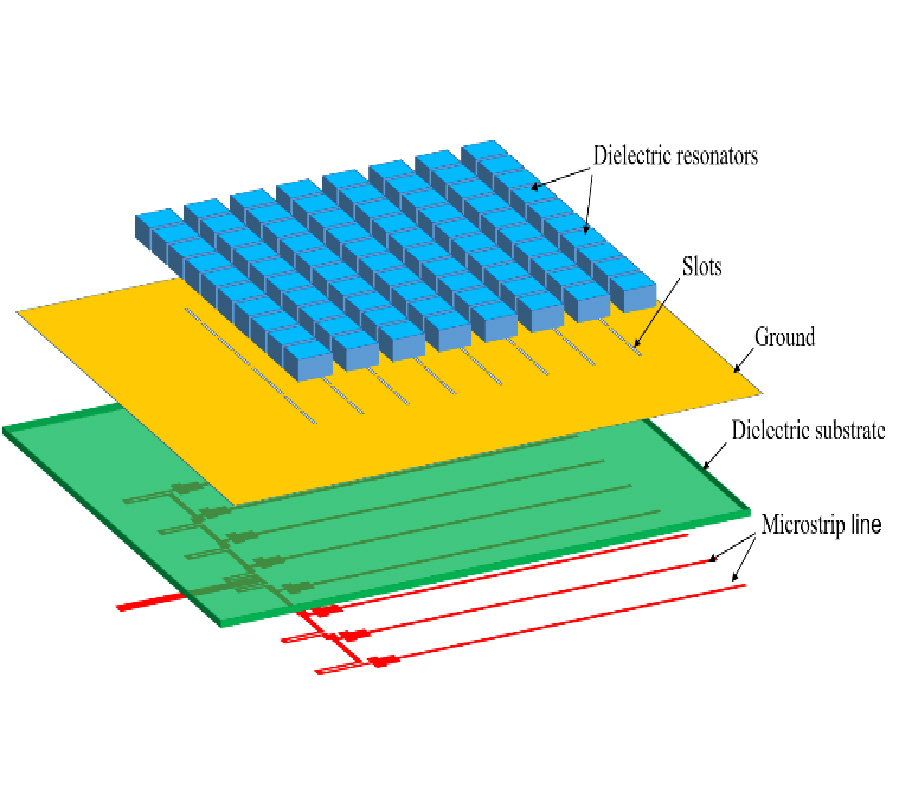
This paper presents the design and investigation of array antennas formed of two narrow rectangular slots. Two approaches for feeding the two slots by microstrip lines are investigated as well as the influence of changing the distance between the slots on the radiation pattern. The two slots are etched on one side of the substrate, while the feed network is placed on the other side. Two designs, depending on the feeding approach, are presented. In the first design, a simple T-shaped divider is used to feed the two slots, while the second design is based on a single microstrip line which feeds the two slots in series. Two antennas are for the first design, each with dimensions of 57.83 х 41.3 mm2, while those of the second design have dimensions of 83.45 x 36.9 mm2. The four proposed designs have been simulated and optimized using Computer Simulation Technology (CST-MWS) simulation program. Prototypes were fabricated and tested to verify the designs. The four antennas achieved -10 dB impedance bandwidths between 8.6% and 9.4%, while the gain values were between 4.7 dB and 5.7 dB. The comparisons between the fabricated and simulated antennas considered the reflection coefficient and radiation pattern showing good agreement.
ANALYSIS AND DESIGN OF TWO-SLOT ANTENNAS FOR WIRELESS COMMUNICATION APPLICATIONS
2020-08-03
PIER C
Vol. 104, 99-113
Reduction of Cogging Torque and Improvement of Electrical Parameters in Axial Flux Permanent Magnet (AFPM) Synchronous Generator with Experimental Verification
Engin Hüner and Gökhan Zeka
This paper presents an axial flux permanent magnet (AFPM) synchronous generator that was manufactured for the reduction of cogging torque by considering the different angles of a rectangle-shaped permanent magnet (RSPM). The placement angle of RSPM was changed from 0 to 28 degrees to obtain total harmonic distortion, line voltage, and cogging torque. A numerical finite element model using Maxwell software was created. The model was validated by the experimental results, with and without a load. The optimum placement angle was obtained at 20 degrees, whose total harmonic distortion (Thd) and cogging torque (Tc) were improved by 41.6% and 71.4%, respectively.
REDUCTION OF COGGING TORQUE AND IMPROVEMENT OF ELECTRICAL PARAMETERS IN AXIAL FLUX PERMANENT MAGNET (AFPM) SYNCHRONOUS GENERATOR WITH EXPERIMENTAL VERIFICATION
2020-08-02
PIER M
Vol. 94, 209-219
Dielectric-Insensitive Phased Array with Improved Characteristics for 5G Mobile Handsets
Naser Ojaroudi Parchin , Haleh Jahanbakhsh Basherlou and Raed A. Abd-Alhameed
In this manuscript, a high-performance beam-steerable phased array antenna is introduced for fifth-generation (5G) mobile handsets. The configuration of the design is arranged by employing eight dielectric-insensitive L-ring/slot-loop radiators in a linear form on the top edge of the handset mainboard. The beam-steerable array design exhibits high radiation performances even though it is implemented on a lossy FR-4 material. The proposed design exhibits an impedance bandwidth of 18-20 GHz with the center frequency of 19 GHz. It provides satisfactory characteristics such as wide beam-steering, high gain and efficiency characteristics indicating its promising potential for beam-steerable 5G smartphones. The characteristics of the antenna array are insensitive for different types of dielectrics. Furthermore, the designed antenna array offers quite good radiation behavior in the presence of hand phantom.
DIELECTRIC-INSENSITIVE PHASED ARRAY WITH IMPROVED CHARACTERISTICS FOR 5G MOBILE HANDSETS
2020-08-01
PIER M
Vol. 94, 201-208
A Contactless System for the Dielectric Characterization of Liquid Drops
Gabriel Galindo-Romera , Javier Carnerero-Cano , José Juan Martínez-Martínez , Alejandro Rivera-Lavado and Francisco Javier Herraiz-Martínez
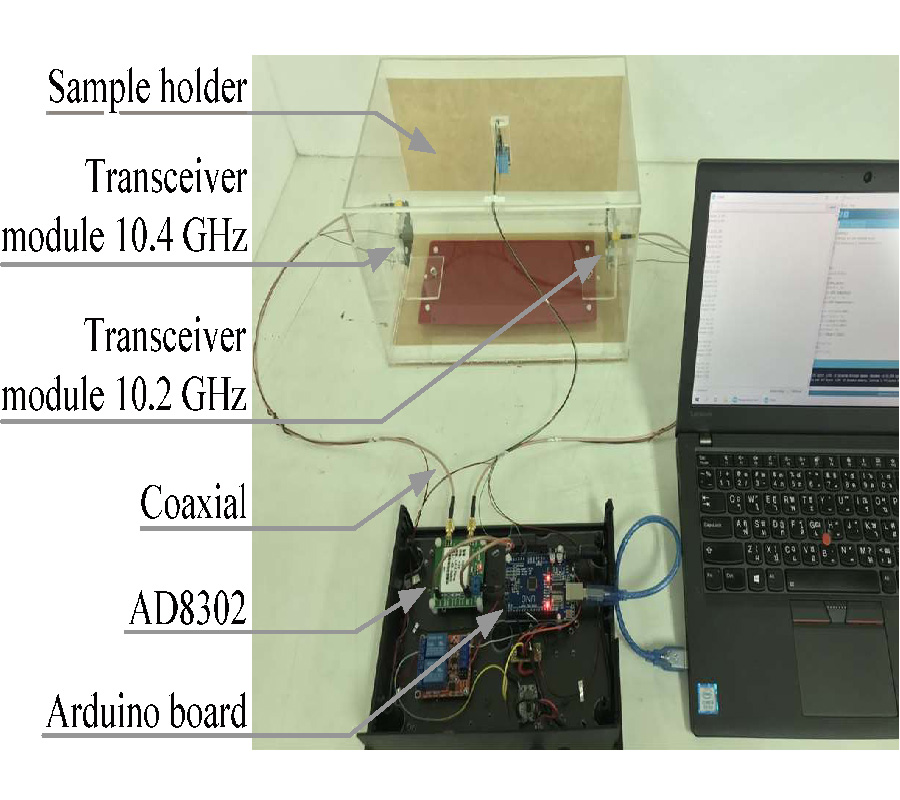
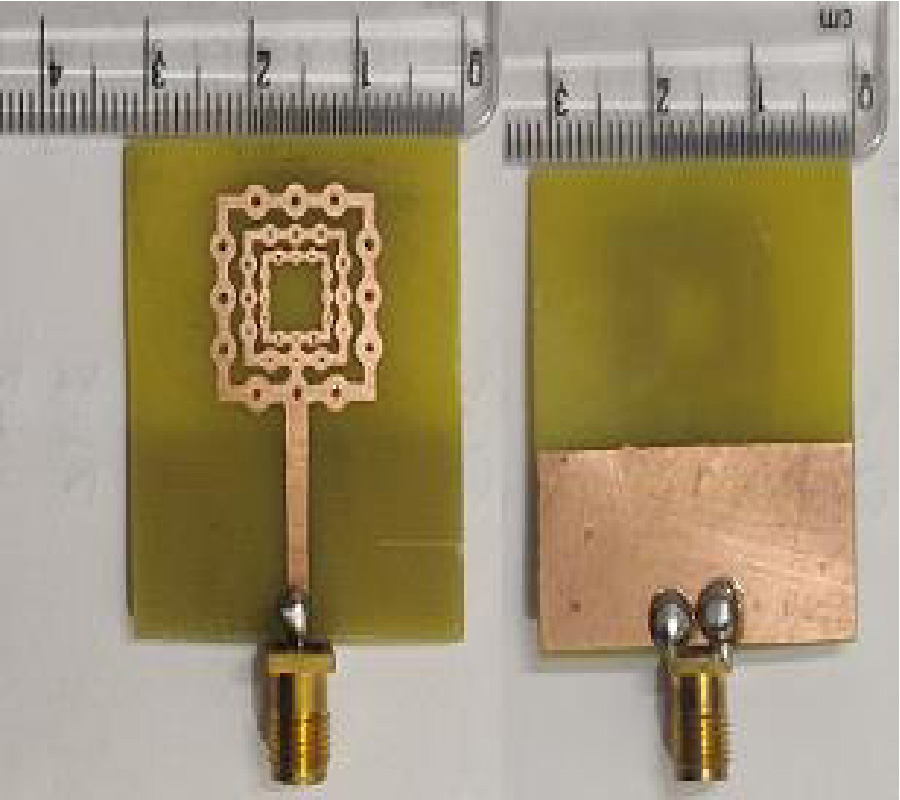
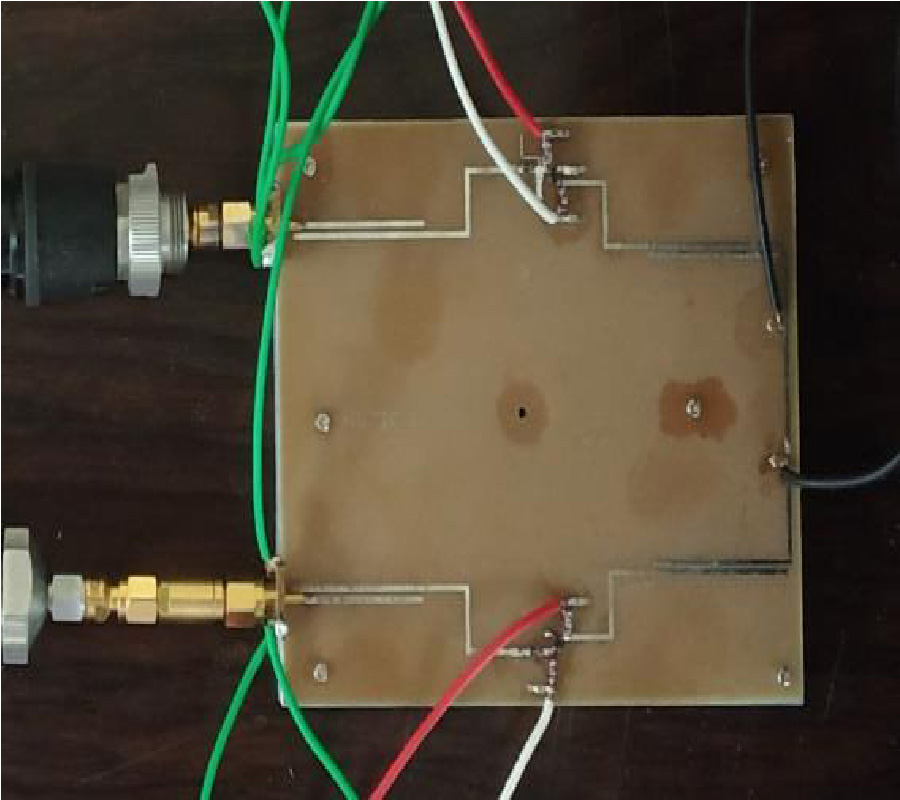
The present article shows the design, implementation, and measurement of a compact contactless electronic system for sensing small volumes of liquids. The system is based on two elements: an electronic reader and a passive sensor. The proposed sensor consists of a printed monopole antenna loaded with two Split-Ring Resonators. This results in a fully-passive and single-layer low-cost design. To allow the sensing of small volumes of liquids, a 1-mm-thick adhesive Kapton layer was attached on the top layer of the sensor, and two drop tanks were added to the structure. On the other hand, the reader was designed following a layered approach, which allows us to develop compact and low-cost electronic sensor readers for the Internet of Things. The resulting reader contains a Radio-Frequency interface for the generation of detection of signals, a minicomputer, and the radiating interface. This interface includes a patch antenna that allows us to interrogate the contactless sensor within a 1-cm range. The whole system was manufactured and tested. The total dimensions of the reader are 15 cm × 15 cm, and its weight is below 1 kg. These imply a dramatic form factor and weight reductions with respect to previous readers. Moreover, the manufactured system was used to measure the dielectric permittivity of different liquid drops. Results show that only 4 ml of liquid were needed to determine the dielectric permittivity with a 0.27% error. This volume means a 98.4% reduction compared to submersible sensors which can be found in the literature.
A CONTACTLESS SYSTEM FOR THE DIELECTRIC CHARACTERIZATION OF LIQUID DROPS
2020-07-30
PIER C
Vol. 104, 85-97
Impact of Users' Finger on the Amount and Direction of Radiated Power from a 28 GHz 4-Element MIMO Antenna Mobile Terminal
Ahmed Mohamed Elshirkasi , Azremi Abdullah Al-Hadi , Ping Jack Soh , Mohd Fais Mansor , Rizwan Khan and Prayoot Akkaraekthalin
This paper investigates the effect of index finger position and distance on the radiated power of 4-element MIMO antenna, operating at 28 GHz. The antenna elements (AEs) are located at the top corner of the user terminal and separated at a distance of half a wavelength. Four different finger placements were investigated, one placement over each AE with six interaction distances between the AEs and the finger at each position starting from 0 up to 2.5 mm. When the finger is placed on an edge AE, the other edge AE maintained above 85 % of its free space radiated power irrespective of the interaction distance. However, the radiated power of each AE was severely affected when the finger was placed on it or on the AE adjacent to it. This effect ranged from total blockage at direct interaction with the element (with a distance of 0 mm) to maintaining more than around 60 % of free space radiated power after the interaction distance is increased to more than 2.0 mm. Besides the effects of the index finger on the amount of radiated power, this work also investigated the direction of radiated power resulting from the influence of this finger.
IMPACT OF USERS' FINGER ON THE AMOUNT AND DIRECTION OF RADIATED POWER FROM A 28 GHZ 4-ELEMENT MIMO ANTENNA MOBILE TERMINAL
2020-07-29
PIER M
Vol. 95, 1-12
Slotted Spherical Antenna with a Multi-Element Diaphragm in the Waveguide
Sergey L. Berdnik , Victor A. Katrich , Victor I. Kijko , Mikhail Nesterenko and Yuriy M. Penkin
A problem of electromagnetic wave radiation by narrow slots cut in an end wall of a semi-infinite waveguide section into space above a perfectly conducting sphere is solved in a strict self-consistent formulation by the generalized method of induced magnetomotive forces (MMF). Inside the waveguide section, a reentrant cavity formed by the volume between a slotted diaphragm and the waveguide end wall is located. The waveguide is operating in the frequency range of a single-mode regime. The electrodynamic characteristics of this radiating system with the spherical screen of resonant dimensions are investigated numerically and ex-perimentally. The possibility to develop the spherical antennas with a narrow-band frequency, energy, and spatial characteristics is substantiated.
SLOTTED SPHERICAL ANTENNA WITH A MULTI-ELEMENT DIAPHRAGM IN THE WAVEGUIDE
2020-07-28
PIER Letters
Vol. 92, 139-145
Wideband and Highly-Integrated Dual-Mode LTCC Filter Using Vertically Stacked Double-Ring Resonator
Liangfan Zhu
A wideband dual-mode band-pass filter (BPF) is proposed and implemented using a vertically stacked double-ring resonator (VSDR) and a pair of broadside-coupled input/output (I/O) feeding lines based on a 4-layer low temperature cofired ceramic (LTCC) substrate. The proposed BPF is required to cover the fifth generation (5G) N77/N78/N79 band (3.3-5 GHz), thus achieves a fractional bandwidth (FBW) of 40%. Furthermore, the proposed structure not only possesses a non-orthogonal I/O feeding style for convenient interconnection with neighboring devices, but also removes disturbing element for simpler layout. Comparison and discussion are implemented as well.
WIDEBAND AND HIGHLY-INTEGRATED DUAL-MODE LTCC FILTER USING VERTICALLY STACKED DOUBLE-RING RESONATOR
2020-07-27
PIER M
Vol. 94, 189-199
Printed GNSS and Bluetooth Antennas Embedded on Flexible Low Loss Substrates for Wearable Applications
Omodara Gbotemi , Sami Myllymäki , Heli Jantunen , Jari Juuti , Sami Ihme , Marika Kurkinen , Ville Majava , Marko Tuhkala and Juhani Kemppainen
This paper presents Global Navigation Satellite System (GNSS) F-type and Bluetooth (BT) L-shaped antennas printed on flexible low loss substrate materials for smartwatch applications. The proposed printed antennas were designed along with the wristband of a smartwatch device with the main purpose of improving their electrical performance by using a new low loss polymer material and locating the antenna on the wrist strap. The antenna performances were simulated using CST Microwave Studio, and the prototypes were measured in a Satimo StarLab anechoic chamber. Silver printing and injection molding technologies were successfully utilized for fabricating new SEBS materials (styrene-ethylene-butylene-styrene) in wearable devices. The SEBS materials improved the radiation efficiency of the antennas by 1.6 dB for the GNSS and 2.2 dB for the BT over the previously used TPU (thermoplastic polyurethane) materials. The overmolded printed and hybrid integrated discrete antennas produced added-value for electronics fabrication thanks to its flexible and seamless integration technique. In addition, it is a low-cost mass manufacturing method. The research opens new perspectives for product definitions with a flexible, low loss material that enables better antenna performance.
PRINTED GNSS AND BLUETOOTH ANTENNAS EMBEDDED ON FLEXIBLE LOW LOSS SUBSTRATES FOR WEARABLE APPLICATIONS
2020-07-27
PIER M
Vol. 94, 179-187
Low-Cost Comb-Line-Fed Microstrip Antenna Arrays with Low Sidelobe Level for 77 GHz Automotive Radar Applications
Soheil Yasini , Karim Mohammadpour-Aghdam and Mahmoud Mohammad-Taheri
In this paper, we design and fabricate a side lobe comb-line fed microstrip antenna array at the frequency of 77 GHz. This antenna can be used in car and also in peripheral protection radars. To design the antenna, a radiating microstrip element on a simple sublayer is first designed and optimized in order to have desirable specification at 77 GHz. Secondly, a one-dimensional array is formed using a row of microstrip antenna array with 32 serried elements. Finally, a two-dimensional antenna array with 16 rows is fabricated and subsequently fed with a waveguide to complete the antenna design.
LOW-COST COMB-LINE-FED MICROSTRIP ANTENNA ARRAYS WITH LOW SIDELOBE LEVEL FOR 77 GHZ AUTOMOTIVE RADAR APPLICATIONS
2020-07-27
PIER Letters
Vol. 92, 133-138
Addition of Interdigital Capacitor to Reduce Crosstalk Between Non-Parallel Microstrip Lines
Yafei Wang , Chang Ma , Wei Yang and Xuehua Li
Non-parallel microstrip lines are a layout often used in high-speed interconnections. This study initiates crosstalk reduction by interdigital capacitor for the non-parallel microstrip lines. This method reduces the far-end crosstalk by adding capacitive coupling to cancel inductive coupling after an interdigital capacitor is added at the near end of the non-parallel microstrip lines. Software simulation and actual measurement results show that the proposed method can effectively reduce the far-end crosstalk in non-parallel microstrip lines. The method is also easy to implement and in low cost.
ADDITION OF INTERDIGITAL CAPACITOR TO REDUCE CROSSTALK BETWEEN NON-PARALLEL MICROSTRIP LINES
2020-07-25
PIER B
Vol. 87, 131-149
Measurement of the Antenna Impedance Mismatch through the Time Domain Mode of the Vector Network Analyzers: an Experimental Procedure
Angelo Gifuni , Michele Ambrosanio , Gabriele Gradoni , Giuseppe Grassini , Christopher Smartt and Stefano Perna
In this paper we show a procedure to measure the impedance mismatch of antennas by exploiting the Time Domain (TD) option available in usual VNAs. The procedure can be applied even in the presence of reflecting obstacles in the measurement scenario surrounding the antenna under test (AUT). It is shown that effective application of the procedure requires to fulfill a reduced number of constraints basically involving the distance of the AUT from the nearest obstacle, the response resolution to be set through the TD option of the VNA, and the length of the gating aperture to be applied to the received signal. The proposed measurement procedure is in principle applicable to any antenna. However, it is very easy and advantageous for antennas having short responses in the time domain, such as horn antennas, where the method can likely be applied to frequencies less than 500 MHz. Comparison between the results obtained from measurements performed inside an anechoic chamber (that is, in the absence of reflecting obstacles around the AUT), outside the anechoic chamber, and even inside a reverberation chamber, demonstrate the effectiveness of the proposed measurement procedure.
MEASUREMENT OF THE ANTENNA IMPEDANCE MISMATCH THROUGH THE TIME DOMAIN MODE OF THE VECTOR NETWORK ANALYZERS: AN EXPERIMENTAL PROCEDURE
2020-07-24
PIER C
Vol. 104, 69-84
Transient Response of Microstrip Patch Antenna Loaded on a Vehicle Platform Illuminated by Electromagnetic Pulse
Xiao Hu , Yang Qiu , Qinglin Xu and Jin Tian
This paper presents an efficient hybrid method consisting of nonuniform mesh finite-difference-time-domain (FDTD) method, thin wire model, and transmission line (TL) equations method, which is utilized to analyze transient responses of the microstrip patch antenna loaded on a vehicle platform illuminated by a high-power electromagnetic pulse (EMP). This hybrid method avoids over-fine mesh generation, thereby improving the computational efficiency and saving the computational memory. The accuracy and efficiency of this method are verified by comparing with the simulation results of traditional FDTD and computer simulation technology microwave studio (CST MWS). Then, considering the influence of the incident conditions of EMP and the support structure of antenna on the coupling effects of the antenna, the coupling responses of the 1.575 GHz microstrip antenna are discussed in terms of incident angles of EMP, heights of the support structure, top areas of the support structure, and different positions of the support structure on the platform. The obtained changing regularity of the transient responses is useful for further designing the installation structure of the antenna and electromagnetic protection against the external EMP.
TRANSIENT RESPONSE OF MICROSTRIP PATCH ANTENNA LOADED ON A VEHICLE PLATFORM ILLUMINATED BY ELECTROMAGNETIC PULSE
2020-07-23
PIER M
Vol. 94, 167-177
A Novel Compact Electromagnetic Band Gap Structure to Reduce the Mutual Coupling in Multilayer MIMO Antenna
Kompella S. L. Parvathi , Sudha R. Gupta and Pramod P. Bhavarthe
This paper presents a novel compact multilayer meander strip line step-via electromagnetic band-gap (MLSV-EBG) structure with the application of mutual coupling reduction in a multilayer multiple input multiple output (MIMO) antenna. The proposed EBG-cell has been developed by using multilayer, novel meander strip line, and step-via concept. To analyse the proposed EBG a parallel LC model method is used. In the proposed MLSV-EBG structure, due to step-via concept, current path length increases, and compactness is achieved per unit cell. Parametric study is also presented. MLSV-EBG structure unit cell is simulated using ANSYS high frequency structure simulator (HFSS), and 5X5 cells are printed on an FR4 substrate for band-gap measurements. Simulated and measured results prove that compared with three-layer central located via EBG (CLV-EBG) and edge located via EBG (ELV-EBG), size reductions of 47.01% and 43.01% have been achieved, respectively, which shows that step via concept gives the significant size reduction per unit multilayer EBG cell. The application of proposed MLSV-EBG for the reduction of mutual coupling between two multilayer MIMO antennas is also demonstrated. The key contribution of the presented work is that the proposed compact multi-layer EBG structure is useful in a multi-layer environment at a lower frequency.
A NOVEL COMPACT ELECTROMAGNETIC BAND GAP STRUCTURE TO REDUCE THE MUTUAL COUPLING IN MULTILAYER MIMO ANTENNA
2020-07-23
PIER C
Vol. 104, 53-67
A Compact Quad Port Band-Notched MIMO Antenna for Wi-MAX Applications with Low Mutual Coupling
Bhakti Vinod Nikam and Maruti R. Jadhav
High data rates and good channel bandwidth are some of the requirements of today's wireless communication systems. The wireless communication systems are now rapidly adopting a Multiple Input Multiple Output i.e MIMO technique due to its advantages such as the data rates and bandwidth. The main focus of this paper is to design a highly isolated MIMO antenna with Wi-MAX bandwidth. This MIMO antenna design is prepared with four pentagonal slotted monopole antennas with a parasitic element structure operating in the band of 5.1 to 5.8 GHz which offers isolation more than 28 dB. Rectangular slots are used for each radiating patch for a band-notched frequency at 5.5 GHz frequency relative to the Wi-MAX frequency band. To improve the isolation of the antenna, on the surface of the dielectric substrate, a single plus-shaped parasitic structure is uniformly inserted between the antenna elements. The result obtained from the fabricated antenna is at an acceptable range with that of the simulated for the Wi-MAX band applications.
A COMPACT QUAD PORT BAND-NOTCHED MIMO ANTENNA FOR WI-MAX APPLICATIONS WITH LOW MUTUAL COUPLING
2020-07-23
PIER C
Vol. 104, 37-52
Design of Airborne Radome Using Novel Temperature Dependent Electromagnetic Modeling
Aparna Parameswaran and Hrishikesh Sonalikar
In this paper, a novel temperature dependent electromagnetic modeling for the design of airborne radome is presented. A smooth spatial temperature distribution on the radome surface is modeled using a piecewise cubic hermite interpolating polynomial as well as piecewise linear interpolation. The temperature gradient across the radome wall is modeled using the inhomogeneous planar layer. The performance of a radome is computed using the 3D ray tracing method in conjunction with aperture integration. A unique radome wall configuration is obtained for each ray for accurate representation of a hot radome. A streamlined radome designed using the proposed model shows a significant performance improvement over the radome designed at the average temperature. The designed radome has the minimum insertion loss of 0.015 dB and the maximum boresight error of 1.8 mrad. The proposed method can be easily used with the experimentally obtained temperature distribution to predict the changes in radome performance in changing hypersonic environment.
DESIGN OF AIRBORNE RADOME USING NOVEL TEMPERATURE DEPENDENT ELECTROMAGNETIC MODELING