Search Results(13790)

2020-06-27
PIER M
Vol. 93, 175-184
GPR Data Regression and Clustering by the Fuzzy Support Vector Machine and Regression
Shahram Hosseinzadeh and Mehdi Shaghaghi
In this paper, the problem of determining the depth and radius of a circular pipe along with the soil characteristics is studied, using electromagnetic waves with a fuzzy support vector machine as well as a fuzzy support vector machine. To this end, three neural network based fuzzy support vectors are used to determine the soil, depth and dimensions. Also, using the 2D time domain numerical simulations of electromagnetic field scattering, along with MATLAB software, 1030 data are generated for training as well as neural network verification. Given the fact that for each of the three parameters the nature of the problem is different, separate neural networks are considered with different parameters, thus the number of different data for the network training is considered. In all three cases, the neural network parameters are optimized using genetic algorithm to reduce the error and also reduce the number of support vectors. It should be noted that the objective function of the genetic algorithm consists of two components of the error, as well as the number of membership functions, which can be determined by determining a control parameter. For soil permittivity, the algorithm can accurately predict 93% of permittivities, and it decreases to 89.8 for the pipe depth determination. For diameter it is seen that for 69.3 of the cases the algorithm can correctly classify the pipes.
GPR DATA REGRESSION AND CLUSTERING BY THE FUZZY SUPPORT VECTOR MACHINE AND REGRESSION
2020-06-27
PIER M
Vol. 93, 165-174
Design of a Directional Antenna Based on a Resonance Based Reflector and Its Applications on Bio-Electromagnetics
Xiao-Feng Li , Yan-Ru Hua , Bao-Jian Wen , Lin Peng and Xing Jiang
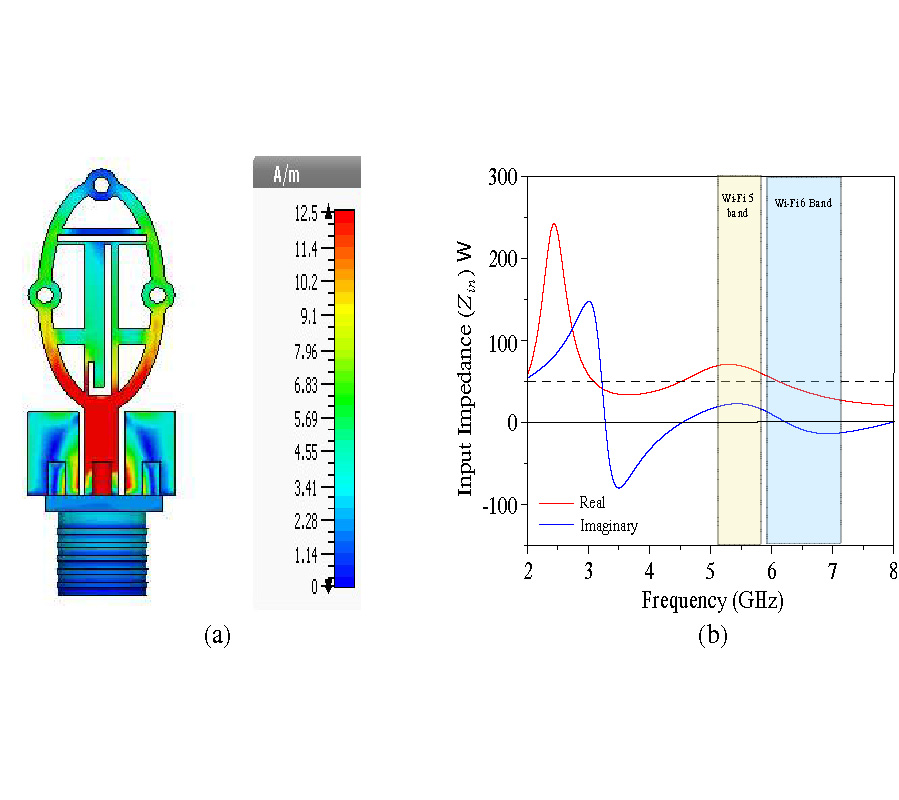
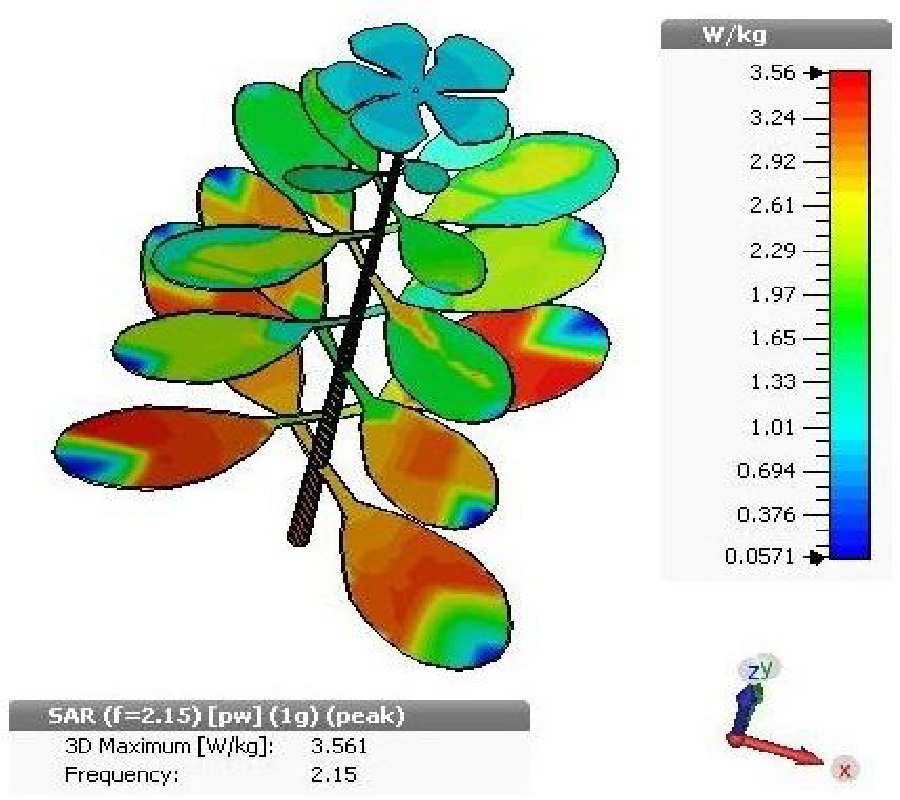
A wideband resonance-based reflector (RBR) is proposed in this paper. It has an in-phase reflection band from 2.61 GHz to 5.59 GHz (72.68%), while high reflection magnitude is also obtained in the band. The proposed RBR was applied to an elliptical monopole antenna, and then, the omnidirectional radiation patterns are transformed to be unidirectional ones. The antenna profile is only 0.12λ. The proposed antenna has a measured impedance band of 2.12 GHz to 6 GHz (95.57%), and a measured front-to-back ratio band (FBR > 10 dB) of 2.2 GHz to 4.68 GHz (72.09%). The maximum FBR is up to 27.21 dB, and the antenna has good radiation performances. In addition, the proposed antenna is applied to investigate the electromagnetic characteristics of a human head. The transmission characteristics of electromagnetic wave in human head and the interactions between the human head and the electromagnetic wave were studied. The field distribution and specific absorption rate (SAR) are also discussed. Research found that the antenna matched well with the human head as good field distribution and propagation characteristics were obtained, and the antenna meets the safety standards.
DESIGN OF A DIRECTIONAL ANTENNA BASED ON A RESONANCE BASED REFLECTOR AND ITS APPLICATIONS ON BIO-ELECTROMAGNETICS
2020-06-24
PIER M
Vol. 93, 155-164
Design and Analysis of a Microstrip Planar UWB Bandpass Filter with Triple Notch Bands for WiMAX, WLAN, and X-Band Satellite Communication Systems
Abdul Basit , Muhammad Irfan Khattak and Mu'ath Alhassan
This manuscript presents a UWB filter with three notch bands for WiMAX, WLAN, and X-Band Satellite Communication by introducing inverted E- and T-shape resonators shorted at the center, designed and fabricated for the use of UWB applications authorized by the US Federal Communications Commission. First, a UWB filter ranges from 2.8 GHz to 10.6 GHz is designed by employing four λ/4 wavelength short-circuited stubs and then couples E- and T-shape resonators on either side of the main transmission line of the proposed UWB filter to achieve notch bands response centered at the resonance frequency of 3.3 GHz for WiMAX applications, 5.1 GHz for WLAN wireless applications, and 8.3 GHz for X-band satellite communication systems, respectively. The proposed filter is able to produce three individually control stopband frequencies centered at 3.3 GHz, 5.1 GHz, and 8.3 GHz with minimum attenuation levels of -28 dB, -19 dB, and -15 dB, respectively. This indicates that the presented filter can efficiently reject superfluous bands at 3.3 GHz in WiMAX system, 5.1 GHz in WLAN system, and 8.3 GHz in satellite communication systems to improve the performance of the UWB communication systems. Finally, the proposed filter with circuit area 34 mm × 12 mm × 0.762 mm between the simulated and fabricated measurements.
DESIGN AND ANALYSIS OF A MICROSTRIP PLANAR UWB BANDPASS FILTER WITH TRIPLE NOTCH BANDS FOR WIMAX, WLAN, AND X-BAND SATELLITE COMMUNICATION SYSTEMS
2020-06-24
PIER Letters
Vol. 92, 75-83
A CPW-Fed Triband Antenna for 2.4/3.5/5.5 GHz Applications
Chandramma Anil Kumar , Binu Paul , Manoj Mani and Pezholil Mohanan
A novel and compact CPW fed triband antenna suitable to support WLAN and WiMAX communications in 2.4/3.5/5.5 GHz bands is reported. The 5.5 GHz band extends from 4.9 to 5.94 GHz. So the proposed antenna can support the use of 4.94-4.99 GHz band allotted for fixed and mobile service (except aeronautical mobile service) for use in support of public safety and 5.85-5.925 GHz band for Dedicated Short-Range Communications (DSRC) services in the Intelligent Transportation System (ITS) radio service. Metallic radiating stub extending from the feed is used to excite the resonance at 2.4 GHz. An open slot in the stub and a pair of open slots in ground plane are used to excite the other resonances. An arc shaped parasitic element is also included in the design for improved radiation performance. The proposed antenna geometry is developed on FR4 glass epoxy substrate with relative permittivity 3.8 and loss tangent 0.02. The geometry is developed and optimized using High Frequency Structure Simulator and experimentally validated the results. Performance comparison of the proposed antenna with similar antennas in literature is presented. Measured radiation patterns and gain are also included in this paper.
A CPW-FED TRIBAND ANTENNA FOR 2.4/3.5/5.5 GHZ APPLICATIONS
2020-06-24
PIER C
Vol. 103, 1-15
Analytical Solution of the Zero-Thickness Perfectly-Conducting Circular Disk in the Presence of an Axisymmetric Magnetic Dipole: A Second-Kind Fredholm Integral-Equation Approach
Luigi Verolino , Giampiero Lovat , Dario Assante , Amedeo Andreotti , Rodolfo Araneo , Paolo Burghignoli and Salvatore Celozzi
The problem of radiation of a magnetic dipole axially symmetric with an infinitesimally thin perfectly conducting circular disk is solved in an exact closed form. This is done by transforming the original dual integral equation system describing the problem into a single second-kind Fredholm integral equation and searching for the solution as a power series. Both low- and high-frequency asymptotic limits are also discussed from which simple approximate solutions are readily derived. Numerical results are provided to validate the proposed formulation.
ANALYTICAL SOLUTION OF THE ZERO-THICKNESS PERFECTLY-CONDUCTING CIRCULAR DISK IN THE PRESENCE OF AN AXISYMMETRIC MAGNETIC DIPOLE: A SECOND-KIND FREDHOLM INTEGRAL-EQUATION APPROACH
2020-06-23
PIER C
Vol. 103, 111-121
Design of Compact Dual Circularly Polarized Concentric Ring Series-Fed Quasi-Lumped Antenna Array
Yazeed Mohammad A. Qasaymeh , Abdullah Almuhaisen and Khaled Issa
A differentially compact dual circularly polarized (CP) concentric ring traveling wave-fed quasi-lumped resonator (QLR) array working at 5.8 GHz is presented. The array consists of seven series QLRs, each with an interdigital finger capacitor, connected by a parallel narrow-strip inductor. The CP was obtained by organizing the radiating QLR over a concentric ring-fed microstrip. The QLR was fed with a current of the same magnitude and some phase delay at each element. The dual-port feeding permitted the selection of the traveling wave direction and, consequently, the mode of CP. The measured bandwidth was 5.76-5.8 GHz at port 1. Meanwhile, the bandwidth was 5.75-5.77 GHz at port 2. The measured peak gain was 5.9 dBi at port 1 and 6.4 dBi at port 2. The cross-polarization was 19 dB lower than the co-polarization at port 1, which is a characteristic of right-hand circular polarization (RHCP). The cross-polarization was 14 dB higher than the co-polarization at port 2, which is a characteristic of left-hand circular polarization (LHCP). The size of each radiating element was 5.8 × 5.6 mm2, and the array was 40 × 40 mm2. These features and its compact size make the proposed array antenna a good candidate to be used in wireless systems.
DESIGN OF COMPACT DUAL CIRCULARLY POLARIZED CONCENTRIC RING SERIES-FED QUASI-LUMPED ANTENNA ARRAY
2020-06-22
PIER M
Vol. 93, 145-154
A New Speed Multiplier Coaxial Magnetic Gear
Mohd Firdaus Mohd Ab Halim , Erwan Bin Sulaiman , Raja Nor Firdaus and Azhan Ab. Rahman
Due to certain conditions, electrical motor (EM) that operates at high speed may lead to magnetic saturation, thermal issue and stress to rotor structure. Magnetic gear (MG) designed for speed multiplier enables the prime mover from EM to operate at lower speed while the output gear multiplies the speed by its designated gear ratio at reduced torque. In this paper, a new coaxial magnetic gear is designed for speed multiplier. The role between inner yoke with PM and pole piece is switched. The inner part of magnetic gear is made to be stationary while the pole piece becomes inner rotor. The working principle is presented analytically. It used flux modulation techniques for torque and speed transmission. Torque characteristic and gear efficiency is analysed using finite element, and compared with existing speed multiplier magnetic gear with the same gear ratio of 7/3. Based on the simulation result, the proposed speed multiplier MG offers 16% better torque density and 12% higher gear efficiency at higher speed range. The structure of the inner rotor was also found to be more robust as only pole piece ring together with plastic is rotated instead of yoke with PM.
A NEW SPEED MULTIPLIER COAXIAL MAGNETIC GEAR
2020-06-22
PIER Letters
Vol. 92, 69-74
Compact SICC Dual-Band and UWB Filters Using Multimode Technology
Xiu-Guang Chen , Guo Hui Li , Zhiwei Shi and Shuo Dan Feng
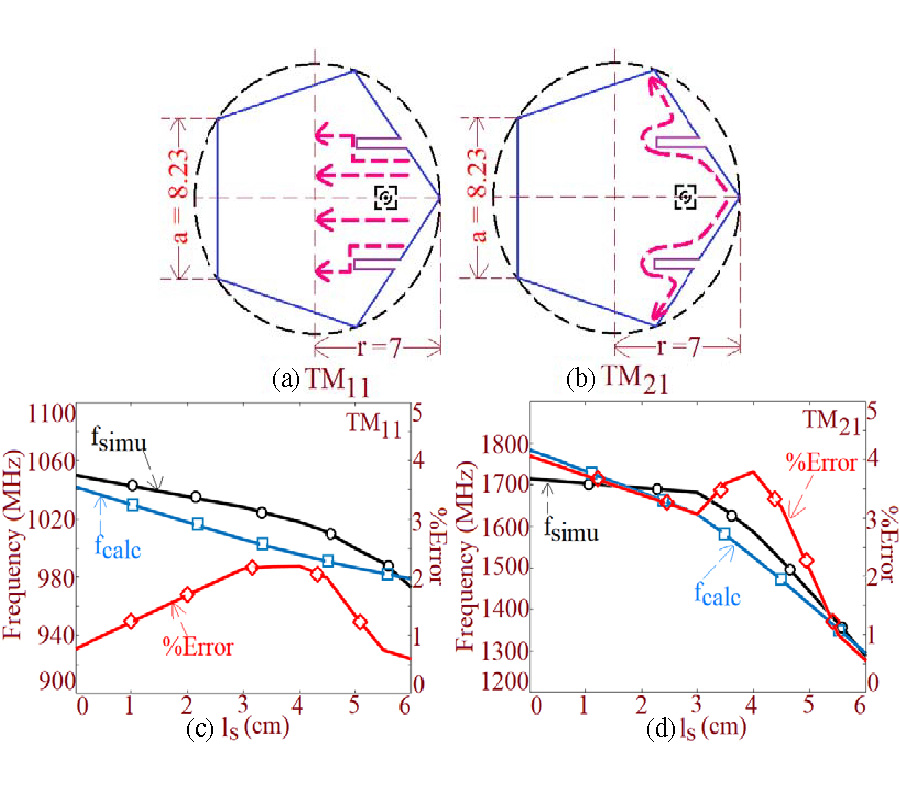
In this paper, a dual-band bandpass filter using sixteenth-mode substrate integrated circular cavity (SM-SICC) and a novel ultra-wideband (UWB) bandpass filter (BPF) using eighth-mode SICC (EM-SICC) cavity are presented. The TM101, TM102, and TM201 resonant modes of the substrate integrated waveguide (SIW) circular cavity are used to design the dual-band filter, where the resonant frequencies can be shifted to the desired frequency through adjusting the position and size of complementary split-ring resonator (CSRR). In addition, the TM101, TM102, TM103, and TM104 resonant modes are employed to realize the UWB filter. A transmission zero appears by introducing the complementary split-ring resonator (CSRR) in the middle of the SICC, so the dual-band BPF and UWB BPF with high selectivity are realized. The proposed filters possess compact size, because of the EMSIW and SMSIW cavity. The dual-band filter operating at 7.79 and 12.83 GHz is fabricated in SM-SICC with 3-dB fractional bandwidths (FBWs) of 7.8% and 31.25%, respectively. The UWB filter with FBW of 97% is simulated in EM-SICC. Compact circuit sizes and excellent measured performances have been achieved for the two filters.
COMPACT SICC DUAL-BAND AND UWB FILTERS USING MULTIMODE TECHNOLOGY
2020-06-22
PIER Letters
Vol. 92, 61-67
Ultra-Compact Bandpass Filter with Super Wide Upper Stopband
Yang Xiong , Wei Zhang and Li Tian Wang
An S-band bandpass filter based on quarter wavelength stepped-impedance resonator (SIR) is presented in this paper. Two SIRs are loaded to the BPF to obtain wide stopband suppression. The center frequency f0 of the bandpass filter is located at 2.105 GHz with 3-dB fraction bandwidth (FBW) of 11.9%. It shows that the spurs free upper stopband with 15 dB rejection level can extend to 40 GHz (19f0). The circuit size of this filter is extremely compact, which occupies only 7.35 mm × 7.5 mm.
ULTRA-COMPACT BANDPASS FILTER WITH SUPER WIDE UPPER STOPBAND
2020-06-22
PIER C
Vol. 103, 97-110
A Novel Liquid Adulteration Sensor Based on a Self Complementary Antenna
Jolly Rajendran , Sreedevi K. Menon and Massimo Donelli
In this paper, a novel OLR loaded self complementary dipole antenna (OSCDA) is proposed. Open loop resonators (OLRs) are introduced into the design of a traditional self complementary dipole antenna (SCDA), to evolve it into OSCDA. The antenna is compact and has an impedance bandwidth of 1.1 GHz to 3.3 GHz with VSWR less than 2 across the frequency band. The use of the proposed antenna as a liquid sensor to detect adulteration in liquids is demonstrated from the relationship between concentration and shift in resonant frequency and variation in reflection coefficient. Variation of reflection coefficient due to change in dielectric properties is studied for different cases viz.: (i) dilution of milk with water, (ii) adulteration of coconut oil with rice bran oil, (iii) adulteration of honey with sugar syrup, and (iv) varying concentration of salt and sugar in water. When an adulterant is added to a liquid or concentration of solute in a solution varied, the dielectric properties change. This is reflected in the variation in reflection coefficient and resonant frequency. Experimental results show that the antenna has a good sensitivity to detect adulterated samples.
A NOVEL LIQUID ADULTERATION SENSOR BASED ON A SELF COMPLEMENTARY ANTENNA
2020-06-21
PIER C
Vol. 103, 83-95
Fields of an Ultra-Relativistic Beam of Charged Particles Between Parallel Plates. Exact Two-Dimensional Solutions by the Method of Images and Applications to the HL-LHC
Boris Levchenko
Exact two-dimensional (2D) analytic expressions for electric and magnetic fields and their potentials created by a linear beam of relativistic charged particles between infinite perfectly conductive plates and ferromagnetic poles are derived. The solutions are obtained by summing an infinite sequence of fields from linear charge-images and current-images in complex space. Knowledge of the normal component of the electric field on the conductor surface makes it possible to calculate the induced electric charge surface density. In addition, we derive within an improved linear approximation new analytical expressions for fields near the beam in the case of an arbitrary beam offset from the median plane. The mathematical features of exact solutions and limitations for the applicability of linear approximations are specified. The primary goals of the future high-luminosity p-p and heavy-ion Large Hadron Collider programme after the Long Shutdown 2 are the search for yet unobserved effects of physics beyond the Standard Model, searches for rare or low-sensitivity processes in the Higgs sector, and probing in more detail the mechanism of electroweak symmetry breaking. This programme relies on the stable operation of the accelerator. However, as the beam luminosity increases, a number of destabilizing phenomena occur, in particular field emission, enhancing the electron cloud effect. For the case of a proton beam, we apply the exact 2D solution for estimating the intensity of electron field emission activated by the electric field of the beam in collimators of the future high-luminosity Large Hadron Collider. Calculation shows that the field emission intensity is very sensitive to a collimator surface roughness. In addition, with a relatively small and accidental beam displacement from the median path, about 20% of the collimator half-gap, the emission intensity increases by a factor of 107. This will partially neutralize the beam space charge, violating acceleration dynamics and enhancing instability effects.
FIELDS OF AN  ULTRA-RELATIVISTIC BEAM OF CHARGED PARTICLES  BETWEEN PARALLEL PLATES. EXACT TWO-DIMENSIONAL SOLUTIONS BY THE METHOD OF IMAGES AND APPLICATIONS TO THE HL-LHC
2020-06-19
PIER C
Vol. 103, 71-82
Improving Bandwidth, Gain and Aperture Efficiency of Patch Antenna Using Hybrid AMC Ground Plane
Jean de Dieu Ntawangaheza , Liguo Sun , Yongjie Li and Zipeng Xie
This paper proposes a new method to enhance the impedance bandwidth (IBW), broadside gain, front-to-back ratio, and aperture efficiency of a rectangular microstrip patch antenna (RMPA) printed on a compact artificial magnetic conductor ground plane (AMC-GND). The technique uses large shorted unit cells at the center and a wide slot cut on the unit cells located under the patch to respectively impede the propagation of surface currents and reduce the adverse effect of the loading capacitance that is formed between the RMPA and the AMC-GND on the antenna IBW. The proposed antenna with dimensions of only 1λ0×0.6λ0×0.06λ0, realizes an IBW of 24% (6.07-7.73 GHz), peak gain of 9.93 dBi, and a simulated aperture efficiency of more than 96%. Due to its compact size, good radiation, and wide IBW performances, the presented antenna can be used in various applications, such as MIMO antenna system, wide-angle scanning antenna array and reflector feed antennas operating in satellite C-band 5.9-6.4 GHz and 6.425-6.75 GHz. It is worth mentioning that the main contribution of the current work is the investigation of the detrimental effects of the overlay capacitor on the IBW of a linearly polarized RMPA etched on a compact AMC surface using a simple equivalent circuit model.
IMPROVING BANDWIDTH, GAIN AND APERTURE EFFICIENCY OF PATCH ANTENNA USING HYBRID AMC GROUND PLANE
2020-06-18
PIER M
Vol. 93, 137-144
Contribution to the Experimental Characterization of the Electromagnetic Properties of HTS
Yazid Statra , Hocine Menana and Bruno Douine
This work is a contribution to the characterization of the electromagnetic properties of high temperature superconductors (HTS) made of Bismuth Strontium Calcium Copper Oxides (BSCCO). The electromagnetic proprieties (critical current density and self-field AC losses) of a tape and a coil are determined experimentally at different frequencies, and compared to analytical models and finite element simulations for a better analysis of the physical phenomena. As shown in this work, the transition from the element to the system is not straightforward, and the characterization of such a material at the system scale is necessary due to their high sensitivity to the magnetic field. Solutions to some measurement problems are also highlighted.
CONTRIBUTION TO THE EXPERIMENTAL CHARACTERIZATION OF THE ELECTROMAGNETIC PROPERTIES OF HTS
2020-06-18
PIER M
Vol. 93, 127-136
Fast Direction-Finding Algorithm by Partial Spatial Smoothing in Sparse MIMO Radar
Sheng Liu , Feng Qin , Jing Zhao , Weizhi Xiong and Ziqing Yuan
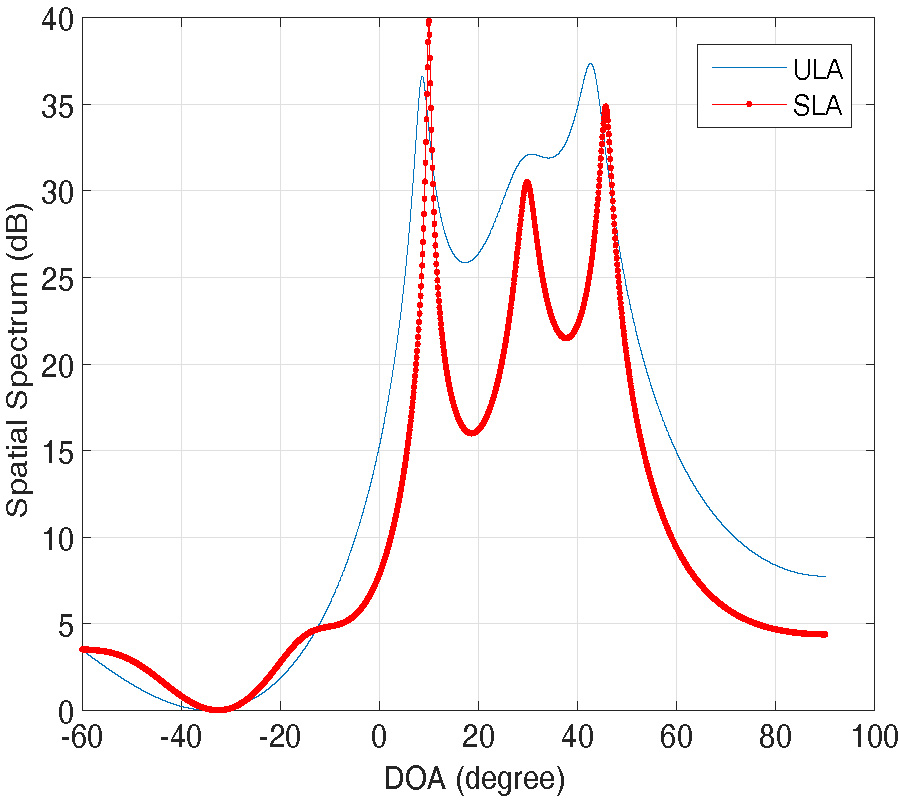
For reducing the computational complexity of direction-finding algorithm in sparse multiple-input multiple-output (MIMO) radar, a low-complexity partial spatial smoothing (PSS) algorithm is presented to estimate the directions of multiple targets. Firstly, by dealing with a partly continuous sampling covariance vector in PSS technology, an incomplete signal subspace can be obtained. Then, a special matrix can be obtained by using this incomplete signal subspace. Meanwhile the incomplete signal subspace can also be repaired by the special matrix. At last, the multiple signal classification (MUSIC) algorithm is used to obtain direction estimations. In the process of obtaining signal subspace, no eigenvalue decomposition (EVD) needs to be performed. Compared with the traditional spatial smoothing (SS) technology, the proposed algorithm has lower computational complexity and higher estimation precision. Many simulation results are provided to support the proposed scheme.
FAST DIRECTION-FINDING ALGORITHM BY PARTIAL SPATIAL SMOOTHING IN SPARSE MIMO RADAR
2020-06-18
PIER C
Vol. 103, 59-70
Dual Band-Notched UWB Antenna with Improved Radiation Pattern
Jun Hui Wang
In this paper, a novel microstrip-fed compact antenna with dual band-notched characteristic is presented for ultra-wideband (UWB) applications. Assisted with symmetrical open-circuited stubs, a UWB impedance matching can be achieved. A novel modified capacitively loaded loop (CLL) resonator is proposed to realize the dual notched bands. By symmetrically placing a couple of proposed resonators in the vicinity of the feed line, dual band-notched properties in 3.4-3.7 GHz for WiMAX and 5.15-5.825 GHz for WLAN are generated. The good performance of the dual notched bands, stable gain, and radiation patterns in the operating bands make the proposed antenna a good candidate for various UWB applications.
DUAL BAND-NOTCHED UWB ANTENNA WITH IMPROVED RADIATION PATTERN
2020-06-17
PIER Letters
Vol. 92, 55-60
A Novel Method for Ship Detection in SAR Images Based on Information Geometric Optimization
Chenchen Yi and Meng Yang
The aim of this letter is to provide a novel method connecting statistical optimization and information geometry for ship detection in synthetic aperture radar (SAR) imagery. The method consists of two steps: initial detection and iterative optimization. For the first stage, the Weibull clutter model is used for initial detection. For the second step, the metric tensor of the Weibull distribution manifold is constructed for iterative optimization. Experiments show that the proposed method is effective in reducing false alarms and obtains a satisfactory detection performance.
A NOVEL METHOD FOR SHIP DETECTION IN SAR IMAGES BASED ON INFORMATION GEOMETRIC OPTIMIZATION
2020-06-17
PIER Letters
Vol. 92, 47-54
High-Power Wideband Elliptical-Grooved Over-Mode Circular Waveguide Polarizer
Gexing Kong , Xianqiang Li , Qingfeng Wang and Jianqiong Zhang
The available polarizers either cannot afford gigawatt-class high-power microwave applications or are large in length. In this letter, a novel grooved polarizer is proposed. The grooves are proposed to be created in an over-mode circular waveguide to improve the power capacity and bandwidth. Moreover, the symmetric elliptical grooves are adopted to suppress high-order modes and realize the desired phase difference. An X-band polarizer prototype is designed and manufactured with length of 91 mm. Simulated results show that the power capacity of the polarizer is more than 1.5 GW. Measured results in accordance with simulations show that the axial ratio is less than 3 dB from 8.6 to 12.2 GHz, with relative bandwidth of 34.6%. The measured return losses are better than -12.7 dB in the same frequency range.
HIGH-POWER WIDEBAND ELLIPTICAL-GROOVED OVER-MODE CIRCULAR WAVEGUIDE POLARIZER
2020-06-17
PIER C
Vol. 103, 45-58
Compact Tri-Band Patch Antenna for Ku Band Applications
Rajeev Kumar , Gurpreet Singh Saini and Daljeet Singh
A compact tri-band antenna is designed and analyzed to achieve both transmission and reception of direct broadcast service (DBS) and fixed satellite service (FSS) in Ku band. The proposed antenna design consists of a truncated E-shaped slot, eight rectangular slots, two C-shaped slots in the patch and eight defected ground structure (DGS) slots. The three frequency bands of 11.40-12.91 GHz, 13.86-14.53 GHz, and 17.20-17.86 GHz are achieved with impedance bandwidths of 12.32%, 4.73%, and 3.77% respectively. Conversely, the measured frequency bands of 11.40-12.98 GHz, 14.21-14.86 GHz, and 17.41-18.98 GHz with the impedance bandwidth of 12.70%, 4.48%, and 8.63% respectively are obtained. The simulated results of the proposed antenna are compared with the results of fabricated antenna and are found to be satisfactory for reflection coefficient, impedance bandwidth, polarization, efficiency, gain, and radiation pattern. Moreover, the proposed antenna design can be used as an element in an array configuration to achieve high gain in both transmission and reception modes of FSS and DBS.
COMPACT TRI-BAND PATCH ANTENNA FOR KU BAND APPLICATIONS
2020-06-16
PIER C
Vol. 103, 31-43
A Reconfigurable All-Textile Wearable UWB Antenna
Antonio Di Natale and Emidio Di Giampaolo
In this work a reconfigurable Ultra Wide Band (UWB) antenna for Wireless Body Area Network (WBAN) is presented. The antenna is completely composed of fabric materials and is able to switch its topology from a monopole-like structure (for on-body communications) to a microstrip-like structure (for off-body communications) maintaining UWB characteristic stable both on body and in free-space. This antenna presents good radiation properties in both configurations. In order to describe its time domain and frequency domain behavior a System Fidelity Factor (SFF) analysis has been done for both topologies.
A RECONFIGURABLE ALL-TEXTILE WEARABLE UWB ANTENNA
2020-06-16
PIER C
Vol. 103, 17-30
Unconditionally Stable Time Stepping Method for Mixed Finite Element Maxwell Solvers
Zane Crawford , Jie Li , Andrew Christlieb and Balasubramaniam Shanker
Time domain finite element methods (TD-FEM) for computing electromagnetic fields are well studied. TD-FEM solution is typically effected using Newmark-Beta methods. One of the challenges of TD-FEM is the presence of a DC null-space that grows with time. This can be overcome by solving Maxwell equations directly. One approach, called time domain mixed finite element method (TD-MFEM), discretizes Maxwell's equations using appropriate spatial basis sets and leapfrog time stepping. Typically, the basis functions used to discretize field quantities have been low order. It is conditionally stable, and there is a strong link between time step size and mesh dependent eigenvalues, much like the Courant-Friedrichs-Lewy (CFL) condition. This implies that the time step sizes can be very small. To overcome this challenge, we use the Newmark-Beta approach. The principal contribution of this work is the development of, and rigorous proof of, unconditional stability for higher order TD-MFEM for different boundary conditions. Further, we analyze nullspaces of the resulting system, and demonstrate stability and convergence. All results are compared against the conditionally stable leapfrog approach.
UNCONDITIONALLY STABLE TIME STEPPING METHOD FOR MIXED FINITE ELEMENT MAXWELL SOLVERS