Search Results(13790)

2020-06-15
PIER Letters
Vol. 92, 39-45
The Deployment of Stub Structures for Mutual Coupling Reduction in MIMO Antenna Applications
Chuanhui Hao , Hongmei Zheng , Jingjing Zhang and Xubao Sun
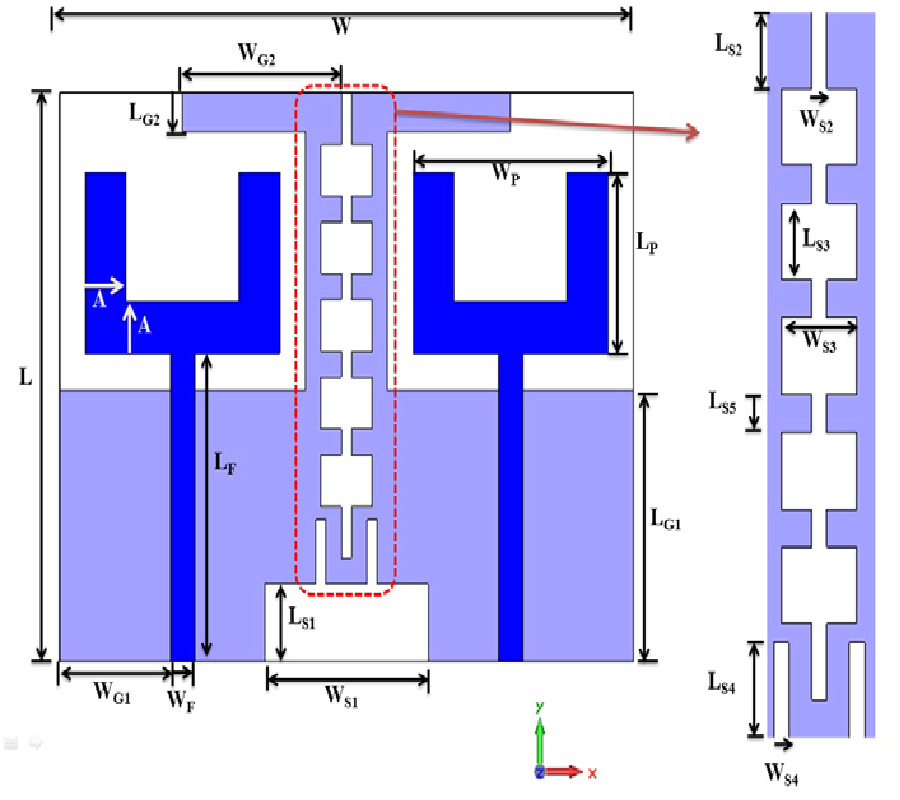
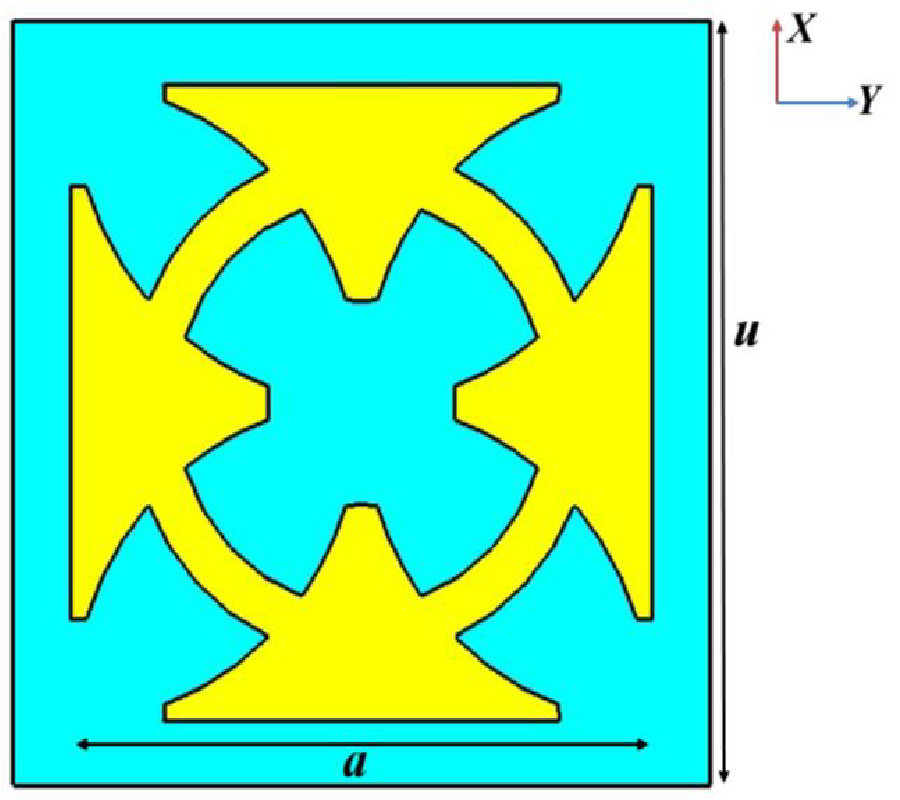
This paper presents a practical scheme for threefold stubs etched on the ground plane (GP) to reduce mutual coupling between adjacent patching elements. The multiple input multiple output (MIMO) antenna array consists of two concentric polyhedron annulus patches, a conventional dielectric substrate, threefold fork-shaped stubs (TFSS) and a microstrip line feeder. The equivalent band-stop filtering function of the TFSS suppressing surface wave propagation has been demonstrated in commercial Advanced Design System (ADS) software. The results of previous case studies indicate that the mutual coupling about 5 dB to 47 dB was reduced from 8 GHz to 9.3 GHz (S11 < -10 dB) for antenna arrays. The capabilities of the antenna (in envelope correlation coefficient = 0.018, voltage standing wave ratio = 1.2892, and diversity gain = 20 dB) have been confirmed in a center frequency of 8.97 GHz. An examination of TFSS antennas shows that the side lobes in both the E-plane and the H-plane descends alongside an increasingly broad radiation pattern. The above results demonstrate that the proposed design is highly efficient in MIMO antenna applications.
THE DEPLOYMENT OF STUB STRUCTURES FOR MUTUAL COUPLING REDUCTION IN MIMO ANTENNA APPLICATIONS
2020-06-14
PIER Letters
Vol. 92, 31-37
Experimental Demonstration of a Multi-Beam Antenna with Full Parameters Based on Inductor-Capacitor Networks
Chengfu Yang , Ming Huang , Haozheng Zhang , Jingjing Yang , Tinghua Li , Peng Li and Fuchun Mao
In this paper, we experimentally demonstrate the performance of a multi-beam antenna based on inductor-capacitor (L-C) transmission line networks. The lumped element parameters of the antenna are derived according to the mapping relations between the Maxwell's equations and L-C network equations. The simulation results are in good agreement with the measurement ones, and the antenna performs well at a wide bandwidth with high directivity. The antenna has potential applications in future communication systems.
EXPERIMENTAL DEMONSTRATION OF A MULTI-BEAM ANTENNA WITH FULL PARAMETERS BASED ON INDUCTOR-CAPACITOR NETWORKS
2020-06-14
PIER C
Vol. 102, 265-281
Axial Ratio Bandwidth Enhancement of Asymmetrically Fed Microstrip Antenna
Kollannore Ukru Sam and Parambil Abdulla
Wide axial ratio bandwidth is imparted by placing rigorously designed radial slits on an asymmetrically fed circular radiating patch antenna with parallel bilateral truncations. A partial ground plane with beveling on both the upper corners and a double stepped notch embedded on it makes the antenna suitable for ultra-wideband and X-band applications. The antenna exhibits a −10 dB impedance bandwidth of 8.6 GHz from 3.4 GHz to 12 GHz (111.6%) and a 3 dB axial ratio bandwidth of 8.7 GHz from 3.3 GHz to 12 GHz (113.7%) thereby contributing an effective operating bandwidth of 8.6 GHz (111.6%). The prototype manifests an exceptional far-field radiation pattern and fair gain throughout the passband.
AXIAL RATIO BANDWIDTH ENHANCEMENT OF ASYMMETRICALLY FED MICROSTRIP ANTENNA
2020-06-12
PIER Letters
Vol. 92, 25-30
Variation of the Shape Parameter of k-Distribution for Sea Clutter with the Spatial Correlation of Sea Surface
Jung-Hoon Park , Dong-Hoon Kim , Dong-Hwan Kim and Sanghoek Kim
In this study, the physical relationship between the shape parameter v of the K-distribution and the spatial correlation of a sea clutter signal received with a radar is demonstrated through simulation results. The spikiness of the sea clutter is well modeled by the shape parameter v of the K-distribution. According to a well-known empirical formula, the shape parameter v changes with the radar resolution based on a constant power-law relation. However, as with most empirical findings, this finding is valid only for the environmental conditions under which the formula was developed. In other words, the existing power-law models for the shape parameter of the K-distribution for sea clutter do not consider the relative ratio of the cross-range resolution Rc to the spatial decorrelation length Rdec of the sea surface. Our study investigates this relation using statistical simulations based on the principle of superposition for backscattered signals that represent sea clutter within a resolved area on the sea surface. This study shows that the constant factor α in the power-law relation must be modified to a function of the ratio Rc/Rdec. The findings of this study will be useful for the evaluation of detection performance in designing radar systems operating in the maritime environment.
VARIATION OF THE SHAPE PARAMETER OF K-DISTRIBUTION FOR SEA CLUTTER WITH THE SPATIAL CORRELATION OF SEA SURFACE
2020-06-10
PIER M
Vol. 93, 119-125
The Upper Bound of the Speed of Propagation of Waves Along a Transmission Line
Vernon Cooray , Gerald Cooray , Farhad Rachidi and Marcos Rubinstein
According to theory, once certain conditions are fulfilled, current and voltage pulses propagate along ideal transmission lines with the speed of light. One can reach such a conclusion only when the conductors are assumed to be perfectly conducting, which cannot be realized in practice. A wave can only propagate along a transmission line with the speed of light if no energy has to be spent in establishing the current in the conductor. However, in establishing a current in a transmission line, energy has to be supplied to the electrons to set them in motion since they have a mass. The energy transfer to the electrons manifests itself in the form of an inductance which is called the kinetic inductance. The effect of the kinetic inductance has to be taken into account in signal propagation along high carrier mobility conductors including super conductors. In the case of transmission lines, the kinetic inductance leads to a change in the characteristic impedance and a reduction in the speed of propagation of waves along the transmission line. The goal of this paper is to show that the kinetic inductance will set an upper bound to the speed of propagation of waves along transmission lines, which is smaller than the speed of light.
THE UPPER BOUND OF THE SPEED OF PROPAGATION OF WAVES ALONG A TRANSMISSION LINE
2020-06-10
PIER M
Vol. 93, 109-118
Perturbative Approach for Fast and Accurate Evaluation of Quasi Axially-Symmetric Cavity Resonance Frequency in Drift Tube Linacs
Giorgio Sebastiano Mauro , Santi Concetto Pavone , Giuseppe Torrisi , Antonio Palmieri , Luigi Celona , Santo Gammino and Gino Sorbello
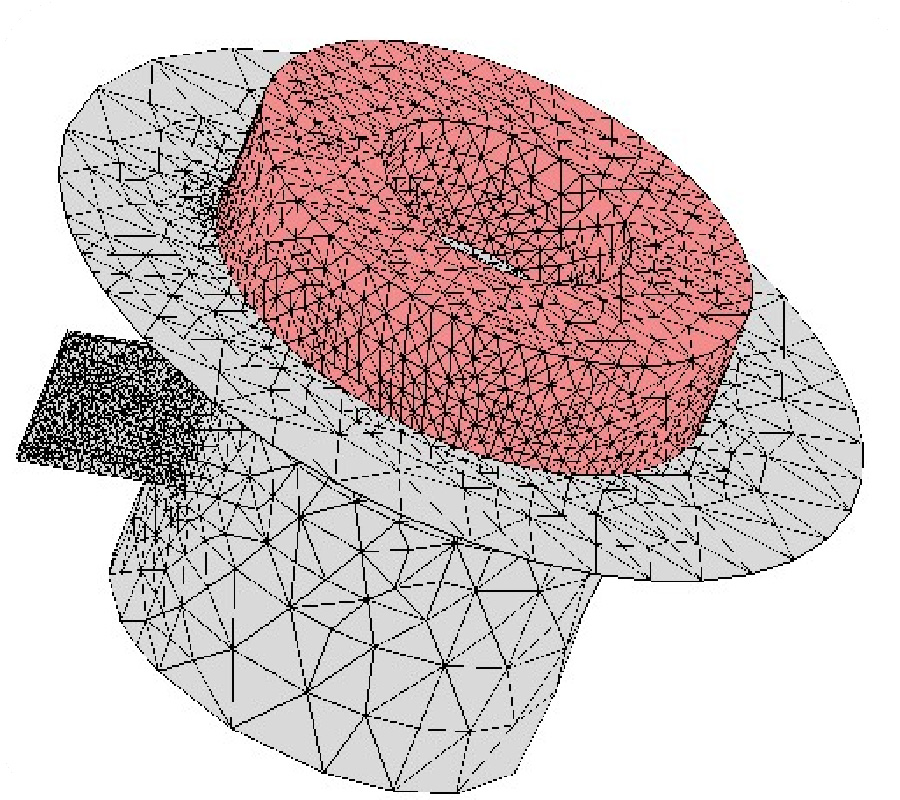
In this paper we present an analytical method, employable with commercial full-wave electromagnetic CADs, which allows full-wave simulations of electromagnetically (EM) large structures, in terms of wavelength, such as linear accelerator cavities (LINACs) and a very accurate estimation of their operating frequency. The proposed technique is based on the exploitation of rotational symmetry through the definition of equivalent axially-symmetric volumes which replaces the non axially-symmetric ones inside the structure being analyzed. After a theoretical study, we show the successful application of the method in the real case study of a Drift Tube Linac (DTL) cell.
PERTURBATIVE APPROACH FOR FAST AND ACCURATE EVALUATION OF QUASI AXIALLY-SYMMETRIC CAVITY RESONANCE FREQUENCY IN DRIFT TUBE LINACS
2020-06-10
PIER M
Vol. 93, 99-108
Design of a Beam Switchtable Superdirective Dipole for IoT Gateway
Sana Souai , Aliou Diallo , Jean-Marc Ribero and Taouifik Aguili
In this paper, a switchable beam and super-directive Electrically Small Antenna (ESA) dipole deployed at an IoT network gateway at 868 MHz is presented. It consists of one fed dipole and one loaded parasitic dipole. The nature and value of the load are obtained using the Uzkov equations, allowing determining current weighting coefficients in the case of two separately fed antennas, in order to maximize the gain and the directivity in a given direction. Reconfigurability in two directions is achieved using a pair of anti-parallel PIN diodes to steer the beam to the desired direction. The array final dimensions are 109 × 43 mm2 (0.3λ × 0.1λ) generating a high directivity of 6.8 dBi in simulation and 6.7 dBi in measurement at 868 MHz for each beam in the azimuth plane.
DESIGN OF A BEAM SWITCHTABLE SUPERDIRECTIVE DIPOLE FOR IOT GATEWAY
2020-06-10
PIER C
Vol. 102, 253-264
Design of an Ultra-Wideband UHF RFID Reader Antenna for Wearable Ankle Tracking Applications
Khodor Jebbawi , Matthieu Egels and Philippe Pannier
In this paper, a broadband reader antenna is designed and manufactured for wearable ankle strap applications. The frequency range covered for S11 < -10 dB is from 850 MHz to 1650 MHz with dipole like radiation pattern in free space. The proposed broadband antenna is manufactured with a semi-flex (Taconic RF-35) and flexible (Kapton) substrates. A good agreement between simulations and measurements has been achieved. Prototypes performances have been tested by measuring the reading distance. The maximum reading distance obtained is about 1.46 m at 865 MHz with an output power of the transmitter (PTX) of 25 dBm. Results of functional RFID test show that the proposed antenna can be used as an RFID reader antenna when it is placed on the ankle of the human body.
DESIGN OF AN ULTRA-WIDEBAND UHF RFID READER ANTENNA FOR WEARABLE ANKLE TRACKING APPLICATIONS
2020-06-10
PIER C
Vol. 102, 241-251
A Computationally Efficient Modified MUSIC Spectrum for Resolving DOAs of Multiple Closely Spaced Non-Gaussian Sources
Chandrasekaran Ashok and Venkateswaran Narasimhan
The objective of this work is to estimate the Direction of Arrival (DOA) of signals from multiple closely spaced non-Gaussian sources corrupted by additive Gaussian noise. Generally, this is achieved by using higher order statistics (HoS) based MUSIC spectrum. In HoS, the Fourth order Cumulant is utilized because of its property of insensitivity to Gaussian process. But in the case of resolving closely spaced sources, a large number of sensor elements are required; otherwise, the resolution gets deteriorated. The large number of sensor elements leads to high computational burden. We propose a computationally efficient modified Spectrum that combines Fourth order Cumulants based MUSIC spectrum and its second-order differential counterparts. The proposed spectrum for DOA estimation offers good statistical performance and better accuracy the existing methods even in the case of extremely closely spaced signal sources. The improvement in the aspects of resolution and accuracy is substantiated by means of various simulation results such as Monte-Carlo simulations, spectral width, resolution with respect to angular separation, and comparison of RMSE with respect to number of array elements, number of snapshots, and SNR. The computational complexity analysis of the proposed method is also presented.
A COMPUTATIONALLY EFFICIENT MODIFIED MUSIC SPECTRUM FOR RESOLVING DOAS OF MULTIPLE CLOSELY SPACED NON-GAUSSIAN SOURCES
2020-06-10
PIER C
Vol. 102, 225-240
Distribution Features of Underwater Static Electric Field Intensity of Warship in Typical Restricted Sea Areas
Cong Chen , Jingxuan Yang , Chuyang Du and Lifeng Si
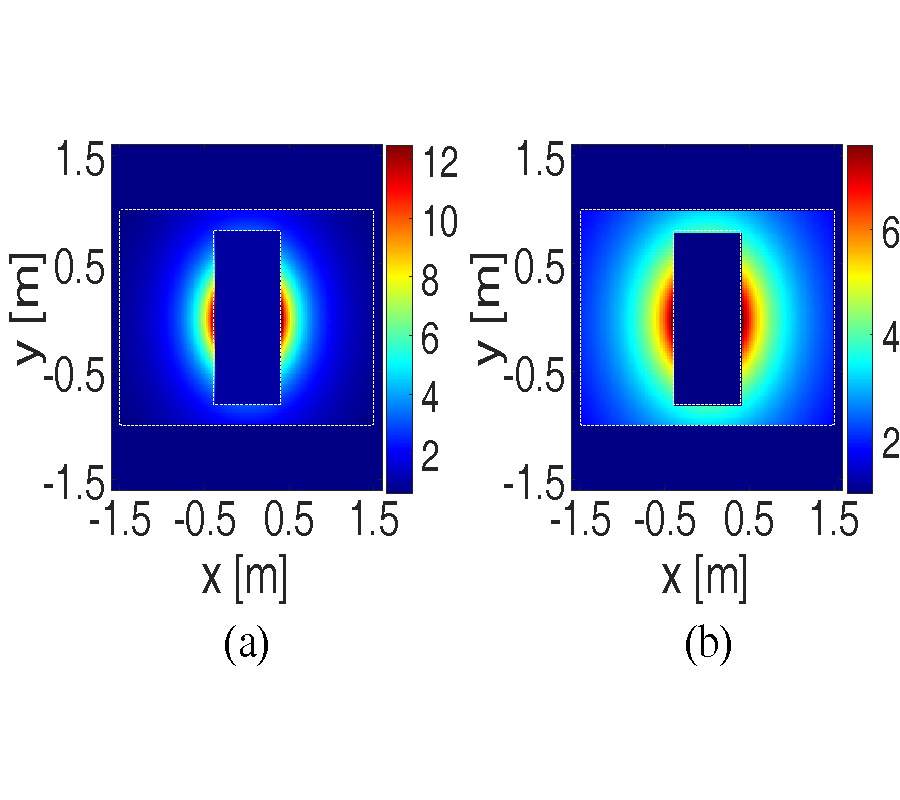
In order to study the distribution feature of the underwater electric field intensity produced by a ship in restricted seawaters, the horizontal DC electric dipole is used as the equivalent field source. Firstly, four kinds of field models are established. Secondly, the expressions of underwater electric field strength produced by a a horizontal DC electric dipole in the sea areas with upright bank is derived based on the mirror theory of static electric field. Then, based on this, the distribution features of the electric field intensity and the influence of the bank on the electric field are studied by numerical simulation. The simulated results show that the main characteristics of field strength distribution in restricted seawaters are consistent with those without bank, but it makes the absolute value of electric strength increased. The field point is closer to the vertical bank, and it generally presents greater influence on the absolute value of electric strength. But the influences of single vertical and parallel banks on the three-component field strength are different. The effect of bank on field intensity distribution in other restricted seawaters can be regarded as a superimposed effects of a series of vertical or parallel banks. Finally, the rectangle marine environment is simulated in laboratory, and the horizontal components of electric field intensity distribution on a certain depth plane under the simulated field source are measured. These theoretical derivation and analytical conclusions of simulation are further confirmed by comparing with the simulated results.
DISTRIBUTION FEATURES OF UNDERWATER STATIC ELECTRIC FIELD INTENSITY OF WARSHIP IN TYPICAL RESTRICTED SEA AREAS
2020-06-09
PIER Letters
Vol. 92, 17-24
Compact LTCC Dual-Mode Filter with Non-Orthogonal Feeding and Harmonics Suppression for 5G Applications
Changkun Li , Li Qian , Ziyang Zhang , Yunheng Wang and Bo Zhou
A dual-mode band-pass filter (BPF) for the fifth generation (5G) N78 band applications is proposed based on a 2-layer low temperature cofired ceramic (LTCC) substrate. The proposed BPF is built with a square resonator and two pairs of open-stubs, which suppressed the 2nd-order and 3rd-order 27 and 21 dB, respectively. The proposed BPF not only achieved a size reduction of 50% compared with a single-mode implementation, but also possessed a non-orthogonal input/output (I/O) feeding style, which presents convenient interconnection and integration with neighboring devices. Moreover, the dual-mode BPF does not need a conventional disturbing element to excite two degenerate modes. Comparison and discussion are carried out as well.
COMPACT LTCC DUAL-MODE FILTER WITH NON-ORTHOGONAL FEEDING AND HARMONICS SUPPRESSION FOR 5G APPLICATIONS
2020-06-09
PIER Letters
Vol. 92, 9-16
Design of a 3-D Tunable Band-Stop Frequency Selective Surface with Wide Tuning Range
Shengli Jia , Bingzheng Xu and Ting Zheng
In this paper, a three-dimensional (3-D) tunable band-stop frequency selective surface (FSS) with wide tuning range is presented. The proposed tunable 3-D FSS consists of a periodic array of an annular resonator loaded with two varactor diodes. By controlling the reverse voltage of the varactor diodes, the resonance frequency could be tuned in a wide frequency range. Full-wave simulation shows 100% tuning range from 3.0 GHz to 6.0 GHz with respect to lower resonance frequency. The simulated results exhibit stable band-stop performance under different incident angles (up to 45˚). By cascaded two 3-D tunable FSSs, the bandwidth and selectivity performance could be further enhanced. The proposed 3-D FSS with its stable stop-band performance can be a potential candidate to shield the RF signals which is the major source of problem leading to RF device malfunctions.
DESIGN OF A 3-D TUNABLE BAND-STOP FREQUENCY SELECTIVE SURFACE WITH WIDE TUNING RANGE
2020-06-08
PIER Letters
Vol. 92, 1-8
A Design of Crossed Exponentially Tapered Slot Antenna with Multi-Resonance Function for 3G/4G/5G Applications
Naser Ojaroudi Parchin , Haleh Jahanbakhsh Basherlou and Raed A. Abd-Alhameed
In this research work, a planar crossed exponentially tapered slot antenna with a multi-resonance function is introduced. The presented antenna design is ascertained on a low-cost Rogers 5870 dielectric with a circular schematic. The antenna is designed to support several frequency spectrums of the current and future wireless communications. The configuration of the design contains a pair of crossed exponentially tapered slots intersected by a star-shaped slot in the back layer and a bowtie-shaped radiation stub with a discrete feeding point extended among the stub parts. The crossed exponential slots exhibit a wide impedance, and the star slot generates an extra resonance at the upper frequencies. For S11 ≤ -6, the antenna provides a wide operation band of 1.7 to 5.9 GHz supporting several frequency bands of 3G, 4G, and 5G communication. The fundamental characteristics of the proposed slot radiator are studied, and good performances have been achieved.
A DESIGN OF CROSSED EXPONENTIALLY TAPERED SLOT ANTENNA WITH MULTI-RESONANCE FUNCTION FOR 3G/4G/5G APPLICATIONS
2020-06-08
PIER Letters
Vol. 91, 153-161
A Compact Dual-Band and Dual-Polarized Antenna Integrated into Textile for WBAN Dual-Mode Applications
Leitao Zhou , Shao-Jun Fang and Xiao Jia
In the letter, a compact dual-band and dual-polarized antenna integrated into textile for wireless body area network (WBAN) dual-mode applications is proposed. A vertically polarized omnidirectional radiation pattern is generated at 2.45 GHz for on-body mode, while a circularly polarized (CP) broadside radiation pattern resonates at 5.8 GHz for off-body mode. The proposed antenna consists of a compact round rigid substrate and a piece of felt with a full ground. On the upper rigid substrate, a center-fed circular patch with two open annular slots is designed to generate CP radiation. Then four pins are introduced to help the outer ring patch generates an omnidirectional radiation pattern of TM01. The performances of the antenna in free space (FS) and on body (OB) are verified. Besides, the bending characteristics of textile materials are also analyzed. The specific absorption rate (SAR) is simulated, which meets the requirementof the IEEE C95.3 standard. These characteristics make the proposed antenna a good choice for WBAN applications.
A COMPACT DUAL-BAND AND DUAL-POLARIZED ANTENNA INTEGRATED INTO TEXTILE FOR WBAN DUAL-MODE APPLICATIONS
2020-06-08
PIER Letters
Vol. 91, 145-152
Low Cost Substrate Based Compact Antennas for 4G/5G Side-Edge Panel Smartphone Applications
Issmat Shah Masoodi , Insha Ishteyaq , Khalid Muzaffar and Muhammad Idrees Magray
The integrated design of 4G LTE and mmWave 5G antennas based on a low cost substrate is proposed for mobile terminals. The 4G LTE antenna is designed along with the millimeter wave 5G antenna element, and this integrated module is mounted orthogonally to cater for smartphone applications. The 4G LTE module consists of two orthogonally placed compact asymmetric coplanar strip (ACS) fed antennas which caters to LTE1900, LTE2300, and LTE2500 bands. ACS-fed antennas operate from 1.8 to 2.7 GHz with a reasonable gain ranging between 1.5 and 2.9 dBi. The mmWave 5G antenna module comprises two compact Vivaldi antennas with wideband operational bandwidth ranging from 23 to 39 GHz. Each mmWave 5G antenna attains 1-dB gain bandwidth of 47.6% indicating high radiation bandwidth across the operating frequency band.Orthogonal pattern diversity is achieved for the usage of smartphone in both portrait and landscape modes. The whole antenna architecture is accommodated to the panel of height 6 mm inside a fabricated three dimensional mobile phone case. Simulated and measured results are presented with technical justification.
LOW COST SUBSTRATE BASED COMPACT ANTENNAS FOR 4G/5G SIDE-EDGE PANEL SMARTPHONE APPLICATIONS
2020-06-08
PIER Letters
Vol. 91, 137-143
Broadband Circularly Polarized CPW-Fed Asymmetrically-Shaped Slot Patch Antenna for X Band Applications
Boualem Mekimah , Tarek Djerafi , Abderraouf Messai and Abdelkrim Belhedri
A broadband circularly polarized CPW-fed slot patch antenna is presented in this paper. The proposed geometry consists of two unequal L-shaped arms, feeding asymmetrically-shaped slots at two opposite corners to achieve wider circularly polarized bandwidth in stable radiation, without any external polariser. The antenna performance exhibits a wide 3-dB axial ratio bandwidth (3-dB ARBW) of 2.8 GHz, starting from 7.4 GHz until 10.2 GHz, within the 10-dB impedance bandwidth (10-dB IBW) of 3.2 GHz (7-10.2 GHz). Results show a stable radiation in the broadside direction, in which the antenna shows a maximum gain of 4 dBi in bidirectional broadside radiation. The proposed structure occupies a global size of 24 × 22 × 0.25 mm3. The outcomes are achieved making, therefore, the proposed antenna an excellent candidate for performed systems within X band range.
BROADBAND CIRCULARLY POLARIZED CPW-FED ASYMMETRICALLY-SHAPED SLOT PATCH ANTENNA FOR X BAND APPLICATIONS
2020-06-08
PIER B
Vol. 87, 111-129
A Numerical Simulation System for Mobile Telephony Base Station EMF Exposure Using Smartphones as Probes and a Genetic Algorithm to Improve Accuracy
Pierre Combeau , Nicolas Noé , François Gaudaire , Steve Joumessi Demeffo and Jean-Benoit Dufour
With the increasing number of mobile phone users, new services and mobile applications, the proliferation of radio antennas has raised concerns about human exposure to electromagnetic waves. This is now a challenging topic to many stakeholders such as local authorities, mobile phone operators, citizen, and consumer groups. Thus, the prediction of exposure map at urban scale is a very important requirement to find a relevant indicator of the real exposure. In this paper, we propose a monitoring solution for electromagnetic field (EMF) exposure based on a numerical modeling of the radio wave propagation radiated by mobile telephony base stations. The accuracy of this tool directly depends on the input data precision, such as location of base station antennas or their radiation pattern, which are often poorly known. These data are therefore refined by an optimization algorithm fed by a lot of information, such as the indication of the received signal strength (RSSI) measured directly from users' smartphones, which are used as probes. Results show that this method significantly improves the precision of unknown data concerning mobile base stations and the accuracy of exposure maps at urban scale.
A NUMERICAL SIMULATION SYSTEM FOR MOBILE TELEPHONY BASE STATION EMF EXPOSURE USING SMARTPHONES AS PROBES AND A GENETIC ALGORITHM TO IMPROVE ACCURACY
2020-06-07
PIER M
Vol. 93, 89-97
Yagi-Uda Combined Radiating Structures of Centimeter and Millimeter Wave Bands
Sergey L. Berdnik , Viktor A. Katrich , Mikhail Nesterenko , Yuriy M. Penkin and Oleksandr M. Dumin
An electrodynamically rigorous mathematical model of a combined vibrator-slot structure consisting of a narrow radiating slot cut in a rectangular waveguide end wall and several thin impedance vibrators placed over the infinite screen is presented. Numerical results concerning internal and external electrodynamic characteristics of the antennas with optimized structural parameters have confirmed the possibility of constructing the Yagi-Uda combined radiating structures in the microwave and extremely high frequency (EHF) bands.
YAGI-UDA COMBINED RADIATING STRUCTURES OF CENTIMETER AND MILLIMETER WAVE BANDS
2020-06-04
PIER M
Vol. 93, 77-87
Design and Analysis of Compact Periodic Slot Multiband Antenna with Defected Ground Structure for Wireless Applications
Bondili Siva Hari Prasad and Makkapati Venkata Prasad
A novel compact patch antenna with Defected Ground structure (DGS) operating for Wireless applications is proposed and investigated. This proposed antenna generates four separate resonances to cover 3.271 GHz (WiMax), 4.92 GHz (WiFi), 6.35 GHz (Space applications) and 11.04 GHz (Fixed Satellite applications) while maintaining overall compact size of 32 × 32 × 1.6 mm3 using an FR-4 substrate commonly available with a permittivity of εr = 4.4. The proposed microstrip patch antenna (MSPA) consists of a square radiator in which a Log Periodic slot is etched out along with square defects on ground surface and a microstrip feed line. The log periodic slot with DGS modifies the total current path thereby making the antenna operate at five useful bands. Structure displays the impedance bandwidth of 8.34% (3.10-3.37 GHz), 2.00% (4.88-4.98 GHz), 14.68% (6.27-7.194 GHz), and 5.41% (10.79-11.39 GHz) with gains 3.25 dB, 0.85 dB, 5.65 dB and 4.47 dB respectively. The antenna performance is analyzed using numerous parametric optimization studies, field distributions, and currents. Excellent agreement is obtained between measured and simulated results.
DESIGN AND ANALYSIS OF COMPACT PERIODIC SLOT MULTIBAND ANTENNA WITH DEFECTED GROUND STRUCTURE FOR WIRELESS APPLICATIONS
2020-06-03
PIER Letters
Vol. 91, 129-135
Filterless 16-Tupled Optical Millimeter-Wave Generation Using Cascaded Parallel Mach-Zehnder Modulators with Extinction Ratio Tolerance
Aasif Bashir Dar , Faroze Ahmad and Rakesh Kumar Jha
A 16-tupling frequency system for millimeter-wave generation using cascaded arrangement of parallel Mach-Zehnder modulators is presented in this paper. Parallel non-ideal Mach-Zehnder modulators are used to realize a Mach-Zehnder modulator (MZM) with an ideal splitting ratio of 0.5. Hence, parallel MZMs work as a modulator with ultra-high extinction ratio. A 5 GHz radio frequency signal is 16-tupled to 80 GHz with optical sideband suppression ratio of 64 dB and radio frequency spurious sideband suppression ratio of 31 dB respectively. The system has radio frequency spurious sideband suppression ratio ≥ 10 dB for modulation range of 2.79 to 2.86. Further, optical sideband suppression and radio frequency spurious sideband suppression ratios are independent of extinction ratio of MZMs.
FILTERLESS 16-TUPLED OPTICAL MILLIMETER-WAVE GENERATION USING CASCADED PARALLEL MACH-ZEHNDER MODULATORS WITH EXTINCTION RATIO TOLERANCE