Search Results(13790)

2020-06-03
PIER C
Vol. 102, 213-223
Design of on-Chip Compatible Concurrent Dual Band Millimeter Wave Antenna
Smriti Agarwal
This paper presents the design and analysis of an on-chip compatible millimeter wave (mmW) antenna concurrently operating at frequencies 60 GHz and 94 GHz. It is quite challenging to design an antenna at mmW frequency due to propagation of surface waves and use of high index Si substrate for system on-chip (SoC) applications. Hence, in this paper a micromachined mmW antenna design using suspended microstrip technology has been proposed for SoC applications. Dual band operation of the antenna has been achieved by reactive loading at the radiating edge. The designed antenna supports the fractional bandwidth of 3.7% & 5% and gain of 7.68 dBi & 8.22 dBi at 60 GHz and 94 GHz, respectively. The results were also compared using two different EM solvers HFSS and CST which were in close agreement. Parametric effects of different substrate and antenna design parameters have also been analyzed. As a proof of concept, a scaled prototype antenna was fabricated and compared with the proposed mmW antenna.
DESIGN OF ON-CHIP COMPATIBLE CONCURRENT DUAL BAND MILLIMETER WAVE ANTENNA
2020-06-02
PIER Letters
Vol. 91, 123-128
A Deadbeat Current Control Method for Switched Reluctance Motor
Qianni Li , Aide Xu , Lifang Zhou and Chaoyi Shang
Aiming at high torque ripple of switched reluctance motor (SRM) caused by hysteresis tolerance control, this study proposes a new deadbeat control based on an SRM rotation coordinate system. The command current is easily calculated on account of the nonlinear deadbeat current controller. For the voltage control, the redefined voltage vectors and space voltage module are discussed to reduce the switching states. Experimental results exhibit that the proposed method can reduce the SRM torque ripple compared with direct torque control and direct instantaneous torque control. In addition, all the results are carried out on a three phase 12/8-poles SRM.
A DEADBEAT CURRENT CONTROL METHOD FOR SWITCHED RELUCTANCE MOTOR
2020-06-01
PIER M
Vol. 93, 67-76
BI-Anisotropic Particles and Chiral Inclusions for Highly-Efficient Electromagnetic Energy Harvesting
Hemn Younesiraad and Mohammad Bemani
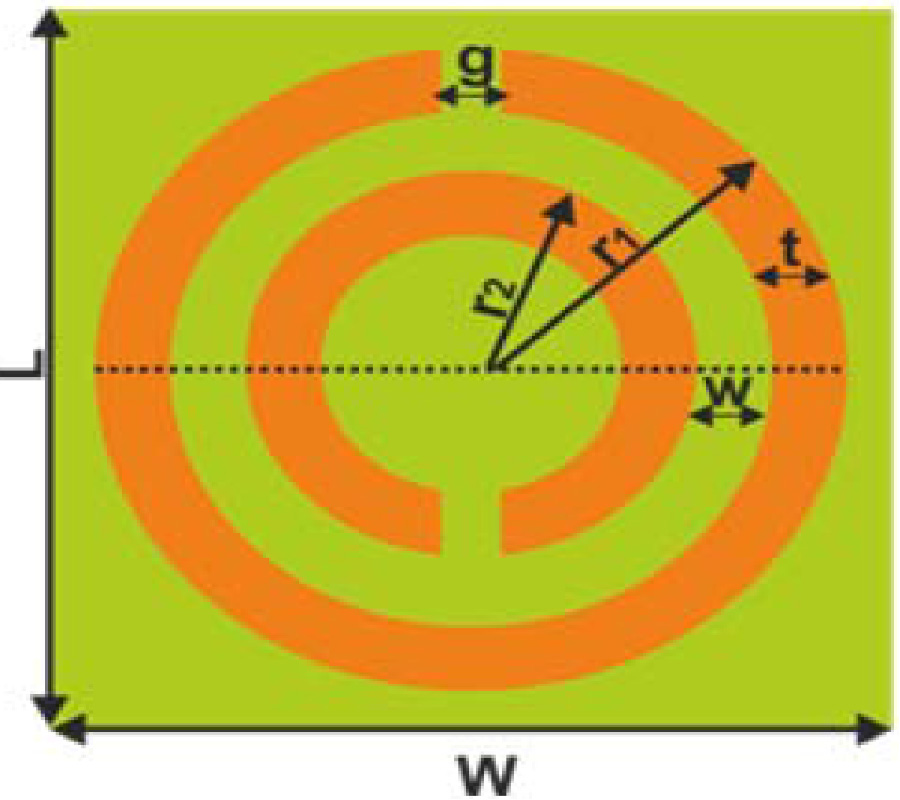
We present an analytical analysis of a metasurface-based ambient electromagnetic energy harvesting system in which the bi-anisotropic particles loaded with a resistor are used. The proposed metasurface composed of an array of bi-anisotropic particles referred to as an electromagnetic energy harvester that can capture the ambient incident electromagnetic wave energy with a radiative to AC conversation efficiency of around 100%. The captured energy by metasurface is delivered to the load. The load acts as the input impedance of a rectification circuit in a rectenna system. The derived optimal polarizable inclusions can be applied to design bi-anisotropic metasurfaces which can be used for electromagnetic energy harvesting. Finally, the optimal dimensions of a typical chiral structure have been calculated to achieve maximum efficiency for circularly polarized propagating waves.
BI-ANISOTROPIC PARTICLES AND CHIRAL INCLUSIONS FOR HIGHLY-EFFICIENT ELECTROMAGNETIC ENERGY HARVESTING
2020-06-01
PIER M
Vol. 93, 53-66
A Penta Band Notched Elliptical Planar Monopole Antenna for UWB Applications
Devireddy Sreenivasa Rao and Govardhani Immadi
In this work, an elliptical planar monopole Penta band-notched ultra-wideband (UWB) antenna is proposed. Band rejection at 2.4-2.6 GHz IEEE 802.11 b/g/n, 3.3-3.75 Wi-MAX, 3.9-4.2 GHz C-band satellite communication, 5.15-5.85 WLAN, and 7.9-8.4 GHz X-band satellite communication frequencies is achieved by etching slots in the radiating patch, feed line, and ground plane. The effect of the slot length on the notched band is also studied. The proposed antenna has been fabricated and tested. The measured impedance bandwidth of the antenna is 2.15-12.5 GHz, which covers bands of Bluetooth and UWB applications. The peak gain of the proposed antenna is 8 dB and drops drastically at notched bands. The proposed antenna shows good omnidirectional radiation patterns in the passbands.
A PENTA BAND NOTCHED ELLIPTICAL PLANAR MONOPOLE ANTENNA FOR UWB APPLICATIONS
2020-06-01
PIER M
Vol. 93, 43-52
Miniature Circularly Polarized Antenna for UHF RFID Handheld Reader: Design and Experiments
Le-Huy Trinh , Khai-Thong Lu , Manh-Thao Nguyen , Nguyen-Vu Truong and Fabien Ferrero
A low-profile circularly polarized (CP) antenna for a handheld Ultra-High Frequency Radio Frequency Identification (UHF RFID) reader is proposed in this paper. The radiating part on the top substrate is composed of three inverted-F elements rotated 120˚ around the center of the structure. A power splitting circuit, placed on the bottom substrate, based on a series transmission line feed delivers equal amplitude to the three IFA with a sequential 120˚ phase shift. Both layers are fabricated on low-cost FR4 material. This design has a disk form factor with a compact size of 35 mm circle radius and an 8.6 mm height. The measurement shows good results with S11 as lower than -10 dB for the whole band, 3 dB-axial ratio around 110˚ (10 MHz of bandwidth), directivity reaching 4.4 dBic, and the total gain of the antenna is 1.9 dBic. In order to validate the proposed antenna performance, a UHF RFID handheld reader is built based on the ThingMagic M6E-Nano module. Different scenarios are investigated to validate the proposed antenna performance in a real environment.
MINIATURE CIRCULARLY POLARIZED ANTENNA FOR UHF RFID HANDHELD READER: DESIGN AND EXPERIMENTS
2020-06-01
PIER C
Vol. 102, 203-212
A Compact Slot-Antenna with Tunable-Frequency for WLAN, WiMAX, LTE, and X-Band Applications
Fouad Fertas , Mouloud Challal and Khelil Fertas
In this paper, a new monopole compact antenna with tunable frequency fed by a coplanar waveguide (CPW) for WiMAX, WLAN, LTE bands, and X-band satellite communication system is presented. This is achieved by adequate combination of a new radiating patch element along with slots and switches. The simulation and measurement results show that depending on ON/OFF states, the proposed reconfigurable antenna, printed on an FR4 substrate, can operate in four applicable frequency bands, i.e., [2.37-2.75 GHz], [3.15-4.08 GHz], [4.48-5.92 GHz], and [6.69-8.31 GHz]. Very interesting results for the reflection coefficient, current distribution, and radiation pattern of the antenna are presented and discussed. The measured results are in good agreement with the simulated ones.
A COMPACT SLOT-ANTENNA WITH TUNABLE-FREQUENCY FOR WLAN, WIMAX, LTE, AND X-BAND APPLICATIONS
2020-06-01
PIER C
Vol. 102, 187-202
Design of Sub-THz Slotted Waveguide Array Antenna for the Broadside Circularly Polarized Applications Beyond 5G
Thevaruparambil Abdulnazer Nisamol , Parambil Abdulla and Kunnath Kodakkat Ansha
This work presents the modelling of a highly efficient all-metal slotted waveguide array antenna (SLWA) at sub-THz frequencies for the 5th generation communication applications or beyond. The slotted waveguide array antenna is modified for the accomplishment of high gain, wide bandwidth, and circularly polarized broadside radiation pattern. The proposed double `T'-shaped slot (DTS) which acts as an active element in the whole antenna radiation and other elements after DTS contribute high directivity and gain. The designed slotted waveguide array antenna with DTS is modified for the reconfiguration of linear polarization into circular polarization and achieves the axial ratio (AR) below 3 dB for the bandwidth of 22.323 GHz with a maximum gain of 14.4 dBi. The length and shape of the slot are altered in the SLWA in-order to set up the advanced rectangular stepdown slots (RSDS) and cross stepdown slots (CSDS) for the circularly polarized beam scanning application. The RSDS SLWA, and CSDS SLWA provide wide impedance bandwidths of 56.506 GHz and 61.236 GHz with 3 dB AR range of 12.417 GHz and 9.688 GHz, respectively. The design and simulation of the proposed antenna are done in CST microwave suite and validated using HFSS software.
DESIGN OF SUB-THZ SLOTTED WAVEGUIDE ARRAY ANTENNA FOR THE BROADSIDE CIRCULARLY POLARIZED APPLICATIONS BEYOND 5G
2020-06-01
PIER C
Vol. 102, 175-185
Dual-Feed, Dipole Antenna System for 2.4/5.2/5.8-GHz, Tri-Band WLAN Laptop Applications
Che-Chi Wan and Saou-Wen Su
A low-profile, printed dipole antenna having two feed ports with two parasitic strips for tri-band operation in the 2.4 GHz (2400-2484 MHz), 5.2 GHz (5150-5350 MHz), and 5.8 GHz (5725-5825 MHz) wireless local area network (WLAN) bands is presented. The strip dipole is coupled-fed via a chip capacitor connected to a dual-feed network and generates the 2.4 and 5.2 GHz bands with the aid of the tuning stubs in the feed network. The two parasitic strips are further employed to introduce additional resonance to cover the 5.8 GHz band. It was found that by loading the chip capacitor with proper values between the strip dipole and the dual-feed network, the port decoupling in both the 2.4 and 5.2 GHz bands can be improved, making a dual-feed and yet single antenna system possible. The design with constant strip width is simple in structure and occupies a compact size of 5 mm × 40 mm (about 0.04-λ × 0.32-λ at 2.4 GHz), which is well-suited to current narrow-bezel laptop computers.
DUAL-FEED, DIPOLE ANTENNA SYSTEM FOR 2.4/5.2/5.8-GHZ, TRI-BAND WLAN LAPTOP APPLICATIONS
2020-05-31
PIER
Vol. 167, 55-65
Design and Fabrication of a Sectoral Beam Slotted Antenna in SIW Technology for Surveillance Applications at Millimeter Waves
Santi Concetto Pavone and Matteo Albani
In this paper, we present the design and fabrication of a sectoral beam slotted antenna in substrate integrated waveguide (SIW) technology able to achieve a high roll-off sectoral pattern in the horizontal plane and a very narrow beam in the vertical plane, as required in surveillance applications in the band 76-77 GHz. The proposed antenna is designed and fabricated in multi-layer PCB technology, which allows to integrate both the corporate feeding network and the radiating aperture in the same planar and lightweight device. To achieve a remarkable roll-off (> 5.5 dB/deg) and a reduced ripple (< 1.5 dB), the antenna has been designed by synthesizing a sinc-shaped (uniform) aperture distribution along x-direction (y-direction). The synthesis and optimization of so tapered aperture distributions is not easy to be found in the literature, especially for planar devices. A prototype of such an antenna has been fabricated with a horizontal half-power beamwidth (HPBW) of 30˚, by embedding both the feeding network and the radiating aperture in three stacked dielectric substrates. Measurements of the prototype show a fair agreement with numerical simulations.
DESIGN AND FABRICATION OF A SECTORAL BEAM SLOTTED ANTENNA IN SIW TECHNOLOGY FOR SURVEILLANCE APPLICATIONS AT MILLIMETER WAVES
2020-05-29
PIER Letters
Vol. 91, 117-122
Flexi Electrode Electron Gun for Long Life Travelling-Wave Tubes
Abhay Shankar , Atmakuru Nagaraju , Amitavo Roy Choudhury and Sanjay Kumar Ghosh
A flexi electron gun consists of multiple electrodes and can be used to maintain uniform beam current over the life of a traveling-wave tube (TWT). The flexi electron gun consists of dispenser cathode, anode1, anode2 and anode3 in addition to a beam focusing electrode (BFE). In an optimized electron gun, anode1 potential plays an important role in increasing beam current within the same biased condition of electronic power conditioner (EPC) and can be used as a critical parameter to increase current with time when cathode performance (beam current) degrades with time. Geometry, position and bias of these electrodes with respect to cathode provide low perveance electron beam optics to the interaction structure of a TWT. The flexi gun has been modelled in EGUN, developed and integrated with TWT, and simulated results are compared with experiment. This paper presents a detailed investigation of the effect of anode1 on beam current and also presents the cause of large variation of simulated and measured beam currents through back simulation in EGUN.
FLEXI ELECTRODE ELECTRON GUN FOR LONG LIFE TRAVELLING-WAVE TUBES
2020-05-28
PIER M
Vol. 93, 35-42
Maxwell's Derivation of the Lorentz Force from Faraday's Law
Arthur D. Yaghjian
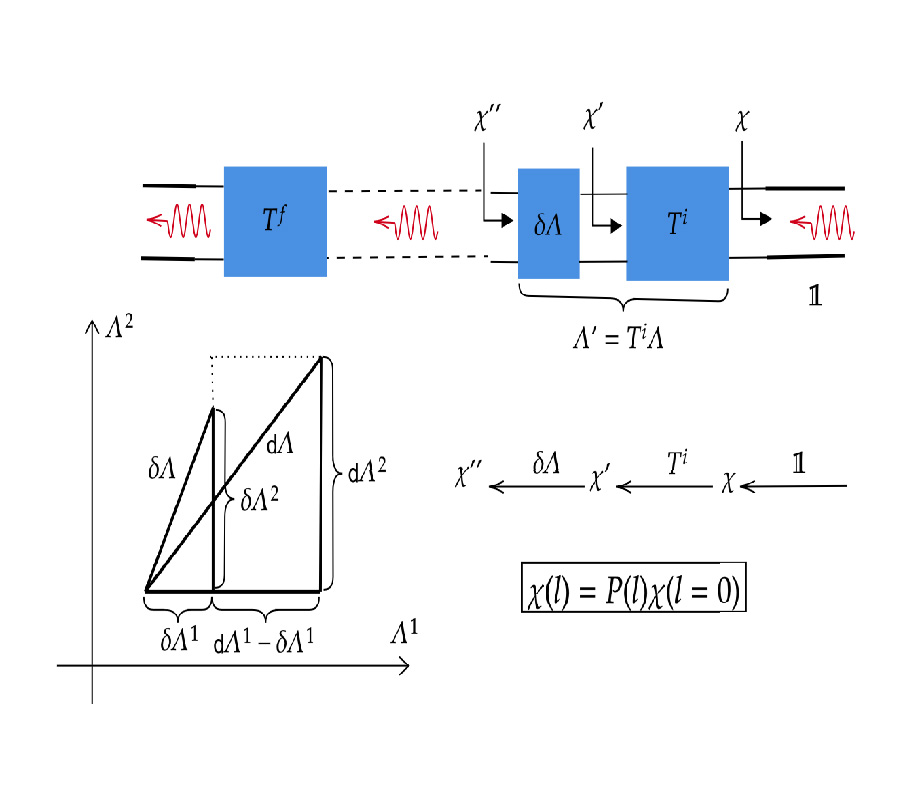
In a brief but brilliant derivation that can be found in Maxwell's Treatise and traced back to his 1861 and 1865 papers, he derives the force on a moving electric charge subject to electromagnetic fields from his mathematical expression of Faraday's law for a moving circuit. Maxwell's derivation in his Treatise of this force, which is usually referred to today as the Lorentz force, is given in detail in the present paper using Maxwell's same procedure but with more modern notation.
2020-05-28
PIER Letters
Vol. 91, 109-116
An Analytical Hybrid Model for the Shielding Effectiveness Evaluation of a Dual-Cavity Structure with an Aperture Array
Hai Jin , Hongliang Zhang , Yurun Ma , Kejian Chen and Xinfeng Sun
Rectangular dual-cavity structure is usually used to improve the shielding efficiency of a shielding chamber or to avoid the interference between the internal electronic components of the system. In order to simplify the estimation of the shielding effectiveness for a dual-cavity structure with an aperture array,a hybrid analytical model is proposed based on Robinson's model and Dehkhoda's model. In the new model, the enclosure of cavity and the aperture array are equivalent to a short-circuited waveguide and admittance respectively. Using this hybrid model, shielding effectiveness could be calculated efficiently for a common frequency band. The results of typical examples are compared with simulation examples, and they are in very good agreement. This method provides an analytic solution for designers to speed up the design process of a rectangular dual-cavity structure with an aperture array.
AN ANALYTICAL HYBRID MODEL FOR THE SHIELDING EFFECTIVENESS EVALUATION OF A DUAL-CAVITY STRUCTURE WITH AN APERTURE ARRAY
2020-05-27
PIER M
Vol. 93, 23-34
Low Sidelobe Cosecant-Squared Pattern Synthesis for Large Planar Array Using Genetic Algorithm
Tarek Sallam and Ahmed Attiya
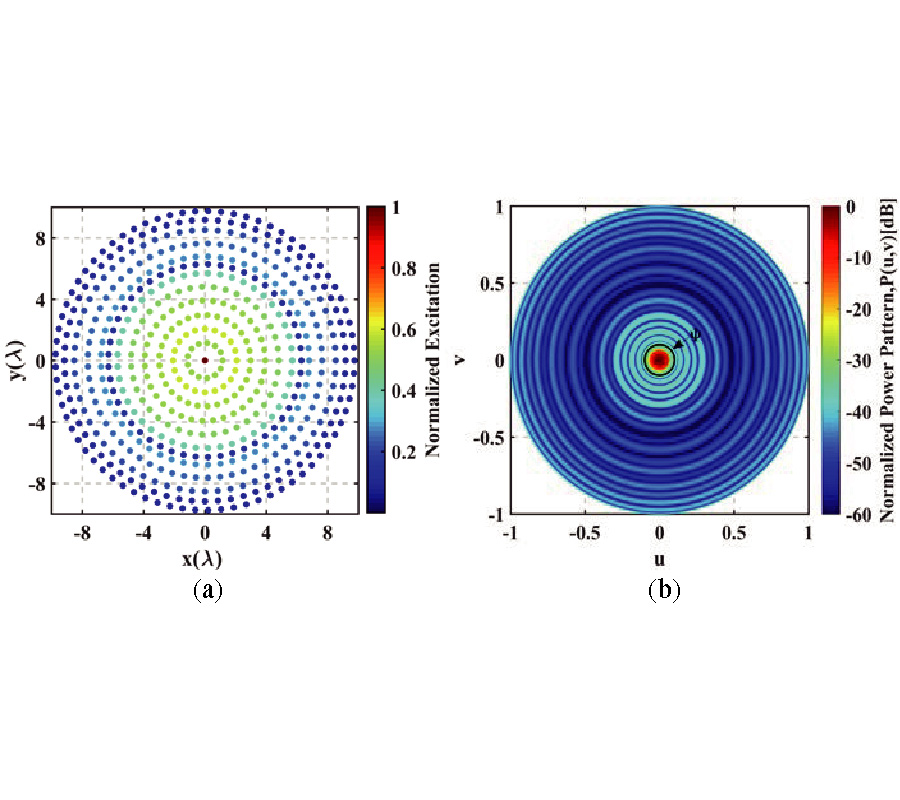
A cosecant-squared radiation pattern synthesis for a planar antenna array by using the genetic algorithm (GA) is presented. GA makes array synthesis flexible to achieve two desired features, namely, low peak side lobe level (PSLL) and small deviation (ripples) in the shaped beam region. In order to obtain a desired csc2 pattern with the PSLL constrained, GA optimizes both the excitation amplitude and phase weights of the array elements. Dynamic range ratio (DRR) of the excitation amplitudes is improved by eliminating the weakly excited array elements from the optimized array without distorting the obtained pattern. To illustrate the effectiveness and advantages of GA, the beam pattern with specified characteristics is obtained for the same array by using particle swarm optimization (PSO). Results show that the performances of GA and PSO are comparable when dealing with small-to-moderate planar antenna arrays. However, GA significantly outperforms PSO on large arrays. Moreover, numerical results reveal that GA is superior to PSO in terms of cost function evaluation and statistical tests.
LOW SIDELOBE COSECANT-SQUARED PATTERN SYNTHESIS FOR LARGE PLANAR ARRAY USING GENETIC ALGORITHM
2020-05-27
PIER Letters
Vol. 91, 99-107
Miniaturized Notched Ultra-Wideband Antenna Based on EBG Electromagnetic Bandgap Structure
Liang Zhang , Shijie Huang , Zhixiang Huang , Changqing Liu , Chao Wang , Zhiwei Wang , Xingchuan Yu and Xian-Liang Wu
This paper proposes a miniaturized monopole ultra-wideband antenna with single-frequency rejection. The recommended antenna size is reduced from 58 × 54 mm2 to 32 × 54 mm2 by the half-cut method. The bandgap design is achieved by placing a dual mushroom type electromagnetic bandgap (EBG) structure on the side of a coplanar waveguide feeding line. The equivalent circuit and surface current distribution were used to analyze and explain the effects of mushroom-like EBG cells and the principle of the half-cut method. Both the prototype antenna and the proposed antenna have been fabricated and tested. From the measurement results, the proposed antenna exhibits good band-stop characteristics and can reject the wireless LAN interference band (5.2 and 5.8 GHz bands). Furthermore, the proposed antenna has considerable gain over the entire operating frequency band except for the notch band.
MINIATURIZED NOTCHED ULTRA-WIDEBAND ANTENNA BASED ON EBG ELECTROMAGNETIC BANDGAP STRUCTURE
2020-05-27
PIER C
Vol. 102, 163-174
High Permittivity Substrate and DGS Technique for Dual-Band Star-Shape Slotted Microstrip Patch Antenna Miniaturization
Zhor Bendahmane , Souheyla Ferouani and Choukria Sayah
Three miniaturization techniques were combined in this work to achieve compact size while maintaining optimal performances of a dual-band star shape slotted Microstrip Patch Antenna (MPA) operating at 2.4 and 5 GHz resonant frequencies. High permittivity substrate and slot techniques were used for miniaturization and impedance matching improvement, while DGS technique was necessary for bandwidth enhancement and further miniaturization of the reference MPA. The miniaturized antenna shows a planar structure and occupies very small area of 15.55 x 19.80 mm2 achieving patch size area reduction of 71.24% and overall size reduction of 75.42%. Respectable positive gains were maintained with radiation efficiency exceeding 83% and 68% at 2.4 GHz and 5 GHz, respectively. The reference and miniaturized MPAs were fabricated, then their performances were measured and compared to the simulated ones. The measured impedance bandwidths of the miniaturized MPA were around 38% and 13% at the two resonant frequencies respectively, which confirm the originality and suitability of the miniaturized MPA for Wireless Local Area Network WLAN and ISM applications.
HIGH PERMITTIVITY SUBSTRATE AND DGS TECHNIQUE FOR DUAL-BAND STAR-SHAPE SLOTTED MICROSTRIP PATCH ANTENNA MINIATURIZATION
2020-05-26
PIER C
Vol. 102, 149-162
Frequency Reconfigurable Multiband Antenna for IoT Applications in WLAN, Wi-MAX, and C-Band
Prem Pal Singh , Pankaj Kumar Goswami , Sudhir Kumar Sharma and Garima Goswami
Due to the upsurge in internet connected devices in everyday life, a compact embedded wireless device becomes essential to cater multiple frequency-based applications at common platform. Reconfigurability is the best solution to enhance the device utility at many technical interfaces. Wireless compatibility among different devices via internet elicits the importance of antenna unit. In this paper, a compact size 25×25 mm2, five-band frequency reconfigurable antenna is presented. The antenna exhibits the choice-based optimized frequency responses of slot structures, corner truncation and parasitic loading. These individual responses comprise the high frequency switching characteristics in synchronized module of three PIN diodes. The antenna is designed to operate among five different frequencies i.e. 3.85 GHz, 4.14 GHz, 4.43 GHz, 4.91 GHz, and 6.01 GHz. The work emphasizes the compact design and wide switching ability of the antenna, which validates its unique feasibility for high speed multiple applications of Internet of Things (IoT) through a common embedded platform under WLAN, Wi-Max, and C-band applications as per the FCC standards.
FREQUENCY RECONFIGURABLE MULTIBAND ANTENNA FOR IOT APPLICATIONS IN WLAN, WI-MAX, AND C-BAND
2020-05-25
PIER Letters
Vol. 91, 93-98
Modeling Thin Graphene Sheets in the WLP-FDTD Algorithm with Surface Boundary Condition
Wei-Jun Chen , Qi-Wen Liang , Shi-Yu Long and Min Zhao
In this article, a two-dimensional (2D) unconditionally stable finite-difference time-domain (FDTD) approach is proposed for graphene electromagnetic (EM) device simulation. The weighted Laguerre polynomials (WLPs) are utilized to resolve stability concerns, and graphene is modelled as a thin conductive layer incorporating the surface boundary condition (SBC) in WLP-FDTD scheme. The transmittance of EM signal propagating through two graphene layers is calculated for 0-10 THz to verify the effectiveness of the proposed method. The simulation results agree excellently with the results calculated from the analytical and other numerical models. The proposed SBC-WLP-FDTD method provides an alternative numerical approach to simulate graphene-like materials with improved computing efficiency.
MODELING THIN GRAPHENE SHEETS IN THE WLP-FDTD ALGORITHM WITH SURFACE BOUNDARY CONDITION
2020-05-25
PIER C
Vol. 102, 139-148
Radar Target Discrimination of Real Size Aircraft with Minor Structural Variations: Challenges and Solutions
Sathyamurthy Anuradha and Jyothi Balakrishnan
A novel aspect independent resonance based radar target discrimination method has been developed in a previous work, and is found to be effective in discriminating canonical shape closely resembling objects with minor structural variations. The method utilizes the Radar Cross Section (RCS) of the unknown target to be identified and the distinction polynomial stored in the database (built from the dominant resonances of the known target). In this paper, the method is implemented successfully to discriminate two real size F5 aircraft with minor structural variations between them. This study involving real size targets poses some challenges that are overcome in this paper. The foremost challenge is the accurate computation of resonance range RCS of electrically large sized target considered (> 10λ), which is computationally demanding. The second challenge is in selecting the dominant resonances (features) of the complex target, useful for discrimination, from a large set of resonances representing the target. The accuracy of the discrimination result is dictated by the accuracy with which the features of the targets are identified. This in turn is dependent on the accuracy with which RCS is determined. To achieve accurate results, the exact Computational Electromagnetic (CEM) method - the Method of Moments (MoM) is used for computing the RCS of real size aircraft. The procedure to choose an optimal number of dominant natural resonant frequencies (NRFs) from a pool of NRFs for real size complex target is presented in this paper. The discrimination quantifying function `Risk' is shown to be effective in discriminating F5 aircraft - with and without missile attached underneath. The two targets have been successfully discriminated at all aspects, which is yet another challenge, establishing the aspect independent discrimination capability of the technique.
RADAR TARGET DISCRIMINATION OF REAL SIZE AIRCRAFT WITH MINOR STRUCTURAL VARIATIONS: CHALLENGES AND SOLUTIONS
2020-05-25
PIER C
Vol. 102, 127-137
Low Reflection Coefficient Ku-Band Antenna Array for FMCW Radar Application
Laxmikant Minz , Hyunseong Kang and Seong-Ook Park
A radar for decisive target detection and tracking requires wideband, high return loss and high efficiency antenna array. In this paper, a 16 element staked-patch microstrip antenna array is presented at Ku-band with very low reflection coefficient for radar system. An aperture coupled feeding approach for a stack patch antenna is employed for wide bandwidth. A thin and low-loss tangent material, Taconic TLY-5, is used in the design of an antenna array to minimize the surface current loss and dielectric loss. Moreover, the antenna is designed with good impedance match, -30 dB, for high efficiency, by optimizing the stacked patches and utilizing reactive loading from u-slit on patch. For a low reflection coefficient antenna array over a wide bandwidth, an adequate feeding network consists of a compact and meandering stripline with metal-post around it is developed. The stripline configuration with metal-post minimizes crosstalk and lateral leakage. The feeding network developed has low reflection coefficient of -30 dB for the target band. The simulated feeding network loss is also low, 0.5 dB. The overall size of the 16 element array is compact, 295 mm x 30 mm (14λ x 1.425λ). The antenna array performance gives a reflection coefficient of -30 dB in the range of 14-14.5 GHz and total efficiency of 80%. The gain of the array is 21.54 dBi at 14.25 GHz.
LOW REFLECTION COEFFICIENT KU-BAND ANTENNA ARRAY FOR FMCW RADAR APPLICATION
2020-05-24
PIER Letters
Vol. 91, 85-91
Compact Dual-Band Wilkinson Power Divider Terminated with Frequency-Dependent Complex Impedances
Xiao Jia , Shao-Jun Fang , Hongmei Liu and Zhongbao Wang
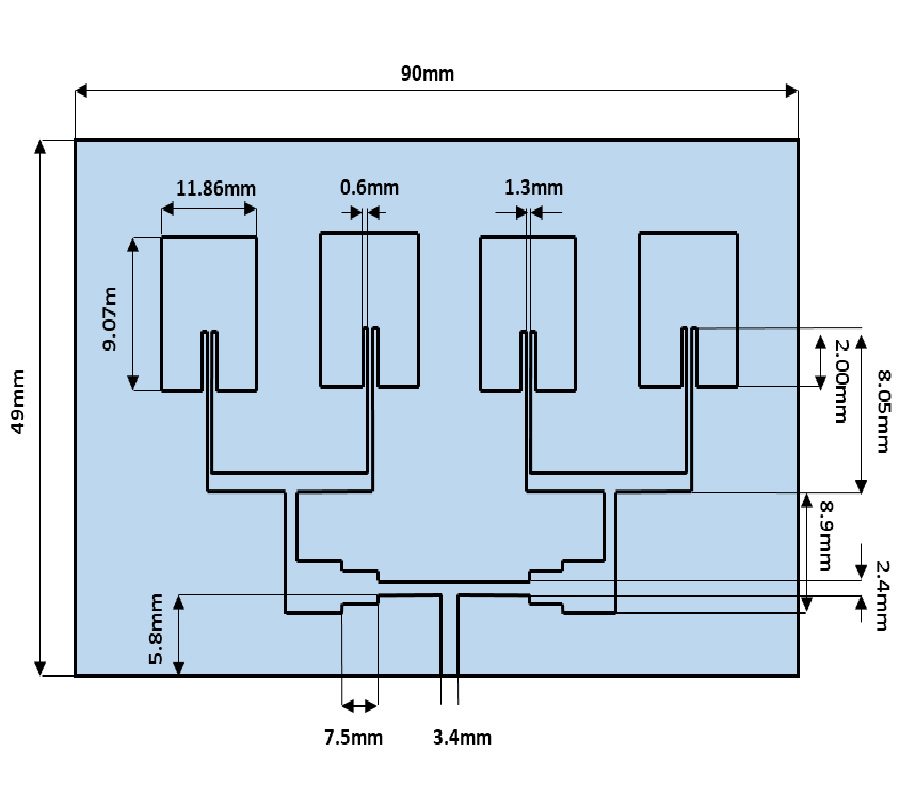
In the letter, a compact dual-band Wilkinson power divider terminated with frequency-dependent complex impedance (FDCI) is proposed, for the first time. It is composed of two sections of coupled lines, two shunt transmission lines and a lumped resistor. By using the coupled lines, the FDCI at two bands can be matched. Further, the design equations for the proposed power divider are derived by using the even-odd mode decomposition technology. For verification, a prototype operating at 1.0 GHz and 1.8 GHz was designed, fabricated and measured with different terminal complex impedances at the two bands. The measured results show that the proposed WPD features equal power distribution, good impedance matching/isolation at two frequency bands.
COMPACT DUAL-BAND WILKINSON POWER DIVIDER TERMINATED WITH FREQUENCY-DEPENDENT COMPLEX IMPEDANCES