Search Results(13790)

2019-01-14
PIER Letters
Vol. 81, 85-91
A Novel Antenna Feeding Network with Separately Resonant Frequency and Impedance Matching Tunable Capability
Linzhi Liu , Qian-Yin Xiang , Dengyao Tian and Quanyuan Feng
A novel C-L-L π-type feeding network is presented to tune the working frequency and impedance matching of antenna. Two varactors are used in the tunable feeding network as tunable elements for antenna resonating frequency and impedance matching tuning. The tunable capability of the network is studied, and a patch antenna is used to verify the tunable feeding network. The tunable feeding network is designed, fabricated and measured. The measurement results show that the patch antenna can be tuned from 630 MHz to 1.04 GHz with a maximum impedance bandwidth of 24 MHz of S11 less than -10 dB.
A NOVEL ANTENNA FEEDING NETWORK WITH SEPARATELY RESONANT FREQUENCY AND IMPEDANCE MATCHING TUNABLE CAPABILITY
2019-01-14
PIER M
Vol. 77, 205-213
Analysis and Compensation of Ionospheric Time-Variant TEC Effect on GEO SAR Focusing
Xingyu Liang and Zhuo Li
Compared to low Earth orbit (LEO) synthetic aperture radar (SAR), geosynchronous (GEO) SAR has a larger coverage and shorter revisit period. However, due to its longer integration timeit will be affected byionospheric time-variant total electron content (TEC), which introduces a phase error into the SAR azimuth signal.Using U.S. total electron content (USTEC) data, TEC variation with timeon GEO SAR trackis analyzed. It is shown thatquadratic phase error caused by time-variant TEC is main effect on image focusing compared to higher order errors. Therefore, contrast optimization autofocus (COA) algorithm can beusedfor compensation. The key steps of COA are given. Simulations based on scenes derived from PALSAR2 data demonstrate the effectiveness of COA.
ANALYSIS AND COMPENSATION OF IONOSPHERIC TIME-VARIANT TEC EFFECT ON GEO SAR FOCUSING
2019-01-13
PIER Letters
Vol. 81, 77-83
Shape Reconstruction of Unknown Targets Using Multifrequency Linear Sampling Method
Mallikarjun Erramshetty
This paper aims to estimate the shape of microwave scattering objects using linear sampling method (LSM) with multifrequency data. LSM is a simple, reliable linear inverse algorithm and uses multiview multistatic single frequency scattered field data measured around target objects. Despite its simplicity and computational effectiveness, the output LSM results depend on the frequency of operation. To improve the LSM performance, the present work proposes a new formulation that incorporates frequency information in the LSM equation. As a result, LSM finds the target's shape by a simple solution to a linear inverse problem via multifrequency data. The output results are tested with various types of numerical examples of synthetic data as well as experimental data provided by the Institute of Fresnel.
SHAPE RECONSTRUCTION OF UNKNOWN TARGETS USING MULTIFREQUENCY LINEAR SAMPLING METHOD
2019-01-13
PIER Letters
Vol. 81, 71-76
A Compact Wideband Filtering Power Divider
Guang Yang , Qiang Liu , Siqi Liu and Yujia Chang
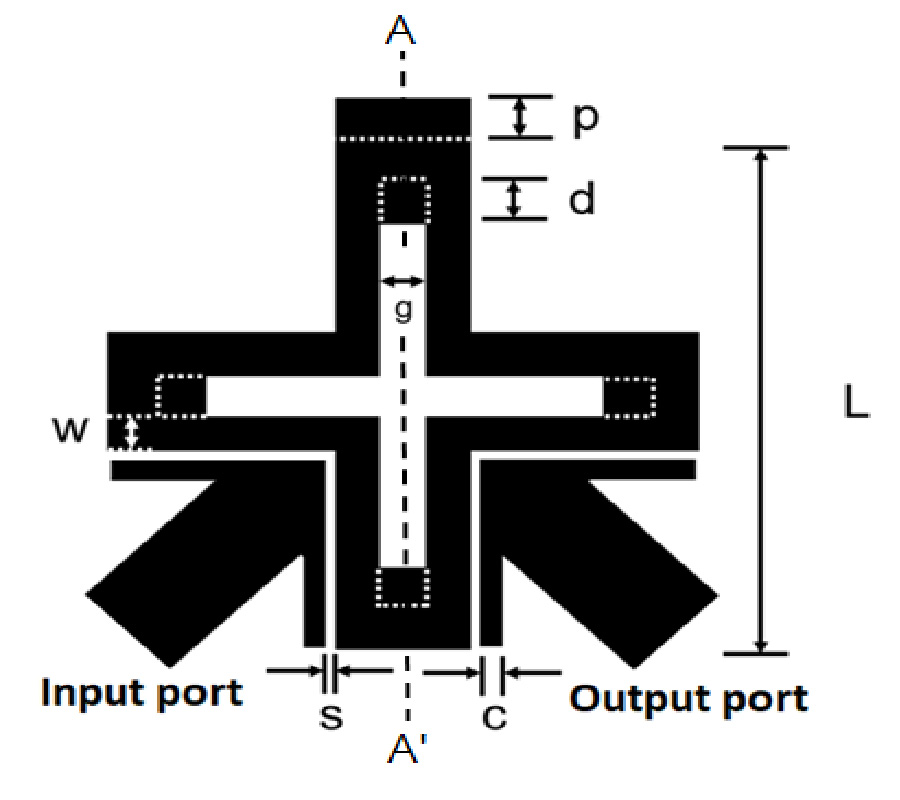
A compact wideband filtering power divider is presented in this paper, by using coupled transmission lines at two output ports to realize filtering function. The return loss and insertion loss of the design in the passband are improved by inserting fan-shaped open stubs and etching a T-shaped slot at the input port. The central frequency of the power divider is 2.4 GHz. The measured results show a 10-dB fractional bandwidth of 60%, and a wideband filtering response can be obtained. The material object is designed by using FR4, and the size is 0.4λg*0.2λg. The design is well used in the WiFi band.
A COMPACT WIDEBAND FILTERING POWER DIVIDER
2019-01-11
PIER M
Vol. 77, 195-204
Design of Novel Miniaturized Multilayer Substrate Integrated Waveguide Filter and Tunable Filter
Mei Qian , Wen-Xuan Xie and Kaiwei Zuo
A novel miniaturized multilayer substrate integrated waveguide (SIW) filter is designed. The filter is constructed with four compact SIW resonator cavities, and each cavity supports TE101 mode, which can be controlled by the slot located between layers. The area of the compact SIW resonator is just 1/16 of that of original substrate integrate waveguide (SIW) resonator. Meanwhile, the area of the four-order filter is 13.2 mm×26.4 mm. The insertion loss and return loss of the fabricated filter are -1.8 dB and -14.6 dB, respectively. Meanwhile, the tunable filter realizes center frequency linearity, which works at 1.6 GHz with an adjustable range of 51.8%. The insertion loss is -1.2 dB, and the return loss is less than -15 dB. The coplanar cavity coupling structure achieves a switchable bandwidth.
DESIGN OF NOVEL MINIATURIZED MULTILAYER SUBSTRATE INTEGRATED WAVEGUIDE FILTER AND TUNABLE FILTER
2019-01-11
PIER M
Vol. 77, 187-194
A Triple Band Polarization Insensitive Ultrathin Metamaterial Absorber for S- C- and X-Bands
Amit Kumar Singh , Mahesh Pandurang Abegaonkar and Shiban Kishen Koul
In this paper, design of a triple band ultrathin compact polarization insensitive metamaterial absorber for S-, C- and X-band applications is proposed. The proposed absorber consists of periodic arrangement of a modified triple circular slot ring resonator as unit cell printed on the top of a continuous metal backed FR-4 dielectric substrate. The proposed absorber is ultrathin having thickness of λ0/135.66 at the lowest absorption center frequency. The measured wide stable absorption bands of 0.40 GHz, 0.45 GHz and 0.47 GHz with absorption peaks of 97%, 96.45% and 98.20% at absorption center frequencies of 2.90 GHz, 4.18 GHz and 9.25 GHz respectively are observed. The temperature profile of absorber is measured by using lock in infrared thermography, and a temperature increase of 1°C at absorbing frequency as compared to non-absorbing frequency is observed. The absorber is demonstrated to be polarization insensitive to TE and TM polarized angles of incidence of electromagnetic wave with wide angular stability up to 45°. The absorber is fabricated and tested in an anechoic chamber. Experimental results agree well with measured ones.
A TRIPLE BAND POLARIZATION INSENSITIVE ULTRATHIN METAMATERIAL ABSORBER FOR S- C- AND X-BANDS
2019-01-11
PIER M
Vol. 77, 177-186
Precise Analysis on Paraxial Region Magnetic Field of Solenoid with Relaxation Polarization Medium
Zhiyong Yang , Wei Cai , Zhili Zhang and Youan Xu
This paper studies distribution characteristics of paraxial magnetic field of solenoid with inner relaxation polarization medium and driven by ac signal. Firstly, the paraxial electromagnetic field model of hollow solenoid was constructed by Maxwell equations, and the influence of the driving signal frequency was analyzed. Then, based on the established paraxial electromagnetic field model of hollow solenoid, the magnetic field model of solenoid with inner relaxation polarization medium was established by ampere loop law. Finally, the effects of relaxation polarization medium and driving signal frequency on magnetic field amplitude and phase shift were analyzed in detail. The conclusions were drawn as follows: driving signal frequency affects magnetic field amplitude; the relaxation polarization medium will cause the phase shift of magnetic field; and the phase shift will increase as the driving signal frequency increases.
PRECISE ANALYSIS ON PARAXIAL REGION MAGNETIC FIELD OF SOLENOID WITH RELAXATION POLARIZATION MEDIUM
2019-01-10
PIER C
Vol. 90, 15-28
Design and Manufacturing of a Novel Compact 2.4 GHz LPF Using a DGS-DMS Combination and Quasi Octagonal Resonators for Radar and GPS Applications
Ahmed Boutejdar , Mouloud Challal , Sudipta Das and Soumia El Hani
In this paper, a new compact microstrip low-pass filter (LPF) with ultra-wide stopband characteristics is presented. The combinations of DGS-DMS along with quasi octagonal resonators are employed in the design of the proposed filter to achieve compact size and ultra-wide stopband suppression level. The proposed filter has been designed, simulated, optimized and tested. The design procedure is validated using the commercial full-wave EM MoM simulator Microwave Office. Simulated as well as measured results of low-pass filter exhibit sharp roll-off (ξ) of 19 dB/GHz and creating transmission zero at around 7.8 GHz with attenuation level -54 dB. The measurement results show good agreement with the simulations. The cutoff frequency of the proposed low-pass filter is 2.4 GHz with the insertion loss less than 0.3 dB. The ultra wide stop band with over 20 dB attenuation extended from 3.42 GHz to 12 GHz. The spurious passband suppression up to six harmonics (5fc) is achieved for the proposed design. The addition of two parasitics DGS elements in the ground plane leads to suppression of the undesired harmonics and thus to improve the stopband. The size of the whole structure is less as (0.44λgx0.26λg) with λg = 68 mm. The proposed filter is useful for microwave L band, GPS system, and RADAR applications.
DESIGN AND MANUFACTURING OF A NOVEL COMPACT 2.4 GHZ LPF USING A DGS-DMS COMBINATION AND QUASI OCTAGONAL RESONATORS FOR RADAR AND GPS APPLICATIONS
2019-01-09
PIER Letters
Vol. 81, 65-70
An Exact Expression for the Mutual Impedance Between Coaxial Circular Loops on a Homogeneous Ground
Marco Muzi
This paper presents an exact expression for the mutual impedance of two coaxial loops located on the surface of a conductive ground. The semi-infinite complete integral representation for the impedance is first converted into a finite integral. Then the spherical Hankel function contained in the integrand is expanded according to Gegenbauer addition theorem. This makes it possible to perform analytical integration and express the mutual impedance as a sum of products of spherical Bessel functions. Since no simplifying assumption is introduced in the mathematical derivation, the obtained formula is valid in quasi-static as well as non-quasi-static frequency ranges. Numerical examples show how, accuracy being equal, the proposed expression is less computationally expensive than standard Gauss-Kronrod numerical integration technique.
AN EXACT EXPRESSION FOR THE MUTUAL IMPEDANCE BETWEEN COAXIAL CIRCULAR LOOPS ON A HOMOGENEOUS GROUND
2019-01-09
PIER Letters
Vol. 81, 59-64
Switching-Mode CMOS Power Amplifier Using a Differentially Coupled Series Inductor
Changhyun Lee and Changkun Park
In this work, we propose a compact CMOS power amplifier using a differentially coupled series inductor for motion detection radar applications. The proposed switching-mode power amplifier is designed with a cascode and differential structure. To realize a compact size matching network, a differentially coupled series inductor is used in the input matching network. In the proposed power amplifier, two typical spiral series inductors for the input matching network are replaced with a single differentially coupled series inductor. As a result, the used chip area of the differentially coupled series inductor is smaller than half that of a typical inductor for the given inductances of each inductor. Additionally, to obtain a high gain characteristic, we adapt modified mode-locking techniques for the power stage of the power amplifier. To verify the feasibility of the power amplifier, we design a 9.5-GHz power amplifier with a 130-nm RFCMOS process. We obtain saturation power of 15 dBm while the power-added efficiency is approximately 28%.
SWITCHING-MODE CMOS POWER AMPLIFIER USING A DIFFERENTIALLY COUPLED SERIES INDUCTOR
2019-01-09
PIER Letters
Vol. 81, 51-58
Design of Continuous Polyharmonic-Tuned Power AmpliEr with Optimal Knee Voltage Parameter
Gideon Naah , Songbai He and Weimin Shi
This paper presents the design of a continuous polyharmonic-tuned mode (CPHTM) power amplifier (PA) with an introduced optimal knee voltage waveform control parameter in a continuous harmonic-tuned voltage waveform equation. The optimal knee voltage waveform control parameter works in unison with derived equations, providing bandwidth and efficiency potentials over the limiting factors of the conventional harmonic-tuned power amplifiers (PAs). The effectiveness of the design strategy is proven by the realisation of a CPHTM type-I (CPHTMT-I) PA as compared with a non-continuous polyharmonic-tuned mode type-II (NCPHTMT-II) PA. Test results with continuous-wave (CW) signals show drain efficiency (DE) levels within 53.6%-79% (1.31-2.39 GHz) with 58.4% fractional bandwidth for CPHTMT-I and 64%-78% (1.65-1.95 GHz) with 16.7% fractional bandwidth for NCPHTMT-II. The CW result evidently shows the validation and efficacy of the proposed theory.
DESIGN OF CONTINUOUS POLYHARMONIC-TUNED POWER AMPLIER WITH OPTIMAL KNEE VOLTAGE PARAMETER
2019-01-08
PIER Letters
Vol. 81, 45-50
Crosstalk Suppression by Applying Multilevel Transmission
Yafei Wang , Yanxiao Zhao and Xuehua Li
Crosstalk is one of the bottlenecks in improving the speed and density of high-speed interconnection systems. In this paper, multi-way and 2-level transmission is changed to one-way and multi-level transmission. Under the condition to maintain the data transmission capacity of the system, the number of microstrip lines is reduced, and the distance between microstrip lines is increased to reduce crosstalk. The simulation results show that over 50% of crosstalk is suppressed in multilevel signal transmission systems.
CROSSTALK SUPPRESSION BY APPLYING MULTILEVEL TRANSMISSION
2019-01-08
PIER M
Vol. 78, 1-10
New Robust Adaptive Beamforming Method for Multipath Coherent Signal Reception
Min Tang , Dong Qi , Chengcheng Liu and Yongjun Zhao
In this paper a novel robust beamforming method is devised to receive multipath signals effectively. The new algorithm constructs a transformation matrix derived through high-order angle constraint to suppress the interferences with the directions of arrival (DOA) of interference signals. Using the transformed data, the composite steering vector of the multipath signals is estimated as the principal eigenvector of the signal subspace, and then it is utilized in minimum variance distortionless response (MVDR) beamforming to compute the optimal weight vector. The new method is improved in robustness to DOA error by forming wide nulls in incident directions of the interferences, and keeps effective in the presence of coherent interferences. Simulations analyses are provided to illustrate the robustness and effectiveness of the new beamformer.
NEW ROBUST ADAPTIVE BEAMFORMING METHOD FOR MULTIPATH COHERENT SIGNAL RECEPTION
2019-01-08
PIER M
Vol. 77, 167-175
Jamming Method Based on Optimal Power Difference for LMS-GPS Receiver
Fulai Liu , Yadong Wang , Ling Yue , Xiaodong Kan and Hui Song
Jamming and anti-jamming techniques for global position systems (GPS) play important roles in electronic countermeasure. Least mean square (LMS)-based anti-jamming algorithm is widely used in GPS receivers, since it can avoid matrix inversion and has low complexity. For convenience, we call them LMS-GPS receivers. To improve the anti-jamming performance of the LMS-GPS receivers, it is very meaningful to study the jamming technique. Considering that existing jamming signals are easily suppressed by LMS-GPS receivers, a new jamming method named as optimal power difference jamming is proposed in this paper to improve the jamming effect further. Specifically, the analytical relationship between jamming-to-signal ratio (JSR) and the power difference of two interference signals is firstly given. Then, the conclusion that there is always an optimal power difference where the JSR can take the extreme value is drawn. Finally, the optimal power difference is derived as about 22 dB for single-tone interference and 29 dB for band-limited Gaussian noise interference. Simulation results show that the proposed method with optimal power difference is able to improve the JSR remarkably.
JAMMING METHOD BASED ON OPTIMAL POWER DIFFERENCE FOR LMS-GPS RECEIVER
2019-01-08
PIER
Vol. 164, 17-25
Design and Experimental Validation of Multifunction Antenna with Direct Modulation for Radar and Communication
Samir Ouedraogo , Israel David Hinostroza Sáenz , Régis Guinvarc'h and Raphael Gillard
A multifunction antenna system providing a radar function and a communication function simultaneously is proposed. The system is composed of a horn antenna whose feeding waveguide is loaded with slots. The horn radiation is used for the main radar function. The slotted waveguide radiation is controlled independently from the horn radiation to perform a direct binary phase shift keying (BPSK) communication provided that each radiating slot is equipped with a simple switching mechanism. Then, the antenna system provides two different functions using orthogonal polarizations and directions. Measured results show 9.1 dB and 32 dB isolation between the two functions at the working frequency. In addition, the proposed system can be integrated with the existing radars which use horns by replacing only the feeding waveguide.
DESIGN AND EXPERIMENTAL VALIDATION OF MULTIFUNCTION ANTENNA WITH DIRECT MODULATION FOR RADAR AND COMMUNICATION
2019-01-07
PIER C
Vol. 89, 233-241
Compact Microstrip Diplexer Based on Dual Closed Loop Stepped Impedance Resonator
Salif Nabouna Dembele , Jingfu Bao , Ting Zhang and Denis Bukuru
A compact microstrip diplexer based on dual closed loop stepped impedance resonator (DCLSIR) is proposed. The proposed microstrip diplexer is composed of the combination of two DCLSIR bandpass filters (BPFs), which are designed for X-band application. For the demonstration, a dual-channel diplexer has been designed and fabricated using microstrip and printed circuit board (PCB) technologies, respectively. The fabricated diplexer operating at 8.3/10 GHz for X-band application has compact size (15.17 mm x 2.69 mm). The measured results are in good agreement with the full-wave simulation results. Good isolation between two channels is achieved.
COMPACT MICROSTRIP DIPLEXER BASED ON DUAL CLOSED LOOP STEPPED IMPEDANCE RESONATOR
2019-01-07
PIER C
Vol. 89, 221-231
A CPW-Fed CSRR and Inverted U Slot Loaded Triple Band Notched UWB Antenna
Ajay Yadav , Mamta Devi Sharma and Rajendra Prasad Yadav
A CPW-fed ultra-wideband (UWB) monopole antenna design which exhibits triple band stop functions is demonstrated. The proposed antenna comprises a Split Ring Resonator (SRR) and inverted U slots on a metallic patch to exhibit triple band-notch functions for WiMAX (3.3-3.6 GHz), C-band (3.8-4.2 GHz) and WLAN (5.1-5.8 GHz) bands. The slot width optimization is examined to tune the band-notch resonance frequency, and their effects are exhibited by surface current distributions. The antenna has compact size of 26*30 mm2, and it functions over 3 to 11 GHz with VSWR < 2 except notched bands. The SRR loaded dual band-notched antenna and amended inverted U slot integrated antenna both are fabricated and their VSWR, radiation characteristics measured. The antenna demonstrates excellent agreement between measured and calculated results.
A CPW-FED CSRR AND INVERTED U SLOT LOADED TRIPLE BAND NOTCHED UWB ANTENNA
2019-01-07
PIER C
Vol. 89, 207-219
5 × 5 Matrix Patch Type Frequency Selective Surface Based Miniaturized Enhanced Gain Broadband Microstrip Antenna for WLAN/WiMAX/ISM Band Applications
Kalyan Mondal , Debasree Chanda Sarkar and Partha Pratim Sarkar
In this work FSS (Frequency Selective Surface) based broadband, compact and improved gain microstrip patch antenna with defected ground structure for WLAN and WiMAX applications are proposed. A comparative study has been done by the proposed antenna. It is designed on a Rogers RT/duroid substrate (dielectric constant 2.2, thickness 1.6 mm, and loss tangent 0.0009). The structure of the rectangular patch is 0.10λ0×0.18λ0 at 5.5 GHz, where λ0 is the free space wavelength. The lateral ground plane dimensions are 0.29λ0×0.27λ0×0.03λ0 mm3. A patch type FSS is loaded under the ground plane with separation 10 mm from the antenna. Broad frequency band is obtained along with three resonant frequencies at 5.25 GHz, 6.7 GHz and 11.05 GHz. The achieved frequency band and peak gain are 6.79 GHz (4.93 GHz-11.72 GHz) and 8.82 dBi, respectively. Maximum size reduction of 86% is achieved. The designed antenna is simulated, fabricated and measured to verify the results. The measured results are in good agreement with simulated data. It may be applied in WLAN, WiMAX 5.5/5.8 GHz wireless communication and X band applications.
5 × 5 MATRIX PATCH TYPE FREQUENCY SELECTIVE SURFACE BASED MINIATURIZED ENHANCED GAIN BROADBAND MICROSTRIP ANTENNA FOR WLAN/WIMAX/ISM BAND APPLICATIONS
2019-01-07
PIER Letters
Vol. 81, 29-37
A Compact Dual-Band Metamaterial Inspired Antenna with Virtual Ground Plane for WiMAX and Satellite Applications
Ashish Gupta , Abhipsha Patro , Akanksha Negi and Arpit Kapoor
A compact dual-band metamaterial-inspired antenna is designed and developed in this paper. This design is carried out by loading a radial stub (acts as virtual ground plane) onto a circular microstrip fed patch antenna. Proposed antenna resonates at two frequencies fc1 = 2.70 GHz and fc2 = 7.34 GHz with -10 dB simulated impedance bandwidth of 6.6% (2.62-2.80 GHz) and 14.57% (6.57-7.65 GHz) respectively. First band is due to the metamaterial transmission line while second band is due to the coupling between microstrip feed and ground plane. Electrical size of the proposed antenna is 0.27λ0 × 0.27λ0 × 0.014λ00, where λ0 is the free space wavelength at f0 = 2.70 GHz. In addition, this antenna provides antenna gain of 1.49 dB at 2.70 GHz and 3.75 dB at 7.34 GHz in the boresight direction. This antenna also provides dipolar type pattern in the xz plane whereas omnidirectional pattern in the yz plane with cross polarization level of -32 dB in the lower band while cross polarization level of -23 dB is maintained even in higher band. Proposed antenna's compactness, excellent radiation characteristics and ease of fabrication make it feasible to be utilized for Worldwide interoperability for microwave access (WiMAX) and satellite TV applications.
A COMPACT DUAL-BAND METAMATERIAL INSPIRED ANTENNA WITH VIRTUAL GROUND PLANE FOR WIMAX AND SATELLITE APPLICATIONS
2019-01-07
PIER Letters
Vol. 81, 21-28
Novel Directional Adaptive Relaxation Parameters for MUSIC-Like Algorithm
Narong Borijindargoon and Boon Ng
An algorithm called MUSIC-like algorithm was originally proposed as an alternative method to the MUltiple SIgnal Classi cation (MUSIC) algorithm in order to circumvent requirement on subspace segregation. The relaxation parameter β, which was introduced into the formulation of the MUSIC-like algorithm, has enabled the algorithm to achieve high resolution performance comparable to the MUSIC algorithm without requiring explicit estimation of the signal and noise subspaces. An adaptive framework for the MUSIC-like algorithm was later developed under the α-stable distributed noise environment. In spite of great improvement on target's resolvability performance, a trade-off between such improvement and the estimation bias is inherent. In this letter, two novel directional adaptive β-selection methods for MUSIC-like algorithm under α-stable distributed noise are proposed. The proposed methods aim at reducing estimation bias and noise sensitivity which are inherent in prior adaptive β framework. Simulation results highlight noticeable reduction on the estimation bias as well as the noise sensitivity of the proposed methods without excessive compromise on target's resolvability performance compared with the original adaptive β framework.
NOVEL DIRECTIONAL ADAPTIVE RELAXATION PARAMETERS FOR MUSIC-LIKE ALGORITHM