Search Results(13790)

2019-03-03
PIER Letters
Vol. 82, 25-32
Bandwidth Enhancement of Low-Profile SIW Cavity Antenna with Bilateral Slots
Bingjian Niu and Jie-Hong Tan
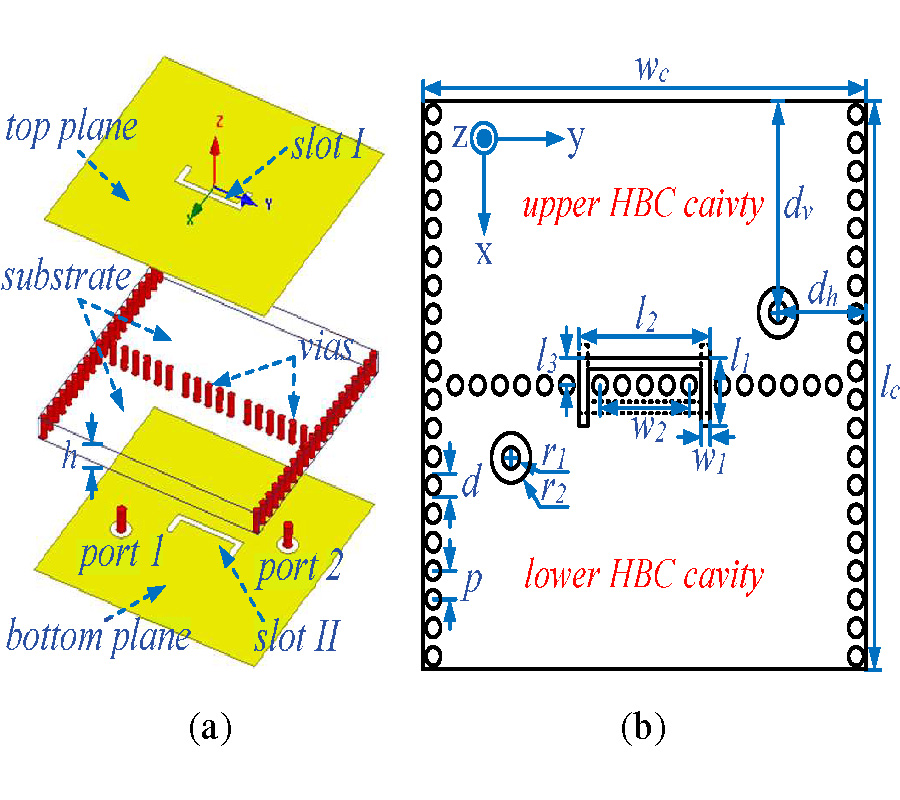
A novel design to enhance the bandwidth of a low-profile substrate integrated waveguide (SIW) cavity antenna is presented. Distinct from traditional antennas with unilateral slots, bilateral slots are utilized as radiating elements in the proposed design. By etching an additional slot at the bottom plane, a new resonant mode is introduced, and quality factors of two original modes are significantly reduced. Antenna's bandwidth can be dramatically enhanced by merging these three modes within a single operating band. A prototype is fabricated and measured. With the height of 0.018λ0, the measured 10-dB bandwidth is 410 MHz (3.24-3.65 GHz), corresponding to 11.9% fractional bandwidth. The measured gain is higher than 4.3 dBi, and the measured efficiency is around 75% within the operation band. Those attractive features, e.g. low profile, enhanced bandwidth and moderate radiation performance, make the proposed antenna suitable for future 5G systems.
BANDWIDTH ENHANCEMENT OF LOW-PROFILE SIW CAVITY ANTENNA WITH BILATERAL SLOTS
2019-03-02
PIER B
Vol. 83, 129-151
Method of Additive Regularization of Field Integrals in the Problem of Electromagnetic Diffraction by a Slot in a Conducting Screen, Placed Before a Dielectric Layer
Vladimir Serdyuk
We present a rigorous solution of a two-dimensional problem of stationary electromagnetic plane wave diffraction by a slot in a perfectly conducting screen having finite thickness in the presence of a plane dielectric layer behind the screen. For obtaining this solution, the method of additive regularization of singularities for field diffraction integrals is developed. This method is suitable for the cases of transparent, absorbing and amplifying dielectric. It reduces to explicit extraction of singularities in the form of supplementary singular integral terms, which describe waveguide modes of a dielectric layer. On the bases of the obtained solution, the conditions of optimum diffraction excitation for such modes are investigated in dependence of geometrical parameters of the problem for the cases, when these parameters are of the order of the radiation wavelength.
METHOD OF ADDITIVE REGULARIZATION OF FIELD INTEGRALS IN THE PROBLEM OF ELECTROMAGNETIC DIFFRACTION BY A SLOT IN A CONDUCTING SCREEN, PLACED BEFORE A DIELECTRIC LAYER
2019-03-02
PIER Letters
Vol. 82, 17-24
Design of X-Band Integrated Filtering Pyramidal Horn Antenna
Yun Wang , Fu-Chang Chen and Qing-Xin Chu
An X-band pyramidal horn antenna with a fourth order Chebyshev filtering function is presented in this paper. Four resonators are implemented in linear rectangular waveguide in the filter design. The last stage resonator provides not only resonance pole but also radiation function. To achieve high directivity, a pyramidal horn is attached to the filter output port, with negligible effect on the filter performance. Theoretical results are calculated based on the coupling matrix between the resonators. Finally, a pyramidal horn antenna operating at 10 GHz is designed and fabricated for demonstration. The measured results have found to be in good agreement with the simulated ones.
DESIGN OF X-BAND INTEGRATED FILTERING PYRAMIDAL HORN ANTENNA
2019-03-01
PIER C
Vol. 90, 169-181
A CMOS Power Amplifier Using a Balun Embedded Driver Stage for IEEE 802.11N WLAN Applications
Minoh Son , Jinho Yoo , Changhyun Lee and Changkun Park
In this work, we propose a balun embedded driver stage to enhance the bandwidth and minimize the chip size of a differential CMOS power amplifier. By removing the passive input transformer, the bandwidth and chip size are improved. The proposed driver stage acts as an input balun as well as the driver stage for the power stage. The proposed driver is composed of a cascade connected PMOS, an inductor, and NMOS to generate the differential output signal. For the function of the input balun, the gate of the PMOS is connected to the drain of the NMOS. To verify the feasibility of the proposed balun embedded driver stage, we design a differential CMOS power amplifier for 5-GHz IEEE 802.11n WLAN applications. The designed power amplifier is fabricated using the 180-nm SOI RF CMOS process. The measured 3-dB bandwidth is approximately 2.5 GHz. The chip size of the fully integrated power amplifier, including input and output matching networks and test pads, is 0.885 mm2. The measured maximum output power is 20.18 dBm with a PAE of 10.16%.
A CMOS POWER AMPLIFIER USING A BALUN EMBEDDED DRIVER STAGE FOR IEEE 802.11N WLAN APPLICATIONS
2019-03-01
PIER C
Vol. 90, 155-167
Design Analysis of a Semi-Circular Floral Shaped Directional UWB Antenna Integrated with Wireless Multiband Applications
Madan Lal Meena and Asheesh Gupta
This work presents a novel structure of semi-circular floral shape slotted antenna for an ultra-wideband (UWB) including WCDMA, Bluetooth and Wi-Max applications. Initially, a semi-circular floral shape radiator is designed by inserting an elliptical slot in patch with partial rectangular ground plane. Further, three rectangle symmetrical stepped slots are inserted in ground below 50 ohm micro-strip (MS) feed line which is integrated with stepped quarter wave transformer to achieve an ultra-wide impedance bandwidth. The proposed antenna structure achieves UWB of 4-18 GHz which cover 127% (S11<-10 dB) fractional bandwidth (FBW). Furthermore, ground plane is modified by loading three asymmetrical capacitive folded strip resonators (CFSR), which provide an additional lower frequency communication bands 2100 MHz (2-2.2 GHz), 2400 MHz (2.34-2.47 GHz), and 2700 MHz (2.69-2.75 GHz) for applications of WCDMA, Bluetooth, and Wi-Max, respectively. An optimized dimension of the proposed antenna is 30×30 mm2 (1.1λ0 ×1.1λ0), which is designed and fabricated on an FR-4 substrate having thickness 1.6 mm and dielectric constant 4.3. The proposed design is computed by Electromagnetic (EM), ADS simulator, and simulation results are validated with measured results.
DESIGN ANALYSIS OF A SEMI-CIRCULAR FLORAL SHAPED DIRECTIONAL UWB ANTENNA INTEGRATED WITH WIRELESS MULTIBAND APPLICATIONS
2019-03-01
PIER B
Vol. 83, 111-128
Land Cover Classification for Polarimetric SAR Image Using Convolutional Neural Network and Superpixel
Yilu Ma , Yuehua Li and Li Zhu
The classification algorithms of polarimetric synthetic aperture radar (PolSAR) imagesare generally composed of the feature extractors that transform the raw data into discriminative representations, followed by trainable classifiers. Traditional approaches always suffer from the hand-designed features and misclassification of boundary pixels. Following the great success of convolutional neural network (CNN), a novel data-driven classification framework based on the fusion of CNN and superpixel algorithm is presented in this paper. First, the region-based complex-valued network utilizes both the intensity and phase information to predict the label of each pixel and constructs the label map based on spatial relations. Second, superpixel generating algorithm is adopted to produce the superpixel representation of the Pauli decomposition image, and the contour information which reflects the boundary of each category is preserved. Finally, the original label map and contour information are fused to make the decision of each pixel, outputting the final label map. Experimental results on public datasets illustrate that the proposed method can automatically learn the intrinsic features from the PolSAR image for classification purpose. Besides, the fusion of the superpixel features can effectively correct the misclassification of the boundary and singular pixels, thus achieving superior performance.
LAND COVER CLASSIFICATION FOR POLARIMETRIC SAR IMAGE USING CONVOLUTIONAL NEURAL NETWORK AND SUPERPIXEL
2019-03-01
PIER M
Vol. 79, 91-100
CS-SFD Algorithm for GNSS Anti-Jamming Receivers
Fulai Liu , Lei Liu , Jiaqi Yang and Miao Zhang
Most of space-time adaptive processing methods have the excellent ability to suppress interferences when the space-time covariance matrix is perfectly estimated. Unfortunately, these methods may have calculation error of the covariance matrix in the case of fewer snapshots, which may lead to remarkable performance degrading. To solve the aforementioned problem, a space-frequency domain anti-jamming algorithm based on the compressed sensing theory (CS-SFD) is presented. Firstly, the proposed method utilizes less sampled data to form a space-frequency two-dimensional sparse representation for the narrowband interference signals. Secondly, the interference covariance matrix estimation problem is modeled as a sparse reconstruction problem which can be efficiently solved by the orthogonal matching pursuit algorithm. Furthermore, the diagonal loading method is used to modify the interference plus noise covariance matrix. Finally, the weight vector is given by the minimum output power criterion. Compared with the previous work, the presented method has better robustness and more effectively anti-jamming performance in the case of fewer snapshots. Simulation results show the effectiveness of the proposed algorithm.
CS-SFD ALGORITHM FOR GNSS ANTI-JAMMING RECEIVERS
2019-02-28
PIER C
Vol. 90, 139-154
Evaluation and Minimization of Cramer-Rao Bound for Conformal Antenna Arrays with Directional Emitters for DOA-Estimation
Yuri Nechaev , Ilia Peshkov and Natalia Fortunova
The Cramer-Rao lower bound (CRLB) for calculating errors and accuracy of direction-of-arrival (DOA) estimation is discussed for a number of planar waves arriving on an antenna array. It is well known that the geometry of antenna arrays imposes restrictions on the performances of the direction-of-arrival estimation. In particular, the influence of the directivity factor of the individual antenna elements on the accuracy of the DOA estimation of the radio emission sources for circular (cylindrical), cubic and spherical antenna arrays consisting of the directional antenna elements is investigated. The directivity factor of antenna elements is changed within wide limits in order to determine the values at which the high accuracy of the direction-finding can be achieved. It is shown that further increasing the directivity factor of each antenna element makes the mean square error in the determination of the coordinates of the signals increase as well. The exact expression for the Cramer-Rao lower bound for the DOA-estimation variance calculation depending on the antenna directivity and the geometry is presented. The obtained exact equation shows the most important factors that the direction-of-arrival estimation accuracy is dependent on. A technique of obtaining antenna arrays with optimal directional elements locations is proposed. Those arrays allow increasing DOA estimation accuracy by several times.
EVALUATION AND MINIMIZATION OF CRAMER-RAO BOUND FOR CONFORMAL ANTENNA ARRAYS WITH DIRECTIONAL EMITTERS FOR DOA-ESTIMATION
2019-02-28
PIER C
Vol. 90, 125-138
A Wide-Beam Base Station Antenna with Modular Radiator for Reconfigurability
Joshua W. Shehan and Ryan S. Adams
This paper presents a reconfigurable, wide-beam antenna with a modular main radiator for base station applications. The addition of new spectrum and the path to 5G create unique antenna requirements in terms of patterns and impedance matching capabilities. The antenna in this paper exhibits a wide azimuth beamwidth up to approximately 180o, and implements a modular approach where the antenna can be recon gured for impedance matching requirements. Two con gurations of the wide-beam antenna are presented; the rst con guration covers the 1.7-2.7 GHz band for 3G/4G/LTE applications where multiple wireless carriers would use the same antenna as a neutral site. This antenna provides wide-beam operation and a 10-dB return loss from approximately 1.64-2.76 GHz. The measured return loss over the 1.7-2.7 GHz band is better than 13 dB. A second con guration of the antenna is tuned for performance from 1.9-2.4 GHz where measured return loss better than 19 dB is achieved in this band. Simulated and measured return losses and patterns are presented that show very good agreement between simulation and measurement, and thorough parametric pattern analysis is presented for the baseline antenna configuration.
A WIDE-BEAM BASE STATION ANTENNA WITH MODULAR RADIATOR FOR RECONFIGURABILITY
2019-02-27
PIER C
Vol. 90, 109-124
Spherical Mapping of the Second-Order Phoenix Cell for Unbounded Direct Reflectarray Copolar Optimization
Vincent Richard , Renaud Loison , Raphael Gillard , Hervé Legay , Maxime Romier , Jean-Paul Martinaud , Daniele Bresciani and Fabien Delepaux
A general synthesis approach is proposed for reflectarrays using second order Phoenix cells. It relies on an original spherical representation that transforms the optimization domain in a continuous and unbounded space with reduced dimension. This makes the synthesis problem simpler and automatically guarantees smooth variations in the optimized layout. The proposed mapping is combined with an Artificial Neural Network (ANN) based behavioral model of the cell and integrated in a min/max optimization process. Bi-cubic spline expansions are used to decrease the number of variables. As an application, a contoured beam for space communication in the [3.6-4.2] GHz band is considered. The gain improvement compared to an initial Phase Only synthesis (POS) is up to 1.62 dB at the upper frequency. Full wave simulation of the final array is provided as a validation.
SPHERICAL MAPPING OF THE SECOND-ORDER PHOENIX CELL FOR UNBOUNDED DIRECT REFLECTARRAY COPOLAR OPTIMIZATION
2019-02-27
PIER C
Vol. 90, 95-107
A Novel Design of Hybrid Open Slot Antenna with Parasitic Element for Wideband Applications
Prashant Purohit , Bhupendra Kumar Shukla and Deepak Kumar Raghuvanshi
In this communication, a novel design of a hybrid open slot antenna is investigated and experimentally verified. The proposed structure comprises a slotted tuning stub, a proximity fed parasitic element, and slotted ground plane. Tuning and overlapping of best matching frequencies fr1, fr2, fr3, fr4, fr5, fr6, and fr7 are accomplished by varying the dimension of the parasitic element and elliptical slot which is the part of the elliptical slot. The experimental results reveal that this antenna covers the fractional bandwidth (BW(%) = 200 * (fh - fl)/(fh + fl)) of 139.5% from 0.98 GHz to 5.5 GHz for |S11|<-10 dB which is suitable for GSM 1800, WiMAX, PCS, and ITM-2000. After the analysis of current distribution, mathematical equations are developed for frequencies 1.04, 1.52, 3.06, 3.67, and 4.58 GHz. The structural analysis is also carried out for optimization and to know the electromagnetic behaviour of the antenna. Asymmetric radiation patterns are found at resonating frequencies due to open slot geometry.
A NOVEL DESIGN OF HYBRID OPEN SLOT ANTENNA WITH PARASITIC ELEMENT FOR WIDEBAND APPLICATIONS
2019-02-22
PIER B
Vol. 83, 93-109
Estimating the Probability Density Function of the Electromagnetic Susceptibility from a Small Sample of Equipment
Thomas Houret , Philippe Besnier , Stephane Vauchamp and Philippe Pouliguen
The failure risk of electronic equipment submitted to an electromagnetic aggression may be seen as the conditional probability that the susceptibility level of equipment is reached, knowing that a given constraint is applied. This paper focuses on the estimation of the probability density function of the susceptibility level of equipment. Indeed, the production variability of electric/electronic equipment under analysis implies that its susceptibility level may be considered as a random variable. Estimation of its distribution through susceptibility measurements of a limited set of available equipment is required. Either a Bayesian Inference (BI) or a Maximum Likelihood Inference (MLI) may be used for assessing the most probable density function. Above all, we highlight that they have to be used to delimit a set of probable distribution functions rather than the most probable one. It then provides realistic bounds of the failure probability at a given test level. First both types of inference are carried out on theoretical distributions. Then we compare the two methods on a virtual piece of equipment whose distribution is not known a priori but can be estimated a posteriori. Finally, we apply these inferences on a set of actual susceptibility measurements performed on several copies of equipment. We check that for extremely small sample size (a dozen) the Bayesian approach performs slightly better. However, above around 40, the two methods perform similarly. In all cases, the likelihood estimations provide a clear statement of the probabilistic estimation of the statistics of susceptibility level given a limited sample of pieces of equipment.
ESTIMATING THE PROBABILITY DENSITY FUNCTION OF THE ELECTROMAGNETIC SUSCEPTIBILITY FROM A SMALL SAMPLE OF EQUIPMENT
2019-02-21
PIER B
Vol. 83, 77-92
Electromagnetic Field Solutions in an Isotropic Medium with Weakly-Random Fluctuations in Time and Some Applications in the Electrodynamics of the Ionosphere
Victor Nijimbere and Lucy J. Campbell
Stochastic wave equations are derived to describe electromagnetic wave propagation in an isotropic medium in which the electric permittivity and the magnetic permeability are weakly-random functions of time. Approximate analytical solutions are obtained using separation of variables and the WKB method for some configurations that can be used to model the electromagnetic field in the ionosphere. The form of the initial and boundary conditions determines whether the solution takes a form representing a direct current electric field or continuous pulsation electromagnetic waves. The temporal variation of the calculated induced electromotive force (EMF) is in agreement with observations.
ELECTROMAGNETIC FIELD SOLUTIONS IN AN ISOTROPIC MEDIUM WITH WEAKLY-RANDOM FLUCTUATIONS IN TIME AND SOME APPLICATIONS IN THE ELECTRODYNAMICS OF THE IONOSPHERE
2019-02-21
PIER Letters
Vol. 81, 133-139
Fast Calculation of Monostatic Radar Cross Section of Conducting Targets Using Hierarchical Characteristic Basis Function Method and Singular Value Decomposition
Can Xia , Wanqing You and Yufa Sun
A novel hierarchical characteristic basis function method (HCBFM) is proposed to calculate monostatic radar cross section based on singular value decomposition characteristic basis function method. In order to reduce the number of incident plane waves and accelerate the generation of characteristic basis functions (CBFs), an improved CBFs construction method is studied in this paper. Firstly, the target is partitioned with hierarchical approach, and at each incident plane wave, the high-level CBFs defined in large blocks are expressed as a linear combination of the previously generated low-level CBFs defined in the corresponding small blocks. Finally, the high-level CBFs in large blocks are orthogonalized by using singular value decomposition at multiple excitations, and a set of linearly independent CBFs can be obtained. Numerical results are given to demonstrate the accuracy and high efficiency of the proposed method.
FAST CALCULATION OF MONOSTATIC RADAR CROSS SECTION OF CONDUCTING TARGETS USING HIERARCHICAL CHARACTERISTIC BASIS FUNCTION METHOD AND SINGULAR VALUE DECOMPOSITION
2019-02-21
PIER M
Vol. 79, 81-90
Ship Detection in SAR Image Based on Information Geometry Method
Xiangxiang Yang , Meng Yang , Yinhua Zhang and Gong Zhang
Aiming at the problem of high false alarm rate with respect to adaptive threshold in the ship detection from synthetic aperture radar (SAR) images, a novel strategy increasing robustness when using local adaptive threshold is proposed. In this article, we establish a fusion detection model based on a combination of the information geometry and surface geometry. Information geometry from a metric viewpoint can increase the contrast between targets and clutter in SAR image. Local surface feature gives a brief application of adaptive threshold method in ship detection from SAR images by means of the constant false-alarm-rate. Experiments indicate that the proposed geometry-based approach can effectively detect ship targets from complex background SAR images by using the method of fusion processing.
SHIP DETECTION IN SAR IMAGE BASED ON INFORMATION GEOMETRY METHOD
2019-02-20
PIER C
Vol. 90, 79-93
Radar Scatter from Layered Media and Rough Surfaces
Pradeep Bobby and Eric W. Gill
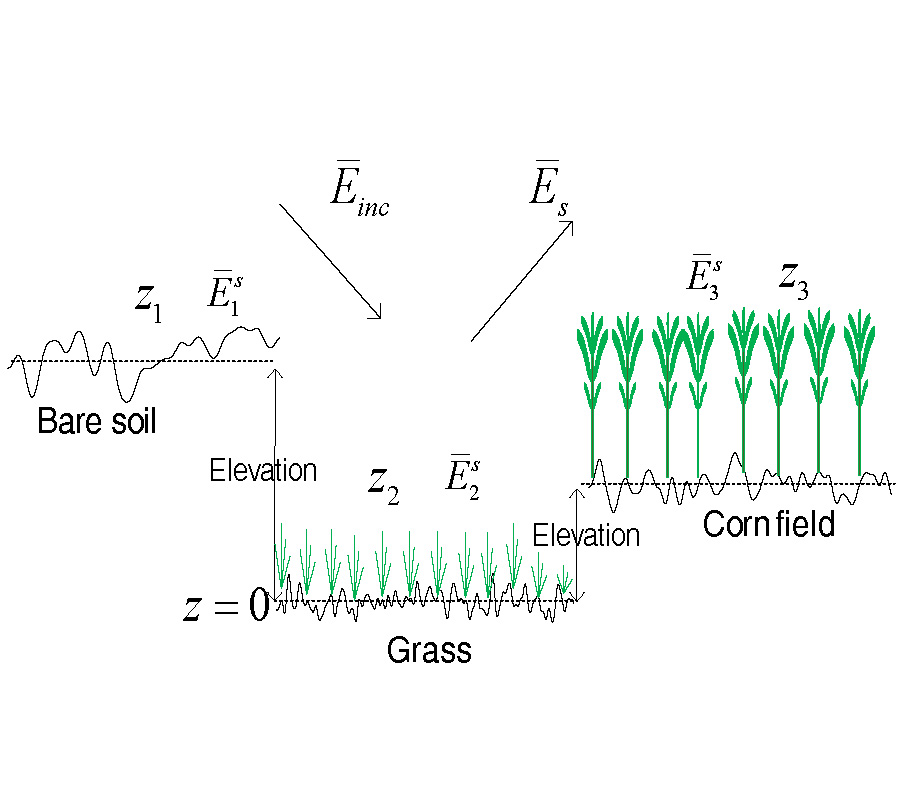
The generalized function approach for modeling radio wave scattering has been used to develop expressions for the scatter from rough surfaces and for horizontally-stratified media. The scattered field from rough surfaces can be found in closed form if plane wave incidence is assumed, but the method is valid for any realizable source without resorting to using Hertz vectors. This approach was originally developed to model high frequency surface wave radar scattering from the ocean or across layers of ice covering the ocean using vertical polarization. This paper presents three extensions to the existing theory: the x component of the scattered field for rough surface scattering is developed, the assumption of a good conducting surface assumption is removed for a rough surface and the scatter from stratified media is simplified in terms of a scattering coefficient. The shape of the scattered field is not affected by the relative permittivity, but the intensity of the scattered field is weaker due to an increased transmission of energy through the surface. The goal for this research is to better understand how signatures from ice-penetrating radar can be used to distinguish hazardous ice ridges from other ice features. Here, ice ridges are modeled as layered media with a rough surface.
RADAR SCATTER FROM LAYERED MEDIA AND ROUGH SURFACES
2019-02-20
PIER Letters
Vol. 82, 9-16
Design of a Novel Multi-Layer Wideband Bandpass Filter with a Notched Band
Xiao-Chun Ji , Wu-Sheng Ji , Li-Ying Feng , Ying-Yun Tong and Zhi-Yue Zhang
A wideband filter with a notched band is presented. The proposed filter is formed by cascading three coupling units, and each coupling unit is composed of two curved T-shaped microstrip patches at the top and bottom layers and a circular coupling slot at the mid layer. Overlapping three coupling units could result in a wideband filter with a tunable notched band. To analyse the resonance characteristics, the equivalent circuit model is presented. The notched frequency is 5.8 GHz, and within the passband, the insertion and return losses are better than -2 dB and -15 dB, respectively. The group delays are 0.08 ns and 0.12 ns correspondingly, and the upper stopband reaches 15 GHz. The multi-layer structure leads to a compact size and tight coupling characteristics, and the feasibility and excellent performance of the design is verified.
DESIGN OF A NOVEL MULTI-LAYER WIDEBAND BANDPASS FILTER WITH A NOTCHED BAND
2019-02-19
PIER C
Vol. 90, 65-77
Higher Order Mode Layered Cylindrical Dielectric Resonator Antenna
Abdulmajid A. Abdulmajid and Salam Khamas
A wideband high gain circularly polarized layered cylindrical dielectric resonator antenna (DRA) that operates in a higher order mode is proposed in the X-band frequency range. The antenna consists of two dielectric layers having different dielectric constants and radii. The results demonstrate a considerably improved performance as a result of adding the outer dielectric layer, where wider impedance and axial ratio bandwidths have been attained in conjunction with a higher broadside gain of ~14 dBic. A prototype has been built and measured with close agreement between experimental and simulated results.
HIGHER ORDER MODE LAYERED CYLINDRICAL DIELECTRIC RESONATOR ANTENNA
2019-02-19
PIER B
Vol. 83, 61-76
Accurate Calculation of the Power Transfer and Efficiency in Resonator Arrays for Inductive Power Transfer
Jose Alberto , Ugo Reggiani , Leonardo Sandrolini and Helena Albuquerque
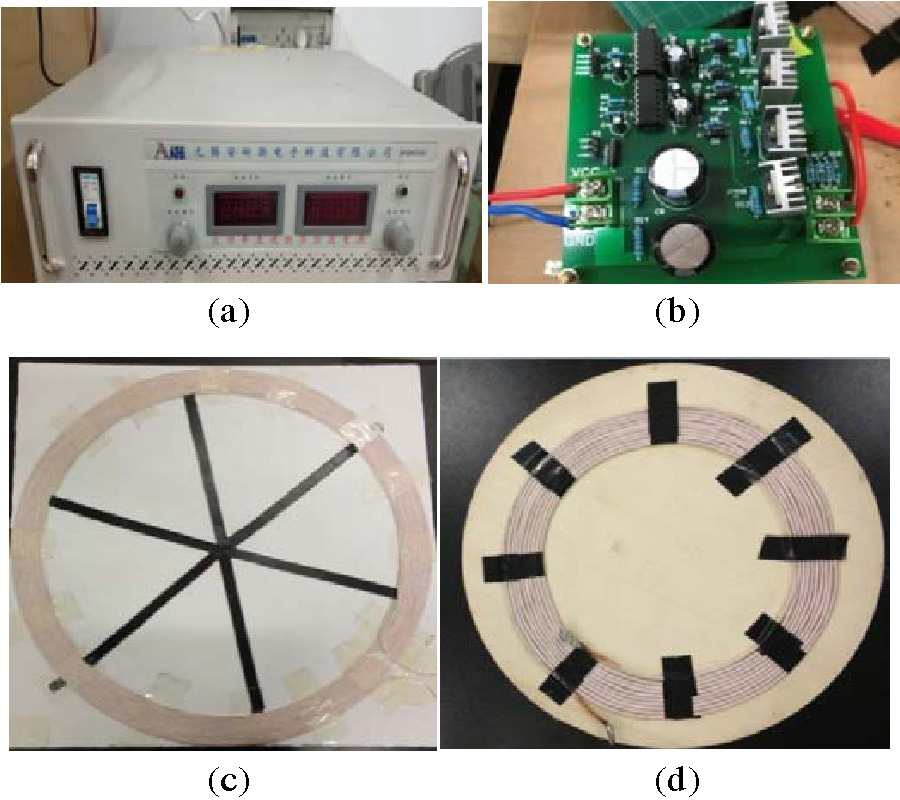
This paper studies the power transfer characteristics of a resonator array for inductive power transfer by means of the accurate analytical solution of its circuit model. Through the mathematical inversion of a tridiagonal matrix, it is possible to obtain closed-form expressions for the current in each resonator and consequently expressions for the power transfer and efficiency of the system. The method can be applied to a resonator array powering a load at the end of the array or a receiver facing the array at any position. With the expressions obtained, it is possible not only to achieve a better understanding of the power transfer characteristics in resonator arrays but also to obtain the conditions for maximum power transfer or maximum efficiency, for several conditions and parameters of the system. A prototype of a stranded-wire resonator array powered by a resonant inverter, capable of delivering power to a load from 65 W to 90 W with efficiency values between 63% and 88%, was built in order not only to validate the expressions obtained but also to show their practical applicability and demonstrate that these arrays can be used for higher power transfer applications.
ACCURATE CALCULATION OF THE POWER TRANSFER AND EFFICIENCY IN RESONATOR ARRAYS FOR INDUCTIVE POWER TRANSFER
2019-02-19
PIER Letters
Vol. 82, 1-8
Design of Compact Bend Triangular Resonator for Wide Band Application
Maruti Tamrakar and Usha Kiran Kommuri
The current wireless technology demands wide frequency operation, like WLAN 5GHz band, which requires 12.75% frequency bandwidth. In this paper, a unit cell metamaterial structure is proposed, which consists of 4 compact bend triangular resonators (CBTRs) that offer wideband frequency rejection. The single negative metamaterial based resonators give band rejection response, but it is generally bandwidth limited. With the proposed unit cell, rejection bandwidth of 16.78% for rejection level of -12 dB is achieved. It can be further increased by increasing the order of unit cells. The proposed unit cell structure is analyzed for the resonant frequency of 5.5 GHz, and the design is suitable for the application where 15% or more rejection band is required.
DESIGN OF COMPACT BEND TRIANGULAR RESONATOR FOR WIDE BAND APPLICATION