Search Results(13790)

2019-03-20
PIER Letters
Vol. 83, 7-14
Broadband Waveguide-Fed 8-by-1 Gap-Coupled Microstrip Antenna Array for 60-GHz Short-Range Point-to-Point Wireless Communications
Chaouki Hannachi , Tarek Djerafi and Serioja Ovidiu Tatu
In this paper, a 60-GHz broadband 8-by-1 gap-coupled microstrip antenna array is presented and experimentally investigated. The proposed antenna array has been implemented using a Miniature Hybrid Microwave Integrated Circuits (MHMIC) fabrication process on a thin ceramic substrate with εr = 9.9, and h = 127 μm. For a comprehensive characterization and to accurately evaluate losses, as well as manufacturing tolerances, the proposed antenna array structure has been implemented using two different feeding techniques. The first one adopts a grounded broadband via-hole less transition from coplanar to microstrip line (GCPW-to-MS), while the second one has involved a broadband waveguide (WR12) to microstrip transition, based on a ridged waveguide concept. The obtained results have demonstrated that the proposed gap-coupled array configuration provides an improved bandwidth (4.56%) and an enhanced gain (11.8 dBi), while maintaining a lower side-lobe level (13.4 dB). These outstanding performances make the proposed WR12 gap-coupled array structure a potential candidate for the future emerging 60-GHz short-range point-to-point wireless communication systems.
BROADBAND WAVEGUIDE-FED 8-BY-1 GAP-COUPLED MICROSTRIP ANTENNA ARRAY FOR 60-GHZ SHORT-RANGE POINT-TO-POINT WIRELESS COMMUNICATIONS
2019-03-20
PIER Letters
Vol. 82, 139-146
Compact CSRR Etched UWB Microstrip Antenna with Quadruple Band Refusal Characteristics for Short Distance Wireless Communication Applications
Rayavaram Kalyan , Kuraparthi Reddy and Kesari Padma Priya
This communication enlightens design, simulation, fabrication and testing of a novel compact CSRR etched ultra-wideband (UWB) patch Antenna with quadruple Band refusal characteristics. To design the antenna, the dimensions are chosen as 28x18x0.8 mm3. The design was done on FR4 substrate of 4.4 dielectric constant, 0.02 loss tangent. The planned antenna contains chamfered bevel slot rectangular radiating material with a complementary split ring resonator (CSRR) etched on one side and an incomplete ground plane on the other side of the substrate. To understand band rejection characteristics, four circular slots with different radii are etched on the radiating material as CSRR to reject bands at Worldwide Interoperability for Microwave Access (WiMAX) at 3.5 GHz, Indian national satellite (INSAT) at 4.6 GHz, wireless local area network (WLAN) services at 5.8 GHz, and Wideband Global SATCOM (WGS) at 8.2 GHz. The rejected bands center frequencies are perfectly coupled at particular slots with different radii. This compact antenna is effective and useful for short areas and can be easily incorporated in small devices. The results show that the antenna has a bandwidth from 2.77 GHz to 13 GHz. This antenna gains a worthy harmony between the simulated and measured results.
COMPACT CSRR ETCHED UWB MICROSTRIP ANTENNA WITH QUADRUPLE BAND REFUSAL CHARACTERISTICS FOR SHORT DISTANCE WIRELESS COMMUNICATION APPLICATIONS
2019-03-20
PIER
Vol. 164, 119-133
A Numerical Kirchhoff Simulator for GNSS-R Land Applications
Weihui Gu , Haokui Xu and Leung Tsang
A distinct feature of GNSS-R land reflectometry is that random rough surfaces are superimposed on many levels of elevations. The rms elevations are in tens of meters which are many times larger than the microwave wavelengths at GNSS frequencies. Such multiple elevations were not considered in the coherent model nor the incoherent model. In this paper, we studied the electromagnetic scattering of this new rough surface scattering problem using Kirchhoff integral as first-principle. A numerical Kirchhoff simulator is developed to calculate the electromagnetic scattering and the power ratio in the specular direction. The integration is carried out over a footprint of 10 km by 10 km with the specular point as the center. In integration the surface discretization is as small as 2cm by 2 cm so that a total of 2.5×10¹¹ patches are used. Parallel computing is implemented requiring a moderate amount of computer resources. The results of the power ratio of the numerical Kirchhoff simulator differ from the results of both the coherent model and incoherent model. The results show that the phase of the first Fresnel zone is random, and the power contributed by the first Fresnel zone is a small fraction of that over the 10 km by 10 km. The power ratios of the numerical Kirchhoff simulations are much larger than that of the incoherent model and smaller than the coherent model for small RMS heights. The results show that the multiple elevations in land have large effects on GNSS-R specular reflections.
A NUMERICAL KIRCHHOFF SIMULATOR FOR GNSS-R LAND APPLICATIONS
2019-03-19
PIER Letters
Vol. 82, 129-137
Design of Dual-/Tri-Band BPF with Controllable Bandwidth Based on a Quintuple-Mode Resonator
Sheng-Fang Zhang , Li Tian Wang , Sheng-Hui Zhao , Jie Zhou , Zhi-Peng Wang , Xin Zhang , Xue-Lian Liang , Ming He and Lu Ji
In this article, a new class of dual-/tri-band bandpass filters (BPFs) using a quintuple-mode resonator (QMR) is proposed. The classic odd-/even-mode analysis method is used to analyze the two filters due to their symmetrical structure. Owing to characteristics of the QMR, the dual-/tri-band BPFs based on the same topology are designed. The bandwidths (BWs) of the passbands are controllable. A dual-band BPF with center frequencies of 2.1 GHz/3.43 GHz and a tri-band BPF with center frequencies of 2.35 GHz/3.44 GHz/5.2 GHz are designed, fabricated, and measured. The fabricated filters are compact in size, and measured results are in good agreement with the simulated ones.
DESIGN OF DUAL-/TRI-BAND BPF WITH CONTROLLABLE BANDWIDTH BASED ON A QUINTUPLE-MODE RESONATOR
2019-03-19
PIER
Vol. 164, 109-118
Broadband Plasmonic Circuitry Enabled by Channel Domino Spoof Plasmons
Liangliang Liu , Li Ran , Huadong Guo , Xinlei Chen and Zhuo Li
Building of compact plasmonic integrated circuits based on domino spoof plasmons (DSPs) is an important requirement and still a challenge. In this work, we report the first demonstration of two kinds of channel domino plasmonic circuitries, which consist of an easy-to-manufacture periodic chain of metallic box-shaped elements inside two finite metallic plates. We reveal that only the channel DSPs itself rather than the hybrid TE10 and DSPs modes is supported in the part of the channel domino plasmonic waveguide with or without the metallic vias on both sides. Two channel domino plasmonic filters based on the efficient transition structures are designed, and the simulated S-parameters and near electric field distributions show excellent transmission performance in broadband. Utilizing the lateral insensitive property of these two channel DSPs, two kinds of broadband plasmonic power dividers/combiners are firstly implemented. Excellent transmission performance validates our optimizations and indicates that the proposed scheme can be easily extended to other bands. This work provides a new route for construction of deep-subwavelength DSP devices in application of high integration of microwave and terahertz circuits.
BROADBAND PLASMONIC CIRCUITRY ENABLED BY CHANNEL DOMINO SPOOF PLASMONS
2019-03-18
PIER Letters
Vol. 82, 121-128
Suppression of Higher Order Modes of a Two Element Microstrip Array Using Open-Ended Stubs
Susmita Biswas , Chandan Kumar Ghosh , Santimoy Mandal , Goffar Ali Sarkar , Soumen Banerjee and Durbadal Mandal
In this paper suppression of higher order modes of a microstrip antenna array is investigated. The array consists of two radiating elements which are fed by a corporate type microstrip feeding network. They array provides resonance at 5.2 GHz frequency for its fundamental mode (TM10 mode). Beside this fundamental mode, two harmonics at 10.4 GHz (1st harmonic) and 15.05 GHz (2nd harmonic) and few sub-harmonics at 7.8 GHz (TM12), 8.8 GHz (TM22), and 13.3 GHz (TM32) are excited. In order to suppress 1st harmonic, a pair of half wavelength open ended stubs (pair of stub-A) whereas for 2nd harmonic a pair of quarter wavelength open ended stubs (pair of stub-B) are employed. From the simulated results it is noticed that the 1st and 2nd harmonics are successfully suppressed, and the sub-harmonics are also suppressed. Prototypes of the antenna arrays are fabricated and measured. Measured results have good agreement with simulated ones.
SUPPRESSION OF HIGHER ORDER MODES OF A TWO ELEMENT MICROSTRIP ARRAY USING OPEN-ENDED STUBS
2019-03-16
PIER M
Vol. 79, 167-174
Aluminum-Based Engineered Plasmonic Nanostructures for the Enhanced Refractive Index and Thickness Sensing in Ultraviolet-Visible-Near Infrared Spectral Range
Pankaj Arora and Harsh Vardhan Awasthi
We engineer very low aspect ratio Aluminum (Al) based periodic plasmonic nanostructures with period ≈ resonance wavelength for enhanced refractive index and thickness sensing, which offer to access complete ultraviolet-visible-near infrared spectral range for SPR sensors. Al-based periodic nanostructures on top of a thin homogeneous Al metal coated on a BK-7 glass substrate were designed by systematic variation of geometrical parameters using Rigorous Coupled Wave Analysis and finite elements full wave solver, while, taking into account applicable fabrication constraints. The reason of adding a thin layer of homogeneous Al metal between the nanostructure and glass substrate was to convert the signature of Surface Plasmons (SPs) from transmission dips to transmission peaks, using ±1st order diffraction mode. The shift in SP mode excited on the nanostructure-analyte interface was used to measure the variation in refractive index, and the number of waveguide modes with the increase in the thickness of the analyte was used to capture the variation in thickness of the analyte. The proposed nanostructures of period 400 nm and an aspect ratio of 0.1 offered a sensitivity of 400 nm/RIU and full width at half maximum of 18 nm resulting in a figure of merit of 22. These plasmonic nanostructures have potential to be used as refractive index and thickness sensor due to a high figure of merit, high localization of the field, and very low aspect ratio that is needed to maintain laminar flow of analyte.
ALUMINUM-BASED ENGINEERED PLASMONIC NANOSTRUCTURES FOR THE ENHANCED REFRACTIVE INDEX AND THICKNESS SENSING IN ULTRAVIOLET-VISIBLE-NEAR INFRARED SPECTRAL RANGE
2019-03-15
PIER Letters
Vol. 82, 113-120
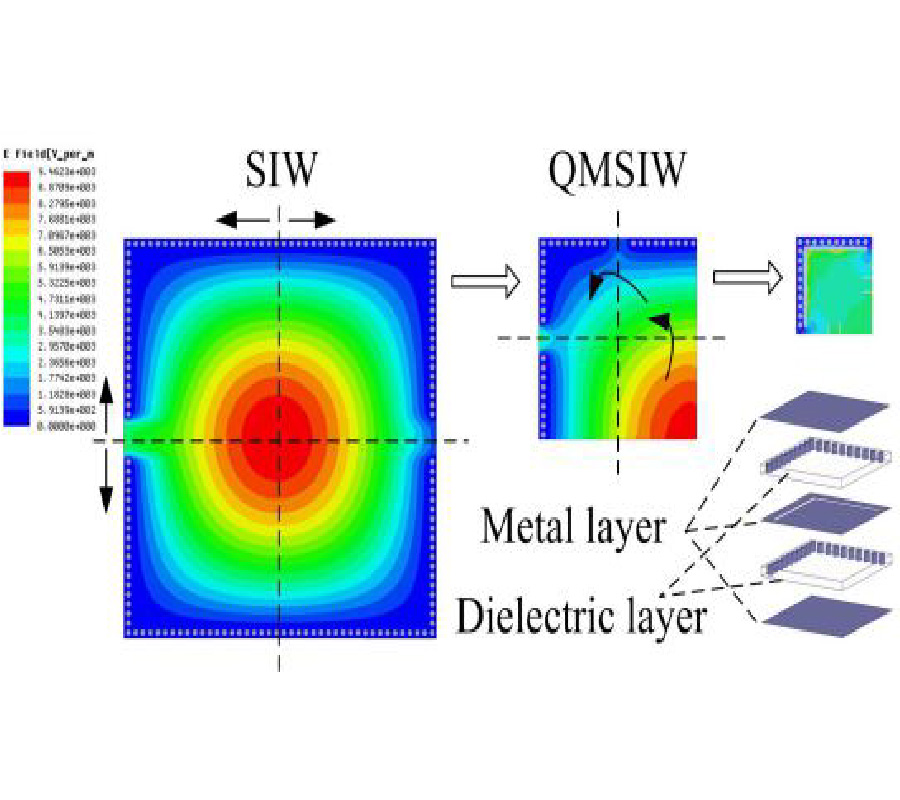
A Novel Ultra-Wideband Design of Ridged SIW Magic-T
Jia Wang and Tianqing Ling
In order to obtain a wideband sum-and-difference network, a novel ridged substrate integrated waveguide (RSIW) magic-T is designed. The proposed magic-T is composed of a five-layer RSIW structure. The signal input from the coaxial H-plane port is transmitted to RSIW through a stripline and split into two in-phase and equal signals at the output ports on the top and bottom layers because of the vertically symmetric structure. An E-plane SIW power divider is utilized to realize the E-plane input/output port of the magic-T. A remarkable bandwidth improvement is achieved due to the ridged structure and the wide bandwidth of a ladder-shape stripline optimized by genetic algorithm (GA). Measured results indicate that the magic-T has a fractional bandwidth (FBW) of 78.7% (6.4-14.7 GHz) with return loss better than 18.1 dB and great isolation characteristics.
A NOVEL ULTRA-WIDEBAND DESIGN OF RIDGED SIW MAGIC-T
2019-03-15
PIER M
Vol. 79, 159-166
Determining Real Permittivity from Fresnel Coefficients in GNSS-R
Patrizia Savi , Silvano Bertoldo and Albert Milani
Global Navigation Satellite System Reflectometry (GNSSR) can be used to derive information about the composition or the properties of ground surfaces, by analyzing signals emitted by GNSS satellites and reflected from the ground. If the received power is measured with linearly polarized antennas, under the condition of smooth surface, the reflected signal is proportional to the modulus of the perpendicular and parallel polarization Fresnel coefficients, which depend on the incidence angle θ, and on the dielectric constant ε of the soil. In general, ε is a complex number; for non-dispersive soils, the imaginary part of ε can be neglected, and a real value of ε is sought. We solve the real-valued problem explicitly giving formulas that can be used to determine the dielectric constant ε and we compare the analytical solution with experimental data in the case of sand soil.
DETERMINING REAL PERMITTIVITY  FROM FRESNEL COEFFICIENTS IN GNSS-R
2019-03-14
PIER Letters
Vol. 82, 107-112
Amplitude Control Null Steering in a Multi-Mode Patch Antenna
Zabed Iqbal and Maria Pour
A novel null steering method in a multi-mode circular microstrip patch antenna is presented in this letter. A stacked patch configuration, capable of exciting three different radiating modes, namely TM11, TM21, and TM31, is investigated. When two or three modes are excited simultaneously, up to three nulls can be formed in the upper hemisphere, and by tuning the amplitude ratio of these modes, a continuous null steering pattern is realized. It is shown that a full hemispherical null steering of ±90° range can be achieved using the proposed method. The null steering capability with different dielectric permittivities is also presented.
AMPLITUDE CONTROL NULL STEERING IN A MULTI-MODE PATCH ANTENNA
2019-03-14
PIER Letters
Vol. 82, 101-106
A Novel UWB Antenna with Triple Band-Notches for WiMAX and WLAN
Lingzhi Cui , Hui Liu , Chuanhui Hao and Xubao Sun
By etching a half-wavelength hook-shaped slot on the ground and adding quarter-wavelength rectangle-shaped strips in the patch, a novel triple band-notched ultra-wideband (UWB) antenna is proposed. The triple band-notches are used to prevent interferences from existing bands at 3.3-3.9 GHz, 5.15-5.35 GHz, and 5.725-5.825 GHz. Fed by coplanar waveguide, the antenna is printed on a 30*30 mm2 substrate. The parameters affecting antenna performance are simulated and analyzed. The simulated and measured results show that the proposed antenna achieves a wide bandwidth from 3 GHz to 11 GHz with triple band-notches. Radiation patterns and gain are also investigated and analyzed.
A NOVEL UWB ANTENNA WITH TRIPLE BAND-NOTCHES FOR WIMAX AND WLAN
2019-03-14
PIER M
Vol. 79, 147-157
A Compact Endfire Radiation Antenna Based on Spoof Surface Plasmon Polaritons in Wide Bandwidth
Kaijie Zhuang , Jun-Ping Geng , Ziheng Ding , Xiaonan Zhao , Wenfeng Ma , Han Zhou , Chao Xie , Xianling Liang and Rong-Hong Jin
A compact slot-coupled endfire radiation antenna based on a tapering spoof surface plasmon polaritons (SSPPs) structure with high efficiency is proposed in this paper. A narrow slot balun is designed to feed the SSPPs structure rather than to work as the primary radiator. Simulated results show that the odd SPP mode is successfully excited on the tapering SSPPs structure, which contributes to the endfire radiation. Due to the high confinement of SSPPs, the proposed antenna shows low RCS within the frequency band of 1.5 GHz-4 GHz and 5.6 GHz-8 GHz. A prototype is fabricated and tested. Simulated and measured results show good agreement that the proposed antenna can provide stable endfire radiation patterns within the frequency band of 2 GHz-3.4 GHz. The maximum gain reaches 8 dBi, and the average efficiency over this bandwidth is 80%. The high-efficiency endfire SSPPs antenna with balanced broad band and high gain has a promising application in communication systems and integrated circuits.
A COMPACT ENDFIRE RADIATION ANTENNA BASED ON SPOOF SURFACE PLASMON POLARITONS IN WIDE BANDWIDTH
2019-03-13
PIER Letters
Vol. 82, 95-100
Beam Scanning Microstrip Leaky Wave Antenna Design Based on Liquid Crystal
Chunyang Pan , Ziyuan He and Yaling Liu
A novel beam scanning microstrip leaky wave antenna based on liquid crystal material is proposed in this paper. Based on the dielectric anisotropy of the liquid crystal, the main beam angle of the antenna pattern can be easily adjusted with the changing of external bias voltages. Good agreement between simulated and measured results is found for the presented leaky wave antenna. Both the simulation and test frequencies of the antenna are set at 12 GHz. Besides, the measured data show that when the dielectric constant of the liquid crystal changes from 2.4 to 2.52, about 10 degrees tuning range of the main beam angle is achieved.
BEAM SCANNING MICROSTRIP LEAKY WAVE ANTENNA DESIGN BASED ON LIQUID CRYSTAL
2019-03-13
PIER Letters
Vol. 82, 89-94
Long Term Irradiance Statistics for Optical GEO Downlinks: Validation with ARTEMIS Experimental Measurements
Theodore T. Kapsis , Nikolaos K. Lyras and Athanasios Panagopoulos
In this letter, a methodology for the generation of received irradiance/power time series for a GEO downlink concentrated on small aperture receiver terminals is reported. The synthesizer takes into account the atmospheric phenomena that degrade the propagation of the optical signal and especially the turbulence effects. For modeling the scintillation effects, Kolmogorov spectrum is assumed, and the Rytov's approximation under weak turbulence is also used. The time series are generated using the theory of stochastic differential equations. Finally, the proposed synthesizer is compared in terms of first order statistics with experimental data from the ARTEMIS GEO optical satellite link campaign with very good agreement.
LONG TERM IRRADIANCE STATISTICS FOR OPTICAL GEO DOWNLINKS: VALIDATION WITH ARTEMIS EXPERIMENTAL MEASUREMENTS
2019-03-12
PIER C
Vol. 91, 55-67
A Compact UWB Printed Monopole MIMO Antenna with Mutual Coupling Reduction
Hossein Babashah , Hamid Reza Hassani and Sajad Mohammad-Ali-Nezhad
A compact multiple-input-multiple-output (MIMO) antenna with very high isolation is proposed for ultrawideband (UWB) applications. The antenna with a compact size of 30.1×20.5 mm2 (0.31λ0×0.λ0) consists of two planar-monopole antenna elements. It is found that isolation of more than 25 dB can be achieved between two parallel monopole antenna elements. For the low frequency isolation, an efficient technique of bending the feed-line and applying a new protruded ground is introduced. To increase isolation, a design based on suppressing surface wave, near-field, and far-field coupling is applied. The simulation and measurement results of the proposed antenna with the good agreement are presented and show a bandwidth with S11 ≤ -10 dB, S12 ≤ -25 dB ranged from 3.1 to 10.6 GHz making the proposed antenna a good candidate for UWB MIMO systems.
A COMPACT UWB PRINTED MONOPOLE MIMO ANTENNA WITH MUTUAL COUPLING REDUCTION
2019-03-12
PIER Letters
Vol. 82, 81-87
Impact of External DC Magnetic Bias Field and Frequency on the Bistability Features of a Nonlinear Microwave Meta-Atom
Aleksey A. Girich and Sergey I. Tarapov
In this paper, we present our experimental study of the effect of the external DC magnetic bias field on the nonlinear properties of meta-atom loaded with ferrite elements of different shapes. It is demonstrated experimentally that the adjustment of the resonance frequency of the meta-atom loaded with the ferrite elements of different shapes is possible not only by the input microwave power but also by the external DC magnetic bias field. It is shown that as the external DC magnetic bias field is increased to a certain value, the resonance curve of the nonlinear meta-atom demonstrates bistability. In addition, we achieve significant enhancement of the meta-atom nonlinearity using the nonlinear properties of both ferrite and varactor diode.
IMPACT OF EXTERNAL DC MAGNETIC BIAS FIELD AND FREQUENCY ON THE BISTABILITY FEATURES OF A NONLINEAR MICROWAVE META-ATOM
2019-03-12
PIER Letters
Vol. 82, 73-80
Coupling Matrix Optimization Synthesis for Filters with Constant and Frequency-Variant Couplings
Gang Li
This paper presents a quickly converging optimization technique for synthesis of filters with constant and frequency-variant couplings (FVC). Unlike the works so far appeared in the literature, the proposed technique is not based on the direct optimization of scattering parameters with assigned topology, but it consists of two procedures. Firstly, an FVC coupling matrix with assigned topology is suitably transformed by means of scaling and rotations for obtaining the new coupling matrix with constant couplings. Then, the cost function is constructed as a least squares problem involving both the eigenvalues of the new coupling matrix with constant couplings and that of the transversal coupling matrix. The solution is found via the solvopt optimization method. Two numerical examples with different topologies and specifications are synthesized to show the validation of the method presented in this paper.
COUPLING MATRIX OPTIMIZATION SYNTHESIS FOR FILTERS WITH CONSTANT AND FREQUENCY-VARIANT COUPLINGS
2019-03-12
PIER M
Vol. 79, 137-145
Systematic Detailed Design of Unequal-Split 3-Way Bagley Power Dividers Using Uniform Transmission Lines
Omar Jibreel , Nihad I. Dib and Khair Al Shamaileh
In this paper, we systematically derive design equations for 3-way Bagley power dividers with arbitrary split ratios using interconnecting transmission lines with the same characteristic impedance. The exact value of the characteristic impedance for a specific dividing ratio is determined using these equations to achieve perfect input port matching. To validate the design procedure, two microstrip dividers with different split ratios, 1:3:1 and 1:10:1, are designed, simulated, fabricated, and measured. The desired split ratios are achieved at the design frequency, 1 GHz. Good agreement between simulated and measured results is obtained.
SYSTEMATIC DETAILED DESIGN OF UNEQUAL-SPLIT 3-WAY BAGLEY POWER DIVIDERS USING UNIFORM TRANSMISSION LINES
2019-03-11
PIER C
Vol. 91, 39-53
A Compact Notched UWB MIMO Antenna with Enhanced Performance
Ekta Thakur , Naveen Jaglan , Samir Dev Gupta and Binod Kanaujia
This paper investigates the performance of compact triple band-notched Multiple Input Multiple Output (MIMO) antenna for Ultra-Wideband (UWB) communication. Open-ended quarter wavelength slots are inserted on the radiators. These slots are used to obtain notch bands at WiMAX/C band, WLAN band and the X-band Satellite Communication System that ranges in 3.3-4.2 GHz, 5-6 GHz, and 7.2-8.6 GHz respectively. An I-shaped stub extends from the ground surface to minimize mutual coupling among radiating elements. Mutual coupling and Envelope Correlation Coefficient are found less than -15 dB and 0.2, respectively. The diversity characteristics like Mean Effective Gain Ratio and Total Active Reflection Coefficient are found around 1dB and less than -10.5 dB, respectively. The radiation efficiency of the radiator is more than 80% over the entire UWB frequency range. The proposed antenna is designed with the overall dimensions of 23×40×1.6 mm3.
A COMPACT NOTCHED UWB MIMO ANTENNA WITH ENHANCED PERFORMANCE
2019-03-11
PIER Letters
Vol. 82, 65-72
Design of an Implantable Antenna Operating at ISM Band Using Magneto-Dielectric Material
Zhihao Luan , Lulu Liu , Wei-Hua Zong , Zhejun Jin and Shandong Li
A novel technique to design a wideband implantable antenna has been proposed by using magneto-dielectric material. The antenna is a half cutting of a coplanar waveguide fed antenna with symmetric geometry printed on a flexible substrate with 24 um thickness. A piece of magneto-dielectric sheet with 0.25 mm thickness is attached on the bottom layer of the antenna to tune the antenna bandwidth. The antenna is simulated in a one-layer body phantom. Simulation shows that the antenna has a wide bandwidth covering 902-928 MHz Industrial, Scientific, and Medical (ISM) band when the body phantom is filled with muscle. There are frequency bandwidth shifts when the body phantom is filled with different tissues of skin, small intestine, and stomach, respectively. The antenna has wide bandwidth covering ISM band in these tissues. Measurement has been done in meat mince. The measured bandwidth of proposed antenna is 810-1062 MHz. The proposed antenna has a compact size of 4 mm×12 mm×0.274 mm suitable to be applied in capsule endoscope, wireless pacemaker, etc.
DESIGN OF AN IMPLANTABLE ANTENNA OPERATING AT ISM BAND USING MAGNETO-DIELECTRIC MATERIAL