Search Results(13790)

2019-01-30
PIER Letters
Vol. 81, 113-120
CPW-Fed Dual-Band Dual-Sense Circularly Polarized Antenna for WiMAX Application
Manas Midya , Shankar Bhattacharjee and Monojit Mitra
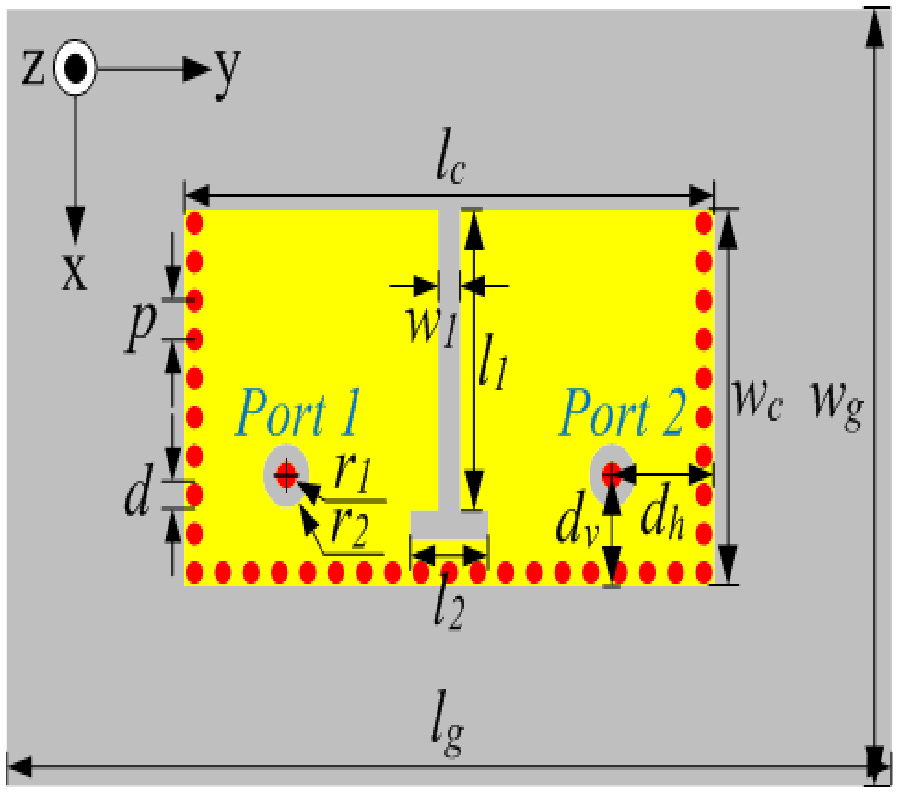
This paper presents a CPW-fed dual-band dual-sense circularly polarized square slot antenna (CPSSA). The antenna consists of a rectangular radiator with two unequal rectangular strips, connected by a CPW feed line. An inverted L-shaped grounded stub is placed in the right side of the slotted ground plane with the orthogonal direction of the feed line to create CP modes. The proposed antenna obtained two CP bandwidths of 3.30-3.78 GHz and 5.40-5.86 GHz with axial ratio (AR) value less than 3 dB, and both the CP bands are overlapped by impedance bandwidth (IBW) of the antenna, ranging from 2.72 to 7.34 GHz. Total size of the proposed antenna is 50×50×1.58 mm3. The antenna is fabricated on an FR4-epoxy substrate and measured. Simulation results are verified by measurement for the given antenna. The designed antenna is well used for WiMAX (3.5 GHz and 5.5 GHz) band with CP characteristics. Design procedures of the antenna are discussed in details for further understanding of the antenna design. Parametric study has been done for describing the mechanism of the dual-band CP with the analysis of electric current distribution of the antenna. Meanwhile, wide axial ratio bandwidth has been obtained in both the bands using this structure compared to other published structures.
CPW-FED DUAL-BAND DUAL-SENSE CIRCULARLY POLARIZED ANTENNA FOR WIMAX APPLICATION
2019-01-28
PIER M
Vol. 78, 115-124
Analysis and Reduction of Cogging Torque of Line-Start Permanent Magnet Motors
Libing Jing , Jun Gong and Ying Lin
Compared with a standard permanent magnet synchronous motor, a line-start permanent magnet synchronous motor (LSPMSM) has additional features that include two-sided slots on its stator and rotor. Thus, due to its complex air gap form, there is no simple method to calculate the cogging torque of this kind of motor at present. This paper presents a new analytical method that models the rotor as an equivalent magnetic motive force (MMF) distribution in the air gap which avoids the influence of rotor slotting in the air gap. Based on the energy method, an analytical method is presented here to analyze the pole-slot match of stator and the influence of number of slots per pole of rotor on the cogging torque. The effect of auxiliary slots on cogging torque of LSPMSM is studied and by changing the number of auxiliary slots to reduce the cogging torque, the correctness of the above method has been validated by the finite element method.
ANALYSIS AND REDUCTION OF COGGING TORQUE OF LINE-START PERMANENT MAGNET MOTORS
2019-01-28
PIER
Vol. 164, 63-74
Efficient Broadband Evaluations of Lattice Green's Functions via Imaginary Wavenumber Components Extractions
Shurun Tan and Leung Tsang
A novel and systematic method is developed to evaluate periodic Green's functions on empty lattices through extractions of an imaginary wavenumber component of the lattice Green's function and its associated derivatives. We consider cases of volumetric periodicity where the dimensionality of the periodicity has the same dimensionality as the physical problem. This includes one-dimensional (1D) problem with 1D periodicity, two-dimensional (2D) problem with 2D periodicity, and three-dimensional (3D) problem with 3D periodicity, respectively. The remainder of the Green's function is put in spectral series with high-order power-law convergence rates, while the extracted imaginary wavenumber parts are put in spatial series with super-fast and close-to exponential convergence rate. The formulation is free of transcendental functions and thus simple in implementation. It is especially efficient for broadband evaluations of the Green's function as the spatial series are defined on fixed wavenumbers that take small CPU to compute, and the spectral series have simple and separable wavenumber dependences. Keeping only a few terms in both the spatial and spectral series, results of the lattice Green's function are in good agreement with benchmark solutions in 1D, 2D, and 3D, respectively, demonstrating the high accuracy and computational efficiency of the proposed method. The proposed method can be readily generalized to deal with Green's functions including arbitrary periodic scatterers.
2019-01-25
PIER Letters
Vol. 81, 107-112
Design and Analyses of a CRLH-HMSIW-Based LWA with Low Cross-Polarization
Huan Zhang , Tao Wan and Tao Ni
A composite right/left-handed (CRLH) half mode substrate integrated waveguide (HMSIW) based leaky wave antenna (LWA) is designed and analyzed in this paper. Equivalent circuit of the unit cell is extracted, and the CRLH performance is clarified. Two HMSIW structures are placed back-to-back to obtain low cross-polarization performance, which is further validated by differential excitation principle. The presented LWA is demonstrated to be a balanced structure with a beam scanning range from -60° to +31°. Besides, less than 1.7 dBi gain variation in the working band (46% centered at 13 GHz) is obtained. Simulated and measured results agree well as experiment shows.
DESIGN AND ANALYSES OF A CRLH-HMSIW-BASED LWA WITH LOW CROSS-POLARIZATION
2019-01-25
PIER M
Vol. 78, 103-113
An Airborne VHF Printed Monopole Antenna for Platform Constrained Applications
Mary Rani Abraham , Sona O. Kundukulam and Chandroth K. Aanandan
Major challenges faced by airborne VHF monopole antennas are to achieve wideband characteristics in permissible antenna height and to find the apt location for mounting, so as to satisfy sufficient ground plane around its feed point. The increased applications of electromagnetic spectrum result in a large number of antennas competing in the limited space available on platform. The asymmetries and curved surfaces on the platform as well as the limited size of the available ground plane may result in an insufficient ground plane for these antennas on platform. The deficient ground plane can deteriorate the radiation characteristics of antenna. Printed monopole antenna, which does not require a backing ground plane, can overcome this deficiency, as the ground planes of these antennas are implemented in the same plane as that of the radiating element. This paper proposes a wideband printed monopole VHF antenna for airborne applications, which simultaneously achieves reduced height and reduced ground plane on platform. The antenna has a size of 0.1045λ × 0.1272λ × 0.072λ, where λ is the free space wavelength at lowest frequency of operation, and it achieves a 3:1 VSWR bandwidth of 38%. The radiation characteristics and size of the proposed antenna are comparable to the conventional airborne blade monopole antenna with the added advantage of requiring minimal ground plane to mount on.
AN AIRBORNE VHF PRINTED MONOPOLE ANTENNA FOR PLATFORM CONSTRAINED APPLICATIONS
2019-01-24
PIER M
Vol. 78, 93-101
An Asymmetric-Width Broad-Side Coupled Transformer to Reduce the Parasitic Coupling Capacitance for CMOS Power Amplifier Applications
Jonghoon Park , Changhyun Lee and Changkun Park
In this study, we propose a broad-side coupled transformer with reduced capacitance for RF CMOS power amplifier applications. The width of the secondary winding is decreased to reduce parasitic coupling capacitance. Additionally, an auxiliary primary winding is added to improve the coupling between the primary and secondary windings. To prove feasibility of the proposed transformer, we design the transformer using 180-nm RF CMOS technology. From the simulated results of a typical transformer and the proposed broad-side coupled transformer, we successfully find that the parasitic coupling capacitance of the proposed structure is reduced compared to that of a typical structure. Additionally, the auxiliary primary winding increases the maximum available gain of the proposed transformer.
AN ASYMMETRIC-WIDTH BROAD-SIDE COUPLED TRANSFORMER TO REDUCE THE PARASITIC COUPLING CAPACITANCE FOR CMOS POWER AMPLIFIER APPLICATIONS
2019-01-24
PIER M
Vol. 78, 83-92
Investigations of Specific Absorption Rate and Temperature Variations for an UWB Antenna for Wireless Applications
Mohandoss Susila , Thipparaju Rama Rao , Karthik Varshini , Palaniswamy Sandeep Kumar and Marudappa Pushpalatha
This paper portrays a compact planar ultra-wideband (UWB) antenna design and development for wireless applications. The proposed antenna is influenced by fractal geometry design, where a pentagon slot is introduced inside a circular metallic patch, and iterations were carried out to achieve needed wide bandwidth. The antenna is deployed over an FR4 substrate with relative permittivity of 4.4 and thickness of 0.16 cm, to achieve wider impedance bandwidth. The proposed antenna is of low profile with dimensions of 32 mm x 32 mm, and it operates over bandwidth of 12.1 GHz (2.9-15 GHz). Specific Absorption Rate (SAR), the measure of exposure of electromagnetic (EM) energy on human tissues, is observed when proposed antenna is placed in close proximity to the dispersive phantom model. Also, the time domain analysis is done on human tissue model to observe the performance of the antenna and to validate its capability with wireless devices which are in near vicinity to the human all the time. Further, in this research, the temperature variation on human tissue is examined using Infrared (IR) thermal camera. Investigation on these parameters and validation with Radio Frequency (RF) equipment helps to prove that the proposed antenna is a suitable candidate for UWB wireless communication applications.
INVESTIGATIONS OF SPECIFIC ABSORPTION RATE AND TEMPERATURE VARIATIONS FOR AN UWB ANTENNA FOR WIRELESS APPLICATIONS
2019-01-23
PIER Letters
Vol. 81, 101-105
Physical Limits of Electromagnetic Responses of Layered Stacked Structures
Binbin Zhu , Huquan Li , Ruopeng Liu , Chunlin Ji and Dong Wei
In this paper, we theoretically investigate the electromagnetic response of the widely used layered stacked structure. For a causality and lossy system, For a causality and lossy system, relationships between maximum values of reflection and transmission coefficients are demonstrated, which are related with many parameters, such as absolute bandwidth, layers thicknesses and real parts of the static permittivity and static permeability. Different polarizations and incident conditions are discussed. The results can provide a criterion to judge different designs operating at different spectrum ranges with different thicknesses and materials by comparing them with achievable physical limits.
2019-01-23
PIER M
Vol. 78, 69-81
An Enhanced Forward-Looking SAR Imaging Algorithm Based on Compressive Sensing
Bo Pang , Hao Wu , Shiqi Xing , Dahai Dai , Yongzhen Li and Xuesong Wang
Having the imaging ability of the area in front of flight direction, forward-looking synthetic aperture radar (SAR) has become a hot topic in areas of SAR research. Nevertheless, constrained by limited azimuth aperture length,the imaging of forward-looking SAR suffers from poor azimuth resolution. Aiming at this problem, an enhanced forward-looking SAR imaging algorithm is proposed in this paper. This algorithm takes both super-resolving ability and computational burden into account. Firstly, an imaging framework is proposed to decrease the computational burden. Secondly, an iterative regularization implementation of compressive sensing (CS) is proposed to improve azimuth resolution. Finally, imaging experiments based on simulated data and Ku-band complex valued image data from the MiniSAR system demonstrate the effectiveness of the proposed algorithm.
AN ENHANCED FORWARD-LOOKING SAR IMAGING ALGORITHM BASED ON COMPRESSIVE SENSING
2019-01-23
PIER
Vol. 164, 27-61
On the Convergence of Numerical Computations for Both Exact and Approximate Solutions for Electromagnetic Scattering by Nonspherical Dielectric Particles (Invited Review)
Ping Yang , Jiachen Ding , Richard Lee Panetta , Kuo-Nan Liou , George Kattawar and Michael I. Mishchenko
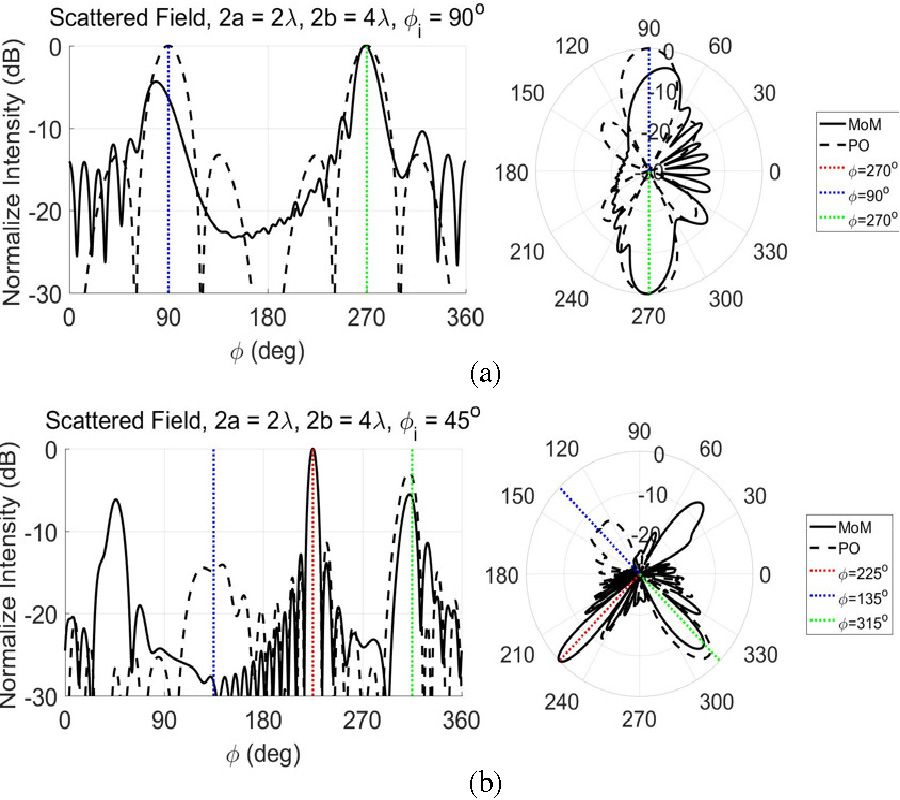
We summarize the size parameter range of the applicability of four lightscattering computational methods for nonspheric dielectric particles. These methods include two exact methods - the extended boundary condition method (EBCM) and the invariant imbedding T-matrix method (II-TM) and two approximate approaches - the physical-geometric optics method (PGOM) and the improved geometric optics method (IGOM). For spheroids, the single-scattering properties computed by EBCM and II-TM agree for size parameters up to 150, and the comparison gives us confidence in using IITM as a benchmark for size parameters up to 150 for other geometries (e.g., hexagonal columns) because the applicability of II-TM with respect to particle shape is generic, as demonstrated in our previous studies involving a complex aggregate. This study demonstrates the convergence of the exact II-TM and approximate PGOM solutions for the complete set of single-scattering properties of a nonspherical shape other than spheroids and circular cylinders with particle sizes of ~48λ, specifically a hexagonal column with a size parameter of length as kL=300, where k=2π/λ and L is the column length. IGOM is also quite accurate except near the exact 180º backscattering direction. This study demonstrates that a synergetic combination of the numerically-exact II-TM and the approximate PGOM can seamlessly cover the entire size parameter range of practical interest. To demonstrate the applicability of the approach, we compute the optical properties of dust particles with a downstream application to the retrieval of dust aerosol optical thickness and effective particle size from polarimetric observations.
ON THE CONVERGENCE OF NUMERICAL COMPUTATIONS FOR BOTH EXACT AND APPROXIMATE SOLUTIONS FOR ELECTROMAGNETIC SCATTERING BY NONSPHERICAL DIELECTRIC PARTICLES (INVITED REVIEW)
2019-01-22
PIER Letters
Vol. 81, 93-100
Impedance Synthesis of 2D Antenna Arrays of Slotted Spherical Radiators
Yuriy M. Penkin , Viktor A. Katrich and Mikhail Nesterenko
An impedance synthesis problem of 2D antenna arrays consisting of slotted spherical radiators, whose geometric centers are located at nodes of a flat rectangular grid with double periodicity, has been solved. The problem is formulated as follows: to determine complex impedances distributed over surfaces of the spherical radiators which allows us to steer the radiation pattern (RP) of the antenna array to given directions. Analytical solution of the impedance synthesis problem (as an alternative to numerical solution) was obtained under the assumption that spherical radiators are excited by axially symmetric magnetic currents with equal amplitudes. The approach was verified by simulation of the five-element linear antenna array. The possibility of RP scanning in a wide range was confirmed by using the synthesized distributions of complex impedances.
IMPEDANCE SYNTHESIS OF 2D ANTENNA ARRAYS OF SLOTTED SPHERICAL RADIATORS
2019-01-22
PIER M
Vol. 78, 59-68
Pole-Zero Analysis of Microwave Filters Using Contour Integration Method Exploiting Right-Half Plane
Eng Leong Tan and Ding Yu Heh
This paper presents the pole-zero analysis of microwave filters using contour integration method exploiting right-half plane (RHP). The poles and zeros can be determined with only S21 by exploiting contour integration method on the RHP along with certain S matrix properties. The contour integration in the argument principle is evaluated numerically via the finite-difference method. To locate the poles or zeros, the contour divide and conquer approach is utilized, whereby the contour is divided into smaller sections in stages until the contour enclosing the pole or zero is sufficiently small. The procedures to determine the poles and zeros separately are described in detail with the aid of pseudocodes. To demonstrate the effectiveness of the proposed method, it is applied to determine and analyze the poles and zeros of various microwave filters.
POLE-ZERO ANALYSIS OF MICROWAVE FILTERS USING CONTOUR INTEGRATION METHOD EXPLOITING RIGHT-HALF PLANE
2019-01-21
PIER B
Vol. 83, 43-60
A Joint Detection and Tracking Algorithm for Unresolved Target and Radar Decoy
Zhiyong Song , Fei Cai and Qiang Fu
Miniature Air Launched Decoy (MALD) is an electronic warfare technique for inducing an angular deception in a monopulse radar by recreating glint angular error. MALD flies cooperatively with the true target, forms unresolved group targets within the radar beam, and destroys the detection, tracking and parameter estimation of monopulse radar for the true target. In this paper, a typical scenario for one target and one decoy was discussed, and the measurement model of target and decoy based on the actual non-ideal sampling conditions was established. The joint multi-targets probability density was adopted to dynamically describe the number and state of the targets within the radar beam. Based on the original observation without threshold decision, a joint detection and tracking algorithm for unresolved target and decoy was proposed under the Bayesian framework, and the judgment of existence of jamming and the target state estimation were deduced. Simulation results showed that the proposed method enabled quick detection of the appearance of MALD and estimated the state of target with minimal delay and high precision. Stable tracking of the true target was achieved under severe jamming conditions.
A JOINT DETECTION AND TRACKING ALGORITHM FOR UNRESOLVED TARGET AND RADAR DECOY
2019-01-17
PIER B
Vol. 83, 25-42
Multi-Objective Optimization of Wireless Power Transfer Systems with Magnetically Coupled Resonators and Nonlinear Loads
Johan Winges , Thomas Rylander , Carl Petersson , Christian Ekman , Lars-Ake Johansson and Tomas McKelvey
We present an optimization procedure for wireless power transfer (WPT) applications and test it numerically for a WPT system design with four resonant circuits that are magnetically coupled by coaxial coils in air, where the magnetic field problem is represented by a fully populated inductance matrix that includes all magnetic interactions that occur between the coils. The magnetically coupled resonators are fed by a square wave voltage generator and loaded by a rectifier followed by a smoothing filter and a battery. We compute Pareto fronts associated with a multi-objective optimization problem that contrasts: 1) the system efficiency; and 2) the power delivered to the battery. The optimization problem is constrained in terms of: 1) the physical construction of the system and its components; 2) the root-mean-square values of the currents and voltages in the circuit; and 3) bounds on the overtones of the currents in the coils in order assure that the WPT system mainly generates magnetic fields at the operating frequency. We present optimized results for transfer distances from 0.8 to 1.6 times the largest coil radius with a maximum power transfer from 4 kW to 9 kW at 85 kHz, which is achieved at an efficiency larger than 90%.
MULTI-OBJECTIVE OPTIMIZATION OF WIRELESS POWER TRANSFER SYSTEMS WITH MAGNETICALLY COUPLED RESONATORS AND NONLINEAR LOADS
2019-01-17
PIER M
Vol. 78, 49-58
A Fast and Accurate Multi-Element Calibration Algorithm of an Active Phased Antenna Array
Akinwale Oluwaseyi Fadamiro , Oluwole John Famoriji , Abdul-Hafeez Ali , Rabiu Sale Zakariyya , Zhongxiang Zhang and Fujiang Lin
In this paper, a simple and fast calibration algorithm is proposed for an active phased antenna array measurement of the amplitude and phase of all the antenna elements. Euler's numerical method is used to simultaneously measure and calibrate the array element's electric field and array factor. Each element's phase shifts are periodically varied with a reference state, and their variations are calculated and analyzed for signal calibration. The method is theoretically studied using numerical simulations providing accurate performance and a very low tolerance to errors. This method provides a multiple element far field calibration technique applicable to radar, satellite, and wireless communication.
A FAST AND ACCURATE MULTI-ELEMENT CALIBRATION ALGORITHM OF AN ACTIVE PHASED ANTENNA ARRAY
2019-01-17
PIER M
Vol. 78, 39-48
Analysis of Connection Way of a Three-Dimensional Receiving Coil Onboard a Capsule Robot for Wireless Power Transmission
Jinyang Gao , Guozheng Yan , Yunbo Shi , Huiliang Cao , Kun Huang , Hui Gao and Jun Liu
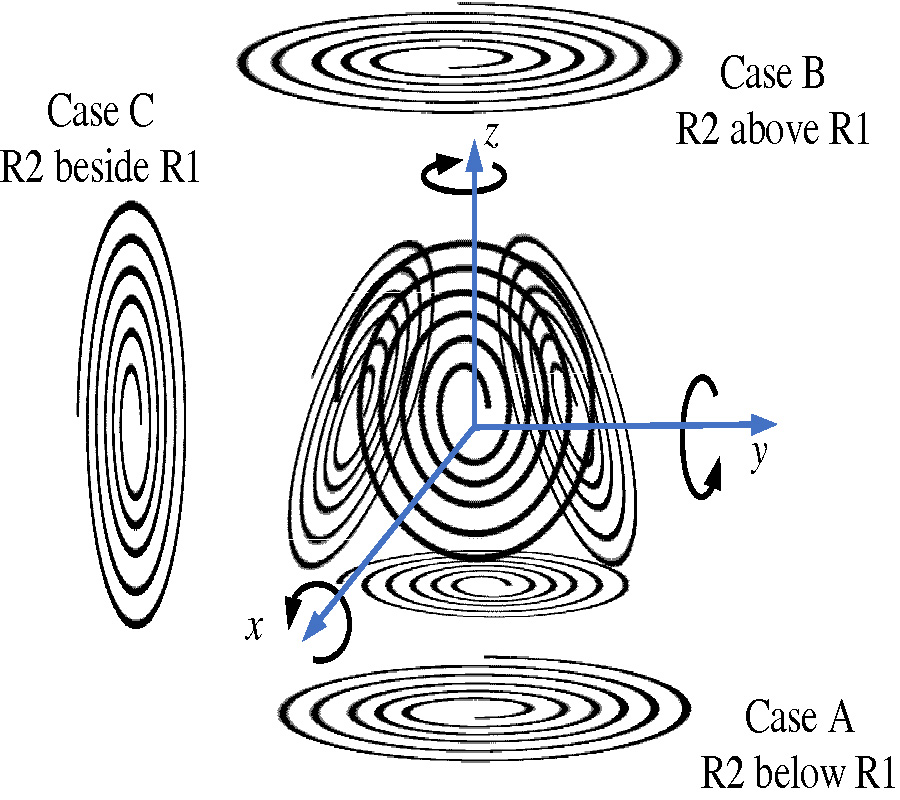
Wireless power transmission (WPT) based on near-field inductive coupling is a promising solution to power a tether-less capsule robot (CR) for medical application, and it is normally implemented with a one-dimensional transmitting coil for exciting an alternating magnetic field and an three-dimensional (3-D) receiving coil onboard the CR for induction. The connection way of the 3-D receiving coil has an influence on its output power supplied to the CR, but a method for quickly selecting series/parallel connection is not available yet. This paper is dedicated to developing such a method. Firstly, an analytical expression of the output power of the 3-D receiving coil when selecting series/parallel connection was derived, and its correctness was experimentally validated: the calculated output power using the analytical expression matched well with the measured one, having an average deviation of 1.42%/0.57% when selecting series/parallel connection. Then, a criterion for quickly selecting the connection way was deduced from the analytical expression, which indicates that the connection way is much related to the CR load: when the CR load is smaller than a critical load, parallel connection enables a larger output power average; otherwise, series connection does. A calculation method of the critical load is also given, which can be determined by available parameters relating to the transmitting coil and 3-D receiving coil. Thus, this paper provides a guidance for quickly selecting the connection way of the 3-D receiving coil.
ANALYSIS OF CONNECTION WAY OF A THREE-DIMENSIONAL RECEIVING COIL ONBOARD A CAPSULE ROBOT FOR WIRELESS POWER TRANSMISSION
2019-01-16
PIER M
Vol. 78, 29-37
Miniaturized Dual-Band Antenna with a Rectangular Patch and Symmetrically Placed Circles in the Partial Ground Plane
Sudeep Baudha , Aman Kumar Goswami and Manish Varun Yadav
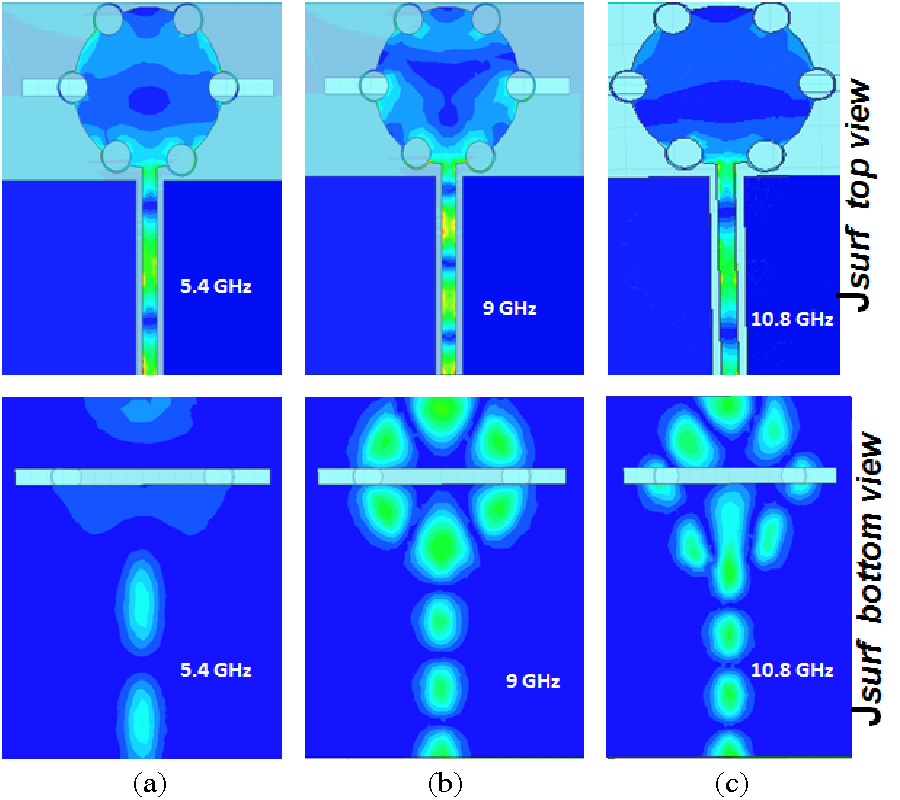
This paper presents a miniaturized dual-band antenna with a rectangular patch and symmetrically placed circles in the partial ground plane. The dimensions of the proposed antenna are 15 * 20 * 1.5 mm3, and the antenna is excited by a 50 Ω microstrip line from the bottom. The proposed antenna is fabricated on the commercially available low-cost FR4 substrate having relative permittivity εr = 4.3 and loss tangent 0.025. By introduction of a rectangular slot with a T-shape in the ground plane and a rectangular patch, the lower frequency band is achieved. The peak gain and radiation efficiency of the proposed antenna are 2 dB and 78%. The proposed antenna operates at 2.846 GHz to 3.24 GHz and 4.05 GHz to 6.22 GHz frequency range. The antenna finds its application in S-band, 5.5/5.8 GHz WiMAX bands, and 4.9/5/5.9 GHz Wi-Fi bands.
MINIATURIZED DUAL-BAND ANTENNA WITH A RECTANGULAR PATCH AND SYMMETRICALLY PLACED CIRCLES IN THE PARTIAL GROUND PLANE
2019-01-16
PIER M
Vol. 78, 19-27
Improving Efficiency of the Secondary Sources Method for Modeling of the Three-Dimensional Electromagnetic Field of Eddy Currents
Dmitriy M. Filippov and Alexandr A. Shuyskyy
A mathematical model is constructed for calculating a three-dimensional quasistationary electromagnetic field in a piecewise-homogeneous medium containing massive conductors which is excited by a variable magnetic field. The field is varying in time according to an arbitrary law. It is proposed to use the integral relation instead of the boundary condition written at a point, which allows one to get away from the problem of collocation points and at the same time increase the computational efficiency of the numerical model. The magnetic field is calculated for the case of the excitation of eddy currents in a conducting sample containing a cut of finite size. The results obtained are confirmed by natural experiments.
IMPROVING EFFICIENCY OF THE SECONDARY SOURCES METHOD FOR MODELING OF THE THREE-DIMENSIONAL ELECTROMAGNETIC FIELD OF EDDY CURRENTS
2019-01-15
PIER M
Vol. 78, 11-18
Secrecy Sustainable Transmission Design in Energy Harvesting Enable Relay Networks
Jianfeng Kong , Feng Zhou and Zhenhai Liu
In this paper, we investigate the secrecy design in a sustainable relay network, where the relay is energy harvesting enabled and utilizes time switching to harvest wireless power. Specifically, assuming half-duplex amplify-and-forward relaying, we investigate the worst-case secrecy rate maximization by jointly designing the relay beamforming matrix, artificial noise covariance, and the time switching ratio. However, the formulated problem is highly non-convex due to the secrecy rate function and the dynamic relay transmit power constraint. By decoupling the original problem, we propose a two-layer optimization algorithm, where the outer problem is solved by two-dimensional search while the inner problem is solved by semi-definite relaxation. Numerical results show the effectiveness of the proposed scheme.
SECRECY SUSTAINABLE TRANSMISSION DESIGN IN ENERGY HARVESTING ENABLE RELAY NETWORKS
2019-01-14
PIER C
Vol. 90, 29-39
A Novel Dual-Passband Net-Shaped FSS Structure Used for MIMO Antennas
Zhiwei Liu , Shunli Jie , Haitao Ma , Xiao-Yan Zhang and Beibei Xing
A dual-passband frequency selective surface (FSS) is designed in this paper. Two passbands are 2-3.4 GHz and 5.5-6.8 GHz, respectively. It is used as a spatial filter to improve the radiation and scattering performance of an antenna. The structure is combined with two layers. One is metal, and the other is intermediate medium. The requirements of wide-band, polarization-independent, wide incidence angle and miniaturized FSS with a thickness of only 0.0085λ are achieved by parameter optimization. When the FSS is used to improve the proposed microstrip antenna, the relative bandwidth can be increased by 31.4% and 50%, and the peak gain is increased by 2.53 dB and 1.86 dB at 5.8 GHz and 6.4 GHz, respectively. Meanwhile, the maximum RCS reduction of the microstrip antenna is 16 dB. On the other hand, the FSS is able to be applied to a dipole antenna to improve the transmission coefficient and phase. Simulation and measurement results of the transmission coefficient and phase of the antenna are almost the same.
A NOVEL DUAL-PASSBAND NET-SHAPED FSS STRUCTURE USED FOR MIMO ANTENNAS