Search Results(13790)

2018-12-13
PIER M
Vol. 77, 17-28
Single-Feed Single-Patch Triple-Band Single-Beam/Dual-Beam U-Slotted Patch Antenna
Huaxiao Lu , Yuan'an Liu , Fang Liu and Weimin Wang
A novel single probe-fed, single-layer, and single-patch triple-band microstrip antenna is presented. By incorporating two identical U-slots in the patch whose length is λd instead of 1/2λd in a conventional patch, three operating bands are achieved. Dual-beam radiation pattern is obtained at the upper band, and a single broadside beam radiation pattern is obtained at each of the lower and middle bands. The antenna's structure is simple. Only by using a single probe-fed point, the impedance matches well at all the three resonant frequencies. The measured and simulated results are in good agreement. The measured lower, middle, and upper bands are centered at 2.442 GHz, 3.505 GHz, and 5.787 GHz, respectively. The measured gains are 6.2 dBi at 2.442 GHz and 5.5 dBi at 3.505 GHz, respectively. At 5.787 GHz, the measured gains for the dual radiation beams are 8.4 dBi directed at 26° and 8.2 dBi directed at -38°, respectively. The proposed antenna can be a candidate for WLAN 2.4 GHz, WLAN 5.8 GHz, and 3.5 GHz of 5G (the fifth-generation mobile communication) operation.
SINGLE-FEED SINGLE-PATCH TRIPLE-BAND SINGLE-BEAM/DUAL-BEAM U-SLOTTED PATCH ANTENNA
2018-12-13
PIER M
Vol. 76, 207-215
Low Loss and High Transmission Electromagnetically Induced Transparency (EIT) Effect in Cylindrical through-Hole Dielectric Cubes
Lei Zhu , Xin Zhao , Chunhui Zhao , Liang Dong , Feng Juan Miao , Chao Hui Wang and Jing Guo
We numerically demonstrate that an electromagnetically induced transparency (EIT) effect can be achieved in an all-dielectric metamaterial, whose micro unit consists of two cylindrical through-hole cubes (CTCs). Two CTCs produce electric and magnetic Mie resonances in the vicinity of 6.2 GHz, respectively. Specially, the appropriate control on the interaction between two Mie resonances can lead to destructive interference of scattering fields, and thus the EIT effect with low loss and high transmission can be achieved. The influences of key parameters of all-dielectric metamaterial on its EIT effects are also investigated. In addition, the slow wave property of proposed structure is verified by computing the group delay, and the superiority of CTC is discussed. Such an all-dielectric metamaterial may have potential applications in areas such as low loss slow wave devices and high sensitivity sensors.
LOW LOSS AND HIGH TRANSMISSION ELECTROMAGNETICALLY INDUCED TRANSPARENCY (EIT) EFFECT IN CYLINDRICAL THROUGH-HOLE DIELECTRIC CUBES
2018-12-12
PIER C
Vol. 89, 13-26
Using Parametric Design to Reduce the EMI of Electronics Products - Example of Medical-Grade Touch Panel Computer
Chien-Yi Huang , Ching-Hsiang Chen and Christopher Greene
With technical advancement and development, the amount of electronic equipment is increasing, while the functions of products are enhanced, and the routing density of Printed Circuit Boards (PCBs) becomes larger. In the electronic industry, medical instruments are used to diagnose, treat, mitigate or prevent human diseases, and maintain and promote health. Industrial PCs for medical use and their accessories should be immune to interference from external electromagnetic noise, and should not become interference sources of electromagnetic noise radiation, so they have become issues of interest with respect to ensuring safety of medical equipments in medical operation environments in recent years. This research relates to parametric design using the Taguchi Method in the early stage of product development for medical-grade touch panel computers. In considering the use of Radiated Emission (RE) in Electromagnetic Compatibility (EMC) as a response value, the experiment covers control factors such as PCB and mechanism design related parameters. In addition, peripheral devices used in conjunction with a product are considered as noise factors when the product is in use, while interaction between the control factors is studied. The Taguchi Method is used to select an appropriate inner/outer orthogonal array, and a response diagram and a variance method are used for analysis to provide an optimal set of design parameters, in which the number of routing layers of a riser card is 6; the EMI filter on the isolated card is 600 Ω; the shunt capacity for the clock on main board is 33p; and the isolated card is grounded. Moreover, it is found that an interaction exists between the number of routing layers of the riser card and the EMI filter of the isolated card. From the result of the experiment, with such a set of parameters, the SN (Signal to Noise Ratio) lies in the confidence interval, indicating good reproducibility of the experiment. Such a parametric design effectively improves the electromagnetic interference (EMI) characteristics of a product to meet design specifications required by customers, accelerate the R&D process of electronic products, and pass EMI test regulations required by various countries in order to improve industrial competitiveness.
USING PARAMETRIC DESIGN TO REDUCE THE EMI OF ELECTRONICS PRODUCTS - EXAMPLE OF MEDICAL-GRADE TOUCH PANEL COMPUTER
2018-12-12
PIER M
Vol. 76, 197-205
MZR Resonators Etched in Microstrip Patch with Enhanced Bandwidth and Reduced Size
Xiao-Feng Li , Lin Peng , Jing Ma , Bin Shi , Xiaoming Li and Xing Jiang
Two mu-zero resonance (MZR) resonators are etched in the patch of a microstrip antenna. The two MZR resonators generate two new resonances. As the MZR resonances are lower than the microstrip antenna resonance and the resonances merge with each other, size reduction and bandwidth enhancement were obtained. A prototype was designed and measured. The measured impedance bandwidth increased from 640 MHz (5.31-5.95 GHz, 11.33%) of the referenced microstrip antenna (RMA) to 940 MHz (4.99-5.93 GHz, 17.22%) of the proposed MZR loaded microstrip antenna (MZR-MA). Moreover, the patch size is decreased from 0.354λl × 0.283λl of the RMA to 0.332 λl × 0.266λl of the MZR-MA, and unidirectional radiation patterns are obtained for the microstrip patch and MZR resonances. A microstrip line based model was built to analyze the MZR resonators.
MZR RESONATORS ETCHED IN MICROSTRIP PATCH WITH ENHANCED BANDWIDTH AND REDUCED SIZE
2018-12-12
PIER M
Vol. 76, 187-195
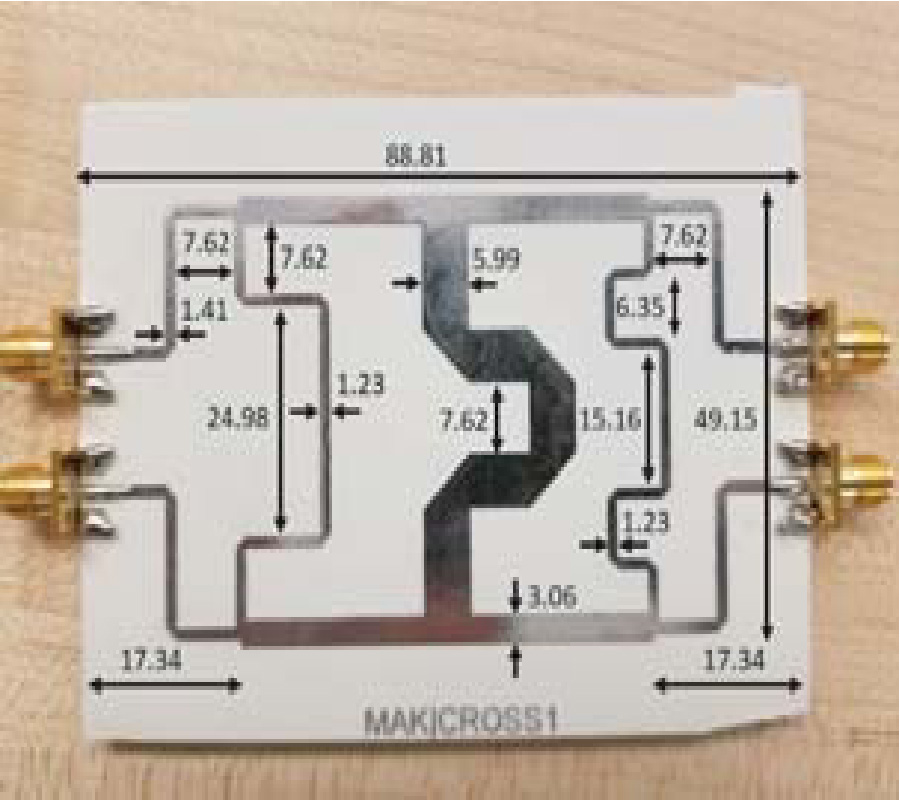
Dual-Mode Diplexer with High Isolation Based on Amplitude and Phase Cancellation Technique
Natchayathorn Wattikornsirikul and Montree Kumngern
This paper presents an ease of dual-mode diplexer with high signal isolation based on amplitude and phase cancellation technique. The dual-mode structure enables a compact and easy asymmetrical frequency response which also requires considerable attenuation between the proximity in frequency of the transmitter and that of the receiver. Two back-to back dual-mode three-port diplexers and a 180˚ phase shifter are easily employed to construct the proposed device, which are combined to form a four-port dual-mode diplexer. A 180˚ phase shift in one branch can be achieved by delayed transmission line. The simulated and measured four-port dual-mode diplexers are designed at the operational frequency of Tx/Rx at 1.95 GHz and 2.14 GHz, respectively. The measured results of Tx/Rx dual-mode diplexer devices are presented of 48.5 dB Tx/Rx isolation. This four-port dual-mode diplexer achieves the isolation (S32) more than 21.5 dB compared with a conventional three-port dual-mode diplexer.
DUAL-MODE DIPLEXER WITH HIGH ISOLATION BASED ON AMPLITUDE AND PHASE CANCELLATION TECHNIQUE
2018-12-11
PIER C
Vol. 88, 285-295
Wide-Band Dual Sense Circularly Polarized Resonant Cavity Antenna for X Band Applications
Swati Vaid and Ashok Mittal
This paper presents the design and analysis of a wideband circularly polarized resonant cavity antenna (RCA). The antenna structure consists of dual-layer Jerusalem cross type partially reflective surface (PRS) above a two-port wideband circularly polarized patch antenna. The PRS enhances the gain of the feeding patch antenna over wide range of frequencies. The structure provides left hand as well as right hand circular polarizations. Parametric analysis of the structure is also presented. The measured 10 dB return loss bandwidth and 3 dB axial ratio bandwidth of the RCA are 25 % (8.24-10.63 GHz) and 28.8% (8.3 GHz-11.1 GHz), respectively. Isolation more than 10 dB is obtained for the frequency range 9.15-10.61 GHz. Measured results show peak realized gain of 9 dBi in the operating band.
WIDE-BAND DUAL SENSE CIRCULARLY POLARIZED RESONANT CAVITY ANTENNA FOR X BAND APPLICATIONS
2018-12-11
PIER M
Vol. 76, 177-185
Microstrip Moisture Sensor Based on Microstrip Patch Antenna
Sweety Jain , Pankaj Kumar Mishra , Vandana Vikas Thakery and Jyoti Mishra
A miniaturized U-Shape patch sensor (15 mm×15 mm) was designed at dual resonating frequencies (fr) 5.2 GHz and 6.8 GHz). The proposed design printed on FR4 material with a thickness of 1.676 mm and relative permittivity 4.4. To simulate the performances of the proposed design, the CST Microwave Studio (CST MWS) was used. The reflection coefficient of U-Shape patch sensor was measured. Basmati rice was investigated, and bulk density was increased with increase of moisture content, hence varied from 554.3 to 591 kg/m3. It has the longest average rice length (L) 7.2 mm, average width (W) 1.61 mm, and L/W ratio 4.47. The percentage of moisture was varied from 10.12% to 20.35% calculated on a wet weight basis. The lowest mean relative error (MRE) determined between predicted moisture content (PMC) and actual moisture content (AMC) was 0.55% at dual frequencies.
MICROSTRIP MOISTURE SENSOR BASED ON MICROSTRIP PATCH ANTENNA
2018-12-11
PIER M
Vol. 76, 167-175
Asymmetric Ground Structured Circularly Polarized Antenna for ISM and WLAN Band Applications
Badugu Prudhvi Nadh , Boddapati Taraka Phani Madhav , Munuswamy Siva Kumar , Manikonda Venkateswara Rao and Tirunagari Anilkumar
This article presents the design and analysis of a dual-band antenna with circular polarization for ISM and WLAN band applications. The proposed antenna operates at two frequencies ranging from 2.1-3.1 GHz and 4.4-7.7 GHz with resonating frequencies at 2.45 GHz industrial, scientific and medical band (ISM) and 5.8 GHz wireless local area network band (WLAN). The antenna is fed by coplanar waveguide feeding (CPW) with an asymmetric ground structure, and the radiating element consists of 24 spokes in the design. The current antenna providing the impedance bandwidths of 38.4% and 49% at two operating bands. The proposed antenna exhibiting circular polarisation with 3 dB axial ratio bandwidth of 150 MHz at 2.33-2.48 GHz and 1600 MHz at 5.14-6.74 GHz. The designed antenna is fabricated on an RT Duroid 5880 substrate with dimensions of 40 x 28 x 0.4 mm3. The intension behind the design of this antenna is to use it for wearable applications in conformal nature with low specific absorption rate (SAR). The SAR values observed at two operating frequencies are 1.09 W/Kg and 1.47 W/Kg, respectively. The placement and radiation characteristics analysis is done with Ansys Savant tool, and the subsequent measured results provide good correlation with simulation results.
ASYMMETRIC GROUND STRUCTURED CIRCULARLY POLARIZED ANTENNA FOR ISM AND WLAN BAND APPLICATIONS
2018-12-08
PIER M
Vol. 77, 1-16
Microwave Time-Reversal Mirror for Imaging and Hyperthermia Treatment of Breast Tumors
Saptarshi Mukherjee , Lalita Udpa , Satish Udpa , Edward J. Rothwell and Yiming Deng
A time reversal method is proposed for imaging and hyperthermia of tumors in breast tissues. Time reversal is based on the reciprocal nature of the electromagnetic scalar wave equation. Time reversed scattered electric fields recorded by the receiver antenna array are back-propagated in an FDTD assisted numerical model to focus back at tumor locations. The potential of this approach for thermal therapy applications is demonstrated by calculating specific absorption rates associated with the time-reversed electromagnetic fields. Simulation results elucidate the feasibility and robustness of the approach. A pulsed time domain measurement system is developed for conducting experiments to detect and measure heat absorbed by single and multiple tumors inside a simple breast phantom.
MICROWAVE TIME-REVERSAL MIRROR FOR IMAGING AND HYPERTHERMIA TREATMENT OF BREAST TUMORS
2018-12-07
PIER B
Vol. 82, 189-210
H-Matrix Arithmetic for Fast Direct and Iterative Method of Moment Solution of Surface-Volume-Surface EFIE for 3-D Radiation Problems
Reza Gholami , Jamiu Mojolagbe , Anton Menshov , Farhad Sheikh Hosseini Lori and Vladimir I. Okhmatovski
Hierarchical (H-) matrix based fast direct and iterative algorithms are presented for acceleration of the Method of Moment (MoM) solution of the Surface-Volume-Surface Electric Field Integral Equation (SVS-EFIE) formulated for scattering and radiation problems on homogeneous dielectric objects. As the SVS-EFIE features the product of the integral operator mapping the tangential equivalent electric current on the surface of the scatterer to the volume polarization current and the integral operator mapping the volume polarization current to the tangential component of the scattered electric field, its MoM discretization produces the product of non-square matrices. Formation of the non-square H-matrices for the MoM discretized integral operators is described. The algorithms for arithmetics pertinent to the product of the non-square H-matrices are explained. The memory and CPU time complexity scaling of the required H-matrix operations are analyzed in details and verified numerically. The numerical validation of the proposed algorithm is provided for both the lowloss dielectric objects as well as for the high-loss biological tissues found in the bioelectromagnetics applications. The numerical experiments demonstrate a signi cant reduction of memory usage and a considerable speedup for CPU time compared to nave MoM, thus, enabling solution of the large-scale scattering and radiation problems with the SVS-EFIE.
H-MATRIX ARITHMETIC FOR FAST DIRECT AND ITERATIVE METHOD OF MOMENT SOLUTION OF SURFACE-VOLUME-SURFACE EFIE FOR 3-D RADIATION PROBLEMS
2018-12-07
PIER Letters
Vol. 80, 101-108
Detection and Location of Nonlinear Scatterers Using DORT Applied with Pulse Inversion
Joesph M. Faia , Yujie He , Hong Soo Park , Edward Wheeler and Sun K. Hong
In this paper, an experimental demonstration employing the decomposition of the time-reversal operator (known as DORT) in combination with pulse inversion is reported, allowing one to detect and selectively focus on nonlinear targets. DORT is a technique based on a multistatic configuration that separates the detected targets by means of eigendecomposition of the time reversal operator allowing for selective transmission of waves towards a target of interest. Pulse inversion is a technique that enhances harmonic responses while suppressing fundamental responses. By applying DORT with pulse inversion (PIDORT), harmonic detection and selective transmission to detected nonlinear targets can be enhanced. The results from our experiment show that PI-DORT can effectively detect and separate nonlinear targets for selective transmission.
DETECTION AND LOCATION OF NONLINEAR SCATTERERS USING DORT APPLIED WITH PULSE INVERSION
2018-12-07
PIER Letters
Vol. 80, 91-99
Gain Enhancement of Cross Shaped Patch Antenna for IEEE 802.11ax Wi-Fi Applications
Pitchai Rajalakshmi and Nagarajan Gunavathi
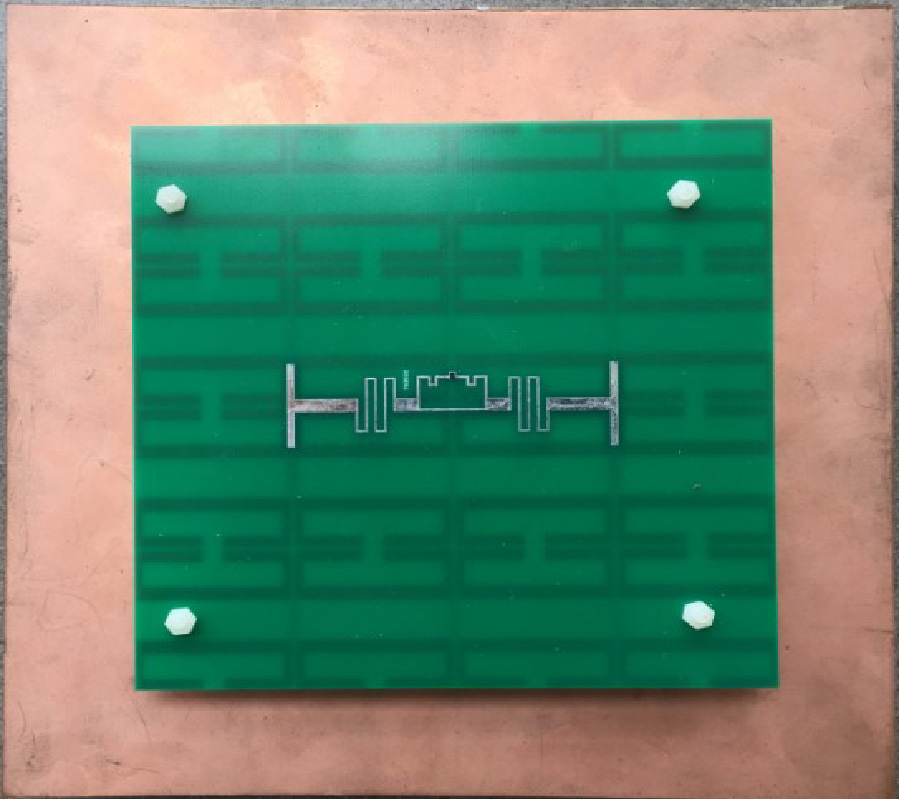
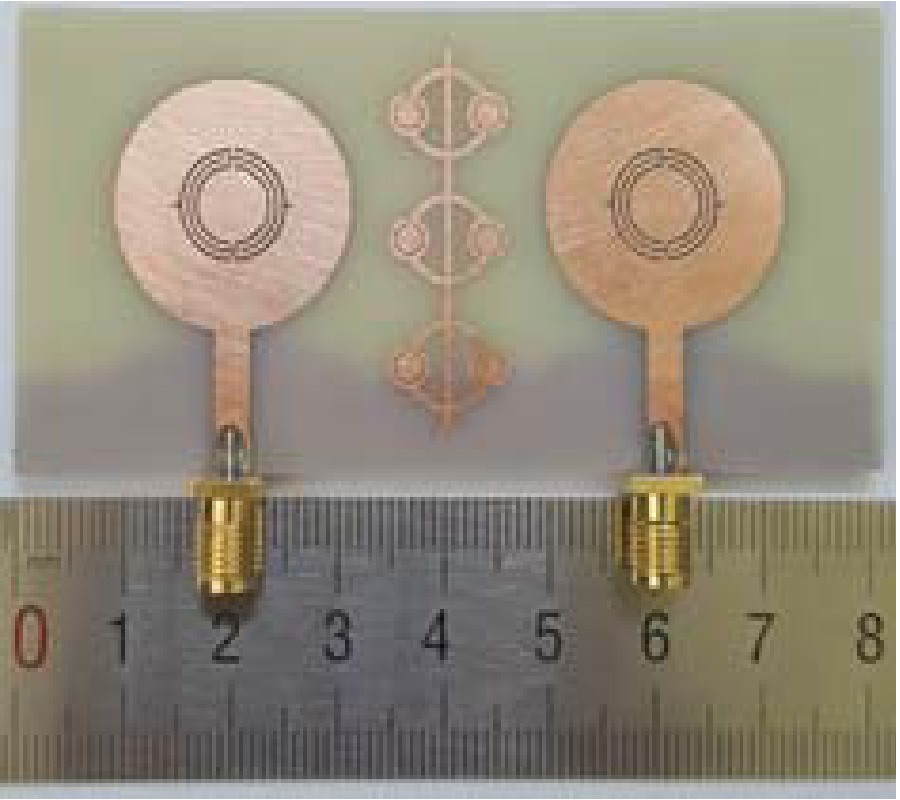
In this paper, a dual band high gain miniaturized cross shaped patch antenna is proposed for IEEE 802.11ax applications. The radiating patch size is 0.330λ0x0.417λ0 on a low cost Flame Retardant 4 substrate. A cross shaped radiating element is designed to cover the upper band of IEEE 802.11ax, and a four ring circular Complementary Split Ring Resonator (CSRR) is etched on the cross shaped radiating element to cover the lower band of IEEE802.11ax. Thus the dual bands of 802.11ax are achieved. In order to enhance the gain, 2x2 array hexagonal metamaterial unit cell is positioned behind the substrate. To extract the constitutive parameters of the circular CSRR, NRW (Nicolson-Ross-Wier) retrieval method is used. The measured maximum gain is approximately 6 dBi, 10 dBi for 2.4 GHz, 5 GHz, respectively. Parametric study on the geometrical dimensions is investigated using HFSS 15.0.
GAIN ENHANCEMENT OF CROSS SHAPED PATCH ANTENNA FOR IEEE 802.11AX WI-FI APPLICATIONS
2018-12-07
PIER M
Vol. 76, 157-166
Cross Polarized 2×2 UWB-MIMO Antenna System for 5G Wireless Applications
Haitham Alsaif , Muhammad Usman , Muhammad Tajammal Chughtai and Jamal Nasir
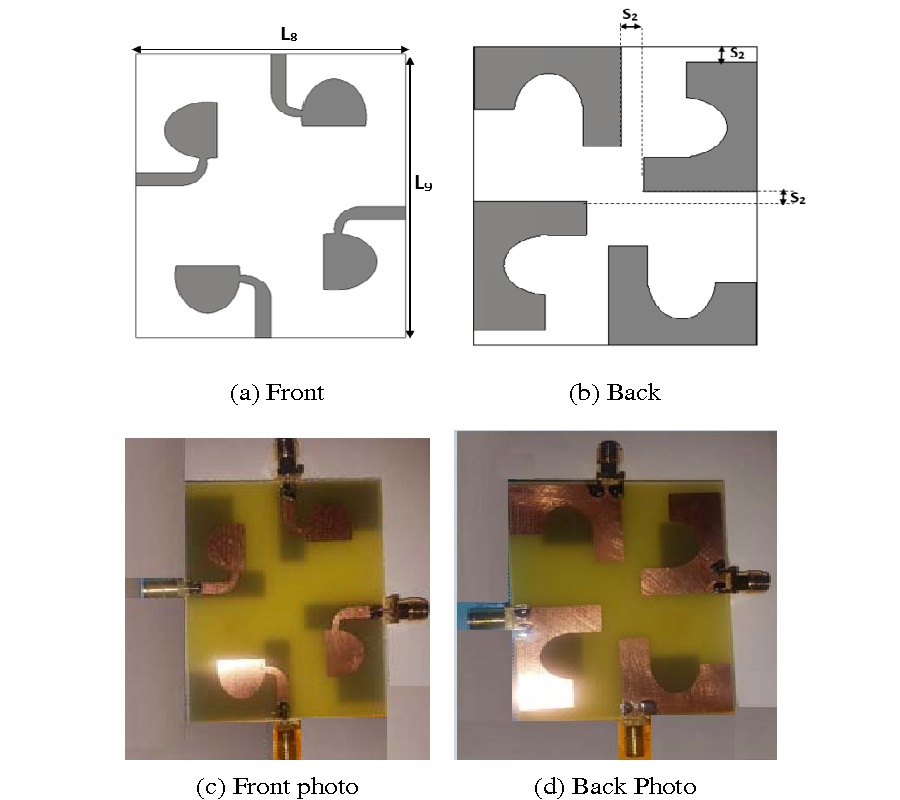
A novel cross polarized compact antenna system is proposed for Ultra Wide Band communications. It also covers the sub-6 GHz band for initial 5G launch. The overall antenna system is a distinctive combination of Multiple Input Multiple Output (MIMO) antenna system covering radio frequency (RF) band starting from 2 GHz to 12 GHz. This MIMO system consists of two F-shaped monopoles with slotted fractured ground planes. The two antennas are fabricated back to back with 90 degree difference. The overall volume of the MIMO antenna system is 14 mm × 14 mm × 0.25 mm. Due to its very compact design, it is suitable for mobile phones and other hand-held devices. The peak measured gain has been achieved as 4.8 dB, and the measured far field patterns are nearly isotropic. Envelope Correlation Coefficient (ECC) and Gain Diversity are presented for the proposed MIMO antenna system.
CROSS POLARIZED 2×2 UWB-MIMO ANTENNA SYSTEM FOR 5G WIRELESS APPLICATIONS
2018-12-06
PIER C
Vol. 88, 269-283
Simulation and Precipitation Detection in the Tropical Cyclones Based on the Microwave Humidity and Temperature Sounder Onboard the Fengyun-3c Satellite
Na Li , Shengwei Zhang and Jieying He
Tropical cyclone (TC) is part of the most serious natural disasters. Western Pacific is the region with the highest frequency of tropical cyclones (TCs). By simulating and correcting the brightness temperatures (TBs) of the microwave humidity and temperature sounder (MWHTS) onboard the Fengyun-3C (FY-3C) satellite, a method is proposed to observe the TCs in the Western Pacific. The Weather Research and Forecasting Model (WRF) and the fast Radiative Transfer model for TOVS (RTTOV) are adopted in our method. Then, simulated TBs are linearly corrected based on the field-of-views (FOVs), channels and latitude bands. After that, the biases of all channels are within 2 K and close to zero, and the RMSEs are less than 10-K except Channels 10 and 15. Therefore, this WRF/RTTOV method can be implemented in other TCs in the Western Pacific region. In addition, a precipitation detection algorithm is proposed and used to detect precipitation in the TC area. Compared with the FY-3C MWHTS and Tropical Rainfall Measuring Mission (TRMM) Multi-Satellite Precipitation Analysis (TMPA) precipitation products, the results indicate that our precipitation detection algorithm has reached better indicators. The potential application can lay a foundation for precipitation rate retrieval and further research.
SIMULATION AND PRECIPITATION DETECTION IN THE TROPICAL CYCLONES BASED ON THE MICROWAVE HUMIDITY AND TEMPERATURE SOUNDER ONBOARD THE FENGYUN-3C SATELLITE
2018-12-06
PIER C
Vol. 88, 251-267
Wave Diffraction Problem from a Semi-Infinite Truncated Cone with the Closed End
Dozyslav B. Kuryliak , Kazuya Kobayashi and Zinoviy Theodorovych Nazarchuk
The electromagnetic wave diffraction from the modified cone formed by a circular truncated cone whose aperture is closed by a spherical cap is considered. The problem is reduced to the solution of the mixed boundary value problem for the Helmholtz equation. The axially symmetric version of the problem, where the cone is excited by a radial electric dipole (E-polarization wave diffraction problem), is analyzed. A new approach to the solution is proposed. The solution includes the application of the Kontorovich-Lebedev integral transformation, the nonstandard procedure for derivation of the Wiener-Hopf equation and its reduction to the set of linear algebraic equations of the second kind. Their solution ensures the fulfillment of all the necessary conditions including the edge condition. The approximate equation for the sharp truncated cone terminated by the spherical cap is analyzed. The low frequency approximation as well as the transition to the plane which incorporates the hemispheric cavity is analysed. The numerical calculation results are presented.
WAVE DIFFRACTION PROBLEM FROM A SEMI-INFINITE TRUNCATED CONE WITH THE CLOSED END
2018-12-06
PIER M
Vol. 76, 143-155
A Technique to Retrieve High-Frequency Permeability of Metals from Constitutive Parameters of Composites with Metal Inclusions of Arbitrary Shape, Estimate of the Microwave Permeability of Nickel
Sergey Nickolaevich Starostenko , Konstantin Rozanov , Artem Olegovich Shiryaev and Andrey Lagarkov
The technique to retrieve the microwave permeability of metals from the measured constitutive parameters of composites with fine powder of these metals is developed. The technique is based on the modified Sihvola mixing rule and describes a wide range of contrasts in the component susceptibility, accounts for both the inclusion shape and the percolation threshold. These parameters are related to the Bergman-Milton shape-distribution width and to composite structure. The technique is applied to retrieve the microwave permeability of nickel. The metal permeability is calculated from the measured permittivity and permeability of paraffin-bound composites filled with nickel flakes or spheres with account for skinning in conducting inclusions. The measurements are performed using the transmission coaxial-cell in the frequency range up to 15 GHz. The effects of filling factor, inclusion shape and size on the retrieved permeability spectra are analyzed. The permeability retrieval procedure is based on parameter fitting of the selected mixing model for the measured permittivity and permeability data. The retrieved permeability is close to the data available from archived literature sources that are obtained with thick nickel wires and foils.
A TECHNIQUE TO RETRIEVE HIGH-FREQUENCY PERMEABILITY OF METALS FROM CONSTITUTIVE PARAMETERS OF COMPOSITES WITH METAL INCLUSIONS OF ARBITRARY SHAPE, ESTIMATE OF THE MICROWAVE PERMEABILITY OF NICKEL
2018-12-05
PIER C
Vol. 89, 1-11
Acceleration of Very Large Reflectarray Radiation Pattern Computation Using an Adaptive Resolution Spectral Grid
Daniel Rodríguez Prado , Manuel Arrebola , Marcos R. Pino , Jose Antonio Encinar Garcinuno and Fernando Las-Heras
In this work, a novel use of the Non-Uniform Fast Fourier Transform (NUFFT) in reflectarray antenna analysis is proposed to greatly accelerate the computation of radiation patterns using a nonuniform, reduced and adaptive grid in the spectral domain. The proposed methodology is very useful for very large reflectarrays, which have very narrow beamwidths due to their large directivity, and shaped-beam reflectarrays for satellite applications such as Direct Broadcast Satellite (DBS), which might require a compliance analysis in very small angular regions. In those cases, high resolution in the radiation pattern is required, while a low resolution could be enough elsewhere to account for side lobes. However, current analysis techniques for such reflectarrays present limitations regarding large memory footprints or slow computations. The methodology presented in this work allows to overcome those limitations by performing computations in a non-uniform, reduced and adaptive grid in the transformed UV domain, achieving faster computations using considerably less memory. Numerical examples for current applications of interest are provided to assess the capabilities of the technique. In particular, the use of the NUFFT allows to compute ef ciently the radiation pattern in any principal plane with improved resolution for multibeam applications. Also, compliance analyses for DBS applications may be improved with the use of a reduced, multiresolution grid and the NUFFT. The proposed technique is thus suitable to greatly accelerate optimization algorithms.
ACCELERATION OF VERY LARGE REFLECTARRAY RADIATION PATTERN COMPUTATION USING AN ADAPTIVE RESOLUTION SPECTRAL GRID
2018-12-05
PIER Letters
Vol. 80, 83-89
Wideband Mushroom Composite Right/Left Handed Transmission Line Antenna with Cavity-Backed Substrate Integrated Waveguide
Hui-Fen Huang and Sun Shuai
A wideband composite right/left handed transmission line (CRLH-TL) antenna with cavity-backed substrate integrated waveguide (SIW) is proposed in this letter. This proposed antenna consists of a 2×2 array of mushroom unit cells, feeding line and cavity-backed SIW. By introducing SIW structure both impedance and gain of the antenna are improved. The proposed antenna has average gain of 7 dBi (peak measured gain 9.5 dBi), wide -10 dB impedance matching bandwidth of 55% from 5.2 GHz to 8.3 GHz, small size of 40 mm×50×4 mm, high integration ability, and reduced back radiation.
WIDEBAND MUSHROOM COMPOSITE RIGHT/LEFT HANDED TRANSMISSION LINE ANTENNA WITH CAVITY-BACKED SUBSTRATE INTEGRATED WAVEGUIDE
2018-12-05
PIER Letters
Vol. 80, 75-82
Grade Nested Array with Increased Degrees of Freedom for Quasi-Stationary Signals
Sheng Liu , Jing Zhao , Decheng Wu and Hailin Cao
In this paper, a grade nested array constituted by a uniform linear array and a grade linear array with uniformly increasing inter-element is presented. The closed-form expression of the proposed array geometries and corresponding direction-of-arrival (DOA) estimation algorithm are derived. Theory analysis certifies that the proposed grade nested array can provide higher degrees of freedom (DOF) than some existing nested arrays. Some simulations are also presented to demonstrate the improved performance of the proposed nested array for DOA estimation of quasi-stationary signals.
GRADE NESTED ARRAY WITH INCREASED DEGREES OF FREEDOM FOR QUASI-STATIONARY SIGNALS
2018-12-04
PIER C
Vol. 88, 235-249
UWB-Radar-Sensed Human Respiratory Signal Modeling Based on the Morphological Method
Miao Liu , Hui Jun Xue , Fulai Liang , Hao Lv , Zhao Li , Fu Gui Qi , Ziqi Zhang and Jianqi Wang
This paper proposes a morphological ultra-wideband (UWB)-radar-based respiratory signal model. According to the detection theory, it is crucial to set up an appropriate model to fulfil the detection purpose. Previous models pay less attention on the time dimension of the respiratory signal, but the frequency domain cannot precisely describe it because of its non-linearity and non-stationarity. This model uses a morphological operator to dilate or erode the base wavelet, and the length and value of the digit in the structure element serve as the parameters in this morphological model. The result of the experiment carried out on 10 human targets with impulse radio ultra-wideband (IR-UWB) radar proves the efficiency of this model. As the UWB radar sensed human respiratory signal is nonlinear and non-stationary, the parameters in the model can be regarded as a measure of non-linearity and non-stationarity. An experiment is carried out with the simulated respiratory signal generated with the proposed model. The result shows that the detection algorithm based on Ensemble Empirical Mode Decomposition (EEMD) method has a better performance than that based on Adaptive Line Enhancer (ALE) and with the value of the digit in the structure element increases, the performance of the ALE method declines, while the EEMD method stays in a good performance, which indicates that the EEMD method has a good potential to deal with the nonlinear and non-stationary respiratory signal.
UWB-RADAR-SENSED HUMAN RESPIRATORY SIGNAL MODELING BASED ON THE MORPHOLOGICAL METHOD