Search Results(13797)

2014-11-03
PIER Letters
Vol. 49, 125-130
A Low-Cost L-Probe Fed Dual-Polarized Slot Antenna for C-Band Phased-Array Applications
Lizhong Song and Yuming Nie
A dual-polarized L-probe fed microstrip patch antenna with high isolation and low cross-polarization levels is proposed. The proposed antenna has been designed and analyzed by using commercially available software --- High Frequency Structure Simulator (HFSS) based on the finite element method algorithm and a simple resonant equation and Computer Simulation Technology Microwave Studio (CST MWS) based on the finite-difference-time-domain algorithm. A prototype antenna is built and tested. The return loss has been compared between measured and simulated data under the criterion of VSWR less than 2 through out the designed 4.95 to 5.05 GHz frequency range. The measured isolation between two ports is higher than 22 dB and the gain is larger than 3 dBi. The cross-polarization levels in both E and H planes are better than -21 dB, along with fair regular radiation patterns.
A LOW-COST L-PROBE FED DUAL-POLARIZED SLOT ANTENNA FOR C-BAND PHASED-ARRAY APPLICATIONS
2014-11-03
PIER M
Vol. 39, 141-150
Kriging-Pareto Front Approach for the Multi-Objective Exploration of Metamaterial Topologies
Patrick J. Bradley
Metamaterials provide the opportunity for designers to create customisable artificial materials by independently tailoring the electric and magnetic response of sub-wavelength geometric structures to electromagnetic energy. Due to the increased complexity of these geometric structures, exacerbated by the increased interest in generating inhomogeneous and anisotropic metamaterials, direct optimisation of these designs using conventional approaches often becomes impractical and limited. In order to alleviate this issue, we propose an alternative optimisation approach which exploits the Kriging methodology in conjunction with an adaptive sampling plan to simultaneously optimise multiple conflicting objectives. Results show the effectiveness of the outlined algorithm in calculating a uniform spread of optimal trade-off designs, balancing the real and imaginary components of the refractive index over a wide range of values.
KRIGING-PARETO FRONT APPROACH FOR THE MULTI-OBJECTIVE EXPLORATION OF METAMATERIAL TOPOLOGIES
2014-11-03
PIER
Vol. 149, 193-204
Electromagnetic Analysis of an Aperture Modified TEM Cell Including an ITO Layer for Real-Time Observation of Biological Cells Exposed to Microwaves
Malak Soueid , Sophie Kohler , Lynn Carr , Sylvia M. Bardet , Rodney P. O'Connor , Philippe Leveque and Delia Arnaud-Cormos
We propose to analyze the aperture and ITO layer presence of a modified transverse electromagnetic (TEM) cell. This TEM cell can be used to study the potential effects of microwave electromagnetic fields on biological cells. This modified delivery device allows realtime observation of biological cells during exposure. Microscopic observation is achieved through an aperture in the lower wall of the TEM cell that is sealed with a 700-nm film of the transparent conducting material Indium tin oxide (ITO). To determine the device efficiency, numerical and experimental electromagnetic dosimetry was conducted. For assessing the effect of the aperture on the specific absorption rate (SAR) in the exposed sample, a plastic Petri dish containing cell culture medium, full-wave 3-D electromagnetic simulations and temperature measurements were performed. For 1-W input power, the SAR values obtained at 1.8 GHz in the sample exposed in the TEM cell with the sealed or non-sealed aperture of 20-mm diameter were 1.1 W/kg and 23.6 W/kg, respectively. An excellent homogeneity of the SAR distribution was achieved when the aperture was sealed with the ITO layer. The performance of the delivery system was confirmed by microwave exposure and simultaneous observation of living cells.
ELECTROMAGNETIC ANALYSIS OF AN APERTURE MODIFIED TEM CELL INCLUDING AN ITO LAYER FOR REAL-TIME OBSERVATION OF BIOLOGICAL CELLS EXPOSED TO MICROWAVES
2014-10-31
PIER
Vol. 149, 183-192
Compact Waveguided Metamaterials for Suppression of Mutual Coupling in Microstrip Array
Zeeshan Qamar and Hyun Chang Park
In this paper, suppression of mutual coupling is achieved using compact waveguided metamaterials in between elements of a densely packed microstrip array. Both the E-plane internally folded complementary split ring resonator and the H-plane internally folded complementary split ring resonator are employed to reduce the mutual coupling between adjacent elements. Coupling suppression of 18 dB and 9 dB, for elements in the E-plane and H-plane, respectively, is demonstrated. Due to the compact size of the waveguided metamaterials, the edge-to-edge separation between elements is kept at only 0.093λ0. With the same elements spacing, a 2×2 array is also simulated with compact WG-MTMs. The proposed structure reduces the array size and enables the implementation of compact Multiple-Input-Multiple-Output systems.
COMPACT WAVEGUIDED METAMATERIALS FOR SUPPRESSION OF MUTUAL COUPLING IN MICROSTRIP ARRAY
2014-10-30
PIER Letters
Vol. 49, 119-123
A Tri-Band Electromagnetic Absorber with Insensitive Properties
Xu-Hua Wang , Hang Zhou , Mingbao Yan , Na Fu , Ming-Yang Li and Xin-Hua Wang
In this paper, we present a tri-band electromagnetic absorber with insensitive properties. A rotational symmetry structure with a metallic ground is proposed for the design of the metamaterial absorber. Calculation results show that the absorber has three perfect absorption points at 4.76 GHz, 7.61 GHz and 10.84 GHz with the corresponding absorption rates of 96.7%, 97.8%, and 99.3%. An experiment is given, and the results verify our design. Such a tri-band absorber has the merits of high absorption rate, stable performance with various incident angles and different polarizations.
A TRI-BAND ELECTROMAGNETIC ABSORBER WITH INSENSITIVE PROPERTIES
2014-10-30
PIER M
Vol. 39, 131-139
Torque Calculation in Interior Permanent Magnet Synchronous Machine Using Improved Lumped Parameter Models
Hooshang Mirahki and Mehdi Moallem
In this paper, we present improved Lumped-Parameter Models for simulation of a Interior Permanent Magnet Synchronous (IPMS) machine to calculate PM flux linkage, and Q and D-axis inductances which can be used for torque calculation. These improved models include all details of flux barriers and air bridges of rotor and also the e ect of saturation in central posts and stator core. To validate the accuracy of these models, results are compared with the Finite Element Method results for a candidate three-layer IPMS machine.
TORQUE CALCULATION IN INTERIOR PERMANENT MAGNET SYNCHRONOUS MACHINE USING IMPROVED LUMPED PARAMETER MODELS
2014-10-28
PIER C
Vol. 54, 117-124
Dual-Band Circularly Polarized Deformed Monopole Antenna
Huan Zhang , Yong-Chang Jiao , Wei-Long Liang and Liang Lu
A novel dual-band circularly polarized monopole antenna fed by coplanar waveguide (CPW) is proposed. Deformed monopole and asymmetrical ground are utilized to achieve dual-band characteristic, by adjusting the tuning stub close to the deformed monopole, the antenna can be further improved to a good performance. Measured results show that the proposed antenna impedance bandwidth is 1.44 GHz centered at 3.42 GHz for the lower band and 400 MHz centered at 5.2 GHz for the upper band, the 3-dB axial ratio bandwidth is 900 MHz centered at 3.25 GHz and 400 MHz centered at 5.1 GHz respectively. The measured results agree well with the simulated results.
DUAL-BAND CIRCULARLY POLARIZED DEFORMED MONOPOLE ANTENNA
2014-10-28
PIER M
Vol. 39, 123-129
Study of Scan Blindness of Microstrip Array by Using Dumbbell-Shaped Split-Ring DGS
Chandan Kumar Ghosh , Susmita Biswas and Durbadal Mandal
A compact dumbbell-shaped split-ring DGS is introduced between array elements of a sixteen-element microstrip array in order to reduce the mutual coupling between antenna elements and eliminate the scan blindness. The proposed DGS is inserted between the adjacent rectangle-shaped slotted microstrip antenna elements separated by 0.35λ, as a technique to suppress the radiation in the horizontal direction. Simulated results show that a reduction in mutual coupling of 36 dB is obtained between elements at the operation frequency of 2.45 GHz (WLAN band). The scan properties of microstrip array with and without DGS have been studied, and the result indicates that the scan blindness of the array has been well eliminated because of the effect of the DGS. We have developed experimental models that have proved the concept of scan blindness elimination. Finally, the influence of other antenna parameters at the presence of DGS in the array system has been studied. Prototype antennas of sixteen-element array with and without resonator have been fabricated, measured, and the idea has been verified. A good agreement is observed between measured and simulated results.
STUDY OF SCAN BLINDNESS OF MICROSTRIP ARRAY BY USING DUMBBELL-SHAPED SPLIT-RING DGS
2014-10-27
PIER B
Vol. 61, 99-119
Building Blocks for a 24 GHz Phased-Array Front-End in CMOS Technology for Smart Streetlights
Ban Wang , Gabriele Tasselli , Cyril Botteron and Pierre-Andre Farine
According to a recent European Union report, lighting represents a significant share of electricity costs and the goal of reducing lighting power consumption by 20% demands the coupling of light-emitting diode (LED) lights with smart sensors and communication networks. This paper proposes the integration of these three elements into a smart streetlight, which is based on LEDs and a 24 GHz phased-array (Ph-A) front-end (FE) designed in low-cost 90nm complementary metal-oxide-semiconductor (CMOS) technology. The selected FE's architecture allows the implementation of transceivers as well as Doppler radar sensors. Furthermore the Ph-A technology is applied to the Doppler radar sensor in order to realize multi-lane road scanning and pedestrian detection. The radar sensor is used to make the streetlight eco-friendly by turning on the lamp only when necessary and to measure traffic parameters such as vehicle speed, type and direction. Intercommunication between the streetlights is based on a time-sharing mechanism and uses the same FE reconfigured as transceiver. Thanks to this functionality, the recorded traffic information is relayed through adjacent streetlights to a control center, and control commands and warnings can be spread through the network. The system requirements are derived assuming a simplified model of the operating scenario with a typical inter-light distance of 50 m and line-of-sight between lights. The radar range is around 60 m, which allows for continuous coverage from one streetlight to the adjacent one. Meanwhile, a communication range of 140 m is derived as a fundamental requirement for reliable communication between streetlight sensors because it allows bypassing of one node in case of failure. For the developed building blocks --- a low-noise amplifier, a variable-gain amplifier, a voltage-controlled oscillator and a vector modulation phase shifter --- the design methodology is presented together with measurement results. The system feasibility is proved by means of a system analysis based on the measured data from the implemented blocks and the state of the art performances for the missing parts. The requirements are fulfilled with a total power consumption of around 375 mW in Doppler radar sensor mode and around 190 mW in transceiver mode. To the authors' knowledge, this kind of integration is new and overcomes some limitations of the currently used solutions based on infrared sensors and low-throughput communications.
BUILDING BLOCKS FOR A 24 GHZ PHASED-ARRAY FRONT-END IN CMOS TECHNOLOGY FOR SMART STREETLIGHTS
2014-10-27
PIER M
Vol. 39, 115-122
Performance Analysis of Rain Rate Models for Microwave Propagation Designs Over Tropical Climate
Obiseye Oluwaniyi Obiyemi , Joseph Ojo and Tunji Samuel Ibiyemi
Rain attenuation is a major source of impairment to signal propagation at microwave and millimeter wave bands. The procedures for the estimation of rain attenuation value regard to microwave signals however rely mainly on 1-minute rain rate statistics, particularly those obtained locally from experimental measurement campaigns over a given location. In this paper, we present recent results on 1-minute rain rate statistics required for satellite and terrestrial link designs, as obtained from a 2-year measurement over Akure, Nigeria. The performance of the existing rain rate models: Rice-Holmberg (RH) model, the Kitami model, Moupfouma model and the global ITU rain rate model were tested based on four metrics namely: Prediction error, Root Mean Square Error (RMSE), Spread-Corrected Root Mean Square Error (SC-RMSE) and the Spearman's rank correlation. Result indicates that no single model completely outperforms all others. Interestingly, the RH model is particularly best behaved over the distribution, while the Moupfouma model performs suitably well. Others seem to vary largely from the measured rain rate distribution. Results for the rain rate exceeded for 0.01% of the time agrees with earlier estimates for the cumulative rain rate distribution derived from higher integration-time statistics over this tropical site.
PERFORMANCE ANALYSIS OF RAIN RATE MODELS FOR MICROWAVE PROPAGATION DESIGNS OVER TROPICAL CLIMATE
2014-10-23
PIER C
Vol. 54, 103-116
Design of CPW-Fed Dual-Band Printed Monopole Antennas for LTE/WiMAX/WLAN and UWB Applications
Praveen Vummadisetty Naidu and Raj Kumar
In this paper, two miniaturized (20 x 20 mm2) coplanar waveguide fed slot antennas are proposed. Both the antennas are characterized by ultra wide impedance bandwidth while one of them has an additional narrow band near 2.5 GHz. The radiating element of the proposed antennas is a modified rectangular geometry which is excited by a 50 ohm line. The radiating element of the proposed antennas is a modified rectangular geometry which is excited by a 50 ohm line. The slot in the ground plane is stair case shape for UWB antenna and octagonal shape for the dual-band antenna. By modifying the slot and adding a λ/4 length metallic stub, an extra resonance is created for the dual-band antenna. The measured impedance bandwidth of the UWB antenna is 7.8 GHz (3.4-11.2 GHz). The impedance bandwidths of the dual-band antenna are 150 MHz (2.45-2.6 GHz) and 8.4 GHz (3.2-11.6 GHz). The radiation patterns of the proposed antenna are found to be bi-directional in E-plane and omnidirectional in H-plane. All the measured and simulated results are in good agreement.
DESIGN OF CPW-FED DUAL-BAND PRINTED MONOPOLE ANTENNAS FOR LTE/WIMAX/WLAN AND UWB APPLICATIONS
2014-10-23
PIER Letters
Vol. 49, 111-118
A Flexible Broadband Antenna and Transmission Line Network for a Wearable Microwave Breast Cancer Detection System
Emily Porter , Gregory Walls , Yahe Zhou , Milica Popović and Joshua D. Schwartz
First, we report on the design, simulation and measurement of a 2-4 GHz conformable antenna optimized for skin contact and implemented on a flexible printed circuit for integration into a wearable device. Second, we experimentally verify the suitability of appropriately long (~10 cm) microstrip traces for the wearable system signal distribution network, which features varying radii of curvature. Consequently, the contribution of the here reported work is two-fold. First, the experimental results obtained both with breast phantoms and on-body measurements, demonstrate a return loss below -10 dB in the desired frequency band. Phantom results also show a through-breast transmission coefficient of above -40 dB at the centre frequency of 3 GHz. Second, and essential for signal integrity in our target application, the results show that the longitudinal curvature of such a microstrip does not increase transmission line losses.
A FLEXIBLE BROADBAND ANTENNA AND TRANSMISSION LINE NETWORK FOR A WEARABLE MICROWAVE BREAST CANCER DETECTION SYSTEM
2014-10-20
PIER C
Vol. 54, 95-101
A Broadband Omnidirectional Antenna Array for Base Station
Bo Wang , Fu-Shun Zhang , Li Jiang , Qichang Li and Jian Ren
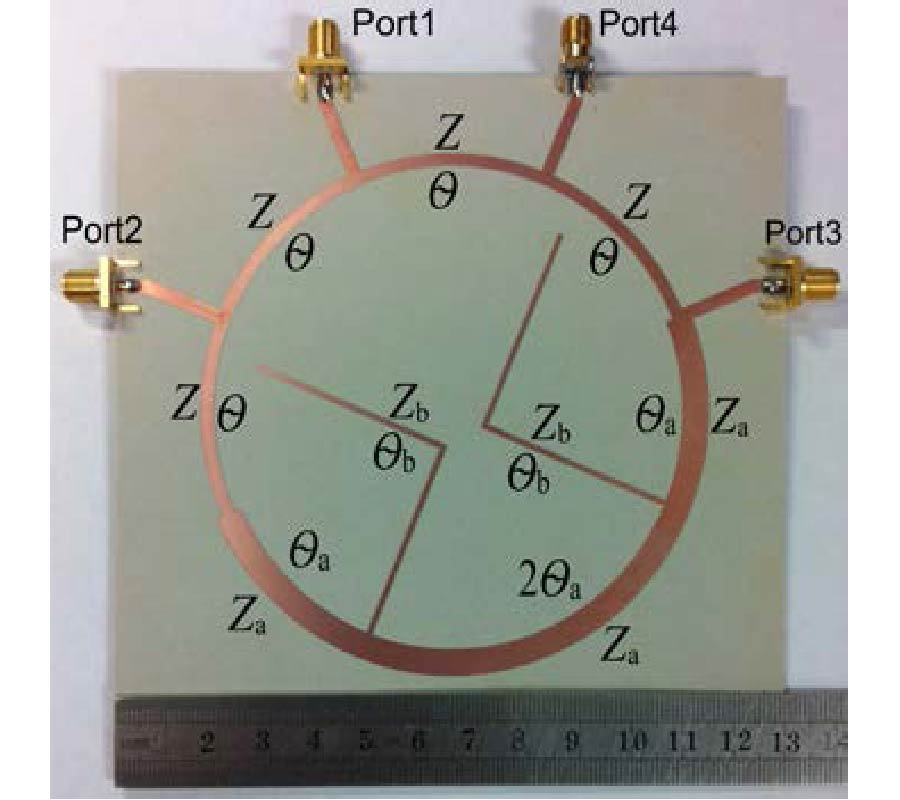
A high gain wideband antenna array with an omnidirectional radiation pattern is presented for base station. The antenna array is composed of four elements and a circular four-way power divider. The proposed planar antenna element consists of four pairs of arc dipoles and a balun, which can achieve a better impedance match and a wider frequency range. Furthermore, the conductor ground of the power divider with a larger size than the element is placed under the four antennas, which can also enhance the peak gain. The antenna array is simulated, fabricated and measured. The measurement results show that the proposed antenna array can achieve a bandwidth from 1.62 GHz to 2.43 GHz or a relative bandwidth of 39.4%. The antenna array has a peak gain of 6.4-7.2 dBi in the work band and obtains a radiation efficiency of 88%. The simulated and measured results show that the proposed antenna array is a good candidate as a base station antenna for GSM, PCS, and UMTS applications.
A BROADBAND OMNIDIRECTIONAL ANTENNA ARRAY FOR BASE STATION
2014-10-20
PIER Letters
Vol. 49, 105-110
A Small Size Three-Band Multi-Functional Antenna for LTE/GSM/UMTS/WiMAX Handsets
Hui-Fen Huang and Wei Zhao
In this paper, a three-band antenna with small size 50×15×0.8 mm3 is developed. The multi-broadband antenna consists of strip-1, tstrip-2, Br-1, Br-2 and S-strip. The lengths of strip-1, strip-2 are close to λ/4 at 680 MHz, 850 MHz and λ3/4 at 2.04 GHz, 2.55 GHz, respectively. S-strip is close to λ at 5.2 GHz and λ3/4 at 3.7 GHz. In addition, two tuning stubs Br-1 and Br-2 connected to strip-2 can further improve the impedance matching. Then six key resonances are excited: 680 MHz, 850 MHz, 2.04 GHz, 2.55 GHz, 3.7 GHz and 5.2 GHz. There exists electromagnetic coupling (EMC) among them, and as a result of the comprehensive effect of the structure, three wide-bands are produced: 660-1050 MHz, 1.60-3.75 GHz, 5.25-6.50 GHz. That is, the operation band covers full LTE700/2300/2500 (1710-2690 MHz)/GSM850/900/ (680 M-960 M)GSM1800/1900/WiMAX3.5G (3400~3650 MHz)/5.4-GHz (5250~5850 MHz)/ UMTS (1710-2170 MHz). The return loss is better than -6 dB. The peak gains also satisfy the requirement for practical application.
A SMALL SIZE THREE-BAND MULTI-FUNCTIONAL ANTENNA FOR LTE/GSM/UMTS/WIMAX HANDSETS
2014-10-19
PIER C
Vol. 54, 125-131
Millimeter-Wave Offset Fresnel Zone Plate Lenses Characterization
German Leon Fernandez , Luis F. Herran , Max O. Munoz , Fernando Las-Heras and Yang Hao
Fresnel Zone Plate Lenses (FZPLs) are transparent-opaque lenses that filter the desirable phase. The centred Fresnel lenses have a strong back radiation towards the feed. In order to solve this drawback, offset feeding or offset pointing lenses are used. In this work, both offset FZPLs are studied using an optical physics method and experimentally characterized in the millimeter band. Two prototypes have been manufactured and measured, presenting a narrow beamwidth. The characteristics of pointing of this beam are studied depending on the feed gain. This work shows the pointing characteristics of the lenses, simply moving the lens in a plane.
MILLIMETER-WAVE OFFSET FRESNEL ZONE PLATE LENSES CHARACTERIZATION
2014-10-19
PIER C
Vol. 54, 85-94
A Push-Push Oscillator Array Using Resonator Type Coupling Circuits
Takayuki Tanaka , Kengo Kawasaki , Masayoshi Aikawa and Ichihiko Toyoda
A coupled oscillator array using push-push oscillators and resonator type coupling circuits is presented. In the proposed oscillator array, the coupling circuit operates at the fundamental frequency and the output signal is the 2nd harmonics. The adjacent oscillators are connected via the coupling circuits. The coupling circuit is used to synchronize the oscillators and control the phase difference of the output signals. In this study, a three elements push-push oscillator array has been designed in Ku band. The measured phase shift between the output signals of the adjacent oscillators is 511 degrees at the maximum.
A PUSH-PUSH OSCILLATOR ARRAY USING RESONATOR TYPE COUPLING CIRCUITS
2014-10-17
PIER Letters
Vol. 49, 99-104
A Varactor-Tuned Bandpass Filter Using Open Split-Ring Resonators
Cheng Liu , Xin Huai Wang , Yangbing Xu and Xiao-Wei Shi
This paper presents a compact tunable bandpass filter that is based on open split ring resonator to achieve high out-of-band rejection. Exact equations and design procedures are given based on strict theoretical analysis. By loading the varactor diodes, the center frequency and bandwidth of the bandpass filter could realize reconfigurable. Then defected ground structure was adopted in the input and output ports for the sake of high out-of-band rejection. In order to verify the result of theoretical analysis, a compact tunable bandpass filter with defected ground structure, whose range of frequency was 1.61 GHz~1.82 GHz and range of relative bandwidth was 8.3%~24.8%, had been simulated and fabricated. Good agreement between the measured data and the anticipated results is achieved.
A VARACTOR-TUNED BANDPASS FILTER USING OPEN SPLIT-RING RESONATORS
2014-10-17
PIER M
Vol. 39, 107-114
The Extended Gauge Transformations
Arbab Ibrahim Arbab
In this work, new ``extended gauge transformations'' involving current and fields are presented. The transformation of Maxwell's equations under these gauges leads to a massive boson field (photon) that is equivalent to Proca field. The charge conservation equation and Proca equations are invariant under the new extended gauge transformations. Maxwell's equations formulated with Lorenz gauge condition violated give rise to massive vector boson. The inclusion of London supercurrent in Maxwell's equations yields a massive scalar boson satisfying Klein-Gordon equation. It is found that in superconductivity Lorenz gauge condition is violated, and consequently massive spin-0 bosons are created. However, the charge conservation is restored when the total current and charge densities are considered.
2014-10-17
PIER M
Vol. 39, 93-106
Transient Analysis of a Rectangular Cavity Containing an Interior Scatterer Using TD-EFIE with Weighted Laguerre Polynomials as Temporal Basis Functions
Dorsaf Omri and Taoufik Aguili
Novel 2-D Time Domain Electric Field Integral Equations (TD-EFIE) are established in order to predict transient response of a wire enclosed within a rectangular cavity. The wire and cavity are excited by an external incident transient electromagnetic wave through a slot in the cavity wall. The formulation of the TD-EFIE is based on equivalence principle and boundary conditions taking account the effect of reflection from cavity walls. The equations are efficiently solved by Method of Moments. The transient unknown coefficients of the electric current at the wire and magnetic current at the slot are approximated using a set of orthonormal temporal basis functions derived from Laguerre Polynomials. The analysis demonstration is presented to prove that the novel TD-EFIE combined to MoM is able to solve this critical problem. No late-time instability is encountered.
TRANSIENT ANALYSIS OF A RECTANGULAR CAVITY CONTAINING AN INTERIOR SCATTERER USING TD-EFIE WITH WEIGHTED LAGUERRE POLYNOMIALS AS TEMPORAL BASIS FUNCTIONS
2014-10-16
PIER C
Vol. 54, 75-84
A T-Section Dual-Band Matching Network for Frequency-Dependent Complex Loads Incorporating Coupled Line with DC-Block Property Suitable for Dual-Band Transistor Amplifiers
Mohammad A. Maktoomi , Mohammad S. Hashmi and Fadhel M. Ghannouchi
This paper reports design of a new dual-band T-type impedance transformer also exhibiting DC-blocking feature. The design aims at achieving matching for frequency-dependent complex loads having distinct values at two arbitrary frequencies to Zs (here, 50 Ω). A step-wise analysis on the developed dual-band impedance transformer provides simple closed-form design equations. The design is verified by extensive simulation in Agilent ADS. For experimental verification a PCB prototype is fabricated using FR-4 material, operating at 1.45 GHz and 2.61 GHz. A good result is obtained confirming the theory and simulation.
A T-SECTION DUAL-BAND MATCHING NETWORK FOR FREQUENCY-DEPENDENT COMPLEX LOADS INCORPORATING COUPLED LINE WITH DC-BLOCK PROPERTY SUITABLE FOR DUAL-BAND TRANSISTOR AMPLIFIERS